Listen to the audio-only version of this podcast by clicking on the player below, or scroll down to watch the video.
You might be checking out this episode with the hope of one day being a leader. Well, Greg and I have good news for you—you already are! Leaders are not just the person at the top, but if you have a leadership mindset you can be a leader in whatever position you currently occupy. Join us as we chat about how important it is to start being a leader before you have the “leader” title.
[0:24] What if you’re not the point leader in your organization?
[1:22] Regardless of your title or position, you are still a leader.
[3:13] Leaders—whether at the top or in the middle—need to try to raise up other leaders.
[5:29] One trait that will increase your value to the organization is cross-training.
[8:20] Another trait is curiosity that keeps you a lifelong learner.
[11:07] An example from Tom Brady about how important passion is for those who aren’t starters yet.
[13:47] Two other important traits for emerging leaders is patience and self-discipline.
[14:37] How do point leader keep their bench players engaged until there is a new leadership position available for them?
[17:07] Mentoring and coaching aren’t the same things. How do we know which one to use in our organizations?
[23:21] What you can do if you don’t have any mentors within your organization?
Check out this episode and subscribe on YouTube so you can watch all of the upcoming episodes. You can also listen to our podcast on Spotify and Apple.
Listen to the podcast of this post by clicking on the player below, and you can also subscribe on Apple, Spotify, or Audible.
The first Church in the Book of Acts could have easily become the first two churches right from the beginning. Why? Because of a deep disagreement that pitted two camps against each other.
Unity was ultimately maintained because they all agreed to only listen to the counsel that agreed with Scripture.
Listen to the podcast of this post by clicking on the player below, and you can also subscribe on Apple, Spotify, or Audible.
As we learned last week, we are not the judge, nor the jury, nor the prosecution, nor even the sin police in deciding appropriate retribution. With that in mind, let’s consider Statement #15 in our series—Do not judge. Is that in the Bible?
Yes, those three words are there, spoken by Jesus, in Matthew 7:1. But then again, we need to say, no, because these words don’t mean we are not to make determination about the rightness or wrongness of something.
Let’s zoom-out a bit get the context of the words Jesus spoke. Who was His audience for these words? This is a part of the Sermon on the Mount (Matthew 5–7). Notice in the opening words, “His disciples came to Him, and He began to teach them” (5:1-2). So Jesus isn’t speaking to the world at-large, but He is talking with His disciples.
Jesus was very specific in His wording. In talking about the world, He uses words like people (5:11) or men (5:16; 6:1, 5). When talking about His disciples, He uses one word quite frequently: brother (3x in 5:22-24).
Matthew 7:1 is still in this sermon, and the word brother appears 3x in vv. 3-5. So these are instructions primarily for Christians to use with other Christian brothers and sisters.
The words judge here in the Greek means, “Those who judge severely (unfairly), finding fault with this or that in others.” To me, “this or that” sounds like a deliberate searching for something wrong, but Jesus assures us that this will boomerang on the judgmental person (v. 2; Luke 6:37).
In modern psychology, we find terms like:
mirroring = a psychological term the means quickly seeing what’s in others because it’s in me
projection = taking the negative things in me and projecting them onto others
Paul addresses both of these thoughts in Romans 2:1-3, where the word for judging here is the same Greek word Jesus uses in Matthew 7.
Paul concludes his remarks by reminding us that God treats us kindly (Romans 2:4). David echos this same thought in Psalm 103:8-10, 13-14.
When you read the whole passage in Matthew 7:1-5, please notice the words “brother,”“first,” and “then.”
Jesus does not mean that I am not to point out to my brothers and sisters any areas of concern. Jesus did this, as well as nearly every epistle writer. What it does mean is that correction needs to be gentle and never condemning. In other words, I want to lovingly help someone before they have to stand before The Judge.
That’s why I need to first humbly recognize that what I see in others may be apparent to me because I am afflicted with the same thing. That’s why Jesus says first deal with my own plank. Examine myselfbefore I try to correct a brother or sister (1 Corinthians 11:28; 2 Corinthians 13:5).
After I have allowed the Holy Spirit to deal with my plank, I will then have the empathy to help my brother or sister (2 Corinthians 1:3-4). Trying to get someone else to repent of something that still exists in my life is hypocritical.
If I see something wrong in someone else:
First ask the Holy Spirit to search me.
If necessary, confess it, repent from it, ask forgiveness, make things right.
Then lovingly and humbly share with your brother or sister (Ephesians 4:15).
If someone else sees something wrong in me, I should follow the exact same steps!
This is not easy, but it is vital for the Body of Christ to grow in a healthy way.
If you’ve missed any of the other messages in this installment of our series Is That In The Bible?, you can find them all here.
Listen to the podcast of this post by clicking on the player below, and you can also subscribe on Apple, Spotify, or Audible.
There are some know-it-alls who want to tell pastoral leaders how they should have done things differently. Much like the “armchair quarterbacks” that seem to know all the right calls a team should make, even though they have virtually no experience.
Pastor, pay very little attention to those armchair quarterbacks that would speak into your life!
To put the quote that Jim shared from When Sheep Bite into context, here is the full passage—
Jesus is our perfect example of a Shepherd Leader. His example was to lay it all on the line, regardless of how the sheep were behaving or misbehaving: “I am the Good Shepherd. The Good Shepherd lays down His life for the sheep” (John 10:11). By contrast, Jesus warns us that those who are not willing to put their lives on the line for the sheep are worse than armchair pastors—Jesus calls them mere hired hands: “The hired hand is not the shepherd and does not own the sheep. So when he sees the wolf coming, he abandons the sheep and runs away. Then the wolf attacks the flock and scatters it. The man runs away because he is a hired hand and cares nothing for the sheep” (John 10:12-13).
If I am called to be a shepherd leader, attacks will come from both sheep and wolves. It’s what I do in those hard times that shows whether I am truly called or merely acting as an armchair shepherd.
Listen to the podcast of this post by clicking on the player below, and you can also subscribe on Apple, Spotify, or Audible.
We have to be very attentive when we hear anyone say something that they claim is a word from God. The first question we need to ask is, “Is that in the Bible?” If it is, then the next question is, “Is that statement being used in its proper context—does it conform with the whole counsel of God’s Word?”
So here is statement #14 in our series—An eye for an eye, and a tooth for a tooth. Is that in the Bible? Yes.
This first shows up in Exodus 21:24, and it is a part of the legal code God gave through Moses (Exodus 21:1). This code was entrusted to capable men (i.e. judges) in Exodus 18:19-22, 25.
This has been referred to as “the law of exact retribution.” Later on the Romans would name it lex talionis—the law of the tooth. This was to prevent one-upmanship or escalating retaliation, and it also applied to false witnesses who were trying to get someone else in trouble (Deuteronomy 19:15-21).
By the time of Jesus, this legal maxim was so well known that when Jesus quoted it to His audience, everyone knew what it meant (Matthew 5:38).
One of the most innate responses that we humans have to threats or to an attack is fight-or-flight.
In this case, flight would be sweeping it under the run or pretending it didn’t happen. But it did happen, and there is a sense of justice in us that wants to see retribution. If this offense isn’t acknowledged and dealt with appropriately, the desire for retribution will allow unforgiveness to fester. This shows up in all sort of negative ways—physically and emotionally—and often there is a breaking point where the injured party lashes out.
Fight would be taking the law into our own hands. I want everyone to know that I was wronged by you, and I want you to suffer more than you made me suffer. But the first time this law is given, God calls for precise compensation (Exodus 21:22-25).
God’s means for carrying our the lex talionis today is exactly the same—a legal code administered by trained judges (Romans 13:1-4).
This is the law of the land—the natural law—but Jesus calls on us to respond supernaturally. Not to be the judge or jury, but to remember that God perfectly judges and vindicates (Luke 8:17; Deuteronomy 32:35).
Jesus continually calls us forego the natural reaction for the supernatural response. Notice the repeated pattern of, “You have heard that it was said” and then, “But I tell you…” in Matthew 5:21-22, 27-28, 31-32, 33-37, 43-44 and specifically vv. 38-42.
If our eyes are on the one who injured us, our eyes are off of the only One who can vindicate and heal us (Romans 12:17-21).
Natural people merely react out of innate instinct. Supernatural people are able to respond with Christlike love.
Don’t give in to the merely natural reaction, but submit to the Holy Spirit who can help you respond supernaturally.
A.W. Tozer said, “There’s an awesomeness about God which is missing in our day altogether; there’s little sense of admiring awe in the Church of Christ these days.” May we repent of little prayers and boldly pray to an awesome God who wants to do awesome things that will bring Him glory!
I have lots of new content every week, which you can check out on my YouTube channel.
This is a very informative Q&A session with cold case detective and Christian apologist J. Warner Wallace. But I especially like his answer to the first question: Do Christians have to investigate every other religion to be convinced that the Bible is true?
“Faith untried may be true faith, but it is sure to be little faith, and it is likely to remain dwarfish so long as it is without trials. Faith never prospers so well as when all things are against her: tempests are her trainers, and lightnings are her illuminators. … No flowers wear so lovely a blue as those which grow at the foot of the frozen glacier; no stars gleam so brightly as those which glisten in the polar sky; no water tastes so sweet as that which springs amid the desert sand; and no faith is so precious as that which lives and triumphs in adversity. … Faith increases in solidity, assurance, and intensity, the more it is exercised with tribulation. Faith is precious, and its trial is precious too.” —Charles Spurgeon
“Mature Christians can be recognized by a variety of indicators. They feast on the Word of God (Hebrews 5:14), persevere in love and good works (Hebrews 6:9-10), bear the fruit of the Spirit rather than the marks of the flesh (Galatians 6:16-23), use their gifts to help build the church (1 Corinthians 12:7-11; Ephesians 4:12-16), teach the things of Jesus to others (Hebrews 5:12: Acts 1:8), and more. This, the New Testament insists, is the condition toward which every Christian strives.” —T.M. Moore (check out all of the Scriptures T.M. references here)
“Now is the accepted time, not tomorrow, not some more convenient season. It is today that our best work can be done.” —W.E.B. Du Bois
Jesus shows us that only secure people can serve others. Insecure people won’t ever make themselves vulnerable, and so they miss out on God’s blessing. I address this in more depth in my book Shepherd Leadership.
Listen to the audio-only version of this podcast by clicking on the player below, or scroll down to watch the video.
In today’s episode we’re going to—IMPATIENCE! Yes, we’re talking about impatience. As a leader it can be hard to resist the temptation of impatience, but Greg and I believe that developing patience is a vital skill for leaders. In this episode we’ll explore some of the pitfalls of impatience, and share strategies for you to develop into a more thoughtful and patient leader.
[0:14] We’re looking at the leadership builder vs. killer of patience vs. impatience.
[1:41] Patience is sometimes misperceived as not being in control—like we’re simply waiting around for something to happen.
[2:27] Can patience be developed?
[3:50] Patience allows a process to mature, and helps people grow.
[7:35] Warning: patience can cross a line into procrastination.
[8:30] Leaders need to avoid the temptation of impatiently answering too quickly.
[10:50] What leadership pressures make us give in to impatience?
[12:59] Leaders can help their teammates with their own impatience by asking some thoughtful questions.
[15:28] Ego + Bad advice = Dangerous impatience
[16:40] Patience helps leaders trust both the process and the people around them.
[18:33] Leaders need to be aware of what’s happening in themselves when their patience is stretched. Patient leaders grow their leadership influence.
[22:24] Greg quizzes me about the origins of patience.
[24:45] I make a confession about my impatience in my early years.
[25:55] Greg shares an insightful quote about the value of patience.
Check out this episode and subscribe on YouTube so you can watch all of the upcoming episodes. You can also listen to our podcast on Spotify and Apple.
Listen to the podcast of this post by clicking on the player below, and you can also subscribe on Apple, Spotify, or Audible.
I am a big fan of Alcoholics Anonymous (AA). They are founded on biblical principles. I would paraphrase two of the most important ones as: (1) We need a Savior to set us free and (2) We need friends to lean on. James 5:16 says this as succinctly as any verse: “Therefore confess your sins to each other and pray for each other so that you may be healed. The prayer of a righteous person is powerful and effective.”
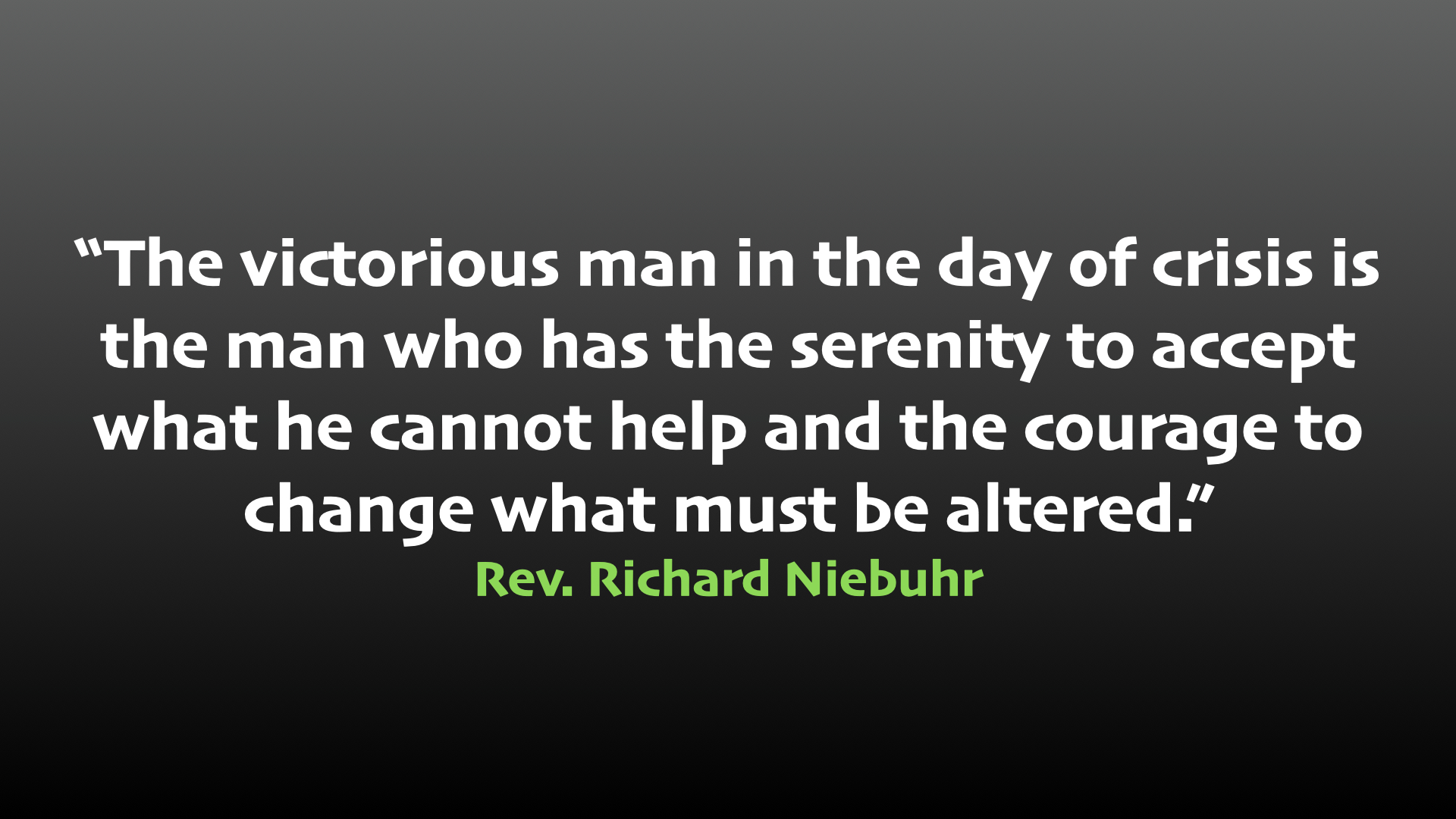
AA says: “Often times, a person with substance use disorder may have a need for control that can prevent them from achieving peace of mind. They may feel frustrated that they cannot control the actions of other people and turn to substances like alcohol to control their feelings, even though the control that alcohol provides is a farce. The Serenity Prayer is a gentle reminder that letting go and accepting a loss of control can help put an end to the substance abuse cycle.”
In light of our series called Is That in the Bible? let’s ask, is the serenity prayer in the Bible.
No, it’s not, but still there are some very important principles we shouldn’t miss from this prayer.
The full prayer is—
God grant me the serenity to accept the things I cannot change; courage to change the things I can; and wisdom to know the difference.
Living one day at a time; enjoying one moment at a time; accepting hardships as the pathway to peace;
Taking, as He did, this sinful world as it is, not as I would have it; trusting that He will make all things right if I surrender to His will;
That I may be reasonably happy in this life and supremely happy with Him forever and ever in the next. Amen.
Should Christians pray a prayer like this? Biblically, there is nothing wrong with Christians praying prayers that have been written by men or women, provided that they don’t contradict the words God has spoken to us.
Remember James 5:16 that we looked at earlier? The Personalized Promise Bible has a prayer for that verse:
If I have stumbled in any way, I do not need to fret over it—I can rest in full confidence that the Lord loves me and forgives all of my shortcomings. I also know that sin is a hindrance to my healing. Therefore, if there is any sin in my life I repent of it. I confess my sins to trusted brothers and sisters in Christ, gaining strength and praying in agreement with them so that I will be healed.
In a similar fashion, I see several passages of Scripture that are woven into the serenity prayer.
“God grant me the serenity to accept the things I cannot change; courage to change the things I can; and wisdom to know the difference.” Proverbs 1:2-3 describes the help God’s wisdom gives us for daily living.
“Living one day at a time; enjoying one moment at a time.” Jesus taught us to pray each day for our daily bread (Matthew 6:8, 11).
“Accepting hardships as the pathway to peace.” Jesus also taught us to pray, “Your will be done on earth as it is in Heaven” (Matthew 6:10), and He also prayed a very similar prayer Himself when He was in the Garden of Gethsemane, “Yet not as I will, but as You will” (Matthew 26:39).
“Taking, as He did, this sinful world as it is, not as I would have it; trusting that He will make all things right if I surrender to His will.” Jesus promised us both trouble in this world and His overcoming power to stand strong in that trouble (John 16:33).
“That I may be reasonably happy in this life and supremely happy with Him forever and ever in the next. Amen.” Jesus promises eternal rewards that vastly outweigh the trouble we may face in this life (Luke 12:32; Matthew 25:21, 34).
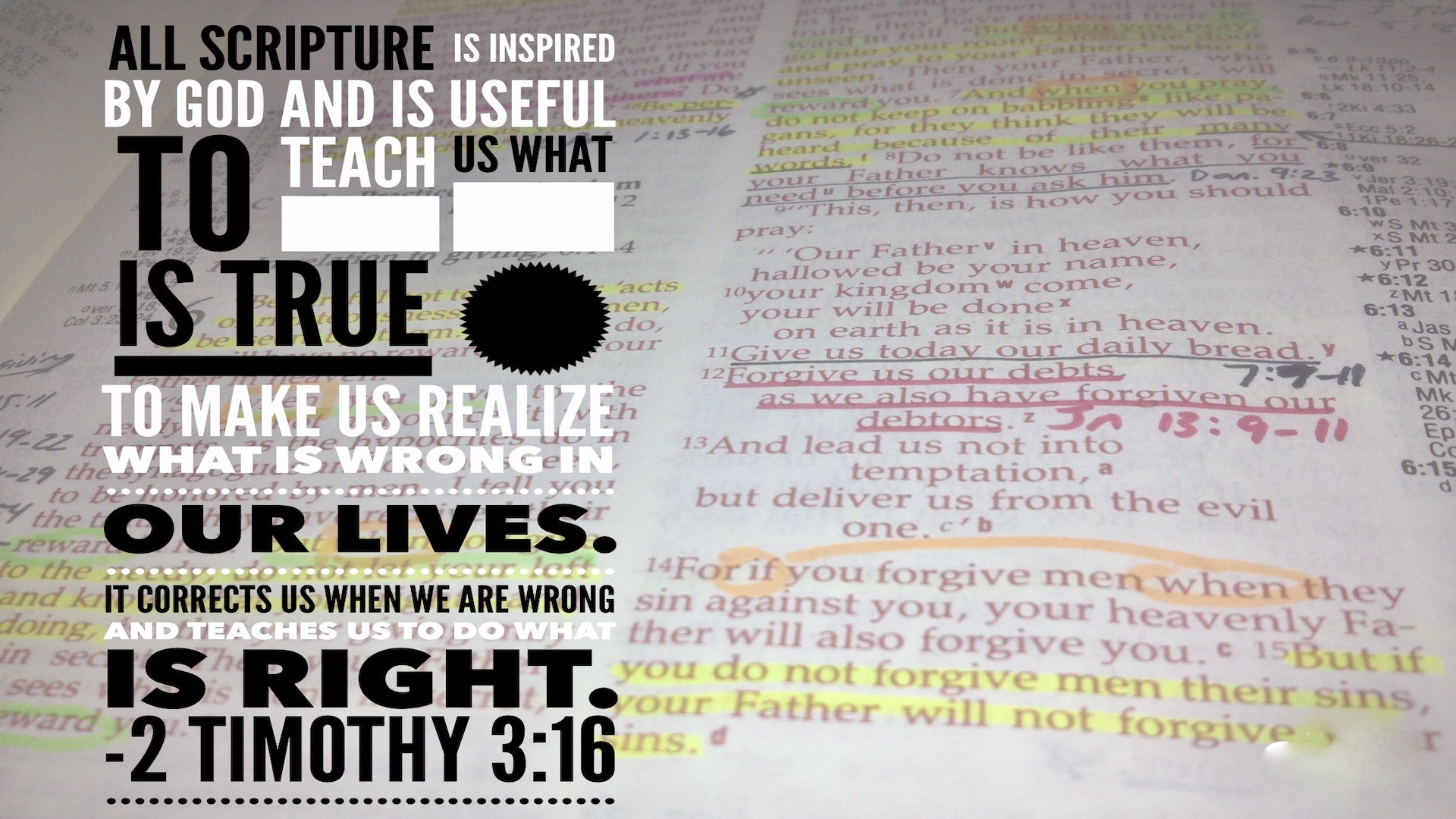
The bottom line: The Bible is not just a Book to read through but a Book to pray through. ALL Scripture is for ALL servants of God. ALL Scripture is applicable to ALL the circumstances we will ever face in life.
If something like the serenity prayer—or any other man-made prayer—is based on Scripture and helps give voice to your prayers, use them! But use them as guides to help you begin to form your own prayers from biblical passages you are reading for yourself.



 You might be checking out this episode with the hope of one day being a leader. Well, Greg and I have good news for you—you already are! Leaders are not just the person at the top, but if you have a leadership mindset you can be a leader in whatever position you currently occupy. Join us as we chat about how important it is to start being a leader before you have the “leader” title.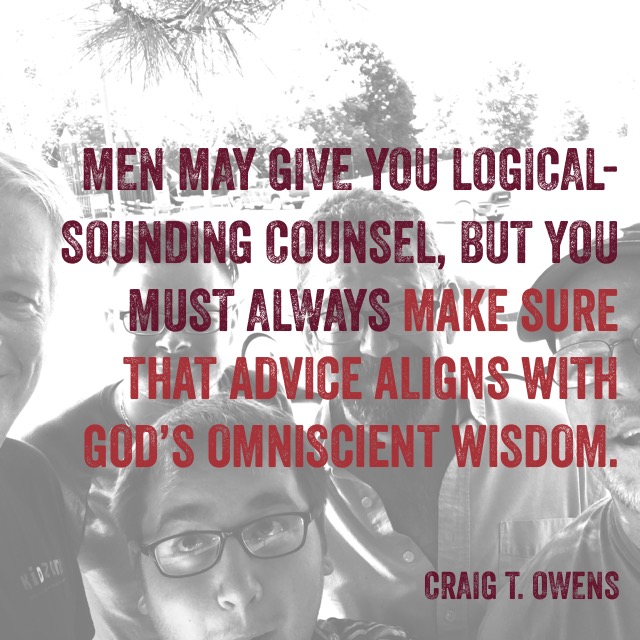








 Craig T. Owens