Gratitude Is A Shield

Listen to the podcast of this post by clicking on the player below, and you can also subscribe on AppleSpotify, or Audible. 

Gratitude is a great attitude. It sets you apart from the crowd of complainers, and it causes people to ask, “What do you know that we don’t know?”      

Wouldn’t you just love to silence the complainers in your life? Maybe you can relate to this poem by Shel Silverstein called Complainin’ Jack

This morning my old jack-in-the-box
Popped out—and wouldn’t get back-in-the-box.
He cried, “Hey, there’s a tack-in-the-box,
And it’s cutting me through and through.
“There also is a crack-in-the-box,
And I never find a snack-in-the-box,
And sometimes I hear a quack-in-the-box,
‘Cause a duck lives in here too.”
Complain, complain is all he did—
I finally had to close the lid.

Since, as Christians, we can’t really “close the lid” on the complaining people around us, maybe there’s something else we can do. I can think of three possibilities. 

  1. We could entirely avoid complaining people. But to do this wouldn’t allow us to live our lives as the salt and light Jesus called us to (Matthew 5:13-16). After all, in order for salt to season or light to drive away darkness, the salt and light have to be in close proximity to those they are helping. 
  1. We could simply ignore the negativity. Be around it, but do nothing about it. But both Paul and Jesus call us to engage with people in a way that points them to the Good News of the Gospel (Philippians 2:14-16; Matthew 28:19). 
  1. If we cannot avoid complainers nor remain apathetic about them, we must find a way to engage them but protect our hearts in the process. 
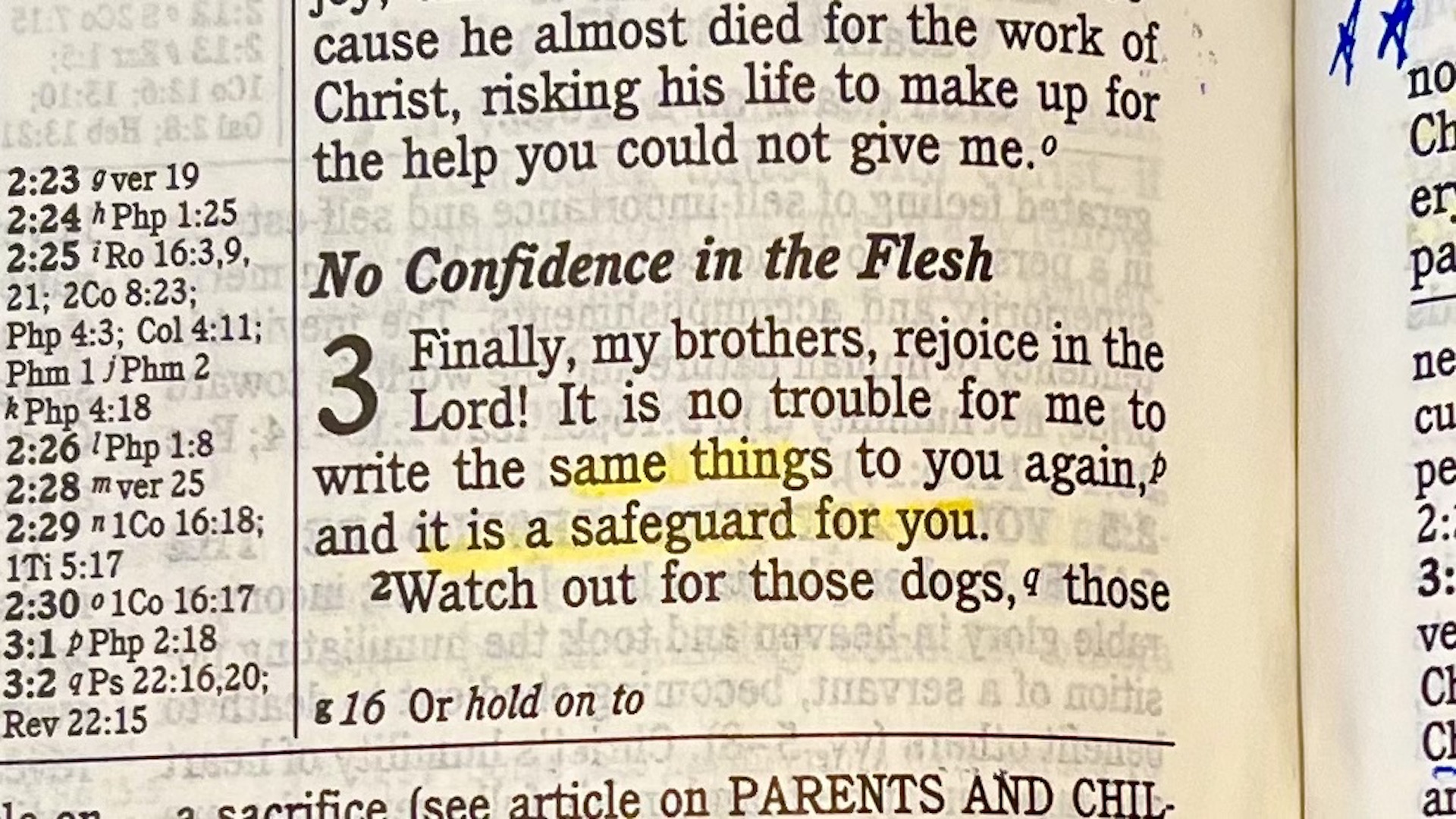
We learn from the apostle Paul’s letter to Philippi that gratitude is our shield against anything that would seek to steal our joy! “Further, my brothers and sisters, rejoice in the Lord! It is no trouble for me to write the same things to you again, and it is a safeguard for you” (Philippians 3:1). 

In the Greek, the root word for “safeguard” means “fail.” But when we add the prefix it becomes cannot fail! So rejoicing makes us secure, firm, reliable.

Quite simply that means that gratitude is our attitude protector because gratitude is our shield against anything that would seek to steal our joy!

Jesus used the same word for rejoicing even when we are facing insults, exclusion, and persecution—

Blessed are you when people hate you, when they exclude you and insult you and reject your name as evil, because of the Son of Man. Rejoice in that day and leap for joy, because great is your reward in heaven. For that is how their ancestors treated the prophets. (Luke 6:22-23) 

Both Jesus in this passage and Paul in Philippians 3:1 remind us that our rejoicing is IN the Lord. We are not expected to rejoice in our circumstances, but in who God is for us. Matthew Henry noted, “The more we rejoice in Christ the more willing we shall be to do and to suffer for Him, and the less danger we shall be in of being drawn away from Him.” 

I also like both the proactive and reactive use of rejoicing that John Henry Jowett identifies when he says, “Gratitude is a vaccine, an antitoxin, and an antiseptic.” Rejoicing is never supposed to be a one-and-done action, but it is an ongoing lifestyle. As Paul wrote to the Christians in Philippi just a few verses later, “Rejoice in the Lord always. I will say it again: Rejoice!” (Philippians 4:4). 

Gratitude is a shield—a vaccine, an antitoxin, and an antiseptic—but it doesn’t protect us unless we use it!

In order to use this shield whenever it’s needed, we have to be constantly reminded to be grateful. This is where we can leverage the power of our brain’s reticular activating system. I shared a short video about how to do this on The Podcast last week—check it out here. 

Gratitude is a great attitude, and grateful people are a winsome testimony of God’s love and provision to those “complainin’ Jacks” we all encounter. Try it and see what a difference it will make with those you are around this week. 

To check out all of the sermons in this series, please click here. 

►► Would you please prayerfully consider supporting this ministry? My Patreon supporters get behind-the-scenes access to exclusive materials, like this exclusive video in which I take my supporters behind the scenes of my thought process in designing my confrontation flowchart. ◀︎◀︎


How To Be Thankful Everyday

Listen to the podcast of this post by clicking on the player below, and you can also subscribe on AppleSpotify, or Audible. 

I learned an important message about thankfulness from an Indiana Jones movie!

Check out this episode of The Podcast.

Some resources to go along with this video:

►► Would you please prayerfully consider supporting this ministry? My Patreon supporters get behind-the-scenes access to exclusive materials, like this exclusive video in which I take my supporters behind the scenes of my thought process in designing my confrontation flowchart. ◀︎◀︎

His Love Endures Forever

Listen to the podcast of this post by clicking on the player below, and you can also subscribe on AppleSpotify, or Audible.

Psalm 136 calls on us to season absolutely every circumstance and every thought with a reminder to be thankful to God for His everlasting love for us. In the 28 verses of this psalm, we are reminded twenty-eight times that “His love endures forever.” 

At every instance we are reminded of God’s eternal attributes: His goodness and His kindness. And at every instance we are reminded to praise God for who He is. 

In creation, He reveals His goodness.

In difficult places, He reveals His goodness. 

In deliverance, He reveals His goodness.

In His miracles, He reveals His goodness.

In our celebration of His strength, He reveals His goodness.

In our confession of our weaknesses, He reveals His goodness.

In His daily provision, He reveals His goodness.

In keeping us close to Himself, He reveals His goodness.

In His eternal nature, He reveals His goodness.

In our thanks giving, we reveal His goodness to a searching world. 

Never, ever miss an opportunity to give God thanks for His ever-enduring love! 

►► Would you please prayerfully consider supporting this ministry? My Patreon supporters get behind-the-scenes access to exclusive materials. ◀︎◀︎

Year-End Review (2022 Edition)

Listen to the podcast of this post by clicking on the player below, and you can also subscribe on AppleSpotify, or Audible.

The apostle Peter said he wrote two letters to the church “as reminders to stimulate you to wholesome thinking” (2 Peter 3:1). And Paul reminded his young friend Timothy to “keep reminding [your congregation] of these things” (2 Timothy 2:14). 

In the spirit of those great apostles, I have made it a practice to take time at the end of each year to look back on all that we have learned in the previous year, and then to look forward to where God may be leading Calvary Assembly of God in this upcoming year.

Clicking on each series title will take you to a list of all of the sermons in that series. 

Awesome—Jesus told us that we could pray in His name and expect amazing things (see John 14:13-14, 15:16, 16:23-24). This does not mean that simply adding the phrase “in Jesus’ name, Amen” to the end of a prayer unlocks a secret code. Rather, it means that the more we understand just how awesome our Savior is, and that He is the Key to God’s storeroom, the more we will being to align our prayers with the will of God. Jesus desires for His Father’s glory to be seen on earth through the answers to our prayers. The writer of Hebrews opens his letter by reminding us that Jesus is “the radiance of God’s glory and the exact representation of His being, sustaining all things by His powerful word” (Hebrews 1:3).

Is That In The Bible? (part 1 and part 2)—A meme that makes me chuckle every time I see it is a “quote” attributed to Abraham Lincoln in which he says, “The problem with quotes found on the internet is that they are often not true.” (Not to spoil the joke for you, but unless Lincoln knew how to time travel to the future, I don’t think he knew about the modern internet! 😂). I love this meme because it captures something that so many people fall into: a quick acceptance of a statement without verifying its source or thinking through the implications of the statement’s truthfulness. I think you may be surprised to discover just how many phrases we call biblical aren’t, and how many phrases there are that we never realized are actually in the Bible.

Christmas Unwrapped At Easter—Remember as a kid when you would unwrap a gift and discover it wasn’t something you really wanted, but then your parents explained that it was something you needed? The birth of Jesus in Bethlehem was a little like that—it wasn’t exactly what people were hoping for, but it was exactly what they needed. The real meaning of that Christmas gift wasn’t realized until after Jesus was crucified and resurrected back to life.

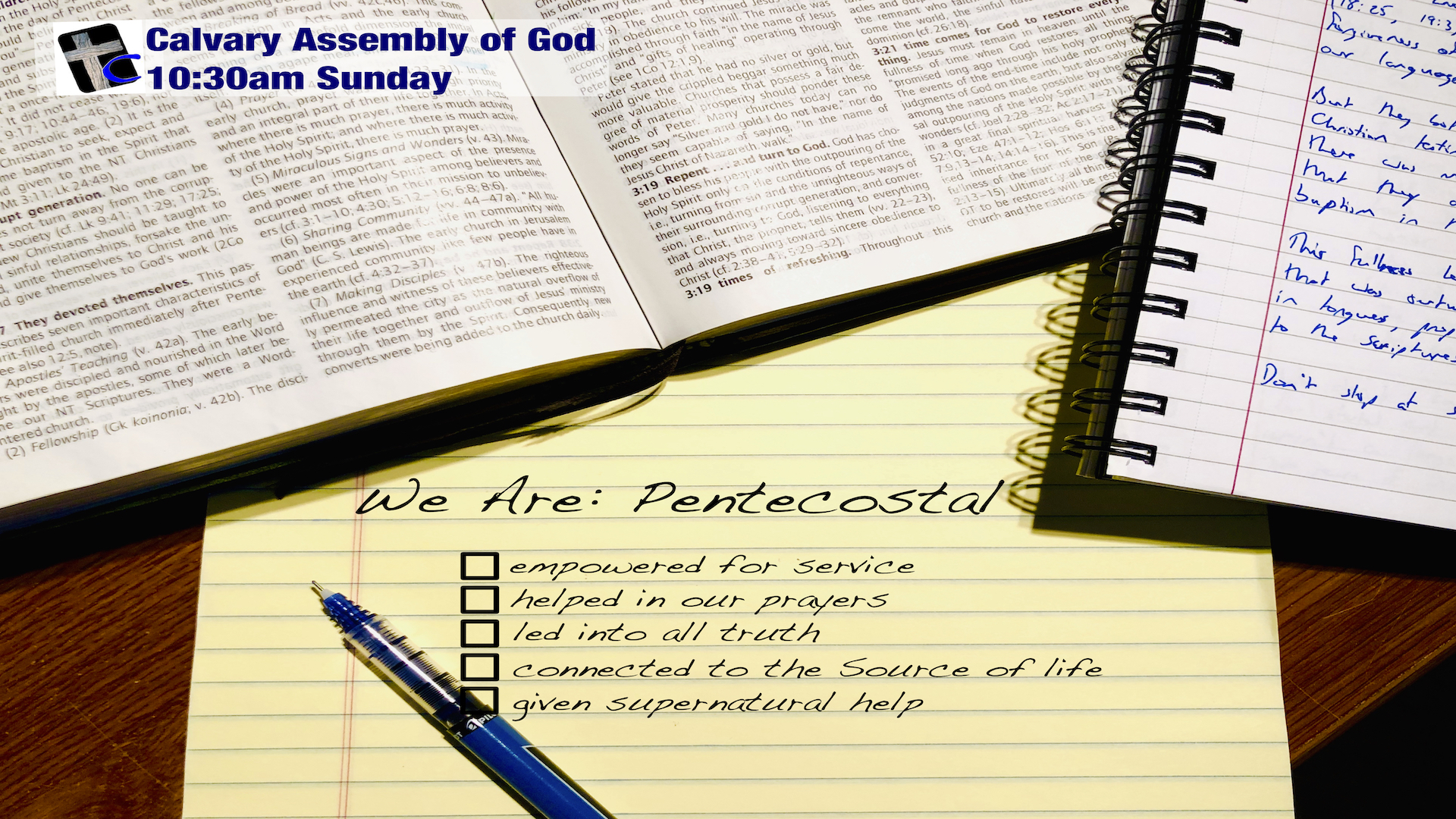
We Are: Pentecostal—Pentecost for over 1500 years was a celebration in Jerusalem that brought in Jews from all over the world. But on the Day of Pentecost that came just ten days after Jesus ascended back into heaven, the meaning of Pentecost was forever changed! Followers of Jesus—now empowered by an infilling of the Holy Spirit—began to take the good news of Jesus all over the world. These Spirit-filled Christians preached the Gospel and won converts to Christ even among hostile crowds, performed miracles and wonders, stood up to pagan priests and persecuting governmental leaders, and established a whole new way of living as Christ-followers. We, too, can be Pentecostal followers of Jesus Christ today. 

Selah—The word Selah appears nearly 70 times in the Bible, almost exclusively in the Psalms. Although it is primarily a musical term, it applies beautifully to our summer series. It means a pause. Throughout the Psalms, Selah appears at the end of a verse, at the end of the psalm, or sometimes even mid-sentence. But each one of them is perfectly placed by the Spirit-inspired authors to get us to take a breath and deeply contemplate what we just read or sang. 

Craving—Doesn’t it seem like far too many Christians think of their relationship with Jesus as bland? After all, we’ve been told that any cravings we have should be quickly downplayed so that they don’t carry “good Christians” away. But what we discover in the Bible is that God made us to be craving creatures—He wants us to long deeply and find ultimate satisfaction for those longings. In short, God created us to long after the things that only He can fulfill. As we dive into this new series, I think you will find it quite eye-opening and heart-lifting. 

The Great Attitude Of Gratitude—There’s something about gratitude that distinguishes people. Think about it: would you rather hang around with grumblers or grateful people? The gratitude of Paul and Silas certainly made them stand out from the crowd when they were in Philippi. Wrongly accused, beaten, and thrown in prison, but instead of bellyaching, they were praising God. Later on, when Paul wrote his letter to the Christians in Philippi, the theme of gratefulness permeates his letter. The distinguishing mark is actually in the title: The GReat ATTITUDE spells out GRATITUDE!

Bethlehem Is Proof—The prophet Micah foretells that the Messiah will arrive in dark times. Enemies will surround Israel, and Israel’s ruler will receive a nasty punch to the jaw. Demonic strongholds, witchcraft, and idolatry will appear to be gaining the upper hand. And then Micah turns his attention to a small village just south of Jerusalem—a village so small that it is often overlooked—a village from which no one would expect Israel’s Deliverer. And yet, Micah writes, “But you, Bethlehem Ephrathah, though you are small among the clans of Judah, out of you will come for Me One who will be Ruler over Israel, Whose origins are from of old, from ancient times” (Micah 5:2). Jesus the Deliverer was born in the little town of Bethlehem, and His birth there 700 years after Micah foretold it is our proof that God always gets the last word, the decisive word, and the best word!

We will be returning to a couple of these series in 2023, and we’ll be launching some brand-new ones as well. If you don’t have a home church in the northern Kent County area, I would love to have you join us! 

►► Would you please prayerfully consider supporting this ministry? My Patreon supporters get behind-the-scenes access to exclusive materials. ◀︎◀︎

Thursdays With Spurgeon—Beware Of Grumblers

This is a weekly series with things I’m reading and pondering from Charles Spurgeon. You can read the original seed thought here, or type “Thursdays With Spurgeon” in the search box to read more entries.

Listen to the podcast of this post by clicking on the player below, and you can also subscribe on AppleSpotify, or Audible. 

Beware Of Grumblers 

     None is so wise as the man who knows nothing. His ignorance is the mother of his impudence and the nurse of his obstinacy; and though he does not know a bee from a bull’s foot, he settles matters as if all wisdom were at his fingers’ ends—the pope himself is not more infallible. Hear him talk after he has been at a meeting and heard a sermon, and you will know how to pull a good man to pieces if you never knew it before. He sees faults where there are none; and if there be a few things amiss, he makes every mouse into an elephant. … 

     Those who know nothing are confident in everything; hence they are bullheaded beyond measure. Every clock and even the sundial must be set according to their watches. … Venture to argue with them, and their little pots boil over in quick style; ask them for a reason, and you might as well go to a sandpit for sugar. … 

     Faultfinding is dreadfully catching: One dog will set a whole kennel howling, and the wisest course is to keep out of the way of a man who has the complaint called the grumbles. … Dogs, however, always will bark; and what is worse, some of them will bite, too. But let decent people do all they can, if not to muzzle them, yet to prevent them from doing any great mischief.

From John Ploughman’s Talks of Plain Advice For Plain People

Charles Spurgeon—the prince of preachers—could also use a sarcastic tone to a great effect when it was needed! This whole book was supposed to be a sort of “shop talk” to the everyday working man. These are not flowery sermons, but straight-shooting for decent people. 

I have just completed a short series of messages on the distinct ways grateful people stand out from the crowd. But isn’t it just as true that those who constantly grumble about anything and everything also stand out from the crowd? 

Spurgeon was right that grumbling and faultfinding are dreadfully catching! King Solomon says that we waste our time trying to reason with such foolish people who believe themselves to be smarter than the rest of us. So Solomon’s advice is to simply leave them alone. 

Indeed, the best way to avoid catching the contagion of grumbling is to stay away from grumblers. If you have the misfortune of living with a grumbler or perhaps working next to a grumbler, the best way to “walk away” is to simply not engage in their faultfinding “barking.” Maybe you could even answer their complaint by pointing out something for which you are grateful. 

Let’s all make sure we’re not the grumbling, barking, growling dogs that Spurgeon identifies in this passage, and then let’s do all we can to keep the contagion of a grumbler contained. To paraphrase the apostle Paul, “Don’t be overcome by grumbling, but overcome grumbling by walking away or with gratitude” (Romans 12:21).

►► Would you please prayerfully consider supporting this ministry? My Patreon supporters get behind-the-scenes access to exclusive materials. ◀︎◀︎

Thanksgiving 365

Listen to the podcast of this post by clicking on the player below, and you can also subscribe on AppleSpotify, or Audible.

Happy Thanksgiving Eve! I am so thankful for you and the many ways you encourage and inspire me. 

I’ve got a challenge for you: How can you make the Thanksgiving spirit a 365-days-per-year thing instead of just one Thursday in November? 

Your gratitude expressed to others could be the lifeline that they need! 

►► Would you please prayerfully consider supporting this ministry? My Patreon supporters get behind-the-scenes access to exclusive materials. ◀︎◀︎

Magnifying God

Listen to the podcast of this post by clicking on the player below, and you can also subscribe on AppleSpotify, or Audible.

No one likes to be around a complainer! 

Complainers, ironically, find things wrong everywhere else but with themselves. Complainers know how everyone else should raise their kids, run their businesses, operate their government, lead their sports teams to victory, but they seldom apply their so-called wisdom to their own lives. Complainers find the one thing that’s wrong in an otherwise perfect situation.   

Complaining is easy because it comes so naturally. What do I mean by that? Take a look at the magazine covers at your grocery store—do they have good news or complaints? Take a look at the lead news stories—are they celebrations or complaints? Those magazines want to sell copies. Those news stations want viewers. Those websites want clicks. They wouldn’t promote the complaints if they didn’t get them the attention (and the advertising revenue) they desire! 

Let me see a show of hands on this: How many of you want to be around complainers? 

I noticed no one raised their hand, so I need to ask a follow-up question: Why do you complain? If you don’t like to be around a complainer, why do you do what others obviously don’t like either? 

I think we complain because we think our situation is unique—no one has experienced anything quite like what we’re going through. We often make a list to “prove” to everyone that we have earned the right to complain. This is what Job did. Check out his list in Job 7:1-11, and then notice his conclusion where he says, “Therefore I will not keep silent; I will speak out in the anguish of my spirit, I will complain in the bitterness of my soul.” 

But we need to be careful because the Bible makes it clear that complainers make God angry (see Numbers 11:1; 1 Corinthians 10:10-11). Why? I think there are two reasons. 

First, I think God gets angry about complaints because of how quickly they spread to everyone around them—like cancer cells they destroy the whole body. 

Second, complainers take everyone’s eyes off God and point their attention to the lousy situation about which they are complaining. 

On the other hand, grateful people stand out because they can find the one thing worthwhile in an otherwise lousy situation. Being a grateful person takes discipline to overcome the downward pull of everyone else’s complaints. 

Paul wrote a letter to the church at Philippi that is bursting with thankfulness! We only have to get three verses in when he says, “I thank my God every time I remember you” (Philippians 1:3). 

Paul stood out because of his great attitude of gratitude. Consider what happened the very first time he visited the city of Philippi. He and Silas were wrongly accused, beaten, and locked in prison. Paul didn’t start a petition, he didn’t give the jailer a bad review on Yelp, he didn’t organize a rally, he didn’t call the Roman governor. Instead, Paul and Silas were praying and singing hymns to God while the other prisoners listened in (Acts 16:16-25). 

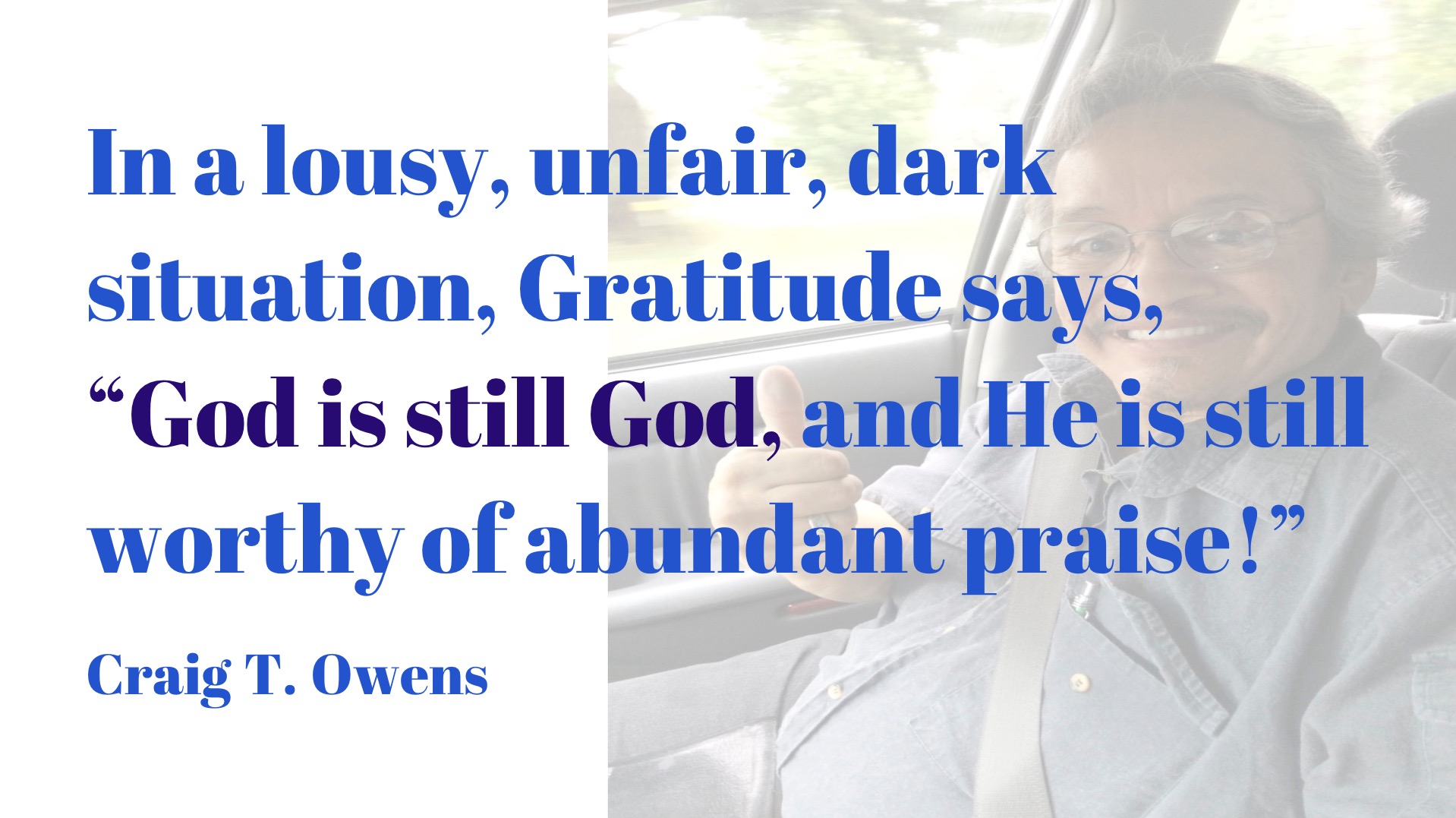
In a lousy, unfair, dark situation, Gratitude says, “God is still God, and He is still worthy of abundant praise!” 

So in the middle of his letter to the Philippians, Paul instructs these Christians to: Do all things without murmurings and disputings (Philippians 2:14 KJV). Murmurings are the vocalizing of the faults we have found. Disputings, though, are internal. In the Greek, this word almost always refers to complaining and grumbling thoughts, and many times it’s translated as “evil thoughts.” 

When the complaining comes out of our mouths, that is just the ugly weed. The root of that complaint is in our hearts. We don’t need a vocabulary change, we need a heart change. 

When we praise God, we magnify Him. That doesn’t make God bigger because He is infinite. But it does put a “telescope” on Him. Telescopes bypass everything that is close by and focus on something majestic. Our praise—like Paul and Silas’ song from prison—invites others to look through our telescope to see the God we are magnifying. 

Gratitude can start with one person, and then it can spread. Gratitude can counteract the cancerous complaints. Will you be that one grateful person at this Thanksgiving season and beyond? Will you be the one that says, “No matter what, God is still God, and He is still worthy of abundant praise”? Will you be that one that sings praise at the exact moment everyone else expects complaints? If you do, your gratitude will entice others to want to worship this all-good God too! 

Follow along with all of the messages in our series called The Great Attitude Of Gratitude by clicking here. 

►► Would you please prayerfully consider supporting this ministry? My Patreon supporters get behind-the-scenes access to exclusive materials. ◀︎◀︎

Thursdays With Spurgeon—Standing Firm

This is a weekly series with things I’m reading and pondering from Charles Spurgeon. You can read the original seed thought here, or type “Thursdays With Spurgeon” in the search box to read more entries.

Listen to the podcast of this post by clicking on the player below, and you can also subscribe on AppleSpotify, or Audible. 

Standing Firm 

     Superficial brilliance is always afraid of fire, but gold is not. The paste gem dreads to be touched by the diamond, but the true diamond fears no test. People who have a kind of confectionery godliness will wish to be preserved from temptations, for they cannot endure them. But the Christian counts it all joy when he falls into different trials, knowing that ‘tribulation produces perseverance; and perseverance, character; and character, hope. Now hope does not disappoint, because the love of God has been poured out in our hearts by the Holy Spirit who was given to us’ (Romans 5:3-5). My dear friends, if your faith is only a sunshiny faith, get rid of it! … 

     So our gracious God, beloved, glorifies Himself by permitting His people to be subjected to trials and by enabling them to endure the strain. We would never know the music of the harp if the strings were left untouched. We would never enjoy the juice of the grape if it were never trod in the winepress. We would never discover the sweet perfume of cinnamon if it were not pressed and beaten. And we would never know the warmth of fire if the coals were not utterly consumed. The excellence of the Christian is brought out by the fire of trouble. The wisdom of the great Workman and the glory of His skill and power are discovered by the trials through which His vessels of mercy are permitted to pass. … 

     Depend upon it, beloved, those who suffer as I have described are the children of God, for they show it. They show it by the way in which they bear their trials. In the worst times there is always a clear distinction that marks them as separate from other men. If they cannot shout, ‘Victory!’ they bear patiently. If they cannot sing to God with their mouth, yet their hearts bless Him. There is a degree of light even in their worst darkness…. If they get into the mire, they do not perish there. They cry for help when their woes surround them, and in the very nick of time, when everything appears to be lost, their heavenly Father hastens to their aid.

From The Believer Sinking In The Mire

I shared a series of messages called Thankful In The Night. Another psalmist wrote, “Yet the Lord will command His loving-kindness in the daytime, and in the night His song shall be with me” (Psalm 42:8). 

Notice that this psalmist was praising God IN the night, not praising Him FOR the night. Many people have gone through what has been called “the dark night of the soul.” I don’t think anyone has ever given thanks because of being in a dark time, but certainly they have given thanks afterward because of the lessons learned in that dark time. 

Quite simply put, there are some things God wants to teach us that we can learn in no other way than to go through a dark night. So we can learn to be thankful even IN those nights. IN those nights, we can learn to say, as Spurgeon did, “I believe in my Lord because He is a God who cannot lie. He is faithful and true to His every word and, therefore, let the whole creation go to rack and ruin, my faith will not waver or give up its confidence.” 

Amen! Let us stand firm in that confidence.

►► Would you please prayerfully consider supporting this ministry? ◀︎◀︎

The Craig And Greg Show: Why Leaders Must Stop Complaining

Listen to the audio-only version of this podcast by clicking on the player below, or scroll down to watch the video.

On this episode of “The Craig And Greg Show” we talk about: 

  • [0:26] Craig gives Greg a special gift
  • [1:27] what leaders do that will undermine their leadership 
  • [2:48] why it’s more fun to be around grateful people 
  • [4:12] Craig shared about the impact grateful teammates have had on him 
  • [4:52] why is it so easy to complain? 

  • [6:28] leaders need to speak positive things into this around them 
  • [7:42] leaders need to shut down complaining teammates quickly 
  • [8:39] Greg challenges leaders to confront their own negative attitude 
  • [10:00] leaders need to create a place of safety to help others to develop to their full potential 
  • [12:08] Greg reminds leaders that busyness can restrict gratitude 
  • [13:29] criticism is both a mindset and a “heartset”
  • [13:59] how many of our criticism come from our assumptions about others? 
  • [15:06] poor leaders have a misunderstanding of what gratitude does 
  • [15:55] some ways leaders can express gratitude to their teammates 
  • [17:57] another look at the problem of assumptions 
  • [19:08] a grateful person attracts others to them 
  • [21:00] Craig gives leaders a challenge to help bolster their attitude of gratitude

Check out this episode and subscribe on YouTube so you can watch all of the upcoming episodes. You can also listen to our podcast on Spotify and Apple.

Honk Your Thanks

Listen to the podcast of this post by clicking on the player below, and you can also subscribe on AppleSpotify, or Audible. 

If anxiety kills joy, what kills anxiety? Anxiety—the joy-killer—is itself killed when joy is expressed.

Being grateful for what you have kills the anxiety of what you don’t have.

Being thankful for what you have kills the fear of what you may be missing.

Being grateful for what you have kills the anxiety of the bad stuff that may never even happen.

If joy kills anxiety, how can we develop more of it? Most people would say, “If you’re happy, give thanks” or “If you’re happy, honk.” But really it’s the other way around: “If you want to be happy, honk!”

Don’t fret or worry. Instead of worrying, pray. Let petitions and praises shape your worries into prayers, letting God know your concerns. Before you know it, a sense of God’s wholeness, everything coming together for good, will come and settle you down. It’s wonderful what happens when Christ displaces worry at the center of your life. (Philippians 4:6-7)

Honking your thanks is not only good for you, but it’s good for everyone around you who hears your “honk! honk!” of gratitude. David experienced this in Psalm 34:1-3. Even when he was at a low point, when he started praising God other anxious people began to experience joy as well.

This is a snippet from a longer message, which you can find by clicking here.

►► Would you please prayerfully consider supporting this ministry? ◀︎◀︎