Links & Quotes

As a Christian, when you are sharing your testimony and someone wants to argue with you, remember that you are not fighting against people but you are fighting FOR people. Remind yourself of this over and over so that you respond in love.

I have a lot of new video content on my YouTube channel every week. Please check it out and subscribe so you don’t miss anything.

“Now in history there is no Revolution that is not a Restoration. Among the many things that leave me doubtful about the modern habit of fixing eyes on the future, none is stronger than this: that all the men in history who have really done anything with the future have had their eyes fixed upon the past. I need not mention the Renaissance, the very word proves my case. The originality of Michael Angelo and Shakespeare began with the digging up of old vases and manuscripts.” —G.K Chesterton 

Dr. Stephen Nichols tells of a national day of thanksgiving in 16th century England that began from a very unlikely source.

“Most of the important things in the world have been accomplished by people who have kept on trying when there seemed to be no hope at all.” —Dale Carnegie 

Point Out What’s Right

Listen to the podcast of this post by clicking on the player below, and you can also subscribe on AppleSpotify, or Audible. 

Christians need to be known more for what is good than for what is bad. Jesus hasn’t called us to point out what’s bad, but to point out how good Jesus is. 

The parable that I reference in this video is found in Matthew 13:24-30, 36-43. 

You can watch the full sermon from which this clip came by clicking here. 

►► Would you please prayerfully consider supporting this ministry? My Patreon supporters get behind-the-scenes access to exclusive materials. ◀︎◀︎

Biblical Worldview

Listen to the podcast of this post by clicking on the player below, and you can also subscribe on AppleSpotify, or Audible. 

The definition of salvation comes from Romans 10:9. When we believe in our heart that Jesus paid the penalty for our sins and we confess that with our mouth, we are now justified. I can now stand before God just as if I had never sinned. But the Christian life is more than merely going to heaven at some point. It’s about glorifying God and pointing others to Jesus while we’re on our way to heaven. 

(Check out all of the Scriptures in this post by clicking here.)

We are immediately justified but sanctification (or as I like to call it “saint-ification”) is an ongoing process. 

  • The sanctified life is fruitful 
  • The sanctified life is joy-filled
  • The sanctified life is a testimony to others  

Paul wrote to saints in Corinth (1 Corinthians 1:2; 2 Corinthians 1:1) but he also called them “mere human beings” in 1 Corinthians 3:1-3. Paul points out that there is a difference between viewing this life from a worldly viewpoint and a biblical viewpoint (2 Corinthians 5:16). 

A naturalistic world view is constantly shifting as new discoveries are made. A biblical worldview knows there is nothing new under the sun, that everything is addressed in Scripture. 

In order to not view this world through the lens of “mere human beings” we have to read, study, meditate on, and apply the whole counsel of God’s Word. We put it in and the Holy Spirit helps us live it out. Just like our prescription glasses won’t do a thing to correct our vision of they aren’t on our face, Scripture won’t help us navigate this world in a God-glorifying way if we haven’t put it in our heart. 

Each day before I ready my Bible I pray Psalm 119:18, which asks the Holy Spirit to open my eyes to the amazing things in Scripture. I read, I journal, and I pray over the passage that I have read. Then the Holy Spirit makes good application of that Scripture (John 14:26, 16:13; 1 John 4:6). I want to be sure to read the whole counsel of God’s Word, not just cherrypicking my favorite parts. And I always want to be going deeper (Hebrews 6:1). 

One place that we see contrasting world views—the natural worldview versus the biblical worldview—is in 2 Timothy 2:14-19. 

  • Natural worldview #1—quarreling about words 
  • Biblical worldview #1—correctly handling the Word of truth 
  • Natural worldview #2—engaging in godless chatter 
  • Biblical worldview #2—standing on the firm foundation of Scripture 

The results of a biblical worldview are amazing: 

  1. A sure foundation (Matthew 7:24-27) 
  2. The attention of others (Matthew 7:28-29) 
  3. Useful treasures to share with others (Matthew 13:52) 
  4. A strong defense against critics (Acts 6:9-10; Psalm 119:99) 

Let’s not get stuck in the “mere human being” level of a natural worldview, but let’s commit to studying our Bibles diligently so that the Holy Spirit can develop a robust biblical worldview in us. This worldview is fruitful, joyful, and enhances our testimony. 

Follow along with all the other messages in our series on B.A.S.I.C. Christianity by clicking here. 

►► Would you please prayerfully consider supporting this ministry? My Patreon supporters get behind-the-scenes access to exclusive materials. ◀︎◀︎
Call It To Mind And Speak It Out

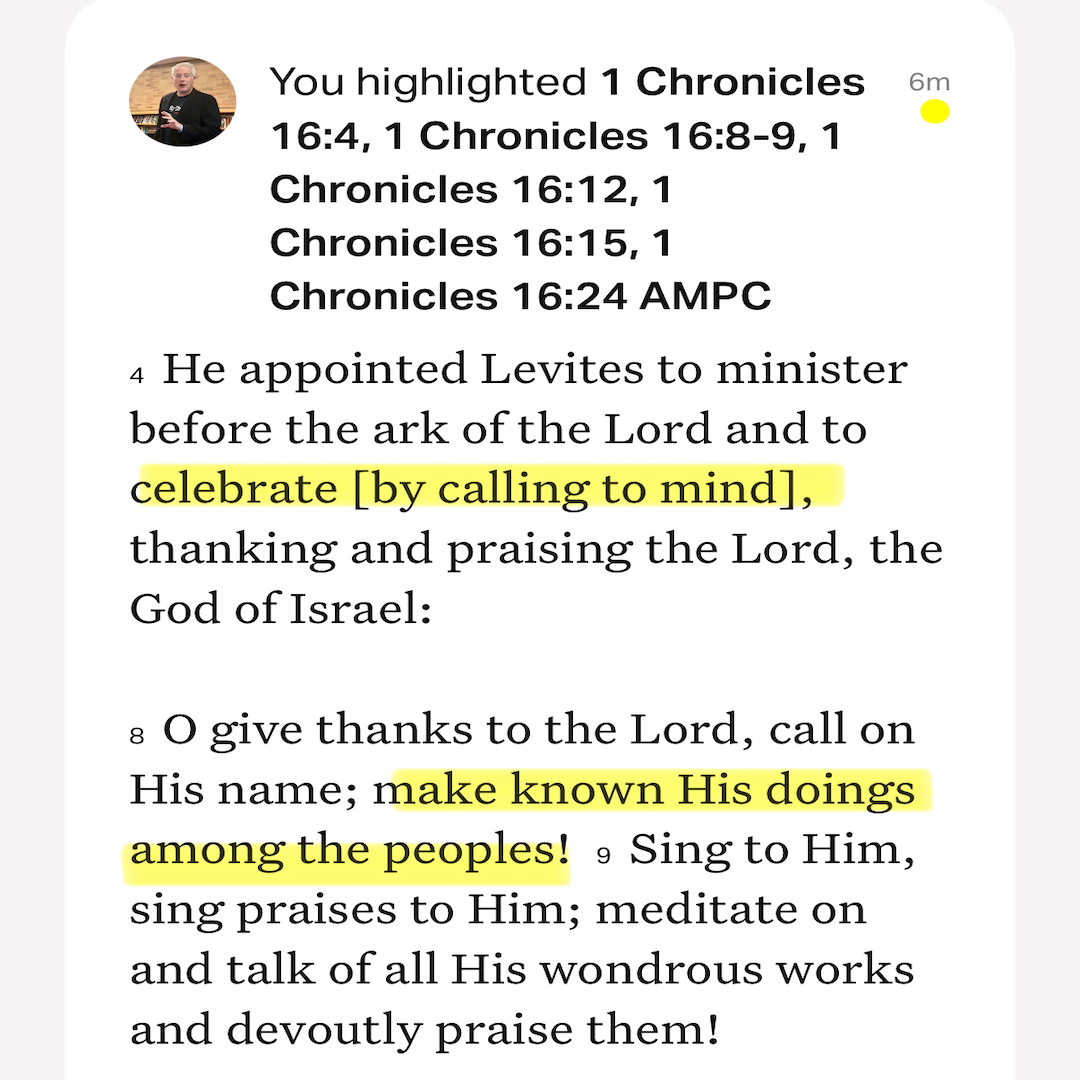
[King David] appointed Levites to minister before the ark of the Lord and to celebrate by calling to mind, thanking and praising the Lord, the God of Israel: … O give thanks to the Lord, call on His name; make known His doings among the peoples! Sing to Him, sing praises to Him; meditate on and talk of all His wondrous works and devoutly praise them! … Earnestly remember the marvelous deeds which He has done, His miracles, and the judgments He uttered as in Egypt. … Be mindful of His covenant forever, the promise which He commanded and established to a thousand generations. … Declare His glory among the nations, His marvelous works among all peoples. (1 Chronicles 16:4, 8-9, 12, 15, 24 AMPC) 

Calling to mind … meditate … earnestly remember … be mindful. All these things lead to both worship and proclamation. 

Recalling to mind all that God has done for us in the past, all that He is for us now, and all that He will do in the future gives us a song of praise. This praise is to be proclaimed among all people—both fellow worshipers and those who don’t know God as their Savior yet. 

The more we meditate on Who God is, the more we praise Him; the more we praise Him, the more compelling our testimony to the nations becomes. 

I blogged about forgetfulness leading to ingratitude in my post Forgetfulness Can Be Fatal. And I also blogged about how calling God’s goodness to mind empowers us in our spiritual battles in the post Grateful Remembering Fortifies Us Against Temptation. 

Weighty Words

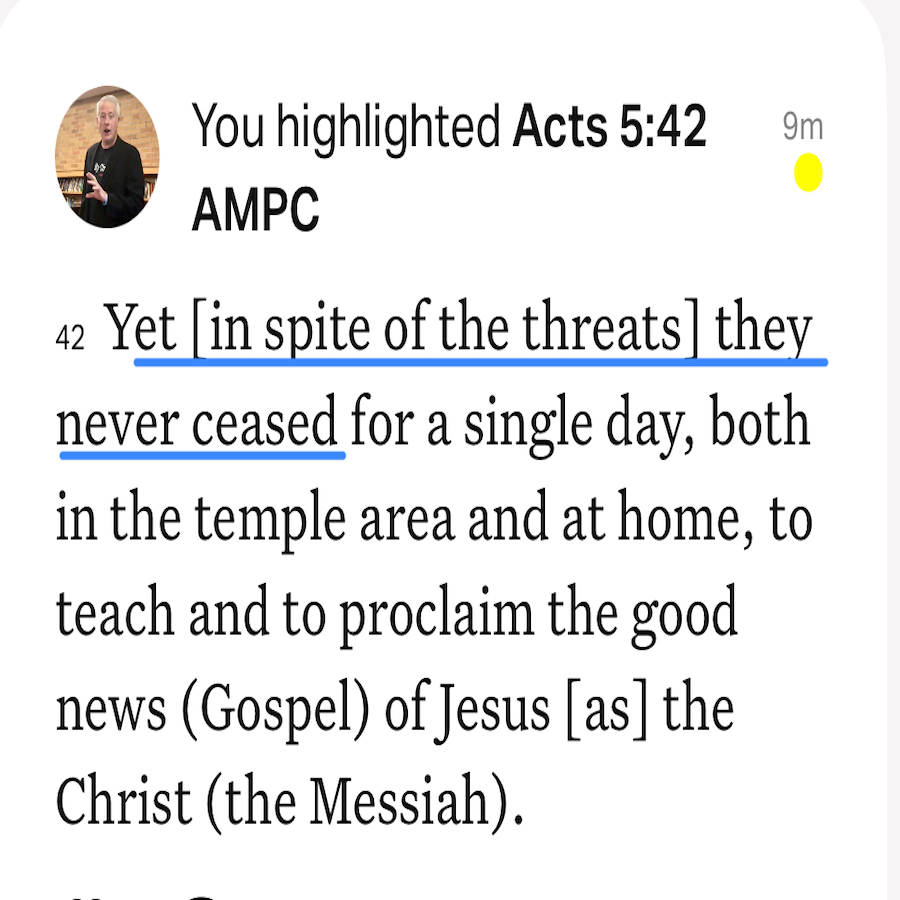
Yet [in spite of the threats] they never ceased for a single day, both in the temple area and at home, to teach and to proclaim the good news (Gospel) of Jesus [as] the Christ (the Messiah). (Acts 5:42 AMPC) 

On the one hand, the apostles were sent by God to proclaim the name of Jesus; on the other hand, the Sanhedrin commanded them not to proclaim the name of Jesus (vv. 20, 28). 

Not only had the Holy Spirit empowered and emboldened these men to testify, but Jesus also said (in John 14:26) that at key moments the Spirit would remind them of His words. One word Jesus had given them, which the Spirit undoubtedly brought to their remembrance, was this: “And do not be afraid of those who kill the body but cannot kill the soul; but rather be afraid of Him who can destroy both soul and body in hell (Gehenna)” (Matthew 10:28). 

God is glorified when we give greater weight and reverence to His words than we do to the words of mere humans.

Inspiration, Illumination, And Boldness

Listen to the podcast of this post by clicking on the player below, and you can also subscribe on AppleSpotify, or Audible. 

David declared that the Holy Spirit inspired the words he penned. “The Spirit of the Lord spoke in and by me, and His word was upon my tongue” (2 Samuel 23:2). 

Both Jesus and Peter affirm this in the New Testament as well when they make mention that David’s words were given to him by the Holy Spirit (Matthew 22:43; Mark 12:36; Acts 1:16, 4:25). 

It’s not just the words of David, but all Scripture is God-breathed (2 Timothy 3:16; 2 Peter 1:21)! This is why we would be wise to pray before reading our Bibles to ask the One Who inspired the Scripture to illuminate our minds to understand it and guide us into its daily application (John 14:26, 16:13). 

Jesus desired that we go even farther than this. His directive to His followers was for them to be baptized in the Holy Spirit. This initial baptism took place on the first Pentecost celebration after Jesus had ascended to Heaven. Luke records it this way—

And they were all filled (diffused throughout their souls) with the Holy Spirit and began to speak in other (different, foreign) languages (tongues), as the Spirit kept giving them clear and loud expression in each tongue in appropriate words. (Acts 2:4 AMPC) 

And in the subsequent verses Luke makes it clear that these were intelligible languages and intelligent words that served as a testimony to the worldwide visitors that were in Jerusalem—

And when this sound was heard, the multitude came together and they were astonished and bewildered, because each one heard them—the apostles—speaking in his own particular dialect. And they were beside themselves with amazement, saying, “Are not all these who are talking Galileans? Then how is it that we hear, each of us, in our own (particular) dialect to which we were born? Parthians and Medes and Elamites and inhabitants of Mesopotamia, Judea and Cappadocia, Pontus and the province of Asia, Phrygia and Pamphylia, Egypt and the parts of Libya about Cyrene, and the transient residents from Rome, both Jews and the proselytes to Judaism from other religions, Cretans and Arabians too—we all hear them speaking in our own native tongues and telling of the mighty works of God!” (vv. 6-11 AMPC) 

In his sermon that followed this event, Peter states that the baptism in the Holy Spirit—with the physical evidence of speaking in tongues—is an evidence of Christ’s resurrection. “Being therefore lifted high by and to the right hand of God, and having received from the Father the promised blessing which is the Holy Spirit, He has made this outpouring which you yourselves both see and hear” (v. 33). 

Later on, when the Christians were facing the threat of persecution from the Jewish leadership, they prayed. In their prayer, they noted again the Spirit-inspired words that David penned and the desire of Jesus for them to be His missionaries (see Acts 4:24-30). 

God answers their prayer powerfully! “And when they had prayed, the place in which they were assembled was shaken; and they were all filled with the Holy Spirit, and they continued to speak the word of God with freedom and boldness and courage” (v. 31). 

The Holy Spirit gave us the Scripture, and He illuminates the Scripture to us. 

The Holy Spirit assures us of our salvation, and He empowers us to share this Good News with others. 

The Holy Spirit gives us words to speak, and He gives us the boldness and courage to speak them. 

He speaks, He illuminates, He empowers, He emboldens! If your theology limits the work of the Holy Spirit to some obscure corner of your world, you are robbing yourself of the power to live a God-glorifying, Jesus-promoting life. 

You may be interested in some additional posts and sermons where I discuss more about the initial physical evidence of speaking in tongues as the Holy Spirit empowers Christians—

You may also be interested in an extensive series of messages I have shared called We Are: Pentecostal. 

►► Would you please prayerfully consider supporting this ministry? My Patreon supporters get behind-the-scenes access to exclusive materials. ◀︎◀︎

When The World Fears Christians

Listen to the podcast of this post by clicking on the player below, and you can also subscribe on AppleSpotify, or Audible. 

Here’s an interesting interaction between King Saul and David—

And Saul jealously eyed David from that day forward. … And Saul cast the javelin, for he thought, I will pin David to the wall. And David evaded him twice. Saul was afraid of David, because the Lord was with him but had departed from Saul. (1 Samuel 18:9, 11-12 AMPC)

This exchange in this well-known story got me wondering. I was thinking how Saul had the position of authority over David and he had a javelin in his hand, but the Bible still says that Saul “was afraid of David.” Why would that be? I think even the most atheistic of people intuitively know there is something other-worldly about those in whom the Spirit of God abides, which makes worldly people lash out at them in fear. 

But those who fear God—as David did—don’t fear mortals. Jesus said, “Don’t be afraid of those who want to kill your body; they cannot touch your soul. Fear only God, Who can destroy both soul and body in hell” (Matthew 10:28 NLT). This reverent fearlessness is what galls those who fear the unknown, so they try to silence confident God-followers. 

In these attacks, Jesus tells us not to respond naturally, but supernaturally. “But to you who are willing to listen, I say, love your enemies! Do good to those who hate you. Bless those who curse you. Pray for those who hurt you” (Luke 6:27-28 NLT). 

Peter picked up those words from Jesus and instructed Christians: “Be careful to live properly among your unbelieving neighbors. Then even if they accuse you of doing wrong, they will see your honorable behavior, and they will give honor to God when He judges the world. … For God called you to do good, even if it means suffering, just as Christ suffered for you. He is your example, and you must follow in His steps.” (1 Peter 2:12, 21 NLT). 

Although Saul feared the presence of God in David, he also had to acknowledge the success that came to David because of God’s abiding presence in him, and also, by extension, the success that came to Saul’s kingdom. On the one hand, Saul wanted David dead; on the other hand, he wanted David close by—

So Saul removed David from him and made him his commander over a thousand; and [David] went out and came in before the people. David acted wisely in all his ways and succeeded, and the Lord was with him. When Saul saw how capable and successful David was, he stood in awe of him. (1 Samuel 18:13-15 AMPC) 

When Christians are supernaturally empowered by God, they never have to respond in natural fight-or-flight from those who lash out at them. Let your faithfulness to God be your testimony that points others to Him. 

►► Would you please prayerfully consider supporting this ministry? My Patreon supporters get behind-the-scenes access to exclusive materials. ◀︎◀︎

Jesus said, “If the world hates you, know that it hated Me before it hated you. If you belonged to the world, the world would treat you with affection and would love you as its own. But because you are not of the world [no longer one with it], but I have chosen (selected) you out of the world, the world hates (detests) you.” (John 15:18-19)

When Grief Becomes A Testimony

Listen to the podcast of this post by clicking on the player below, and you can also subscribe on AppleSpotify, or Audible. 

None of us are strangers to grief—we’ve all experienced this dark place. 

The dictionary defines grief three ways: (1) keen mental suffering or distress over affliction or loss; (2) sharp sorrow; (3) painful regret. We sometimes define it with terms like at the end of my rope, down for the count, nothing but gray skies all around, or unable to see any light at the end of the long tunnel. 

One psychologist recently asked, “Can you die of a broken heart?” And she meant it literally. She wondered if a person’s grief—what we sometimes call an emotionally broken heart—could lead to a physically broken heart. The answer was, quite simply, yes. Those who cannot get relief from their grief are more susceptible to heart disease, autoimmune disorders, and breakdowns in their immune system. 

We need some good news to pull us out of our grief. The good news is that God specializes not just in removing grief, but in turning grief into joy. In the hymn O Holy Night, one of the lines says, “In all our trials, born to be our Friend. He knows our need, to our weakness is no stranger.” Isaiah calls Jesus, “A Man of sorrows and acquainted with grief” (Isaiah 53:3). 

(Read all of the Scriptures in this post by clicking here.)

Grief tends to wash over us in waves. When the waves hit, they often cause us to forget what God has done for us in the past. The apostle Paul said we should learn lessons from the history of the Israelites in the Old Testament. Let me zoom in on one particular story. Notice the waves of grief that follow one after another. 

Israel was complacent about their sin (Amos 6:1, 4-7) and eventually was taken into captivity in Assyria. Soon after that, the Assyrians then defeated by the Babylonians. Meanwhile, instead of learning the lessons from Israel’s captivity, Judah had more evil kings than God-fearing kings and they were eventually defeated by the Babylonians (Psalm 137:1-4). Babylon was then defeated by the Medes and Persians. 

Somewhere in this time of exile, a young Israelite girl named Hadassah becomes orphaned. She is adopted by Mordecai, who changes her name into the Persian name Esther. Queen Vashti is divorced and banished by King Xerxes, and as a result Esther is chosen from all of the eligible bachelorettes in Persia to become queen in Vashti’s place. 

(Check out two of my posts related to this story in the Book of Esther: 4 Big Lessons from Esther and All of HIStory is His Story.)

Mordecai is an attendant at the gate to the castle, giving him a good vantage point to stay in touch with Esther. It also puts him in a place to overhear an assassination plot against King Xerxes, which Mordecai relayed to Esther to tell the king. Sadly, Mordecai’s good deed, which saved King Xerxes’ life, is overlooked. Instead, Mordecai’s faith is attacked by Haman, the prime minister, and all of the Jews in Persia are targeted by Haman for destruction. Once again, Mordecai gets word to Esther to have her appeal to the king. Esther is put in a no-win situation here: to approach the king without an invitation could be fatal, but to do nothing would mean the death of all of the Jews. 

How did all of this come to be? 

Let me take you back to Deuteronomy 8:3. God allowed His people to be humbled and hungry so that they would learn that He is their only source. In the following verses we are told twice to “beware”: beware of forgetting that God is our Provider, and beware of thinking we are our own provider. If we do either of these, God will discipline us (Deuteronomy 8:5). 

God isn’t mentioned at all in the Book of Esther, but He is so obviously at work. God said, “My purpose will stand, and I will do all that I please” (Isaiah 46:10). Before the Israelites went into captivity, God promised that His people would not be annihilated there but would return to Jerusalem (Jeremiah 31:10-17). 

Esther did interceded before King Xerxes. Because of this, Haman was hanged, Mordecai was exalted to Haman’s place, and the Jews were saved (Esther 7:1-6; 8:1-2, 15-17; 9:20-22; 10:3). 

God turned overwhelming grief into unspeakable joy!  

Dick Brogden wrote, “Are you overwhelmed, out of strength, nowhere to go, out of resources, at a most critical time in your family, ministry, job, or life? Great! God allowed it so that all the earth may know that He is God alone. Don’t waste the crisis. It’s a great opportunity for missions, a great opportunity for God’s glory to be known in all the earth.”  

Let your grief be a time you press into God’s presence. Like Esther taking her grief and her petition into the king’s presence, take your grief into the presence of King of kings. 

Esther was unsure if Xerxes would extend favor to her, but God is already extending His favor to you even before you approach Him. He wants to turn your grief into joy. 

God doesn’t want to simply remove your grief, but He wants you to be testimony for Him because of the way He moves on your behalf. 

Follow along with all of the messages in our series Grief Into Joy by clicking here. 

►► Would you please prayerfully consider supporting this ministry? My Patreon supporters get behind-the-scenes access to exclusive materials. ◀︎◀︎
Keep Your Lamp Burning

     In the Tent of Meeting [of God with His people], outside the veil which sets apart the Testimony, Aaron and his sons shall keep it burning from evening to morning before the Lord…. (Exodus 27:21) 

     Then the kingdom of heaven shall be likened to ten virgins who took their lamps and went to meet the bridegroom. Five of them were foolish (thoughtless, without forethought) and five were wise (sensible, intelligent, and prudent). … Watch therefore [give strict attention and be cautious and active], for you know neither the day nor the hour when the Son of Man will come. (Matthew 25:1-2, 13) 

Just as the lamps in the Tabernacle had to be continually supplied with oil so they never went out, we have to keep our lamps burning. We have the full supply of the Holy Spirit, but we have to make sure we don’t quench the Spirit. That means listening to His voice and responding in quick obedience. 

If we want to be shining brightly when Jesus returns, we must “give strict attention and be cautious and active” every single day. 

God-Sent Enemies

Listen to the podcast of this post by clicking on the player below, and you can also subscribe on AppleSpotify, or Audible.

It could be that the enemies that are dogging your footsteps—harassing you and closing in on you—are doing so because God incited them to do this. 

Why? 

So that you will grow stronger in your dependence on His keeping power. God says He will gain the honor and glory when He does what no earthly power can do. 

Check out this part of the story about the Egyptians pursuing the Israelites—

     “For Pharaoh will say of the Israelites, ‘They are entangled in the land; the wilderness has shut them in.’ I will harden (make stubborn, strong) Pharaoh’s heart, that he will pursue them, and I will gain honor and glory over Pharaoh and all his host, and the Egyptians shall know that I am the Lord.” And they did so. … The Lord made hard and strong the heart of Pharaoh king of Egypt, and he pursued the Israelites, for they left proudly and defiantly. … Moses told the people, “Fear not; stand still (firm, confident, undismayed) and see the salvation of the Lord which He will work for you today. For the Egyptians you have seen today you shall never see again. The Lord will fight for you, and you shall hold your peace and remain at rest.” … Thus the Lord saved Israel that day from the hand of the Egyptians, and Israel saw the Egyptians dead upon the seashore. And Israel saw that great work which the Lord did against the Egyptians, and the people reverently feared the Lord and trusted in (relied on, remained steadfast to) the Lord and to His servant Moses. (Exodus 14:3-4, 8, 13-14, 30-31 AMPC) 

God allowed the enemies to pursue the Israelites. Actually, God Himself stirred up these enemies to go after His people. 

So let me ask again: Why would God do this?

Two things happened as the Israelites remained at rest: 

  1. The Egyptians were defeated, which caused God’s name to be revered 
  2. The Israelites were delivered, which caused them to place their trust more firmly in God. 

Instead of complaining about your foes—or even trying to defend yourself or fight back against them—keep your eyes on your Savior. He will be glorified as He cares for you as only He can! And when God does unleash His power on your behalf, you will have a testimony that will reverberate through the ages—

     Then Moses and the Israelites sang this song to the Lord, saying, “I will sing to the Lord, for He has triumphed gloriously; the horse and his rider or its chariot has He thrown into the sea. The Lord is my Strength and my Song, and He has become my Salvation; this is my God, and I will praise Him, my father’s God, and I will exalt Him. … Who is like You, O Lord, among the gods? Who is like You, glorious in holiness, awesome in splendor, doing wonders?” (Exodus 15:1-2, 11)

God will be glorified in your difficult situation. Stand still and watch your awesome God work in awesome ways!

I wrote about this story from a different angle in my post Between a Rock and a Hard Place. And check out my video clip Different Thinking in Difficult Places. 

►► Would you please prayerfully consider supporting this ministry? My Patreon supporters get behind-the-scenes access to exclusive materials. ◀︎◀︎