I like the bridge in the song I Keep Falling In Love With Him—
When I first fell in love with Jesus, I gave Him all my heart And I thought I couldn’t love him more than I did right at the start. But now I look back over the mountains, and the valleys where I’ve been And It makes me know I love Him so much more than I did then
Out of the depths—Think how far we’ve come on this climb. In the first Song of Ascent, we were experiencing the woes of being in the valley (Psalm 120:5-7). But now in this song, the feelings of being in the depths are not from someone else’s sinful activity.
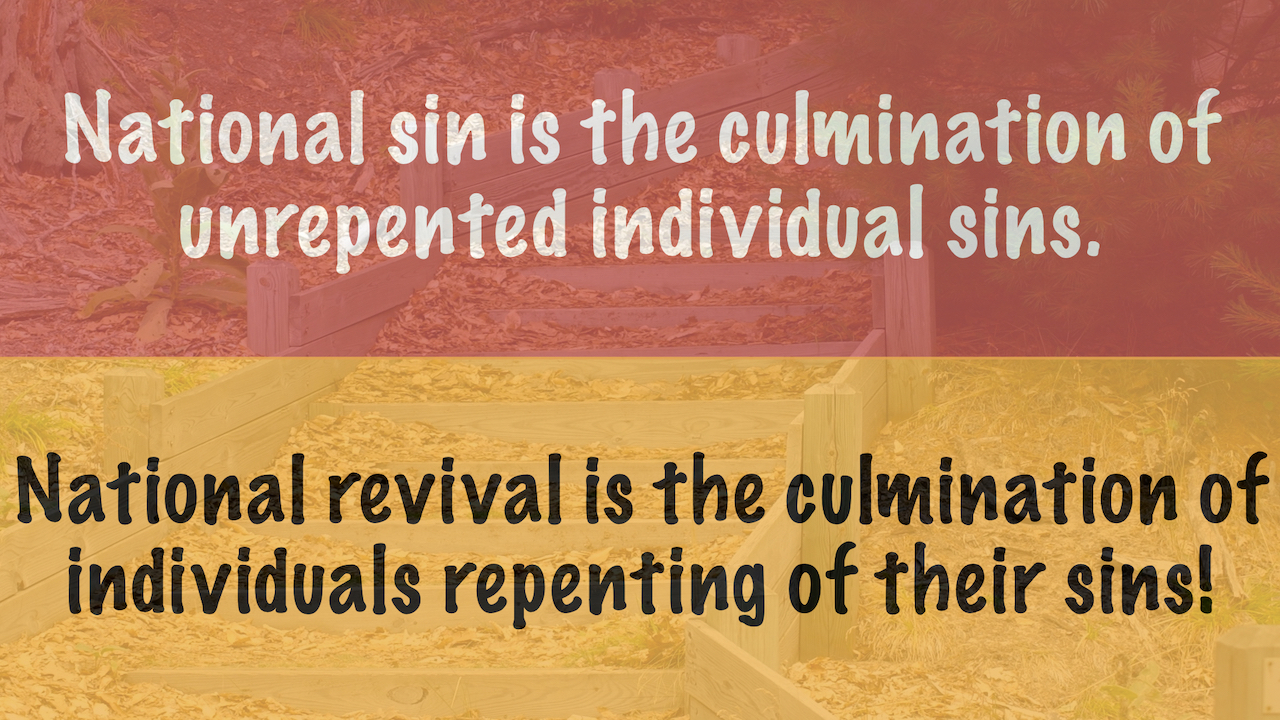
The psalmist is pointing out that national sin is the culmination of unrepented individual sins. God addressed this in Leviticus 20:22—Keep all My decrees and laws and follow them, so that the land where I am bringing you to live may not vomit you out.
Even in these depths, the psalmist is confident that God will hear—let Your ears be attentive (v. 2). Nehemiah was confident too. Look how he joins his personal sin to the national sin after Israel had be vomited out of the land (Nehemiah 1:1-7).
Our confidence comes from the rock-solid assurance that God completely forgives our sins and then forgets all that He forgives (vv. 2-3; Psalm 103:10-12).
The middle verses (vv. 5-6) have the key words wait, watch, and hope. This middle part comes down to: (1) What I’m going to pay attention to, and (2) What God pays attention to.
God is attentive to our cries for mercy, and He is watchful for our care, not for our punishment!
We are called to wait and watch in hope because God has proven that He is all in for us. Look at this completeness:
full forgiveness (v. 3)
unfailing love (v. 7a)
full redemption (v. 7b)
all their sins (v. 8)
Notice in v. 7 the phrase “all THEIR sins” is now corporate (not singular, personal as in the opening verses).
We’ve gone FROMmy voice, my cryTOyour hope, O Israel and redemption of their sins.
If national sin is the culmination of unrepented individual sins, then national revival is the culmination of individuals repenting of their sins!
Listen to the podcast of this post by clicking on the player below, and you can also subscribe on Apple, Spotify, or Audible.
Have you ever said to yourself…
…I should have known better?
…why I am going through this again?
…I thought I was over this hurdle?
…you would think I would have matured enough by now to not have to deal with this?
Maybe the author of Psalm 129 felt this way: “Here I am on the 10th step and I’m still having to deal with this! When will I finally arrive at the top and be done with these issues?” (compare Psalm 129:1-2 with 124:1-5).
I think those statements—“I should have known better” or “I thought I was over this”—pre-suppose that we will reach a point in our life where we “arrive.” If nothing else, this psalm is a reminder that we are still on the journey, that we are still a work-in-progress, that the saint-ification process is still ongoing. It’s clear from Scripture that we never “arrive” until we arrive in Heaven and hear our Master say, “Well done, good and faithful servant.”
While we are ascending up toward our heavenly home, these great oppressions and plowings remind us that there is still work to be done in us and through us to bring glory to God (Romans 5:3-4; James 1:2-4, 12).
Of his Soviet prison, Alexander Solzhenitsyn said, “I bless you, prison—I bless you for being in my life—for there lying on rotting prison straw, I learned the object of life is not prospering as I had grown up believing, but the maturing of the soul.”
The reality is God is using all of those things for my good and for His glory (Romans 8:28).
What happens as I am oppressed and plowed?
(1) I am refined—Psalm 66:8-12, 16-20. God is removing the impurities from my life.
(2) My prayers are matured. Psalm 129:5-8 is an imprecatory prayer, a prayer that says, “Get ‘em, God!” These have their place, but for us they are to be our emergency release valve (which I discuss in more depth in my book When Sheep Bite). But Jesus calls for our prayers to mature from imprecatory to intercessory (Matthew 5:43-45). In my book I write, “This is the highest level of Christian maturity: To pray like Jesus did for those who insulted Him, slandered Him, and crucified Him, ‘Father, forgive them for they don’t understand what they are doing’ (Luke 23:34)”
(3) I develop more intimate God-dependence—2 Corinthians 1:8-10.
(4) I am better equipped to help others—2 Corinthians 1:3-6.
(5) Others feel more inclined to pray for me—2 Corinthians 1:7, 11.
“God uses broken things. It takes broken soil to produce a crop, broken clouds to give rain, broken grain to give bread, broken bread to give strength.” —Vance Havner
Oppressed? Yes! Defeated? No!
Plowed? Yes! Enslaved by the plow’s cords? No!
God uses this to bring us closer and closer to Him until He can eventually say to us face-to-face, “Well done, good and faithful servant!” That’s when we truly arrive! Until then, we keep on ascending.
Listen to the podcast of this post by clicking on the player below, and you can also subscribe on Apple, Spotify, or Audible.
Let’s review the historical background for the Psalms of Ascent. The Jewish people made four pilgrimages to Jerusalem each year, which sit about 2500 fee above sea level, so this was a physical climb. But this also has a spiritual lesson for us today: We are to continue progressing in our walk with God—upward and onward!
The songs of ascent that these pilgrims sang give us life-changing lessons that we can still apply today.
I’m sure there were some pilgrims who thought, “We have to go to Jerusalem.” Just as there are some people today who may something like, “I have to tithe.” But when you have experienced the blessing that comes from obedience, your “have to” turns to “get to” really quickly!
There is a longing in Psalm 128 for God’s blessing. In fact, we see it in nearly every verse: blessed (v. 1), blessing and prosperity (v. 2), blessed (v. 4), bless and prosperity (v. 5), and peace (v. 6).
We have to remember that our obedience doesn’t earn God’s blessing, but rather our obedience keeps us in the place where we can receive God’s ever-flowing blessings. When I have experienced the blessing that followed even my “have to” attitude, I now joyfully “get to” obey because I know that keeps me in a blessed place.
But even knowing that these blessings are flowing for us, sometimes we still get weary. Sometimes it seems as if we are being faithful but we aren’t seeing the results that perhaps we saw before.
Think about these pilgrims ascending 2500 feet year after year after year. It was challenging enough during the golden days of King David and King Solomon, but can you imagine the feelings of futility during the dark days? Perhaps during the exile when the temple was in ruins, or after the exile when the temple didn’t look as it did before and there were overlords ruling Israel? And then it was unquestionably true that the older a pilgrim got, the harder the climb became for them.
But the struggle keeps us reliant on God. Like Solomon said, “The way of life winds upward for the wise, that he may turn away from hell below” (Proverbs 15:24). The longer I walk, the more I get to rely on God’s help, and the sweeter He becomes to me!
I love the line in the hymn Great is Thy Faithfulness, “Strength for today and bright hope for tomorrow—blessings all mine with ten thousand beside.” Because of God’s blessings that I’ve already experienced, I can trust Him for more, even in the struggle of the climb.
Look at some of these promises that come out in other biblical translations.
Blessedare those who fear God (NIV) = “How joyful are those who fear the Lord” (NLT)
Blessing and prosperity will be yours (NIV) = “You will enjoy the fruit of your labor” (NLT) and “You will eat what you worked so hard to grow” (NET)
The middle of this psalm is in verses 3-4. Remember above when I said nearly every verse contains a word of blessing? I didn’t list verse 3, but there is language in this verse that makes it pregnant with blessing—Your wife will be like a fruitful vine within your house; your sons will be like olive shoots around your table.
You may ask, “How is this a blessing?”
The phrase “under their own vine and under their own fig tree” appears throughout the Old Testament. It described a blessed, prosperous, happy, and peaceful home. It was a home at peace within because there was also peace without.
This described the golden era of King Solomon—During Solomon’s lifetime Judah and Israel, from Dan to Beersheba, lived in safety, everyone under their own vine and under their own fig tree (1 Kings 4:25).
After the northern kingdom of Israel fell and the southern kingdom of Judah was surrounded by the Assyrian forces of King Sennacherib, the king’s field commander tried to entice them the people with similar words—
Do not listen to Hezekiah. This is what the king of Assyria says: “Make peace with me and come out to me. Then each of you will eat fruit from your own vine and fig tree and drink water from your own cistern until I come and take you to a land like your own—a land of grain and new wine, a land of bread and vineyards, a land of olive trees and honey. Choose life and not death! Do not listen to Hezekiah, for he is misleading you when he says, ‘The LORD will deliver us.’” (2 Kings 18:31-32)
Notice that he said the land would be “a land like your own.” He was trying to get them to compromise, to no longer listen to God’s voice, to no longer climb up into God’s presence. Much like satan tempted Adam and Eve to eat the forbidden fruit with the promise, “You will be like God.”
But these blessings in Psalm 128 don’t come from fearful “have to” obedience to man, but from reverencing God above all else. So the longing of verses 1-4 become the prayer of verses 5-6 (notice the word may used three times in these verse).
The focus of our longing—where we need to keep our eyes—is on God’s heavenly throne: Zion, Jerusalem, Israel (vv. 5-6; Micah 4:1-5).
In an earlier story, Caleb may have gotten tired while he waited for God to fulfill His promise to him, but he always trusted God as he walked on (see Joshua 14:9-12).
What promises of God are you still praying for?
What are you longing to see accomplished?
What has God already done that you can look back on?
The Hill, though high, I covet to ascend, The Difficulty will not me offend; For I perceive the Way to life lies here. Come, pluck up Heart, let’s neither faint nor fear;
Better, though difficult, the Right Way to go,
Than wrong, though easy, where the End is Woe. (John Bunyan)
Don’t give in.
Don’t give up.
Keep climbing.
Like Caleb say, “It may have been 85 years of walking and climbing, but I’ll keep climbing. GOD, GIVE ME THIS HILL!”
If you would like to check out the other songs of ascent that we’ve already studied, please click here.
Every year, Jews from around the world made four pilgrimages up to Jerusalem for various feasts and sacrifices. These journeys reminded them of God’s goodness as they went to the Temple to worship, and they helped refocus on God’s ways as they returned to their regular routines.
Jerusalem is over 2500 feet above sea level, so the pilgrimage there was a physical workout as well as a spiritual workout. These workouts were beneficial for God’s people, preparing them to minister in their cities in the following months.
The Book of Psalms contains 15 songs that these pilgrims would sing to and with each other as they traveled up to Jerusalem. These Psalms of Ascent are still instructive for Christians today.
As we resume this series this summer, I hope you can join me for this look at the life-changing truths these pilgrimage songs can still teach today to all of God’s people. We would love to have you join us in person, but if you are unable to do so you can watch the videos of these messages on my YouTube channel.
You can check out the messages we shared last summer from Psalms 120-127 here. And the current series of messages include:
Listen to the podcast of this post by clicking on the player below, and you can also subscribe on Apple, Spotify, or Audible.
On Mother’s Day, I mentioned that Proverbs 31 might be an intimidating description for Moms, but it doesn’t need to be that way. This chapter lists what is possible when a woman is fully committed to God, her husband, and her children.
Her faithfulness is her superpower which unleashes so many good things for those around her. Or as we said it: Her nobility helps her be a king maker.
I concluded by saying that men have an important role to play in order to honor the king-making power which the godly women in his life have unlocked. This is a man’s superpower! Together, God-fearing men and women can create a legacy of king makers. But separated or self-focused men and women can create a legacy of king breakers.
The Hebrew word for noble is used five times in Proverbs: three times for the godly superwoman (Proverbs 12:4, 31:10, 31:29), and twice for the godly superman (13:22, 31:3).
Remember that this word is also translated in different versions of the Bible as excellent, virtuous, and strong in character.
In Proverbs 31:3 the word vigor for men is attached to that same Hebrew word. In this context, the word can be defined as strength, efficiency, ability, or wealth.
On Mother’s Day, we said that Eve is the “help meet” (as the old King James Version says), which means that she is the key that unlocks Adam’s potential. The teaching throughout Proverbs says that men can squander this unlocked potential by…
…forgetting God’s laws—Proverbs 31:4-5
…not stewarding the unlocked leadership opportunities in our marriage, parenting, work, or community involvement (Proverbs 5:15-20; 2:1-5, 12-17; 22:29; 31:23).
In essence, we cancel the definition of vigor that we saw above, changing strength to weakness, efficiency to inefficiency, ability to inability, and wealth to poverty.
On Mother’s Day we looked at virtuous Ruth who used her godly superpower to unlock the potential for Boaz, the man who would become her husband. Let’s look at his example:
he was called a man of standing because his righteousness was well known in Bethlehem—Ruth 2:1
he was obedient to the smallest details of the law—Ruth 2:3; Leviticus 19:9-10
he honored his father by following his example—Matthew 1:5; Joshua 2:1-24, 6:23
he was an honored employer—Ruth 2:4
he was also (just like Ruth) called a man of noble character—Ruth 3:7-11, 14
A Dad’s superpower looks very similar to a Mom’s superpower. The godly woman unlocks the potential, and when the godly man carefully stewards that potential, he is also using his godly superpower (Luke 12:42-43, 48)!
Guys, when we use our God-given superpower, we honor Him and the godly women in our lives who have made this possible for us. We do this by…
…faithfully loving God with all our heart, soul, mind, and strength—Proverbs 31:4-5; Mark 12:28-31
…caring for our bride like Jesus cares for His bride—Ephesians 5:25
…honoring the legacy of our parents—Ephesians 6:2-3
…passing on a godly heritage to our children—Ruth 4:21-22
This is God’s design. And it is God’s delight when we live this way. So we must make the choice to either carry on the godly heritage that was handed down to us, or reverse the ungodly heritage that we may have inherited.
Godly men and women unlock and perpetuate their God-given superpower by giving their heart, soul, mind, and strength to God. And then God will continue to empower us as the spouses, parents, and leaders in our community that He desires for us to be!
Listen to the podcast of this post by clicking on the player below, and you can also subscribe on Apple, Spotify, or Audible.
I’ve noticed how quick some people are to give up when things don’t get them the results they thought they should get, or the results don’t come as soon as they expected.
Anytime we try something new, there is always the potential for failure. Even later on, those who appear to be an expert at something rarely do it perfectly. But in either case, there are three things we need to do if we don’t get the results we expected: (1) reflect, (2) evaluate possible improvements, (3) re-engage.
Even before Jesus commissioned us to take His message of Good News to every street everywhere, He told us not to expect perfect results. In one of His best-known parables, Jesus talked about the farmer sowing seed (see Luke 8:5-8).
Jesus didn’t say, “All of your efforts at sharing the Gospel will be successful.” In fact, He said some efforts would totally fail (falling on the hard path), and some would have only temporary success (falling on the weedy and stony ground). But we keep on sowing the seed because some will fall on good soil and yield a harvest a hundred times more than was sown!
So, as John Wesley said, “Do all the good you can, by all the means you can, in all the ways you can, in all the places you can, at all the times you can, to all the people you can, as long as ever you can.”
The baptism of the Holy Spirit brings dynamic, life-changing power (Acts 1:8). The life that is changed first is our own. Everything about us begins to change.
When people heard Jesus speak, they said, “How did this Man get such learning without having been taught?” (John 7:15). The same Holy Spirit who empowered Jesus to speak is the same Holy Spirit who will empower our words.
When our words are Spirit-empowered words, people can feel it. When our words are matched by our lifestyle, people can’t ignore it (John 7:46; Acts 2:37, 4:13, 6:10)!
Just like salt that influences effortlessly, silently, and irreversibly, we never know what part the salt of our lives is playing in someone else’s life, even if it appears that nothing substantial is happening at all. But God said His word always accomplishes its purpose (Isaiah 55:10-11), which is why we keep on living and speaking as Spirit-empowered witnesses.
And we live expecting that something is happening—Let us not become weary in doing good, for at the proper time we will reap a harvest if we do not give up (Galatians 6:9).
How do we take this message of Jesus to every street?
Stay yielded to the influence of the Holy Spirit
Regularly and consistently read and apply God’s Word to your own life
Keep sowing in expectation
If your efforts appear to fail: reflect, evaluate, re-engage in expectation
We can be salt without being salty; we can be light without being annoying.
We have been empowered to take the Good News to every street, so let us not become weary in doing this.
We don’t worship because we have a comfortable setting. We worship God because He is worthy to be worshiped! Our focus is not on these temporal things, but on His eternal, majestic glory!
Listen to the podcast of this post by clicking on the player below, and you can also subscribe on Apple, Spotify, or Audible.
Jesus sent us and the Holy Spirit empowers us to take the Good News to all nations—all the streets (Luke 24:47-49; Acts 1:8)—even the streets of Samaria where we will have more differences than similarities.
There is one street that has infiltrated and affected every other street more profoundly than any other: Hollywood Boulevard. The constant bombardment of messages through movies, television programs, music, literature, and the arts is almost immeasurable.
I think Christians rarely stop to ponder how much of the culture on Main Street is influenced by the content from Hollywood Boulevard. Probably because so few Christians are involved in the artistic or creative communities.
Here’s what we need to remember: All of this creativity is God-given. The opening words in the Bible say, “In the beginning God created…” (Genesis 1:1).
We specific examples of God-given creative skills in:
Bezalel—Exodus 31:1-5
Oholiab—Exodus 31:6, 35:34
craftsmen and craftswomen—Exodus 31:6; 35:10, 22, 25
In more modern times, we see notable creative people giving credit to God for their abilities.
William Shakespeare’s use of biblical themes—and even exact phrases—throughout his work is easy to spot. In the opening line of his last will and testament, he wrote, “I commend my soul into the hands of God my Creator, believing through the merits of Jesus Christ, my Savior, to be made a partaker of life everlasting.”
Johan Sebastian Bach, considered by many to be the greatest composer to ever live, placed “S.D.G.” on every one of his musical compositions, which stands for Sola Deo Gloria: only for the glory of God.
The apostle James tells us that every good and beautiful gift has come to us from God our Creator (James 1:17). And then this is my paraphrase of a similar thought the apostle Peter—
Each of you should use whatever gift you have received to serve others, as faithful stewards of God’s grace in its various forms. If anyone speaks [writes, paints, composes, sculpts], they should do so as one who speaks [writes, paints, composes, sculpts] the very words of God. (1 Peter 4:10-11)
So, here are four thoughts about how we can take the Good News of Jesus to Hollywood Boulevard.
Create a beautiful culture in your home, your Main Street, your workplace, your school. Ask the Holy Spirit to help you answer the question, “What can I do so that the love and beauty of Jesus will be felt here?”
Use your creative skills—write poems, compose music, paint a picture, sew clothing, bring innovation to your job.
Support beautiful authors, musicians, moviemakers, painters, etc. Hollywood produces what they think will make money, so if you are supporting creators of beautiful things, they will produce more of those things.
Leverage Hollywood’s culture to talk to others about heavenly culture. Point out biblical themes, challenge the rationale behind unbiblical lyrics, etc.
“Christians need to ask themselves a few key questions to help us respond to the society around us. First, what is good in our culture that we can promote, protect, and celebrate? Second, what’s missing in our culture that we can creatively contribute? Third, what’s evil in our culture that we can stop? And fourth, what’s broken in our culture that we can restore?” —John Stonestreet
Don’t complain—create something better.
Don’t compromise—promote what is beautiful and edifying.
The Holy Spirit can empower us to take the Good News of Jesus even to Hollywood Boulevard!
If you’ve missed any of the other messages in our series Takin’ Him to the Streets, you can find them all here.
Listen to the podcast of this post by clicking on the player below, and you can also subscribe on Apple, Spotify, or Audible.
Jesus sent us and the Holy Spirit empowers us to take the Good News to all nations—all the streets (Luke 24:47-49; Acts 1:8). As we move away from Jerusalem and into Judea, we should expect to see more differences with our audience. And then as we move into Samaria, there will probably be more differences than similarities. Regardless of how little we may have in common with those on other streets, the Holy Spirit still empowers us to witness there.
When we don’t live on someone else’s street, we tend to make some pretty big assumptions about them. For example, until I married a school teacher, I thought, “How nice it must be to be done with work by 3:00 every afternoon and have three months off in the summer!”
Mistakenly, we think we can so easily fix the problems people on other streets have—we think we can show them how simple it is to correct anything out of balance on their street. These are natural thought patterns when so little of our circles overlap.
If you live on Main Street, two streets which are quite different from you are Easy Street and Skid Row. When it comes to finances, there tends to be extremes in our thoughts about the Samaritans that live on those streets—
Those on Easy Street only cares about themselves
Those on Skid Row should work harder
Those on Easy Street have too much—it’s not fair!
Those on Skip Row don’t have enough—it’s not fair!
But here’s the thing: It’s really not about the money but it’s about our attitude about the money.
In Luke 21:1-6, Jesus saw both rich people from Easy Street placing their tithe in the temple treasury, and a poor widow from Skid Row doing the same. Jesus said this widow put in more than anyone else. He was talking in terms of quality, not quantity.
While they were still in the temple, the disciples pointed out how beautifully embellished the temple was. These decorations came from the money those on Easy Street had contributed. Jesus told them not to focus on the temporal temple but on the eternal Kingdom of God.
As I said, Jesus doesn’t have a problem with money, but He does warn us about our ungodly attitude toward money (Luke 8:1-3; Matthew 27:57; Acts 4:32-5:4; Exodus 20:17; Luke 12:13-22).
Even though Easy Street and Skid Row seem to be at opposite ends of the spectrum, I think we are effective witnesses for Jesus on these streets in exactly the same way.
(1) Guard your attitude about money. Remember that Gad often provides for us by giving us a skill, and then making a job available that can use our skill. So let’s be thankful for our God-given jobs. Then we guard our attitude about money by tithing regularly, and making sure that when we bless others financially, we do it without expecting any fanfare (Colossians 3:23; Malachi 3:10; Matthew 6:2-3).
(2) Let God be unique as unique with these folks on Easy Street and Skid Row as He is with you on Main Street. Don’t try to be someone else, and don’t expect others to be you—simply obey what God has spoken to your heart, just as you allow others to obey what God has spoken to their hearts.
(3) Don’t tell, but show how you use the resources God has given to you. It’s not our place to “preach” to others about how they should or shouldn’t be handling their finances, but simply live out the biblical principles outlined above, and let your life show your godly attitude.
(4) Always turn the focus to the eternal. Just as Jesus did with His disciples in the temple, He always reminded people that this world with its perks or tragedies is only temporary. What ultimately matters is where we will spend eternity (Luke 13:1-5).
Money is always a touchy subject with people, so let’s make sure we have our own attitude aligned with Scripture before we try to bring the subject up with others.
If you’ve missed any of the other messages in our Takin’ Him To The Street series, you can find them all here.
Listen to the podcast of this post by clicking on the player below, and you can also subscribe on Apple, Spotify, or Audible.
Jesus sent us to all nations—to all the streets in all the world (Luke 24:47-49; Acts 1:8). We are to begin in Jerusalem and move outward. As we have seen, Jerusalem is like out Main Street, where there are more similarities than differences between us and the people to whom we are taking the Good News of Jesus. Judea is our Lombard Street & Rodeo Drive, where we are starting to see more differences.
Then we move to Samaria where there are now way more differences than similarities. But still, let’s never forget that Jesus sent us and the Holy Spirit empowers us to be effective in our witness on every street—even those with whom we have very little in common.
Jesus was baptizing in the Judean countryside (John 3:22) and now He is heading back to Galilee. “The shortest route from Judea in the south to Galilee in the north went through Samaria. The journey took three days if one wanted to travel the direct route. The Jews often avoided Samaria by going around it along the Jordan River. The hatred between the Jews and Samaritans went back to the days of the exile” (Dr. Henry Halley).
There were wide differences between Jesus and this woman of Sychar:
Cultural differences—The Jews considered the Samaritans to be no longer “pure” Jews, but half-breeds and traitors (vv. 5-9).
Personal differences—She was female, Jesus was male; she was a divorcée, Jesus was single (vv. 9, 16-18).
Religious differences—The Samaritans only recognized the Pentateuch; the Jews recognized the entire Old Testament Scripture. And the Samaritans saw Mt. Gerizim as the center of worship and the place the Messiah would reign; the Jews believed Jerusalem to be the center of worship (vv. 19-20).
Our first task is to find common ground with whoever we can. Jesus used the word “whoever” three times in John 3:16, 18, 36, saying that whoever believed in Him would have eternal life. We need to have this same mindset. It’s not His desire that any should perish—not even the Samaritans!—but that all should come to know Him as Savior.
In his book Winning With People, John Maxwell presents The 101% Principle: Find the 1% we can agree upon and give that 100% of your effort.
Jesus found the 1% and gave 100% to it. For He and this Samaritan woman their common connection was water and worship (John 4:9-15, 21-26). Jesus used both of those things to open a conversation about eternal matters.
Who are the Samaritans in my life? They are people…
…I have very little in common with
…I go out of my way to avoid talking to
…I think are never going to “get it”
…who make me angry, defensive, or combative
But they are also people…
…for whom Jesus died
…who are dearly loved by our Heavenly Father
…who need to hear the Gospel
…to whom I have been sent
Our prayer should be this:
Holy Spirit, help me to notice the people to whom I have been blind or whom I have been avoiding. Help me to find the 1% on which we can agree, and then empower me to give 100% of my effort to that 1%. I want my heart to beat with the heart of my Savior: Whoever believes on Him will not perish but will have eternal life.



 After making it up to the 11th step—so close to the top now—how could the psalmist be saying, “Out of the depths I cry to You, O LORD”? (Psalm 130:1)
  Notice in v. 7 the phrase “all THEIR sins” is now corporate (not singular, personal as in the opening verses).