


 “When Jesus was crucified, His followers were discouraged and depressed. They no longer had confidence that Jesus had been sent by God, because they believed anyone crucified was accursed by God. They also had been taught that God would not let His Messiah suffer death. So they disbursed. The Jesus movement was all but stopped in its tracks. Then, after a short period of time, we see them abandoning their occupations, regathering, and committing themselves to spread a very specific message—that Jesus Christ was the Messiah of God who died on the Cross, returned to life, and was seen alive by them. And they were willing to spend the rest of their lives proclaiming this, without any payoff from a human point of view. It’s not as though there were a mansion awaiting them on the Mediterranean. They faced a life of hardship. They often went without food, slept exposed to the elements, were ridiculed, beaten, imprisoned. And finally, most of them were executed in torturous ways. For what? For good intentions? No, because they were convinced beyond a shadow of a doubt that they had seen Jesus Christ alive from the dead. What you can’t explain is how this particular group of men came up with this particular belief without having had an experience of the resurrected Christ. There’s no other adequate explanation.” —J. P. Moreland, quoted in More Than A Carpenter
The Resurrection Of Jesus Makes All The Difference
February 14, 2017 — Craig T. Owens9 More Quotes From “The Bad Habits Of Jesus”
January 23, 2017 — Craig T. Owens I know suggesting that Jesus might have some “bad habits” sounds a bit sacrilegious, but you’ve got to check out my review of Leonard Sweet’s thought-provoking book (which you can find by clicking here). I have already shared a few quotes from this book here, but there were just too many good ones for just one post!
“Jesus’ mysterious, open-ended, twisty endings [to His stories] were brilliantly conceived, and His lack of explanation was perfectly pitched. He wanted people not only to think about the story and to converse with each other about the story, but also to ask Him about the story. Ultimately, Jesus’ stories were about cultivating a relationship with Him. We call it discipleship.”
“The people Jesus was interested in the most, the ones Jesus celebrated the most, were those who asked questions like He did. … Jesus loves people who would not just listen to Him, but who would follow Him, learn from Him, and be in relationship with Him—and with God.”
“Why do we feel that to be good and faithful Christians, we must not look too happy, not enjoy ourselves too much, when throughout the Scriptures, God clearly loves a party?”
“For Christians, every day is a reminder of the Resurrection. Each and every day should be a grand celebration of God’s amazing gift of Jesus. Everything in life is filled with Resurrection moments. And every person is filled with Resurrection hope just waiting to be celebrated. The church above all should be a place of festivities and joy. People should look at the church and think, What joyful people!”
“The ‘Nice God’ of therapeutic culture leads one to expect that if I have a need, God needs to meet my need. This is Christianity as Niceianity. For Jesus, God is loving and merciful and true but not necessarily ‘nice.’ The holy God is dangerous, because the holy God is truth.”
“Traveling with Jesus is not always dignified, pretty, or easy. Jesus takes the common routes and dangerous pathways, seeks out the messy and the dirty and the difficult. But traveling with Jesus is also beautiful, for those who follow Jesus also bring God’s lost and dirty people home to God—to be renewed, to be cleansed, to be clothed, to be loved.”
“How often does our ‘religion’ get between us and God? Are we so filled up with religion and all its trappings that there isn’t room for the inpourings of God’s presence and the outpourings of God’s power?”
“Jesus is the way into a life of truth, not a way out of life’s problems, difficulties, failures, and missteps.”
“Jesus was inclusive, but while He accepted people as they were, He didn’t affirm them as they were; He transfigured them into the singular images of God they were created to be.”
More quotes from The Bad Habits Of Jesus coming soon. And you can also follow me on Twitter and Tumblr to read some great quotes each and every day.
8 Quotes From “More Than A Carpenter”
November 30, 2016 — Craig T. OwensMore Than A Carpenter by Josh & Sean McDowell is a wonderful resource to prepare you to share the uniqueness of Jesus Christ. Check out my book review by clicking here, and then enjoy these quotes that I especially found interesting.
“Why don’t the names of Buddha, Mohammed, or Confucius offend people the way the name of Jesus does? I think the reason is that these other religious leaders didn’t claim to be God.” —Josh McDowell
“It was reserved for Christianity to present to the world an ideal which through all the changes of eighteen centuries has inspired the hearts of men with an impassioned love; has shown itself capable of acting on an all ages, nations, temperaments, and conditions; has been not only the highest pattern of virtue, but the strongest incentive to its practice. … The simple record of these three short years of active fife has done more to regenerate and soften mankind than all the disquisitions of philosophers and all the expectations of moralists.” —William Lecky, one of Great Britain’s most noted historians and a fierce opponent of organized Christianity
“This testimony [that Jesus was God], if not true, must be downright blasphemy or madness. … Self-deception in a matter so momentous, and with an intellect in all respects so clear and so sound, is equally out of the question. How could He be an enthusiast or a mad man who never lost the even balance of His mind, who sailed serenely over all the troubles and persecutions, as the sun above the clouds, who always returned the wisest answer to tempting questions, who calmly and deliberately predicted His death on the Cross, His resurrection on the third day, the outpouring of the Holy Spirit, the founding of His church, the distraction of Jerusalem—predictions which have been literally fulfilled? A character so original, so complete, so uniformly consistent, so perfect, so human and set so high above all human greatness, can be neither a fraud nor a fiction. The poet, as has been well said, would in this case be greater than the hero. It would take more than a Jesus to invent a Jesus.” —Philip Schaff
“There exists no document from the ancient world witnessed by so excellent a set of textual and historical testimonies, and offering so superb an array of historical data on which an intelligent decision may be made. An honest [person] cannot dismiss a source of this kind. Skepticism regarding the historical credentials of Christianity is based on an irrational bias.” —Clark H. Pinnock
“The Gospels tell us Jesus’ family, including James, were embarrassed by what He was claiming to be. They didn’t believe in Him; they confronted Him. In ancient Judaism it was highly embarrassing for a rabbi’s family not to accept him. Therefore, the Gospel writers would have no motive for fabricating this skepticism if it weren’t true. Later the historian Josephus tells us that James, the brother of Jesus, who was the leader of the Jerusalem church, was stoned to death because of his belief in his brother. Why did James’ life change? Paul tells us: the resurrected Jesus appeared to him. There’s no other explanation.” —J. P. Moreland
“The resurrection takes the question ‘Is Christianity valid?’ out of the realm of philosophy and makes it a question of history.”
“I believe in the resurrection, partly because a series of facts are unaccountable without it.” —Michael Ramsey, former Archbishop of Canterbury
“The Old Testament contains sixty major messianic prophecies and approximately 270 ramifications that were fulfilled in one Person, Jesus Christ. … We find the chances of just forty-eight of these prophecies being fulfilled in one person to be only 1 in 10157. … All of the prophecies about the Messiah were made at least four hundred years before He was to appear. … This description of the manner of [Christ’s] death was written eight hundred years before the Romans used crucifixion as a method of execution.” —Josh McDowell
I am always sharing quotes from More Than A Carpenter and other interesting authors regularly on both Twitter and Tumblr. Please make sure you are following me there as well to see these quotes as soon as they are posted.
More Than A Carpenter (book review)
November 29, 2016 — Craig T. OwensHolidays are usually really good times for Christians to start up a conversation about their faith. Especially Christmas. C’mon, Christ’s name is the main part of CHRISTmas, right?! But I realize as well that some folks are reluctant to begin such a conversation because they think they might be at a loss as to what to say. This is where More Than A Carpenter by Josh McDowell and Sean McDowell will be an excellent ally.
Christians and atheists alike found More Than A Carpenter compelling reading when it was first published nearly 40 years ago. Now the book has been given a makeover, incorporating new discoveries that have further validated the book’s content, and adding a new chapter by Sean McDowell specifically addressing the “new atheists.”
Jesus is an historical character. He actually lived and walked and died and was resurrected in places that are verified by historical records. And yet Jesus was so much more than merely a person in history. His life impacted history in ways that are still being discovered today. His life is still changing the trajectory of people’s lives today.
Clearly Jesus was much more than merely a first century carpenter!
In easily-readable language, Josh and Sean arm you with all of the evidence you will need to have compelling conversations about Jesus.
- You will learn about the historical accuracy of the authors who recorded the details of Jesus Christ’s life.
- You will learn what science, philosophy and archeology verify about His life.
- You will get insight into the arguments that some atheists use to deny Christ’s deity, and how you can offer alternative facts to counteract those arguments.
- And you will hear about Josh’s personal life-changing encounter with this Carpenter from first-century Israel.
This is a phenomenal book for you to read as we head into this CHRISTmas season. This is also a great resource for you to put into the hands of someone who is skeptical or even antagonistic toward the claims of Christians. In short: you will be better prepared to have meaningful conversations with others after you have read More Than A Carpenter!
I am a Tyndale book reviewer.
If you would like to access a ton of great resources associated with More Than A Carpenter, I highly recommend you check out the Josh McDowell Ministry’s store by clicking here.
Thursdays With Oswald—What Prayer Does In Us
June 2, 2016 — Craig T. Owens This is a weekly series with things I’m reading and pondering from Oswald Chambers. You can read the original seed thought here, or type “Thursdays With Oswald” in the search box to read more entries.
What Prayer Does In Us
Prayer is the point where the reality of God merges with human life. Until we are born from above, prayer with us is honestly nothing more than a mere exercise; but in all our Lord’s teaching and in His own personal life, as well as in the emphasis laid on prayer by the Holy Ghost after He had gone, prayer is regarded as the work (see John 14:11-13). …
If prayer is the highest reach of communion possible between Almighty God and the Son of Man, what part ought prayer to play in our lives? …
Prayer is not meant to develop us, but to develop the life of God in us after new birth.
From The Psychology Of Redemption
In another lesson, Chambers reminds us that prayer is easy for us because it cost Jesus so much to make it possible for us.
Jesus knew the value of prayer, which is why it was an essential priority all throughout His earthly life. Now we have access to the same Almighty God through the name of Jesus. Yes, Jesus is interceding for us, but we don’t have to stop there—we should never stop there!—because Christ’s death and resurrection makes a way for us to go right into Almighty God’s presence.
Prayer is powerful! Prayer brings the life of God right down into our own souls.
So… what part ought prayer to play in your life?
12 Quotes From “The Place Of Help”
April 13, 2016 — Craig T. Owens As always, any Oswald Chambers book I read is thoroughly highlighted. There is always so much great content! On this blog, I have a weekly series called “Thursdays With Oswald” where I share quotes and thoughts from his book I’m currently reading. Be sure to check that out. Below are just a few of the quotes I noted from The Place Of Help. (By the way, you can read my review of this book by clicking here.)
“This is the age when education is placed on the very highest pinnacle. In every civilized country we are told that if we will educate the people and give them better surroundings, we shall produce better characters. Such talk and such theories stir aspirations, but they do not work out well in reality. The kingdom within must be adjusted first before education can have its true use. To educate an unregenerate man is but to increase the possibility of cultured degradation.”
“Not what the disciple says in public prayer, not what he preaches from pulpit or platform, not what he writes on paper or in letters, but what he is in his heart which God alone knows, determines God’s revelation of Himself to him. Character determines revelation (see Psalm 18:24-26).”
“Our Lord never gives private illuminations to special favorites. His way is ever twofold: the development of character, and the descent of Divine illumination through the Word of God.”
“The voice of the Lord listened to in darkness is so entrancing that the finest of earth’s voices are never afterwords mistaken for the voice of the Lord.”
“Jesus Christ distinctly stated that He came to do the will of His Father. ‘I must work the works of Him that sent Me.’ His first obedience was not to the needs of men, but to the will of God. He nowhere chose the altar of His sacrifice, God chose it for Him. He chose to make His life a willing and obedient sacrifice that His Father’s purpose might be fulfilled. … ’For we preach not ourselves, but Christ Jesus as Lord, and ourselves as your servants for Jesus’s sake,’ as Paul says in 2 Corinthians 4:5. We are the servants of men, says Paul, not primarily because their needs have arrested us, but because Jesus Christ is our Lord.”
“If you become a necessity to a soul you have got out of God’s order, your great need as a worker is to be a friend of the Bridegroom. Your goodness and purity ought never to attract attention to itself, it ought simply to be a magnet to draw others to Jesus.”
“Suppose you talk about depending on God and how wonderful it is, and then others see that in your own immediate concerns you do not depend on Him a bit, but on your own wits, it makes them say, ‘Well, after all, it’s a big pretense, there is no Almighty Christ to depend on anywhere, it is all mere sentiment.’ The impression left is that Jesus Christ is not real to you.”
“The highest Divine love is not only exhibited in the extreme amazement of the tragedy of Calvary, but in the laying down of the Divine life through the thirty years at Nazareth, through the three years of popularity, scandal, and hatred, and furthermore in the long pre-incarnate years (cf. Revelation 13:8).”
“The Cross is the supreme moment in Time and Eternity, and it is the concentrated essence of the very nature of the Divine love. … The Self-expenditure of God for His enemies in the life and death of our Lord Jesus Christ, becomes the great bridge over the gulf of sin whereby human love may cross over and be embraced by the Divine love, the love that never fails.”
“Christian experience does not mean we have thought through the way God works in human lives by His grace, or that we are able to state theologically that God gives the Holy Ghost to them that ask Him—that may be Christian thinking, but it is not Christian experience. Christian experience is living through all this by the marvelous power of the Holy Ghost. The Holy Ghost working in me does not produce wonderful experiences that make people say ‘What a wonderful life that man lives’; the Holy Ghost working in me makes me a passionate, devoted, absorbed lover of the Lord Jesus Christ.”
“It is not the baptism of the Holy Ghost that changes men, but the power of the Ascended Christ coming into men’s lives by the Holy Ghost that changes men. The baptism of the Holy Ghost is the evidence of the Ascended Christ.”
“There is only one Lover of the Lord Jesus and that is the Holy Ghost; when we receive the Holy Ghost He turns us into passionate human lovers of Jesus Christ. Then out of our lives will flow those rivers of living water that heal and bless, and we spend and suffer and endure in patience all because of One and One only.”
More quotes from this book coming soon…
Life Or Death?
April 4, 2016 — Craig T. Owens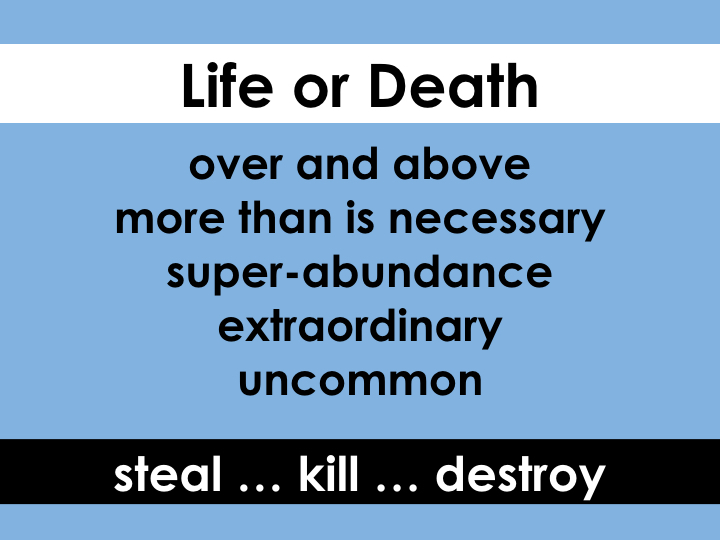 Since Jesus predicted His death on a Cross, and His resurrection from the dead three days later, and since that really happened(!), I think that it would be wise to consider the other words Jesus said!
Here’s an important one—The thief cometh not, but for to steal, and to kill, and to destroy: I am come that they might have life, and that they might have it more abundantly (John 10:10).
It’s a pretty clear distinction: One way brings death and the other way brings life. But not just any kind of life.
The Greeks had three words for “life”—
- Bios from which we get our word biology. We can see when something is alive because of its biological growth.
- Psuche from which we get our word psychology. Plants might be biologically alive, but they don’t have the psychological life of a human.
- Zoe. This is the word Jesus used in John 10:10. It’s the word that means “life force” or better stated it’s God’s life.
God is a Triune God: Father, Son, and Spirit. When God created humans, we were created in His “trinity” image—Let Us make man in Our image (Genesis 1:26). Adam was created with bios, psuche, and zoe life. God told Adam and Eve that if they sinned, they would die (Genesis 2:17). When they did eat that forbidden fruit, they remained biologically and psychologically alive, but the zoe life force was cut off.
Jesus came to restore that! He came to bring us back to the state God originally intended for us, which meant He had to go to the Cross to become our sin, so that we could be forgiven and brought back to life.
Placing your faith in Jesus Christ’s work on the Cross means a complete about-face. The devil wants to steal from you, kill you, and destroy your soul for eternity. But Jesus came that you could have zoe in a way that was above-and-beyond, super-abundant, extraordinary and uncommon!
To get this life, Jesus asks us to do something that He did—If anyone would come after Me, he must deny himself and take up his cross and follow Me (Matthew 16:24).
Jesus isn’t calling for our hands and feet to be nailed to a wooden Cross. But He is calling for our selfish thoughts to be crucified (Matthew 16:23), and for us to give no more attention to our old sinful life.
I think this passage in Romans captures that thought so well—
Could it be any clearer? Our old way of life was nailed to the Cross with Christ, a decisive end to that sin-miserable life—no longer at sin’s every beck and call! What we believe is this: If we get included in Christ’s sin-conquering death, we also get included in His life-saving resurrection. We know that when Jesus was raised from the dead it was a signal of the end of death-as-the-end. Never again will death have the last word. When Jesus died, He took sin down with Him, but alive He brings God down to us. From now on, think of it this way: Sin speaks a dead language that means nothing to you; God speaks your mother tongue, and you hang on every word. You are dead to sin and alive to God. That’s what Jesus did. That means you must not give sin a vote in the way you conduct your lives. Don’t give it the time of day. Don’t even run little errands that are connected with that old way of life. Throw yourselves wholeheartedly and full-time—remember, you’ve been raised from the dead!—into God’s way of doing things. Sin can’t tell you how to live. After all, you’re not living under that old tyranny any longer. You’re living in the freedom of God. (Romans 6:6-14)
The choice is yours: the rip-off, destruction, and death the devil offers OR the abundant, overflowing, extraordinary, more-than-is-needed, zoe life that Jesus offers.
Life or death. Your choice.
9 Quotes From “Your Joy Will Turn To Sorrow”
March 30, 2016 — Craig T. Owens Although Your Joy Will Turn To Sorrow is intended to be read each morning and evening of Holy Week (check out my book review here), the content is so good that it will benefit you anytime you decide to read it! Here are some quotes that especially caught my attention.
“The only Savior who truly saves, only saves through suffering. The Cross was the only means of making us sinners right before a holy God. Our salvation was purchased with suffering, and it will be sealed and preserved with suffering (James 1:2-4), not comfort. We are promised comfort in the Christian life (2 Corinthians 1:4), but not the cheap, temporal imitation we’ve grown accustomed to in our modern world.” —Marshall Segal
“Jesus did not come to purchase the approval of others. No, He ‘was despised and rejected by men; a Man of sorrows, and acquainted with grief; and as One from whom men hide their faces He was despised’ (Isaiah 53:3). Why? Because it is God’s approval we desperately need. And God’s approval doesn’t come by popular opinion, but by divine intervention—the substitution of His own Son in our place.” —Marshall Segal
“The irony of Mark 14 is that Judas could see the value of the ointment rolling down Jesus’ head, but he couldn’t see the value of Jesus. He was a pawnbroker with cataracts. That’s why he took such offense at the woman. The woman, on the other hand, could see both the value of the ointment and the value of Jesus. That’s why she broke the flask.” —Jonathan Bowers
“No one understands better than God how difficult it can be for a human to embrace the will of God. And no human has suffered more in embracing the will of God the Father than God the Son. When Jesus calls us to follow Him, whatever the cost, He is not calling us to do something He is either unwilling to do or is never done Himself.” —Jon Bloom
“So, now, we say with an entirely different meaning, let His blood be on us, not defiantly as the crowds that crucified Him, but desperately—with gratitude and hope and adoration—as those who depend wholly on His sacrifice. Jesus, let Your blood be on us. Let it cover us. Let the blood that flows from Your head, Your hands, Your feet wash over us and cleanse us from all our iniquity. We proclaim Jesus’ death. We rejoice in his death, not because we believe He was a fraud or a lunatic, but because it is by His death, by His wounds, by His blood that we are healed.” —Marshall Segal
“Jesus spoke of this joy as He faced the torture of Good Friday. He faced denial, faced betrayal, faced beatings, faced splinters and nails and spears—He could not stop talking about joy! Only joy would keep Him going. Joy was on His mind, joy was on His tongue, and joy was drawing Him, not away from suffering, but into it (Hebrews 12:2). Jesus went to the Cross for joy: to buy joy, create joy, and offer joy. As the world celebrated the savage killing of God, out of this sea of foaming rebel hostility emerged a blood-bought, inextinguishable joy.
“If the killing of the Author of life could not extinguish this joy Jesus speaks about, nothing can—and nothing ever will. No opposition from the world, no opposition to the gospel, and no cultural despising of Christ will overcome the resurrection joy of Jesus.” —Tony Reinke
“If Christ is still dead, death reigns, and all our joys our vain. So hoard every plastic Easter egg you find, because whatever you find inside is all the joy you have to grab. Or, as Paul says, ‘If the dead are not raised, let us eat and drink, for tomorrow we die’ (1 Corinthians 15:32). But if death is dead, and if the dead are raised—if Christ is risen from the dead!—brothers and sisters, let us feast and celebrate, for the daunting light of our inextinguishable and inexhaustible eternal pleasures have broken into the darkness, offering us a life of joy in Christ that cannot fade or rust or be stolen away!” —Tony Reinke
“Easter has now become our annual dress rehearsal for that great coming Day. When our perishable bodies will put on the imperishable. When the mortal finally puts on immortality. When we join in the triumph song with the prophets and the apostles, ‘O death, where is your victory? O death, where is your sting?’ (Hosea 13:14; 1 Corinthians 15:55).” —David Mathis
“Indeed, even agony will turn to glory, but Easter doesn’t suppress our pain. It doesn’t minimize our loss. It bids our burdens stand as they are, in all their weight, with all their threats. And this risen Christ, with the brilliance of the indestructible life in His eyes, says, ‘These too I will claim in the victory. These too will serve your joy. These too, even these, I can make an occasion for rejoicing. I have overcome, and you will more than conquer.’
“Easter is not an occasion to repress whatever ails you and put on a happy face. Rather, the joy of Easter speaks tenderly to the pains that plague you. Whatever loss you lament, whatever burden weighs you down, Easter says, ‘It will not always be this way for you. The new age has begun. Jesus has risen, and the Kingdom of the Messiah is here. He has conquered death and sin and hell. He is alive and on His throne. And He is putting your enemies, all your enemies, under His feet.’” —David Mathis
Your Sorrow Will Turn To Joy (book review)
March 29, 2016 — Craig T. OwensHoly Week is always a good time to slow down to take a closer look at the events leading up to Christ’s crucifixion and resurrection. I never want to “go through the motions” and miss out on some new revelation of all that Jesus did for us. An excellent companion for this journey is Your Sorrow Will Turn To Joy by the writers at Desiring God.
This book covers the eight days of Holy Week, from Palm Sunday to Resurrection Sunday. Each day has an insightful reading selection for both the morning and evening. The authors pulled together the accounts from all four of the Gospels, to offer unique insights and observations on each step of Christ’s journey to the Cross, the grave, and the empty tomb. As I read, I marveled again at the amazing love God showered on us!
The good folks at Desiring God have made this book available free of charge in its ebook format. Otherwise, the paperback can be purchased at a nominal cost.
Pick up a copy and read through it on the next Holy Week, and I promise you will see something fresh about the joy that Christ’s finished work on Calvary brings to those who will believe in Him!
3 Possibilities For An Empty Tomb
March 28, 2016 — Craig T. Owens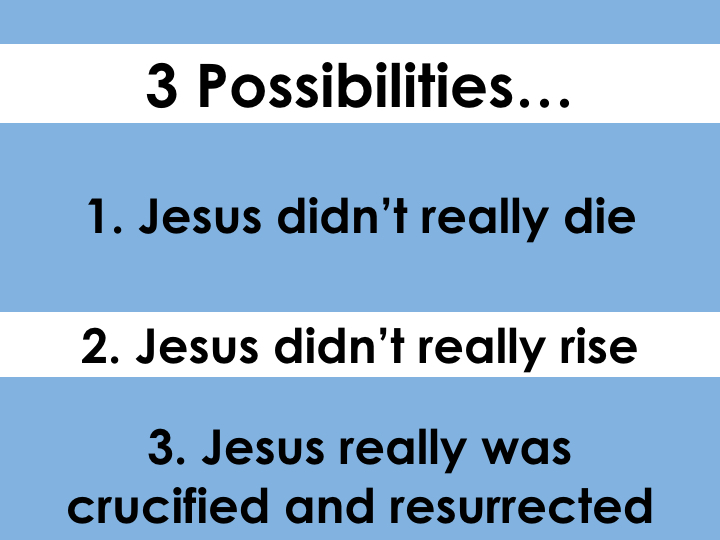 Last week we explored the validity of the evidence for the accuracy of the biblical accounts for the life of Jesus (you can check that out here). You might be one who says, “Okay, I think Jesus was a good Man, but I think it’s a bit of a stretch to believe that anyone could be raised from the dead after three days.” I think that’s a reasonable thing to explore…
If the tomb where Jesus was placed is really empty, then there are only three possibilities for us to consider.
(1) Jesus didn’t really die.
- It’s hard to imagine anyone could go through the intense torture Jesus did prior to His crucifixion unscathed.
- The crucifixion process itself is one of the most gruesome forms of execution man has ever invented.
- As a result, forensic science shows that Jesus most likely died of a heart attack. The mention in John 19:34 of the blood and water that flowed from Christ’s body is an indication of the cardiac distress His body experienced.
- Men who were followers of Jesus handled His dead body, and undoubtedly would have checked for any signs life (John 19:38-40).
- A Roman centurion reported to the Roman governor Pilate that Jesus had in fact died (Mark 15:43-45).
- Extra-biblical historians, many of whom were unfriendly to Jews and Christians, reported Christ’s death as an historical fact.
(2) Jesus didn’t really rise.
- Some have claimed that Christ’s followers “saw” Jesus only in a grief-induced hallucination. The problem is, Jesus appeared to individuals, small groups, and large groups multiple times and in multiple settings over the course of 40 days (1 Corinthians 15:3-8).
- At least one of Christ’s closest followers said he wouldn’t be convinced by verbal testimony alone, but needed to touch Christ’s body for Himself (John 20:24-28).
- The disciples were afraid and lacked any military training that would have allowed them to get past the trained soldiers guarding the tomb (Matthew 27:62-66; 28:11-15).
(3) Jesus really did die on a Cross and was raised back to life.
Arthur Conan Doyle’s Sherlock Holmes rightly said, “When you have eliminated the impossible, whatever remains, however improbable, must be the truth.”
Real-life cold-case detective J. Warner Wallace explains how detectives use abductive reasoning to examine all of the evidence and infer to the most reasonable explanation from that. As a result, Detective Wallace says about this third explanation:
“The last explanation (although it is a miraculous, supernatural explanation) suffers from the least number of liabilities and deficiencies. If we simply enter into the investigation without a pre-existing bias against anything supernatural, the final explanation accounts for all of the evidence without any difficulty. The final explanation accounts for the evidence most simply and most exhaustively, and it is logically consistent…. The final explanation is also superior to all other accounts (given that it does not suffer from all the problems we see with the other explanations).” —J. Warner Wallace, Alive
The truth is Jesus loved you so much that He had to die for you. He had to pay the penalty for your sins. And God loved His Son so much, that He raised Him back to life. Jesus can live in you now, and you can live with Him forever, if you will simply believe what He did for you on Calvary.
Jesus left an empty tomb behind to show how powerful His love and life is!
My most-viewed posts


