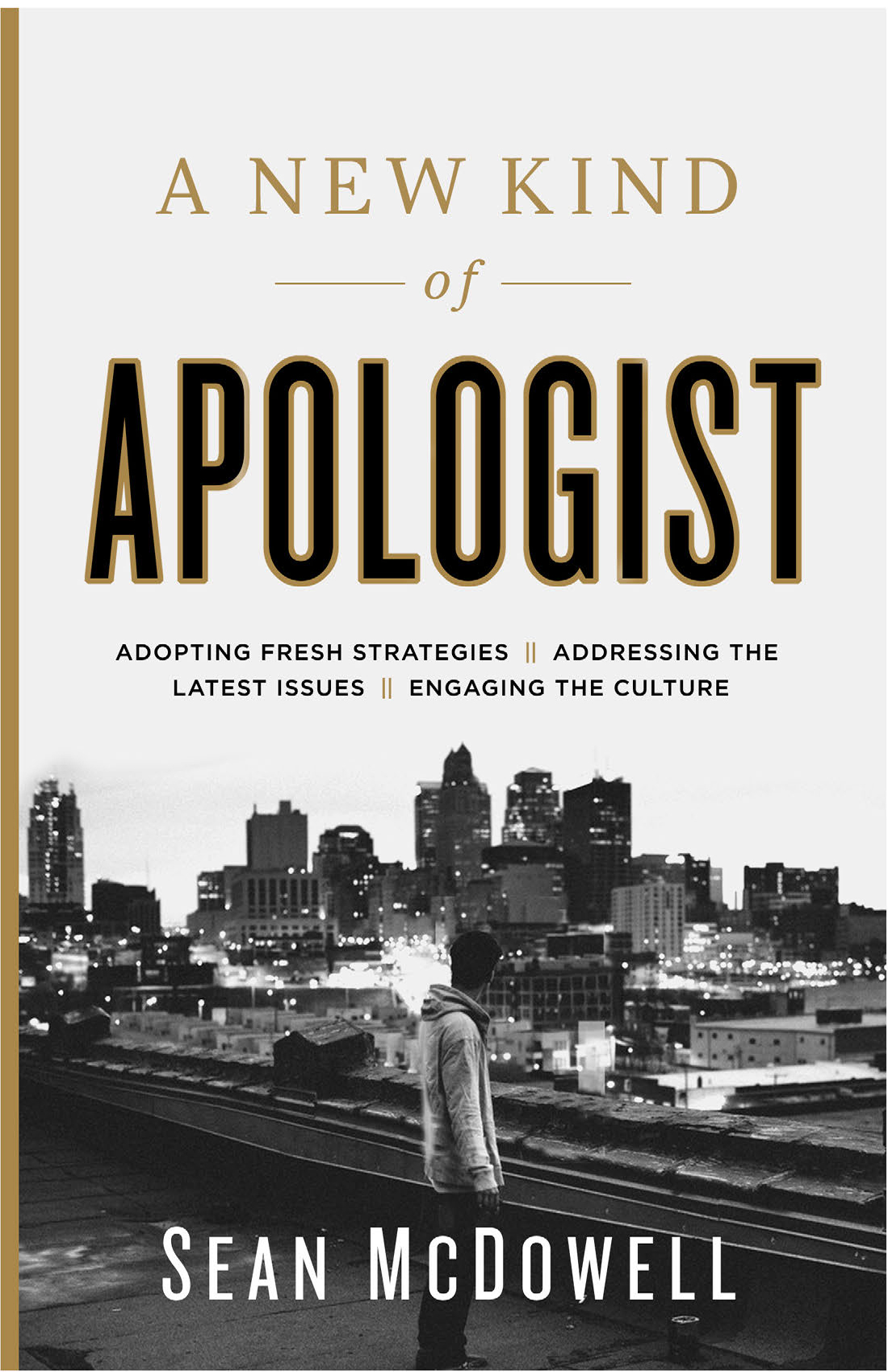
12 Quotes From “A New Kind Of Apologist”

A New Kind Of Apologist is edited by Sean McDowell and contains a collection of fabulous essays to prepare Christian apologists to be effective in this current generation. You can read my full book review by clicking here. These quotes mainly deal with the attitude that a Christian apologist should adopt.

“Truth must be wedded to grace, and what we say is important…but how we say it is equally critical.” —Sean McDowell 

“To listen to a person will require that we temporarily set aside our objections to what a person is saying and allow him or her to speak openly without fear of being challenged.” —Tim Muelhoff

“Our character and relationships with others have a greater capacity for attracting those around us to the Christian message than do our arguments or rhetoric.” —Ken Wytsma & Rick Gerhart 

“If our beliefs are not expressed in love and by example, we miss the greatest command of all, which is loving God and loving others.” —Dan Kimball

“The Barna Research Group found that twentysomethings who stay in church were twice as likely to have a close personal friendship with an adult inside the church. Those who had an adult mentor at church, aside from the pastor, were almost three times as likely to stay as those who did not.” —Jeff Myers

“Any fully-orbed presentation of the truth about ourselves and God’s plan for us cannot be a disembodied, purely intellectual truth; it must truthfully reflect our nature as created beings.

“Part of being incarnate means that it is good and right for us to have emotions and express them—as our Lord did, for example, by weeping at the tomb of Lazarus and getting angry with the money changers in the temple. The fact that little children wanted to come to Him suggests that He had a welcoming physicality and a warm personality that they instinctively trusted and found attractive. He wasn’t just a walking dictionary of Christian theology.” —Holly Ordway

“At its core, apologetics is the art and science of defending the faith. However, practically understood, the work of the apologist is simply to answer with integrity, clarity, and compassion the questions critics are asking about the gospel (1 Peter 3:15). The context of this passage implies a lifestyle on the part of the apologist that engenders and welcomes questions from their audience. The encouragement of Peter seems to be that we avoid the telemarketer approach of simply enduring questions solely for the sake of closing the deal. Rather, Peter calls us to anticipate and patiently answer the questions of our unbelieving friends, family members, and neighbors in an uncompromising and yet humble manner.” —Christopher Brooks

“We must be Christians first and apologists second, which means our intellectual lives must be primarily shaped by seeking to understand the faith we live within rather than debating, disputing, or even persuading those who do not believe it.” —Matthew Anderson 

“It is our responsibility to share the message of hope through Christ ‘with gentleness and respect’ and ‘with grace,’ as Peter and Paul taught. The gospel message is already offensive to some. We need not make it more offensive by presenting it in a manner that lacks gentleness, respect, and grace.” —Mike Licona

“Truth without grace is abusive and arrogant. Grace without truth is mushy sentimentalism. … As much as possible, always deal with the person in grace and the issue itself in truth.” —Glenn T. Stanton

“Paul doesn’t say that we ought to know how to answer each question [see Colossians 4:5-6]. He specifically teaches us to answer each person. … Paul tells us that we aren’t in the question-answering business. We are in the people-answering business. Today’s apologist must understand that questions don’t need answers; people need answers. … I am convinced that the key to apologetics today is to identify what non-Christians thirst for most and show how the Christian faith alone can slake that thirst.” —Abdu Murray

“The manner in which we communicate the gospel is not a minor add-on to the gospel itself [see 1 Peter 3:15-16]. Very often it is the nature of the communication that determines whether the gospel gets a hearing at all. …

“It remains true that it is not arrogant to make truth claims, it is not arrogant to pursue a knowledge of that truth, and to argue that we’ve found it. It is important that the content of our message is a genuine reflection of the gospel, and that the manner in which we communicate it doesn’t become a stumbling block.” —Tanya Walker

More quotes from A New Kind Of Apologist will be coming soon. You can also follow me on Tumblr and Twitter to read great quotes every single day.
The Broken Way (book review)

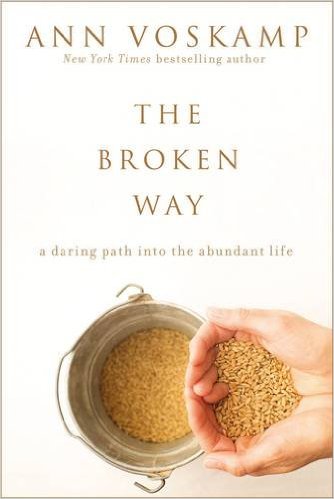
“What in God’s holy name do you do when it feels like you’re broken and cut up, and love has failed, and you’ve failed, and you feel like Somebody’s love has failed you?” With these raw, penetrating questions, Ann Voskamp opens her book The Broken Way.

Not only does she open her book, but she opens her heart. In every chapter we are gifted with Ann’s vulnerability and realness. Yes, it is a gift that someone like Ann would be so transparent in sharing her pain, her questions, and also her path to healing and wholeness.

Yet Ann would probably tell me that “wholeness” is not the goal. The goal is brokenness and givenness before God and to the other broken, hurting people around me. It’s in the embracing of the healing that comes from the Healer, and in giving that healing to others, that we truly find how Jesus walks with us on the broken way.

This is a book of healing. A book that will remind you that you are not alone in your pain, in your questions, in your searching for answers. This book is a gift to anyone who feels broken, cut up, cut off, or beaten down.

Perhaps you need this book for yourself. Perhaps you can read it with a broken friend. In either case, reading this book will help reveal the depths of love that can flood into your life when you encounter the Wounded Healer: Jesus!

Poetry Saturday—Which Tent?

Max LucadoAll men live in one of two tents: Content or Discontent 
In which tent do you live? 

The contented man looks beyond his circumstances and sees a better day.

The discontented man looks at his circumstances and sees no other way.


The contented man understands the purpose for which he was born.
The discontented man looks at others’ success with a face that’s filled with scorn.

The contented man has surrendered to a purpose that demands his very best.

The discontented man selfishly hoards much, and grasping for more, will not rest.


The contented man has placed his values on things that will forever last. 
The discontented man has placed his values on things which will soon be passed. 

The contented man is anchored to clear goals and hardly is ever swayed. 

The discontented man has no goals that anchor him, and many times has become dismayed. 


The contented man counts his blessings, and names them one by one. 
The discontented man counts others’ blessings, and thinks he has no fun.

All men live in one of two tents: Content or Discontent. 
In which tent do you live? —Max Lucado

Thursdays With Oswald—6 Questions About Your Relationship With Jesus

Oswald ChambersThis is a weekly series with things I’m reading and pondering from Oswald Chambers. You can read the original seed thought here, or type “Thursdays With Oswald” in the search box to read more entries.

6 Questions About Your Relationship With Jesus

“How much more shall the blood of Christ, Who through the enteral Spirit offered Himself without blemish unto God, cleanse your conscience from dead works to serve the living God?” (Hebrews 9:14)

     Our right to ourselves in every shape and form was destroyed once and for ever by the death of Jesus, and we have to be educated into the realization of what this means in all its fullness. We have to come to a relationship to the Cross in thought as well as in life. … 

     We are here with no right to ourselves, for spiritual blessing for ourselves; we are here for one purpose only—to be made servants of God as Jesus was. …

   “How much more” does the death of Jesus mean to us today than it ever has before? Are we beginning to be lost in wonder, love and praise at the marvelous loosening from sin, and are we so assimilating the nature of Jesus that we bear a strong family likeness to Him?

     The most devout among us are too flippant about this great subject of the death of Jesus Christ. When we stand before the Cross, is our every common pious mood stripped off? … 

     How does all the profound thought underlying the death of Jesus touch us? The writer to the Hebrews instantly connect it with conscience—“How much more shall the blood of Christ,…cleanse your conscience from dead works to serve the living God?” Has conscience the place in our salvation and sanctification that it ought to have? … 

     Are you thankful to God for your salvation and sanctification, thankful He has purged your conscience from dead works? Then go a step further; let Jesus Christ take you straight through into identification with His death until there is nothing left but the light at the foot of the Cross, and the whole sphere of the life is hid with Christ in God. 

From The Philosophy Of Sin

I challenge you: take some time to thoughtfully answer these questions.

Thursdays With Oswald—The New Life In Me

Oswald ChambersThis is a weekly series with things I’m reading and pondering from Oswald Chambers. You can read the original seed thought here, or type “Thursdays With Oswald” in the search box to read more entries.

The New Life In Me

     Oswald Chambers points out several things which affirms that one has experienced the new birth of salvation.

     “If Christ is formed in us, the great characteristic is that we know Him and perceive Him for ourselves. We do not need anyone to tell us about Him now, He is our Lord and Master.” 

     “Where do we go in a crisis? If we are born from above and Jesus Christ is Lord and Master, we will go direct as a homing pigeon to Him.” 

     “When Christ is formed in us, we are a satisfaction to our Lord and Master wherever He places us. The point of importance is to know that we are just exactly where He has engineered our circumstances. There is no ‘foreign field’ to our Lord.” 

     “Another evidence of new birth is that we see the rule of God. We no longer see the haphazard of chance for fate, but by the experience of new birth we are in able to see the rule of God everywhere. … We all see the common occurrences of our daily life, but who amongst us can perceive the arm of the Lord behind them? The saint recognizes in all the ordinary circumstances of his life the hand of God and the rule of God, and Jesus says we cannot do that unless we are born from above. … Nothing happens by chance to a saint, no matter how haphazard it seems. It is the order of God.” 

     “Do we seek to stop sinning, or have we stopped sinning? We are always inclined to make theoretical what God makes practical. Learned divines and others talk about the sin question, and make it a doctrinal matter of dispute. In the Bible it is never, Should a Christian sin? The Bible puts it emphatically: A Christian must not sin. … 

     “When we are born into the new realm the life of God is born in us, and the life of God in us cannot sin (1 John 3:9). That does not mean that we cannot sin; it means that if we obey the life of God in us, we need not sin. God never takes away our power to disobey; if He did, our obedience would be of no value, for we should cease to be morally responsible. By regeneration God puts in us the power not to sin.” 

From The Psychology Of Redemption

As you read through this list, what do you think? Are you trying to be a Christian, or are you letting this new birth simply do its work in you?

Thursdays With Oswald—What Does Your Religion Mean?

Oswald ChambersThis is a weekly series with things I’m reading and pondering from Oswald Chambers. You can read the original seed thought here, or type “Thursdays With Oswald” in the search box to read more entries.

What Does Your Religion Mean? 

     To believe is literally to commit. Belief is a moral act, and Jesus makes an enormous demand of a man when He asks him to believe in Him. To be “a believer in Jesus” means to bank our confidence in Him, to stake our soul upon His honor. …

     Many of us use religious jargon, we talk about believing in God, but our actual life proves that we do not really believe one tithe of what we profess. … “The unsearchable riches of Christ”—yet we often live as if our Heavenly Father had cut us off with a shilling! We think it is a sign of real modesty to say at the end of a day—“Oh well, I have just got through, but it has been a severe tussle.” We carry our religion as if it were a headache, there is neither joy nor power nor inspiration in it, none of the grandeur of the unsearchable riches of Christ about it, none of the passion of hilarious confidence in God. …

     Christianity is the vital realization of the unsearchable riches of Christ. …

     We have made Christianity to mean the saving of our skins. Christianity means staking ourselves on the honor of Jesus; His honor means that He will see us through time, death and eternity. … 

     Why do you pray? Why are you religious? Because of a consuming passion for a particular set of your beliefs to be enthroned and proved right, or because of a consuming passion for Jesus Christ? 

From The Place Of Help

Wow, those are excellent questions to consider—What do I think Christianity really is? Do I really believe what Jesus did for me, or is it just jargon I use? Am I consumed in my passion for Christ, or is it only something I profess when things are going my way?

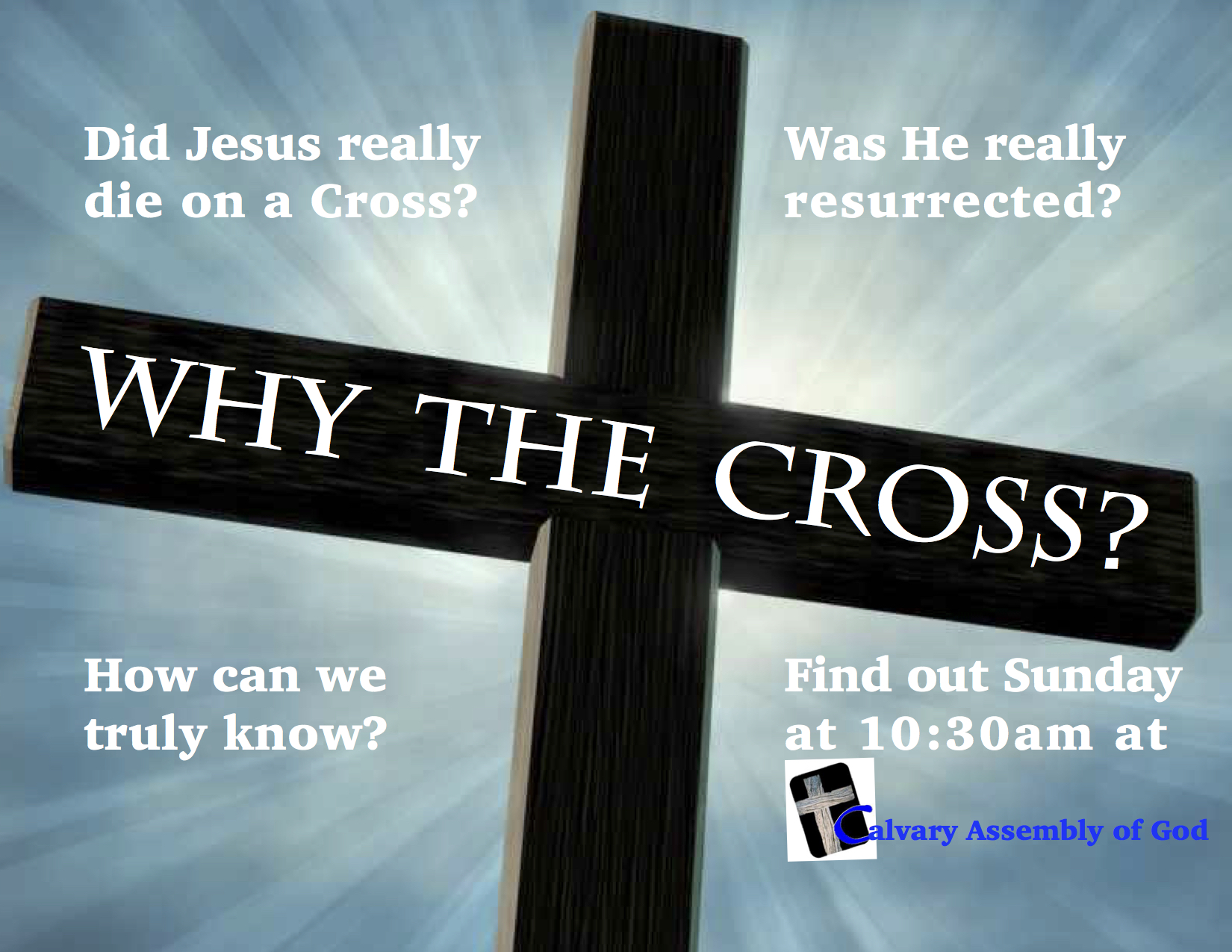
Why The Cross?

Why The CrossCrucifixion seems so extreme (click here to read The Horrors of Crucifixion)! Why would God allow His Son to go through this?

But perhaps we should back up a step or two. Before asking why the Cross maybe there are some other questions we should explore. Questions like…

  • Did Jesus actually die?
  • Is the account true that Jesus came back to life?
  • How can we know for sure?
  • Is this just too fantastic to believe? Or is the evidence reasonable?

These are questions we must all wrestle with, especially those who call themselves Christians. After all, Christian means a follower of Jesus Christ who believes that Jesus in fact died on a Cross and was raised back to life three days later.

Join me this Sunday was we explore the reliability of the evidence. Then on Easter Sunday morning we will consider the claims that Jesus died and came back to life, as well as the claims that this is all make-believe stuff.

You won’t want to miss this! Click here to find a map to our meeting place. If you cannot join us in person, we will be broadcasting live on Periscope (click here to find the account to follow to be notified when the broadcast begins).

Links & Quotes

link quote

“Christ did not risk death. He embraced it. That is precisely why He came: not to be served but to serve and give His life a ransom for many (Mark 10:45). … Christmas is for freedom. Freedom from the fear of death. Jesus took our nature in Bethlehem, to die our death in Jerusalem, that we might be fearless in our city. Yes, fearless. Because if the biggest threat to my joy is gone, then why should I fret over the little ones?” —John Piper

“The danger of all dangers would be to lose trust and confidence in the mercy of God. … To distrust Him would be a far more terrible thing than any physical evil which all the enemies of God put together could inflict on us, for without God’s permission neither the devils nor their human ministers could hinder us in the slightest degree.” —Francis Xavier

“Each instant of present labor is to be graciously repaid with a million ages of glory.” —J.W. Alexander

“If God did so much for us when enemies, what will He do, or rather, what will He not do, for us now that we are friends? … If Christ’s death did so much for us, what will not His life do?” —Horatius Bonar

“Ignorant men raise questions that wise men answered a thousand years ago.” —Goethe

[VIDEO] Tim Dilena shares some practical keys for a consistent prayer life.

“I would exhort those who have entertained an hope of their being true converts, and yet since their supposed conversion have left off the duty of secret prayer, and do ordinarily allow themselves in the omission of it, to throw away their hope. If you have left off calling upon God, it is time for you to leave off hoping and flattering yourselves with an imagination that you are the children of God.” —Jonathan Edwards

“For too many of us, Christian experience is episodic rather than continuous, with a few religious experiences interspersed throughout our lives, which are otherwise lived on our own terms. Such people can see little need or use for prayer.” —Ralph Lehman

Eric Metaxas helps us get ready for Religious Freedom Day on January 16.

[VIDEO] Not just at Christmas when you are receiving gifts, but all year long we should be people of appreciation. Check out John Maxwell’s short video—

Links & Quotes

link quote

“Be not satisfied, my dear friends, with being saved; desire to know how you are saved, why you are saved, the method by which you are saved. It is a rock on which you stand, I know, but think upon the questions—how you were put upon that rock, by whose love you came there, and why that love was set on you. I would to God that all the members of this church were not only in Christ Jesus, but understood Him, and knew by the assurance of the understanding whereunto they have attained.” —Charles Spurgeon

“I get the impression that some Christians think there are two kinds of history, two kinds of time. First, there is Bible time, and Bible history. Things happened in the Bible that were unique, and that we don’t expect to see happen in normal time and history, where we live, you know, today. Things like God doing extraordinary acts of deliverance, help, and support, or extraordinary empowerments for witness or service. Like Moses leading the people out of Egypt, or Joshua leading them to subdue the land of promise, or David leading an entire nation to build a glorious temple for the Lord. That was then, many Christians seem to think; this is now. But when we think this way we may be cutting ourselves off from one of the most powerful resources for visionary leadership, and that is the promise of the past … Visionary leaders understand that God has done remarkable, nearly incredible things in the past, and they reach back and recall those mighty works of God in order to encourage His people in the present. They recognize that the straight line of the covenant continues from Scripture through Church history right down to our day.” —T.M. Moore

“The psalmist does not yield. He battles unbelief with counterattack. In essence, he says, ‘In myself I feel very weak and helpless and unable to cope. My body is shot and my heart is almost dead. But whatever the reason for this despondency, I will not yield. I will trust God and not myself. He is my strength and my portion’ [Psalm 73:26]. … God has put these testimonies in the Bible so that we might use them to fight the unbelief of despondency.” —John Piper

Yesterday I posted a book review about our brains. Here is 11 things you need to know to keep your brain healthy.

“If homosexuals are bullied, we need to protect them. If they’re unjustly discriminated against, we need to help them. If they’re treated with contempt, the person hurting them should be stopped. If a family member comes out as gay and then is belittled, harmed, or vilified, then the offending family needs to be corrected. If Christians ridicule people who identify as gay or lesbian, they need to admonished. If a church doesn’t welcome seekers of all stripes (including people who identify as gay, lesbian, or bisexual), then it needs to change. But none of these circumstances are reasons to reinterpret Scripture to affirm homosexuality” (emphasis mine). Read more in Bad Reasons To Adopt Pro-Gay Theology.

Is It Okay To Question The Bible?

DoubtGod is not intimidated by your questions. In fact, if you look in the Bible itself, you will see lots and lots of question marks: questions asked by God, and questions asked of God. So go ahead and question!

And check out this great video from the Impact 360 Institute…