Quieting The Storms

Listen to the podcast of this post by clicking on the player below, and you can also subscribe on AppleSpotify, or Audible. 

“Anxiety disorders are the most common mental illness in the U.S., affecting 40 million adults in the United States age 18 and older, or 18.1% of the population every year.” —Anxiety & Depression Association of America 

A multitude of factors go into someone’s anxiety: genetics, temperament, brain chemistry, life experiences. In addition to those factors, we have to keep in mind that humans are a three-part being—with a body, mind, and spirit—and a disease in one area does affect the other two areas. 

All of this means that there is no one-size-fits-all solution for anxiety. But there is one Healer: 

  • He may supernaturally heal your body, mind, or spirit 
  • He may direct you to a medical doctor, a mental health professional, or a spiritual counselor 
  • But always, He will walk through the challenges with you, strengthening you, and preparing you to minister to others going through a similar struggle (Psalm 23:1-6; 2 Corinthians 1:3-4) 

David wrote, “When I am afraid, I put my trust in You” (Psalm 56:3). Notice that he said “when” not “if.” David knows what you probably know too: we can be easily consumed by our anxiety, doubts, and fears. But David also knows (and I hope you do too) that at those moments, we can go to God as our trustworthy First Source. 

One of the dictionary definitions of anxiety is a feeling of disquiet. All of the conflicting thoughts make it hard to concentrate, the abundance of noise makes it difficult to talk to yourself, let alone talk to God. 

I’d like you to consider another psalmist’s words. Look at the first half of Psalm 94:19—

  • When anxiety was great within me… (NIV) 
  • In the multitude of my anxious thoughts… (AMP)
  • When doubts filled my mind… (NLT) 

The setting of this psalm is one of lots of disquieting voices: a desire to see the wrongdoers punished, listening to arrogant words, getting fed up with boasting words, seeing good people being trampled, hearing foolish words uttered about God (vv. 1-8). 

Experiencing anxiety is not sinful, but I do think that we grieve God’s heart when we immediately run to other sources for relief instead of going to our loving Heavenly Father first. After dealing with the disquiet in the opening verses of Psalm 94, the psalmist says, “My anxiety level was sky high!” But then notice how that verse concludes—

  • Your consolation brought me joy (NIV) 
  • Your comforts cheer and and delight my soul (AMP)
  • Your comfort gave me renewed hope and cheer (NLT)

Jesus told us about our Comforter who would always be with us (John 14:1, 16-17). A little further on in these same remarks Jesus also said, “These things I have spoken to you, that in Me you may have peace. In the world you will have tribulation; but be of good cheer, I have overcome the world” (John 16:33 NKJV). 

I like that phrase, “Be of good cheer.” That phrase is just one word in Greek, and sometimes it’s translated “be of good courage.” In every single instance, it’s only used by Jesus and it’s only used when He comes close to anxious people (Matthew 9:2, 9:22, 14:27; Mark 6:50, 10:49; Luke 8:48; John 16:33; Acts 23:11). 

A furious squall battered the boat, almost swamping it. The disciples were—to say the least—disquieted! In their anxious state they notice Jesus peacefully sleeping. They wake Him up with, “Don’t You care that we’re drowning?!” Jesus stands up and says to the storm, “Quiet. Be still.” 

Recall that one of the descriptions of anxiety was being disquieted. That prefix dis- means to be separated: our anxiety would seek to distance us from God’s presence, to make us feel like His help is too far away. But when we go to Jesus, He alone can say, “Quiet” to our disquieting thoughts. He can remove the “dis-” and bring us close to Him. Only His peace can X-out the noise of the storm and bring you to a place of quiet rest. 

After Jesus said, “Quiet. Be still,” notice this: “THEN the wind died down and it was completely calm” (Mark 4:39). And the great thing is this: Even if another storm begins disquieting us just a few minutes after the calm, we can go to Him again. There is no limit: We can continually go to the Eternal Source of peace, to the only One who can speak, “Quiet” to our anxious thoughts. 

Please follow along with us as we learn more about X-ing out our anxieties. 

►► Would you please prayerfully consider supporting this ministry? ◀︎◀︎
X-ing Out Anxiety

Two brothers—one a doctor and one a pastor—addressed the prevalence of anxiety in our culture. They wrote, “A recent survey of primary care physicians in the United States revealed that at least one-third of office visits were prompted by some form of anxiety.” 

Anxiety can negatively impact our relationships, our ability to think creatively, our physical health, and even our relationship with God. Thankfully, one of the titles given to Jesus is The Prince of Peace. 

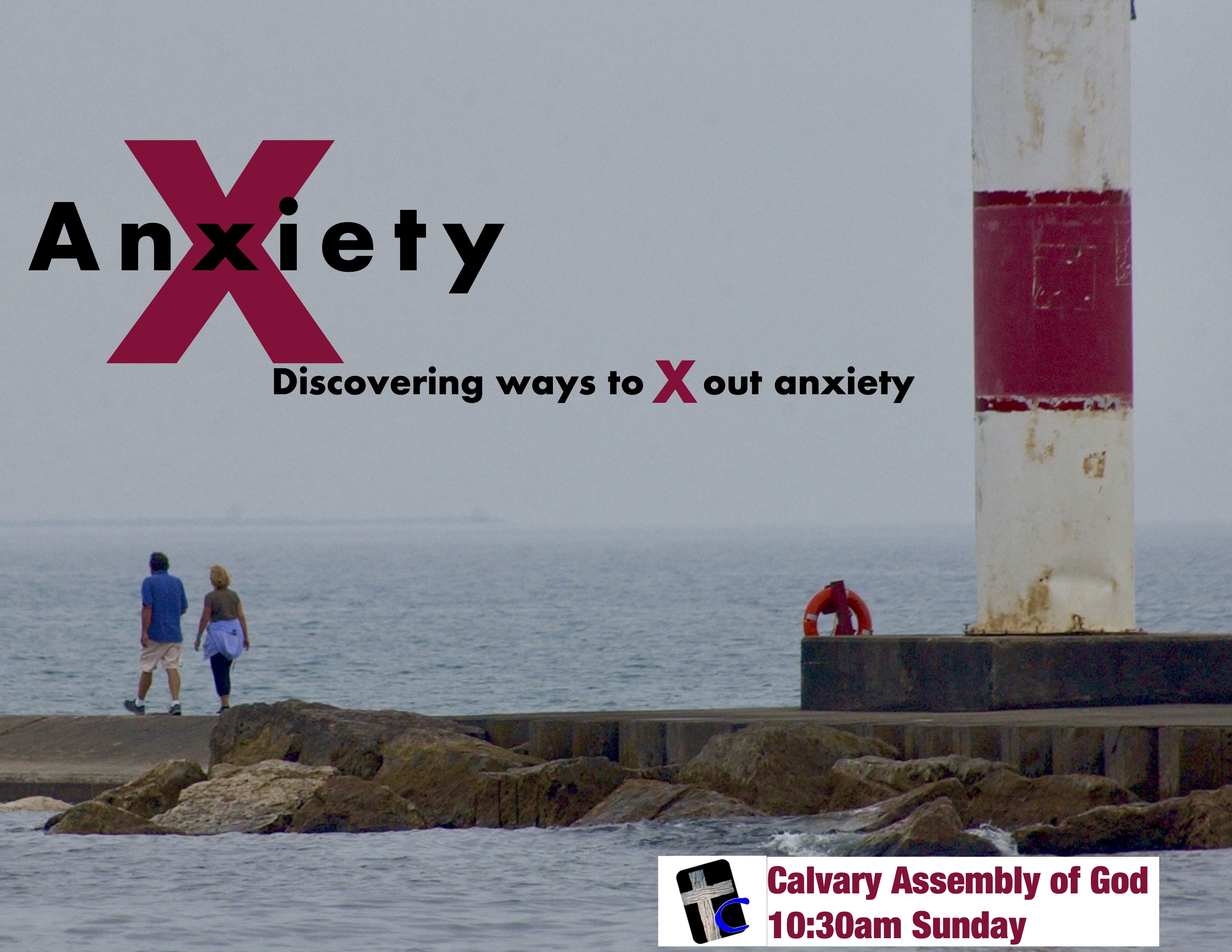
Join us for this freeing series called X-ing Out Anxiety, where we will be learning what God’s Word says about getting free from the anxiety that is robbing us of life, and replacing that anxiety with His peace. Please join me either in-person or online at Calvary Assembly of God.

If you have missed any of the messages in this series, check them out here:

Known And Unknown Threats

Listen to the podcast of this post by clicking on the player below, and you can also subscribe on AppleSpotify, or Audible. 

I call on the Lord in my distress, and He answers me (Psalm 120:1). 

What power and love is packed into this short verse! “I call…He answers.” There’s nothing else I need to do—just called to my God. There is no delay or deliberation on His part—He answers me. 

Distress” comes from the root word that can mean a tight spot, or it can mean a hard pebble. The distress we face may be a full frontal assault or it may be a nagging, almost indefinable, annoyance. Since Psalm 120 is a Psalm of Ascent, whatever the distress is, the psalmist feels like it is keeping him from going up into God’s presence. He lists three known distresses: 

  1. Deceit—people around him were lying or distorting the truth. 
  2. Separation—he wants to ascend into God’s presence but feels held back by those among whom he lives. 
  3. Turmoil—he’s looking for peace, but everyone around him wants to stir up trouble and controversy. 

What about those annoying, hard-to-identify distresses? In the next Psalm of Ascent the call is for us to trust God and to not worry. But in this psalm, there’s no calling to God for help because no specific threats have been identified. Still we learn that our Heavenly Father, who does not slumber, perpetually watches over us. Our Father knows our needs before we can even perceive them, and He is fully prepared to handle them. 

So we are promised: 

  • I can sleep securely
  • I can travel safely
  • I can work each day confidently
  • I can pass through the night unharmed
  • I can move around without having to look around
  • The LORD will watch over my coming and going both today and forevermore! 

Father, may any distresses I experience today send me ascending into Your presence. Whether I know what the threats are or not, I know that You are watching over me and will answer me whenever I call to You. I thank You for this confidence that I have both today and forevermore! 

►► Would you please prayerfully consider supporting this ministry? ◀︎◀︎

The Craig And Greg Show: Handling Personnel Conflicts

On this episode of “The Craig And Greg Show” we talk about: 

  • a previous episode where we discussed how leaders handle general problems [0:28]
  • the distinction between conflict management and conflict leadership [1:30] 
  • managers who try to make people get along vs. leaders who empower people to solve their own issues [2:44]
  • my 3 tips to prepare yourself before a meeting with your teammates [3:38]
  • how to look beyond the “triggers” to the root issue of a problem [5:04]
  • most people share the same values but conflict happens when they express that value differently [6:17]
  • leaders allow for the differences in style and personality [7:15]
  • how leaders can proactively prepare themselves and their team members to navigate personnel conflicts [8:00]
  • Greg relates conflict leadership to parenting terminology [10:15]
  • leaders need to stay among their team members [11:29]
  • what “peace” really is and where conflicts usually originate [12:50]
  • team members bring their past experiences with them [14:20]
  • Craig & Greg are ready to help coach you [16:30]

Check out this episode and subscribe on YouTube so you can watch all of the upcoming episodes. You can also listen to our podcast on Spotify and Apple.

Poetry Saturday—Peace

Listen to the podcast of this post by clicking on the player below, and you can also subscribe on Apple or Spotify.

Sweet Peace, where dost thou dwell? I humbly crave,
                                           Let me once know.
             I sought thee in a secret cave,
             And ask’d, if Peace were there.
A hollow winde did seem to answer, No:
                                           Go seek elsewhere.

I did; and going did a rainbow note:
                                           Surely, thought I,
             This is the lace of Peaces coat:
             I will search out the matter.
But while I lookt, the clouds immediately
                                           Did break and scatter.

Then went I to a garden, and did spy
                                           A gallant flower,
             The Crown Imperiall: sure, said I,
             Peace at the root must dwell.
But when I digg’d, I saw a worm devoure
                                           What show’d so well.

At length I met a rev’rend good old man,
                                           Whom when of Peace
             I did demand, he thus began:
             There was a Prince of old
At Salem dwelt, who liv’d with good increase
                                           Of flock and fold.

He sweetly liv’d; yet sweetnesse did not save
                                           His life from foes.
       But after death out of his grave
              There sprang twelve stalks of wheat:
Which many wondring at, got some of those
                                           To plant and set.

It prosper’d strangely, and did soon disperse
                                           Through all the earth:
        For they that taste it do rehearse,
             That vertue lies therein,
A secret vertue bringing peace and mirth
                                           By flight of sinne.

Take of this grain, which in my garden grows,
                                           And grows for you;
        Make bread of it: and that repose
             And peace, which ev’ry where
With so much earnestnesse you do pursue,
                                           Is onely there. —George Herbert **spelling is 1663 English**

►► Would you please prayerfully consider supporting this ministry? ◀︎◀︎

An Unmistakable Response

Listen to the podcast of this post by clicking on the player below, and you can also subscribe on Apple or Spotify.

When something goes wrong, the response from most people is pretty predictable, isn’t it? Some try to ignore the problem, some complain about it, many get quite angry, and most people try to find someone or something to blame. 

These responses don’t sound very Christian-like, do they? What many people think the Christian response should be is something closer to the opening words of Rudyard Kipling’s poem—“If you can keep your head when all about you are losing theirs and blaming it on you….” 

And yet, though this sounds Christian-like, it still misses the mark for Spirit-baptized Christians. Remember that a couple of weeks ago I described the baptism in the Holy Spirit as a “distinctive doctrine.” There is nothing distinct about a Christian responding predictably like everyone else does. 

A Spirit-baptized Christian is distinguished by the miraculous ways God confirms His presence in that person’s life. What really honors God is not a predictable response or even a learned response, but an unpredictable, miraculous response: A Spirit-baptized Christian’s response to bad news should be peace and joy. 

I believe the Holy Spirit can so transform our hearts that our response becomes an unmistakable testimony of the power of God. We may experience the initial pang of regret and pain but our next response turns all the focus off of us and on to God.  

The Holy Spirit uses trials to transform our hearts and minds into Christlike thinking and action. 

Our Heavenly Father’s desire is for everyone to come into a close, personal relationship with Him. Before Jesus came this was first pictured for us in the operations of the temple and its sacrifices. Yet man’s attempts to control this hijacked what God intended. This is why we see Jesus acting in righteous anger to clear out the temple of merchants and money-changers (John 2:12-17; Luke 19:45-48). 

Oswald Chambers noted the similarities between what Jesus did in the physical temple and what the Holy Spirit does in our hearts: 

“Immediately the Spirit of God comes in we begin to realize what it means—everything that is not of God has to be cleaned out. People are surprised and say, ‘I asked for the Holy Spirit and expected that He would bring me joy and peace, but I have had a terrible time ever since.’ That is the sign He has come, He is turning out the ‘money-changers,’ that is, the things that make the temple into a trafficking place for self-realization.” 

The Holy Spirit has to disturb our man-made peace so that His peace can take its place. Or as Jesus said, “Do not think that I came to bring peace on earth. I did not come to bring peace but a sword” (Matthew 10:34). 

Jesus told us that the indwelling Holy Spirit would bring about this heart and mind transformation in His followers. The Holy Spirit doesn’t teach us how to respond in a learned, predictable way, but He transforms us to respond in an unmistakably unpredictable way (John 16:12-15, 20-22; 14:26-27). 

The transformed response of the Spirit-baptized Christian is joy in place of anger, and peace in place of frustration (James 1:2-4; Romans 5:3-5). I like how the Amplified Bible defines “blessed” in the Beatitudes Jesus lists in Matthew 5: “happy, to be envied, and spiritually prosperous—with life-joy and satisfaction in God’s favor and salvation, regardless of [the] outward conditions.” 

This transformation brings God glory and is exactly what Jesus prays for us (John 17:13-18), which is why I keep on saying: Don’t stop at salvation—press on to be baptized in the Holy Spirit! 

Your unpredictable, unmistakable peace and joy in the face of trials becomes a testimony to a watching world. 

If you’ve missed any of the posts in our series on the empowerment that comes from being baptized in the Holy Spirit, you can find the full list by clicking here.

►► Would you please prayerfully consider supporting this ministry? ◀︎◀︎

“Father, Into Your Hands I Commit My Spirit”

Listen to the podcast of this post by clicking on the player below, and you can also subscribe on Apple or Spotify.

I have some sobering news for you: You are going to die. 

Death is the great equalizer. It comes for the rich and poor, the scholar and the illiterate, all races, all ages, the healthy as well as the sick. Unless you’re still alive when Jesus comes back again, your odds of dying are 1-in-1. 

What happens “on the other side”? What happens after this life is over? Since it seems dark and mysterious to most people, they tend to ignore it until it’s thrust upon them. That’s why I find the dying words of people interesting. Like P.T. Barnum asking, “How were the receipts today at Madison Square Garden?” or W.C. Fields reading a Bible on his deathbed and telling a friend, “I’m looking for a loophole.” 

Or the very last words of Jesus: “Father, into Your hands I commit My spirit.” 

Jesus is steeped in Scripture, so nearly everything He says in His final four declarations come directly from the Psalms, including His final phrase which comes from Psalm 31:5. 

When Jesus broke a three-hour silence with His cry, “My God, My God, why have You forsaken Me,” both Matthew and Mark use the Greek words megas phoné to describe how loudly Jesus spoke. And now with His final words, Luke uses the same megas phoné description. 

Notice in the first megaphone cry Jesus calls on God the All-Powerful Creator. And with His last megaphone declaration, He calls on His Father who is All-Loving. How comforting it is to know that God is both All-Powerful and All-Loving! Not only can He answer our cries, but He delights to answer them! 

The word Jesus uses for “commit” is in the future tense and it means “to entrust as a deposit.” Jesus believed that God was going to do more than just give Him life again, but that He would give life to all who would believe in Him. 

Unlike atheist Bertrand Russell who said, “I would never die for my beliefs because I might be wrong,” Jesus DID die for His beliefs, and by rising from the dead proved He was right in trusting God. 

Job saw an inescapable death for all mankind, but he also foresaw the forgiveness of God (Job 14:5, 16-17). Jesus died once for all mankind and was then resurrected, bringing about the death of death by making forgiveness accessible to anyone (Hebrews 9:27-28; 1 Corinthians 15:19-22). 

We can now have the peace that comes from trusting the only One to Whom we can safely entrust our souls. Because Jesus brought death to death, we can have the same peace when we die that Jesus had when He died. 

With faith in Jesus, you can…

…live today knowing you’re invincible until God calls you home 

…live today full of joy because your home in heaven is secure

…live your very last day in peace because you know to Whom your soul is entrusted 

Because Jesus died at peace with God, we can face death triumphantly! 

If you’ve missed any of the messages in our series on the dying declarations of Jesus, you can access the full list by clicking here.

►► Would you please prayerfully consider supporting this ministry? ◀︎◀︎

Poetry Saturday—Eternal Spirit

Listen to the podcast of this post by clicking on the player below, and you can also subscribe on Apple or Spotify.

Eternal Spirit, we confess
And sing the wonders of Your grace!
Your power conveys our blessings down
From God the Father and the Son.
Enlightened by Your heavenly ray,
Our shades and darkness turn to day.
Your inward teachings make us know
Our danger and our refuge, too.
Your power and glory work within,
And break the chains of reigning sin,
Does our imperious lusts subdue,
And forms our wretched hearts anew.
The troubled conscience knows Your voice,
Your cheering words awake our joys;
Your words allay the stormy wind,
And calm the surges of the mind.

*Spurgeon used this poem as a conclusion to his sermon entitled Human Depravity and Divine Mercy. I was unable to find this poem attributed to anyone else, so I am assuming it was written by Spurgeon himself. 

►► Would you please prayerfully consider supporting this ministry? ◀︎◀︎

The Reason We Can Live Securely

Listen to the podcast of this post by clicking on the player below, and you can also subscribe on Apple or Spotify.

The wicked plot…but the Lord laughs… (Psalm 37:12).

The wicked may hatch all sorts of evil plots that appear to benefit themselves, but God always gets the final word and the last laugh!  

This 37th Psalm is filled with the contrasts of the temporary advantages of evil versus the eternal rewards of righteousness. Wicked people may flourish for a moment in time, but righteous people have both an inheritance that lasts forever and God’s help every single day too! In other words, the righteous get to securely live in a win-win relationship. 

With this in mind, David instructs the righteous how to live out their days: 

  1. not fretting over evil people
  2. trusting God to supply their needs 
  3. doing good for others
  4. delighting in God
  5. remaining steadfastly committed to God
  6. patiently
  7. refraining from anger 
  8. full of hope
  9. generously
  10. securely in God’s peace 

Righteous people can live securely every single day because they know that not only does God holds them securely today, but He will continue to hold them securely for all of eternity. Secure people are empowered to live a joy-filled, others-centered, God-glorifying life. 

If you know Jesus as your Savior, you can say “Amen!” to this secure way of living. 

►► Would you please prayerfully consider supporting this ministry? ◀︎◀︎

Soul-Calming Peace

Listen to the podcast of this post by clicking on the player below, and you can also subscribe on Apple or Spotify.

…the Lord blesses His people with peace (Psalm 29:11). 

Please forgive me for the use of so many exclamation points in this post, but it’s the only way I can even begin to come close to portraying the awesomeness of our God!  

What brings peace to God’s people? David says it is the glimpse of God’s awesome power—

  • the God of glory thunders! 
  • His voice is powerful! 
  • His voice is majestic! 
  • His voice splits cedar trees! 
  • lightning and thunder cannot compare to His voice! 
  • His voice shakes the deserts! 
  • His voice twists oak trees and strips forests! 
  • He is enthroned as the King over all forever and ever!

Count all of the ways God is awesome! Give Him praise that is equally great! Tremble at His weighty, majestic holiness! Be filled with the awe of His strength! And let this bring you peace.

Why? 

Because this awesome, glorious, omnipotent, majestic, powerful, unrivaled, holy God wants to be in a relationship with you! He cares about you! He will unleash His power against any enemy that comes against you! What brings peace to your trembling soul? A glimpse of this awesome God! 

The awesome strength of your God IS your soul-calming peace! 

►► Would you please prayerfully consider supporting this ministry? ◀︎◀︎