Listen to the podcast of this post by clicking on the player below, and you can also subscribe on Apple, Spotify, or Audible.
You may have heard it said that Christians are supposed to pray for those who are in governmental leadership positions over them. Is that really true? And if it is, what exactly are we supposed to pray for them?
►► Would you please prayerfully consider supporting this ministry? My Patreon supporters get behind-the-scenes access to exclusive materials. Become a supporter today and get access to all of my previous posts plus have instant access to all of the new materials that are being posted weekly. ◀︎◀︎
Listen to the podcast of this post by clicking on the player below, and you can also subscribe on Apple, Spotify, or Audible.
The events in the Bible are rooted in history. These are actual events in which real people lived in a moment in recorded history. The songs of ascent were sung both pre-exile and post-exile. The post-exile pilgrims were returning to Jerusalem after the edict of King Cyrus (2 Chronicles 36:22-23).
The first pilgrims to go up to Jerusalem after the exile were the rebuilders of both Jerusalem and the temple, and they faced heavy opposition (Ezra 4:1-5; Nehemiah 4:1-3, 7-8). In light of these events, I think the song of ascent in Psalm 125 is especially pertinent to this situation.
The middle verse of Psalm 125 contains a warning to godly people. God’s followers may be tempted to grab earthly political power to try to make things right—to “fight fire with fire.” The phrase “the scepter of the wicked” symbolizes the royal authority of a foreign conqueror. In other words, we might justify using the scepter of the wicked because we think “the ends justify the means.” But notice the warning if we do: “the righteous might use their hands to do evil.”
You can see this in a couple of other biblical translations. The Amplified Bible says, “lest the righteous (God’s people) stretch forth their hands to iniquity and apostasy,” and the New Living Translation says, “the godly might be tempted to do wrong.”
Instead, we are called to look to God for our security. Psalm 125:1-2 sounds like an echo of Psalm 121, in which we are reminded that our God is unshakable, unrivaled, and eternal. Political parties come and go, even evil dictators and tyrannical regimes come and go, but the Sovereign God remains forever. All of History is His story!
Chuck Colson used to frequently remind his audiences, “Salvation does not arrive on Air Force One!”
The motto on our US currency is still accurate: In God we trust! Psalm 125:4 says the same thing: God does good to those who trust Him.
Earlier I mentioned the opposition that Ezra and Nehemiah recorded. Let me also share with you how these God-fearing men instructed the Jewish people to respond. Ezra says that the prophets called them to remember “the name of the God of Israel, who was over them,” and three times Nehemiah records that their response was prayer to God (Ezra 5:1; Nehemiah 4:4, 9; 6:9).
In God we trust, not in political power. On the flip side, Psalm 125:5 warns us that God treats as evildoers those who look to the worldly scepter to try to get ahead.
So when opposition and even persecution come, we should pray to God and ask for Him to remove the scepter of the wicked. Let’s pray for God to put His favor in the hearts of even ungodly leaders. Ezra recognized this when he said—
Praise be to the Lord, the God of our ancestors, who has put it into the king’s heart to bring honor to the house of the Lord in Jerusalem in this way and who has extended His good favor to me before the king and his advisers and all the king’s powerful officials. Because the hand of the Lord my God was on me, I took courage and gathered leaders from Israel to go up with me.(Ezra 7:27-28)
The New Testament calls on Christians to pray for those in governmental leadership over us (1 Timothy 2:1-2). But perhpas you ask, “What exactly are we to pray for these leaders?” Solomon wrote, “The king’s heart is like channels of water in the hand of the Lord; He turns it wherever He wishes” (Proverbs 21:1). So perhaps a God-honoring prayer is to ask for our leaders’ hearts to be moved as King Cyrus’ heart was.
“God is King of kings and ultimately always wins, always gets His way. Even when it seems that earthly authorities continually rebel against the Lord and His Anointed, the reality is that even their most heinous acts are turned against them. It must be very frustrating to be the devil and to constantly see how God turns situations to gospel good and God’s unique glory. God is so wise that He turns the hearts of authorities without them knowing it. Smug on their decaying thrones, the power brokers of this world revel in their supposed autonomy and imagined resistance, never realizing how foolish they look to the angel hosts who are privy to God’s unmatched strategic dominance.”
Let’s never try to fight fire with fire, but let’s turn repeatedly to God in prayer whenever opposition arises against God-fearing people anywhere.
Listen to the podcast of this post by clicking on the player below, and you can also subscribe on Apple, Spotify, or Audible.
“Highly esteemed” is how two different angels addressed Daniel (Daniel 9:23, 10:11). This was a title they obviously heard from God Himself. At both instances, Daniel was in a time of intense and sustained prayer and fasting.
While I was speaking and praying, confessing my sin and the sin of my people Israel and making request to the Lord my God for His holy hill … Gabriel, the man I had seen in the earlier vision, came to me…. (Daniel 9:20-21)
At that time I, Daniel, mourned for three weeks. I ate no choice food; no meat or wine touched my lips; and I used no lotions at all. (Daniel 10:2-3)
Prayer was a regular habit for Daniel and prayer was also what Daniel turned to immediately in times of trouble (Daniel 2:18, 6:10).
We see the same thing in the lives of two notable women in the New Testament. Elizabeth is described as an upright woman who observed all of God’s commandments blamelessly. She continuously prayed that she might get pregnant, and then Gabriel came to bring the good news of her upcoming pregnancy. Elizabeth responded by saying, “The Lord has done this for me.… He has shown me His favor” (see Luke 1:5-25).
Mary was also a righteous woman who was steeped in Scripture (as we can see in her song of praise). When Gabriel appeared to her, he called her “highly favored” (see Luke 1:26-55).
A righteous, prayer-filled lifestyle also brings favor and esteem with earthly kings. Daniel and his friends fasted and prayed, which led to King Nebuchadnezzar’s favor directed to them (Daniel 1:11-20, 2:48-49). After three days of prayer and fasting, Queen Esther found favor in the eyes of King Xerxes, which led to the salvation of all the Jewish people (Esther 4:15—5:3). And Nehemiah’s sustained prayer over four months won the favorable reply from King Artaxerxes (see Nehemiah 1:1—2:8).
If you want to hear deep things from God, if you want to be called “highly esteemed” by the Most High, if you want to gain favor with earthly kings, you must be committed to the sustained work of prayer and righteous living. If you would like to dig into this deeper, check out 4 Thoughts To Help Prayer Become A Daily Habit.
Listen to the podcast of this post by clicking on the player below, and you can also subscribe on Apple, Spotify, or Audible.
Therefore groan, son of man! Groan before them with broken heart and bitter grief. And when they ask you, “Why are you groaning?” you shall say, “Because of the news that is coming.” (Ezekiel 21:6-7)
Judah’s sin had exhausted God’s patience. Now punishment was coming in the form of the invincible Babylonian army, and Ezekiel was tasked to deliver the news.
I and my fellow pastors often have to speak a heavy word. How we speak this word may make all the difference in the world in how it is received. We cannot speak brashly nor robotically. The Word of God should break our own hearts first, just as it did to Nehemiah.
I must tell people about the consequences of their sin, but I must tell them with groaning.
I must warn people of the horrors of hell, but I must warn them with bitter grief.
I hope all my fellow pastors will join me in praying this: Holy Spirit, help me! May Your word break my heart before I open my mouth. May tears always lubricate the painfully loving words I must speak!
It’s one thing to read things, hear things, and even believe things, but it’s something completely different when you experience those things for yourself.
The one with an experience…
…is never at the mercy of the one with an argument
…gains the ear of others
…inspires others to desire a similar experience for themselves
In the case of prayer, I feel bad for those who have heard that God no longer answers prayer, or no longer does the miraculous for His children. I have personally experienced God’s healing power as a direct result of someone praying for me. In fact, I’m alive today because of the prayers of my two grandmothers!
When God answers prayer, it is awesome!
The dictionary defines awesome with three main words: reverence, admiration, and fear. I think we can be a bit more specific with these definitions—
for saints: reverence
for seekers: admiration
for sinners: fear
It is so important for Christians to personally experience the awesome deeds our God has done because we have prayed in the awesome name of Jesus!
A.W. Tozer wrote, “There’s an awesomeness about God which is missing in our day altogether; there’s little sense of admiring awe in the Church of Christ these days.”
I think this is because our prayers are too tame.
The writer of Hebrews tells us about the powerful personal relationship we can have to Almighty God through Jesus Christ. His conclusion is, “Therefore, since we are receiving a kingdom that cannot be shaken, let us be thankful, and so worship God acceptably with reverence and awe, for our ‘God is a consuming fire’” (Hebrews 12:28-29).
When Christians pray in the awesome name of Jesus, and God does awesome things in response, the saints stand in reverent worship of Him. God told Moses, “The people you live among will see how awesome is the work that I, the Lord, will do for you,” and David exclaimed, “You answer us with awesome and righteous deeds” (Exodus 34:10; Psalm 65:5).
These awesome answers that we personally experience gain the attention and admiration of seekers. Again, David said, “Come and see what God has done, His awesome deeds for mankind!” (Psalm 66:5).
But God showing up in His awesome strength will also create fear in sinners. The prophet Joel said, “The day of the Lord is an awesome, terrible thing” (Joel 2:11). The righteous judgment of God is awesome, but so is the love of God: “Lord, the God of heaven, the great and awesome God, who keeps His covenant of love with those who love Him and keep His commandments” (Nehemiah 1:5). We need to use the awesomeness of God as a means to tell both sinners and seekers how they can know the awesome love of God.
Remember that Tozer said “there’s little sense of admiring awe in the Church of Christ these days.” So I think we need to pray this, “God, forgive us for expectations of You that are too low.”
I challenge you:
Let’s pray bolder prayers this year to our awesome God.
Let’s worship in reverence of His awesome deeds.
Let’s create a sense of admiration in seekers which will lead them to reverence as saints.
Let’s address the fear of sinners, and lead them to admiration as seekers, and to reverence as saints.
“Love of the Word appears preeminently in our Lord and Savior Jesus Christ. He read it publicly. He quoted it continually. He expounded it frequently. He advised the Jews to search it. He used it as His weapon to resist the devil. He repeatedly said, ‘The Scripture must be fulfilled.’ Almost the last thing He did was to ‘open their minds so they could understand the Scriptures’ (Luke 24:45). I am afraid that man cannot be a true servant of Christ, who has not something of his Master’s mind and feeling towards the Bible.” —J.C. Ryle, Bible Reading
“The character of our praying will determine the character of our preaching. Light praying will make light preaching. …The preacher must be preeminently a man of prayer. His heart must graduate in the school of prayer. In the school of prayer only can the heart learn to preach.” —E.M. Bounds, Power Through Prayer
“Some pastors and preachers are lazy and no good. They do not pray; they do not read; they do not search the Scripture. … The call is: watch, study, attend to reading. In truth you cannot read too much in Scripture; and what you read you cannot read too carefully, and what you read carefully you cannot understand too well, and what you understand well you cannot teach too well, and what you teach well you cannot live too well. … The devil … the world … and our flesh are raging and raving against us. Therefore, dear sirs and brothers, pastors and preachers, pray, read, study, be diligent.” —Martin Luther
Listen to the podcast of this post by clicking on the player below, and you can also subscribe on Apple or Spotify.
When I first began this series on prayer, I challenged all of us to make prayer a habit. I suggested putting up “Have I prayed about it?” Post-It Notes all over the place to get us thinking about prayer continually.
“Have I prayed about it?” is a great start. But then I need to ask, “How long have I prayed about it?” or maybe even, “How long am I willing to pray about it?”
Thomas Merton wrote, “What is the use of praying if at the very moment of prayer we have so little confidence in God that we are busy planning our own kind of answer to our prayer?” In other words, why do we go through the motions of praying and then strike out on our own? Or why do we pray for a little bit and then think, “Oh, perhaps God isn’t interested in this prayer”?
In Romans 12:12, the apostle Paul challenged us to never stop praying:
faithful in prayer (NIV)
constant in prayer (AMP)
prayerful always (TLB)
continuing steadfastly (NKJV)
This verb emphasizes the –ing part. Even though this is a verb, it’s what is known as a “verbal noun”: the noun pray is the same thing as the verb praying.
This Greek word is defined as: devoted, giving unremitting care to something, being courageous in perseverance, and staying at constant readiness. I would sum it up this way—
Prayer that is both persistent and insistent!
When Jesus teaches us that the motive for our prayer is, “Your kingdom come, Your will be done,” He is also implying that this requires continuous—persistent and insistent—involvement. With every prayer, we are persistently and insistently advancing God’s Kingdom and God’s glory.
I’m also moved by the insistent and persistent prayer of Nehemiah. He prayed, “Give Your servant success today by granting him favor in the presence of [King Artaxerxes].” He prayed this every day for over 4 months. The king finally noticed Nehemiah’s downcast face, asked him what was wrong, and then “because the gracious hand of my God was upon me, the king granted my requests.”
Nehemiah kept praying for 120 days or more, believing every day God would open the door of favor. In the meantime, God was moving things into place so that when Artaxerxes finally noticed Nehemiah’s downcast face, and Nehemiah shared what was on his heart, the king grantedevery single request!
Friends, don’t be timid in your prayers and don’t give up praying. P.U.S.H.—Pray Until Something Happens. Pray for God’s glory to be seen, for His kingdom to advance on earth, and for His will to be done.
Although the word in English is “joy,” there are two different Hebrew words used here. Think of them this way—one is the root and the other is the flower.
In verse 10, the Hebrew word chedvah is only used twice in all of the Old Testament (it’s also used in 1 Chronicles 16:27). This word describes the source of joy—or the root—which is found exclusively in God’s presence.
In verses 12 and 17 the word for “joy” is simchah. This word essentially becomes the outward expression—or the flower—because it is nourished by the chedvah root.
Here’s how it plays out in the book of Nehemiah. Because the people had heard and been given understanding of God’s Word, they joyfully celebrated. And because God helped them complete the wall around Jerusalem and reestablish worship at the temple, they also happily celebrated. God was the chedvah root of their joy, and their outward celebration was the simchah flower.
God alone is the Root—the Source—of chedvah. My simchah celebration both glorifies Him as the Source and points others to Him. My simchah flower will make others desirous for the chedvah root that has brought about this outward joyful expression from me.
To be a joyless Christian is a contradiction of terms. To not express simchah means either I am not abiding deeply in the root of chedvah, or that I don’t believe it is worthwhile enough to share with others. But of course, if I have truly been to the Source, I will want others to enjoy this relationship with God as well.
Two questions for me to ask myself: (1) Is my heart abiding deeply in God as my Source of joy? And (2) Is my outward joy a making others desirous to know this Source of joy for themselves?
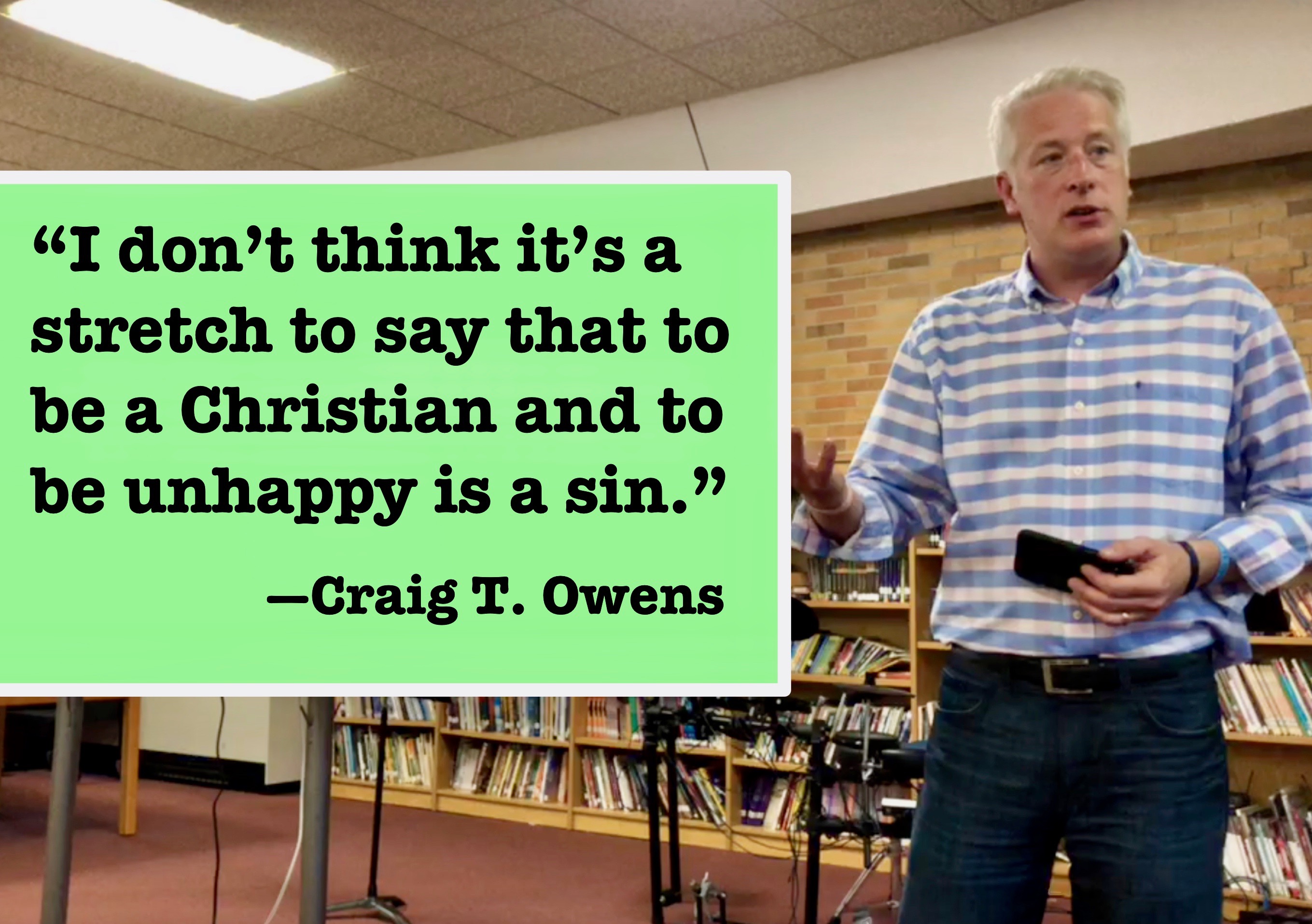
I don’t think it’s a stretch to say that to be a Christian and to be unhappy is a sin. A joyless, unhappy Christian gives God no praise, robs Him of glory, and paints God in a bad light. A happy Christian knows the Lord is his strength, his comfort, his supply. The joy-filled, happy Christian lifts God high and invites others to know this All-Good, All-Happy God too!
The picturesque language of someone’s hand being on another person signifies who is in control and to whom one is giving their allegiance. Ezra and Nehemiah boil it down to God’s hand or the hand of foreign leaders.
God’s hand brings:
favor with foreign kings
safety
courage
coworkers
protection from bandits
A foreign king’s hand brings:
a sword
captivity
pillage
humiliation
Ezra explains, “The gracious hand of our God is on everyone who looks to Him, but His great anger is against all who forsake Him” (8:22). So God’s hand prevents the hand of a foreign king from doing anything outside of God’s will.
Here are two irrefutable and unchangeable principles: (1) I can only have one hand on my life at a time, and (2) I get to choose which hand it will be: God’s or a foreign leader.













 Craig T. Owens