The psalmist says this in every single verse of Psalm 136.
Get the point? Just in case you missed it—
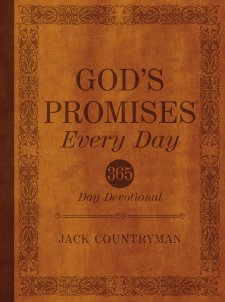
God’s Promises by Jack Countryman is a wonderful resource to help you use the Bible to enhance your prayer life and build your faith. Check out my full review of this fantastic book by clicking here.
“Each day we can look forward to God’s Spirit going before, clearing the way, leading the path, and giving us the guidance we need. … But God doesn’t stop at mere survival. He doesn’t just satisfy and strengthen. Though there will be difficulties and times of drought in our lives, God guides us to His living waters. He enables us to flourish ‘like a watered garden,’ where His blessings always bloom.” [Isaiah 58:11]
“When life darkens our door with its troubles and trials, satan wants nothing more than for us to feel forsaken and alone—but we are not! God stands by our side; He guides, counsels, and comforts. Rest assured, no matter what you face in the coming year, nothing can separate you from the love of your Father (Romans 8:38-39). Therefore walk boldly into each new day, knowing that you follow the footsteps of the One who never leaves you.” [Deuteronomy 31:8]
“Troubles are never pleasant at the time, but they quickly turn into tools when entrusted to God. Our Lord will take our times of troubles and trials—even the hard feelings we experience in them—then use them to teach us to fully rely on Him and His provision.” [Psalm 138:7]
“Our God is a loving God, but He isn’t Santa Claus or a genie in a bottle. Our God loves to give good gifts, but in His economy the best gifts are not tangible or material. Yes, our God feels compassion when we hurt, but He still allows hardships into our lives that will refine our character and strengthen our faith. Against the backdrop of these truths, we can better understand the often-misread statement that God will give us the desires of our hearts. The real promise of this verse is that, as we pray, read His Word, and grow closer to the Lord, He will change our hearts so that what we desire for ourselves is what He desires for us.” [Psalm 37:4]
“Mercy. We don’t deserve it. We haven’t done—can’t possibly do—anything to earn it. And yet we are promised that this unbelievably lavish gift is ours when we choose to follow Jesus. Why? Why would such a perfect and powerful God gives such a gift to ones so undeserving? He tells us in Titus 3:4: because of ‘the kindness and love of God our Savior toward man.’ And He not only gave us mercy, He also ‘poured out on us abundantly’ His own Spirit, to live and work within us, making us more and more like the Savior who died to save us.” [Titus 3:4-6]
“Our God is not some fickle, capricious, changeable sort of God. He does not search out ways to be angry or displeased with His people. In fact, He so wants to be pleased with us that He gave us the example of His Son to follow.” [Ephesians 5:2]
“When our burdens and sorrows seem too heavy for us to bear, God offers to carry them for us, inviting us to cast them upon Him (Psalm 55:22). And when the sorrow is so great that we feel we cannot put one foot in front of the other, God gives us this promise: ‘I will carry you; I will sustain you’ (Isaiah 46:4).”
“Perhaps nothing is as devastating as being betrayed by someone you love and trust. Know that Jesus—betrayed by Judas, denied by Peter—fully understands. He will enable you to recover. The key, as hard as it is, is to pray for that person and ask God to bless him or her. When you pray to God—and you may have to do this again and again—you release the anger and disappointment that come with being betrayed. It is difficult to despise someone you lift up in prayer. And though retaliating is a natural response, it’s not a godly one. Praying is always the best option. Allow the Lord to receive your hurt and to replace it with His peace.” [Psalm 3:4, 6]
“When we place our faith in Christ, the stormy seas of our lives—churned up by our own sins—are stilled. And while the storms may still rage around us in this sin-plagued world, they do not rage within us. That does not mean our troubles and tribulations are over, but it does mean we can rest in knowing God will see us through them.” [Romans 5:1]
As Dr. Les Parrott presented the five ways Jesus showed His love to us, he supported his thoughts with some insightful quotes from other authors. Check out my full book review of Love Like That by clicking here.
“If you stop to be kind, you must swerve often from your path.” —Mary Webb
“We may ignore, but we can nowhere evade, the presence of God. The world is crowded with Him. He walks everywhere incognito.” —C.S. Lewis
“Pride is our greatest enemy and humility our greatest friend.” —John R.W. Stott
“Jesus was the Man for others.” —Dietrich Bonhoeffer
“Jesus was able to love because He loved right through the layer of mud.” —Helmut Thielicke
“They that know God will be humble; they that know themselves cannot be proud.” —John Flavel
“Those who judge will never understand, and those who understand will never judge.” —Wilson Kanadi
“Mercy gave the Prodigal Son a second chance. Grace gave him a feast.” —Max Lucado
“Christ accepts us as we are, but when He accepts us, we cannot remain as we are.” —Walter Trobisch
“Jesus did not identify the person that with his sin, but rather saw in this sin something alien, something that really did not belong to him, something…from which He would free him and bring him back to his real self.” —Helmut Thielicke
“While every other religion offers a way to earn approval, only Christianity dares to make God’s love unconditional.” —Philip Yancey
“Judgmentalism finds its identity in what is not. … Rare is the person who can weigh the faults of others without putting his thumb on the scale.” —Byron Langenfeld
“To love a person means to see him as God intended him to be.” —Fyodor Dostoevsky
“I do not at all understand the mystery of grace—only that it meets us where we are but does not leave us where it found us.” —Anne Lamott
“All human nature vigorously resists grace because grace changes us and the change is painful.” —Flannery O’Connor
“Those who make peaceful revolution impossible will make violent revolution inevitable.” —John F. Kennedy
“We often err not because we find it hard to perceive the truth (it is often right there, at the surface), but because it is easier and more pleasant to be guided by our feelings, especially if self-centered.” —Alexander Solzhenitsyn
“A ‘no’ uttered from deepest conviction is better and greater than a ‘yes’ merely uttered to please, or what is worse, to avoid trouble.” —Mahatma Gandhi
“Every time you listen with great attentiveness to the voice that calls you the Beloved, you will discover within yourself a desire to hear that voice longer and more deeply.” —Henri Nouwen
Check out some of Dr. Parrott’s quotes from Love Like That which I shared here.
“God’s name marks Him out; by it will we address Him; it embodies His character. … This name that is written all over the Bible, but specially exhibited in Christ Jesus, Who came to declare to us the Father’s name, is a name—
[Each chapter in the Book of Proverbs contains thoughts that fit into a theme; they are not just random thoughts gathered together. In this “Saturday In The Proverbs” series, I will share a theme that I see in each chapter. But the cool thing about God’s Word is that you may see an entirely different theme. That’s great! If you do, I would love for you to share it in the comments below.]
My son, do not … but … (Proverbs 3:1).
This chapter of Proverbs is filled with these contrasts—don’t do this, but do this instead—and then Solomon shared the blessings that follow when we do the right thing.
Don’t forget God’s Word BUT keep it in your heart. Blessing—long life and peaceful days.
Don’t lose sight of mercy and truth BUT find ways to remind yourself. Blessing—favor with God and man.
Don’t lean on your own understanding BUT lean on God’s wisdom. Blessing—God’s direction.
Don’t become enamored with yourself BUT fear God and avoid evil. Blessing—health and strength.
Don’t hoard God’s gifts to you BUT honor God with your possessions. Blessing—overflowing blessings.
Don’t despise God’s correction BUT learn from it. Blessing—wisdom, understanding, happiness.
Don’t forsake God’s wisdom BUT keep it squarely in front of your eyes. Blessing—grace, safety, security, sweet sleep, no fear, confidence.
Don’t withhold good from your neighbor BUT love your neighbor. Blessing—God’s blessing in your home.
It’s no secret that when a Christian says, “This is what I believe,” or “This is what the Bible says,” or even something as simple as, “I believe in God,” that there will be people who disagree. Sometimes their disagreement may even become an outright attack.
How are Christians to respond?
Here are five ways I’ve found to be effective and Christ-honoring—
1. Don’t argue. Arguments tend to create an “I don’t want to lose” feeling in the other person, which makes them unable to truly hear what you’re saying. Solomon wrote, “Do not answer a fool according to his folly, or you will be like him yourself” (Proverbs 26:4).
2. Ask questions. Jesus was a master at this. Look through the Gospels and you will see Jesus asking questions to clarify others’ positions. Questions stimulate further conversation, while statements tend to shut down the conversation. Questions develop a relationship, while definitive statements make you seem superior to the other person.
3. Don’t argue. Yes, this is good enough to repeat! Paul’s advice to Timothy was, “Do not waste time arguing over godless ideas and old wives’ tales” (1 Timothy 4:7).
4. Pray for mercy. Remember that if you are really speaking truths from the Bible, the person arguing against those truths is arguing with God, not with you.
5. Pray for light. Paul said that the “god of this age” has blinded people (see 2 Corinthians 4:2-4), so we should pray that the Holy Spirit would grant them light to see the truth.
“Oh, the unmitigated curse of controversy! Oh, the detestable passions that corrections and contradictions kindle up to fury in the proud heart of man! Eschew controversy, my brethren, as you would eschew the entrance to hell itself. Let them have it their way; let them talk; let them write; let them correct to you; let them traduce you; let them judge and condemn you; let them slay you. Rather let the truth of God suffer itself, than that love suffer. You have not enough of the divine nature in you to be a controversialist.” —Dr. Alexander Whyte
Let’s be passionate for people, not passionate to win an argument!
I go into more detail in this video…
I will… (9x in Psalm 101).
Psalm 101 is only eight verses long, but David makes nine I will resolutions to God. Perhaps you might consider making these resolutions yourself—
(1) I will sing of mercy and justice. These are two sides of the same coin; in fact, it’s only when we know God’s justice that we can appreciate His mercy. Both God’s justice and His mercy need to be celebrated.
(2) I will sing praises. Regardless of our situation or setting, God is worthy to be praised.
(3) I will behave wisely in a perfect way AND (4) I will walk within my house with a perfect heart. A commitment to integrity, living a godly lifestyle, and leaving a godly legacy.
(5) I will set nothing wicked before my eyes AND (6) I will not know wickedness. A commitment to be childlike in regard to wickedness, and watchfulness of anything impure.
(7) I will destroy AND (8) I will not endure AND (9) I will destroy all the wicked. A resolution to cut-off all relationships that are not God-honoring.
Resolutions aren’t just for New Year’s Day. Resolutions can be made any time we sense something in our life isn’t as God-pleasing as it could be.
In The Pastor In Prayer we discover that Charles Spurgeon is not only the prince of preachers, but the prince of pray-ers as well. Check out my review of this fabulous book by clicking here.
“Thy grace must give us even to know our need of grace. We are not willing to confess our own sinfulness until Thou dost show it to us. Though it stares us in the face our pride denies it, and our own inability is unperceived by us. We steal Thy power and call it our own till Thou dost compel us to say that we have no strength in ourselves.”
“Thy grace has almost out-graced itself, Thy love has reached its height love to rebels; so to love that even Thy Son could not be spared. O God, we are afflicted in our hearts to think we do not love Thee more after such love as this.”
“O God, we beseech Thee bring men away from all their false trusts to rest in the great sacrifice of Thy dear Son.”
“Oh that we might live so near to the great Shepherd as to be familiar with His voice, to know its tones, that so a stranger we may not follow, for we know not the voice of strangers.”
“Thou art good when Thou givest, and Thou art good when Thou takest away. Thou art good when the night gathers heavy about us. Thou art good when the sun shineth and gladdeneth our pathway. Thou art always good and doest good, and blessed be the name of the Lord from the rising of the sun unto the going down thereof, and through the night watches let His praise be still celebrated.”
“And truly since we have received so many mercies at Thy hand, we do feel that Thou wilt never forsake us in any darkness which may be in our path in the future. Thou hast done too much for us to desert us now. We have cost Thee so much—Oh wondrous price that Thou hast paid for us—and Thou hast spent so much of wise thought, and gracious act upon us, that we are persuaded Thou wilt go through with the work which Thy wisdom has undertaken. But give us faith to believe this when the stormy times come, let us not doubt.”
“Lord, while we work for Thee, always keep us sitting at the feet of Jesus. Let our faith never wander away from the simplicity of its confidence in Him. Let our motive never be anything but His glory; may our hearts be taken up with His love, and our thoughts perpetually engaged about His person.”