As we mature physically we pay more attention to our physical health. Why is that people who see themselves as spiritually mature think they can do the exact opposite by taking it easy? We must pay more attention, not less.
A worldwide missions movement that was started by five college students while they were sheltering from a storm in a haystack. Appropriately enough, this is remembered as the haystack prayer meeting.
“Intangible falsehood, based upon no authority, is of all things the most difficult to fight.” —G.K. Chesterton
“In his gospel, Luke traces Jesus’ genealogy to Adam. He then says Jesus went into the desert to be tempted by satan, the same spiritual being who tempted Adam thousands of years before. The apostle Paul makes the same comparison in Romans. Adam brought death into the world; Jesus brought life. In fact, Jesus came to save us because of what Adam did. When Paul is in Athens, he explains that all people are descended from one man. When Paul writes to the Ephesians, he says marriage goes back to the first couple. And when Paul talks about roles in the church, He refers to the first temptation.” —From the ‘Is Genesis History?’ reading plan on YouVersion. Check out Luke 3:23-38, 4:1-13; Romans 5:12-15; Matthew 19:4.
About 14 years ago I wrote a blog post called “More and More” in which I was challenging myself and other Christians to keep setting the bar higher.
As for other matters, brothers and sisters, we instructed you how to live in order to please God, as in fact you are living. Now we ask you and urge you in the Lord Jesus to do this more and more. (1 Thessalonians 4:1)
I pointed out that in the Greek language the phrase “more and more” in 1 & 2 Thessalonians is just one word. It means…
More willingly
More readily
Sooner
I asked, “When the Holy Spirit speaks to me, do I respond and obey more willingly? more readily? sooner?”
So here I am again looking back—all these years later—and asking myself: Am I still wanting more and more? Am I growing more and still more? Am I loving more and still more? Am I leading more and still more?
It’s a lifelong pursuit chasing after more and still more.
Listen to the podcast of this post by clicking on the player below, and you can also subscribe on Apple, Spotify, or Audible.
Prayer can unleash God’s miracles. Sometimes the most visible miracles are the changes that are seen in us—our attitude, our expectation, our focus, and our maturity.
Maturity is not stuffy and stodgy. Those folks actually become quite childish when others around them don’t “act right,” according to their standards. The most mature people are the most childlike.
Do you want proof for that last statement? The most mature Person to ever live on earth was Jesus, and He loved being around kids and having children around Him (Mark 10:13-14).
His teaching examples were frequently quite simple—farmers, birds, flowers, trees, and even going to the bathroom!. He knew their songs (Luke 7:31-32), and many of His interactions with the overly-mature religious leaders were quite playful and childlike (Mark 11:27-33).
Jesus wants us to come to our Father like children (Mark 10:15-16). “Like a little child” means childlike, which is the exact opposite of childish. Those who think they are too mature for such simplistic things are actually the ones who are childish.
Jesus uses the Father-child relationship over and over to teach us about praying to a Father who is desirous of giving us the best things (Matthew 6:7-9; Luke 12:32).
One of the Psalms of Ascent written by David strikes this childlike note (Psalm 131). Verse 1 describes the childishness he’s giving up, and verse 2 describes the childlikeness he is taking on:
“my heart is not proud”—not focused on me (v. 1a)
“my eyes are not haughty”—overly grown up (v. 1b)
“I don’t concern myself with matters too great or too awesome for me to grasp” (v. 1c NLT)
instead I am stilled, quieted, trustingly at peace (v. 2)
and then David calls all of us to this same childlikeness (v. 3)
Jesus taught about persistent prayer in Luke 18:1-8 and then used a scenario from the temple to illustrate His point (Luke 18:9-17), contrasting the childish pseudo-maturity of the overly-religious man and the childlike maturity the childlike man. And then, as directed by the Holy Spirit, Luke includes the same exchange Mark used about Jesus taking up children in His arms to bless them.
Childlike is loving dependent; childish is fiercely independent.
Childlike is trusting someone wise; childish always knows best.
Childlike is imaginative; childish is realistic.
Childlike is persistent; childish is whining.
I love the Henry Wadsworth Longfellow poem called The Children’s Hour. As you read through this, imagine our Heavenly Father as Longfellow and yourself as his three daughters.
Between the dark and the daylight,
When the night is beginning to lower,
Comes a pause in the day’s occupations,
That is known as the Children’s Hour.
I hear in the chamber above me
The patter of little feet,
The sound of a door that is opened,
And voices soft and sweet.
From my study I see in the lamplight,
Descending the broad hall stair,
Grave Alice, and laughing Allegra,
And Edith with golden hair.
A whisper, and then a silence:
Yet I know by their merry eyes
They are plotting and planning together
To take me by surprise.
A sudden rush from the stairway,
A sudden raid from the hall!
By three doors left unguarded
They enter my castle wall!
They climb up into my turret
O’er the arms and back of my chair;
If I try to escape, they surround me;
They seem to be everywhere.
They almost devour me with kisses,
Their arms about me entwine,
Till I think of the Bishop of Bingen
In his Mouse-Tower on the Rhine!
Do you think, O blue-eyed banditti,
Because you have scaled the wall,
Such an old mustache as I am
Is not a match for you all!
I have you fast in my fortress,
And will not let you depart,
But put you down into the dungeon
In the round-tower of my heart.
And there will I keep you forever,
Yes, forever and a day,
Till the walls shall crumble to ruin,
And moulder in dust away! —Henry Wadsworth Longfellow
We mature by trading childishness for childlikeness. We mature best by coming to God our Father in prayer as a child comes to his father.
Let prayer change your maturity!
If you’ve missed any of the other messages in this series on how prayer changes us, you can find them all here.
When the Holy Spirit shines His light on a biblical promise, and you turn that into a prayer, write it down! You may need to go back to this again and again. When God answers your prayer, write it down again! This can become a testimony journal that you and others can use to recall God’s provision.
“The pathway to maturity and to solid biblical food is not first becoming an intelligent person, but becoming an obedient person.” —John Piper
“Somehow or other an extraordinary idea has arisen that the disbelievers in miracles consider them coldly and fairly, while believers in miracles accept them only in connection with some dogma. The fact is quite the other way. The believers in miracles accept them (rightly or wrongly) because they have evidence for them. The disbelievers in miracles deny them (rightly or wrongly) because they have a doctrine against them.” —G.K. Chesterton
“At every moment, we always have a choice, even if it feels as if we don’t. Sometimes that choice may simply be to think a more positive thought.” —Tina Turner
Every day should be a day of thanksgiving!
“We are strangers on Earth; our homeland is in Heaven. Our walk is here; our hearts are there.” —Dr. Henry Halley
I have already shared the first two posts in the latest archeological research on the biblical city of Jericho. Here is part three.
“Success is no accident. It is hard work, perseverance, learning, studying, sacrifice, and most of all, love of what you are doing or learning to do.” —Pelé
“The greatest leader is not necessarily the one who does the greatest things. He is the one who gets people to do the greatest things.” —Ronald Reagan
Not that I have already obtained all this, or have already arrived at my goal, but I press on to take hold of that for which Christ Jesus took hold of me. … I press on toward the goal to win the prize for which God has called me heavenward in Christ Jesus. (Philippians 3:12, 14)
There is no neutral, but always going forward.
There is no complacency, but always striving.
There are no shortcuts, but always straining.
There is no baggage, but always something new.
There is no regression, but always progression.
There is no relaxing, but always gripping tightly.
There is a reward—an eternal reward—which I eagerly long to receive.
As I was studying the Book of Jude, I came across this phrase, “Though you already know all this, I want to remind you.” This prompted these three quick thoughts that I want to share with my fellow pastors.
Using the words from Isaiah 40:10-11, Sarah Young has Jesus speaking these words to us: “Adverse circumstances become growth opportunities when you affirm your trust in Me no matter what.”
Ken Blanchard has long used a challenge for leaders to catch their teammates doing something right. That phrase has now become the title of a biography about Ken. He says, “Great leaders who want to encourage and motivate their people set up a positive cycle:
A great leader catches someone doing something right and praises them.
The leader’s praise helps the person feel good about themselves.
People who feel good about themselves produce good results.
A great leader notices when people produce good results.
See #1.”
This is a very encouraging read for men! Scott Hubbard writes, “You may not have ability for preaching and teaching, as Timothy did. But the Holy Spirit does not leave any Christian giftless. … You may have a small vision for your life; God does not.”
An amazing series from T.M. Moore on the law in a Kingdom economy. T.M. writes, “Christians don’t keep the Law to be saved; we keep it because we are saved, because it is the path that Jesus walked (1 John 2:1-6); and we recognize its value for helping us realize more of the life of holy, righteous, and good works for which we have been redeemed (Romans 7:12; Ephesians 2:8-10).”
Geologists have discovered what Creationists already proposed about plate tectonics related to the Flood described in the Bible. “Flood geologists have predicted that plate motion slowed at the end of the Flood year, and now conventional scientists are finding it to be true.”
The Assemblies of God has always responded to popular religious trends with solid biblical exegesis. The “latter day rain” movement in the 1940s is a good example.
“Mature leaders swallow their egos and recognize God as their power source. They walk confidently in His authority, but never assume credit for it. Faith enables them to stretch, while humility enables them to stoop.” —John Maxwell
Listen to the podcast of this post by clicking on the player below, and you can also subscribe on Apple, Spotify, or Audible.
The apostle Paul’s letters to the church in Corinth show two things: a lot of correction and a lot of love. In fact, it’s in the middle of some correction and redirection about the misuse of spiritual gifts that Paul gives us the quintessential definition of love in 1 Corinthians 13.
Paul also wrote, “For I wrote you out of great distress and anguish of heart and with many tears, not to grieve you but to let you know the depth of my love for you” (2 Corinthians 2:4).
The truth does need to be spoken to wayward sheep, but it has to be birthed in love and spoken in love or else it will alienate more than help. People don’t care to listen to my counsel or correction until they know how much I truly care for them.
There needs to be a connection before attempting the correction.
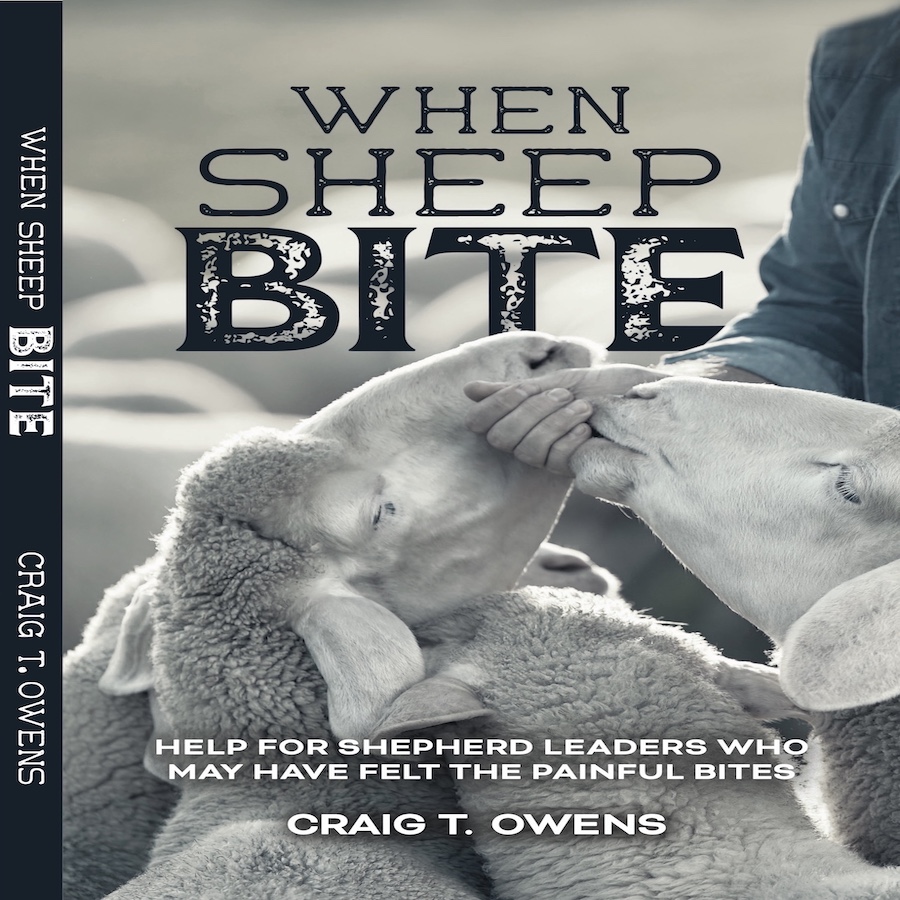
I have an entire chapter in my book When Sheep Bite on this topic. Here’s an excerpt—
It is possible that our grace-filled response to our biting sheep may make the difference to their eternal home. The apostle Paul told Timothy that those sheep who were out of line were trapped by the devil, and unless Timothy did something those sheep may never break free—
And the Lord’s servant must not be quarrelsome but must be kind to everyone, able to teach, not resentful. Opponents must be gently instructed, in the hope that God will grant them repentance leading them to a knowledge of the truth, and that they will come to their senses and escape from the trap of the devil, who has taken them captive to do his will. (2 Timothy 2:24-26)
For some reason many shepherd leaders have made “confrontation” a dirty word, or have sullied its usefulness by confronting in an ungodly way. One thing that will help us handle confrontation the right way is to remember why we confront: The goal of confrontation is restoration, not destruction!
There is a cliché that says, “Once bitten, twice shy.” As I mentioned earlier, after we’ve been bitten we need to allow the Holy Spirit to search our hearts to point out anything in us that may have contributed to such a painful outburst from that sheep. Perhaps after doing all of that you attempted to confront a sheep and it didn’t go so well. As a result, you are now a bit shy to confront another wayward sheep. Dick Brogden wrote:
“Experience so easily leads us to cynicism. Information too easily leads to pain. Leadership often makes us jaded because we’ve seen so much junk, all the effects of broken people breaking people. … A strong heart determines that it will stay soft, that it will absorb hurt, disappointment, and reality, and yet believe that God can redeem people and circumstances.”
Handled correctly, confrontation can lead to restoration, a deeper intimacy, and newfound maturity. Handled incorrectly, and, well, let’s just say it can get very ugly!
I imagine we have all heard stories of the fallout from confrontation in another pasture, or perhaps we know the painful consequences in our own pastures. But let’s try for a moment to put those past experiences or secondhand stories out of our minds and take a fresh look at how to handle confrontation.
Samuel was going to be sent by God to confront King Saul about the sin he had committed. Look at this passage: “Then the word of the Lord came to Samuel: ‘I am grieved that I have made Saul king, because he has turned away from Me and has not carried out My instructions.’ Samuel was troubled, and he cried out to the Lord all that night” (1 Samuel 15:10-11).
Did you catch how Samuel responded? He cried out to the Lord all that night.
Perhaps if we, as godly under-shepherds, cried before we confronted the results might be more healthy. Billy Graham noted, “Tears shed for self are tears of weakness, but tears shed for others are a sign of strength.” (from Chapter 5 ‘Cry Before You Confront’)
If you have some difficult but necessary words to speak to someone, take time to cry before you confront. Ask the Holy Spirit to reveal to you the most loving way to handle this situation. Cry before you confront, and may your tears soften your heart to speak truthful words saturated in your love for God and your love for this wayward saint.
Please pick up a copy of When Sheep Bite to learn more biblical strategies for handling biting sheep and for healing from biting sheep. If I can be of help to you, please get in touch with me.
P.S. You may also be interested in a whole series about growing and showing our love called Loving the Unlovable.
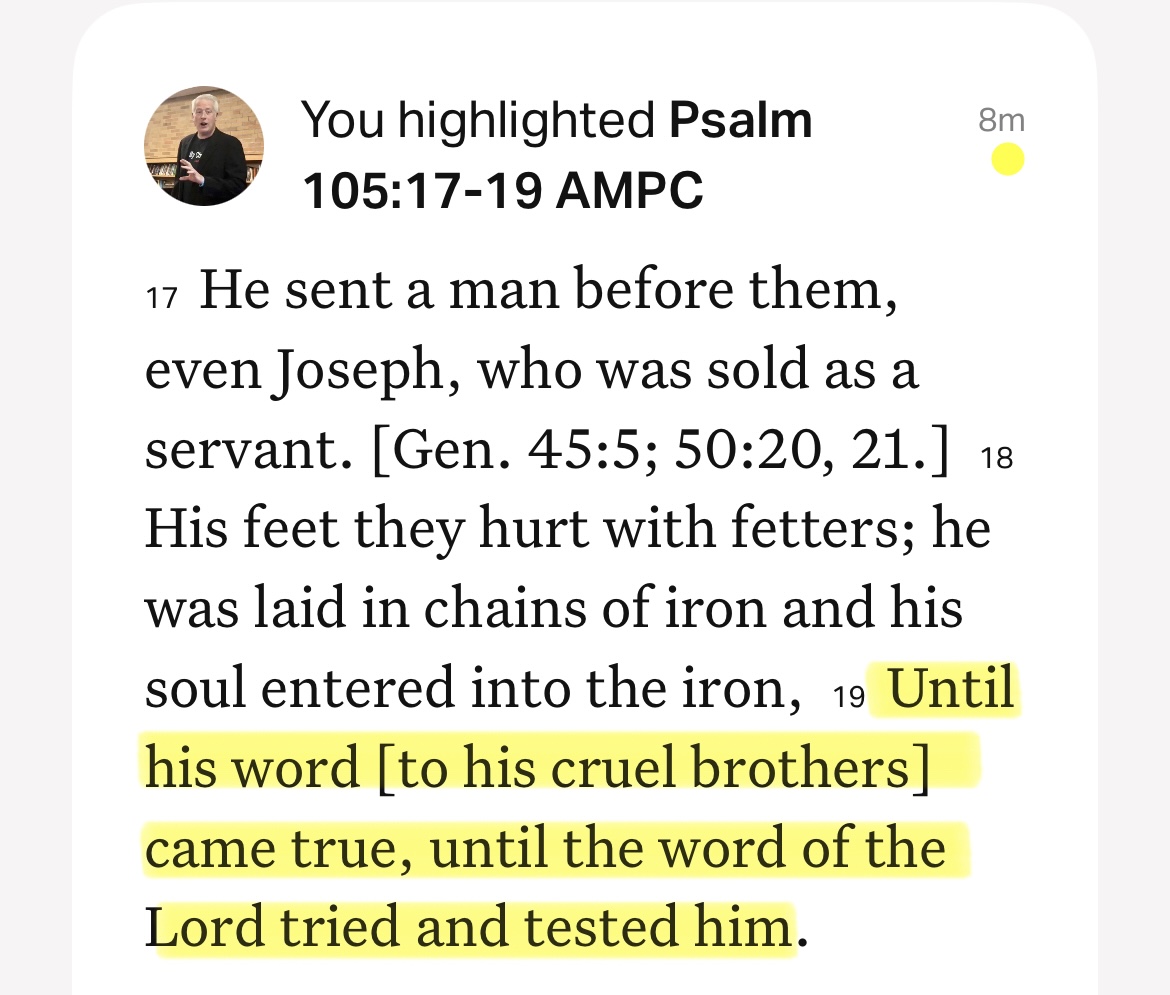
Moreover, [God] called for a famine upon the land of Egypt; He cut off every source of bread [Genesis 41:54]. He sent a man before them, even Joseph, who was sold as a servant [Genesis 45:5; 50:20, 21]. His feet they hurt with fetters; he was laid in chains of iron and his soul entered into the iron, until his word to his cruel brothers came true, until the word of the Lord tried and tested him. The king sent and loosed him, even the ruler of the peoples, and let him go free. He made Joseph Lord of his house and ruler of all his substance [Genesis 41:40]. To bind his princes at his pleasure and teach his elders wisdom. (Psalm 105:16-22 AMPC)
“The word of the Lord tried and tested him.” When we cling to God’s promises despite the seemingly impossible circumstances we are in, that faithful clinging matures us. It both softens our heart and strengthens our trust in God.
Before going through the difficulties, Joseph wasn’t ready to operate effectively in such a lofty leadership position. God uses all things to mold us and shape us for His purpose (Romans 8:28). We certainly see a more mature Joseph standing before Pharaoh than we saw interacting with his brothers earlier in his life.
God called Joseph and he prepared Joseph. All that was lacking was Joseph’s faithful clinging to God and yielding to God’s maturing process. The end result was one of the most impactful leaders that history has ever known!
Listen to the podcast of this post by clicking on the player below, and you can also subscribe on Apple, Spotify, or Audible.
After God created Adam, He said, “It’s not good for you to be alone.” That’s just as true today: God didn’t intend for us to journey on our own, but He gives us companions along the way.
Last week we saw that God has to sometimes cause us grief to get our attention when we are straying from His path. He sometimes puts people in our lives to do the same thing.
There’s a reason God puts the people in our lives that He does. We are called to speak the truth in love (Ephesians 4:15). But that sometimes means people will get upset with us (Galatians 4:16). “Real friends hurt each other. … Truth is the primary way faithful friends should wound each other—it is the help that hurts.” —Dick Brogden
The Corinthians thought they were super-spiritual, but Paul had to call them out on their foolishness (1 Corinthians 3:3; 5:1-2). Before Pauls’ letter, the Corinthians seemed happy. His letter caused them grief, but it was good grief that led to repentance and true joy (2 Corinthians 7:8-10).
To keep silent when a brother or sister is straying is not God-honoring. We are not to be the sin police, but we are to address sinful issues (James 5:19-20).
As King David flirted with the idea of how he could get something that he thought would make him happy, an anonymous attendant tried to get his attention. David ignored this and then tried to sweep it under the rug. In fact, he thought he got away with his sin (2 Samuel 11:1–12:7).
But God sent Nathan to speak a hard word to David. We don’t know when Psalm 141 was written, but we know that David did write it. Perhaps it was penned at the time of Nathan’s loving confrontation. He said, “Let a righteous man strike me—that is a kindness; let him rebuke me—that is oil on my head” (Psalm 141:5).
We do know that David wrote Psalm 51 after Nathan’s loving hard word, and in this prayer we see David’s confession, repentance, and a request for God’s joy to replace David’s grief.
So how do New Testament-era Christians use good grief to help fellow saints?
Examine yourself first (Matthew 7:1-5). Make sure you aren’t plagued by the same sin you have noticed in a brother or sister.
Cry before you confront, just as the prophet Samuel did before he had to deliver a hard word to King Saul (1 Samuel 15:10-11).
Confront in love with the goal of restoration, but make sure you are confronting someone who know you love them and who will receive your loving word(Proverbs 27:5; 9:8).
Pray that their grief will be turned to joy (Luke 22:31-32; Galatians 6:1; Psalm 51:12).
Friendships with fellow saints are precious and they are vital. We need iron to sharpen iron (Proverbs 27:17) so that we will all stand before the throne together for eternity.
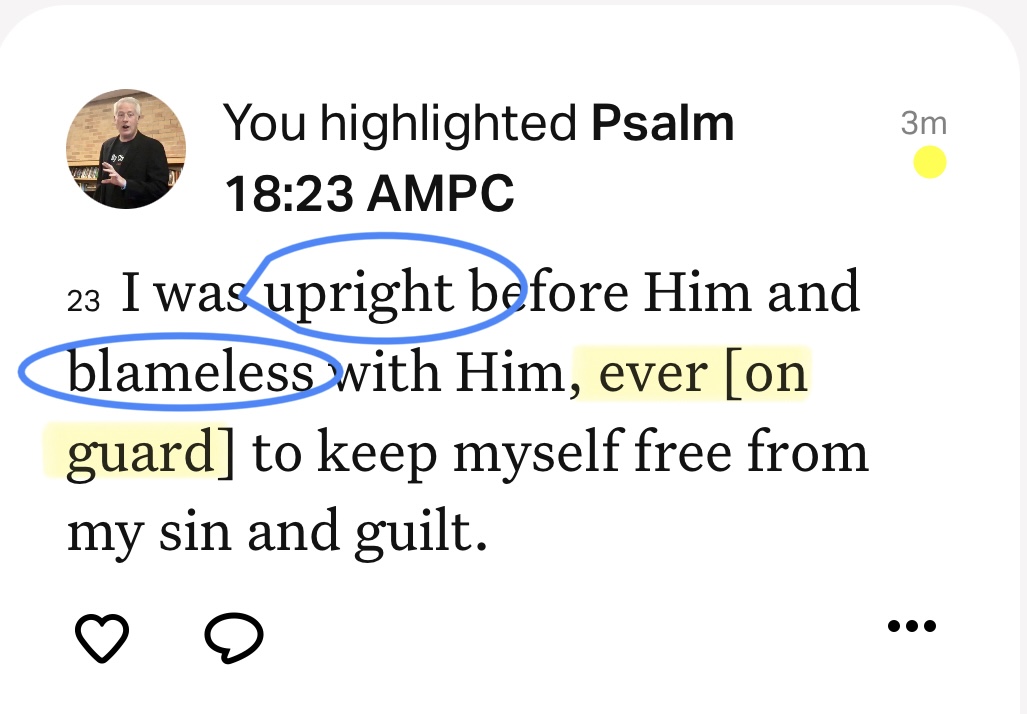
For I have kept the ways of the Lord and have not wickedly departed from my God. For all His ordinances were before me, and I put not away His statutes from me. I was upright before Him and blameless with Him, ever on guard to keep myself free from my sin and guilt. (Psalm 18:21-23 AMPC)
May we always be on guard against drifting away from the truth.
It is human nature to try to cut corners, to relax standards, to not be as careful as we once were. But we need to listen to the voice of the Holy Spirit that is calling us to blamelessness—being increasingly attentive to the standards shown us in God’s Word and in the example of the life of Jesus.
Part of being “ever on guard” is to continually raise our standards. Being challenged to meet a higher standard will keep us from the complacency that can lead to us slipping away.



 As we mature physically we pay more attention to our physical health. Why is that people who see themselves as spiritually mature think they can do the exact opposite by taking it easy? We must pay more attention, not less.














 Craig T. Owens