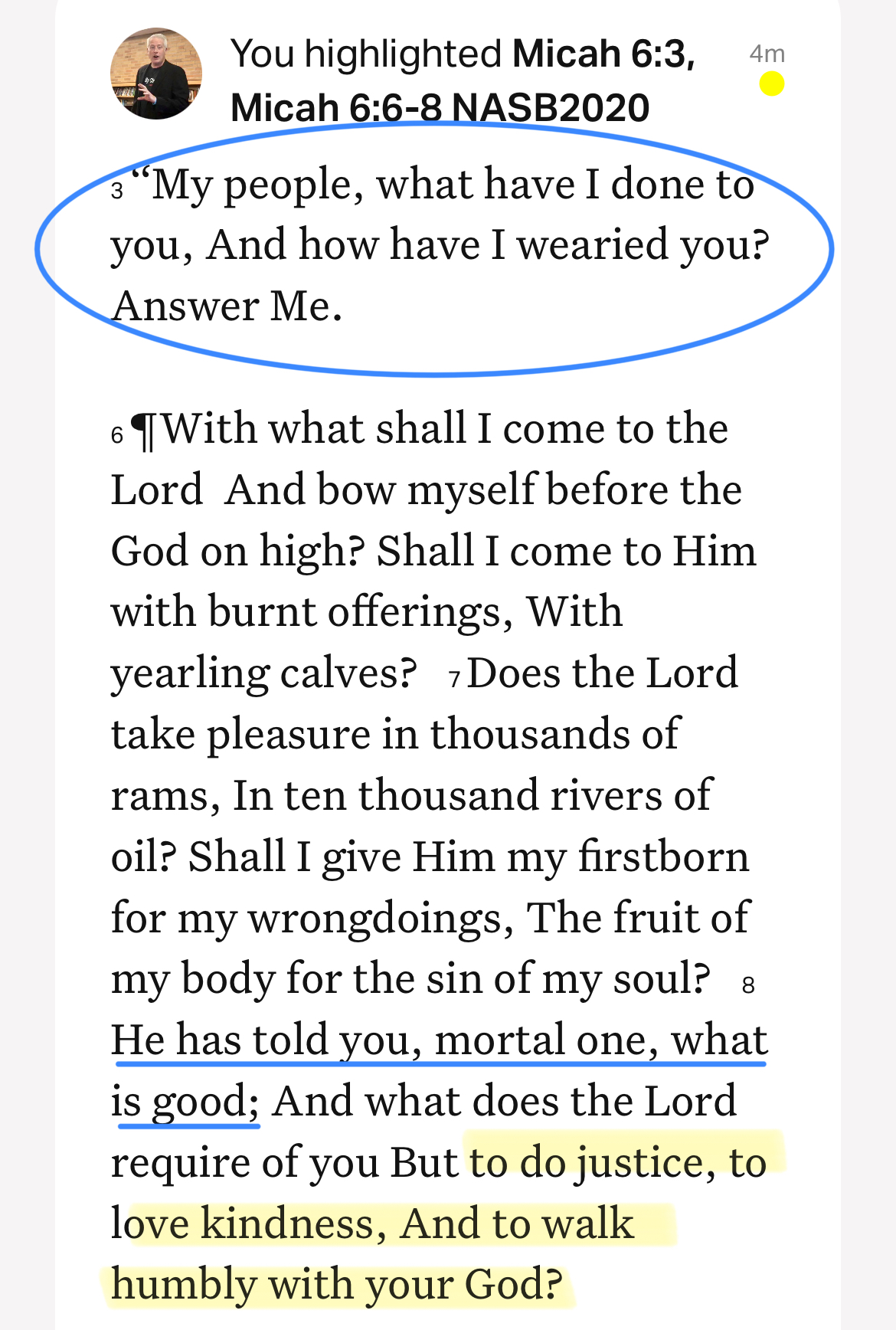
My people, what have I done to you, and how have I wearied you? Answer Me. … With what shall I come to the Lord and bow myself before the God on high? Shall I come to Him with burnt offerings, with yearling calves? Does the Lord take pleasure in thousands of rams, in ten thousand rivers of oil? Shall I give Him my firstborn for my wrongdoings, the fruit of my body for the sin of my soul?He has told you, mortal one, what is good; and what does the Lord require of you but to do justice, to love kindness, and to walk humbly with your God? (Micah 6:3, 6-8)
God doesn’t weary us with constantly changing or overbearing rules!
What God asks of us is that we give Him our heart (love the Lord your God with all your heart, soul, mind and strength), and then we live a life that shows His love to others (love your neighbor as yourself).
That’s it: Love God, and then let justice, love, and humility flow out from that Source of love.
Listen to the podcast of this post by clicking on the player below, and you can also subscribe on Apple, Spotify, or Audible.
An expert in Jewish law asked Jesus, “What must I do to inherit eternal life?”
Jesus, knowing this man was an expert in the law, turned the question back on him, “What do you think is written in the law about this?”
This man quoted to Jesus two passages in the mosaic law, and Jesus told him, “You have answered correctly. If you do that you will have eternal life.”
The two things he quoted were loving God with all your heart, soul, mind, and strength, and loving your neighbor as yourself. But then comes an interesting phrase. Luke writes that, “He wanted to justify himself, so he asked Jesus, ‘And who is my neighbor?’” This tells me that this expert in the law was trying to figure out the least that he could do to be approved by God.
In answer to his question, Jesus told the story that we now refer to as the parable of the good Samaritan. The Samaritan didn’t measure his love by the least he could do, and he didn’t limit himself to doing only what was comfortable or convenient. In fact, he didn’t measure his response at all—he simply did what was needed without any thought of the cost.
We often use WWJD to ask ourselves, “What would Jesus do?”
Since Jesus embodied love, maybe a more clarifying question would be WWLD—What would love do?
Maybe we could combine this with the Golden Rule. If I was in need, how would I want my neighbor to treat me? Then, as Jesus said to the expert in the law, “Go and do likewise to all your neighbors.” This is what pleases God and glorifies Jesus.
(Read this whole account for yourself in Luke 10:25-37.)
Perhaps a good prayer for us would be: Heavenly Father, I want to love the way Jesus loved. Help me to do what Love would do in all my interactions with my neighbors today. Father, be glorified in my neighborly responses today. I want to follow the example Jesus gave me, so I pray this prayer in His name. Amen.
Listen to the podcast of this post by clicking on the player below, and you can also subscribe on Apple, Spotify, or Audible.
I think the best-known verse in the Bible may be, “For God so loved the world that He gave His one and only Son, that whoever believes in Him shall not perish but have eternal life” (John 3:16). This truly is amazing love!
But on several occasions, the Gospel writers talk about the compassion of Jesus. This is a different word altogether. The root Greek word is “bowels.” To feel this kind of compassion means to feel it in your gut—to ache with the same pain that is afflicting someone else.
But compassion means more than feeling the pain, it also means going into action to alleviate the pain. True compassion aches and then acts.
Look at the compassion of Jesus—
He sees crowds of people “harassed and helpless, like sheep without a shepherd.” His compassionate response is to pray for His Father to send more shepherds to these sheep (Matthew 9:36-38).
He sees people plagued by diseases—paralysis, deafness, blindness, even death—and He places His hands on them and brings complete healing (Matthew 14:14, 20:34; Mark 1:41, 9:22; Luke 7:11-15).
He notices hungry people and He feeds them (Matthew 15:32; Mark 8:2).
He encounters confused people and He teaches them the illuminating truth (Mark 6:34).
This kind of compassion is costly. It cost Jesus time to be alone, it cost the king, the prodigal father, and the Samaritan money to forgive a debt, lose an inheritance, and pay medical bills. But Christ-like compassion knows there is no greater reward than aching and acting like Jesus.
Christ-like compassion must be extended in faith. Like touching someone with unclean disease, or fasting to receive power to release a loved one shackled to a heavy burden, or embracing someone who hurt me, or canceling a debt owed to me, or helping someone who despises me. When we ache and act like this, we show the love of God in irrefutable ways. Our selfless, Christ-like compassion paints a vivid picture for a skeptical world to see and embrace the love of God that sent His Son to ransom us.
Let’s make it our prayer that we would ache with the needs of the people around us, and then to move in faith-filled, Christ-honoring, selfless action to alleviate that need. Then let us believe that our compassion will show others the love of a Savior.
Listen to the podcast of this post by clicking on the player below, and you can also subscribe on Apple, Spotify, or Audible.
I’m a bit of a nut about the exactness of words, so one of my pet peeves is the incorrect use of imply and infer. “Imply” is something I do as the speaker; “infer” is something you do as the listener. Or you might say implying is like throwing and inferring is like catching.
A big problem arises when I infer something that you didn’t imply. Or even worse, when I infer something based on something you didn’t say. People will often say something like this, “Since Jesus didn’t specifically talk about ________ then it must be okay.” In logic, this would be called an argument from ignorance: concluding that an action must be acceptable because it has not been specifically stated to be unacceptable.
Statement #10 in our series asking “Is that in the Bible?” is—Love your neighbor. Is that in the Bible? Yes!
Later on, Jesus would add to this Deuteronomy 6:5—Love the Lord your God with all your heart and with all your soul and with all your strength—to answer the question about the greatest commandment of all.
In Leviticus 19, the Hebrew word for love means love in the broadest sense of the word, and neighbor means a friend or a fellow citizen. Unfortunately, the rabbis inferred that someone not a Jew was therefore an enemy and therefore not worthy of love. They further inferred that the opposite of love was hate.
Matthew Henry commented, “They were willing to infer what God never designed.”
Statement #11 is—Hate your enemy. Is that in the Bible? Yes, in the fact that it appears in print in Matthew 5:43, but it doesn’t appear in the Scripture that Jesus knew. It had become so ingrained in the thinking of people that they now assumed it was in the Bible.
In many ways, the Old Testament laws were easier to live out because they were all external and easy to measure, like don’t murder or don’t sleep with someone who isn’t your spouse. But Jesus made it a heart issue—He said lust is the same as adultery and hate is the same as murder.
Jesus also made love for enemies a heart issue. The word He used for love in the Greek is agape—the same word describing God’s love for His enemies in John 3:16—For God so LOVED the world, that He gave His one and only Son, that whoever believes in Him would not perish but would have everlasting life.
Jesus said our enemies were really our neighbors and were worthy of sacrificial love because they, too, were loved by God.
Matthew 5:44 is shortened in the NIV and has a footnote explaining that the longer verse was not seen in the earlier manuscripts. But given the fact that Jesus demonstrated everything found in the longer version of this verse, I think we are safe in using it. So let’s look at the response Jesus calls us to from the NKJV: But I say to you, love your enemies, bless those who curse you, do good to those who hate you, and pray for those who spitefully use you and persecute you.
Here’s what Jesus says it means for us to love our enemies:
(2) Help the haters. Jesus said we are to do those things that are beautiful and excellent—like the Good Samaritan did for his enemy-turned-neighbor (see Luke 10:25-37).
(3) Pray for the persecutors. Talk to God about them; don’t talk to others about them.
This response from Christians toward people whom others would call an enemy is totally unexpected by the world. This unexpected response will begin to draw enemies toward Jesus (1 Peter 2:12). If we will treat enemies and neighbors, they may soon become brothers and sisters in the family of God!
When the world hits us Christians out of hate, let’s respond with unexpected love: blessing those who curse us, helping those who hurt us, and praying for those who persecute us.
This is a weekly series with things I’m reading and pondering from Charles Spurgeon. You can read the original seed thought here, or type “Thursdays With Spurgeon” in the search box to read more entries.
Listen to the podcast of this post by clicking on the player below, and you can also subscribe on iTunes or Spotify.
Active Love
True love next shows itself in obedience. … ‘Tis love that makes our willing feet in swift obedience move.’ We can do anything for those we love, and if we love Jesus, no burden will be heavy, no difficulty will be great. We should rather wish to do more than He asks of us and only desire that He was a little more exacting that we might have a better opportunity of showing forth our affection. …
The apostle says, ‘Let us not love in word or in tongue, but in deed and in truth’ (1 John 3:18). Actions speak louder than words, and we will always be anxious to tell our love in deeds as well as by our lips. The true disciple asks continually, ‘Lord, what do You want me to do?’ (Acts 9:6). He esteems it his highest honor to serve the Lord. …
I believe in an active love that has hands to labor and feet to run as well as a heart to feel, eyes to glance, and ears to listen.
how you can get a free copy of The Shawn Effect [3:53]
Shawn’s parents set him up for success [5:15]
leaders get informed so they can interact with others and stay relevant [6:28]
Shawn demonstrated chivalry and trained young men to be gentlemen [7:53]
leaders don’t need a platform or a big following to be an influencer [8:40]
Shawn shows how leaders love [10:33]
leaders are encouragers [11:37]
leaders are readers and appliers [12:27]
Check out this episode and subscribe on YouTube so you can watch all of the upcoming episodes. You can also listen to our podcast on Spotify and Apple.
Listen to the podcast of this post by clicking on the player below, and you can also subscribe on Apple or Spotify.
I recently shared my book review on the heroic story of the ten Boom family during the Nazi occupation of Holland, as told in the story The Hiding Place. This story is a must-read! Please check out my full book review by clicking here.
These are some quotes from these godly sisters.
“Worry does not empty tomorrow of its sorrow. It empties today of its strength.” —Corrie ten Boom
“Any concern too small to be turned into prayer is too small to be made into a burden.” —Corrie ten Boom
“When Jesus Christ tells us to forgive our enemies, He gives us the power He demands of us.” —Corrie ten Boom
“We must tell people how good God is. After the war, we must go around telling people. No one will be able to say that they have suffered worse than us. We can tell them how wonderful God is, and how His love will fill our lives, if only we will give up our hatred and bitterness.” —Betsie ten Boom
“At that moment when I was able to forgive, my hatred disappeared. … Forgiveness is the key which unlocks the door of resentment and the handcuffs of hatred. It is a power that breaks the chains of bitterness and the shackles of selfishness. What a liberation it is when you can forgive.” —Corrie ten Boom
“Never be afraid to trust an unknown future to a known God.” —Corrie ten Boom
“When a train goes through a tunnel and it gets dark, you don’t throw away the ticket and jump off. You sit still and trust the engineer.” —Corrie ten Boom
“If they can be taught to hate, they can be taught to love.” —Betsie ten Boom, speaking to Corrie about the Nazi prison guards
“We never know how God will answer our prayers, but we can expect that He will get us involved in His plan for the answer. If we are true intercessors, we must be ready to take part in God’s work on behalf of the people for whom we pray.” —Corrie ten Boom
“Holiness is the Holy Spirit, a holy God in my heart, which makes me similar to Jesus.” —Betsie ten Boom












 Craig T. Owens