Walk This Way

In his letter to the Christians in Ephesus, Paul uses the word “walk” seven times to instruct them how to follow the path Jesus laid down for us. 

In Greek, the word for “walks” (peripatēo) means something that regulates my life, or something that keeps me on the right path. It’s my lifestyle that is kept in proper boundaries by something outside of me. 

First of all, notice how Paul tells Christians how not to walk. DON’T WALK THIS WAY…

…following pop culture (2:2)—Living a certain lifestyle because “everyone” is doing it, or because some popular people are living that way. 

…without thinking about why you’re walking the way you are (4:17)

…without comparing your walk to truth (5:8)—Living a life because it feels good to me is a dangerous way to live. I must make sure there is an objective truth that is keeping me on a proper path.

…foolishly (5:15)—To be foolish is either (a) not knowing the truth, (b) not applying the truth I have been shown, or (c) choosing to disregard the truth I’ve been given. 

Instead, Paul tells Christians to WALK THIS WAY

…knowing I am God’s workmanship, created for a great purpose (2:10)—It may take me some time to discover my purpose and my talents, but I keep at it. 

…worthy of my vocation (4:1)—Once I have discovered my talents, I develop them into strengths that will benefit others. 

…lovingly (5:2)—Just as Jesus did! 

…in the light of God’s truth (5:8)—This is the exact opposite of foolishly walking. It means I seek the truth and I apply the truth to my life. 

…circumspectly (5:15)—Not wasting my moments, but making sure I am giving 100 percent every single day.

When I WALK THIS WAY people will inevitably notice that I’m motivated not by popularity with people, but by intimacy with God (5:2-7). They will see that my path is bordered by the principles in God’s Word (5:8-14; Psalm 119:105). And they will notice that my life has purpose and is productive (5:15-20). 

All Christians should ask themselves:

  • Is Jesus pleased with the path I’m on today?
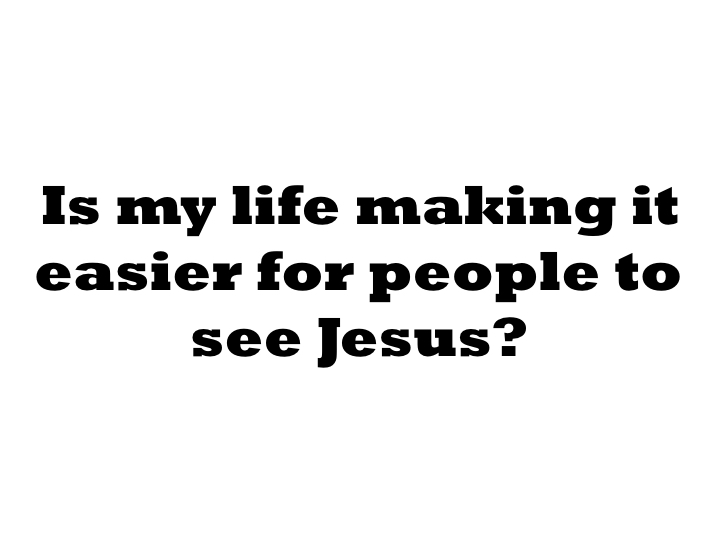
  • Can others follow my footsteps toward their own relationship with Christ? 

If you can answer “yes” to those questions, then Jesus will be pleased that you WALK THIS WAY! 

[You can check out the Scriptures I referenced in this post by clicking on DON’T WALK THIS WAY and WALK THIS WAY above.]

What Is Church?

All across the world on Sunday morning, people met for church? But what exactly is church? Is it a place we go to? Is it something that only happens on Sundays? 

The Greek word for church is ekklesia. It meant an assembly of citizens. Luke used the term when he recorded a government official saying, “If there is anything further you want to bring up, it must be settled in a legal assembly” (Acts 19:39). But in the New Testament, it came to mean “a community based on a special religious idea and established in a special way” (Dr. Marvin Vincent). It can also mean either a local group of Christians or “the whole body of Christians scattered throughout the earth” (Dr. James Strong). 

Church never means a building. Nowhere does the phrase “go to church” appear in the New Testament. Instead, church carried the idea of a living, growing organism because church was wherever a follower of Jesus was. Sometimes the church met collectively in one location, and sometimes individual believers were out in the community. But wherever the Spirit of God went, church was happening. 

If church is not something we go to, it’s also not something that takes place only one day per week. Look at what Jesus did on the Sabbath day: 

But we also see Jesus doing all of these things EVERY day of the week. 

For Jesus, neither the day of the week nor the location determined the way He lived. Peter summed it up this way, “God anointed Jesus of Nazareth with the Holy Spirit and with power. Then Jesus went around doing good and healing all who were oppressed by the devil, for God was with Him” (Acts 10:38). 

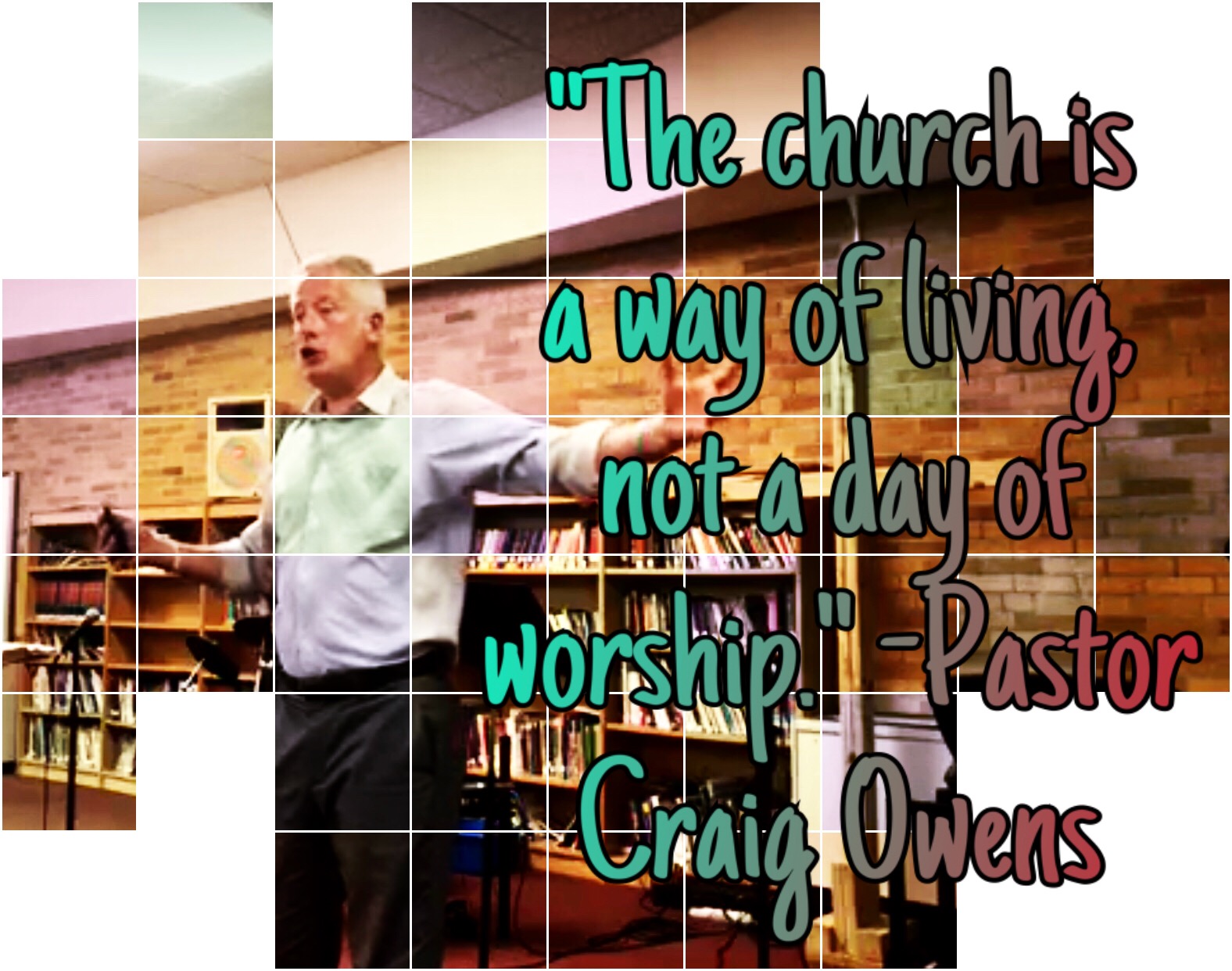
In fact, before they were called Christians the church was simply called “the Way” letting us know that the church was a way of life, not a day of the week. 

Based on how Jesus lived and how the Apostle taught, I think we can see the Church Way like this: 

In other words, EVERY day and in EVERY place the followers of Jesus were being enriched in their own lives so that they could reach out to the hurting so that they could come to know Jesus personally so that their lives could be enriched so that they too could reach out to others, and on, and on, and on it goes! 

Limiting “church” to a specific location or to a specific day of the week is way too small-minded. Church as Jesus intended it was a powerful force that would set people free EVERY day and in EVERY place from the power of the devil and introduce them to God’s eternal life! 

Saturday In The Psalms—Resolutions

I will… (9x in Psalm 101).

Psalm 101 is only eight verses long, but David makes nine I will resolutions to God. Perhaps you might consider making these resolutions yourself—

(1) I will sing of mercy and justice. These are two sides of the same coin; in fact, it’s only when we know God’s justice that we can appreciate His mercy. Both God’s justice and His mercy need to be celebrated.

(2) I will sing praises. Regardless of our situation or setting, God is worthy to be praised.

(3) I will behave wisely in a perfect way AND (4) I will walk within my house with a perfect heart. A commitment to integrity, living a godly lifestyle, and leaving a godly legacy.

(5) I will set nothing wicked before my eyes AND (6) I will not know wickedness. A commitment to be childlike in regard to wickedness, and watchfulness of anything impure.

(7) I will destroy AND (8) I will not endure AND (9) I will destroy all the wicked. A resolution to cut-off all relationships that are not God-honoring.

Resolutions aren’t just for New Year’s Day. Resolutions can be made any time we sense something in our life isn’t as God-pleasing as it could be.

What resolutions are you willing to make?

Inside & Outside

When God was about to deliver the Israelites out of Egypt, the last event that displayed His power is now remembered as the Passover. It was the night that anyone who followed God’s command to sacrifice a perfect lamb and apply the lamb’s blood to the doorposts of their house was spared His judgment. In other words, His judgment passed over that house.

How did an Israelite family know that God’s judgment had passed over them? Quite simply, their firstborn child was still alive the next morning.

Jesus described Himself as not only the sacrificial Lamb and the saving Blood, but He also said, “I am the Door.” When we place our faith in what Jesus did for us on the Cross, His blood is applied to our heart, we enter in His door and we are safe from God’s judgment.

But how do we know that God’s judgment has passed over us? Are there any visible signs?

Actually, God gives us two assurances that we have been saved from His judgment:

  1. The inner witness of the Holy Spirit
  2. The outward evidence of our new life in Jesus

The Apostle Paul talked about his inner turmoil when he tried to live a life he could control (note the prevalence of me, I, and my, and the absence of any mention of Jesus in Romans 7:14-24). His bottom line conclusion—O what a wretched man I am! Who will rescue me from this body of death?

But then he discovers the power of Christ: Thanks be to God—through Jesus Christ our Lord, and as a result of this he discovers…

  • there is no more condemnation
  • there is no more death
  • there is no more hostility
  • there is no more fear
  • there is now life
  • there is now freedom
  • there is now assurance of God’s love

How? By the Holy Spirit’s inner witness in his heart (see Romans 8).

With this inner witness, a new lifestyle (the outward evidence) begins to show, as Paul begins to live a brand new life. This brand new life on the inside shows on the outside. Paul says it’s a life full of love, joy, peace, patience, kindness, goodness, faithfulness, gentleness and self-control.

So here’s the new cycle for a Christian that an assurance of salvation from God’s judgment, and gives an encouragement to live a life that glorifies Jesus our Savior:

The inner witness of the Holy Spirit assures me of God’s love ➞ I want to live a life that pleases Him ➞ the Holy Spirit internally approves or corrects my outward lifestyle ➞ I continue to live outwardly in a way that is showing more fruitfulness …. and on and on and on it goes. 

All for the glory of God!

If you are a Christian, do you have that inner assurance? If you do, are you acting on it outwardly so that people can see the difference Jesus has made in your life?

Thursdays With Oswald—Is Your Religion Rotten?

Oswald ChambersThis is a weekly series with things I’m reading and pondering from Oswald Chambers. You can read the original seed thought here, or type “Thursdays With Oswald” in the search box to read more entries.

Is Your Religion Rotten?

      No man can redeem his own soul, or give himself a new heredity; that is the work of the sovereign grace of God. Man has nothing to do with Redemption, it is God’s “bit”; but God cannot give a man a good character, that is not God’s business, nor is it an inevitable thing. God will give us what we cannot give ourselves, a totally new heredity (see Luke 11:13). God will put the disposition of His Son, Holy Spirit, into any man who asks, then on that basis man has to work out a holy character. “Work out your own salvation with fear and trembling; for it is God which worketh in you….” [Philippians 2:12]

      If your religion does not make you a better man, it is a rotten religion. The test of true religion is when it touches these four things—food, money, sex and mother earth. These things are the test of a right sane life with God, and the religion that ignores them or abuses them is not right. … A man needs to hold a right attitude to all these things by means of his personal relationship to God.

From Shade Of His Hand

God gives Christians a new heredity—a new way of looking at life through a relationship with Jesus Christ—by placing His Holy Spirit in us. That, as Chambers says, is God’s bit.

What we do with this new heredity—this new way of looking at life—is our bit.

So… how are you doing? Does your relationship with Jesus Christ help you handle food, money, sex and mother earth in God-honoring ways? Is the Holy Spirit able to correct your attitude so it aligns with the biblical viewpoint on these topics?

If you can answer “yes” to those questions, your religion is true. If not, Chambers says you have “a rotten religion.”

Thursdays With Oswald—Becoming A Real Saint

Oswald ChambersThis is a weekly series with things I’m reading and pondering from Oswald Chambers. You can read the original seed thought here, or type “Thursdays With Oswald” in the search box to read more entries.

Becoming A Real Saint

     The real life of the saint on this earth, and the life that is most glorifying to Jesus, is the life that steadfastly goes on through common days and common ways, with no mountain-top experiences. We read that John the Baptist “looked upon Jesus as He walked…”—not at Jesus in a prayer meeting or in a revival service, or Jesus performing miracles; he did not watch Him on the Mount of Transfiguration, he did not see Him in any great moment at all, he saw Him on an ordinary day when Jesus was walking in an ordinary common way, and he said, “Behold the Lamb of God!” That is the test of reality. …

     God’s purpose is to make us real, that is, to make us perfectly at one with all our own powers and perfectly at one with God, no longer children but understanding in our heads as well as in our hearts the meaning of the Redemption, and slowly maturing until we are a recommendation to the redeeming grace of our Lord Jesus Christ.

From The Philosophy Of Sin

Oh, how I want to be a real saint!

Not someone who only shines for Christ when I have a mountain-top experience, but one who shines brightly for Him every day, in every common setting. What an amazing thing for my life to be a recommendation to the redeeming grace of our Lord Jesus Christ!

Thursdays With Oswald—Thinking Like Christians

Oswald ChambersThis is a weekly series with things I’m reading and pondering from Oswald Chambers. You can read the original seed thought here, or type “Thursdays With Oswald” in the search box to read more entries.

Thinking Like Christians 

     The New Testament insists on an instructed mind as well as a vital experience. … 

     There is always a quarrel between our common sense and the revelations made in God’s Book. We must lose our soul in order to find it. We have to be born from above and receive the Holy Spirit into our spirit, and then begin to construct another soul, or way of reasoning, and to do this we must accept not only the facts that come to us through our common sense, but the facts that come by revelation. We say seeing is believing, but it is not. We must believe a thing is possible before we should believe it even though we saw it (John 20:29). … 

     Our beliefs will mock us unless something comes into us from God, because nothing has any power to alter us save the incoming of the life of God. The Holy Spirit is the One Who makes experimentally real in us what Jesus Christ did for us. … The great need for men and women is to receive the Holy Spirit. Our creeds teach us to believe in the Holy Spirit; the New Testament says we must receive Him (Luke 11:13). Are you powerless in your life? Then, for Christ’s sake, get at Reality! Ask God for the Holy Spirit. … 

     We starve our minds as Christians by not thinking, and we cannot think as Christians until we are born from above. So many of us have a good spiritual experience, but we have never thought things out on Christian lines. It is just as true that a man may live a Christian life without thinking as that a man may think a Christian life without living it. We have to learn to combine the two, and to do this we must build up our minds on these great truths. 

From The Psychology Of Redemption

How are you doing at thinking AND living a Christian life? To do both, you must receive the Holy Spirit, and begin to rely on Him for both Christian thinking and living.

Are You Expecting The Lord?

Horatius Bonar“Are you expecting the Lord? Are you living in this expectation? Is it a deep-seated, abiding, cherished hope? Is it a hope that tells upon your character, your life, your daily actings in public or private, your opinions, your whole man? Does it quicken you? Does it purify you? Does it keep you separate from the world? Does it keep you calm in the midst of earth’s most exciting events, or most untoward changes? Does it give you a new view of history as well as prophecy? …

“Let your expectation of the Lord’s coming be a calm and healthy one; not one that excites, but one that tranquilizes; not one that unfits for duty, but one that nerves you more firmly for it; not one that paralyzes exertion, but one that invigorates you for it; not one that makes you indifferent to present duty, but one that makes you doubly in earnest about everything that your hand findeth to do; not one that stops liberality, and prayer, and work, but one that increases all these a hundred fold; not one that dwells exclusively on the future’s dark side—the judgments that are at hand—but one that realizes the glory and the joy of Messiah’s approaching victory and triumphant reign.” —Horatius Bonar

Thursdays With Oswald—Experience Or Expression?

Oswald ChambersThis is a weekly series with things I’m reading and pondering from Oswald Chambers. You can read the original seed thought here, or type “Thursdays With Oswald” in the search box to read more entries.

Experience Or Expression?

     It is not sufficient to have an experience. If all I can do is to preach and recount the experiences God has given me, it is dangerously inefficient. … Experience must be worked out into expression; the expression is a strong family likeness to Jesus, and its mark is found in the secular life, not in the sequestered life. … 

     A witness is not one who is entranced by Jesus, by the revelation He gives, by what He has done; but one who has received the energy Jesus Himself had, and is become a witness that pleases Him, wherever he is placed, whatever he is doing, whether he is known or unknown. … 

     The spiritual life can never be lived in religious meetings, it can only be lived on sordid earth, where Jesus lived, amongst the things that makes human life what it is. 

From The Place Of Help

It’s not what I’ve experienced from Jesus, but how I am expressing that experience in my daily life. People don’t need me to be a storyteller of my experiences, but a living expression of the change that has taken place in me because of that experience with Christ!

All of the stories of my spiritual experiences can be undone in a single moment of un-Christlike living. But when I live a life energized by the power of Jesus in me, the story of His life-changing power is told without words.

Do I want to merely experience God’s life-changing power, or do I want to be a living expression of His life-changing power?

6 More Quotes From “Light & Truth—Acts and the Larger Epistles”

Light & Truth [Acts]Horatius Bonar’s wisdom and insight in the Scriptures is still clear and relevant for us today. Here are some additional quotes I highlighted in his commentary. The reference in brackets is the passage in the Bible on which Bonar is commenting.

“We are described as feeble men, bearing on our shoulders a burden too heavy to be borne; the Holy Spirit comes up to us; not exactly to take away the burden; nor to strengthen us under it; but to put His own Almighty shoulder under it, in the room of, and along with ours; thus lightening the load, though not changing it; and bearing the heavier part of it with His own Almightiness. Thus it is that He ‘helps’ our infirmities; making us to feel both the burden and the infirmity all the while that He helps; nay, giving us such a kind and mode of help, as will keep us constantly sensible of both.” [Romans 8:26

“How real, how true, how fast must that love have been. Here is its sincerity demonstrated. Here are its dimensions measured. What is its height? The answer is, ‘He spared not His Son.’ What is its depth? ‘He spared not His Son.’ What is its length? ‘He spared not His Son.’ What is its breadth? ‘He spared not His Son.’ Nay, He delivered Him up. Nay, He laid our sins upon Him; He made Him a curse for us. The more that we meditate on this one gift, the more does its greatness display itself. It passeth all measurement and all understanding.” [Romans 8:32]

“Prayer takes for granted that God is full, and we are empty; that He is infinitely full, and we unspeakably empty. … Prayer takes for granted that there is a connection between His fullness and our emptiness. The fullness is not inaccessible. It is not too high for us to reach, or for it to stoop. It is not too great for us, nor too distant, so as to be incommunicable. There is a connection, and it has been established by God Himself; it is a divine medium of communication: ‘Ask, and you shall receive.’ Prayer takes for granted that we are entitled to use this channel.” [Romans 12:12

“If you are Christians then, be consistent. Be Christians out and out; Christians every hour, in every part, and in every matter. Beware of half-hearted discipleship, of compromise with evil, of conformity to the world, of trying to serve two masters. … Half-hearted Christianity will only dishonor God, while it makes you miserable. There is abundance of Christianity, so-called, in our day. Who does not call himself a Christian? But who cultivates the holiness, the blamelessness, the devotedness, the calm consistency of a follower of Christ? Who hates sin as it ought to be hated? Who separates from the world as he ought? Who follows Christ as He ought to be followed? Who walks in the footsteps of the holy Son of God?” [1 Corinthians 1:8]

“Let us walk worthy [of the blessings in Christ Jesus]; as men who really believe it; happy, holy, unworldly, zealous, generous, loving. Let us carry the consciousness of our calling into everything—great or small; into business, daily life, recreations, reading, education, everything; maintaining our true position before men; manifesting our proper character; letting the world know our prospects, and doing nothing inconsistent with what we profess to be now, and with what we shall be when the Lord comes.” [1 Corinthians 1:9]

“Thus, then, is our whole earthly life, in all its parts, to be regulated by the magnitude of the eternal. Things present must be subordinated to those which are to come, the seen to the unseen, the earthly to the heavenly. It is by the light of the coming glory that we must walk while here. It is from the clock of eternity that our time is to be always taken. Arrange your business, your recreations, your duties with reference to the invisible and unending future. Live, speak, work, move, as those who believe that the things which are seen are temporal, but the things which are not seen are eternal.” [1 Corinthians 7:29-31]

The first set of quotes I shared from this book can be read here. And my review of this book is posted here.