Stronger Christians

When the Bible calls Christians to be strong, it is really calling them to be stronger and more courageous than they were previously. This requires a workout plan for our spiritual muscles!

Links & Quotes

I’ve found that in helping my teammates receive feedback about areas that need to be addressed, asking questions is the best way to do this. Check out the full conversation Greg and I had about blind spots.

I have a lot of new video content on my YouTube channel every week. Please check it out and subscribe so you don’t miss anything.

William Shakespeare was a master at a well-timed insult when one of his characters zinged another! Reader’s Digest has a list of 53 Shakespearian insults that are still good today!

What happens when you hold your breath? Among other things “your blood is delivering the last of oxygenated blood cells to your tissues while carbon dioxide is rapidly building up (hypercapnia). At the same time, there is a steady decrease of blood oxygen (hypoxia). The pH of your blood is getting slightly lower (acidic), and your heart starts to beat faster. God designed your brain to sense the increased carbon dioxide levels and initiates the effort for you to breathe. This will last for about a minute before there will be an involuntary intake of air via the contraction of your diaphragm.” And yet God designed aquatic mammals in a way uniquely suited to thrive in water. Amazing! 

When the Bible says that God’s hand was against His people, that is actually a very loving thing! Consider this example of a parent with a small child. Please watch this full sermon.

I have been sharing a series of messages with my church about how God turns our grief into joy. As a tie-in with this series, John Piper has Fifteen Tactics for Joy.

Grief From God

Listen to the podcast of this post by clicking on the player below, and you can also subscribe on AppleSpotify, or Audible. 

The insidious thing about leprosy is that it kills the body’s pain receptors. Lepers may walk on a broken ankle, utterly mangling their foot. Or they may stick their hand in the first without realizing it.  

Pain is important to us—it tells us that something isn’t right and that we should seek help. Just as there is a danger if we ignore physical pain, there is a greater danger if we ignore spiritual pain. It’s a greater danger because eternal separation from God is far more deadly than mere physical death. 

Moses warned the Israelites of the danger of spiritual complacency, or we could call it spiritual leprosy. Check out the warning in Deuteronomy 8:10-14, 17. It didn’t take too long for this spiritual numbness to set it (see the fulfillment of Moses’ words in Judges 2:10-15). 

(Check out all of the Scriptures in this post by clicking here.) 

When we read in Judges 2, “The hand of the Lord was against them,” this is actually a very loving statement. Think about it: What would happen if God continued to give them success in their sinful endeavors? 

We can see this a little more clearly in Isaiah 63:7-10 where we see that God’s love is both redemptive and corrective. His fighting against His people caused them to recall God’s ways and wait on Him once again (63:11; 64:4-5). Notice the last question of verse 5, “How can we be saved?” 

It starts with remembering—that’s what Moses said at the beginning of this journey, and it’s also what Jesus says at the end (Revelation 2:5). 

We have to meditate on God’s Word because it…

  • …is a mirror (James 1:22-25) 
  • …is a bright, revealing light (Psalm 90:8 AMPC) 
  • …surgically brings healing (Hebrews 4:12-13; Psalm 119:67, 70) 
  • …prompts godly sorrow without condemnation (Romans 8:1-2; 2 Corinthians 7:8-9) 

Only when this grief is turned to joy again can God use us to minister to others. We are able to comfort and redirect others because God has comforted and redirected us back onto His path. 

David became enamored with his spiritual success and forgot God’s laws. His sin caused God to turn and fight against him. In his deep grief, David cried out to God (Psalm 51:7-13). It was only after David repented that his grief was lifted and he was able to teach others about our loving God. 

Let’s not ignore our grief, but instead let’s ask God what He is trying to tell us through that grief. Remember, in our distress He is distressed and will carry us. But if our spiritual leprosy has taken us away from God, He will lovingly fight against us to get us to return to Him! 

You can check out all of the other messages in this series by clicking here. 

►► Would you please prayerfully consider supporting this ministry? My Patreon supporters get behind-the-scenes access to exclusive materials. ◀︎◀︎

Temporary Sorrow For Eternal Joy

Listen to the podcast of this post by clicking on the player below, and you can also subscribe on AppleSpotify, or Audible. 

On Sunday we looked at the thought that our grief often comes because our current situation isn’t what we expected it to be. Notice that we say, “what we expected,” as though we can control anything!  

Today we remember the horrific death of Jesus on the Cross and we call it Good Friday. We can only call it “good” now because we see the results on the other side. If we were to go back in time to the weeks, days, and even moments before Jesus was arrested and so cruelly treated, those around Him would call that time anything but good. 

Look how the disciples responded to this coming event (Matthew 16:21-22). Grief can also come when we give more weight to today’s pain than we do to eternity’s joy. 

(Check out all of the Scriptures in this post by clicking here.) 

This has always been a strategy of the devil to get people to look at now and not consider eternity. That’s how he tempted Adam and Eve, who gave in to this ploy. And then he tried the same strategy on Jesus, but failed (see Genesis 3:1-5; Matthew 4:1-10). 

Jesus knew why He came to earth (Matthew 20:28). And as He got closer and closer to the day of His crucifixion, the weight began to build (John 12:27). 

Look at how Jesus fought grief by making sure He gave more weight to eternity. He turned His pain into prayer so His Father could exchange His grief for His joy (Matthew 26:36-44).

Jesus prepared His disciples by trying to give them an eternal focus (Luke 22:14-20). He told them to pray that they wouldn’t give in to this temptation to trade eternal joy for momentary pain, but they didn’t understand. This is what focusing on the pain of now does—the weight of it exhausts us emotionally, physically, and spiritually.

But look at the eternal focus in vv. 17-19:

  • The crushed grape gives us wine 
  • The bruised wheat gives us bread 
  • The crushed, bruised, crucified Savior gives us eternal life  

“Very truly I tell you, unless a kernel of wheat falls to the ground and dies, it remains only a single seed. But if it dies, it produces many seeds” (John 12:24).

Remember the devil’s strategy: get us so focused on the pain of now that we forget about the far greater joy that lasts forever. 

Jesus wants us to “do this in remembrance of Me”—to see the crushed grape and the bruised wheat and the crucified Savior in the light of eternity. 

Check out the other messages in this series called Grief Into Joy by clicking here.

►► Would you please prayerfully consider supporting this ministry? My Patreon supporters get behind-the-scenes access to exclusive materials. ◀︎◀︎

Turning Pain Into Prayer

Listen to the podcast of this post by clicking on the player below, and you can also subscribe on AppleSpotify, or Audible. 

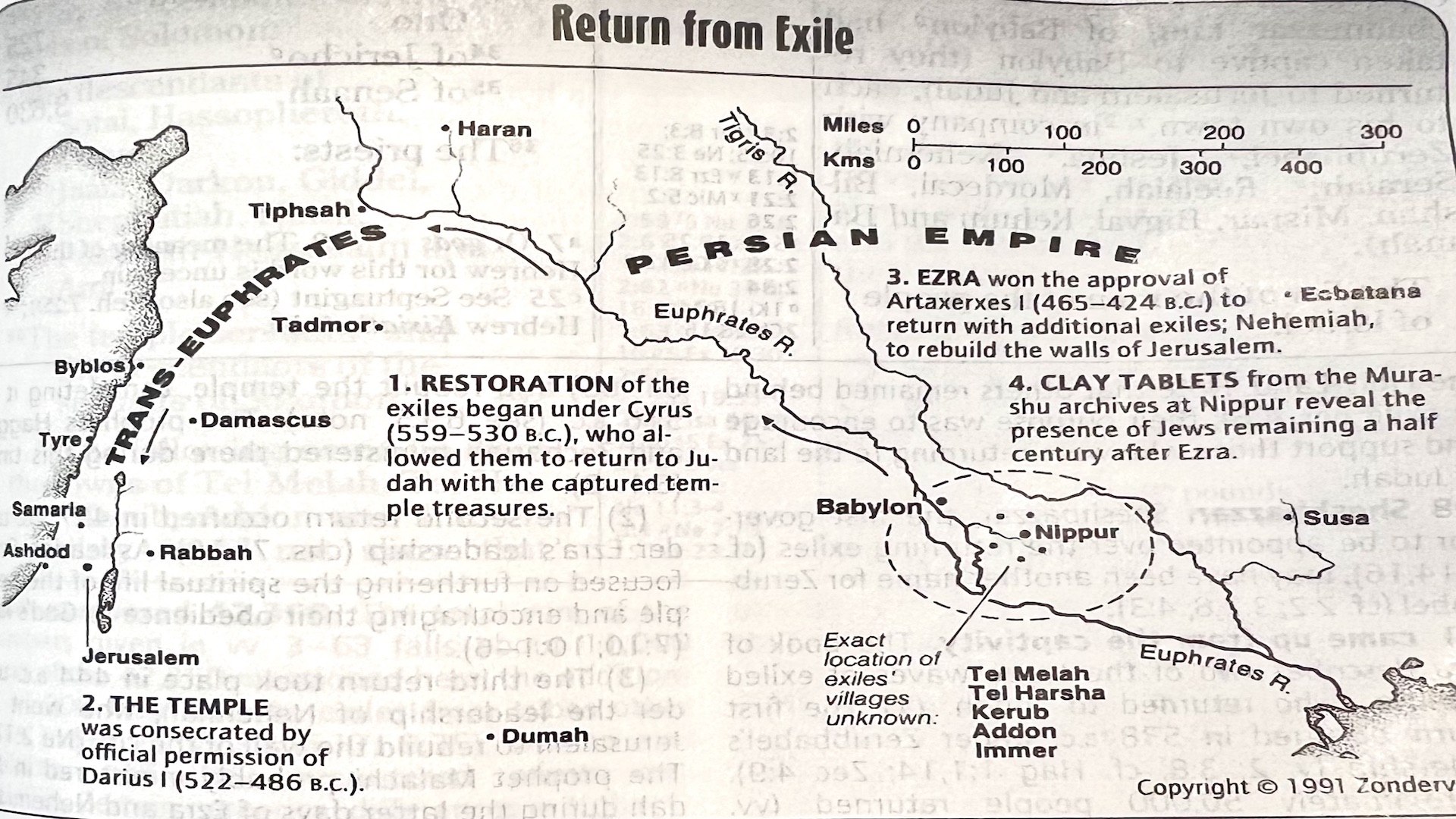
Last week we saw how the Israelites in exile had their time of grief—being targeted for annihilation—turned to joy when God granted favor to Queen Esther. 

The books of 1 and 2 Chronicles, Ezra, and Nehemiah are all written during this time period as the exiles are returning in waves to Israel. This is another grief-into-joy moment! More than likely, all four of these books were written by Ezra. Notice the note of joyful celebration that is repeated in the last words of 2 Chronicles and the opening words in the Book of Ezra (2 Chronicles 36:22-23; Ezra 1:1-4). We don’t know which psalmist wrote Psalm 126, but it sounds the same joyful note. 

(Please check out all of the Scriptures in this post by clicking here.)

Not all the exiles returned at once. In fact, the Book of Daniel shows us that Daniel likely stayed in his position of leadership to these governments until his death. 

The exiles were returning in waves. As the worship practices at the temple were reestablished and as people returned to lands allotted to each tribe, it was important for the leaders to make sure the right people were in the right places. So 1 Chronicles opens with genealogies. 

  • Beginning with Adam and Noah (1:1-4) 
  • The spiritual fathers (1:34) 
  • The family line of the Messiah (2:1-15; Matthew 1:1-6) through the family tree of David (3:1-24) 

Then 1 Chronicles 4 lists more clans in the tribe of Judah. Of special note is the Calebite clan (2:9, 18). 

In the Calebite clan we meet Jabez in 1 Chronicles 4:9-10. His name literally translated is sorrow. I wonder: is this a nickname or his birth name? how did he even get this name? 

His mother is quoted, “I gave birth to him in pain.” Did that mean it was physically a difficult birth? Did she die after childbirth? Was he born during the painful exile? His father isn’t mentioned, so maybe his birth reminded everyone of the father who was no longer there. The Amplified Bible says his mother named him “sorrow maker.” 

Whatever the case, Jabez has become aware that his name or his presence is causing grief to others. There is a bit of a play on words here: “his mother named (Hebrew: qara) … Jabez cried out (Hebrew: qara) to the God of Israel.” In essence, Jabez is saying, “Since my mother cried out in pain—or thinks I am a sorrow maker—I have no where else to go but to cry out to God!” 

I believe Jabez was a teenager at this time. One medical journal says, “Adolescents are physically, cognitively, and socioemotionally more advanced than children but prone to behave in ways that are inconsistent with adult values and norms. … Adolescents also frequently report greater self-consciousness, and are more concerned with and interested in others’ perceptions of self.” 

This means that as the brain matures during adolescence, teenagers begin to look at themselves through the eyes of others. They are beginning to make decisions that will earn approval from their peers and their family. 

This describes Jabez. He doesn’t want to be the sorrow maker any longer. 

Grief happens when my reality falls short of my expectations. Jabez has become self-aware that he is a painful reminder to everyone around him. He is living in a place of grief

Jabez is called “more honorable than his brothers” (v. 9) because he turns his pain into his prayer. His brothers may either have not been as self-aware, or maybe they were aware but simply didn’t care. Jabez realized, “People have been calling me sorrow maker my whole life. There’s nothing I can do about it on my own, so the only thing I can do is call on the only One who can turn my grief into joy” (v. 10). 

Look at his noble prayer:

  • bless me—God, You are the only One whose favor I desire 
  • enlarge my territory—even out of this grief, bless me so that I can be a blessing  
  • let Your hand be with me—only Your hand can restore my fortunes, can help me reap a harvest, and can allow me to sing Your songs of joy (see Psalm 126:1-6). 

Let us follow this example from Jabez’s life and begin to turn every pain into prayer. 

God doesn’t want to give us temporary relief from our pain, but He desires for us to know His never-ending joy (Isaiah 25:7-9; Revelation 21:3-4). 

If you’ve missed any of the other messages in this series Grief Into Joy, you can find them all here. 

►► Would you please prayerfully consider supporting this ministry? My Patreon supporters get behind-the-scenes access to exclusive materials. ◀︎◀︎

Links & Quotes

Hey, leaders, let me ask you a simple question: Is your workplace a safe place for people to make mistakes? It should be or else we will be limiting the potential of both our teammates and our whole organization. Greg and I unpack this in greater detail in this episode.

I have a lot of new video content on my YouTube channel every week. Please check it out and subscribe so you don’t miss anything.

“You yearn for a simplified lifestyle, so that your communication with Me can be uninterrupted. But I challenge you to relinquish the fantasy of an uncluttered world. Accept each day just as it comes, and find Me in the midst of it all. … Remember that your ultimate goal is not to control or fix everything around you; it is to keep communing with Me. A successful day is one in which you have stayed in touch with Me, even if many things remain undone at the end of the day. Do not let your to-do list (written or mental) become an idol directing your life. Instead, ask My Spirit to guide you moment by moment.” —Sarah Young, Jesus Calling [1 Thessalonians 5:17; Proverbs 3:6]

“God is God, and since He is God, He is worthy of my worship and my service. I will find rest nowhere else but in His will, and that will is necessarily infinitely, immeasurably, unspeakably beyond my largest notions of what He is up to.” —Elizabeth Elliot 

“If you want to lift yourself up, lift up someone else.” —Booker T. Washington 

As I have mentioned previously, T.M. Moore and I share the conviction that pastors are called by God to shepherd the sheep God has placed under their care. Moore writes, “Jesus indicated six disciplines that shepherds must master in leading His churches.” Check out this post where he outlines these six disciplines.

Pornography adversely effects the viewer’s brain, leading to a growing list of physical and emotional problems. Check out this post from Fight The New Drug, in which they report, “No matter what you believe about porn, ‘what is undeniable is that we’re consuming far more of it than at any point in human history, and the effects of this are yet to fully register.’”

I have always loved the fact of God’s laughter—the perfect joy He has must be expressed in perfect laughter! David Mathis writes about the encouragement in God’s laugh: “One way to enjoy the smile of our fiercely happy Father is to tune your ears to the wonders of His laughter.”

Scientists took a cubic millimeter of a mouse’s brain and mapped out the neurons and connections. The result is astounding! In Nature, they wrote, “A cubic millimetre might not sound like much—roughly the size of a grain of sand—but to neuroscientists, it is enormous. One cubic millimetre of a mammalian brain contains tens of thousands of neurons with hundreds of millions of connections, or synapses, between them.” Can you imagine what the human brain is like?! How amazing is our Creator! 

“Fairy tales do not tell children the dragons exist. Children already know that dragons exist. Fairy tales tell children the dragons can be killed.” —G.K. Chesterton 

When Grief Becomes A Testimony

Listen to the podcast of this post by clicking on the player below, and you can also subscribe on AppleSpotify, or Audible. 

None of us are strangers to grief—we’ve all experienced this dark place. 

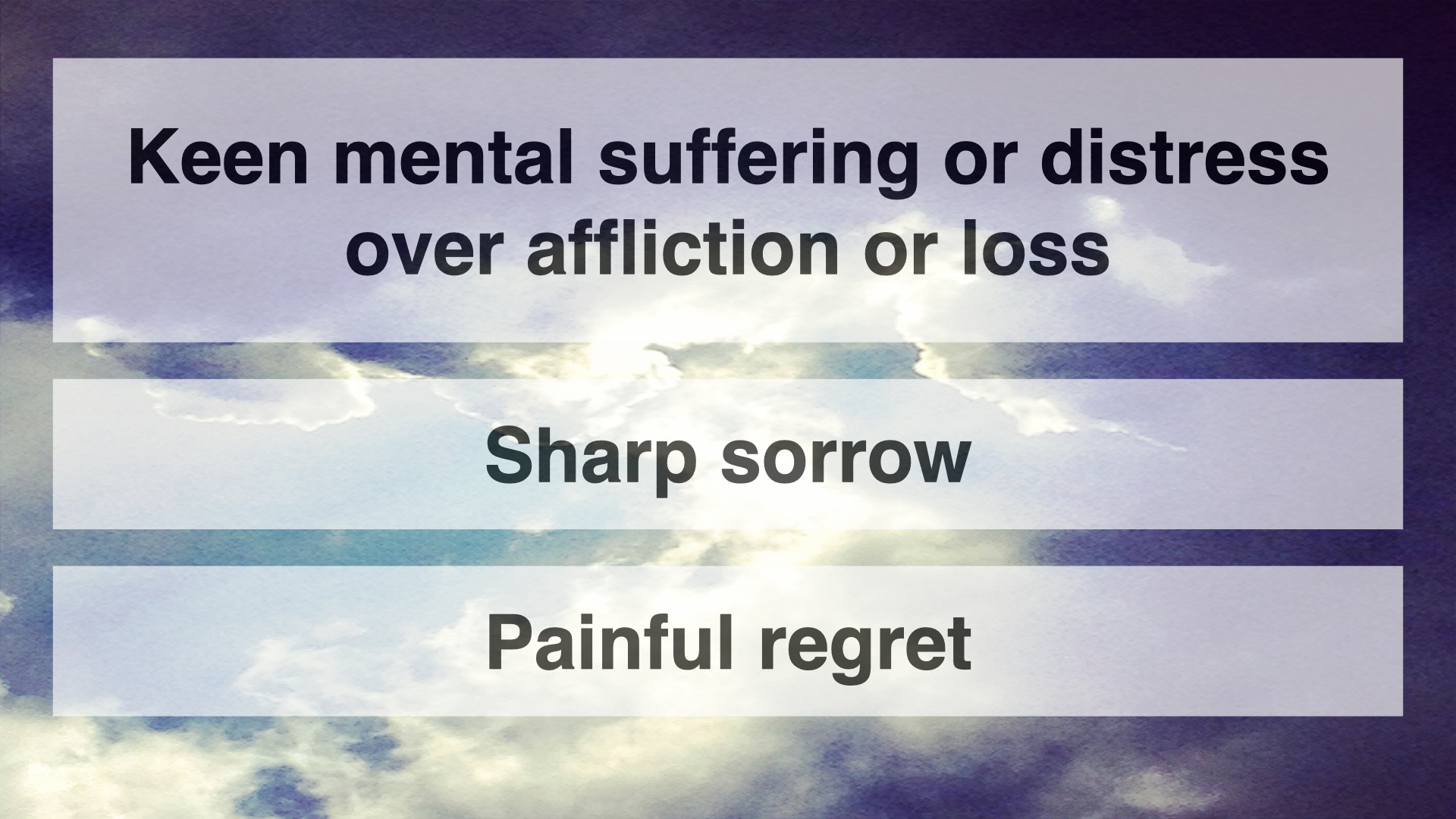
The dictionary defines grief three ways: (1) keen mental suffering or distress over affliction or loss; (2) sharp sorrow; (3) painful regret. We sometimes define it with terms like at the end of my rope, down for the count, nothing but gray skies all around, or unable to see any light at the end of the long tunnel. 

One psychologist recently asked, “Can you die of a broken heart?” And she meant it literally. She wondered if a person’s grief—what we sometimes call an emotionally broken heart—could lead to a physically broken heart. The answer was, quite simply, yes. Those who cannot get relief from their grief are more susceptible to heart disease, autoimmune disorders, and breakdowns in their immune system. 

We need some good news to pull us out of our grief. The good news is that God specializes not just in removing grief, but in turning grief into joy. In the hymn O Holy Night, one of the lines says, “In all our trials, born to be our Friend. He knows our need, to our weakness is no stranger.” Isaiah calls Jesus, “A Man of sorrows and acquainted with grief” (Isaiah 53:3). 

(Read all of the Scriptures in this post by clicking here.)

Grief tends to wash over us in waves. When the waves hit, they often cause us to forget what God has done for us in the past. The apostle Paul said we should learn lessons from the history of the Israelites in the Old Testament. Let me zoom in on one particular story. Notice the waves of grief that follow one after another. 

Israel was complacent about their sin (Amos 6:1, 4-7) and eventually was taken into captivity in Assyria. Soon after that, the Assyrians then defeated by the Babylonians. Meanwhile, instead of learning the lessons from Israel’s captivity, Judah had more evil kings than God-fearing kings and they were eventually defeated by the Babylonians (Psalm 137:1-4). Babylon was then defeated by the Medes and Persians. 

Somewhere in this time of exile, a young Israelite girl named Hadassah becomes orphaned. She is adopted by Mordecai, who changes her name into the Persian name Esther. Queen Vashti is divorced and banished by King Xerxes, and as a result Esther is chosen from all of the eligible bachelorettes in Persia to become queen in Vashti’s place. 

(Check out two of my posts related to this story in the Book of Esther: 4 Big Lessons from Esther and All of HIStory is His Story.)

Mordecai is an attendant at the gate to the castle, giving him a good vantage point to stay in touch with Esther. It also puts him in a place to overhear an assassination plot against King Xerxes, which Mordecai relayed to Esther to tell the king. Sadly, Mordecai’s good deed, which saved King Xerxes’ life, is overlooked. Instead, Mordecai’s faith is attacked by Haman, the prime minister, and all of the Jews in Persia are targeted by Haman for destruction. Once again, Mordecai gets word to Esther to have her appeal to the king. Esther is put in a no-win situation here: to approach the king without an invitation could be fatal, but to do nothing would mean the death of all of the Jews. 

How did all of this come to be? 

Let me take you back to Deuteronomy 8:3. God allowed His people to be humbled and hungry so that they would learn that He is their only source. In the following verses we are told twice to “beware”: beware of forgetting that God is our Provider, and beware of thinking we are our own provider. If we do either of these, God will discipline us (Deuteronomy 8:5). 

God isn’t mentioned at all in the Book of Esther, but He is so obviously at work. God said, “My purpose will stand, and I will do all that I please” (Isaiah 46:10). Before the Israelites went into captivity, God promised that His people would not be annihilated there but would return to Jerusalem (Jeremiah 31:10-17). 

Esther did interceded before King Xerxes. Because of this, Haman was hanged, Mordecai was exalted to Haman’s place, and the Jews were saved (Esther 7:1-6; 8:1-2, 15-17; 9:20-22; 10:3). 

God turned overwhelming grief into unspeakable joy!  

Dick Brogden wrote, “Are you overwhelmed, out of strength, nowhere to go, out of resources, at a most critical time in your family, ministry, job, or life? Great! God allowed it so that all the earth may know that He is God alone. Don’t waste the crisis. It’s a great opportunity for missions, a great opportunity for God’s glory to be known in all the earth.”  

Let your grief be a time you press into God’s presence. Like Esther taking her grief and her petition into the king’s presence, take your grief into the presence of King of kings. 

Esther was unsure if Xerxes would extend favor to her, but God is already extending His favor to you even before you approach Him. He wants to turn your grief into joy. 

God doesn’t want to simply remove your grief, but He wants you to be testimony for Him because of the way He moves on your behalf. 

Follow along with all of the messages in our series Grief Into Joy by clicking here. 

►► Would you please prayerfully consider supporting this ministry? My Patreon supporters get behind-the-scenes access to exclusive materials. ◀︎◀︎
Grief Into Joy

At the end of your rope … down for the count … nothing but gray skies all around … unable to see any light at the end of the long, dark tunnel. Ever been there? The reality is, we all have been there. 

But the good news is that we don’t have to stay there! 

God is always at work to turn our apparent no-win, dark, hopeless situations into something bright and glorious! He is working in ways that no human mind could have dreamed up, and working on our behalf in a way no human power could ever hope to rival. 

God specializes in turning grief into joy! 

We are approaching the time of year where we remember the death of Jesus. Without a doubt that was the darkest, most grief-stricken day in all of history. Yet that time of mourning was completely forgotten in the overwhelming joy that exploded from an empty tomb on Resurrection Sunday! 

Please join me at Calvary Assembly of God for this hope-filled series as we learn how God is at work in all of our grief-darkened circumstances to bring about something gloriously joyful!

Follow along with all the messages in this series:

God’s Name On Me

Listen to the podcast of this post by clicking on the player below, and you can also subscribe on AppleSpotify, or Audible. 

I have always been both intrigued and encouraged by the blessing Moses was instructed to give the the priests to pronounce over God’s people. 

Tell Aaron and his sons, “This is how you are to bless the Israelites. Say to them: ‘The Lord bless you and keep you; the Lord make His face shine on you and be gracious to you; the Lord turn His face toward you and give you peace.’” (Numbers 6:23-26) 

After giving this blessing, God then says, “And they shall put My name upon the Israelites, and I will bless them” (Numbers 6:27 AMPC). 

What does it mean to put God’s name on me? 

I think the Bible shows that it means—

I feel the heaviness of His holiness AND
I feel the security of His surrounding presence.

I feel the unapproachableness of His perfect righteousness AND
I feel the welcoming embrace of His atonement.

I feel how unworthy I am AND
I feel how worthy He is.

I know that He knows everything about me AND
I know He still loves me with an unquenchable love.

I know He is the holy Judge AND
I know He is the Forgiver of my sins.

I know that His Holy Spirit convicts me of my sins AND
I know the His Holy Spirit helps me get free of those sins.

What an inexpressible, overflowing-with-joy, irrepressible, unshakable assurance I have in my relationship with my Heavenly Father, through the work of Jesus Christ, and the assurance of the Holy Spirit. This is indeed a blessing that the no one else but my God can put on me! 

P.S. You may also be interested in another take on the priestly blessing in my post The Blessing.

►► Would you please prayerfully consider supporting this ministry? My Patreon supporters get behind-the-scenes access to exclusive materials. ◀︎◀︎
Don’t Confuse Pleasure With Joy

Listen to the podcast of this post by clicking on the player below, and you can also subscribe on AppleSpotify, or Audible

The dictionary’s definition for “joy” is missing just a couple of words to make it align with the biblical definition of joy. 

Oswald Chambers used this same example of Solomon’s cry of, “Meaningless” in my post Cynical or Satisfied

You can check out the full sermon from which this clip was taken by clicking here

►► Would you please prayerfully consider supporting this ministry? My Patreon supporters get behind-the-scenes access to exclusive materials. ◀︎◀︎