People Are Watching 👀

 “…they watched Him closely… (Luke 14:1). 

The skeptics were always watching Jesus. As with our Master, so with us.

They wanted to find an inconsistency with which they could discount all that Jesus stood for. Thankfully, they found none! May the same be said of you and me.

May our lives and speech (or silence) never cause skeptics to discount the Gospel or—even worse—blaspheme God, nor may our lives cause a weak Christian to doubt or stumble.

This requires from us—

  • Self-awareness … I have to know my tendencies and avoid those things that cause offense.
  • Boldness … to speak the truth in love.
  • Knowledge of the Scripture … and its correct application.
  • God-confidence … so that we’re not intimidated by man’s disapproval.
  • Humility … to not seek things for our own benefit.
  • Charity … as we demonstrate our faith in loving action.
  • Focus … on eternity and on the greater treasure in Heaven.

Holy Spirit, empower us to live like our Master every day. “Adam’s likeness now efface, stamp Thine image in its place.” May people see and hear Jesus in us. No matter how closely they watch us, may they see no inconsistencies.

9 More Quotes From “Jesus Always”

Sarah Young does a masterful job of weaving Scriptures together and presenting them to us as though Jesus Himself were speaking to us in first person. You can check out my full book review of Jesus Always by clicking here. 

“The problem arises when you gaze too long into the future, trying to visualize and take control of those not-yet events. A future-focus can easily deteriorate into a problem-focus. Weeds of worry and fear spring up quickly in this sort of ‘soil.’ When you realize this has happened, turn away from your worries and back to the One Who is lovingly present with you. Rejoice that I will still be with you when you arrive at each coming stage of your journey.”

“When My followers are joyful, unbelievers are more likely to be drawn to Me. Joy shines in stark contrast to your ever-darkening world, and some people will ask you about it. Always be prepared to give an answer to everyone who asks you the reason for your hope.”

“Treasure Me above all else. … To treasure something is to hold or keep it, esteeming it as precious. I am training you to hold securely onto Me, your Savior-God and constant Companion. … When you prize Me above all else, other things lose their grip on you.”

“Thank Me for all the challenges in your life. They are gifts from Me—opportunities to grow stronger and more dependent on Me. Most people think that the stronger they get, the less dependent they will be. But in My kingdom, strength and dependence go hand in hand.”

“For Christians, aloneness is an illusion—a dangerous one that can lead to depression or self-pity. The devil and his underlings work hard to cloud your awareness of My presence. It’s crucial for you to recognize and resist their attacks. Fight back with My powerful Word, which is living and active. Read it; ponder it; memorize it; speak it.”

“My followers often fail to see the many blessings I shower on them. They’re so busy looking for other things that they miss what is before them—or is on the way. They forget I am sovereign God and the timing of events is My prerogative.”

“Do not be frightened by world events or news reports. These reports are biased—presented as if I do not exist. News clips show tiny bits of world events from which the most important factor has been carefully removed: My presence in the world.”

“It’s important for you to grow not only more trusting but more thankful. A grateful attitude is essential for living near Me. Ingratitude is offensive to Me, and drags you down both spiritually and emotionally.”

“Stillness is a rare commodity in this world. Many people judge themselves and their day by how much they have accomplished. Resting in My presence is usually not one of those accomplishments. Yet how much blessing can be found in this holy rest!”

You can check out other questions I’ve shared from Jesus Always by clicking here and here.

Thursdays With Oswald—Grow Like A Lily

Oswald ChambersThis is a weekly series with things I’m reading and pondering from Oswald Chambers. You can read the original seed thought here, or type “Thursdays With Oswald” in the search box to read more entries.

Grow Like A Lily

     Jesus declares it to be unreasonable for the disciple to be careful of all that the natural man says we must be careful over [Matthew 6:26-32]. … Jesus does not use the illustration of the birds and the flowers by accident, He uses it purposely in order to show the utter unreasonableness from His standpoint of being so anxious about the means of living. …

     Imagine a lily hauling itself out of its pot and saying, “I don’t think I look exactly right here.” The lily’s duty is to obey the law of its life where it is placed by the gardener. “Watch your life with God,” says Jesus, “see that that is right and you will grow as the lily.” We are all inclined to say, “I should be all right if only I were somewhere else.” There is only one way to develop spiritually, and that is by concentrating on God. …  

     How are you to grow in the knowledge of God? By remaining where you are, and by remembering that your Father knows where are you are and the circumstances you are in. Keep concentrated on Him and you will grow spiritually as the lily. 

From Studies In The Sermon On The Mount

Don’t think for one moment that God doesn’t see where you are. Don’t think He doesn’t care about you. He knows precisely where you are, and He knows precisely what He is doing. 

If you want to grow, don’t worry about your circumstances or your setting. Keep concentrated on God and let Him grow you as only He can. 

8 Prayers From “Dangerous Prayers”

Dangerous Prayers give a brief biography of 50 culture-shifting people, and the world-changing prayers they prayed. Check out my full book review by clicking here, and then enjoy just a few of the prayers from this excellent book. 

“Listen to my supplication, Master, so that my soul doesn’t stagger under Your instruction, so that I don’t stumble in testifying to Your mercies, by which You tore me away from all my ruinous pathways. Thus You’ll grow sweet to me beyond all that led me wrong, in my willingness to follow it. Thus I’ll love You most mightily, and grasp Your hand with all the strength of my inmost being. Thus You’ll tear me away from every trial, clear to the end.” —Augustine 

“Restore me to liberty, and enable me so to live now that I may answer before Thee and before the world. Lord, whatever this day may bring, may Thy name be praised. Amen.” —Dietrich Bonhoeffer, while awaiting execution in a Nazi concentration camp 

“Give us grace, O God, to dare to do the deed which we well know cries to be done. Let us not hesitate because of ease, or the words of men’s mouths, or our own lives. Mighty causes are calling us—the freeing of women, the training of children, the putting down of hate and murder and poverty—all these and more. But they call with voices that mean work and sacrifice and death. Mercifully grant us, O God, the spirit of Esther, that we may say: ‘I will go unto the king and if I perish, I perish.’” —W.E.B. DuBois 

“Because we have need continually to crave many things at Your hands, we humbly beg You, O heavenly Father, to grant us Your Holy Spirit to direct our petitions, that they may proceed from such a fervent mind as may be agreeable to Your holy will.” —John Knox 

“O keep us, we beseech Thee, Lord, for without Thy keeping we cannot keep ourselves.” —Charles Spurgeon 

“Oh Jesus, You who suffer, grant that today and every day I may be able to see You in the person of Your sick ones and that, by offering them my care, I may serve You. Grant that, even if You are hidden under the unattractive disguise of anger, of crime, or of madness, I may recognize You and say, ‘Jesus, You who suffer, how sweet it is to serve You.’” —Mother Teresa 

“I now make it my earnest prayer, that God would have you, and the State over which you preside, in His holy protection, that He would incline the hearts of the Citizens to cultivate a spirit of subordination and obedience to Government, to entertain a brotherly affection and love for one another, for their fellow Citizens of the United States at large, and particularly for their brethren who have served in the Field, and finally, that He would most graciously be pleased to dispose us all, to do Justice, to love mercy, and to demean ourselves with that charity, humility, and pacific temper of mind, which were the Characteristics of the Divine Author of our blessed Religion, and without an humble invitation of whose example in these things, we can never hope to be a happy Nation.” —George Washington 

“God give me a deep humility, a well-guided zeal, a burning love, and a single eye, and then let men or devils do their worst.” —George Whitefield 

God Knows Your Name

Allow me to introduce myself in the Aramaic fashion—I am Craig bar Raymond. I am proud of my father and want my name to always be associated with his, so I remember my heritage by telling people I am Craig son of Raymond. 

If I wanted to be a little more formal I might introduce myself as Craig Bar Raymond Bar Colson, or even Craig Bar Raymond Bar Colson Bar Walker, to honor my forefathers back four generations. 

People took great pride in their family heritage. They wanted to keep their connection to their family and their tribe intact and known to those around them. It’s how they kept their standing in their community.

That’s why it’s odd that Luke—the premier historian that he is—introduces us to a man he simply calls “a blind man” in the city of Jericho. Luke was always so precise in mentioning names throughout both his Gospel and the Book of Acts, and it appears that this man does have a name. In the Gospel of Mark he is called Bartimaeus, and presumably Luke used Mark as one of his source documents. So why would Luke omit this guy’s name?

Keep in mind that “bar” simply means “son of,” so although Mark calls him Bartimaeus, his name is really something like “_________ son of Timaeus.” Is that because he was born blind and his parents didn’t even name him? Or was he thought so little of that people couldn’t remember his first name? Maybe it’s because Timaeus means unclean, defiled, polluted. So this blind beggar is really just the Anonymous son of Filth! 

This beggar is looking for alms in Jericho when he hears a commotion. He asks what is happening and is told, that Jesus of Nazareth is passing by. 

This man knows the reputation of Jesus, recalling that He has even opened blind eyes. Immediately he shouts, “Jesus, son of David have mercy on me!” Son of David is a title only used twice in the New Testament (also see Matthew 15:22), and both times by desperate people who wouldn’t take “no” for an answer. 

Actually, his phrase is in the form of a command, so he really says, “Jesus, son of David, have mercy on me NOW! 

“Who do you think you are, you nameless beggar,” the townspeople rebuke him. “How dare you demand anything of anyone! Shut your mouth, you worthless piece of filth!” 

Undeterred, this man now raises his voice to a shriek and repeats, “JESUS, SON OF DAVID, HAVE MERCY ON ME NOW!” 

This shriek gets Christ’s attention and He stops dead in His tracks. He commands that this man be brought to him.

Check out the confidence this blind man shows—he throws his cloak aside to get to Jesus. Why is that significant? Because he’s blind! If he can’t see, how is he going to find his cloak again? Who would ever want to help him? 

Jesus asks him, “What do you want me to do for you?” He was testing him: did he want a hand-out? did he want revenge on the cruel people in Jericho? did he want to get back at his parents? 

He specifically prays, “I want to see.” Jesus is moved by compassion (Matthew 20:34) and says, “Your faith has made you whole.” The blind man immediately is healed! 

What was his faith that healed him? It was a loud, insistent, persistent, won’t-take-no-for-an answer, audacious request. The crowd said he was asking too much, but Jesus was moved to compassion by his insistence and boldness and answered his prayer. 

That community may have forgotten that man’s name. Maybe the blind man had even forgotten his own name. But God hadn’t! 

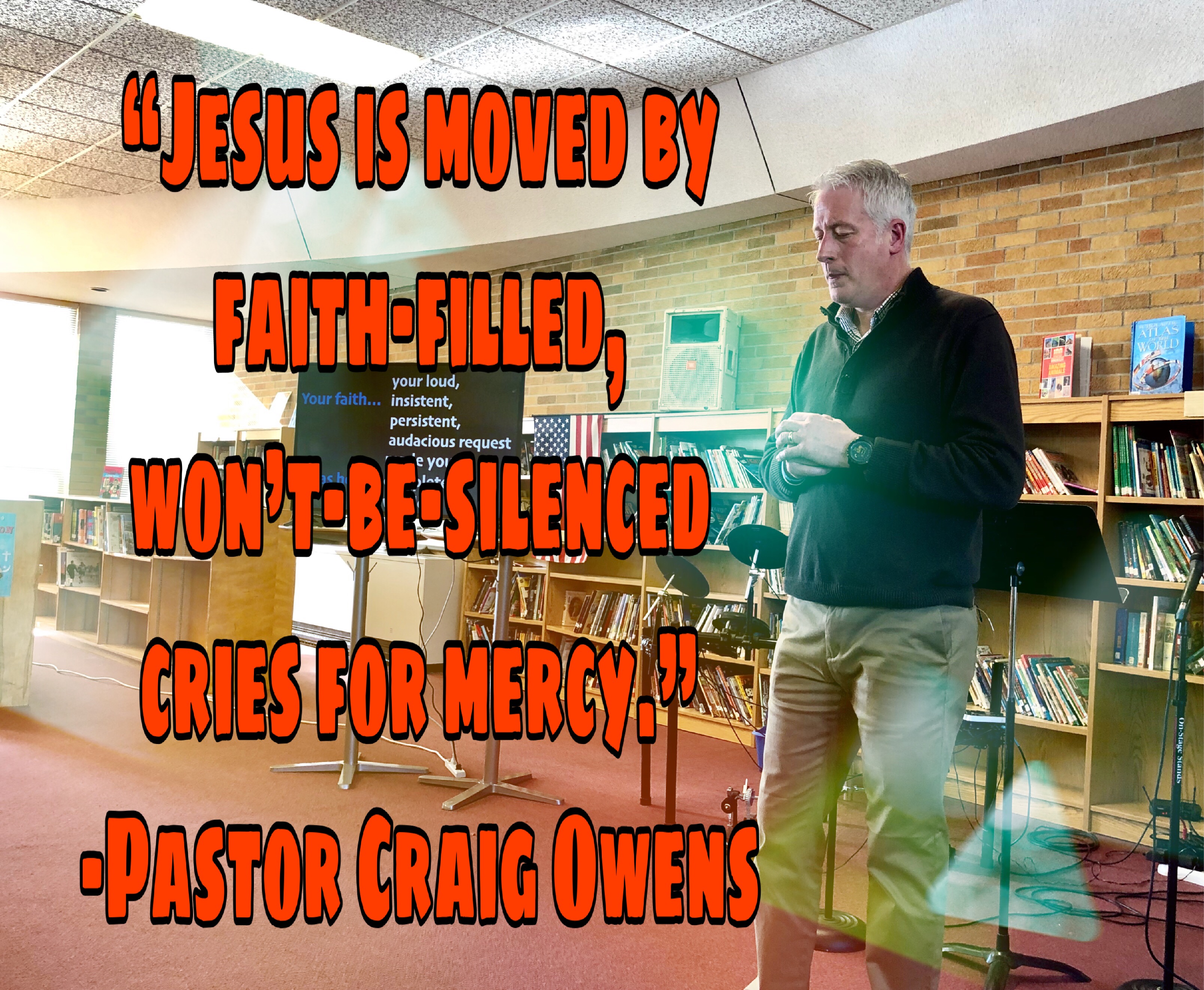
Jesus is moved by faith-filled, won’t-be-silenced cries for mercy. He wants to answer your specific requests. You aren’t an anonymous son or daughter of filth. You aren’t marginalized, worthless, or overlooked by your Heavenly Father. 

God knows your name. He knows your need. He is passing by. Cry out to Him again and again and again! When He answers your prayer, you are made whole and our Heavenly Father is glorified. 

Join me this Sunday as we continue to learn lessons for our prayer life from the bold pray-ers we find on the pages of the Bible. 

No Looking Back

…He steadfastly set His face… (Luke 9:51). 

Jesus wasn’t about to be deterred, delayed, or detoured from fulfilling His Father’s mission. 

Some of the other Bible translations fill in this meaning:

  • resolutely (NLT) 
  • steadfastly and determinedly (AMP) 
  • gathered up His courage and steeled Himself (MSG)
  • “to turn in a certain direction, confirm it, and resolutely follow it” (Strong’s Concordance)

Jesus could do this for at least three reasons—

  1. He knew “the time had come” (see v. 51 and John 13:1, 3) 
  2. He knew the joy at the end of the journey (Hebrews 12:2)
  3. He knew His Father loved Him (John 3:35, 5:20, 10:17)

A mark of a godly leader is one who resolutely follows God. No matter what!

Jesus calls His followers to the same path He walked—“No one who puts a hand to the plow and looks back is fit for service in the kingdom of God” (Luke 9:62)

It’s hard because people reject a resolute man. 

It’s hard because the accommodations along the way are uncertain. 

It’s hard because I have to give up my right to myself. 

But the reward is incomparable—Heaven forever with Jesus!

This is part 33 in my series on godly leadership. You can check out all of my posts in this series by clicking here.

Thursdays With Oswald—Becoming Carefully Careless

Oswald ChambersThis is a weekly series with things I’m reading and pondering from Oswald Chambers. You can read the original seed thought here, or type “Thursdays With Oswald” in the search box to read more entries.

Becoming Carefully Careless

     Faith is our personal confidence in a Being Whose character we know, but Whose ways we cannot trace by common sense. … Common sense is mathematical; faith is not mathematical, faith works on illogical lines. …  

     To have faith tests a man for all he is worth, he has to stand in the common-cents universe in the midst of things which conflict with his faith, and place his confidence in the God Whose character is revealed in Jesus Christ. …  

     Most of us are pagans in a crisis; we think and act like pagans, only one out of a hundred is daring enough to bank his faith in the character of God. …  

     Jesus does not say, “Blessed is the man who does not think about anything”; that man is a fool; He says, “Be carefully careless about everything saving one thing—your relationship to God.” … Many people are careless about what they eat and drink, and they suffer for it; they are careless about what they put on, and they look as they have no right to look; they are careless over property, and God holds them responsible for it. Jesus is saying that the great care of the life is to put the relationship to God first and everything else second. Our Lord teaches a complete reversal of all our practical sensible reasonings. Do not make the ruling factor of your life what you shall eat, or what you shall drink, but make zealous concentration on God the one point of your life. … Jesus Christ says, “Reverse the order, get rightly related to Me first, see that you maintain that as the great care of your life, and never put the concentration of your care on the other things.”

From Studies In The Sermon On The Mount

It does seem illogical from our human perspective to not think about the basics of life first and foremost, but Jesus is clear and consistent in His message to us that God should be THE priority. Seek Him first and all the other things fall into place. Be “carefully careless” about everything except your relationship with Jesus! 

Don’t be a pagan atheist in a time of trial. Don’t be that 99 out of a hundred that abandons God when times are tough. Instead, be that “one out of a hundred [that] is daring enough to bank his faith in the character of God” no matter what the circumstances are! 

8 Quotes From “Defiant Joy”

For anyone going through a trying time, Stasi Eldredge has given us a timely reminder of how we can tenaciously and defiantly cling to the joy the God gives us. Check out my full book review by clicking here. 

“Ignoring reality does not breed joy. Pretending that what is true does not exist is not holy defiance. The seeds of joy can only be firmly planted in the pungent soil of the here and now while at the same time being tethered to eternity. Joy is fully rooted in the truth. Joy embraces all the senses and is fully awake to the laughter, the wonder, and the beauty present in the moment as well as the sorrow, the angst, and the fear. Joy says, ‘Even so, I have a reason to celebrate.’” 

“Defiant may not be a word we would normally associate with the living God, but it can actually be quite fitting. Defiance means resistance, opposition, noncompliance, disobedience, dissent, and rebellion. And when it comes to things that would destroy our souls, that is exactly the right response.” 

“Joy is not happiness on steroids. It is not happiness squared. … Joy is connected to God and reserved for those who are tapping into His reservoir, who are connected to His life. Joy is rooted in God and His kingdom, in the surety of His goodness, His love for us. It is immovable. Unshakable. Joy is available at all times, day and night, because God and His kingdom are always available to us. … Joy is the heartbeat of heaven, the very light that emanates from Jesus’ heart, so as we grow closer in relationship with God, we’ll also grow in joy.” 

“Joy and breakthrough are not opposed to suffering But are available in the midst of it. Suffering is not a failure of faith on our part; its presence does not mean the absence of the presence of God. We can live with suffering and joy simultaneously.” 

“Joy is deeply rooted in the availability of God and His kingdom right here, right now. Sometimes we find breakthrough. Sometimes we find a deeper knowing of God in our suffering.” 

“Here is the truth we must remember in the middle of this sometimes painful healing process: we matter to the heart of God. He hasn’t taken His eyes off us. He thinks of us constantly. He has hopes and dreams for us. God planned on us before He made the stars, and He planned on us being His. He planned on us sharing our lives with Him on this wild adventure. And His plans are good.” 

“God drops things in our laps at just the right time. He puts barriers in our paths that look like roadblocks but are really gifts in disguise, beckoning us to take a closer look at what’s going on inside of us. We can either step over them or choose to pick them up and examine them for the potential they may hold.” 

“When the sadness refuses to be silenced and the feelings arise that this is not the life we had signed up for, we can either go to shame or go to God.” 

I’ll be sharing more quotes in the near future, so stay tuned…

The Value In Retreating

So He Himself often withdrew into the wilderness and prayed (Luke 5:16).

So”—in light of what just happened. What happened? Jesus was preaching everywhere, He healed a leper, and great multitudes came to hear Him speak and to be healed. So Jesus had to withdraw frequently to pray and be replenished.

All of us have only a finite amount of energy. When we are sensing that energy level is low, we also need a retreat. Otherwise, our low energy levels can sabotage us and diminish what God wants to do through us. 

Then check out the results after Christ’s time of replenishing:

  • God’s power was “present to heal” (v. 17)
  • People were saved (v. 20)
  • Jesus had holy perception (v. 22)
  • Miracles confirmed the word that Jesus preached (v. 24)
  • God was glorified (v. 26)
  • People followed Jesus (vv. 27, 28)
  • Jesus had enough grace and patience to handle criticism (v. 30)
  • Jesus had enough wisdom and patience to handle tricky theological questions (vv. 33-39)

J.C. Ryle noted, “The most successful workmen in the Lord’s vineyard are those who are, like their Master, often and much upon their knees.”

Healthy leaders are keenly aware of their own energy levels. 

So… A mark of a godly leader is one who frequently retreats. 

This is part 32 in my series on godly leadership. You can check out all of my posts in this series by clicking here.

Immeasurable!

Your value to God is immeasurable!

Jesus called satan the father of lies, that means every word he speaks is false. He uses his falsehoods to constantly slander God’s children, “For the accuser of our brothers and sisters has been thrown down to earth—the one who accuses them before our God day and night” (Revelation 12:10).

But we’re not helpless victims against the devil’s slander. The Holy Spirit reminds us of what the Word of God says, and what the God of the Word has done (John 14:26). That Word becomes our sword and shield against the slanderer, “They triumphed over him by the blood of the Lamb and by the word of their testimony” (Revelation 12:10-11).

This passage from Psalm 139 is a great weapon to use against the devil whenever he slanderously calls into question your worth in God’s sight. Silence his lies and strike him down with the Truth that your value to God is immeasurable!