Prayer Is The Battle

When I was growing up and struggling with a problem, my Mom would always challenge me with one simple question—“Have you prayed about it?”

This is a great question because it helps us keep the main thing the main thing.

Typically we have three substitutes for prayer—

(1) Ignoring the problem. We’re like the board of directors that was facing falling sales and falling profits, but their solution was to just wait for something magical to happen.

(2) Talking about the problem. Christians often call this “a prayer request.” We take 10 minutes to give our friends all the gory, depressing details of our situation and oftentimes say “please pray for me” as we walk away. Solomon said, “Talk is cheap, like daydreams and other useless activities” (Ecclesiastes 5:7).

(3) Working to solve the problem. This isn’t in the Bible, but many times we act as if it is: God helps those who help themselves. Instead, God wants us to call on Him so He can reveal things to us (see Jeremiah 33:3).

Something that is in the Bible is this: “Ask whatever you wish, and it will be done for you.” But there is a condition for this, and it’s the part of the sentence that comes before the asking that makes all the difference—

If you remain in Me and My words remain in you, ask whatever you wish, and it will be done for you (John 15:7).

Oswald Chambers said, “We are apt to think of prayer as a common-sense exercise of our higher powers in order to prepare us for work; whereas in the teaching of Jesus, prayer is not to fit us for the ‘greater works,’ prayer is the work. Prayer is…the means whereby we assimilate more and more of His mind, and the means whereby He unveils His purposes to us.”

Prayer IS the work!

We don’t ignore the problem, and we don’t just talk about the problem. But neither do we pray and then work on the problem. Prayer is the work!

It can’t be stated enough: Prayer doesn’t prepare us to work, prayer IS the work.

Even the Apostle Paul identified this in his teaching on spiritual warfare. In language similar to what Jesus said in John 15:7, Paul says, “Be strong IN the Lord and IN His mighty power. Put on the full armor of God SO THAT you can take your stand against the devil’s schemes” (Ephesians 6:10-11).

Paul doesn’t tell us to ignore the devil’s schemes, nor does he tell us to talk about them. But neither does he tell us to put on God’s armor to fight against the devil’s schemes. He tells us to put on the armor of God so that we can pray (see Ephesians 6:18-20).

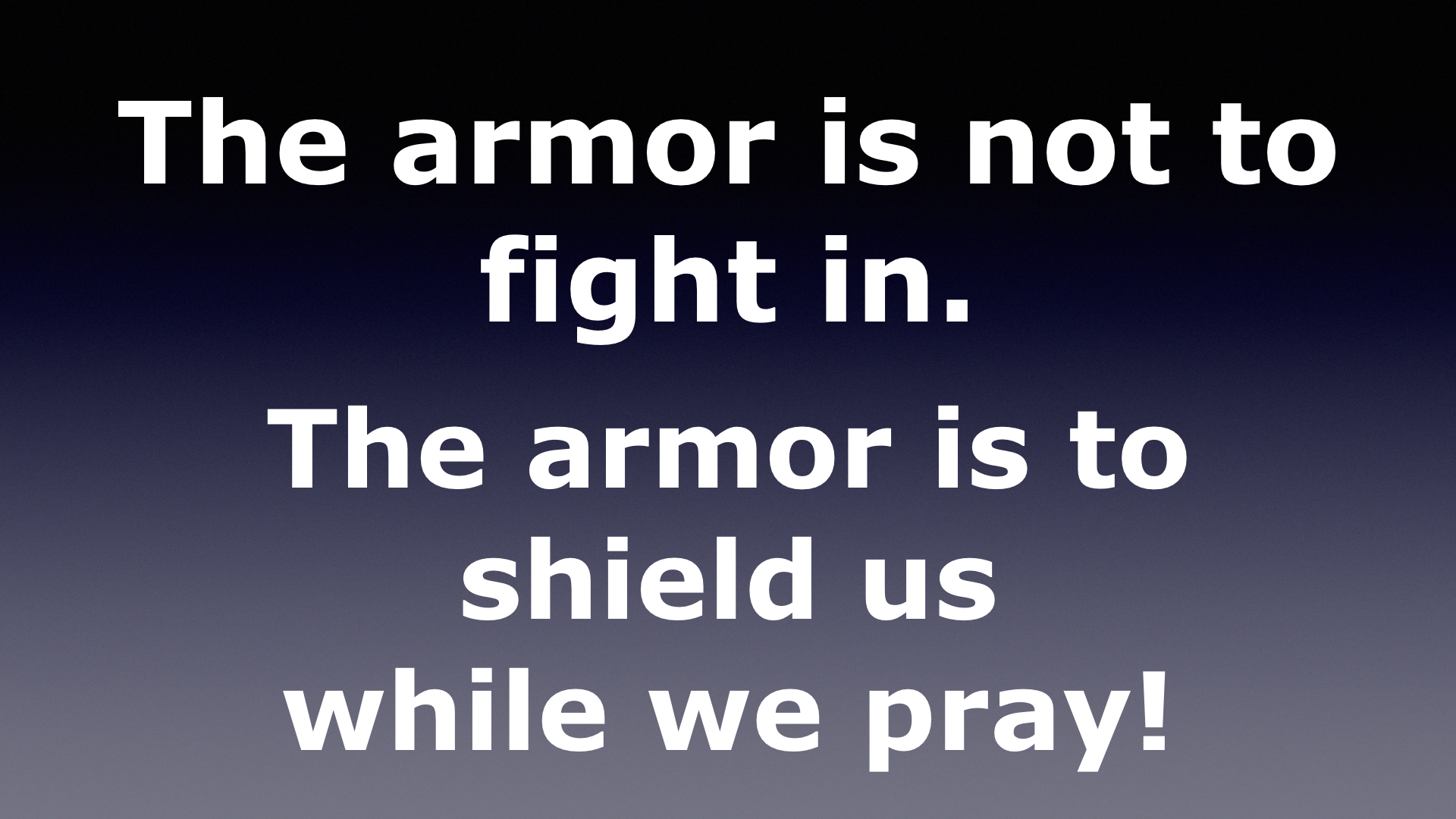
The armor of God is NOT to fight in, but to shield us while we pray!

PRAYER IS THE BATTLE … PRAYER IS THE WORK

When you are facing a difficulty, don’t ignore it, don’t just talk about it, and don’t go to work fighting it. Listen to the Holy Spirit asking you, “Have you prayed about it,” and then drop to your knees and PRAY!

This principle is illustrated so wonderfully in the life of David. We’ll be looking at David’s prayers over the next few weeks, and I hope you will join me in learning that prayer is the battle!


Thursdays With Oswald—God Has A Plan For Your Life

Oswald ChambersThis is a weekly series with things I’m reading and pondering from Oswald Chambers. You can read the original seed thought here, or type “Thursdays With Oswald” in the search box to read more entries.

God Has A Plan For Your Life

     “Before I formed thee…I knew thee…” [Jeremiah 1:5]. There are prenatal forces of God at work in a man’s life which he may be unconscious of for long enough; but at any moment there may break upon him the sudden consciousness of this incalculable, supernatural surprising power that has got hold of his life before he has got hold of it himself.  

     Another force at work is the prayers of other people. You are born into this world and will probably never know to whose prayers your life is the answer. … Our lives are the answers not only to the prayers of other people, but to the prayer the Holy Spirit is making for us, and to the prayer of Our Lord Himself. …  

     When once Paul realized God’s call and knew the meaning of his life, there was no competitor for his strength. Is there anything competing for our strength in our devotion to the call of God?

From So Send I You

Isn’t it amazing to think that not only has God had a plan for your life before you even arrived on earth, but that your life is an answer to prayer?!

The Apostle Paul lived the first part of his life oblivious to God’s call. But once he had his encounter with Jesus, his whole focus and passion changed (see Acts 9:15-16; Galatians 1:15-16).

What about you?

  • Have you realized that God has a plan for your life?
  • Are you living like you are an answer to prayer?
  • Is there anything competing for your attention that is keeping you from being “all in” for God?

Thursdays With Oswald—Becoming Bread

Oswald ChambersThis is a weekly series with things I’m reading and pondering from Oswald Chambers. You can read the original seed thought here, or type “Thursdays With Oswald” in the search box to read more entries.

Becoming Bread

     It is the plough that prepares the ground for sowing the seed. The hard way through the field is the same soil as the good ground, but it is of no use for growing corn because it has never been ploughed. … 

     “The heart is deceitful above all things, and it is exceedingly corrupt: who can know it?” (Jeremiah 17:9). The way through the field which has been battered hard by men’s feet is an illustration of the human heart. The human heart should be the abode of God’s Holy Spirit, but it has been trampled hard by passions until God has no part in it, and the plough has to come into the desecrated place. … 

     Standing corn has to be cut down and go through the process of reaping, threshing, grinding, mixing and baking before it is good for food; and sanctified souls must be told that their only use is to be reaped for God and made into bread for others. It is time we got away from all our shallow thinking about sanctification. … 

     The sound of millstones is music in the ears of God. The worldling does not think it music, but the saint who is being made into bread knows that his Father knows best, and that He would never allow the suffering if He had not some purpose. … 

     “Be content, ye are His wheat growing in our Lord’s field. And if wheat, ye must go under our Lord’s threshing instrument, in His barn-floor, and through His sieve, and through His mill to be bruised, as the Prince of your salvation, Jesus, was (Isaiah 53:10), that ye may be found good bread in your Lord’s house” (Samuel Rutherford). … 

     When by the sanctifying power of the grace of God we have been made into bread, our lives are to be offered first of all to Jesus Christ. … The saints who satisfy the heart of Jesus make other saints strong and mature for God. 

From The Sacrament Of Saints

Do you want to be useful for God? Then you must let Him prepare you to be bread that He can use to nourish others. Chambers reminds us that this preparation process entails the painful processes of ploughing, reaping, threshing, grinding, mixing and baking. But God knows best! He only allows this pain so that He can use you to bless others.

How Do You Start A Conversation With God?

pray-through-the-bibleLast week I asked you to imagine how your relationship grew with your best friend. You probably found that this special friendship was formed during hours and hours of talking.

I’m going to guess that at first your conversation was a little on the superficial side. You talked about “tame” topics like sports teams, or your job, or the city you lived in. But at some point you took a huge riskyou became vulnerable by sharing something really personal. Perhaps you shared a time that you got hurt, or something that makes you anxious, or maybe a big dream you carry around in your heart. But if that friend is still your friend, that means they treated what you shared reverently. They didn’t laugh at you, belittle your hurts or dreams, nor did they share with others what you said.

The relationships became deeper and more special because you now knew each other on a more intimate level.

Prayer is a conversation with a Friend. Of course, that Friend is God, so some people wonder, “What do I talk to God about?” The simple answer is anything and everything!

Time and time again God calls us to come closer to Him (see Isaiah 55:1-3), to discuss with Him things we don’t understand (Jeremiah 33:3), or to be assured that He is intimately tuned in to what’s happening in our life (Psalm 139:17; 1 Peter 3:12).

How do we get there? A good place to start is with our Bible. Dwight Moody said:

“The two first and essential means of grace are the Word of God and Prayer. … If we read the Word and do not pray, we may become puffed up with knowledge, without the love that buildeth up. If we pray without reading the Word, we shall be ignorant of the mind and will of God, and become mystical and fanatical, and liable to be blown about by every wind of doctrine.”

Scripture was written to point us to Jesus. So we don’t read the Bible just to read it; we read it to get to know God.

We don’t want to know the Word of God; we want to know the God of the Word. 

A great place to start is in the book of the Psalms. Many of these were written as prayers, so it’s a good way to start our conversation with God. You can also search in the New Testament for all the places that biblical writers said, “I pray…” or “This is my prayer….”

I share a personal example of this in this video, especially if you want to fast forward to the 36:00 minute mark.

Don’t just read through the Bible this week—pray through the Bible. Use it as a means to have a conversation with the very Best Friend you could ever know!

I encourage you this week, as you think about this topic, to get together with an earthly friend and discuss these questions:

  1. How can I use my Bible as a “conversation starter” with God?
  2. How can I get into the regular practice of talking to God as a Friend?

Don’t Settle For Low Expectations

isaac-newtonSome of the greatest discoveries and revelations came about because people were curious. They refused to just go along with what they had always been told, what they grew up believing, or what the conventional wisdom told them was impossible.

Archimedes had his “Eureka!” moment because he refused to believe that it was impossible to measure the volume of an irregularly-shaped object.

Isaac Newton formulated the laws of gravitation because he curiously wondered about why apples fell perpendicular and at the same velocity.

The Apostle Peter saw a vision from God with animals, but didn’t stop there. His openness helped him realize that God didn’t have “favorites.”

Far too many people live their lives cursed with low expectations. They say, “That’s all there is.” and they put a period on it.

God wants us to soar above those low expectations! He tells us things like:

  • Come now, let us reason together… (Isaiah 1:18).
  • Call to Me and I will answer you and tell you great and unsearchable things you do not know (Jeremiah 33:3).
  • Are you listening to this? Really listening? … The knowledge of the secrets of the kingdom of heaven has been given to you… (Matthew 13:9, 11)

great-expectationsBut we are trapped in the curse of low expectations when we put a period on things, when we refuse to learn more, see more, hear more.

  • Most people—“That’s all there is.” (period)
  • What if we changed it up—“Is this all there is?” (question mark)
  • Perhaps you might get—“There is so much more!” (exclamation point)

For example, Paul uses the word “mystery” multiple times in his letter to the Ephesians. He explains that a mystery is something hidden from those who have it all figured out (the “period” people), but is revealed to those who will ask God (the “question mark” people). Only the “question mark” people get to see the “exclamation points” God has for them. Things like…

  • God has a plan, and it is His pleasure to reveal it to me (Ephesians 1:9-10; 2:10).
  • God’s revelation is fully revealed to me in His Word (3:3-5).
  • Faith in Jesus makes Christians co-heirs and sharers in all God’s promises (3:6).
  • I have access to God’s inexhaustible riches, His immense wisdom, and I may approach Him with freedom and confidence (3:8-12).

Don’t stop with “.” but go on to “?” and experience “!

With great expectation, read God’s Word, approach His throne, dig into His riches, wrestle with the difficult things, learn more of God’s purpose for your life. He wants to give you so much more “!” 

4 Terrible Ways & 4 Great Ways To Study Your Bible

Isaac Newton Bible study.001There are two Greek words in the New Testament that have to do with trying to figure things out. One of them leads to less knowledge, and one opens the way for greater learning. Not surprisingly, Jesus never used the first way, but He confronts people who try to.

The first Greek word is defined as learning through self-calculation. In other words, I try to get at the right answer by either teaching myself, or by talking with people who don’t know any more than I do. This way leaves me in the dark.

For example, notice the phrase “discussed among themselves” in Matthew 16:7 and Mark 11:31. These are people who wanted to try to get answers without going to someone who could teach them. So that leads to four terrible ways to study your Bible—

  1. Approach your Bible with a know-it-all attitude.
  2. Try to figure out what the Bible is saying all on your own.
  3. Try to be your own Bible teacher.
  4. Grade your own tests as to your answers being right or wrong.

These are not only terrible ways to learn, but they are the exact opposite of what God desires. God says things like, “Come, let us reason together” (Isaiah 1:18), and “Call to Me and I will tell you things you do not know” (Jeremiah 33:3).

There is another Greek word which means to learn by having a conversation with someone more knowledgable than myself. So that means four great ways to study your Bible are—

  1. Ask the Holy Spirit to illuminate Scripture to you (John 16:13).
  2. Study the Bible in a daily systematic way (Acts 19:9).
  3. Don’t take anyone else’s word for what the Word says (Acts 17:11).
  4. If you’re confused, ask God to make it clear to you (Jeremiah 33:3).

Luke records an important story for us that took place on the day Jesus was raised from the dead. Two men were walking along “discussing these things with each other,” but not consulting the Scriptures. The result: they were sad and confused. Jesus join them on their journey (although they didn’t recognize Him at first), and took them to the Scriptures that showed them the answers for which they were yearning. They even said, “When He talked to us from the Scriptures, that’s when our hearts burned within us!” (see Luke 24:13-32).

You can try to figure life out on your own, and you will probably end up stymied like the religious leaders in Mark 11, or downcast like the disciples in Luke 24. Or you can ask the Holy Spirit to show you truths from the Scriptures, and have your eyes opened, like the two disciples after Jesus met with them. I think the choice is obvious!

Join me next week as we continue our series How To Study Your Bible.

Week Of Prayer—Saturday

WOP_2016_Slide_SatOur week of prayer concludes today with this prayer focus—

Give praise to God for this powerful assurance that He is working out His plans and purposes in your life, both in the present and in the future.

All week long we have been praying God’s Word. Here’s a prayer thought you might want to pray today:

Father, I know that all plans you have for my life are plans to prosper me and not to harm me. They are plans to give me hope and a future [Jeremiah 29:11]. Sometimes it appears things have gotten off track, but I know that You are able to use even my “mistakes” to work out all the details of Your loving plan for my life [Romans 8:28]

Today I pray the same prayer You honored in the life of someone else who cried out to You for help: “Oh, that You would bless me and enlarge my territory! Let Your hand be with me, and keep me from harm so that I will be free from pain” [1 Chronicles 4:10]. I believe You are powerful enough to complete all You have determined to do for my life. In Jesus’ name, Amen.

Peace On Earth! Really?

Craig T. OwensFor some people, “peace on earth” is just a wish. Perhaps all of this talk of peace and goodwill during the buildup to Christmas is doing just the opposite, and you’re feeling a bit stressed out.

How do you think Joseph felt on the night of his first son’s birth? Do you think he was peaceful, or do you think things weren’t going as he had planned, and his stress level was through the roof? We can learn a very valuable lesson from his life.

Please gather your family and friends around to watch this short 10-minute video before you begin your Christmas celebration. This encouraging word may be just what you need to have a peaceful and joyous Christmas.

(If you have any trouble with the above video, here’s another link to try.)

I encourage you to read the Scriptures I mention in this video. They are:

And the quote from Max Lucado I shared:

“You’ve stood where Joseph stood. Caught between what God says and what makes sense. You’ve done what He told you to do only to wonder if it was Him speaking in the first place. You stared into a sky blackened with doubt. And you’ve asked what Joseph asked. You’ve asked if you’re still on the right road. You’ve asked if you were supposed to turn left when you turned right. And you’ve asked if there is a plan behind the scheme. Things haven’t turned out like you thought they would. Each of us knows what it’s like to search the night for light. Not outside a stable, but perhaps outside an emergency room. On the gravel of a roadside. On the manicured grass of the cemetery. We’ve asked our questions. We’ve questioned God’s plan. And we’ve wondered why God does what He does. The Bethlehem sky is not the first to hear the pleading of a confused pilgrim. If you are asking what Joseph asked, let me urge you to do what Joseph did. Obey.”

Merry Christmas!

11 More Quotes From “Our Portrait In Genesis”

The Complete Works Of Oswald ChambersOswald Chambers’ book Our Portrait In Genesis is an excellent companion book when you read the book of Genesis from the Bible. I’ve already shared a few quotes from this book here, and here. Below are a few more I found highlighter-worthy.

“Degeneration and backsliding are by no means one and the same. Degeneration begins in almost imperceptible ways; backsliding in the Scriptural use of the term is a distinct forsaking of what I know of God and a deliberate substitution of something other (cf. Jeremiah 2:13). … If I maintain my right to my natural self I will begin to degenerate and get out of God’s purpose. … If I refuse to sacrifice the natural, the God-life in me is killed.”

“To experience conviction of sin is not a cause for misgiving, but an occasion for understanding the impossible things God has done in the Redemption.”

“All through, a personal crisis ought to serve as an occasion for revealing the fact that God reigns, as well as compelling us to know our own character.”

“We have the notion that it is only when we are pure and holy that God will appear to us; that God’s blessing is a sign that we are right with Him. Neither notion is true. Our Lord took care to say that God makes His sun to rise on the evil and on the good, and sends His rain on the just and on the unjust. God’s blessings are not to be taken as an indication of the integrity of the character blessed, yet on the other hand the discernment of God’s character is determined entirely by the individual character of the person estimating God. ‘With the merciful You will show Yourself merciful’ (Psalm 18:25). The way I discern God’s character is determined by my own character. God remains true to His character, and as I grow in integrity I discern Him. Jacob’s undeservedness, and the fact that God continually blesses him, are brought out very clearly all through his life.”

“‘I can’t understand why I have no confidence in God’; the reason may be a matter of digestion, not enough fresh air, or sleep, too much tea—something slight. It is the shallow things that put us wrong much more quickly than the big things. The great object of the enemy of our souls is to make us fling away our confidence in God; to do this is nothing less than spiritual suicide. When we experience misgiving because we have sinned there is never any ambiguity as to its clause, the Holy Spirit brings conviction home like a lightning flash.”

“Prayer in distress dredges the soul (cf. Psalm 107). It is a good thing to keep note of the things you prayed about when you were in distress. We remain ignorant of ourselves because we do not keep a spiritual autobiography.”

“That is always the test of the reality of sanctification, not so much that I have received something, but that I have ceased to be my old self.”

“The warrior of God is not the man of muscle and a strong jaw, but the man of un-utterable weakness, the man who knows he has not any power; Jacob is no longer strong in himself, he is strong only in God, his life is no longer marked by striving, but by reliance on God. You cannot imitate reliance on God.”

“Authority never comes from you, but from God through you, therefore let God introduce or withhold as He chooses.”

“Beware of saying, ‘Oh well, it doesn’t matter much what I think about in secret’; it does, for the opportunity will come when what you think about in secret will find expression and spurt out in an act. The Bible always speaks of sin as it appears in its final analysis. Jesus does not say, ‘You must not covet because it will lead to stealing’; He says, ‘You must not covet because it is stealing.’ He does not say, ‘You must not be angry with your brother because it will lead to murder’; He says, ‘You must not be angry with your brother because it is murder.’”

“Four times over in this chapter [Genesis 39] is this statement made, ‘the Lord was with Joseph.’ It is the presence of God that is the secret of victory always. The fear of the Lord creates an atmosphere in which impure thoughts and unholy desires die a natural death.”

You can also read my review of this book by clicking here.

The Counselor Brings Reproof

Search meNo one likes being rebuked, but it is necessary. In fact, it is vital for healthy growth. As a Dad, I didn’t look forward to the times I had to rebuke my children. But what’s the alternative? What happens if I just let misbehavior slide? We must rebuke those we love if we want them to mature.

The Counselor—the Holy Spirit—not only teaches us, but He reproves us as well because of His love for us. And we all need it!

  • The human heart is the most deceitful of all things, and desperately wicked. Who really knows how bad it is? (Jeremiah 17:9)
  • For I know that in me (that is, in my flesh,) dwelleth no good thing… (Romans 7:18)

This knowledge of my wickedness becomes even more painful when I think that Jesus calls us to perfection (Matthew 5:48). I can’t “do” perfect on my own. But thankfully Jesus didn’t tell us to “do” perfect things, but to BE perfect.

The Holy Spirit reproves us—that is, He shows us where we are deviating from the mark—so that we can BE perfectly at one with Jesus, with our lives demonstrating Christ’s perfect nature.

Warning: the enemy wants to pervert The Counselor’s reproof. He wants to whisper to you that God is mad at you, that you’ve blown it too many times, that you’ll never be good enough.

Just like Jesus countered all of satan’s temptations with the Spirit-breathed Scripture, you need to do the same thing. You tell him, “My Father loves me so much that He sent His One and Only Son to die on a Cross for me! He wants me to display the glory of Jesus in my life because that’s what brings Him pleasure. He only reproves me because He loves me. If He didn’t care about me, He would leave me alone!”

Because He loves you and wants the very best for you, here’s what you can boldly pray:

Search me, God, and know my heart; test me and know my anxious thoughts. See if there is any offensive way in me, and lead me in the way everlasting.

I will be continuing my series on the Holy Spirit as our Counselor this Sunday. If you are in the Cedar Springs area, please come join us!