Thursdays With Oswald—Jeremiah 10

Oswald ChambersThis is a weekly series with things I’m reading and pondering from Oswald Chambers. You can read the original seed thought here, or type “Thursdays With Oswald” in the search box to read more entries.

Jeremiah 10

[These are notes from Oswald Chambers’ lecture on Jeremiah 10.] 

     The ungodly disposition in a man makes him worship beings or things or ideas in order to render them powerless, and the same idea is apt to creep into the worship of God amongst Christians if not watched—“God will never let this or that come to me; I am a favorite of His.” Jesus Christ’s life is an illustration as to how God will deal with us, He will not shield us from the world, the flesh or the devil, they are allowed to do their worst because God has staked His all on what He has done in us (see John 16:33; 1 John 4:4). Trials and tribulations are trumpet calls to the witnesses to God. …  

     One moment’s realization that Almighty God is your Father through Jesus Christ, and I defy anything to terrify you again for long. If we realize, what these prophets realized, that nothing can happen without God’s permission, we are kept in peace. Worrying is wicked in a Christian. “Let not your heart be troubled.” How dare we be troubled if Almighty God Who made the world and everything in it, is our Father? … 

     We have got to be holy someday, why not be holy now? … No matter how moral we may be, every domain of our life that is not regulated by the direct application of the wisdom of God is brutish in God’s sight. … 

     The greatest obstruction to the working of God comes from those who give themselves to interpreting the words of God rather than doing them. … Obedience is superbly easy because we have Almightiness on our side. Acknowledge God’s voice, take the step in the right direction and obey, and you will be backed by omnipotence in every detail. 

From Notes On Jeremiah

We go wrong when…

  • …we try to make God in our image, telling others what God will or won’t do 
  • …see trials and temptations only as bad things 
  • …allow our fears to paralyze us to God’s strength
  • …think we are unworthy to call God our Father 
  • …worry obsessively 
  • …block the Holy Spirit from continuing to make us holy
  • …keep God out of certain areas of our life 
  • …hear God’s Word but don’t obey it

I love this question—“We have got to be holy someday, why not be holy now?” Well, why not?! 

Thursdays With Oswald—Jeremiah 9

Oswald ChambersThis is a weekly series with things I’m reading and pondering from Oswald Chambers. You can read the original seed thought here, or type “Thursdays With Oswald” in the search box to read more entries.

Jeremiah 9

[These are notes from Oswald Chambers’ lecture on Jeremiah 9.] 

    Jeremiah states that wisdom and enlightenment are not to be found among the infatuated people, they have been swept away from right judgment by false prophets who taught that everything develops along a natural rational line. That was the infatuation in Jeremiah’s day, and in our own day the proclaimers of the truth of God are in the minority; men won’t listen to them.

     There are those who say there is no such thing as the supernatural incoming of Jesus Christ, either in history or in the human heart. Our Lord Jesus Christ is not Someone Who has sprung from human nature by evolution: He is Someone Who has come crushing into the human nature by the superb miracle of the Incarnation. The supernatural is the only explanation of our lives if we are right with God, and at any moment God may tumble our lives up as He likes. The question is, are we willing to let Him? We have to maintain our personal relationship to God in Christ Jesus, no matter what happens. The one thing that is of value to God in a human life is a personal relationship of holiness to God, and every part of physical, mental, moral life and of Christian work that is not so related will be desolated and burnt as rubbish.

     The characteristic of life today is that the gospel of, ‘Cheer up, look on the bright side,’ is being preached on all sides. Our Lord says, in effect, that every happiness and peace and well-being that is based on the ignoring of a relationship to God will end in dirges and woes, disasters and terrors.

From Notes On Jeremiah

This statement arrested my attention—At any moment God may tumble our lives up as He likes. The question is, are we willing to let Him?

That is the true question for all followers of Jesus Christ: Am I willing to let Him have His way with my life?

Thursdays With Oswald—Jeremiah 8

Oswald ChambersThis is a weekly series with things I’m reading and pondering from Oswald Chambers. You can read the original seed thought here, or type “Thursdays With Oswald” in the search box to read more entries.

Jeremiah 8

[These are notes from Oswald Chambers’ lecture on Jeremiah 8.] 

     Wherever I banish them, all the survivors of this evil nation will prefer death to life (Jeremiah 8:3). 

     Our Lord Jesus used these burning words, “The worms that eat them do not die, and the fire is not quenched,” [Mark 9:44, 46, 48] in reference to the condition of people who deprive themselves of right judgment by persistently going wrong (see also 2 Thessalonians 2:11). In the prophecies of Jeremiah we have the same great revelation, that eternal issues are involved in temporal living, but in a different connection. If we are going to remain true disciples of Jesus Christ, we will have to remain alien to the day we live in.

     Such terrible suggestions as these verses contain [verses 1-3] serve as a very wholesome awakening, and bring men to the understanding of the need of Redemption. …  

     The subject of the Second Coming is the one the average unholy Christian cannot stand, and the tendency is to listen, as the people did in Jeremiah’s day, to the false prophets (2 Peter 3:3-6). …  

     The modern scholar pretends to be expounding the Word of God, but in reality he is writing with a lying pen, he builds his wisdom out of his own rationalism, and takes out of the law of God only what agrees with it. …  

     Paul says the same to Timothy—“For the time will come when men will not put up with sound doctrine. Instead, to suit their own desires, they will gather around them a great number of teachers you say what their itching ears want to hear” (2 Timothy 4:3). 

     They dress the wound of My people as though it were not serious. “Peace, peace,” they say, when there is no peace (Jeremiah 8:11). That is the perpetual peril at all times, relieving present pain by a temporal fictitious cure, when what is needed for an effectual cure is a surgical operation. …  

     All Christians are not Christian workers, but those who are called to be workers need the courage of the Holy Ghost to face life from God’s standpoint. We have to keep our hearts and minds faced with the awful condition of human life apart from the Cross of Christ. We must get into our souls the iron of God which makes us strong enough to present Jesus Christ to men. …  

     The majority of us know nothing about shame and repentance, consequently we drift from the central point because we more easily get into sympathy with men than with God, and that is slander against God. To save the world cost Jesus Christ His life, and if we teach that the world can be saved in any other way we slander God.

From Notes On Jeremiah

Oh God, help us—all of us, but especially Your workers—to preach sound doctrine that would save lost people from an eternal Hell. 

No Pity Parties, Please

And do you seek great things for yourself? Do not seek them… (Jeremiah 45:5). 

Baruch faithfully obeyed God and faithfully stood by Jeremiah, but now that the heat was on he was having a bit of a pity party—“Woe is me now! For the Lord has added grief to my sorrows. I fainted in my sighing and find no rest.”

In essence, Baruch was saying, “Things are not working out as I had planned.” God reminds Baruch that His plans are much bigger, and He graciously assures him that He will protect his life where ever He sends Baruch. 

A mark of a godly leader is one who quickly leaves his pity parties.

Instead, my posture should always be: I will obey God and then say, “I am an unworthy servant who is simply doing my Master’s duty” (see Luke 17:7-10). 

This is part 24 in my series on godly leadership. You can check out all of my posts in this series by clicking here.

UPDATE: In my book Shepherd Leadership: The Metrics That Really Matter, I tell a story about a pity party I briefly hosted on my leadership journey in a chapter called “Stick-to-it-iveness.” I think you will really like it!

Thursdays With Oswald—Jeremiah 7

Oswald ChambersThis is a weekly series with things I’m reading and pondering from Oswald Chambers. You can read the original seed thought here, or type “Thursdays With Oswald” in the search box to read more entries.

Jeremiah 7

[These are notes from Oswald Chambers’ lecture on Jeremiah 7.]

     To seek a place instead of a Person is the first peril in the spiritual life, and to sentimentalize over places where God has met you is the beginning of spiritual twist. Beware of relying on a principle saving you from moral wrong, for it never can. A personal relationship to a personal Savior is the only power that can shield the soul from moral peril. The golden rule is, my personal Savior in every place, not that in certain places I meet my Savior. …  

     Self-deception always arises by ignoring the personal relationship to God….

     Self-examination is the only exercise for a soul who would remain true to the light of God. … The hardest thing in a saint’s life is to maintain a simple belief in Jesus until he realizes the one relationship is—my Lord and I; then His joy will be fulfilled in us.

From Notes On Jeremiah 

We have to be very careful about making a special landmark out of a place, an experience, or even a passage of Scripture where God met us in a profound way. Those special encounters are intended for one specific purpose: to draw us more deeply into a relationship with the Person of Jesus Christ. 

We are on the road to self-deception if we keep seeking experiences. The road to spiritual health is paved with Spirit-inspired self-examination where we ask, “How did that experience lead me closer to Jesus?” When all the other stuff is stripped away, that’s where we will feel Christ’s joy fulfilled in us.

Thursdays With Oswald—Jeremiah 6

Oswald ChambersThis is a weekly series with things I’m reading and pondering from Oswald Chambers. You can read the original seed thought here, or type “Thursdays With Oswald” in the search box to read more entries.

Jeremiah 6

[These are notes from Oswald Chambers’ lecture on Jeremiah 6.] 

     Providence is God’s oversight and in-ruling of the men on this earth, and men without the Spirit of God alternately disbelieve and hate the providence of God. … When we have the Spirit of God we do not understand what God is doing, but we know God. Faith is the process by which our confidence is built up in a Person Whose character we know, however perplexing the present things may be that He is doing. Fate is superstitious yielding to a person whose character we do not know and have not the slightest confidence in but have succumbed to. … 

     If we cling to things that are going to be shaken, then God will not prevent us being shaken with them, until we learn to let go of everything that He has condemned. 

From Notes On Jeremiah

God is in charge. God rules this earth and the men on this earth. 

Even for Christians, this is a hard concept to grasp, but it’s impossible for men without God’s Spirit to comprehend. Christians may not fully understand what is happening, but they can know Who is making it happen. 

God tells us, “Call to Me and I will answer you and tell you great and unsearchable things that you do not know” (Jeremiah 33:3). 

God also gives us a choice between a curse and a blessing—Cursed is the one who trusts in man, who draws strength from mere flesh and whose heart turns away from the Lord. … But blessed is the one who trusts in the Lord, whose confidence is in Him. They will be like a tree planted by the water that sends out its roots by the stream. It does not fear when heat comes; its leaves are always green. It has no worries in a year of drought and never fails to bear fruit. (Jeremiah 5, 7-8)

It’s your choice: Confidence in One you know (with His blessing), or superstitiously yielding to one you don’t know (with God’s shaking). 

God’s Gift To The World

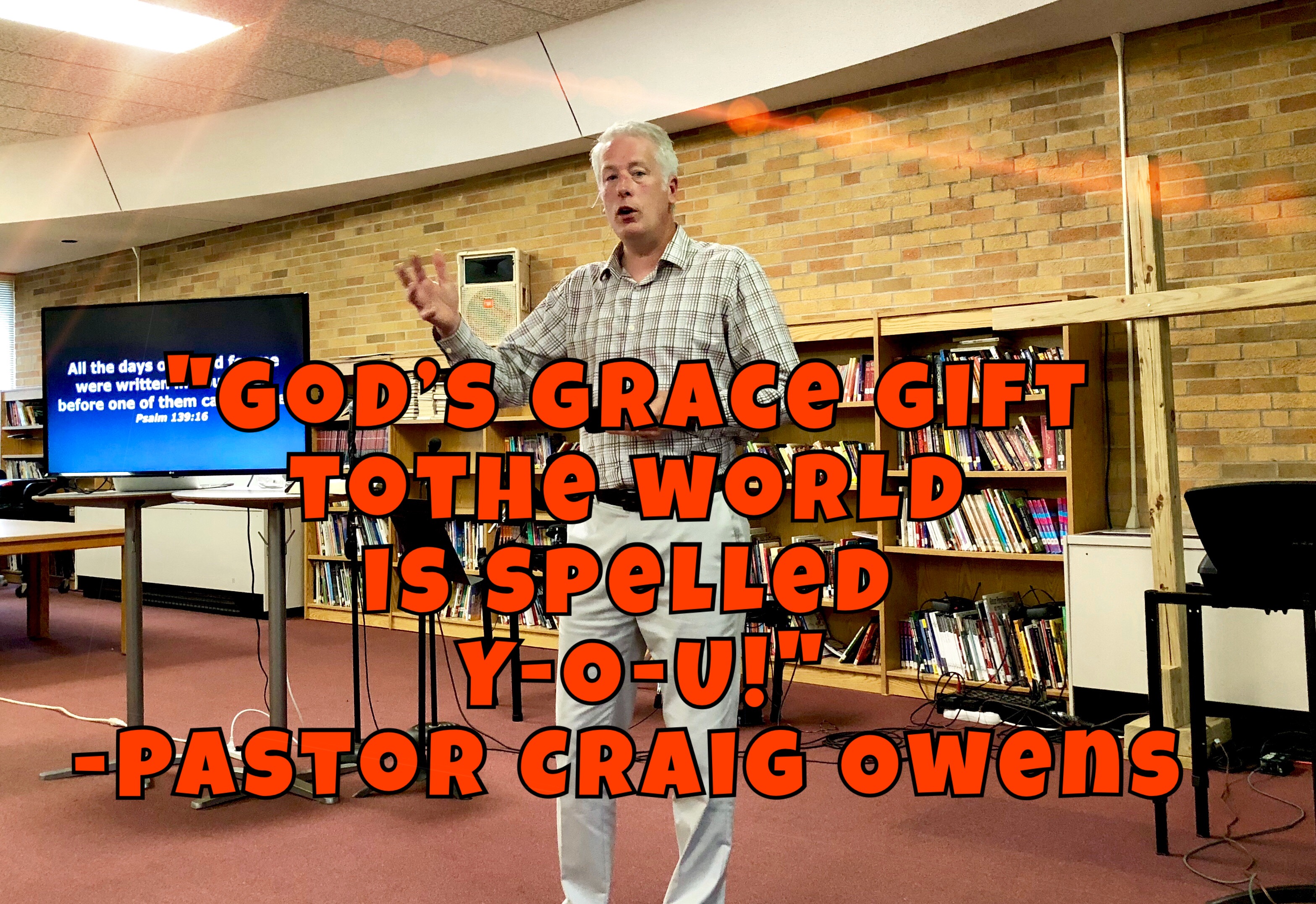
You are a gift. You are God’s grace gift to the world. 

Max Lucado said it this way: “You are you-nique. 

God made you on purpose and for a purpose.

God implanted unique abilities in you from conception (see Psalm 139:13). And check out what God said to Jeremiah, “Before I formed you in the womb I knew and approved of you…” (Jeremiah 1:5). Before you were even conceived, God already knew all about you AND He approved of you! 

Why did God implant these unique abilities in you? Because He knew of the unique opportunities you would face during your lifetime (see Psalm 139:16). Because God is for you, He gave you all that you would need to successfully face every opportunity that came your way. 

Every one of us has been given these grace gifts of unique talents and opportunities. The Bible says, “to each one of us grace has been given as Christ apportioned it” (Ephesians 4:7). If God is for you, and God is for me, then that means that you have been gifted to be a blessing to me and I have been gifted to be a blessing to you (Romans 12:3-6; 1 Corinthians 12:4-7).

Let me state it again: every one of us has been entrusted by God with unique talents in order to successfully face the unique opportunities that He knew we would face. Jon Bloom reminds us, “Some are given more, some are given less, but all are given much.” 

So what do we do with what we’ve been entrusted? There are two possibilities: (1) We can invest our talents and abilities in a way that glorifies God, or (2) We can squander the talents God has given us. 

How do you squander the grace gift of your life? 

  1. Not discovering it—I have a gift?
  2. Devaluing it—I’m nothing special.
  3. Overvaluing it—I’m super-important. I don’t need anyone else.
  4. Laziness—I don’t want to mess it up, so there’s no need for me to invest my gift.
  5. Short-sightedness—My gift is just for me, so it doesn’t matter what I do with it.

I hope we can all say what Erma Bombeck wrote: “When I stand before God at the end of my life, I would hope that I would not have a single bit of talent left but could say, ‘I used everything You gave me.’”

How do you honor God with your you-niqueness? I can tell you in just three simple words—You be you! 

If you will just be who God made you—not downplaying your talents, not wishing you had someone else’s talents—that’s when you will feel fulfilled, and God will be glorified, and the rest of the world will be blessed! So…

YOU BE YOU! 

Thursdays With Oswald—Jeremiah 5

This is a weekly series with things I’m reading and pondering from Oswald Chambers. You can read the original seed thought here, or type “Thursdays With Oswald” in the search box to read more entries.

Jeremiah 5

[These are notes from Oswald Chambers’ lecture on Jeremiah 5.] 

     The Bible is not so much a revelation about God as a revelation of God who is adequate to deal with the worst. …  

     The tumbling and turmoil in human history is caused everywhere by the consuming fire of God rather than by the futile rage of the devil. In reading history the saint sees that the great presence and power is God, not the devil. …

     Hordes of barbarians and powers of worldly dominion are unconscious of God, but God uses them for His own purpose. Nothing happens by chance. When our Lord stood before Pilate He said, “You would have no power over Me if it were not given to you from above” (John 19:11). The tyranny of the Roman Empire over God’s people was the providential order of God, and Jesus recognized that this was so, He did not start a revolution, or say, “We must fight against this” (John 18:36). Perils are clear to God’s mind alone, but they mean panic to everyone who does not know the mind of God. …  

     We learn the marvelous truth that we may become more than conquerors through our right relationship to God over everything that may come against us. …  

     In order to make proper changes in a nation’s life, you must change the people’s wants. 

From Notes On Jeremiah 

All over the globe, it appears that evil is holding sway and that sin is running rampant. It could appear as if the devil is winning, and Christians are just desperately trying to hold on to the end. But is that what it means when the Bible says that we are more than conquerors? 

Let’s be clear about this—God is in control. 

God may use barbarians, dictators, and evil people to accomplish His purposes, but they are all under His control. These forces have bounds past which they may not go. Any power they have has been given to them from above. 

If we forget this, we can easily fall into a hand-wringing panic. But let’s remind ourselves again and again that God is in control! If our relationship with Him is right, then we truly soar over these temporal upheavals; we become more than conquerors through Him Who loves us!

Thursdays With Oswald—Jeremiah 4

Oswald ChambersThis is a weekly series with things I’m reading and pondering from Oswald Chambers. You can read the original seed thought here, or type “Thursdays With Oswald” in the search box to read more entries.

Jeremiah 4

[These are notes from Oswald Chambers’ lectures on Jeremiah 4.]

     The great truth underlying calamity is that the truth and way of God is seen but abandoned because it is too difficult. Unless we understand this we shall misjudge God in His dealings with His people and imagine that He is too stern. … Abandon is not rebellion yet; abandon simply means—“That is a nice vision, but it is not for me.” … 

     The battle is lost or won in the secret places of the will with God alone, never first in external circumstances. … When that is done we can go forth with the smiling certainty that our battle is won, nothing will ever again enthrall us on that line. The world, the flesh and the devil have not the slightest power over the man who can rule his own spirit, who has fought the battle out before God and won there. …

     When the secret places of our will before God are revealed you know exactly what you have to do. Let the Word of God bore a hole in your self-complacency about the particular thing He has hauled you up about and then put in another Word that He brings to you, and you will soon find His dynamite at work. … 

     We are choked by a little thing that has not its root in God, which God condemned and we pathetically wept over but left there. … Never put a thing off and say, “It does not matter, no one sees.” No, but they will see you go down like standing corn before the scythe in external circumstances, because you played the traitor to God in secret. If God has revealed anything to you for the tiniest glimmer of a second and you don’t obey Him and cultivate that territory for Him, you will go down when the crisis comes. … 

     The basis of life on earth apart from God is chaos. … No whining and no shirking will ever help us to escape the utter confusion that is at the basis of every bit of human life that has ignored God. … 

From Notes On Jeremiah 

Our battles are won or lost in secret long before they are ever fought externally. 

God’s Holy Spirit wants to dynamite the areas of our life that would cause us to falter in the day of battle. If we will allow Him to deal with these things in private, we will be more than conquerors when that day of external temptation finally comes. 

If we maintain the “It’s no big deal” attitude with God in private, we shall surely be defeated by the temptations when they do come. 

The choice is yours…

Thursdays With Oswald—Jeremiah 2-3

Oswald ChambersThis is a weekly series with things I’m reading and pondering from Oswald Chambers. You can read the original seed thought here, or type “Thursdays With Oswald” in the search box to read more entries.

Jeremiah 2-3

[These are notes from Oswald Chambers’ lecture on Jeremiah 2-3.]

     God is the “adornment” of His people; but God says, “My people have forgotten Me days without number”; the dead set of their life has been away from God (Jeremiah 2:32). Forgetting as an infirmity of mere consciousness is one thing; but forgetting by steadfastly refusing to recognize is another thing. These people had deliberately turned out of God’s way. They were wantoning after some other god than the God Who was holy (2:33). …  

     The thing that shocks us most is not the thing that shocked Jesus most. Social immorality shocks us till we don’t know where we are; but what struck the heart of Jesus Christ with horror was immorality against God, pride against Himself (see Luke 16:15). …  

     The innocence arising from evil is always like this—“I’ve done nothing.” It is the innocence we are all born with; sooner or later it takes its stand with evil and only knows good by contrast; whereas the innocence arising from the presence of the Spirit of God takes its stand with good and knows evil only by contrast. If we hand our hearts over to God we need never know in experience what Jesus Christ says of the human heart is true (see Mark 7:20-23). 

From Notes On Jeremiah

This is a tough concept that takes some quiet introspection in the presence of the Holy Spirit. Christians should ask themselves: Do I know the difference between good and evil because I’m doing evil and the opposite of what I’m doing is good, or because I’m doing good and the opposite of what I’m doing is evil? 

Originally, Eve knew evil only as the opposite of how she was living. But when satan tempted her to take the forbidden fruit, Eve now knew evil as something she was doing. Jesus said evil is what would naturally come out of our heart, unless “we hand our hearts over to God” and allow His Spirit to supernaturally bring out of us the Christlike fruit He produces. Is this happening in your life?