Thursdays With Spurgeon—Guided For God’s Sake

This is a weekly series with things I’m reading and pondering from Charles Spurgeon. You can read the original seed thought here, or type “Thursdays With Spurgeon” in the search box to read more entries.

Listen to the podcast of this post by clicking on the player below, and you can also subscribe on AppleSpotify, or Audible. 

Guided For God’s Sake 

In You, Lord, I have taken refuge; let me never be put to shame; deliver me in Your righteousness. Turn Your ear to me, come quickly to my rescue; be my rock of refuge, a strong fortress to save me. Since You are my rock and my fortress, for the sake of Your name lead and guide me. Keep me free from the trap that is set for me, for You are my refuge. Into Your hands I commit my spirit; deliver me, Lord, my faithful God. (Psalm 31:1-5) 

     To lead and to guide are two different things very like each other, but patient thought will detect different shades of meaning, especially as the last may mean ‘provide for me.’ The double word indicates an urgent need—we require double direction, for we are fools and the way is rough. 

     Lead me as a soldier, guide me as a traveler! Lead me as a babe, guide me as an adult; lead me when You are with me, but guide me even if You are absent; lead me by Your hand, guide me by Your Word. The argument used is one fetched from the armory of free grace: not for my sake, but ‘for the sake of Your name’ guide me. 

From Spurgeon And The Psalms

When we let God lead us and guide us, we are never “put to shame.” It’s my own attempts at guiding myself that end up in shame and failure. This is why Jesus taught us to pray for God’s name to be glorified as His will is done. Part of that leading and guiding provides our daily bread and an escape from falling in the face of temptation. 

Interestingly, Jesus prayed the same thing for Himself in the Garden of Gethsemane: “Not My will, but Yours be done.” And then Jesus could confidently use the same words from this Psalm as He hung on the Cross: “Father, into Your hands I commit My spirit.” We can pray with the same assurance when we are allowing the Holy Spirit to both lead and guide us every single day.

►► Would you please prayerfully consider supporting this ministry? My Patreon supporters get behind-the-scenes access to exclusive materials. ◀︎◀︎

Links & Quotes

T.M. Moore wrote to pastors, “Effective ministry and fruitful Christian living are not automatic. They don’t just happen. Each requires that we receive the gifts of God, develop them according to His Word, and put them to proper use day by day. We must work out our salvation and work at our calling with focus and vigor.” Check out the rest of his post 

Speaking of pastors: In order for us pastors to be at our peak, we need to take care of ourselves. Here is a short video where I talk about the principle of sabbathing (a topic I explore in-depth in my book Shepherd Leadership: The Metrics That Really Matter).

This study from PennMedicine tells us that our brains can continue to learn new things until the day we die. So apparently you can teach an old dog new tricks!

My friend Greg and I have always tried to combine work and play. We’ve found that fun can really help leadership lessons stick. Check out this clip from a recent Craig And Greg Show leadership podcast.

Some really fast-moving stars in our Milky Way galaxy have further called into question the dating of our universe. These stars seem to indicate a universe that was created by God recently.

“When you’re good at something, you’ll tell everyone. When you’re great at something, they’ll tell you.” —Walter Payton

How does the word of man become the Word of God? Great teaching from John Piper in his “Look at the Book” series.

Thursdays With Spurgeon—Encouragement For Preachers

This is a weekly series with things I’m reading and pondering from Charles Spurgeon. You can read the original seed thought here, or type “Thursdays With Spurgeon” in the search box to read more entries.

Listen to the podcast of this post by clicking on the player below, and you can also subscribe on AppleSpotify, or Audible. 

Encouragement For Preachers

…For the mouth of the Lord has spoken (Isaiah 1:20).

     We preach because ‘the mouth of the Lord has spoken.’ It would not be worth our while to speak what Isaiah had spoken if in it there was nothing more than Isaiah’s thought—neither should we care to meditate hour after hour upon the writings of Paul, if there was nothing more than Paul in them. … The true preacher, the man whom God has commissioned, delivers his message with awe and trembling because ‘the mouth of the Lord has spoken.’ … 

     Woe unto us if we dare to speak the Word of the Lord with less than our whole heart and soul and strength! Woe unto us if we handle the Word as if it were an occasion for display! If it were our own word, we might be studious of the graces of oratory. But if it is God’s Word, we cannot afford to think of ourselves. … Because the mouth of the Lord has spoken the truth of God, we therefore endeavor to preach it with absolute fidelity. …  

     Believing that ‘the mouth of the Lord has spoken,’ it is my duty to repeat God’s Word to you as correctly as I can after having heard it and felt it in my own soul. It is not mine to amend or adapt the gospel. …  Again, dear friends, as ‘the mouth of the Lord has spoken,’ we speak the divine truth with courage and full assurance. Modesty is a virtue, but hesitancy when we are speaking for the Lord is a great fault. …  

     We preach not the gospel by your leave. We do not ask tolerance nor court applause. We preach Christ crucified, and we preach boldly as we ought to speak because it is God’s Word not our own. … We cannot use ‘ifs’ and ‘buts,’ for we are dealing with God’s ‘shalls’ and ‘wills.’ If He says it is so, it is so. And there is the end of it. Controversy ceases when Jehovah speaks [Jeremiah 1:17-19].

From The Infallibility Of Scripture

Preaching God’s Word is not for the faint of heart. It takes one who is confidently humbled—confident that God has spoken and humbled that He would choose someone like me to speak His Word to His people. 

In my book Shepherd Leadership: The Metrics That Really Matter I wrote: 

Check this out: “Now Moses was a very humble man, more humble than anyone else on the face of the earth” (Numbers 12:3). Who wrote the book of Numbers? If you answered “Moses,” you are correct. Doesn’t that sound a bit brash to declare that you are more humble than anyone else on the earth? Yet, God allowed Moses to pen those words, making that a Holy Spirit-inspired statement of fact. Humility is a double-edged sword: it can serve a leader well when it is balanced with appropriate confidence, but it is a detriment to an organization’s health if it is self-de-basing humility that undercuts a leader’s credibility. 

The God-honoring preacher gets his message from the mouth of the Lord, and then confidently endeavors “to preach it with absolute fidelity.” Whether others praise of criticize, the humble leader says, “I am only God’s servant speaking God’s Word.” 

Preachers, let’s make sure that everything we confidently and humbly share from our pulpits is the whole counsel of what has been spoken by the mouth of the Lord.

►► Would you please prayerfully consider supporting this ministry? My Patreon supporters get behind-the-scenes access to exclusive materials. ◀︎◀︎

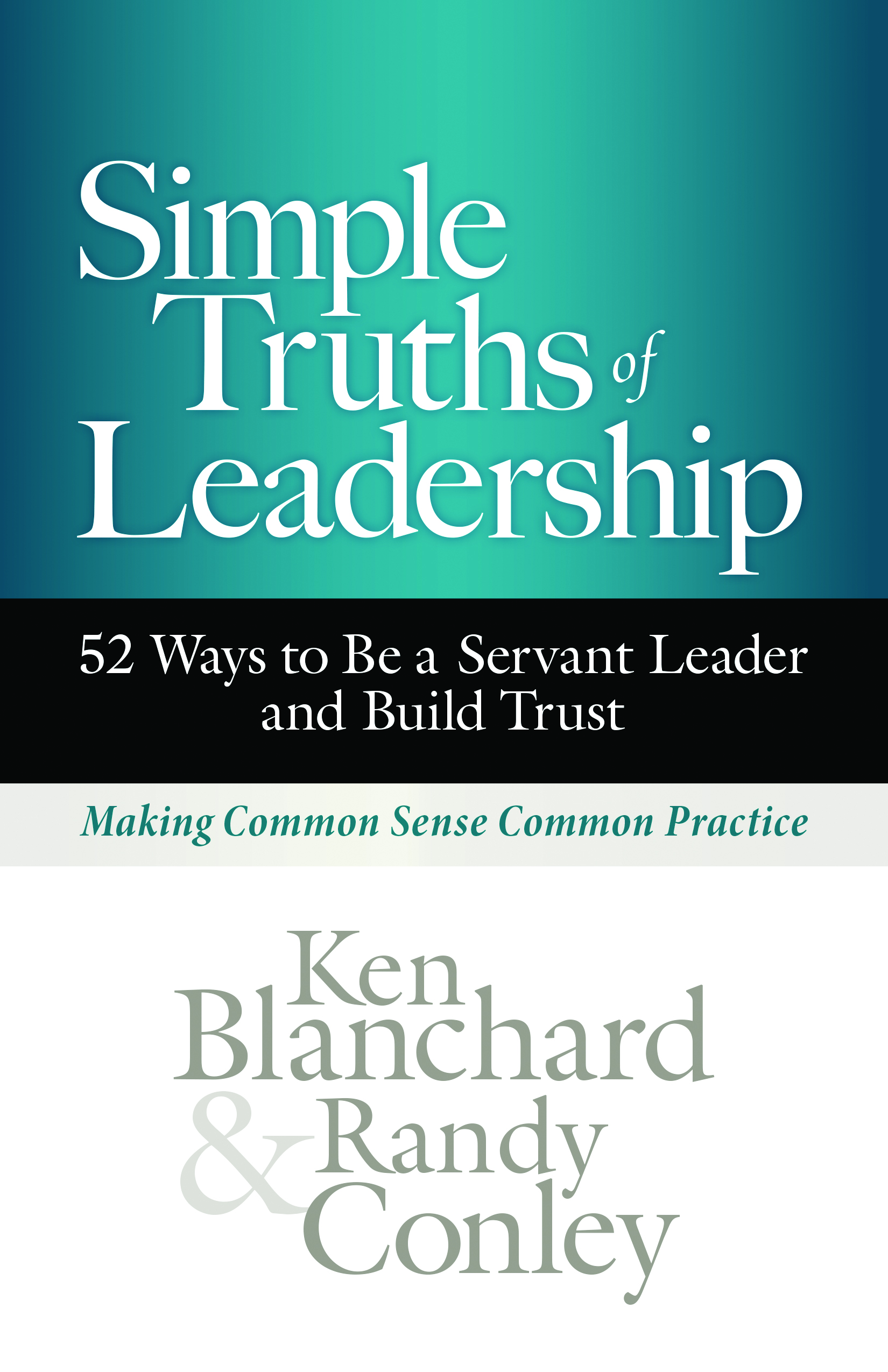
13 Quotes From “Simple Truths Of Leadership”

Kenneth Blanchard and Randy Conley have given leaders a gift in Simple Truths of Leadership. Inside you will find 52 leadership lessons that can be immediately added to your leadership toolbox, and ample follow-up information if you want to dive deeper into any of these principles. Check out my full book review by clicking here. 

“If today’s leaders had a more commonsense approach to leadership, we’d venture to say that 65 to 70 percent of the workforce would not be considered disengaged. That’s one reason our original title for this book was ‘DUH! Why isn’t commonsense leadership common practice?’” 

“The most persistent barrier to being a servant leader is a heart motivated by self interest that looks at the world as a ‘give a little, take a lot’ proposition. … If leaders don’t get their heart right, they will never become servant leaders.” 

“Organizational leaders often have an either/or attitude toward results and people. … You can get both great results and great relationships if you understand the two parts of servant leadership: the leadership aspect focuses on vision, direction, and results; the servant aspect focuses on working side-by-side in relationship with your people.” 

“Empower your people by letting them bring their brains to work.” 

When people are off track, don’t reprimand them—redirect them.” 

“The best minute servant leaders spend is the one they invest in people.” 

The remaining seven quotes are exclusive content for my Patreon supporters. In addition to book quotes, there are also videos and behind-the-scenes views that only these supporters have access to. I would love it if you would prayerfully consider supporting my ministry for just $5 per month.

Stop Self-Promoting

Listen to the podcast of this post by clicking on the player below, and you can also subscribe on AppleSpotify, or Audible. 

My book Shepherd Leadership: The Metrics That Really Matter opens with a chapter ‘The Wrong Ladder.’ This chapter is a reminder that we don’t have to figure out which ladder to climb in order to be successful. The last chapter of my book is entitled ‘Applause,’ which begins with the words, “Self-promotion is an anti-God attitude.” 

Throughout the Bible we never see people polishing up their résumés. There is no angling among godly leaders for who should get the prominent position. When some of the disciples of Jesus momentarily engaged in this kind of thinking, Jesus quickly corrected them. 

Often we see God taking obscure people and vaulting them to a position of prominence. Sometimes they will remain in that position until the day they die, and sometimes God will remove them after a rather short period of time. 

God prepares people, God promotes people, and God removes people as He sees best.

This is never more true than in the story of Daniel. “So Daniel prospered during the reign of Darius and the reign of Cyrus the Persian” (Daniel 6:28). In fact, for most of Daniel’s life, he is in a prominent leadership position. Daniel prospered, but he did so because God promoted him. Daniel never sought a position, and even if he was removed from a position, he didn’t try to retain it nor regain it.

Daniel knew God was in control, and he trusted His timing.

I’ve been sharing a series of leadership lessons from the life of Daniel with my Patreon supporters. Check out this brief clip from a lesson I entitled “No Self-Promotion.” 

If you are a Christian leader, I challenge you to stop polishing up your résumé. Whether you have a résumé that looks great or not, God will still place you where He needs you, when He needs you to be there. Remember: “Self-promotion is an anti-God attitude.” 

I would also ask you to consider becoming one of my Patreon supporters. For just $5 per month, you will have access to my exclusive content, and you will be helping to support the free side of this ministry.

Shepherd Leadership: The Metrics That Really Matter is available in print or ebook, and in audiobook through either Audible or Apple.

Don’t Putrefy Your Leadership

Listen to the podcast of this post by clicking on the player below, and you can also subscribe on AppleSpotify, or Audible. 

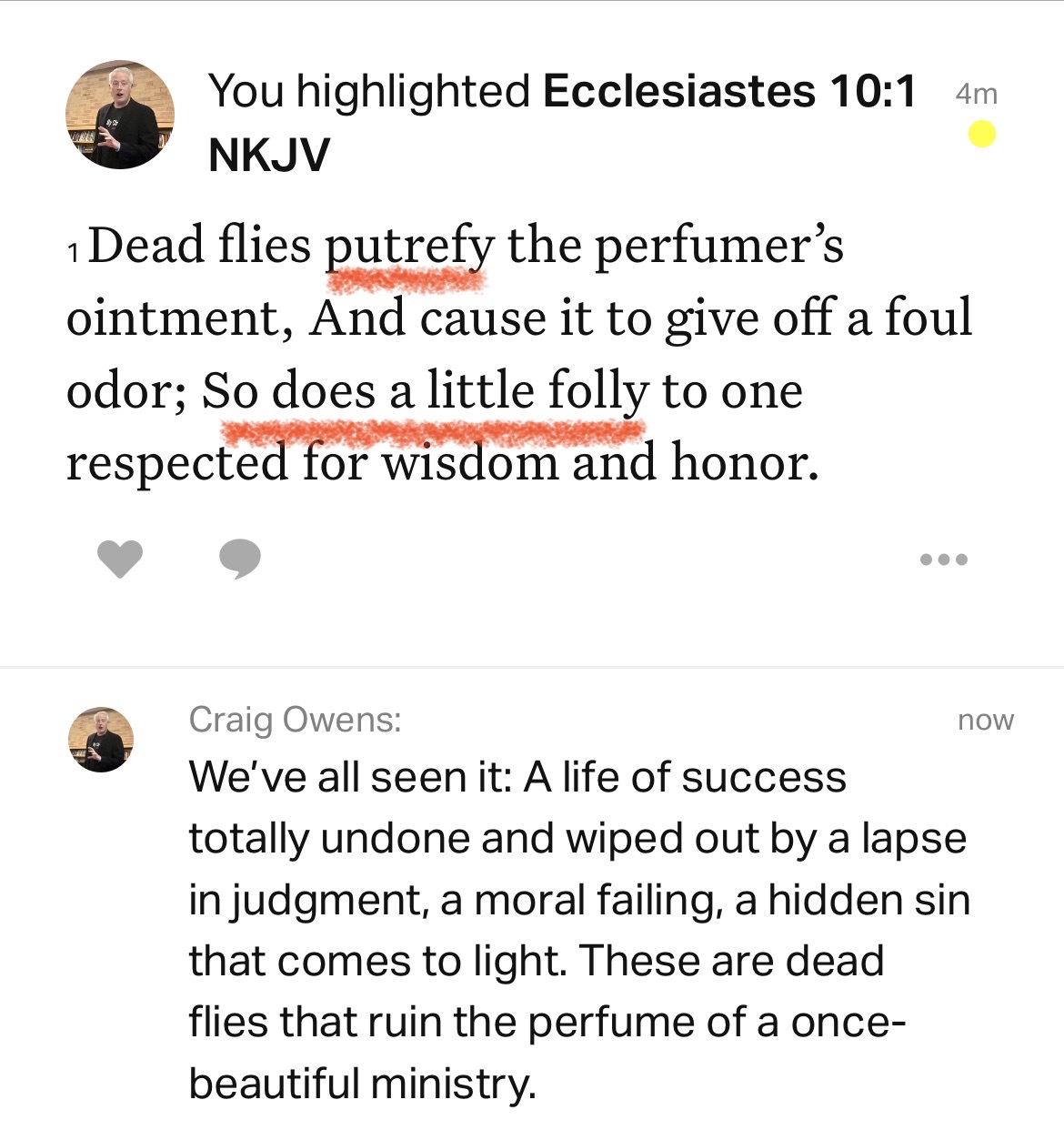
King Solomon nailed it pretty succinctly with this verse: Dead flies putrefy the perfumer’s ointment, and cause it to give off a foul odor; so does a little folly to one respected for wisdom and honor. (Ecclesiastes 10:1) 

As a Christian leader, I always have mixed emotions when I hear of another prominent Christian leader who has stumbled. Part of me is angry because I know that all Christian leaders will get painted with the same brush. Another part of me is incredibly sad to hear of a brother or sister who has squandered the trust that was placed in them. Finally, part of me becomes quite self-reflective, because I don’t want to repeat their mistakes. 

Tom Peters said, “There are no minor lapses of integrity.” King Solomon would agree. And so do I. 

Godly leadership can be such a beautiful thing, but just a couple of dead flies can putrefy the whole thing! 

Here are four things that I have seen in the lives of those leaders who haven’t finished well. These are the things all of us need to watch carefully in our own lives.

(1) They compromised in “the little things.” None of them started off by saying, “I’m going to completely ruin my reputation as a godly leader.” But they allowed themselves to indulge in things that were just “little things” in their minds. Perhaps they thought, “It won’t hurt if I indulge in this one little thing.” The apostle Paul warns us, “So, if you think you are standing firm, be careful that you don’t fall!” (1 Corinthians 10:12). 

(2) Pride crept in. They thought they were better than others. Peter said it this way: “All of you, clothe yourselves with humility toward one another, because, ‘God opposes the proud but shows favor to the humble’” (1 Peter 5:5). I addressed this topic in my book Shepherd Leadership: The Metrics That Really Matter like this—

     Did you catch that? God stands back from the proud person who will not admit his error nor ask for help, let alone ask for forgiveness. On the other hand, God lavishes His grace on the humble one who admits both his error and his need for help. Admission of an inappropriate action or reaction brings God’s help! 

     Friends, the mark of a maturing shepherd is not one who never misspeaks or never makes a mistake. No, the mark of a maturing shepherd is the one who is closing the gap between his mess up and his confession.

Pride will keep us from confessing the “little sins” and keep us from God’s help. But humility quickly admits the smallest of slip-ups and therefore receives God’s grace and help. 

(3) They lowered their standards. If anything, leaders should raise their standards as they become more successful. Think of it this way: when I was young and immature, I didn’t give much thought to my diet or my exercise routine. As I became older (and hopefully more mature), I became much more tuned-in to these things. Physically, the older I get, the more I need to pay attention to my health. The same thing is true in our leadership: maturity should lead to higher standards and higher levels of scrutiny. 

(4) They stopped listening to others. The combination of little compromises, pride, and lowered standards doesn’t easily invite accountability nor transparency. The track record is pretty consistent among those who have fallen short: they stopped listening to people who tried to correct them.

I want to finish well. I don’t want a leadership stumble in my life to rob God of glory, nor to cause others to stumble in their Christian walk. I am committed to living my life in a way that will allow Jesus to say to me at the end, “Well done, good and faithful servant.” 

I pray that all Christian leaders will join me in this.

►► Would you please prayerfully consider supporting this ministry? My Patreon supporters get behind-the-scenes access to exclusive materials. ◀︎◀︎

The Craig And Greg Show: Mistake Your Way To Success

Listen to the audio-only version of this podcast by clicking on the player below, or scroll down to watch the video.

On this episode of “The Craig And Greg Show” we talk about: 

  • [0:20] Craig shares an insightful quote from John Maxwell 
  • [0:45] The guys claim to have never made a mistake, and we definitely believe them…
  • [1:12] Mistakes help both individuals and teams grow 
  • [2:12] Craig shares a lesson from his wife’s classroom about it being a safe place to make mistakes 
  • [3:06] Leaders need to distinguish between success and perfection 
  • [3:50] What do our faces show when others make mistakes? 
  • [4:40] Greg explains how grace and humility from the leader will help other teammates deal with their mistakes 
  • [6:16] Sports show us how mistakes can lead to excellence 
  • [7:24] Greg’s football mistakes led to his high level of success 
  • [11:06] Leaders have to remind everyone that mistakes aren’t fatal 
  • [13:30] Thomas Edison gave us a good example about success coming from failure 
  • [15:31] When leaders share their mistakes, it’s freeing for the rest of the team
  • [17:26] Leaders need to take initiative—as the leader goes, so goes the team

Check out this episode and subscribe on YouTube so you can watch all of the upcoming episodes. You can also listen to our podcast on Spotify and Apple.

Thursdays With Spurgeon—How Pruning Helps Prayer

This is a weekly series with things I’m reading and pondering from Charles Spurgeon. You can read the original seed thought here, or type “Thursdays With Spurgeon” in the search box to read more entries.

Listen to the podcast of this post by clicking on the player below, and you can also subscribe on AppleSpotify, or Audible. 

How Pruning Helps Prayer 

If you remain in Me and My words remain in you, ask whatever you wish, and it will be done for you. (John 15:7)

     How is this privilege of mighty prayerfulness to be obtained? The answer is, ‘If you abide in Me and My words abide in you.’ … Beloved, the first line tells us that we are to abide in Christ Jesus our Lord. … 

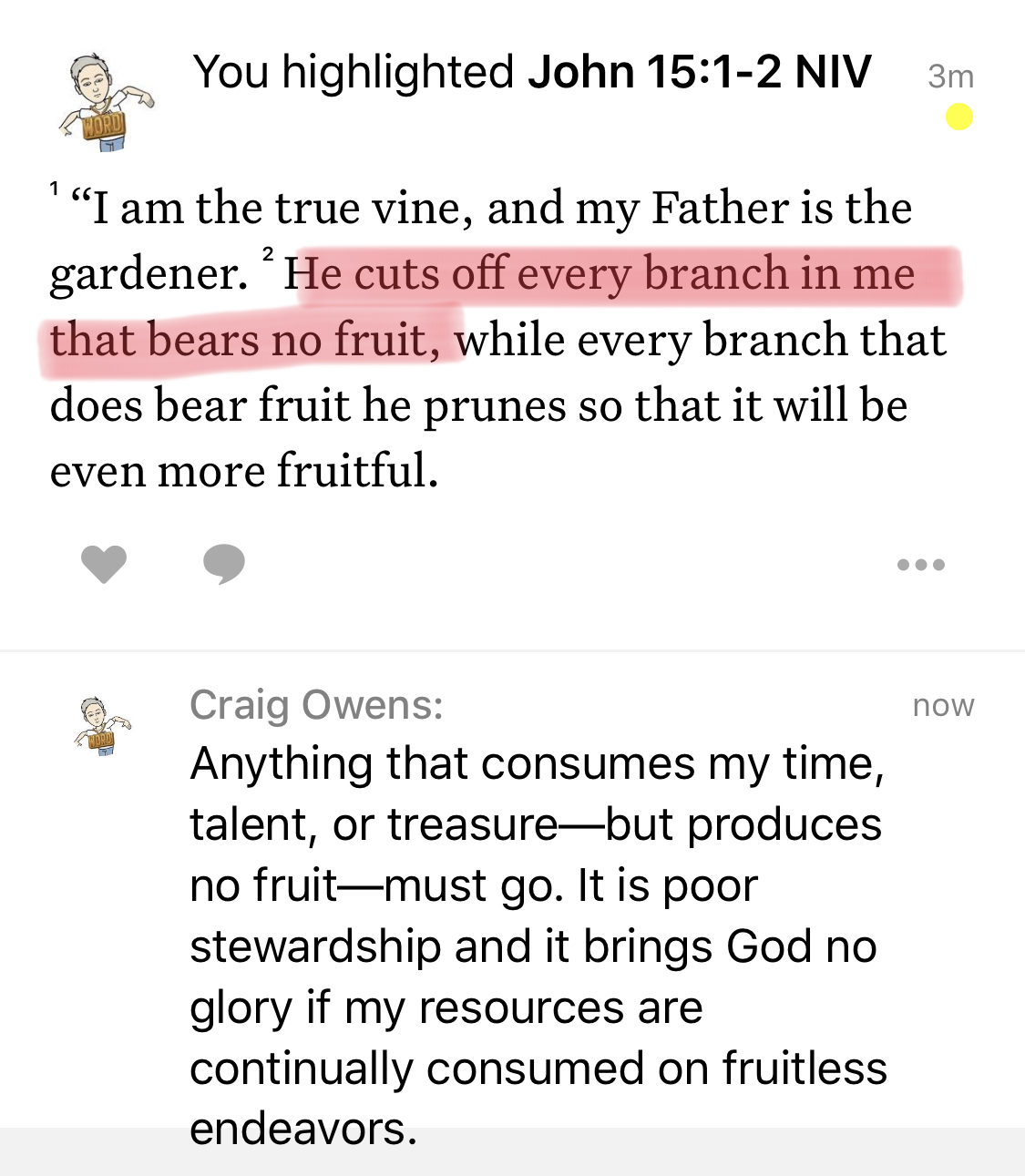
     As if to help us understand this, our gracious Lord has given us a delightful parable. Let us look through this discourse of the vine and its branches. Jesus says, ‘Every branch in Me…that bears fruit He prunes’ (John 15:2). Take care that you abide in Christ when you are being purged. ‘Oh,’ says one, ‘I thought I was a Christian. But alas! I have more troubles than ever. Men ridicule me, the devil tempts me, and my business affairs go wrong.’ Brother, if you are to have power in prayer, you must take care that you abide in Christ when the sharp knife is cutting everything away. …  

     Take care, also, that when the purging operation has been carried out you still cleave to your Lord. … When you see the work of the Spirit increasing in you, do not let the devil tempt. He will try to get you to boast that now you are somebody; you need not come to Jesus as a poor sinner and rest in His precious blood alone for salvation. Abide still in Jesus. … Your work for Christ must be Christ’s work in you or else it will be good for nothing.

 From The Secret Of Power In Prayer

Our Heavenly Father wants us to be fruitful because that brings Him glory and lifts Jesus up for others to see. 

We have to commit to abiding in Jesus despite the pruning process. It’s helpful to remember that the reason the Husbandman prunes us is because He has seen fruitfulness in us, but He wants us to be even more fruitful. When we stay in the process during the uncomfortable—and sometimes painful—pruning, more fruit will begin to appear in our lives. 

It’s at this point that we have to guard against pride. The devil loves for me to get proud of “my accomplishments.” But I have to remind myself that apart from the Vine I am worse than fruitless; I’m just a dead branch only fit for the fire. I’ve learned that there is a danger in success, so I must constantly choose humility over pride, and abiding over self-sustaining. 

As we abide, our prayers take on an ever-increasing vitality so that conversation with our Lord becomes as natural as breathing. I hope none of us will ever settle for anything less than this intimate, ongoing communion with our Master!

►► Would you please prayerfully consider supporting this ministry? My Patreon supporters get behind-the-scenes access to exclusive materials. ◀︎◀︎

Links & Quotes

T.M. Moore wrote, “It’s not likely John the Baptist would be welcomed in many pulpits today. Even though Edwards used him as a model of ‘The True Excellency of a Gospel Minister,’ few and far between are the shepherds today who would even think of adopting his example.

“Edwards wrote, ‘He also shone bright in his conversation, and his eminent mortification and renunciation of the enjoyments of the world; his great diligence and laboriousness in his work, his impartiality in it, declaring the mind and will of God to all sorts without distinction; his great humility, rejoicing in the increase of the honour of Christ, though his honour was diminished, as the brightness of the star diminishes as the light of the sun increases; and in his faithfulness and courage, though it cost him his own life.’

“These days many pastors secure their ‘honor’ in subtle but significant ways. They go by ‘Reverend’ or ‘Doctor.’ Have reserved parking places and their name on the church sign. Adopt fashionable garb and speech. Try hard to be friends with all the right people. Such shepherds want to advance their honor; John worked to have his honor diminished, that the honor of Christ might increase.”

I share T.M.’s passion for shepherd in the Church, which is why he graciously wrote an endorsement for my book Shepherd Leadership: The Metrics That Really Matter.

Vaughn Shoemaker (1902-1991) was an American editorial cartoonist. He won the 1938 and 1947 Pulitzer Prizes for Editorial Cartooning for his work with the Chicago Daily News. He was the creator of the character, John Q. Public, and a faithful Assemblies of God layman. I am a fourth-generational Pentecostal in the Assembly of God fellowship, so I love studying more about the men and women who have made this such a robust missions-minded fellowship! Read more of this amazing man here.

Dan Reiland has an important list for leaders: 11 Leadership Mistakes To Avoid At All Costs.

This is a radical call for us to look hard at our present lives to see if they are shaped by the hope of the resurrection. Do we make decisions on the basis of gain in this world or gain in the next? Do we take risks for love’s sake that can only be explained as wise if there is a resurrection?” —John Piper

“Jesus will do the things we ask for if they make God’s greatness known. So how do we ask this way? We must ask from right relationships (Mark 11:24-25, 1 Peter 3:7), with right motives (James 4:3, Proverbs 16:2), through right living (James 5:16, Proverbs 15:29), in good faith (James 1:6-7), according to His will (1 John 5:14-15). In short, if you think Jesus would put His name on it, and it will make His Father famous, then ask and believe! But remember, we’re here for Him—He’s not here for us.” —Craig Groeschel, in Twisted 

For parents and anyone else who works with students, this is a segment from the Axis ministry’s Culture Translator newsletter:

In his book Man’s Search for Meaning, Viktor Frankl writes that “success, like happiness, cannot be pursued; it must ensue, and it only does so as the unintended side-effect of one’s personal dedication to a cause greater than oneself… Happiness must happen, and the same holds for success: you have to let it happen by not caring about it.”

An idea like that would likely seem counterintuitive to many of the students in Professor Santos’ classes—students who have been raised from young ages to pay careful and constant attention to their academic viability. Students like these grow up with a hope and an expectation that achieving perfection (whether academic, relational, spiritual, or other) will finally yield the happiness, satisfaction, and recognition they’ve been looking for. But after achieving perfection, the next source of anxiety is maintainingperfection. As Christopher Fry once put it, “What, after all is a halo? It’s only one more thing to keep clean.”

Jesus concludes Matthew 5 by saying to his hearers, “Be perfect, therefore, as your heavenly Father is perfect.” It’s a verse most Christians may not want to touch, and one that anxious overachievers might point to as justification for their continual striving. But as C.S. Lewis points out in Mere Christianity, Jesus’ words presuppose our dependence on Him. He writes, “The command Be ye perfect is not idealistic gas. Nor is it a command to do the impossible. He is going to make us into creatures that can obey that command… The process will be long and in parts very painful, but that is what we are in for. Nothing less. He meant what He said.”

In other words, our betterment is in partnership with our Creator, and happiness is merely a by-product of our total surrender. Whoever has ears, let them hear.

Links & Quotes

“If you want to make people happy, don’t be a leader. Sell ice cream.” —Steve Jobs

“Pride is the first chapter in the book of failure. Humility is the first chapter in the book of success.” —Mark Batterson

“Great shepherds seek daily to increase in the Good Shepherd and to lead the people they serve to feed on Him and grow in His salvation.” (T.M. Moore). I share T.M.’s passion for shepherd in the Church, which is why he graciously wrote an endorsement for my book Shepherd Leadership: The Metrics That Really Matter

Sobhi Malek has an excellent prayer guide which gives weekly prayer points for Muslims. Each week you will get more insight into the mindset of our Muslim friends, a prayer, and a passage of Scripture. I encourage you to subscribe to this page so you won’t miss any updates.