“We simply can’t change ourselves. Only the Spirit of God can conform us to the glorious image of Christ.” —David Wilkerson
“Oh, that today my clothes may be vestments, my meals sacraments, my house a temple, my table an alter, my speech incense, and myself a priest!” —Charles Spurgeon
“Sound biblical and theological learning is useful for building the church when it is delivered with patience and gentleness by a loving shepherd.” —T.M. Moore
“Are you becoming more sweet-spirited, more like Jesus? Are you looking soberly in the mirror each day and praying, ‘Lord, I want to conform to Your image in every area of my life’? Or has your bitterness taken root, turning into rebellion and hardness of heart? Have you learned to shield yourself from the convicting voice of God’s Spirit?” —David Wilkerson
“Prayer at its holiest moment is the entering into God to a place of such blessed union as makes miracles seem tame and remarkable answers to prayer appear something very far short of wonderful by comparison.” —A.W. Tozer
“I find that when I think I am asking God to forgive me I am often in reality (unless I watch myself very carefully) asking Him to do something quite different. I am asking Him not to forgive me but to excuse me. But there is all the difference in the world between forgiving and excusing.” —C.S. Lewis
“No man should stand before an audience who has not first stood before God. Many hours of communion should precede one hour in the pulpit. The prayer chamber should be more familiar than the public platform. Prayer should be continuous, preaching but intermittent. …See to it that we pray more than we preach and we will never preach ourselves out. Stay with God in the secret place longer than we are with men in the public place and the fountain of our wisdom will never dry up. Keep our hearts open to the inflowing Spirit and we will not become exhausted by the outflow. Cultivate the acquaintance of God more than the friendship of men and we will always have abundance of bread to give to the hungry.” —A.W. Tozer
Listen to the podcast of this post by clicking on the player below, and you can also subscribe on Apple, Spotify, or Audible.
King David wrote a coronation psalm for his son Solomon as he ascended the throne in Jerusalem. The opening words say, “Endow the king with Your justice, O God, the royal son with Your righteousness. He will judge Your people in righteousness, Your afflicted ones with justice” (Psalm 72:1-2).
David was calling on God’s blessing on his son, but He was also reminding Solomon that he couldn’t rule without God’s help. David’s singular focus was for God to receive all the glory. He closes the coronation psalm like this: “Praise be to the Lord, the God of Israel, Who alone does marvelous deeds. Praise be to His glorious name forever; may the whole earth be filled with His glory. Amen and Amen” (vv. 18-19).
Solomon started out well. “Solomon son of David established himself firmly over his kingdom, for the Lord his God was with him and made him exceedingly great” (2 Chronicles 1:1). Even when God gave Solomon the option to ask for anything, he choose wisdom “to govern this great people of Yours” (1 Kings 3:7-9).
David strongly impressed on Solomon that obedience to God was the key to God’s blessing on Solomon and on the nation of Israel. “So be strong, act like a man, and observe what the Lord your God requires: Walk in obedience to Him, and keep His decrees and commands, His laws and regulations, as written in the Law of Moses. Do this so that you may prosper in all you do and wherever you go” (1 Kings 2:2-3).
But there is an ominous word that creeps in very early on in Solomon’s reign. Just one word that foreshadows the downfall that is to come—
Solomon showed his love for the Lord by walking according to the instructions given him by his father David, EXCEPT… (1 Kings 3:3).
As you’ve probably heard, Solomon’s many foreign wives began to lead him astray from “observing what the Lord your God requires” and eventually became his downfall. But it began right here with the EXCEPT.
It’s all or nothing.
I cannot pick and choose which words from God I’m going to follow and which I’m going to “except.” If God says I must do it, then I must do it!
The EXCEPT will lead to my downfall just as surely as it did for Solomon.
Heavenly Father, may I be so sensitive to the prompting of Your Holy Spirit if I’ve let any EXCEPTs creep into my life. Reveal them to me so that I may repent, show myself a man, and follow You wholeheartedly.
“Unutterable mercy! There is no sinner out of hell so black but that God can wash him white. There is not out of the pit one so guilty that God is not able and willing to forgive him; for He declares the wondrous fact—‘I, even I, am He that blotteth out thy transgressions.’” —Charles Spurgeon
“The Holy Spirit is the missing factor in our personality, and without Him we cannot be altogether as God wants us to be. An abiding gift makes an abiding change in the person to whom the gift is made.” —Thomas Selby
“Continually revise your relationship to God until the only certainty you have is not that you are faithful, but that He is.” —Oswald Chambers
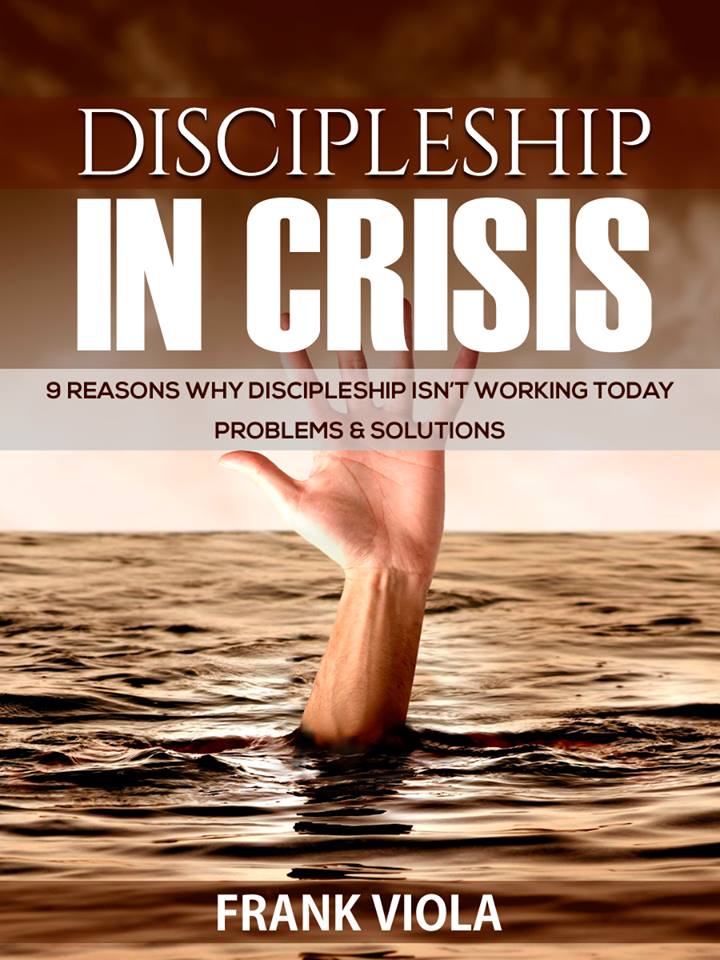
Check out my review of Discipleship In Crisis by Frank Viola by clicking here. Below are a few quotes which I found especially highlighter worthy.
“The presupposition that sits underneath virtually every sermon heralded today and most of the Christian books that fill bookstores is that we can live the Christian life if we just try hard enough. If we study our Bible more, pray more, witness more, tithe more, hear more sermons… then we can be like Jesus. But that’s not the gospel. The gospel teaches that just as Jesus couldn’t do anything of Himself, we can’t do anything of ourselves. Listen to the Lord again: ‘Without Me you can do nothing.’ The Christian life is impossible. It’s only Him-possible.”
“The goal of the gospel is not to get you out of hell and into Heaven, but to get God out of Heaven and into you.”
“A person who is living by the tree of life doesn’t sit back and say, ‘Let me try to do good and avoid evil.’ Instead, he allows the life of God to flow with in and through him. He yields to the instincts, promptings, and energy of that God-life. … You see, ‘good’ is a form of life. And only God is good. Here are the two choices before you today: (1) The choice to intellectually know good from evil and to try to do good = the tree of the knowledge of good and evil; (2) Living by the life of God, which is goodness itself = the tree of life.”
“The only way you and I can truly imitate Jesus’ external lifestyle is to imitate His internal relationship with His Father.”
“What history teaches us is that men have never learned anything from it.” —G.W.F. Hegel
“In a word, you cannot raise the bar on discipleship without raising the bar on the ekklesia—the living experience of the body of Christ—the native habitat in which true disciple-making and transformation take place.”
“The New Testament talks about spiritual seeing, spiritual touching, spiritual tasting, spiritual handling, and spiritual healing. These are the faculties of your Spirit-regenerated human spirit. Jesus was very much in touch with His spiritual instincts, and hence, He ‘perceived’ things ‘in His spirit’ that were outside natural means. He did this as a man anointed by the Holy Spirit, not because He was God.”
This is a weekly series with things I’m reading and pondering from Oswald Chambers. You can read the original seed thought here, or type “Thursdays With Oswald” in the search box to read more entries.
Remorse Is Hell On Earth
Never mistake remorse for repentance; remorse simply puts a man in hell while he is on earth, it carries no remedial quality with it at all, nothing that betters a man.
I meet people all the time who are sorry for the wrong things they’ve done, and perpetually beat themselves up over those sins. As Chambers says, their remorse has created a hell on earth and it doesn’t do a single thing to help them.
Even a great man like the Apostle Paul felt the hell-on-earth trap of remorse. “I know what the wrong thing is and I don’t want to do it, but I give in and do it anyhow. I say I’m not going to do it again, but I do it again. Oh, what a wretched man I am! (see Romans 7:15-24). That’s where remorse leaves us, and the devil uses that feeling of remorse to condemn us and to imprison us in his hell on earth.
Repentance, on the other hand, is feeling bad for the sin and also asking God to forgive us through the work Jesus Christ did on the Cross—Thanks be to God, who delivers me through Jesus Christ our Lord! (Romans 7:25). As a result of this repentance and forgiveness Paul can then conclude…
So now there is NO CONDEMNATION for those who belong to Christ Jesus. And because you belong to Him, the power of the life-giving Spirit has freed you from the power of sin that leads to death. (Romans 8:1-2)
Remorse imprisons. Repentance and forgiveness are the only things that free us!
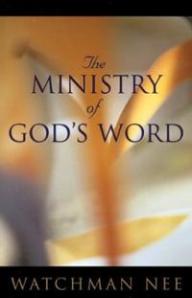
As a pastor I am frequently in awe that God would use me to share His Word with His people. At times it can feel almost overwhelming. Reading Watchman Nee’s teaching to pastors in The Ministry Of God’s WordI feel equal parts heaviness and encouragement.
The heaviness comes from the even deeper realization that Nee brings to pastors of their awesome responsibility before God to be the messengers of His Word. Nee makes it clear that if a pastor’s heart or mind is not as tuned in as possible, the message will be diminished in its delivery.
The encouragement comes from the realization of how much the Holy Spirit wants to help a preacher get his heart, mind, spirit, memory, and even vocabulary in a place that can be used greatly by God.
Pastors, this is not an easy-to-read book. Not because of the vocabulary, but because of the deepness of the subject matter. You will find yourself confronted at every page. But as you persevere through Nee’s challenging message, you will feel God’s Spirit moving to equip you for even great ministry of God’s Word.
And I would be remiss if I didn’t say thank you to my son Harrison for giving this book to me as a gift. Thank you, son!
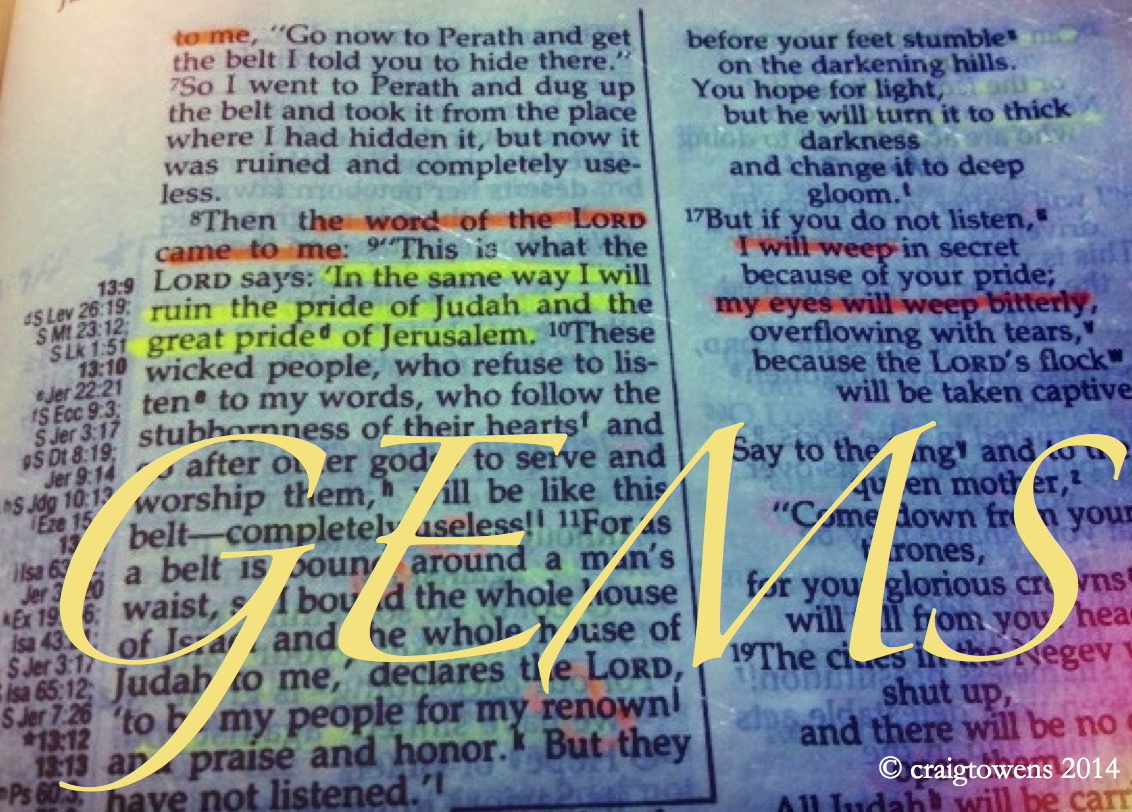
Do you ever get lost in the “begats” of the Bible? You know those long, tedious lists of who was born to whom? In 1 Chronicles there’s an equally long list of names that goes on for five chapters(!) of who’s in charge of what. But be careful not to skip over these lists. The Holy Spirit included them in the inspired Word of God for a reason, and sometimes you find some real gems buried in these lists.
Here are a few that I recently unearthed…
For David had said… (1 Chronicles 23:25)—David’s heart was so closely knit with God’s heart that the words he spoke were God’s words coming through David’s mouth, as he gave instructions about how worship in the tabernacle should be conducted.
David, together with the commanders of the army, set apart some of the sons of Asaph… (25:1, 3, 7)—Asaph, Hemen and Jeduthun prophesied through their singing in the tabernacle. They didn’t compose music and sing to entertain, but to call people to God. Notice, too, that all of the worship leaders in the tabernacle were “trained and skilled in music for the Lord.” Those God calls, He equips.
For God had blessed Obed-Edom… (26:5-8)—The Ark of the Covenant—the symbol of God’s presence—had been housed in Obed-Edom’s home. God’s presence produces blessing! Listen to how Obed-Edom’s descendants are described:
Leaders
Capable men
Able men
Capable men with the strength to do the work
Elihu… (27:18)—Even David’s older brother chose to serve him.
Hushai the Arkite was the king’s friend… (27:33)—In the listing of all the court officials, here is a man with no other title than David’s friend.
God’s Word is alive! Ask the Holy Spirit, Who inspired the men who penned these words, to give you fresh revelation as you read the Bible. Then prepare to be amazed at the gems He will reveal to you!








 Craig T. Owens