Listen to the podcast of this post by clicking on the player below, and you can also subscribe on Apple, Spotify, or Audible.
When Jesus was discussing end times events with His disciples, He described days that looked pretty bleak. Do any of these descriptions sound familiar today?
In times like these, Jesus said many people will be deceived. This is why Jesus twice tells His followers to “be on your guard” (vv. 9, 23).
What exactly does “on guard” look like?
Maybe you’ve heard a similar phrase before a fencing match, reminding the combatants to raise their swords. That’s a good picture for Christians. Paul tells us that we can use the “sword of the Spirit, which is the Word of God” to defend ourselves during spiritual warfare (Ephesians 6:17).
While Jesus is instructing His disciples, He tells them the sword-like power of His words. He said, “My words will never pass away” (Mark 13:31). In other words, His sword is invincible!
Another modern-day phrase that fills out the definition of being on guard is when someone says, “Heads up!” This means to watch out for things that may be headed your way. Jesus reminded us, “I have told you everything ahead of time” (v. 23) so we can be aware of what’s coming.
We are aware of the approaching dark days of the end times, but we are not afraid of them. Three times, Jesus tells us to “keep watch” (vv. 34, 35, 37). This Greek word means to be aroused from sleep so that we can give active and strict attention to the task before us.
“Be on guard! Be alert!” Jesus said (v. 33), so that you don’t become apathetic. The devil prowls around, seeking to use the times of turmoil to confuse, deceive, and then mislead people.
But we are not unaware of his schemes.
Christian, we must stay on guard. We must be ready but unafraid of the opposition. We must keep in mind the never-failing Word of God, and we must use that sword to cut down the deceiving ideas. The Holy Spirit will give you the right words to wield at the right moment—
“…Don’t worry in advance about what to say. Just say what God tells you at that time, for it is not you who will be speaking, but the Holy Spirit.” (Mark 13:11)
Listen to the podcast of this post by clicking on the player below, and you can also subscribe on Apple, Spotify, or Audible.
I’m not a fan of rollercoasters, but I know a lot of people who really like them. Some even travel all over the world to experience unique rollercoasters. The anticipation as the cars climb slowly up the big hill, knowing that there’s no stopping this thing now! Then the rush of emotions, a deep breath and a laugh at the end (usually laughing at our friends’ responses while on the ride), and then we just walk away. The moment of anticipation leading up to the big drop was usually longer and more intense than the ride itself.
Not only do people travel all over to find rollercoasters, some people seem to have their emotions perpetually on rollercoasters.
One of the telltale signs of someone with an immature mental health is the way every situation gets blown out of proportion before anything even happens. Then as an event unfolds, their exaggerations continue: the molehills are mountains, every valley is the valley of the shadow of death, the night is a nightmare, the “crisis” is lasting forever, no one has ever gone through what they’re going through, and the list goes on.
To break out of this habit requires us developing emotional capacity. John Maxwell describes it like this: “Emotional capacity is the ability to handle adversity, failure, criticism, change, and pressure in a positive way.” Just as athletes have to develop lung capacity or muscle capacity, developing emotional capacity takes time, patience, and diligence.
Increased emotional capacity is not escaping from our problems or even learning coping skill. Escapism never allows us to confront the things that are keeping our emotional capacity immature. On the other hand, maturing emotional capacity is learning to pause to get perspective so that we can avoid turning every mountain into a molehill, and every challenge into a do-or-die battle.
Let me illustrate this by looking at two emotions which seem to be the most rollercoaster-ish.
(1) The first rollercoaster emotion is anger
Out-of-proportion anger can either burn everyone around us when we explode, or it can eat away inside us if we hold it in. Neither of these are healthy emotional responses. Jesus got angry at the religious crowd that was keeping people away from God’s kingdom, but He didn’t ride the rollercoaster that led to a sinful expression of His anger.
God asked Jonah a very helpful question: Have you any right to be angry? (Jonah 4:4). When we feel the Holy Spirit asking us this question, our defiant first response is almost always, “Yes! I didn’t do anything wrong! It was all him!” Solomon would counsel us to cross-examine that thought (Proverbs 18:17).
Sometimes God will bring someone else across our path to help us pause to get perspective—to flatten the rollercoaster. For instance, God used Abigail to help David (see the story in 1 Samuel 25). However the Holy Spirit cross-examines us, we need to learn to truly listen. James told us:
My dear brothers and sisters, take note of this: Everyone should be quick to listen, slow to speak and slow to become angry, because human anger does not produce the righteousness that God desires. (James 1:19-20)
(2) The second rollercoaster emotion is fear
Fear usually causes us to fight or flight. Those are the natural responses, but the supernatural response is to pause to evaluate. I love the reminder that F.E.A.R. means false evidence appearing real.
As with anger, our first pause to get perspective on this potential rollercoaster that can plunge us into a deep, dark valley should be to cross-examine the false evidence of fear.
When the group of ladies came to the tomb of Jesus on the Sunday following His crucifixion, they were already battered and bruised in their emotions. Finding an empty tomb brought even more fear in their hearts. But there is a keyword in this account that will help us:
In their fright the women bowed down with their faces to the ground, but the men [angels] said to them, “Why do you look for the living among the dead? He is not here; He has risen! Remember how He told you, while He was still with you in Galilee: ‘The Son of Man must be delivered over to the hands of sinners, be crucified and on the third day be raised again.’” Then they remembered His words. (Luke 24:5-8)
The Holy Spirit can help us remember the truth in God’s Word to counteract the fear-inducing false evidence (2 Timothy 1:7; John 14:26), but we must pause to listen to this evidence before this rollercoaster emotion picks up speed.
The bottom line: Don’t try to escape your strong emotions. Pause. Cross-examine the evidence with the help of God’s Word, the Holy Spirit, and a friend to get a healthy perspective. This can help you flatten the rollercoaster before your emotions run away with you.
The Holy Spirit who inspired the words of the Bible is the same Holy Spirit in you. He can illuminate the biblical promises for your prayer time, and He can help you apply the biblical principles to your everyday circumstances. I have lots of new content every week, which you can check out on my YouTube channel.
“Carl M. ‘Daddy” Hanson (1865-1954), a spiritual father to many early Pentecostals on the northern Great Plains, earned his Pentecostal stripes on both sides of Azusa Street. He experienced the Pentecostal distinctive of speaking in tongues in the 19th century, and he became an early leader in the Assemblies of God in the first half of the 20th century.” Check out this mini-biography of this Pentecostal pioneer.
Absolutely astounding! The silk of spider webs has unique properties that medical science is beginning to use in humans. What an amazing Creator we serve!
In my sermon about parenting, I quoted from Proverbs 22:6. Commenting on this verse, Dick Brogden, in Proverbs: Amplified and Applied, wrote, “The principle regarding our children is that the things they are taught early on will give them every opportunity for stability later in life. This reality does not guarantee that they will make right choices (including whether or not to follow Jesus); it does guarantee that they have the resource of wisdom to draw on should they choose. … Whatever their choice, we can rest in the peace that we laid up for them every resource for good. Our peace (regarding our children) comes from what we have done with our heart and resources, not what they have done with theirs.”
One of the loudest, most persistent advertising messages is about speed: Take action now, get immediate results as soon as you sign up, don’t miss out, act today! Because of this sentiment that appears all around us, many people often think that any life changes they make should bring about immediate and lasting results.
I’ve often joked that I wish I had the superpower to zap myself or a friend—“<Poof!> There, you’ve got it now. You’re all set!” Unfortunately, that’s usually not how it works.
Instead, we need to be ready for a lengthy process—possibly even a lifelong process—of the Holy Spirit helping us to make the micro-adjustments that are necessary.
Check out this part of my conversation with Jim and John as we discussed this idea.
If you would like to watch this full interview on the Leading From Alignment podcast, please go here.
I’ll be sharing more clips from this interview soon, so please stay tuned. My book Shepherd Leadership: The Metrics That Really Matter is available in print or ebook, and in audiobook through either Audible or Apple.
Listen to the podcast of this post by clicking on the player below, and you can also subscribe on Apple, Spotify, or Audible.
Jesus began to speak to them in parables… (Mark 12:1).
What Jesus relates here in the 12th chapter of Mark’s Gospel is only the fourth parable that Mark records, and as the final parable that Jesus shares, it brings His public ministry to a close.
Jesus concludes this parable by quoting from Psalm 118. This Psalm is the last of the “Hallel Psalms” that were sung at the conclusion of the Passover celebration. This song specifically looks eagerly forward to the arrival of the Messiah. It contains the words that the crowd used on Palm Sunday: “Lord, save us! Lord, grant us success! Blessed is He who comes in the name of the Lord” (Psalm 118:25-26). By quoting from the same Psalm—that was perhaps hundreds of years old, but had just been sung and shouted by the crowd—Jesus was claiming to be the Messiah longed for in that Hallel Psalm.
As you may recall, these shouts from the crowd and the activities of Jesus as He cleansed the temple got the religious leaders riled up! They, in essence, asked Jesus, “Who do You think You are?!” His answer is contained in this parable of Mark 12.
At the conclusion of this parable, the religious leaders “knew He had spoken this parable against them” (Mark 12:12).
Pastors, if you want to deliver soul-shaking, life-transforming, eye-opening, heart-melting sermons, you must follow this example of Jesus: Stick with the Scripture!
We don’t need to try to be clever or witty or even memorable. We just need to speak the Word of God that is inspired by the Holy Spirit, and then allow the Holy Spirit to illuminate that inspired Word to each person’s needs. As Randy Pope noted, “Preaching is not talking to people about the Bible; it is talking to people about themselves from the Bible.”
I don’t want to try to make my voice impress people, but I am desperate for God’s voice to impact people. Nearly every week as I prepare a sermon, I’ll pray this prayer from Oswald Chambers: “In my preaching, cause Thy glorious voice to be heard, Thy lovely face to be seen, Thy pervasive Spirit felt.” My dear pastor, I would encourage you to make this your prayer as well.
Some of our best lessons are learned in difficult places, so let’s not be too quick to rush in and soften the blow for someone who has taken a tumble.Check out the full conversation I had with my podcast partner Greg. And be sure to check out all of my videos on my YouTube channel.
“A champion is one who gets up when he can’t.” —Jack Dempsey
Once again, archeological finds in Israel confirm the historicity of the biblical accounts of the kings of Judah and Israel. John Stonestreet shares some of the most recent finds. Jewish archeologist Nelson Gluek states, “It may be stated categorically that no archaeological discovery has ever controverted a biblical reference.”
“The reward for work well done is the opportunity to do more.” —Jonas Salk
Scott Hubbard writes, “Stepping into leadership means stepping into mistakes, regrets, and many small but stinging failures. And surviving in leadership, I am learning, means stepping upward on those mistakes—owning them, learning from them, and having the stability in Christ to keep leading after them.” Read more about how leaders can fail well.
J. Warner Wallace addresses the claim that all religions are true or are essentially the same.
“The Scriptures represent the Holy Spirit, not only as moving, and occasionally influencing, the saints, but as dwelling in them as His temple, His proper abode, and everlasting dwelling-place. And He is represented as being there so united to the faculties of the soul, that He becomes there a principle or spring of a new nature and life.” —Jonathan Edwards
Listen to the podcast of this post by clicking on the player below, and you can also subscribe on Apple, Spotify, or Audible.
Bruce Barton said, “When you’re through changing, you’re through!” I think the same thing could be said about a leader’s learning—when you think you’ve learned it all, your leadership is beginning to crumble.
I never want to get to the place where I think I have “arrived” as a leader, but I want to be humble enough to admit that there are so many things I have yet to learn. Jesus reminded us, “Every student of the Scriptures who becomes a disciple in the kingdom of heaven is like someone who brings out new and old treasures from the storeroom” (Matthew 13:52 CEV).
“New and old treasures” tells me that there’s some good stuff we need to protect, and also some good stuff we haven’t yet learned.
A mark of a godly leader is his commitment to being a lifelong learner.
Here are three new things the Holy Spirit has recently taught me:
Acts 6:3 says, “Choose seven men from among you who are known to be full of the Spirit and wisdom. We will turn this responsibility over to them.”
My lesson: The résumé for those that are to be placed in ministry leadership positions should include servant-heartedness, Christlike character, wise experience for the task, and reliance on the Holy Spirit.
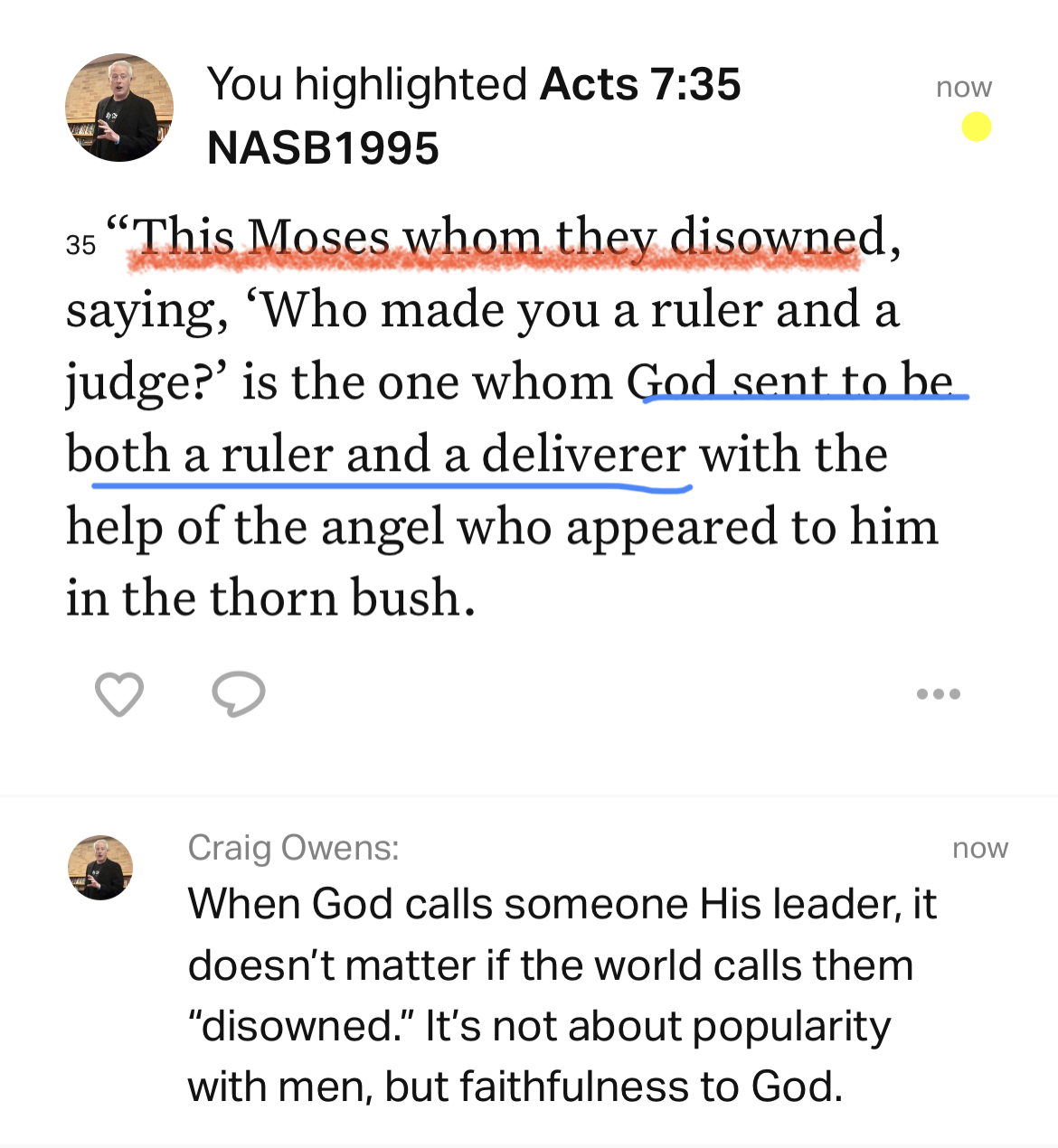
“This Moses whom they disowned…is the one God sent to be both a ruler and a deliverer” (Acts 7:35).
My lesson: When God calls someone His leader, it doesn’t matter if the world calls them disowned. It’s not about popularity with men, but faithfulness to God.
There is no shortage of books that define “success” in our business or ministry endeavors, but as Christians, let’s try to get a more precise definition—a biblical definition.
I did a quick search for the words “success” or “successful” in just the New International Version of the Bible, and I was somewhat surprised by two things. First of all, the relatively few times this word is used: Only 25 times in the entire Scripture. We read of prayers offered for a successful journey, or a king’s reign, or a building project, success that comes to someone because of God’s favor on their life, or success in battle.
The second thing that surprised me: The word “success” isn’t used in the New Testament. The reason this surprised me is because without there being even a close second, Jesus has to be the most successful person who ever walked this planet. No one ever taught like He did, performed the miracles He did, or willingly laid down His life and was resurrected like He was. And yet the word “success” is never attached to His life.
This means we are left to draw some Holy Spirit-illuminated inferences from the Bible on how to define success. You may ask, “Why do we even need to know what ‘success’ is?” I would say we need a biblical definition for success to avoid the inevitable feelings of failure that come if things aren’t going as well as we thought they should.
In business, we often define success as revenue growth or a healthy net profit. In ministry, we typically measure success by church attendance, the number of people launched into ministry, or the amount of money given to missions work.
But what happens if we apply these metrics to the work Jesus did while He was on Earth? We see His disciples fretting over not having enough money to buy food for the congregation, and Jesus mentioning He often didn’t have a bed to sleep in, or the fact that Jesus only had one set of clothes. As a businessman, Jesus wouldn’t be considered successful by any current metrics. Even as a ministry leader, the congregation that gathered after Jesus was resurrected back to life only numbered 120 people. So if we consider Jesus as a pastor, His church wasn’t exactly thriving according to modern metrics.
After Peter’s sermon on the day of Pentecost (Acts 2) and his sermon following the healing of the lame man (Acts 3), we don’t hear much about quantitative growth throughout the rest of the Book of Acts. But in the balance of the Book of Acts, in the teachings of Jesus, and in the instructions in the epistles, we do hear substantially more about qualitative growth.
I think the clear message is that qualitative metrics are much more important to God than quantitative measurements. Specifically, I think we see the emphasis on two important qualities for godly leaders: faithfulness and excellence.
Solomon wrote, “Whatever you do, do well” (Ecclesiastes 9:10 NLT), and Paul told us, “Whatever you do, do it all for the glory of God” (1 Corinthians 10:31 NIV). These things tell us that our best effort is always required—no cutting corners, no half-measures, no bare-minimum effort. Instead, we should always do the best that we can, always striving for excellence.
My Grandma drilled a poem into my memory whenever I wanted to stop at “good enough.” She would say—
Good, better, best
Never let it rest
Until your good is better
And your better is best
How long do we do this excellent work? Until our Master returns.
Jesus said, “Who then is the faithful and wise manager, whom the master puts in charge of his servants to give them their food allowance at the proper time? It will be good for that servant whom the master finds doing so when he returns” (Luke 12:42-43 NIV).
Our devotion to these qualitative metrics of faithfulness and excellence can only truly be judged by listening to the Holy Spirit each day. He alone can speak to each of our hearts about our level of excellence and faithfulness for that day. He alone can help us know what true success is. We need to listen to His voice so that we don’t get distracted, disillusioned, and possibly even de-railed by trying to measure up to others’ quantitive metrics of success.
After all, ultimate success for any leader is to hear the applause from nail-scarred hands as our Master says, “Well done—excellently and faithfully done—My good and faithful servant!”
Listen to the podcast of this post by clicking on the player below, and you can also subscribe on Apple, Spotify, or Audible.
Father’s Day can bring up a lot of different emotions for folks. Growing up, you might not have had a very good experience with your father or perhaps you didn’t have a father involved with you at all. Maybe you look back on your own history as a Dad and have some regrets. Perhaps you’re an empty-nester now or maybe you’ve never had kids of your own.
Regardless of your experience with your father or with your own circumstances, I think there are some things that we all naturally expect from our Dads. These are things that we should honor and things we as Dads should strive to demonstrate in our lives.
Luke introduces us to a man in the Book of Acts named Joseph. We don’t know if he is a biological father or not, but he is presented to us as a spiritual father that we would do well to emulate. In fact, we only know his name is Joseph from our first introduction to him. This man was such an inspiration to so many people that he was given the nickname Barnabas—the name that is used everywhere else in the New Testament.
When we think of our list of attributes of an ideal father, I think we all look to our fathers for these five things.
(1) Be there when we are getting started. Barnabas was there when Saul (later named Paul) first became a Christian and when the first Gentiles became Christians (Acts 9:26-28; 11:19-23).
(2) Provide for us financially. Barnabas is the first person mentioned by name that gave a significant and much-needed financial donation to the Church (Acts 4:34-37).
(3) Help us learn to leave our nest and fly on our own. Barnabas gave Paul his first leadership role in the Church (Acts 11:25-26).
(4) Step back as we learn to soar on our own. Barnabas took the lead in the first commissioned missionary journey, but then we see him stepping aside for Paul to take the lead (Acts 13:1-2, 13).
(5) Continue to “be there” for us even after we’ve left the nest. Barnabas also picked John Mark to accompany him and Paul on that first missionary endeavor, but when Barnabas stepped aside for Paul, Mark headed home instead of continuing on their trip. Later on, Barnabas wanted to give Mark another shot, but Paul was strongly against that. As a result, Paul and Barnabas parted company, with Barnabas taking Mark with him. From this point on, Luke doesn’t tell us anything else about Barnabas, but we know that Mark became the first one to write his Gospel account of the life of Jesus and that he became reconciled to both Paul and Peter, becoming an invaluable help to both of them. Although we don’t read what happened, I think it’s a good bet that all of this came about through the encouragement of Barnabas (Acts 13:13, 15:36-40; 2 Timothy 4:11; 1 Peter 5:13).
The name Joseph means “exalted.” Joseph was born into the tribe of Levi, placing him at the heart of the Jewish faith, yet he risked it all to not only acknowledge Jesus as the Messiah but to be so invested in the Christian Church that they called him Barnabas. Luke tells that his name means Son of Encouragement.
The word “encourage” literally comes from in + courage—to put courage into someone, to inspire others with the courage or confidence they need to do something great.
The word “encouragement” in Acts 4:26 in Greek is paraklesis: the same word used for the Holy Spirit.
Fathers can only put in others what is already in themselves.
Acts 11:24 tells us that Barnabas was “a good man, full of the Holy Spirit and faith.” Because He was full of the Spirit of God, he could put that courage and security in others around him.
Guys, it’s the same for us today. We have to be filled with the security, the joy, and the courage that springs eternally from the Holy Spirit. Only when we are filled with the Spirit can we put something truly impactful into the lives of our kids—both our biological and spiritual children.
We don’t know how old Barnabas was. We don’t know if he had children of his own or not. All we know is that he was a good man that was full of the Holy Spirit, and that gave him the courage to put into others.
What a great example for all of us to follow!
If you’ve missed any of the other messages in our series We Are: Pentecostal, where we’ve been learning about the blessings that come to those who are baptized in the Holy Spirit, you can find all of those messages here.



 When Jesus was discussing end times events with His disciples, He described days that looked pretty bleak. Do any of these descriptions sound familiar today?







 Craig T. Owens