Listen to the podcast of this post by clicking on the player below, and you can also subscribe on Apple, Spotify, or Audible.
Consistent leaders are exemplary leaders, but consistency doesn’t happen automatically. Effective leadership of others starts with effective leadership of yourself.
Listen to the podcast of this post by clicking on the player below, and you can also subscribe on Apple, Spotify, or Audible.
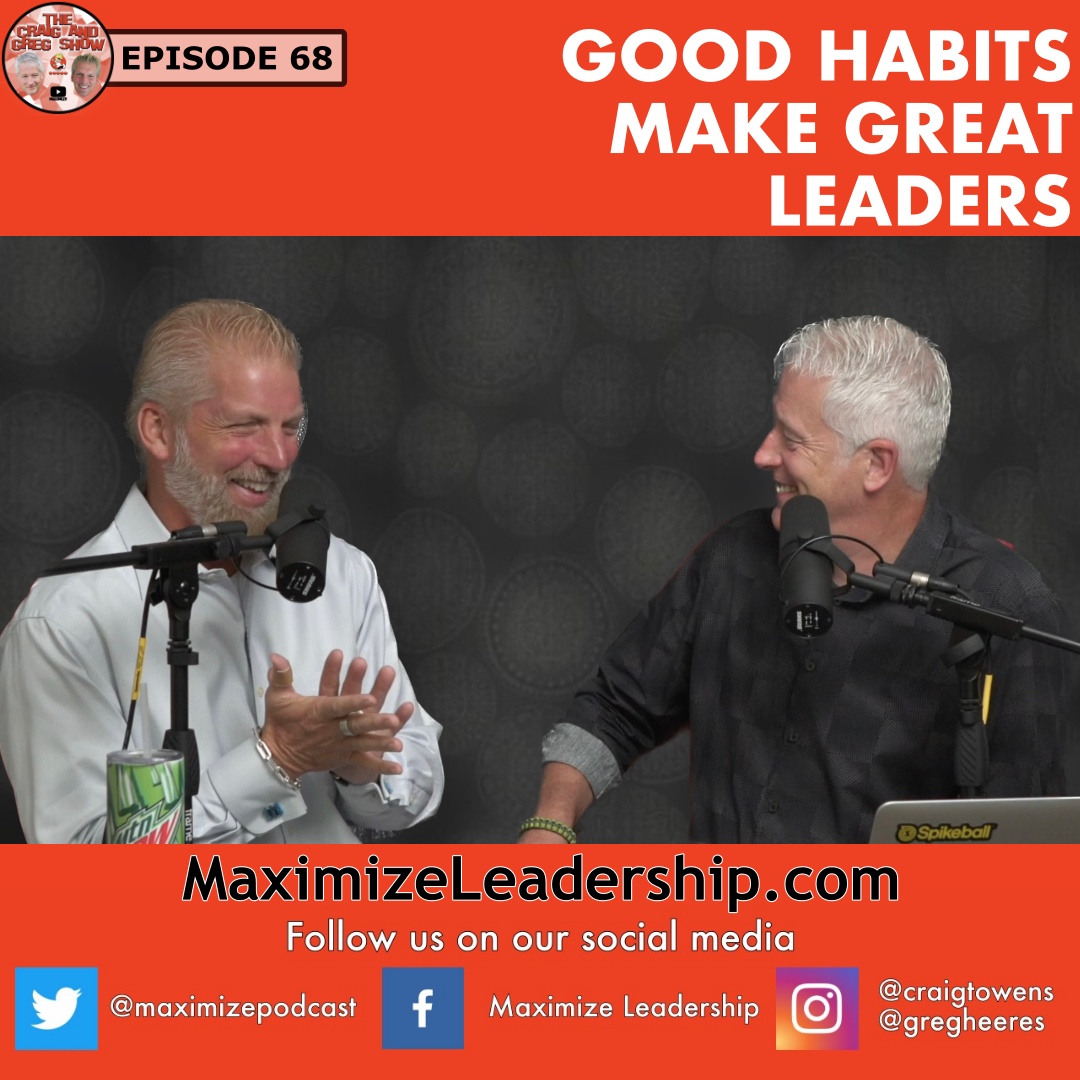
On a recent episode of The Craig And Greg Show, Greg and I talked about the importance of leadership habits. In this particular clip, Greg asks me about my most important leadership habits.
Listen to the audio-only version of this podcast by clicking on the player below, or scroll down to watch the video.
Automatic habits are an integral part of our everyday lives. From driving a car to the way we tie our shoes, these habits help us all the time with very little thought. Of course, habits aren’t limited to these mundane tasks, we also form them in other areas, like our leadership. As a leader, it’s important to be self-reflective of our habits and make sure they are taking us in the direction we want to go. In this episode, Greg and I discuss how cultivating the right habits will help you flourish as a leader.
[0:19] Aristotle said excellence is a matter of our habits.
[1:27] Our habits are mostly automatic—both the good and the bad habits.
[3:10] How do we keep our habits healthy during chaotic times?
[5:54] What about coping habits—should a leader use them or avoid them?
[7:15] My most beneficial leadership habit.
[9:13] Time-wasters are habits too.
[10:37] When we make changes in our habits, they should be incremental changes.
[12:17] We need to know why we want to make the change in a habit. The “why” determines the “what” and the “how.”
[15:24] How do leaders sustain their healthy habits?
[16:33] How can leaders regain their list momentum of good habits?
[19:27] Leaders need to be aware of the pull of their unintentional habits.
[22:23] How do we get our habits to serve us?
[23:30] I share two vital habits all high-performing leaders need.
[24:56] Leaders need to develop “muscle memory” to keep their healthy habits serving them.
[26:27] Greg shares some important quotes about a leader’s habits.
Check out this episode and subscribe on YouTube so you can watch all of the upcoming episodes. You can also listen to our podcast on Spotify and Apple.
Listen to the podcast of this post by clicking on the player below, and you can also subscribe on Apple, Spotify, or Audible.
Last week I challenged you to free up some time in your schedule so that you could begin to apply these six spiritual disciplines we are going to discuss.
Let’s keep in mind why we are learning and working on these disciplines. The key phrase is “so that”: I’m going to get stronger so that I have something to give to others, so that they will have something to give to others (and to me), and on and on it goes. Each of us needs all of us, and all of us need each of us!
I love to read. In fact, I’m usually reading several books at the same time. Without a close second, my favorite book is my Bible. I say “my Bible” because I’ve made it mine—it’s underlined, circled, notated, and marked. It’s the Book I’m in every day, and it’s the Book that helps me glean the best knowledge from all the other books I read.
G.K. Chesterton, the famous British writer, was once invited to a meeting of the leading intellectuals in England. They were discussing what one book they would want to have with them if they were shipwrecked on an island. Everybody expected Chesterton to say, “My Bible.” But when it came to his turn to speak, Chesterton said, “If I were shipwrecked on a desert island, I’d like to have Thomas’s Guide to Practical Shipbuilding.”
Chesterton wasn’t saying the Bible wouldn’t have been of benefit to him on that island, but he was saying that those who study the Bible have the most practical insights! The Bible doesn’t just have lofty ideas, but it gives us heavenly wisdom that is highly practical to our everyday lives.
The first spiritual discipline we are considering in our series Saints Together is: Studying our Bible. Notice I didn’t say just to read the Bible, but to really study the Book of books.
The apostle Paul wrote, “So then faith comes by hearing, and hearing by the Word of God” (Romans 10:17). How do we know our faith is growing? It must be tested. Look at what James had to say about growing our faith—“the testing of your faith produces perseverance” (James 1:3).
Testing really comes down to this: Does what I believe work in my everyday life? Can I truly put what the Bible teaches me into action? James went a little deeper with this in James 2:17-19.
Allow me to share four indispensable components of our Bible study time. You will notice that for all of these components, I am giving you verses from the 119th chapter of the Psalms. This single chapter mentions God’s Word in every single one of its 176 verses. As an added bonus, this chapter is divided into twenty-two 8-verse sections. Scientists tell us that if you do anything for twenty-one days in a row, you will have gone a long way toward making it a permanent habit. So reading one section of Psalm 119 every day is a great place to start on this spiritual discipline of studying your Bible.
Here are the four components:
(1) Read the Word. You cannot study something you haven’t read. I would suggest you pray before reading (Psalm 119:18, 33). I’d also suggest you leverage the power of your brain using a well-worn path by setting aside the same time, same place, and same method of study every day.
(4) Live out the Word. Apply it by allowing it to make a change in your life. Notice the action words in Psalm 119:1-4: walk … keep … walk … fully obey…. Or as God said to Joshua—
“Keep this Book of the Law always on your lips; meditate on it day and night, so that you may be careful to do everything written in it. Then you will be prosperous and successful.” (Joshua 1:8)
This is how Jesus lived His life and it’s also how He said the Holy Spirit would help us live our lives in a God-glorifying way (John 12:49-50, 14:26).
Every day we should be living out the living Word of God!
Listen to the podcast of this post by clicking on the player below, and you can also subscribe on Apple, Spotify, or Audible.
I don’t think there’s any arguing that Jesus must have been the healthiest Person to ever live. Dr. Luke records His growth in just one succinct verse: “And Jesus grew in wisdom and stature, and in favor with God and man” (Luke 2:52). Every word of Scripture is inspired, right down to the order the words are penned. So when Luke says first that “Jesus grew in wisdom,” that is our indication that a healthy mind is the foundation for every other aspect of health.
I recently received an email from a Christian brother asking for prayer and counseling in overcoming lust and pornography. I naturally agreed to pray with him, but I also said, “Before I offer you any strategies to try, let me ask you a quick question: What have you already tried to get victory over this?”
He replied, “I’ve tried praying, watching videos on it, and basically saying no to the devil. But the temptation comes when I am weak and I think, ‘I can just try again tomorrow!’ And then I fall into it. I am just tempted at times throughout the day, and sometimes I fight it with prayer, but other times I just fall right into it basically without even trying.”
What my friend is dealing with here is a natural, unconscious response. Our brains like well-worn paths because it’s very easy and comfortable for our minds to automatically respond as they have responded before. As in the case of my friend, it may be heading down a path of lust that leads to pornography. For others, it may be unhealthy choices made in response to certain triggers, or it may be the anger that flares up into biting words when a certain someone pushes your buttons.
We head down that well-worn path unconsciously and automatically. Our immediate response might bring some temporary relief, but usually, we’re not very happy with where we’ve ended up once again.
If we are going to make a new path—or a new, healthier response—we first need to become aware of the well-worn path we automatically go to. So my counsel to my friend who emailed me for help was to start keeping a journal. I wrote back:
Your willpower alone isn’t going to cut it (as you’ve probably realized). Here’s the first step I would suggest: keep a journal of every time you are tempted to lust or porn. Write down what you were feeling, was it day or evening, what was happening just before that, did you have time in prayer and Bible reading that day or not, how did you fight the temptation, were you successful or not? I think as you keep track of these things you will begin to see some triggers and some patterns. Maybe you were physically tired, or lonely, or hungry. Maybe it was a certain person you talked with or a show you watched. Maybe it was after checking your social medias or after a super-hard day at work. When you start to see patterns of what is causing you to go to porn for relief, you can recognize them earlier and head them off before they grip your mind so strongly.
Psychologists call it metacognition when we think about what we’re thinking about—when we think about why we are taking a certain well-worn path again.
We don’t think about our thinking very frequently. We keep thinking along those well-worn paths out of habit, not because we want to go down those paths. This is where the Holy Spirit is invaluable: He helps us see those well-worn paths, identify which paths are unhealthy or unproductive, and then help us begin to carve out a new path.
It’s not just thinking about right things, but thinking rightly about all things—even the painful things or the triggering things.
In Ephesians 4:22-25, Paul counsels us to take off the “old self” and “put on the new self, created to be like God in true righteousness and holiness. Therefore” (and this is an important conclusion) “each of you must put off falsehood and speak truthfully to his neighbor.”
Do you remember that Jesus taught us to love our neighbor as ourselves (Mark 12:28-31)? Paul says we are to speak truthfully to our neighbor, so doesn’t that mean that we have to first speak truthfully to ourselves? Yes, we do! If we are going to make new paths for our mind, we are going to have to talk to ourselves differently.
My cousin Dick Brogden wrote, “A primary theater of spiritual warfare is in our heads and thoughts. The primary weapon of the enemy is deceit. He starts with attractive little lies and half-truths, and works his way up to blatant, ridiculous, perverted nonsense. Winning the battle for truth in the mind is critical to winning the war. If we lose enough of the little skirmishes, we can believe and do any wicked thing. If we daily combat lies with light and truth, we will stand firm.”
The “little lies and half-truths” will keep us trapped on our old, well-worn paths. But identifying those lies, and speaking the truth to them, will help us travel down new paths that lead to health and freedom.
Let the Holy Spirit be your Counselor. Let the Holy Spirit help you think about what you’re thinking about when you’re triggered to unconsciously head down the unhealthy well-worn path. Let the Holy Spirit help you see a new path. And then let the Holy Spirit empower you to stick with it—to keep doing the hard work of blazing a new path.
I am going to build on this series of messages about a Christian’s mental health, but let’s start with this simple prayer:
Holy Spirit, help me make new paths.
As you pray this, listen to how the Holy Spirit will guide you away from the unhealthy, unconscious, well-worn paths, and will then lead you into the new, healthy path that brings you freedom.
DON’T #1: Don’t be a hypocrite. That word literally means a play-actor. More than anyone else ever will, God sees who we really are. We cannot fool Him so there is no reason to fake it. For proof, check out some of the gut-level-honest prayers David records in the psalms!
DON’T #2: Don’t babble. The Greek word here is unique: It’s made up of the name of a poet named Battus who was needlessly wordy, and the Greek word for word. In Greek, the word battologeō is an onomatopoeic word (like our English words that sound like what they really are describing: words like whoosh, buzz, or smack). It means rambling with our mouth, but our hearts and heads simply aren’t engaged as well.
“When prayer has become secondary, or incidental, it has lost its power. Those who are conspicuously men of prayer are those who use prayer as they use food, or air, or light, or money.” —M.E. Andross
My friend’s trainer recently told him, “You cannot out-exercise a bad diet.” I think this is just as true in the realm of prayer: You cannot out-________ a bad prayer diet. You cannot…
…out-religion a bad prayer diet, as though your religious exercises can make up for a lack of prayerful food.
…out-talk a bad prayer diet, or “babble,” as Jesus said.
…out-strategize a bad prayer diet, as one successful man attempted to do (see Luke 12:16-20).
Jesus said our heavenly Father is just waiting for us to ask Him for what we need. In Psalm 5, David explained how attentive God is, even understanding our cries, our sighs, and our groans. So David’s conclusion was: “Lord, every morning You hear my voice. Every morning, I tell You what I need, and I wait for Your answer.”
Friends, we need to be first responders in prayer. Make it a habit every morning to let God hear your voice before anyone else does. DON’T make a show out of it or babble some words you don’t really feel, but DO talk with your loving heavenly Father about what you need for this upcoming day. He has already prepared a good, healthy diet for you, so ask Him to give you this day what you need, and then be expectant all day long in the ways your Father will answer you.
As A Man Thinketh feels a lot like the biblical book of Proverbs, stimulating us to think about our habitual thought patterns. Check out my full book review by clicking here.
“As the plant springs from, and could not be without, the seed, so every act of a man springs from the hidden seeds of thought, and could not have appeared without them.”
“Man is made or unmade by himself; in the armory of thought he forges the weapons by which he destroys himself; he also fashions the tools with which he builds for himself heavenly mansions of joy and strength and peace.”
“The soul attracts that which it secretly harbors; that which it loves, and also that which it fears; it reaches the height of its cherished aspirations; it falls to the level of its unchastened desires.”
“Good thoughts and actions can never produce bad results; bad thoughts and actions can never produce good results. This is but saying that nothing can come from corn but corn, nothing from nettles but nettles. Men understand this law in the natural world, and work with it; but few understand it in the mental and moral world (though its operation there is just as simple and undeviating), and they, therefore, do not co-operate with it.”
“Blessedness, not material possessions, is the measure of right thought; wretchedness, not lack of material possessions, is the measure of wrong thought.”
“A man only begins to be a man when he ceases to whine and revile.”
“Men imagine that thought can be kept secret, but it cannot; it rapidly crystallizes into habit, and habit solidifies into circumstance.”
“They who have no central purpose in their life fall an easy prey to petty worries, fears, troubles, and self-pityings.”
“This is the royal road to self-control and true concentration of thought. Even if he fails again and again to accomplish his purpose (as he necessarily must until weakness is overcome), the strength of character gained will be the measure of his true success, and this will form a new starting-point for future power and triumph.”
“The oak sleeps in the acorn; the bird waits in the egg; and in the highest vision of the soul a waking angel stirs. Dreams are the seedlings of realities. Your circumstances may be uncongenial, but they shall not long remain so if you but perceive an Ideal and strive to reach it. You cannot travel within and stand still without.”
…And because of this I rejoice. Yes, and I will continue to rejoice (Philippians 1:18).
Paul is in prison, yet he tells his friends that he is choosing to rejoice. Wow!
Not only that, but this same imprisoned man also reminds his friends to…
… let their joy in Jesus overflow
… conduct themselves in a manner worthy of the gospel of Christ
… continue to have a servant’s attitude like Jesus
… don’t give in to complaining or arguing
… look out for the interests of other people
… rejoice in the Lord
… don’t rest on their laurels
… forget the past and press on toward the future
John Maxwell has noted that most people have uphill dreams but downhill habits. That is definitely not a winning combination!
Paul is making his friends aware of the possible downhill habits that may hold them back from their uphill dreams, and using himself as an example. This first step—awareness—is vital if we are going to break free of the things that are pulling us away from our God-given dreams.
Solomon wrote, “The path of life leads UPWARD for the prudent to keep them from GOING DOWN to the realm of the dead” (Proverbs 15:24).
Being prudent is saying, “I’m always on the lookout for what’s best.”
None of us can go UP by ignoring our downhill habits, or even trying to coast through life. The only way to achieve our uphill dreams is to ask the Holy Spirit to reveal our downhill habits so that we can make a plan to turn those around.
Making my own way Getting a mentor / partner (4:9)
Being discontent Being content (4:11-12)
Trying to be self-made Striving to be Christ-reliant (4:13)
A good prayer for all of us who have uphill dreams that we want to achieve—Holy Spirit, reveal to me my downhill habits. I acknowledge that I need Your help to see and break these habits. Then help me to replace them with Christ-honoring uphill habits that will allow me to achieve the purpose God has for my life.
This is a weekly series with things I’m reading and pondering from Oswald Chambers. You can read the original seed thought here, or type “Thursdays With Oswald” in the search box to read more entries.
Difficult Times Reveal Our Habits
Practice means continually doing that which no one sees or knows but ourselves. Habit is the result of practice, by continually doing a thing it becomes second nature. The difference between men is not a difference of personal power, but that some men are disciplined and others are not. The difference is not the degree of mental power but the degree of mental discipline. If we have taught ourselves how to think, we will have mental power plus the discipline of having it under control. Beware of impulse. Impulsiveness is the characteristic of a child, but it ought not to be the characteristic of a man, it means he has not disciplined himself. Undeterred impulse is undisciplined power.
Every habit is purely mechanical, and whenever we form a habit it makes a material difference in the brain. The material of the brain alters very slowly, but it does alter, and by repeatedly doing a thing a groove is formed in the material of the brain so that it becomes easier to do it again, until at last we become unconscious of doing it. When we are regenerated we can reform by the power and presence of God every habit that is not in accordance with His life. … We have to learn to form habits according to the dictates of the Spirit of God. The power and the practice must go together. … If we keep practicing, what we practice becomes our second nature, and in a crisis we will find that not only does God’s grace stand by us, but our own nature also. The practicing is ours not God’s and the crisis reveals whether or not we have been practicing. [See Matthew 5:31-37.]
From Studies In The Sermon On The Mount
All of us have blind spots. These are typically habits that we have left in place, unchallenged and unchanged. That “groove” in our brain is operating on auto-pilot, but those blind-spot habits aren’t serving us well.
The role of the Holy Spirit in the life of a Christian is to help us notice these habits in which we are unconsciously incompetent. But once the Spirit of God points these out, then we must practice, and practice, and practice until the new healthy habit has overwritten the old groove of the unhealthy habit.
Then we will find, as Chambers points out, that in a time of crisis “not only does God’s grace stand by us, but our own nature also.”
Times of difficulty will reveal habits—both the unhealthy and the healthy. The question then becomes: what are you going to do about the unhealthy habits?












 Craig T. Owens