This is a weekly series with things I’m reading and pondering from Oswald Chambers. You can read the original seed thought here, or type “Thursdays With Oswald” in the search box to read more entries.
Swine And Testimonies
Jesus Christ is inculcating the need to examine carefully what we present in the way of God’s truth to others [Matthew 7:6]. …
Over and over again men water down the Word of God to suit those who are not spiritual, and consequently the Word of God is trampled under the feet of “swine.” Ask yourself, “Am I in any way flinging God’s truth to unspiritual swine?” “Be careful,” Jesus says, “not to give God‘s holy things to ‘dogs.’” …
Our Lord never tells us to confess anything but Himself, ‘Whosoever…shall confess ME before men…’ (Matthew 10:32). Testimonies to the world on the subjective line are always wrong, they are for saints, for those who are spiritual and who understand; but our testimony to the world is our Lord Himself, confess Him, “He saved me, He sanctified me, He put me right with God.” …
If we are only true to a doctrine of Christianity instead of to Jesus Christ, we drive our ideas home with sledge-hammer blows, and the people who listen to us say, “Well, that may be true”; but they resent the way it is presented. When we follow Jesus Christ the domineering attitude and the dictatorial attitude go and concentration Jesus comes in.
From Studies In The Sermon On The Mount
The apostle Paul also talked about wanting to make sure that Jesus was seen above all else. More harm than good is done when we talk about our personal experiences with God, which have now become our personal doctrines about God.
Let God be as unique with others as He is with you. Don’t make other people fall in line with what you believe. Just point them to Jesus. As Chambers says, our testimony should be nothing but “He saved me, He sanctified me, He put me right with God.” Anything else, and we run the risk of casting pearl before swine.
Lepers were outcasts in society. Unable to participate in normal daily activities, unable to go to the temple to worship God, even unable to be with their family. These ten lepers encountered Jesus and did two positive things. But 9-of-10 lepers also did two sad things.
(+) They knew to call on Jesus for help—“Jesus, Master, have pity on us!”
(+) They took Jesus at His word. Their healing happened astheyobeyed Christ’s words—“‘Go, show yourselves to the priests.’ And astheywent, they were cleansed.”
(-)Only one cleansed leper came back to praise God for his healing.
(-)Only one was pronounced “well” by Jesus. All ten lepers were “cleansed,” which simply meant they were ceremonially clean and could once again participate in daily life and temple worship. But only one was made completely “well.” The Greek word is sozo, which means saved from eternal destruction. The same word is used to describe what Jesus came to do for us: “You shall call His name Jesus, for He shall save [sozo] His people from their sins” (Matthew 1:21).
“What a rare thing is thankfulness.… ‘Were there not ten cleansed? But where are the nine?’ The lesson before us is humbling, heart-searching, and deeply instructive. The best of us are far too like the nine lepers. We are more ready to pray than to praise, and more disposed to ask God for what we have not, than to thank Him for what we have. … If we would be anxious for nothing, we must make our requests known to God not only with prayer and supplication, but with thanksgiving (Philippians 4:6).” —J.C. Ryle (emphasis mine)
Probably all of us experience daily blessings from our good God, yet many of us never acknowledge Him as the Source of those blessings. We just accept the blessing and then keep on walking.
Let’s be the 1-in-10!
Let’s be quick to recognize God’s blessings. Let’s always remember that He does more than give us strength for today, but He saves [sozo] us entirely from eternal destruction. Let’s be the ones who always return—day after day after day—to give glory to God!
This is a weekly series with things I’m reading and pondering from Oswald Chambers. You can read the original seed thought here, or type “Thursdays With Oswald” in the search box to read more entries.
Don’t Judge Others
This statement of our Lord’s [Matthew 7:2] is not a haphazard guess, it is an eternal law which works from God’s throne right down (see Psalm 18:25-26). … Life serves back in the coin you pay; you are paid back not necessarily are the same person, but the law holds —“for in the same way you judge others, you will be judged, and with the measure you use, it will be measured to you.” …
In Romans 2, this principle is applied still more definitely—I am guilty myself of what I criticize in another. Every wrong I see in you, God locates in me; every time I judge you, I condemn myself. “You, therefore, have no excuse, you who pass judgment on someone else, for at whatever point you judge the other, you are condemning yourself, because you who pass judgment do the same things” [v. 1]. …
We have judged our fellow-men as sinners; if God had judged us like that we would be in hell. God judges us through the marvelous Atonement of Jesus Christ.
Jesus warns us against judging people by a different standard that even God Himself uses! Can you imagine that we think we actually know better than God does who should be punished and who should be spared?!
The trouble is, we cannot see inside the other person’s heart so we judge by mere outward appearances. We ended up judging the other person by their actions, but we judge ourselves by our intentions. How utterly unfair!
We are in a far better place to simply let the Holy Spirit help us deal with the beams in our own eyes (Matthew 7:3-5), and let the Holy Spirit deal with others too. There is no good in my being involved in any judgments at all!
This is a weekly series with things I’m reading and pondering from Oswald Chambers. You can read the original seed thought here, or type “Thursdays With Oswald” in the search box to read more entries.
Grow Like A Lily
Jesus declares it to be unreasonable for the disciple to be careful of all that the natural man says we must be careful over [Matthew 6:26-32]. … Jesus does not use the illustration of the birds and the flowers by accident, He uses it purposely in order to show the utter unreasonableness from His standpoint of being so anxious about the means of living. …
Imagine a lily hauling itself out of its pot and saying, “I don’t think I look exactly right here.” The lily’s duty is to obey the law of its life where it is placed by the gardener. “Watch your life with God,” says Jesus, “see that that is right and you will grow as the lily.” We are all inclined to say, “I should be all right if only I were somewhere else.” There is only one way to develop spiritually, and that is by concentrating on God. …
How are you to grow in the knowledge of God? By remaining where you are, and by remembering that your Father knows where are you are and the circumstances you are in. Keep concentrated on Him and you will grow spiritually as the lily.
From Studies In The Sermon On The Mount
Don’t think for one moment that God doesn’t see where you are. Don’t think He doesn’t care about you. He knows precisely where you are, and He knows precisely what He is doing.
If you want to grow, don’t worry about your circumstances or your setting. Keep concentrated on God and let Him grow you as only He can.
Allow me to introduce myself in the Aramaic fashion—I am Craig bar Raymond. I am proud of my father and want my name to always be associated with his, so I remember my heritage by telling people I am Craig son of Raymond.
If I wanted to be a little more formal I might introduce myself as Craig Bar Raymond Bar Colson, or even Craig Bar Raymond Bar Colson Bar Walker, to honor my forefathers back four generations.
People took great pride in their family heritage. They wanted to keep their connection to their family and their tribe intact and known to those around them. It’s how they kept their standing in their community.
That’s why it’s odd that Luke—the premier historian that he is—introduces us to a man he simply calls “a blind man” in the city of Jericho. Luke was always so precise in mentioning names throughout both his Gospel and the Book of Acts, and it appears that this man does have a name. In the Gospel of Mark he is called Bartimaeus, and presumably Luke used Mark as one of his source documents. So why would Luke omit this guy’s name?
Keep in mind that “bar” simply means “son of,” so although Mark calls him Bartimaeus, his name is really something like “_________ son of Timaeus.” Is that because he was born blind and his parents didn’t even name him? Or was he thought so little of that people couldn’t remember his first name? Maybe it’s because Timaeus means unclean, defiled, polluted. So this blind beggar is really just the Anonymous son of Filth!
This beggar is looking for alms in Jericho when he hears a commotion. He asks what is happening and is told, that Jesus of Nazareth is passing by.
This man knows the reputation of Jesus, recalling that He has even opened blind eyes. Immediately he shouts, “Jesus, son of David have mercy on me!” Son of David is a title only used twice in the New Testament (also see Matthew 15:22), and both times by desperate people who wouldn’t take “no” for an answer.
Actually, his phrase is in the form of a command, so he really says, “Jesus, son of David, have mercy on me NOW!”
“Who do you think you are, you nameless beggar,” the townspeople rebuke him. “How dare you demand anything of anyone! Shut your mouth, you worthless piece of filth!”
Undeterred, this man now raises his voice to a shriek and repeats, “JESUS, SON OF DAVID, HAVE MERCY ON ME NOW!”
This shriek gets Christ’s attention and He stops dead in His tracks. He commands that this man be brought to him.
Check out the confidence this blind man shows—he throws his cloak aside to get to Jesus. Why is that significant? Because he’s blind! If he can’t see, how is he going to find his cloak again? Who would ever want to help him?
Jesus asks him, “What do you want me to do for you?” He was testing him: did he want a hand-out? did he want revenge on the cruel people in Jericho? did he want to get back at his parents?
He specifically prays, “I want to see.” Jesus is moved by compassion (Matthew 20:34) and says, “Your faith has made you whole.” The blind man immediately is healed!
What was his faith that healed him? It was a loud, insistent, persistent, won’t-take-no-for-an answer, audacious request. The crowd said he was asking too much, but Jesus was moved to compassion by his insistence and boldness and answered his prayer.
That community may have forgotten that man’s name. Maybe the blind man had even forgotten his own name. But God hadn’t!
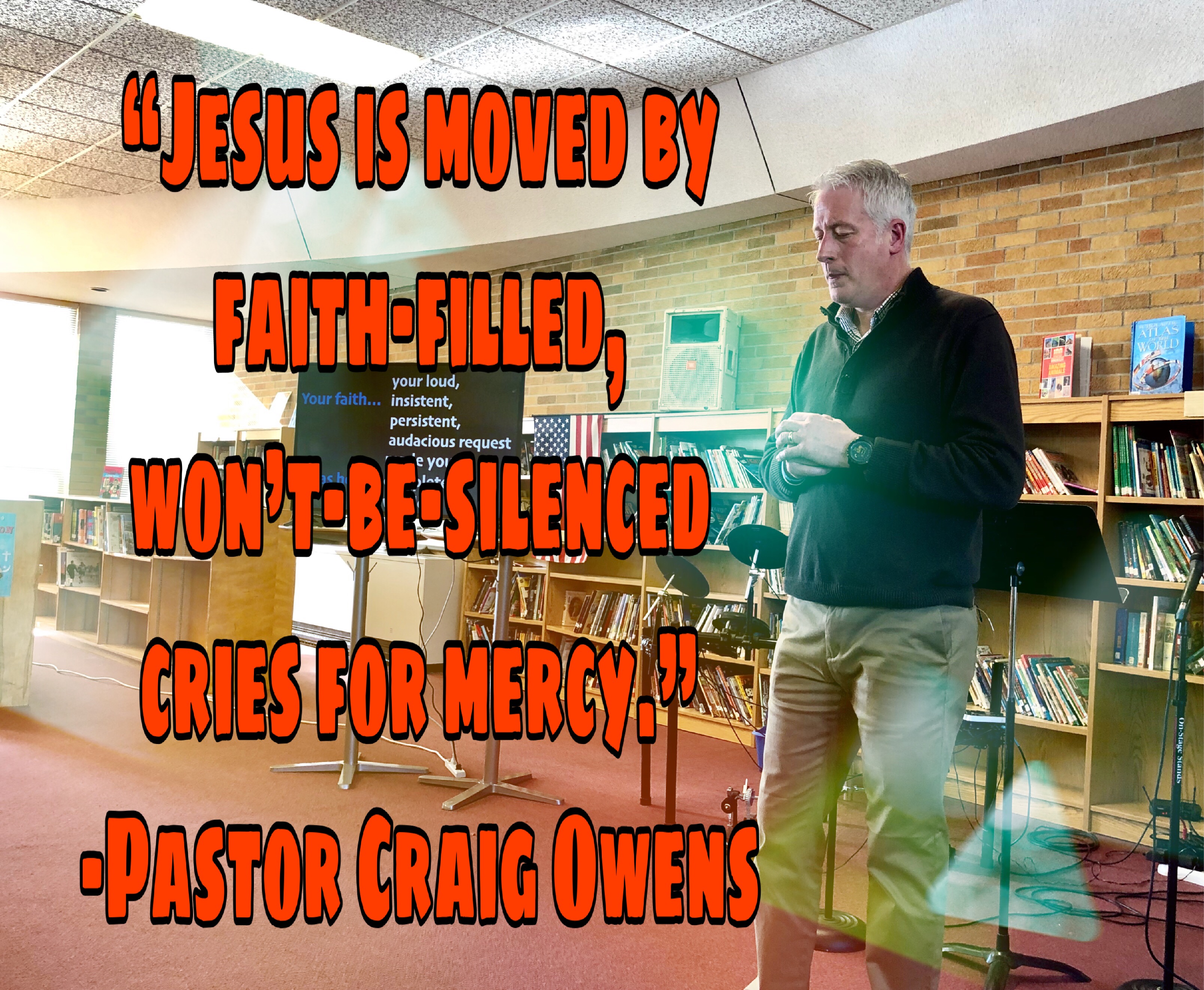
Jesus is moved by faith-filled, won’t-be-silenced cries for mercy. He wants to answer your specific requests. You aren’t an anonymous son or daughter of filth. You aren’t marginalized, worthless, or overlooked by your Heavenly Father.
God knows your name. He knows your need. He is passing by. Cry out to Him again and again and again! When He answers your prayer, you are made whole and our Heavenly Father is glorified.
This is a weekly series with things I’m reading and pondering from Oswald Chambers. You can read the original seed thought here, or type “Thursdays With Oswald” in the search box to read more entries.
What Is Mammon?
You cannot serve God and Mammon [Matthew 6:24]. A man of the world says we can; with a little subtlety and wisdom and compromise (it is called diplomacy or tact), we can serve both. The devil’s temptation to our Lord to fall down and worship him, i.e., to compromise, is repeated over and over again in Christian experience. We have to realize that there is a division as high as heaven and as deep as hell between the Christian and the world. ‘Whosoever therefore will be a friend of the world is the enemy of God’ [James 4:4]. …
Never compromise with the spirit of Mammon. When you are right with God, you become contemptible in the eyes of the world. Put into practice any of the teaching of the Sermon on the Mount and you will be treated with amusement at first; then if you persist, the world will get annoyed and will detest you. … What is Mammon? The system of civilized life which organizes itself without considering God. …
When we become mature in godliness God trusts His own honor to us by placing us where the world, the flesh, and the devil may try us, knowing that ‘greater is He that is in you than he that is in the world’ [1 John 4:4].
From Studies In The Sermon On The Mount
Mammon wants to get what it wants to get, without considering God and without regard to the long-term consequences. Mammon wants satisfaction right now!
Mammon is the system of the world. People are constantly driven by what they can get for themselves right now, with little—if any—thought to what God thinks or to what the inevitable outcome is going to be.
A Christian is different.
A Christian is focused on something which cannot be seen right now. But just because the rewards cannot be seen doesn’t make them any less real. In fact, Jesus teaches that the rewards He gives are Reality itself.
When a Christian insists on doing things God’s way, the devil will sneer and people will laugh. But God’s Spirit in you is greater than all of that, and He will help you to stand firm in Him, not compromising with the lure of Mammon.
This past Christmas I was quite surprised to receive a package in the mail. It was something I ordered as a Christmas gift for my wife.
Sort of.
It was actually half of what I thought I ordered. I went back online and discovered some “fine print” that I hadn’t really noticed earlier.
You’ve probably experienced that too—asterisks … fine print … footnotes … hidden fees … “limits and exclusions may apply” are all so frustrating!
Unfortunately, we get so used to these things that we begin to—consciously or subconsciously—plug them into places where they don’t actually belong. So even when Jesus Himself says something that sounds wonderful like, “I tell you the truth, if you have faith as small as a mustard seed, you can say to this mountain, ‘Move from here to there’ and it will move. Nothing will be impossible for you” (Matthew 17:20), we want to insert an asterisk.
Or when He says, “And I will do whatever you ask in My name so that the Son may bring glory to the Father. You may ask Me for anything in My name, and I will do it” (John 14:13-14), we think we’re supposed to ask, “What’s the catch?”
Christians are inserting asterisks where they don’t belong and, as a result, are praying timid prayers.
Why do we pray this way? Perhaps we are…
…fearful of being too bold. But in telling us how to pray, Jesus says God rewards our bold “shameless persistence” in prayer.
I tell you, although he will not get up and supply him anything because he is his friend, yet because of his shameless persistence and insistence he will get up and give him as much as he needs. So I say to you, ask and keep on asking and it shall be given you; seek and keep on seeking and you shall find; knock and keep on knocking and the door shall be opened to you. (Luke 11:8-9 AMP)
…unsure that God hears us, cares for us, or even wants to answer us. But the Bible is quite clear that all of these things are true: He hears us, cares for us, and does want to give us what He has promised (1 John 5:14-15; Romans 8:32; Romans 4:20-21).
…ignorant of what/how to pray. T.M. Moore reminds us, “God has given us three great helps to assist us in our prayers. His Spirit groans for us; His Word guides us; and His Son governs and intercedes for us.”
…not looking for God’s answer. David said that after praying, he expectantly watched for God’s answer (Psalm 5:3). Indeed, the Aramaic word for prayer means “to set a trap.”
“He is the God of limitless resources—the only limit comes from us. Our requests, our thoughts, and our prayers are too small, and our expectations are too low. God is trying to raise our vision to a higher level, call us to have greater expectations, and thereby bring us to greater appropriation. Shall we continue living in a way that mocks His will and denies His Word?” —A.B. Simpson
Why are you hesitating to ask God for even a tiny amount when such vast resources are available? What would happen if you started to pray more boldly? What if you began to make mountain-moving requests? I dare you to try!
Stop looking for the asterisks and start taking God at His word!
Join me next week as we continue our series on Boldly Praying, looking at some bold pray-ers in the Bible.
This is a weekly series with things I’m reading and pondering from Oswald Chambers. You can read the original seed thought here, or type “Thursdays With Oswald” in the search box to read more entries.
Philanthropy, Prayer, And Penance
In chapter Matthew 5, our Lord demands that our disposition be right with Him in our ordinary natural life lived to men; in chapter 6, He deals with the domain of our life lived to God before men. The main idea in the region of religion is: Your eyes on God, not on men. …
Briefly summed up these verses [6:1-4] mean: Have no other motive in giving than to please God. In modern philanthropy we are ‘egged on’ with other motives—It will do them good; they need the help; they deserve it. Jesus Christ never brings out that aspect in His teaching; He allows no other motive in the giving than to please God. … It is a very penetrating thing to ask ourselves this question—“What was my motive in doing that kind act?” …
“But when you give it to the needy, do not let your left hand know what your right hand is doing.” That means do good until it is an unconscious habit of the life and you do not know you are doing it….
Have no other motive in prayer than to know Him [6:5-15]. … Call a halt one moment and ask yourself—“Why do I pray? What is my motive? Is it because I have a personal secret relationship to God known to no one but myself?” …
It is impossible to live the life of a disciple without definite times of secret prayer. You will find that the place to enter in is in your business, as you walk along the streets, in the ordinary ways of life, when no one dreams you are praying, and the reward comes openly, a revival here, a blessing there. …
In verse 8 Jesus goes to the root of all prayer—“Your Father knows what you need before you ask Him.” Common sense says, “Then why ask Him?” Prayer is not getting things from God, that is a most initial stage; prayer is getting into perfect communion with God; I tell him what I know He knows in order that I may get to know it as He does. …
Penance [6:16-18] means putting ourselves into a straitjacket for the sake of disciplining our spiritual character. Physical sloth will upset spiritual devotion quicker than anything else. If the devil cannot get at us by enticing to sin, he will get at us by sleeping-sickness spiritually…. Penance means doing a hardship to the body for the sake of developing the spiritual life. … Jeremy Taylor said that men hang out the sign of the devil; to prove there is an angel within; that is, they wear sad countenances and look tremendously severe in order to prove they are holy.
From Studies In The Sermon On The Mount
Good questions from Oswald Chambers:
Philanthropy—What was my motive in doing that kind act?
Prayer—Why do I pray? What is my motive? Is it because I have a personal secret relationship to God known to no one but myself?
Penance—Am I “hanging out a sign” just to let other people know that I’m discipling myself?
This is a weekly series with things I’m reading and pondering from Oswald Chambers. You can read the original seed thought here, or type “Thursdays With Oswald” in the search box to read more entries.
Where Does Christian Character Come From?
Christian character is not expressed by doing good, but by God-likeness. It is not sufficient to do good, to do the right thing, we must have our goodness stamped by the image and superscription of God, it is supernatural all through. The secret of a Christian’s life is that the supernatural is made natural by the grace of God. The way it is worked out in expression is not in having times of communion with God, but in the practical details of life. The proof that we have been regenerated is that when we come in contact with the things that create a buzz, we find to our astonishment that we have a power to keep wonderfully poised in the center of it all, a power we did not have before, a power that is only explained by the Cross of Jesus Christ. …
“Be perfect, therefore, as your heavenly Father is perfect” [Matthew 5:48], not in a future state, but—“You shall be perfect as your Father in heaven is perfect if you let Me work that perfection in you.” If the Holy Spirit has transformed us within, we will not exhibit good human characteristics, but divine characteristics in our human nature. …
It is not a question of putting the statements of our Lord in front of us and trying to live up to them, but of receiving His Spirit and finding that we can live up to them as He brings them to our remembrance and applies them to our circumstances.
From Studies In The Sermon On The Mount
Jesus said one of the roles of the Holy Spirit was to remind us of everything Jesus said (John 14:26). The Holy Spirit will constantly be working to bring the principles in the Bible to be applied in the real-life circumstances we are in—this is how Christian character is formed in us.
God’s Word + the Holy Spirit’s application + our obedience = Christian character perfected in us
Are you reading God’s Word? Are you letting the Holy Spirit apply the Word to your life? Are you obeying what He’s showing you? These are the steps to exhibiting our heavenly Father’s divine characteristics in our human nature.
This is a weekly series with things I’m reading and pondering from Oswald Chambers. You can read the original seed thought here, or type “Thursdays With Oswald” in the search box to read more entries.
Getting The Order Right
Beware of walking in the spiritual life according to your natural affinities. We all have natural affinities—some people we like and others we do not; some people we get on well with and others we do not. Never let those likes and dislikes be the rule of your Christian life. “If we walk in the light, as He is in the light, we have fellowship one with another” [1 John 1:7], i.e., God gives us fellowship with people for whom we have no natural affinity. …
Our example is not a good man, not even a Christian man, but God Himself. We do not allow the big surprise of this to lay hold of us sufficiently. Jesus nowhere says, “Follow your Father which is in heaven—that you may be good men? that you may be lovable to all men?” No, “that you may be the children of your Father which is in heaven” [Matthew 5:44-45], and that implies a strong family likeness to Jesus Christ. …
It takes a long time to get the full force of our Lord’s statements. “I say unto you, love your enemies”—an easy thing to do when you have no enemies; an impossible thing when you have. “Bless them that curse you”—easy when no one is cursing you, but impossible when someone is. “Do good to them that hate you, and pray for them that despitefully use you.” It seems easy to do all this when we have no enemies, when no one is cursing or persecuting us; but if we have an enemy who slanders and annoys and systematically vexes us, and we read Jesus Christ’s statement “I say to you, Love your enemies”—how are we going to do it? Unless Jesus Christ can remake us within, His teaching is the biggest mockery human ears ever listened to. …
“I say unto you, love your enemies.” Jesus does not say, “Love every one.” The Bible never speaks vaguely, it always speaks definitely. People speak about loving “mankind,” and loving “the heathen”; Jesus says, “Love your enemies.” Our Lord does not say, “Bless your enemies,” He says, “Love your enemies.” He does not say, “Love them that curse you”; He says, “Bless them that curse you.” “Do good to them that hate you”—not bless them. He does not say, “Do good to them that despitefully use you”; He says, “Pray for them that despitefully use you.” Each one of these commands is stamped with sheer impossibility to the natural man. If we reverse the order Jesus has given it can be done with strain, but in His order I defy any man on earth to be able to do it unless he has been regenerated by God the Holy Ghost. When a man does love his enemies, he knows that God has done a tremendous work in him, and everyone else knows it too.
From Studies In The Sermon On The Mount
It’s impossible to do what Jesus commands if we’re trying to do it solely in our own strength. But when we allow the Holy Spirit to remake us from within, we can do what Jesus says:
If someone is your enemy—love them.
If someone persecutes you—pray for them.
If someone curses you—bless them.
If someone hates you—do good to them.
When we operate this way, we know that God has made this possible in us—and everyone else knows it too!



 This is a weekly series with things I’m reading and pondering from Oswald Chambers. You can read the original seed thought here, or type “Thursdays With Oswald” in the search box to read more entries.


 Craig T. Owens