Doing Justice The Right Way

Once I was asked to teach a class on business ethics but I said, “I can’t because there’s no such thing as ‘business ethics.’ There is only ethics: Either something is right or it’s not.” 

I think the same concept holds true for “social justice.” There is no such thing: Either something is just or it’s not. 

For those situations that are truly unjust, the Bible tells us how to handle them. But first, let’s get a sense of what the Bible actually means by the word “justice.” 

Psalm 50 is a courtroom scene, with God Himself presiding as the Judge, summoning all of creation into His presence (see Psalm 50:1-6). Just before The Judge begins to speak, the psalmist Asaph calls on us to Selah—or pause to consider—after saying, “The heavens proclaim God’s righteousness.” 

The New Living Translation has this verse saying, “The heavens proclaim His justice…” and the Amplified Bible uses both words: “The heavens declare His righteousness (rightness and justice)….” So which word is it: righteousness or justice? 

The Hebrew word (tsedeq) means something that is ethically right. In other words, something for which God sets the objective standard for rightness and wrongness. There is another Hebrew word that is often very closely associated with tsedeq, and that is justice (mishpat): that is the penalty for violating tsedeq. 

But here’s where things get really interesting. We usually associate the idea of justice with retribution (or payback), but God’s justice is usually portrayed as restoration. 

In other words, God’s mercy is so strong and His desire for us to be restored into right standing with Him is so passionate, that His default is restorative mercy. 

God’s response to our acts of unrighteousness wasn’t to rain down retributive justice on us, but to send His Son to earth to make restorative mercy available! 

In his first public sermon, Jesus quoted the prophet Isaiah. The last words Jesus read about His mission on earth were “to proclaim the year of the Lord’s favor.” He left off the last phrase in Isaiah which said, “and the day of vengeance of our God.” Favor (restoration) now; judgment (retribution) later for those who would not accept the restoration Jesus made available. 

Back in the Psalm 50 courtroom, God tells us the wrong way to address injustice: with angry, demeaning words (Psalm 50:19-20).  

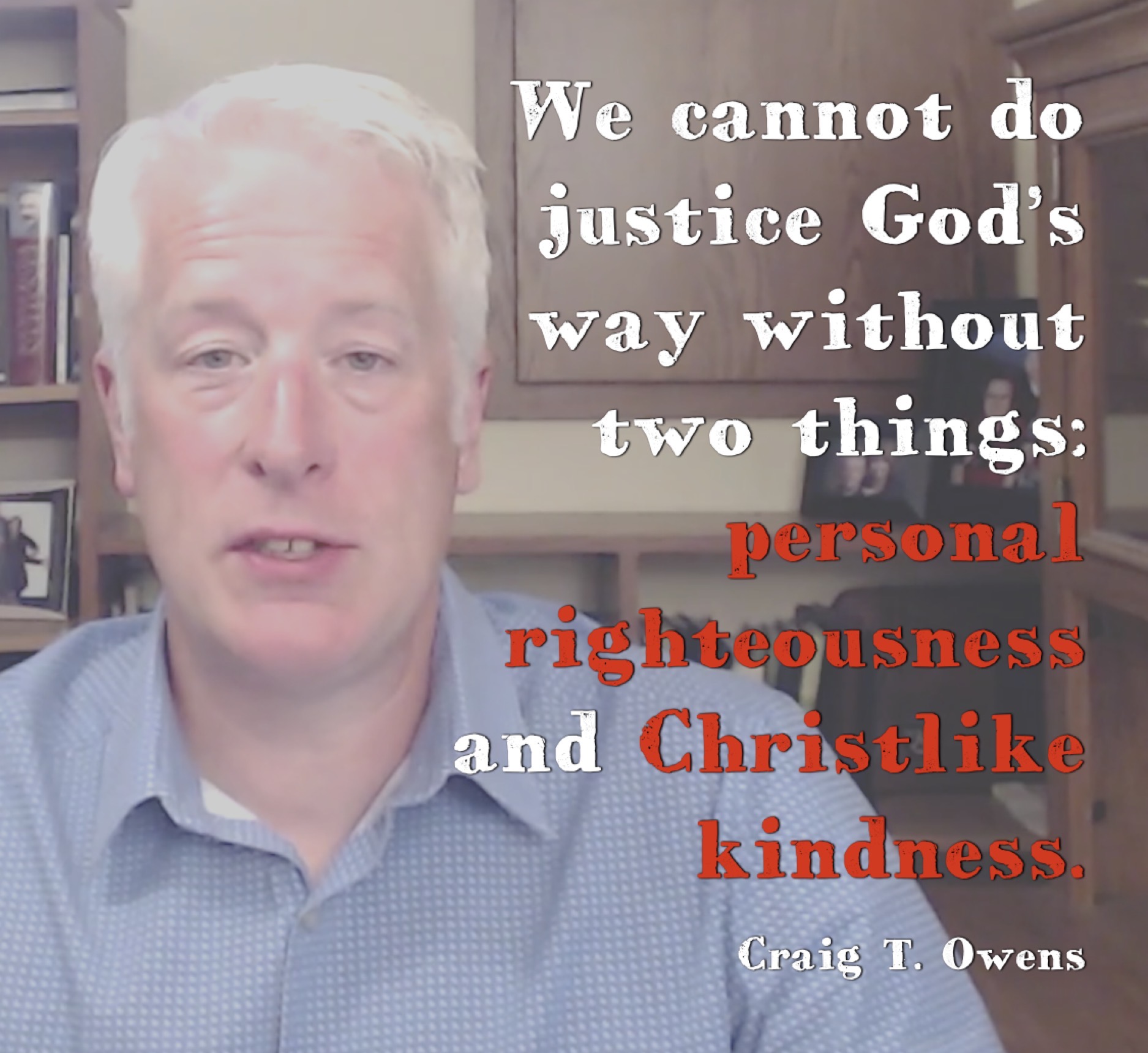
We CANNOT do justice God’s way without two things: 

  1. Personal righteousness which comes from Jesus in us (Romans 5:1); otherwise, we’re just hypocrites pointing out the exact same injustice that’s in ourselves. 
  2. Kindness. “But let the one who boasts boast about this: that they have the understanding to know Me, that I am the Lord, who exercises kindness, justice and righteousness on earth, for in these I delight,” declares the Lord. (Jeremiah 9:24)

And what does the Lord require of you but to do justly, and to love kindness and mercy, and to humble yourself and walk humbly with your God? (Micah 6:8)

The darkness of injustice is the absence of light. Jesus says to us, “You are the light of the world” (Matthew 5:14). 

The hate of injustice is the absence of love. Jesus says to us, “A new command I give you: Love one another. As I have loved you, so you must love one another. By this everyone will know that you are My disciples, if you love one another” (John 13:34-35). 

Here are my takeaways—

  1. Let God be The Judge. 
  2. Make sure I am in right standing with God through my relationship with Jesus Christ. 
  3. If I see injustice, address it with kindness, light, and love.

If you have missed any messages in this current series in the Selahs in the Psalms, you can get caught up by clicking here.

Prescribed & Personal Worship

But you are to seek the place the Lord your God will choose from among all your tribes to put His Name there for His dwelling (Deuteronomy 12:5).

THE place—not a place.

The Old Testament physical practices always point to the New Testament spiritual practices:

  • We cannot worship like everyone else does—You must not worship the Lord your God in their [pagan] way (v. 4) 
  • We cannot worship God like it’s always been done before—You are not to do as we do here today, everyone doing as they see fit (v. 8) 
  • We cannot worship God in a way that is cheap and convenient—Be careful not to sacrifice your burnt offerings anywhere you please (v. 13) 

Go to THE place the Lord will choose (v. 26). 

The exclusivity focus is on the Person not the place or the practice.

Jesus said, “Not here or in Jerusalem, but in spirit and in truth” (John 4:20-24). And He made clear that He is THE exclusive way to the Father (John 14:6).

The apostle Paul noted that the day of the week or the type of food doesn’t matter in our worship practices; THE focus on Jesus is what matters (Romans 14).

So worship of God is both prescribed and personal:

  • Prescribed in that it’s only THE work of Jesus that makes worship possible. 
  • Personal in that I worship God as me—as He created me—not by following a formula. 

Paul went on to say in Romans 14 that we shouldn’t judge the sincerity of another person’s worship. If they are glorifying God—great! If not—they will have to stand before THE Judge.

We only have access to God through THE High Priest Jesus Christ. Let us always make sure that He is THE focus.

Where’s God Today?

Transitions are always hard things. We are leaving the known for the unknown. Even if the known is unhealthy or painful, it’s still hard to go to the unknown. 

Why are these transitions so difficult? Perhaps it’s because I’ve learned how to cope with the known, or I’ve gotten used to this “normal” life, or even I’ve simply learned to navigate any dysfunctional areas.

But is that really living? Am I managing my life or is God? When I’m against transitions, aren’t I really saying that I’ve put God’s plan for my life in my box?

Those questions trigger even more questions in my mind: Where’s God in all of this? Why can’t He just make my known better? Why is He leading me (or maybe even pushing me) into this unknown? 

Jesus didn’t endure the unimaginable horrors of the Cross just so you could cope with life. Jesus came to bring us abundant life—not a barely-getting-by life or just a coping life!

How does He bring us into this abundant life? By leading us through transitions. And where is He in all our transitions? Closer than you think! 

Moses sang a song to conclude his sermon in Deuteronomy. In that song, he mentions God taking care of His people the way an eagle cares for its eaglets.

Adults eagles build their extremely large nests in the highest point they can find. Their nests are made of massive branches. In fact, they build some of the largest nests of all birds, and build them in the most inaccessible of places. Before their eggs are laid, the adult eagles will soften their nest with feathers pulled from their own body. From the time the eggs are laid until the eaglets leave the nest, they are never without a parent present—while one parent hunts, the other watches. 

Eaglets first test their stumpy wings by jumping around in the nest, mimicking their parents. Eventually they will start “branching”—jumping to nearby branches—and then “fledging”—taking their first short flights from the nest. All under the watchful eye of the parents. Finally, the adult eagles will “stir up” their nest by blowing away all of the comforts of their plucked feathers, encouraging the eaglets to soar. 

Moses said that this is how God cares for His children. First by shielding and guarding us, and then by stirring up our nest and encouraging us to soar! 

Much like when Jesus ascended back to Heaven. He was going to physically leave His disciples, but He knew He had adequately trained his “eaglets” to soar without Him with them in bodily form. 

But Jesus never leaves us spiritually. He said that His ascension back to heaven would allow for the Holy Spirit to be resident in each of His followers (see John 16:7-15). It is the Holy Spirit that continues to guide us, teach us, empower us, correct us, and lead us to SOAR into abundant, God-honoring, Christlike living. 

There are many, many times of transition as we soar, but He never leaves us. The Holy Spirit is our constant Counselor. God shows His love for us by caring for us. God also shows His love for us by making us uncomfortable with the status quo. 

May the times of transition cause us to rely even more on the very present help of the Holy Spirit.

Continue to follow along with me in a new series of posts looking at how the Holy Spirit helps us to soar!

Thursdays With Spurgeon—The Assurance In Christ’s Ascension

This is a weekly series with things I’m reading and pondering from Charles Spurgeon. You can read the original seed thought here, or type “Thursdays With Spurgeon” in the search box to read more entries.

The Assurance In Christ’s Ascension

     Our Savior descended when He came to the manger of Bethlehem, and further descended when He became ‘a Man of sorrows and acquainted with grief’ (Isaiah 53:3). He descended lower still when He was obedient to death, even the death of the Cross—and further yet when His dead body was laid in the grave. … Long and dark was the descent. There were no depths of humiliation, temptation, or affliction that He did not fathom. …  

     The time came for our Lord to continue His homeward, upward journey and return to the glory from which He had come down. From the Mount of Olives, ‘while they watched, He was taken up, and a cloud received Him out of their sight’ (Acts 1:9). The rest of His upward progress we cannot describe. Imagination and faith step in and conceive of Him as rising beyond all regions known to us, far above all imaginable height. … 

     How high He ascended after He passed the pearly portal Paul cannot tell us, save that he says God ‘seated Him at His right hand in the heavenly places, far above all principality and power and might and dominion’ (Ephesians 1:20-21). He describes our Master as ‘dwelling in unapproachable light’ (1 Timothy 6:16). The Man Christ Jesus has gone back to the place from where His Godhead came! …

     We are sure that the purpose of His love is secure or He would not have returned to His rest. The love that brought Him here would have kept Him here if all things necessary for our salvation had not been finished. …

     Remember that His assent to the Father is representative. Every believer rose with Him and grasped the inheritance. When He rose up, ascending on high, He taught our feet the way. At the last His people will be caught up together with the Lord in the air, and so will they be forever with the Lord. He has made a stairway for His saints to climb to their bliss, and He has traveled it Himself to assure us that the new and living way is available for us. In His ascension He bore all His people with Him.

From Our Lord’s Triumphant Ascension

Jesus told His Father that He had completed everything He was sent to complete (John 17:4). John also says that Christ’s “It is finished” cry from the Cross also marked the completion of everything that had been prophesied about Jesus (John 19:28-30). 

Such amazing love brought Jesus to earth! And His steadfast love also made sure that He left absolutely nothing undone that was needed for our salvation! 

There’s now no reason for us to live fearful or anxious or skeptical about what is coming next. When Jesus says, “I will never leave you nor forsake you” and when He promises that He has gone to prepare a place for us to bring us to be with Him, He has demonstrated His authority to make these claims in His death, resurrection, and ascension. 

Oh my friends, live every day in that glorious assurance!

How Long Will This Last?

Chaos is all around us! There’s infighting both politically and religiously. Government officials are imposing new laws and regulations and restrictions. Lots of rival voices are clamoring to be heard. Loss of personal freedoms, civil liberties, and even the freedom of worship. Uncertainty about the future. Fear in the present. 

Although this may sound like current conditions in the USA, I’m actually describing life in Israel around 31 BC. 

The people of Israel were frustrated beyond words with the restrictions they faced. They thought they were living in their land and that they should be able to govern themselves as they saw best. 

Have you ever been in that place of utter frustration? Are you there now? “What’s happening? Why is this not going according to plan? Isn’t there anything I can do? How long is this going to last? God, where are You in all of this?! 

We humans like to think we are in control. Or at least we like to think that we know God’s timetable. Throughout the Bible—and still today—the questions persist: 

  • How long will this last? 
  • When will this take place? 
  • What about him? 
  • Is this the right time? 

(see Psalm 13:1-2; Matthew 24:3; John 21:21; Acts 1:6; Revelation 6:9-10) 

When we ask God, “How long?” He never answers us by pointing to the calendar or the clock, but He points us to principles in His Word.

Here are four principles that we need to ask the Holy Spirit to help us grasp: 

  1. God’s timing was determined before Time even started. 
  2. God is using this “How long?” time to perfect us for His service.
  3. God is using this “How long?” time to empower us to point others to Him.
  4. God is calling us to trust Him alone during our “How long?” times. 

(see Psalm 90:2; Isaiah 46:10; Psalm 13:5-6; Romans 5:3-4; Matthew 24:13-14; Acts 1:7-8; John 21:21) 

Those Israelites I described earlier were so frustrated with asking “How long?” and apparently getting no answer, that they frequently took matters into their own hands. This never turned out well for them. But God’s perfect timing was heading toward His perfect fulfillment.  

We may not perceive it, but God IS doing more than we will ever know during our “How long?” times. 

God’s perfect timing for His people couldn’t be until Caesar Augustus came on the scene and brought an end to the political uncertainty that kept everything in chaos. Nearly 30 years before Jesus was to be born in Bethlehem, Augustus was launching the pax Romana—the peace of Rome—all over the world. Pax Romana was creating the perfect environment in which Jesus could be born and minister, as well in which His followers could then take the Good News all over the world. 

Jesus was born “in the fullness of time” (Galatians 4:4), around 5 BC, in a land where a Jordanian king (Herod the Great) served an Italian emperor (Caesar Augustus) to a people frustrated with waiting. But God knew exactly when and where and how to send His Son to be our Savior!

So, my friends—Trust God in the “How long?” times! 

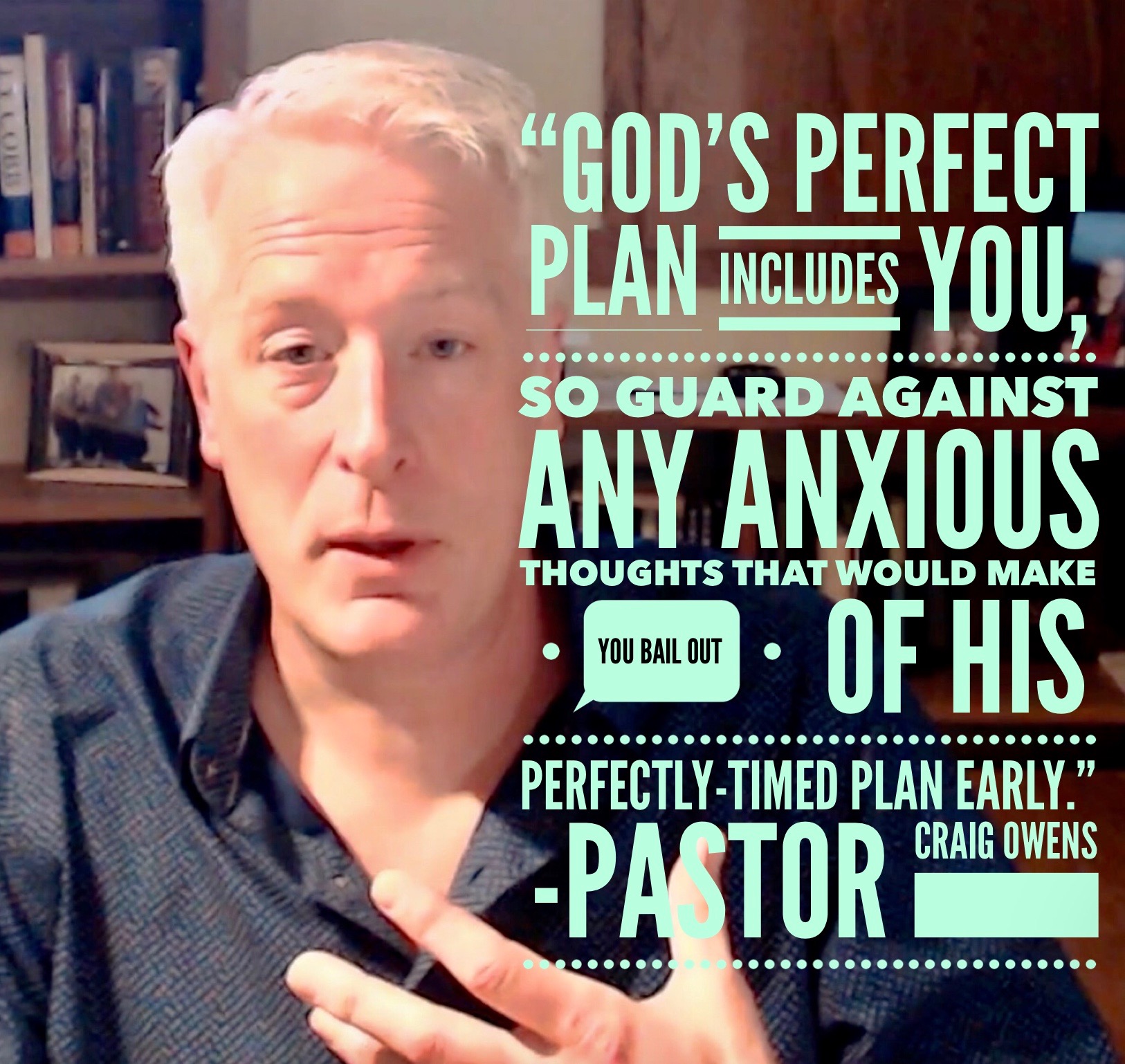
God’s perfect plan includes YOU, so guard against any anxious thoughts that would make you bail out of His perfectly-timed plan early. (see Psalm 139:16, 23-24)

Join me this Sunday as we continue our series called Where’s God? 

The God That Runs To You

I’m sure you’ve experienced what I’ve experienced. My nice, orderly world came crashing down all around me. It totally blindsided me! I got on my knees to do some serious soul searching and I prayed, “God I know you called me here. I know I’ve done what You’ve asked me to do. What’s happening? Why am I being attacked? Where are You, God?

I’m sure you’ve been there too. “Where’s God?” has been the cry of countless people from the oldest book of the Old Testament until this very day. In dark times our world seems to shrink, and the weight of the entire world seems to rest on our shoulders. We begin to at first sigh and say, “Why me?” and then those sighs become sobs of “God, where are You?!” 

“Left to ourselves we tend immediately to reduce God to manageable terms. We want to get Him where we can use Him, or at least know where He is when we need Him. We want a God we can in some measure control. We need the feeling of security that comes from knowing what God is like.…” —A.W. Tozer 

Here’s the truth: We are always in a spiritual battle. It’s just hard to see it in the “good ol’ days.” But in the “bad ol’ days” we realize we don’t have it all figured out! The dark days are simply the reality of spiritual warfare revealed. 

Answers don’t come easily because there are no easy answers!

One of Job’s friends named Zophar thought he had God all figured out. He concluded his easy answer that the wicked have a bad life and the righteous have a good life. So if things were going badly for Job, he must have messed up somewhere. Except Zophar was wrong! God Himself pronounced Job righteous (see Job 20:1-8; 1:8). Zophar’s easy answer now doesn’t seem so easy, does it? 

I’ll say it again: In the hard times, answers don’t come easily because there are no easy answers. 

In fact, Jesus told us, “I have told you these things, so that in Me you may have peace. In this world you will have trouble. But take heart! I have overcome the world” (John 16:33). 

How did Jesus overcome the world of hurt and pain? He did it by taking a hands-on approach—Since the children have flesh and blood, [Jesus] too shared in their humanity…. For this reason He had to be made like His brothers in every way…. Because He Himself suffered when He was tempted, He is able to help those who are being tempted (Hebrews 2:14, 17-18). 

The phrase “He is able to help” literally means that He runs to the cry! 

In order to be able to run to our cry, Jesus has to know what our cries sound like and what our pain feels like. He had to taste all our pain for Himself. He had to feel all of them in a human body. The Limitless God was incarnated in limited flesh to experience everything we would ever feel. 

Now that Jesus has died and been resurrected, our cries bring Him running to us with ALL of His LIMITLESS love and power and empathy! 

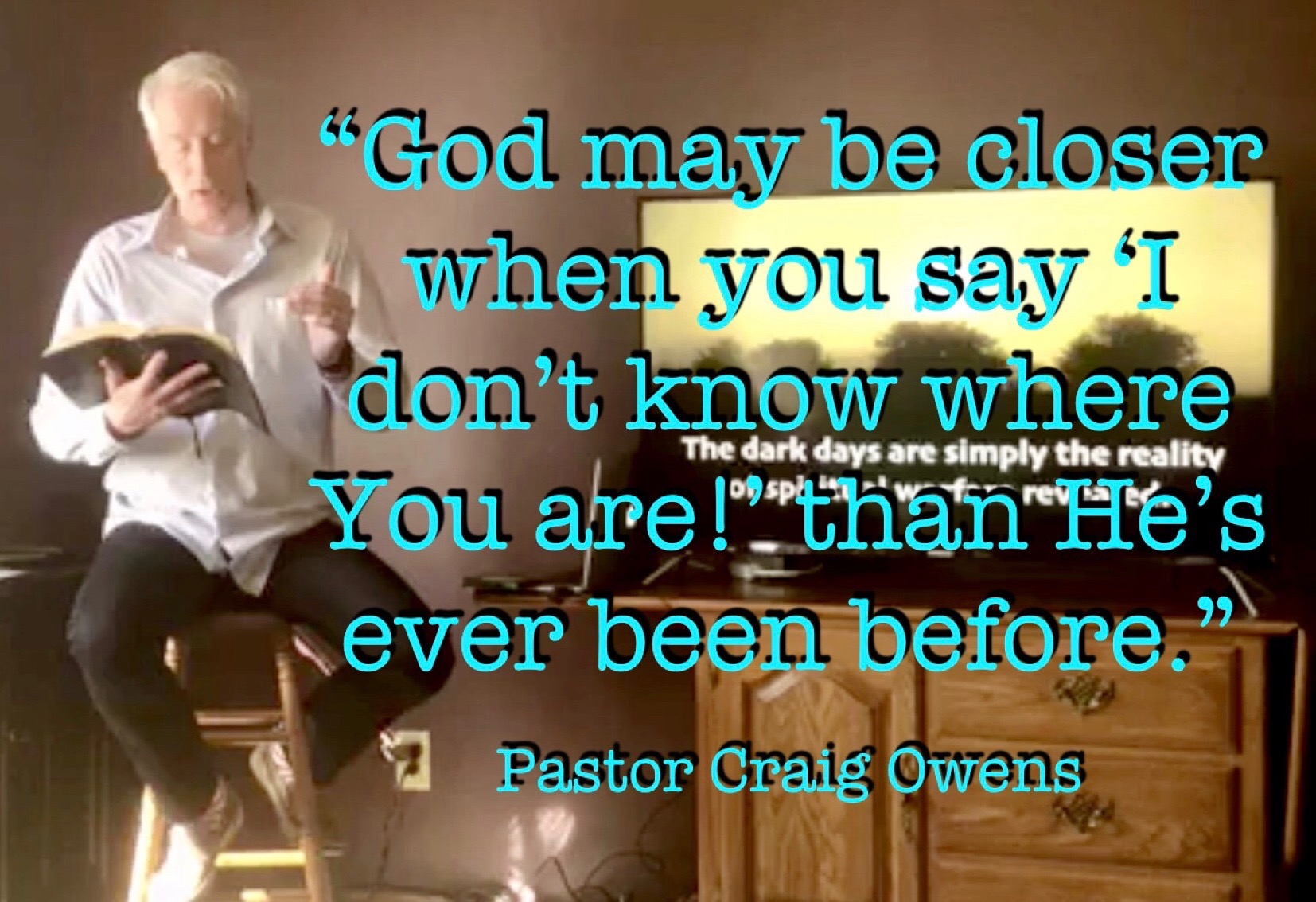
In the good ol’ days we may not recognize just how close God is to us. But when the bad days come and we cry out to Him, He comes running. Jesus may be closer when you say, “I don’t know where You are!” than He’s ever been before. 

Go ahead and cry out. Jesus knows those cries. He hears you, He knows your pain, He runs to your cries, He comes close to help.

Join me next week as we continue this series asking “Where’s God?” in the specific difficulties that we face. We’ll ask questions like, “Where’s God in my depression?” and “Where’s God in my divorce?” and “Where’s God in this national calamity?” Please don’t miss these encouraging messages! 

Thursdays With Spurgeon—The Humility Of Christ’s Birth

This is a weekly series with things I’m reading and pondering from Charles Spurgeon. You can read the original seed thought here, or type “Thursdays With Spurgeon” in the search box to read more entries.

The Humility Of Christ’s Birth

     Moreover, there was a peculiar wisdom ordaining that Jesus Christ should be the Son of the woman, and not of the man, because ‘that which is born of the flesh is flesh’ (John 3:6). Had He been born of the flesh, and merely flesh, He would, naturally, by carnal generation, have inherited all the frailties and the sins and the infirmities that man has from his birth. He would have been conceived in sin and shaped in iniquity, even as the rest of us. Therefore He was not born of man, but the Holy Spirit overshadowed the virgin Mary and Christ stands as the one man, save one other, who came forth pure from His Maker’s hands, who could ever say, ‘I am pure.’ Yes, and He could say far more than that other Adam could say concerning his purity, for He maintained His integrity and never let it go! And from His birth down to His death He knew no sin, neither was guile found in His mouth….

     Let us take courage here. If Jesus Christ was born in a manger in a rock, why should He not come and live in our rocky hearts? If He was born in a stable, why should not the stable of our souls be made into a house for Him? If He was born in poverty, may not the poor in spirit expect that He will be their friend? If He thus endured degradation at the first, will He count it any dishonor to come to the very poorest and humblest of His creatures and tabernacle in the souls of His children? Oh no!

From The Birth Of Christ

If Jesus was only God, He would never have been able to stoop to love us. 

If Jesus was only Man, He would never have been able to help us. 

Only the God-Man has both the power and the love to save use. Truly there is no one like Jesus! 

No one like Jesus our troubles can see
No one can feel them so keenly as He
No one like Jesus our burdens will bear
He and He only can answer our prayer

No one like Jesus could die for our sins
No one but Jesus can make the heart clean
No one but Jesus such mercy can show
He and He only such love can bestow

Jesus, Jesus
Precious Savior
Oh, how I love You
Love and adore You
Thank You, thank You
Precious Jesus
Oh, how You love me
Oh, what a Savior to me —Fanny J. Crosby, No One Like Jesus

Fasting Power

We are always engaged in an intense spiritual battle. Sometimes we feel the intensity of the battle, sometimes we don’t. But it’s always happening. 

This is why we need to make prayer an ongoing discipline. If we do, we will be much more likely to turn to prayer when we feel the intense moments, and our faith in those intense moments will be strengthened and ready to respond. 

Every day we are either preparing or repairing. Prayer is either helping us prepare for the challenges we will be facing, or it’s helping us recover from the battle we just fought. Believe me: it’s much better to be preparing than it is to be repairing!

One time the disciples of Jesus got stymied in a spiritual battle. A father brought his demon-possessed son to them, asking that they cast out the demon. But this distraught father then had to report to Jesus, “They couldn’t do it” (see Matthew 17:14-21). 

Why couldn’t they? These men had been taught how to pray by Jesus Himself, and they already had experienced ministry success (Matthew 6:9-13; Mark 6:13). So were they stumped now? 

Jesus told them, “It’s because you have so little faith.” He went on to tell them that these intense spiritual battles require an ongoing lifestyle of prayer. Jesus wasn’t suggesting that they should have said to that father, “Come back in a few days after we have prayed and fasted.” 

But what Jesus was really saying was that all of us need to stay connected to the Source of our spiritual power at every single moment (John 15:5, 7). Sometimes this requires taking our eyes off ourselves and our own appetites. 

In a word: we need to fast. 

The word fasting means “to cover the mouth” or “to close the mouth.” 

  • often fasting is in response to calamity or as a sign of mourning 
  • sometimes it’s alongside an intense prayer 
  • ideally it should be a regular discipline in our lives. In Matthew 6:16-18, notice the phrase “when you fast.” Not “if you fast,” but when. Jesus assumed that we would do this, and since this teaching appears right after Jesus teaches us how to pray, it makes sense that prayer and fasting go well together.  

Fasting is not…

Fasting intensifies our focus on God in the quiet times so that we can keep our eyes on Him in the crashing storms. 

Fasting helps us tune in to the unmistakable Voice of the Holy Spirit in the peaceful moments so that we can still recognize His Voice in the tumult of battle. 

Is there a comfort food you tend to run to? Is there a coping activity that you typically use to de-stress? Is there someone or something other than God that is your go-to in times of trouble? Perhaps we should start there and fast from those things for a short period of time. 

Fasting in the quiet times will strengthen us for the intense battle times. 

Let’s prepare daily for victory, instead of having to repair after a failure.

Thursdays With Spurgeon—Why Bethlehem?

This is a weekly series with things I’m reading and pondering from Charles Spurgeon. You can read the original seed thought here, or type “Thursdays With Spurgeon” in the search box to read more entries.

Why Bethlehem?

     There [in Bethlehem] cleaved to [Naomi] Ruth the Moabitess, whose Gentile blood should unite with the pure untainted stream of the Jew and should thus bring forth the Lord our Savior, the great King both of Jews and Gentiles. … And in the streets of Bethlehem did Boaz and Ruth receive a blessing that made them fruitful, so that Boaz became the father of Obed and Obed the father of Jesse—and Jesse the father of David. … 

     There is something in the name of the place. Bethlehem Ephrathah. The word Bethlehem has a double meeting. It signifies ‘the house of bread’ and ‘the house of war.’ …

     Bethlehem, you house of bread, rightly were you called, for there the Bread of life was first handed down for man to eat.

     And it is called ‘the house of war,’ because Christ is to a man either ‘the house of bread’ or else ‘the house of war.’ While He is food to the righteous, He causes war to the wicked, according to His own words: ‘Do not think that I came to bring peace on earth. I did not come to bring peace but a sword…’ (Matthew 10:34–36).

     Sinner, if you do not know Bethlehem as ‘the house of bread,’ it will be to you a ‘house of war.’ If from the lips of Jesus you never drink sweet honey—if you were not like the bee, which sips sweet luscious liquor from the Rose of Sharon, then out of the selfsame mouth there will go forth against you a two-edged sword! And that mouth from which the righteous draw their bread will be to you the mouth of destruction and the cause of your ill. … 

     Ephrathah … the meaning of it is ‘fruitfulness’ or ‘abundance.’ … 

     If we are like trees planted by the rivers of water, bringing forth our fruit in our season, it is not because we were naturally fruitful, but because of the rivers of water by which we were planted. It is Jesus who makes us fruitful. ‘If you abide in Me, and My words abide in you, you will ask what you desire, and it shall be done for you’ (John 15:7). Glorious Bethlehem Ephrathah! Rightly named! Fruitful house of bread—the house of abundant provision for the people of God! 

From The Incarnation And Birth Of Christ

Bethlehem wasn’t just a random place for Jesus Christ to be born. God doesn’t do anything randomly. Everything He does has a plan and a purpose. We may have difficulty seeing what the purpose is. As Martin Tupper noted in one of his poems—

We look through a glass darkly, we catch but glimpses of truth;
But, doubtless, the sailing of a cloud hath Providence to its pilot…
Man doeth one thing at once, nor can he think two thoughts together;
But God compasseth all things, mantling the globe like air…

Not only was the birthplace of Jesus purposely chosen by God, so was your birthplace. And your birth parents. And, indeed, everything about you. You are not an accident or some chance encounter. You have been created by God on purpose and for a purpose. 

Let the birthplace of Jesus—all the rich meaning of Bethlehem Ephrathah—be an encouragement to you that God knows and loves you dearly. Your life has meaning and purpose, which you can discover through a personal relationship with your Heavenly Father through Jesus Christ. 

Thursdays With Spurgeon—All The Trinity In Salvation

This is a weekly series with things I’m reading and pondering from Charles Spurgeon. You can read the original seed thought here, or type “Thursdays With Spurgeon” in the search box to read more entries.

All The Trinity In Salvation

     We are, alas, too apt to forget that while there are distinctions as to the persons in the Trinity, there are no distinctions of honor—and we do frequently ascribe the honor of our salvation, or at least the depths of its mercy and the extremity of its benevolence, more to Jesus Christ than we do to the Father. This is a very great mistake.

     What if Jesus came? Did not His Father send Him? If He were made a Child, did not the Holy Spirit beget Him? If He spoke wondrously, did not His Father pour grace into His lips that He might be an able minister of the new covenant? If His Father did forsake Him when He drank the bigger cup of gall, did He not love Him still? And did He not, by and by, after three days, raise Him from the dead and at last receive Him up on high, leading captivity captive?

     Ah, beloved, he who knows the Father, the Son, and the Holy Spirit as he should know them never sets one before another. He is not more thankful to one than the other; he sees them at Bethlehem, at Gethsemane, and on Calvary all equally engaged in the work of salvation.

From The Incarnation And Birth Of Christ

All of the Godhead is involved in our salvation. God doesn’t separate Himself—He is One. 

God the Father planned our salvation and sent His Son (Micah 5:2; Matthew 10:40; Ephesians 1:4-5).

God the Son proclaimed the Father’s good news and purchased our salvation (Mark 10:45; John 3:17; Ephesians 1:9-10). 

God the Holy Spirit seals and confirms our salvation (Galatians 4:4-6; Ephesians 1:13-14). 

We come to the Father, through the Son, by the drawing of the Spirit. We need the full Trinity to bring us fully into His presence forever and ever!