Sowing In Expectation

Listen to the podcast of this post by clicking on the player below, and you can also subscribe on AppleSpotify, or Audible. 

I’ve noticed how quick some people are to give up when things don’t get them the results they thought they should get, or the results don’t come as soon as they expected. 

Anytime we try something new, there is always the potential for failure. Even later on, those who appear to be an expert at something rarely do it perfectly. But in either case, there are three things we need to do if we don’t get the results we expected: (1) reflect, (2) evaluate possible improvements, (3) re-engage. 

Even before Jesus commissioned us to take His message of Good News to every street everywhere, He told us not to expect perfect results. In one of His best-known parables, Jesus talked about the farmer sowing seed (see Luke 8:5-8). 

(You can see all of the Scriptures I mention in this post by clicking here.)

Jesus didn’t say, “All of your efforts at sharing the Gospel will be successful.” In fact, He said some efforts would totally fail (falling on the hard path), and some would have only temporary success (falling on the weedy and stony ground). But we keep on sowing the seed because some will fall on good soil and yield a harvest a hundred times more than was sown! 

So, as John Wesley said, “Do all the good you can, by all the means you can, in all the ways you can, in all the places you can, at all the times you can, to all the people you can, as long as ever you can.” 

The baptism of the Holy Spirit brings dynamic, life-changing power (Acts 1:8). The life that is changed first is our own. Everything about us begins to change. 

When people heard Jesus speak, they said, “How did this Man get such learning without having been taught?” (John 7:15). The same Holy Spirit who empowered Jesus to speak is the same Holy Spirit who will empower our words. 

When our words are Spirit-empowered words, people can feel it. When our words are matched by our lifestyle, people can’t ignore it (John 7:46; Acts 2:37, 4:13, 6:10)! 

Just like salt that influences effortlessly, silently, and irreversibly, we never know what part the salt of our lives is playing in someone else’s life, even if it appears that nothing substantial is happening at all. But God said His word always accomplishes its purpose (Isaiah 55:10-11), which is why we keep on living and speaking as Spirit-empowered witnesses. 

And we live expecting that something is happening—Let us not become weary in doing good, for at the proper time we will reap a harvest if we do not give up (Galatians 6:9). 

How do we take this message of Jesus to every street? 

  1. Stay yielded to the influence of the Holy Spirit 
  2. Regularly and consistently read and apply God’s Word to your own life 
  3. Keep sowing in expectation 
  4. If your efforts appear to fail: reflect, evaluate, re-engage in expectation 

We can be salt without being salty; we can be light without being annoying. 

We have been empowered to take the Good News to every street, so let us not become weary in doing this. 

If you’ve missed any of the message in our series Takin’ Him to the Streets, you can find them all by clicking here. 

►► Would you please prayerfully consider supporting this ministry? My Patreon supporters get behind-the-scenes access to exclusive materials. ◀︎◀︎
A Christlike Response To Skeptics

Listen to the podcast of this post by clicking on the player below, and you can also subscribe on AppleSpotify, or Audible. 

God is precise in His promise making and promise keeping. He doesn’t just fulfill promises in a vague way or in “the spirit of the law,” but He attends to the jots and tittles of every single detail.  

Last week we saw the example of Jesus going into a dark place to bring the light of hope. It’s the same for us: God uses circumstances to direct our steps into dark places because people need to see the light. 

But people living in darkness sometimes don’t like the light. 

When we feel like our message of hope is being ignored or rejected (or we’re even being persecuted for sharing the truth) we have a natural emotional response that begins to bubble up. That emotion is anger. How do I know this? Because Jesus experienced this too. 

We can do two things with our anger: 

  1. We can blast skeptics with righteous judgment <or> 
  2. We can follow the example of Jesus  

In The Pilgrim’s Progress, Faithful told how a man came and beat him because he had broken the law. Even when Faithful begged for mercy the man said, “I don’t know how to show mercy to anyone.” This man was Moses the Lawgiver. Faithful explained what finally gave him relief: “He would have finished me off, but then One came by, and told Him to stop. I did not know Him at first, but as He went by, I saw the holes in His hands and in His side and I concluded that He was Jesus.” 

Moses had every right to be angry, and he expressed it a way that tried to finish off Faithful. 

Jesus also got angry, but let’s see what He did with it. 

(Check out all of the Scriptures I list below by clicking here.)

In Matthew 12:9-10 we see the motive of the skeptics: catch Jesus doing something wrong. This opposition came from the religionists—they weren’t interested in the truth, they were interested in proving themselves right and righteous. 

As they are asking their entrapping question, Luke tells us that “Jesus knew what they were thinking” (Luke 6:8). And Mark tells us that Jesus then asked a question of His own (Mark 3:4-5). These religionists refused to answer His question, and their stubborn hearts made Jesus deeply angry! 

So Jesus answered His own question, concluding that the Sabbath was the day that god intended for healing and helping. To prove this point, Jesus then healed the shriveled hand of the man who stood before Him (Matthew 12:11-14). In response to this, the Pharisees plotted with the Herodians on how to kill Jesus (Mark 3:6). 

Matthew then writes, “Aware of this, Jesus withdrew from that place (Matthew 12:15). He didn’t withdraw in fear, but in complete awareness of His Father’s plan. Part of that plan was not for Jesus to win argument, but for Him to win souls. 

Perhaps in His anger in the moment, Jesus would have spoken words that were too harsh. There is a time to speak, but it’s usually not in the heat of the moment. In fact, Laurence J. Peter rightly said, “Speak when you are angry, and you will make the best speech you’ll ever regret.” 

So in fulfillment of another prophetic word given in Isaiah 42, Jesus withdrew to continue His teaching and healing ministry (Matthew 12:17-21). 

What does this mean for us today? I think we can see five important responses in these prophetic words: 

  1. I am to serve others as Jesus did—even those who want to silence me.  
  2. I can let the Holy Spirit use this opposition to bring greater fruitfulness out of my life (Galatians 5:19-26).  
  3. I don’t need to win an argument with skeptics. 
  4. I can be a peacemaker that points people to the Prince of Peace (1 Peter 2:8-12). 
  5. I should live in the assurance of ultimate victory, just as Jesus did (1 Peter 2:23).  

God gets the final word, the decisive word, and the best word, so I don’t have to try to win arguments with skeptics. Like Jesus, I can love and serve in a way that leaves them an unmistakable testimony. 

To check out the other messages in this series called Jots and Tittles: Why it matters that God is in the smallest of details, please click here. 

►► Would you please prayerfully consider supporting this ministry? My Patreon supporters get behind-the-scenes access to exclusive materials. ◀︎◀︎

Links & Quotes

Our anxiety is usually tied to our insecurity about our needs being met. Philippians 4:6-7 counsels us to turn those anxieties into prayer. It’s not what we can provide for ourselves, but trusting what our Heavenly Father has already provided for us. Check out this amazing series on prayer. I have lots of new content every week, which you can check out on my YouTube channel.

A recent post at the Institute for Creation Research says, “despite popular perception, the impact theory of dinosaur extinction has problems and is still a source of contention among even conventional scientists.” In fact, “Despite uniformitarian claims to the contrary, these rocks and fossils are best explained by the Genesis Flood that covered the earth about 4,500 years ago. All the air-breathing, land-dwelling creatures outside the Ark perished. However, the representatives of these animals that God brought on board the Ark, including dinosaurs, survived, reproduced, and spread across the Earth after the Flood. Many ancient peoples wrote about and described what appear to be dinosaurs, even though they called them by other names, e.g., dragons. In the creation Flood model, impacts may have hit the earth during the Flood, but none of them caused the dinosaurs to go extinct.” This article is a good overview of the geological and paleontological evidence that supports the biblical account of the Flood.

“Scripture teaches us that there are two points of view from which we may regard Christ’s death upon the Cross. The one is the redemption of the Cross: Christ dying for us as our complete deliverance from the curse of sin. The other, the fellowship of the Cross: Christ taking us up to die with Him and making us partakers of the fellowship of His death in our own experience. … O Christian, when the world crucified Christ, it crucified you with Him, when Christ overcame the world on the Cross, He made you an overcomer too. He calls you now, at whatever cost of self-denial, to regard the world, in its hostility to God and His kingdom, as a crucified enemy over whom the Cross can ever keep you conqueror. What a different relationship to the pleasures and attractions of the world the Christian has who by the Holy Spirit has learned to say: ‘I have been crucified with Christ;…[the crucified] Christ lives in me!’ (Galatians 2:20).” —Andrew Murray

Sullivan and Addie Chainey were both deaf, but that didn’t stop them from becoming premier missionaries in the Assembly of God fellowship. Their work with other deaf people was amazing! I love this concluding thought in this short biography of their ministry work: “The Chaineys’ story testifies that God can empower those who are marginalized in society to do redemptive work in their own communities and beyond.”

“Earth, I think, will not be found by anyone to be in the end a very distinct place. I think earth, if chosen instead of Heaven, will turn out to have been, all along, only a region in Hell: and earth, if put second to Heaven, to have been from the beginning a part of Heaven itself.” —C.S. Lewis, in The Great Divorce

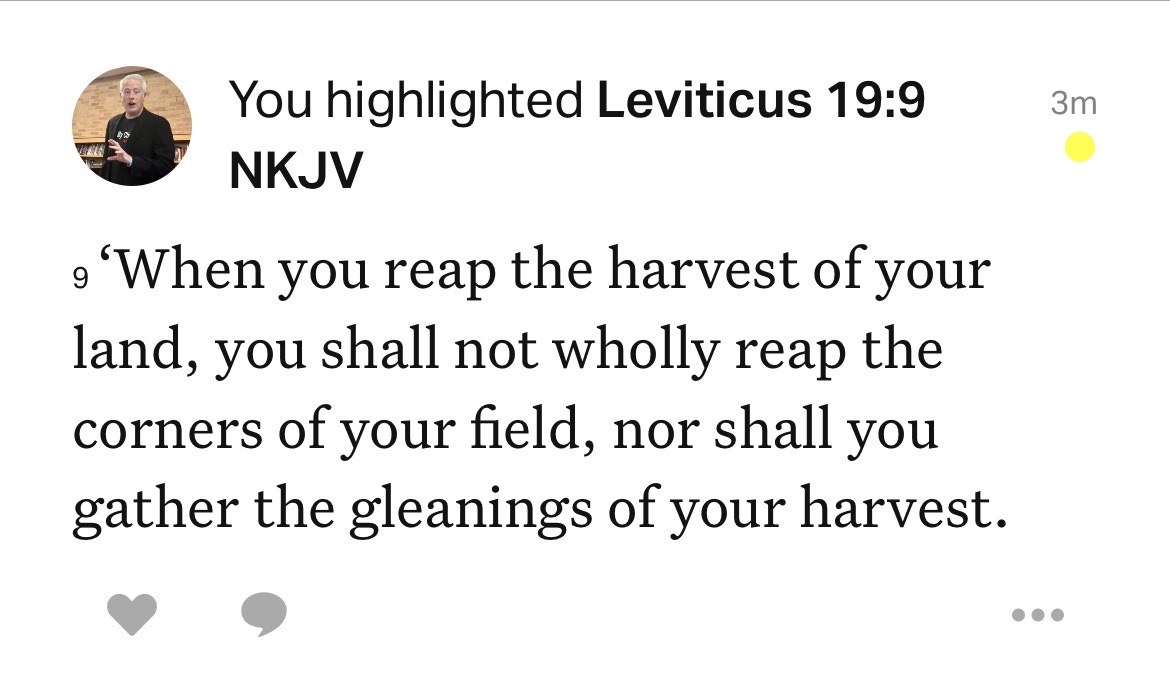
Years later, Boaz was obeying this commandment in Leviticus 19:9. That allowed Ruth to be in his field, which led to a marriage that began the family line of King David, which traces all the way to Jesus! Obedience matters. Just imagine if Boaz had been disobedient in this. The Messiah still would have come, but Boaz and Ruth (and their children and grandchildren) would have missed out on this blessing.

The Promise Of The King

Listen to the podcast of this post by clicking on the player below, and you can also subscribe on AppleSpotify, or Audible.

My podcast partner Greg and I just recorded an episode of our leadership podcast about Christmas traditions. I think there more traditions associated with this time of year than with any other event on our calendars. Traditions keep us connected to our roots, but they also help us feel like we can be in control of things. 

There has been a tradition in countries with monarchies that whenever a king died, the people would say something like, “The king is dead. Long live the king!” They would say this because the next king ascended to the throne immediately after his predecessor died. Except when a nation had been defeated, the traditional cry of, “The king is dead” was unanswered by, “Long live the king!” 

It appears at this moment that a new tradition has to be started—one where we take leadership over our own fates. 

The apostle Peter noted that people awaiting the Second Coming of Jesus would question if that event was ever going to happen. And the prophet Malachi closed the Old Testament with people saying much the same thing: “There doesn’t seem to be any advantage to following God’s laws, so maybe we should just do things our own way” (2 Peter 3:3-4; Malachi 3:13-15).

But then we turn the page to the dawn of the New Testament, and Matthew writes his Gospel about the First Advent of Jesus. He wants to show us that although the line of earthly kings in Israel may have been broken, the promised King of kings had now come to earth. 

I’m intrigued by the exceptions Matthew lists in his opening genealogy to illustrate this truth. First, as you might expect, the phrase “the father of” appears 39 times. This tells us a biological fact of life. These men didn’t know if they had fathered a son or a daughter, what their child’s contribution to the world might be, or even if their child would live faithfully to God. 

Matthew opens his genealogy by saying “the son of” twice. First, Matthew lists Jesus as the son of David—the king to whom God gave a very special promise of an eternal King coming from David’s family line. Then Matthew traces the genealogy back further to say “the son of Abraham”—the one through whom God said He would bless all nations (2 Samuel 7:11-16; Genesis 12:1-3). 

And what about the exceptional women Matthew records in this male-dominated genealogy? We have Tamar, Judah’s daughter-in-law, who tricked him into fathering a child by her; Rahab, a Canaanite prostitute who put her faith in God; Ruth, a Moabitess who left her homeland because she trusted God; Bathsheba, an adulteress who became David’s wife; and then Mary, the mother of Jesus, who was called “highly favored” of God (Luke 1:28). 

The phrase “son of” appears one more time when the angel calls Joseph by this title (Matthew 1:20). Jospeh is also called “the husband of Mary” (Matthew 1:16). 

Whereas Abraham and David were rewarded for their faithfulness to God and were told of future blessings, Joseph’s act was different. Joseph had a choice. He was told that the Child in Mary’s womb would be the Messiah. Now Jospeh had to decide: Would he choose to believe this? Would he choose to bear the shame and reproach to accept his role as father? 

We have the a similar choice today: Will we choose to believe that God has announced His plan and that He is fulfilling His plan? 

Here’s the simple truth. It appears as two statements, but it is really the same thought—

The Advent of Jesus has come. The Advent of Jesus will come. 

The First Advent of Jesus should build our anticipation for the Second Advent. His First Advent should be proof that God keeps His promise. 

Jesus told us that believing God’s promise would bring us into God’s family. Jesus said, “For My Father’s will is that everyone who looks to the Son and believes in Him shall have eternal life, and I will raise them up at the last day” (John 6:40). 

The apostle Paul also assures us, “So in Christ Jesus you are all children of God through faith” (Galatians 3:26). 

Let’s not blindly follow the traditions of previous generations, but let us chose for ourselves to believe in God’s promised Messiah, to trust that He alone can give us eternal life, and then let us live in both celebration of His First Advent and expectation of His Second Advent. 

If you’ve missed any of the messages in our Christmas series called Long Live The King Of Kings, you can find them all by clicking here. 

►► Would you please prayerfully consider supporting this ministry? My Patreon supporters get behind-the-scenes access to exclusive materials. ◀︎◀︎

Perfect Training Time

Listen to the podcast of this post by clicking on the player below, and you can also subscribe on AppleSpotify, or Audible. 

Are you willing to put in all the time and effort it takes to be as effective as you could be?

Check out this episode of The Podcast.

Resources mentioned in this video:

►► Would you please prayerfully consider supporting this ministry? My Patreon supporters get behind-the-scenes access to exclusive materials. ◀︎◀︎

It Takes All Of Us

Listen to the podcast of this post by clicking on the player below, and you can also subscribe on AppleSpotify, or Audible. 

In my book Shepherd Leadership I talk about some strong, godly men who gave into temptation at a moment of weakness—David who behaved so poorly toward Bathsheba and Uriah, Elijah who got depressed and suicidal, and Peter who denied knowing Jesus. 

One common factor for all of these guys is that their moment of giving in came when they were alone. They were isolated from others who may have been able to help them overcome the temptations that tripped them up. 

The principle is clear: Christians are stronger when they are with other Christians.  

Have you ever heard of the law of the weakest link? 

If I have a chain with links that can handle 400, 300, 250, 175, and 500 pounds, how much weight can the chain hold? You don’t really need a calculator for this one because the answer is the capacity of the weakest link: 175 pounds. This is why it’s to my advantage to not only strengthen myself, but to help others grow their strength as well. 

In Galatians 6:2-5, the apostle Paul talks about the strength we need for ourselves and our fellow Christian brothers and sisters. First, he says that each of us should test our own actions. I can only know my breaking point if I’m tested, and the Holy Spirit knows how to do this perfectly. After this testing, Paul says then I can take pride in myself without saying, “Well, at least I’m better than him!” 

Quite simply, Paul tells each of us that we must be able to carry our own loads. Why? Because only a strong Christian can help someone else with their load. We each have to get stronger individually so that we have strength for others! 

This is just like what we’ve been learning in our look at the Songs of Ascent: the goal is for all of the pilgrims to get to Zion together!

In this series, we are going to learn about six spiritual disciplines. Much like a physical workout, the Holy Spirit will start with us where we are. Not everyone will be at the same level nor will everyone progress at the same rate. But all of us will need these four things.

(1) Discipline. This is saying no to the easy thing or the thing that brings only fleeting happiness so that I can say yes to the things that bring eternal joy. 

(2) Stick-to-it-iveness. I have to be committed to this process for a lifetime. 

(3) Grace for yourself. There are going to be moments of struggles, plateaus, and even stumbles. Those are all a part of the journey, so we must extend grace to ourselves to learn, repent, and move forward. 

(4) Patience for others. As I just mentioned, we are all on our own journey and we all progress at different rates. Let’s be patient with each other. 

All of these spiritual disciplines are to strengthen us individually so that we have something to share with other saints (2 Corinthians 1:3-6). 

These spiritual disciplines shouldn’t become legalistic. Don’t make the way you do it the way everyone has to do it. After all, a 175-pound link will be different than a 250-pound link. 

What I am calling spiritual disciplines, C.S. Lewis called religious practices. In a letter to a friend, he wrote about the safety and beauty that result from these pursuits—

“I think about the practices what a wise old priest said to me about a ‘rule of life’ in general—‘It is not a stair but a bannister’…i.e. it is, not the thing you ascend by but it is a protective against falling off and a help-up. I think thus we ascend. The stair is God’s grace. One’s climb from step to step is obedience. Many different kinds of bannisters exist, all legitimate. It is possible to get up without any bannisters, if need be: but no one would willingly build a staircase without them because it would be less safe, more laborious, and a little lacking in beauty.” (C.S. Lewis)

The New Testament always has the words “saints” in the plural, so these disciplines will help us grow from strong individual saints to a healthy and effective collection of saints. 

Each of us needs all of us, and all of us need each of us! It does, indeed, take all of us.  

If you would like to follow along as we learn about these six spiritual disciplines, you can find all of the messages by clicking here. 

►► Would you please prayerfully consider supporting this ministry? My Patreon supporters get behind-the-scenes access to exclusive materials. ◀︎◀︎

Our Musical Testimony

Listen to the podcast of this post by clicking on the player below, and you can also subscribe on AppleSpotify, or Audible.  

As these songs of ascent are reminding us, we’re trying to ascend into God’s presence. But it seems like the forces pulling us back downward are so strong! The lyrics in the most popular songs are getting more and more raunchy, the blockbuster movies routinely celebrate sin, TV shows increasingly push a decidedly unbiblical agenda, government leaders are caught in scandals, and church leaders are “de-transitioning” from their Christian testimony. 

It doesn’t seem like there is much to celebrate. 

Just like the Jews who found themselves defeated and living in a foreign land, or fighting opposition to rebuild their way of life, or contending with occupying forces that were hostile to their religion, we, too, find ourselves in a very similar place—even in a country that was supposedly built on godly principles. 

The worldly-minded and irreligious have always tried to pull down the godly. When they do, it makes it hard to even worship God (Psalm 137:1-4). 

I’ve been reminding you that in Hebrew literature we can usually get our perspective from the middle of the story. So before we look at this next song of ascent, let’s look at the middle of the Jewish story—the middle of their time of exile, when things seemed darkest. 

Jeremiah wrote a book of Lamentations which was in the middle of the exile. In the middle of his tears and gall and bitterness he wrote this—

I remember my affliction and my wandering, the bitterness and the gall. I well remember them, and my soul is downcast within me. Yet this I call to mind and therefore I have hope: Because of the Lord’s great love we are not consumed, for His compassions never fail. They are new every morning; great is Your faithfulness. I say to myself, “The Lord is my portion; therefore I will wait for Him.” … I called on Your name, Lord, from the depths of the pit. You heard my plea: “Do not close your ears to my cry for relief.” You came near when I called You, and You said, “Do not fear.” (Lamentations 3:19-24, 55-57) 

Jeremiah said when he called God, He came near. He’s not saying that God had left him, but instead, Jeremiah is saying that he got his eyes off the ever-present God. As soon as he put his eyes back on God, he could feel His nearness. 

Our next song of ascent (Psalm 126) opens with the word “when.” This is a celebration of how God kept His word that the exiles would be released from Babylon and return to Jerusalem. As the Jews praised God for keeping His Word, then the surrounding nations saw and heard the testimony in the songs of joy that were being sung. 

God’s people were both singing for joy for God’s deliverance AND they were singing in joyful anticipation of what was still to come. 

They make a request in prayer for God to “restore our fortunes” (v. 4). This phrase always means that God is going to bring back everything that was taken away and then some. 

We have a promise two times in the next two verses that God will (not might) bring in these restored fortunes. In the midst of darkness or drought, it may seem hopeless to keep sowing seed. God sees your tears, and He will use your tears to water that seed and He will bring a harvest. 

The New Testament assures us of the same promise: “Let us not become weary in doing good, for at the proper time we will reap a harvest if we do not give up” (Galatians 6:9). 

We show our faith in God’s eternal victory by lifting up our voices in song today. That song is a testimony to the nations around us and an encouragement to other saints who may be struggling with weariness (see Ephesians 5:18-20). We keep on singing these songs of joy in anticipation of the final and eternal song we will sing in Heaven. 

God is near. He hears your sighs. He sees your tears. He is watering the seeds you are sowing, and He will bring a harvest. As you sow in tears, sow also with songs of joy! 

If you’ve missed any of the other messages in our Ascending series, you can find them all here. 

►► Would you please prayerfully consider supporting this ministry? My Patreon supporters get behind-the-scenes access to exclusive materials. ◀︎◀︎
In, On, And Through

Listen to the podcast of this post by clicking on the player below, and you can also subscribe on AppleSpotify, or Audible. 

I’ve talked before about the benefits of calling the Old and New Testaments the First and Second Testaments. This helps me not to subconsciously slip into the thought that “old” means outdated or that “new” means a replacement of what came before it. When I say First and Second I remember that there cannot be a Second without a First, that the First anticipates the Second and the Second fulfills the First. 

The people of the First Testament experienced the Spirit of God in an often-repeated phrase: “the Spirit of the Lord came on” someone. It usually came on them for a specific task or season. For instance…

  • 70 leaders to help Moses (Numbers 11:25)
  • the judges that delivered Israel from their enemies (Judges 3:10, 6:34, 11:29, 14:6, 15:14)
  • the anointing for Israel’s king (1 Samuel 16:13)
  • empowerment for prophets to prophesy (Ezekiel 11:5)

(Check out all of the above references by clicking here.)

When the Holy Spirit came on these men, there was a noticeable supernatural anointing and empowerment, but more times than not these men also had visible and sometimes crippling stumbles. 

What happens on the outside often stays on the outside. Sort of like the little boy whose mom brought him to church one Sunday. The little boy was constantly standing up on his chair and disturbing everyone around him. Finally, the exasperated mother whispered, “If you don’t sit down I’m going to take you to the restroom and spank you.” The little boy immediately sat down with his arms tightly crossed. He looked at his mom and said, “Outside I may be sitting down but inside I’m standing up!” 

God looks at the heart. He told the Israelites that their inward defiance didn’t outweigh their outward religious practices. And Jesus said that people who prophesied, cast out demons, and performed miracles, but still had an unrepentant heart, would hear Him say, “I never knew you” (Isaiah 1:12-13; Matthew 7:21-23). 

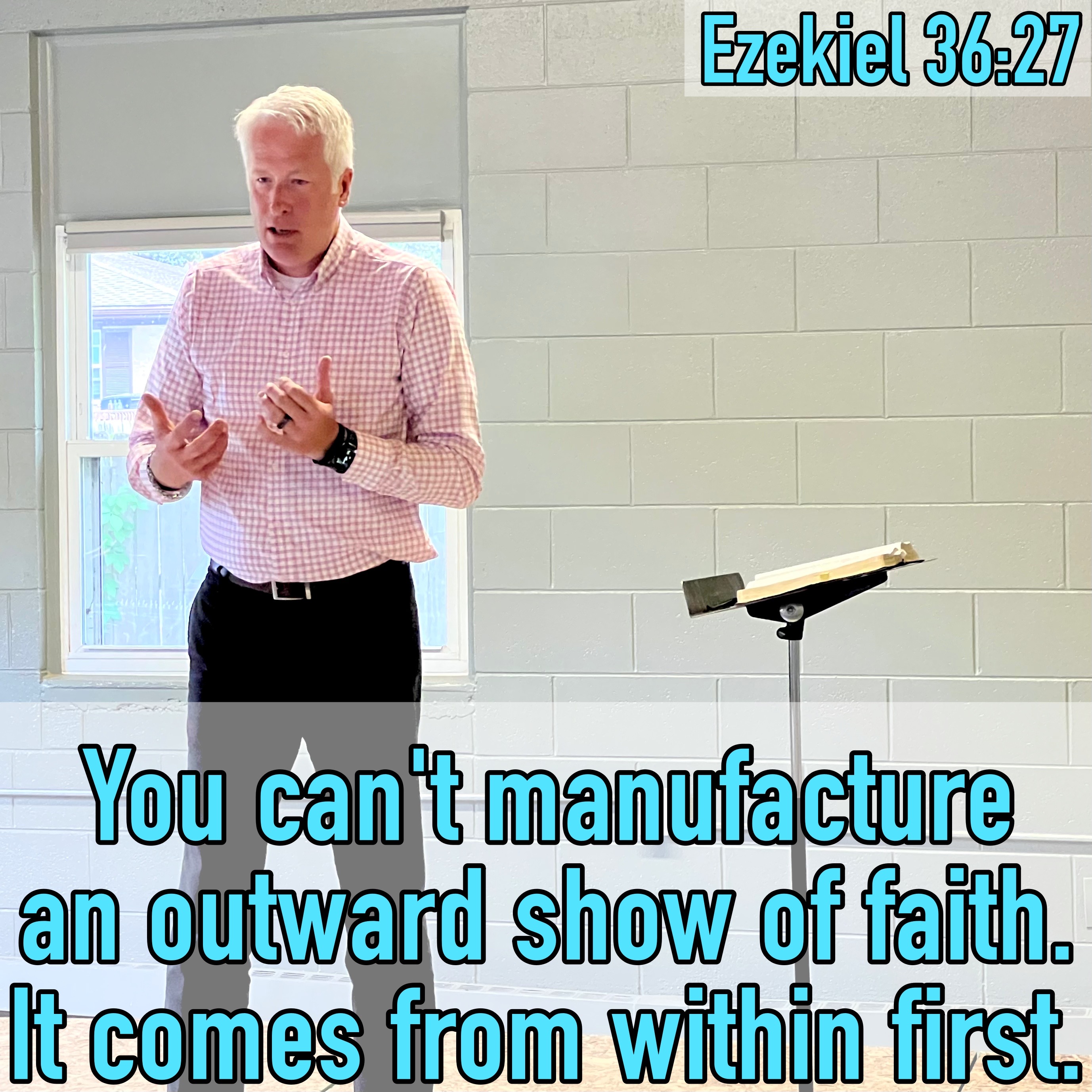
In the First Testament, we see a desire for the Holy Spirit to be more than on—a desire for Him to come in. David prayed, “Create in me a pure heart, O God, and renew a steadfast spirit within me” (Psalm 51:10). And God promised His people, “I will give them an undivided heart and put a new spirit in them … And I will put My Spirit in you and move you to follow my decrees and be careful to keep My laws” (Ezekiel 11:19, 36:27). 

That is exactly what happened on that Pentecost Sunday immediately following Christ’s resurrection and ascension. The Christians were baptized in the Holy Spirit. He came in them and brought them into the Godhead (John 14:20). 

Jesus described this “in-ness” in the picturesque language of a branch joined to the vine. The branch cannot produce any fruit on its own, but it abides in the vine so that the fruit-producing power can flow into the branch (see John 15:1-5). 

Paul identified this fruit of the Spirit as “love, joy, peace, forbearance, kindness, goodness, faithfulness, gentleness and self-control,” and he concluded with the phrase, “against such things there is no law” (Galatians 5:22-23). The law always sets limits, but when the Holy Spirit abides in us, the production of fruit is limitless! 

Being baptized in the Holy Spirit means that we allow Him to come in us and then to work on us. It’s only when the Holy Spirit has worked in us that can He flow through us to others. Jesus said that we would receive the Spirit’s empowerment to be witnesses—that’s an inward change that produces an outward fruit.

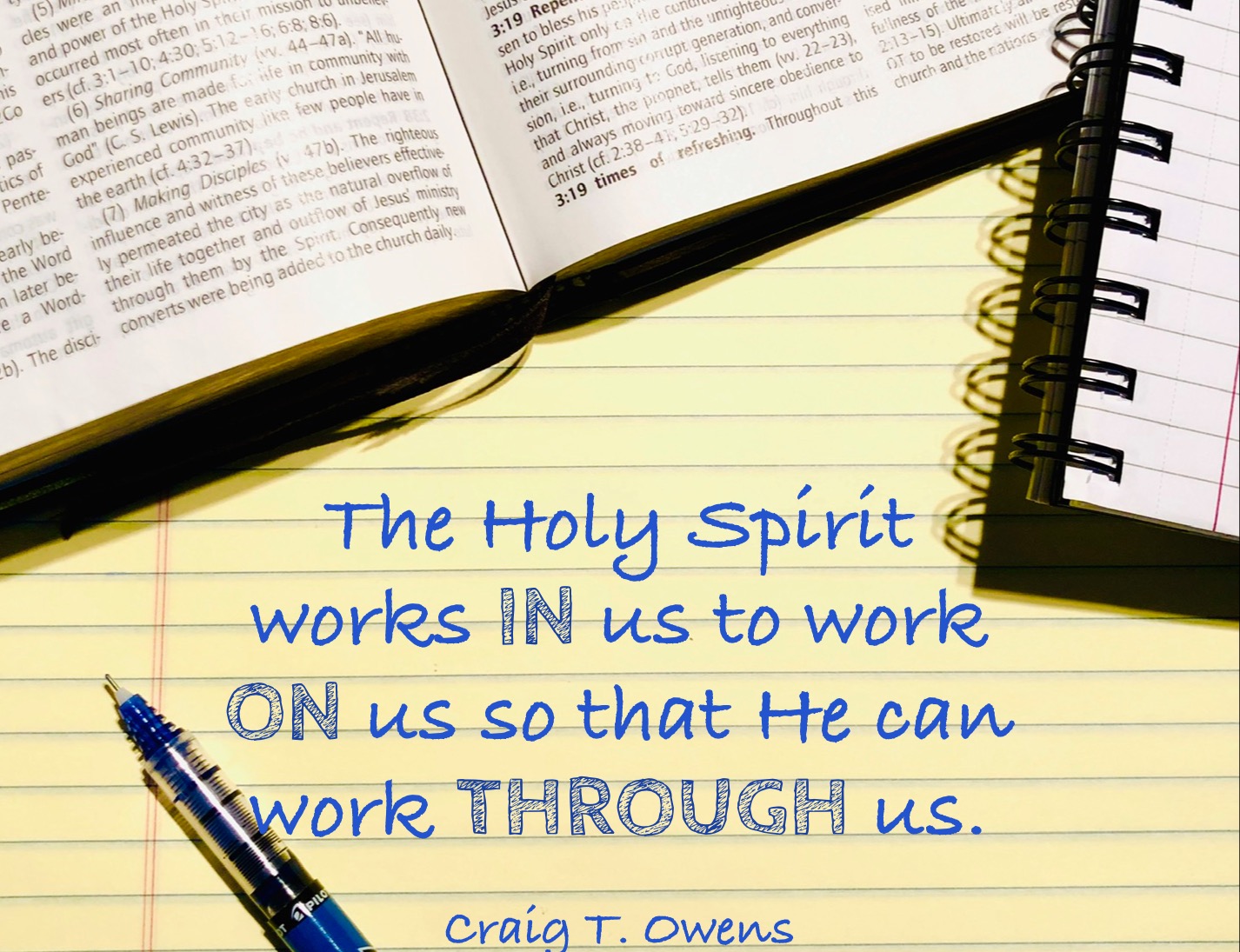
The Holy Spirit works in us to work on us so that He can work through us. So don’t stop at just salvation, but be baptized in the Holy Spirit! 

If you’ve missed any of the messages in our series on the Pentecostal experience, you can find all of those messages by clicking here. 

►► Would you please prayerfully consider supporting this ministry? My Patreon supporters get behind-the-scenes access to exclusive materials. ◀︎◀︎

When The Holy Spirit Redirects Us

Listen to the podcast of this post by clicking on the player below, and you can also subscribe on AppleSpotify, or Audible. 

A well-known passage in Proverbs tells us, “Trust in the Lord with all your heart and lean not on your own understanding; in all your ways submit to Him, and He will make your paths straight” (Proverbs 3:5-6).

Here’s what this looks like in a New Testament setting

Paul reminds us, “Since we live by the Spirit, let us keep in step with the Spirit” (Galatians 5:25). I cannot think of a better way to live. 

If you would like to watch the full video from which the above clip was taken, you can find it here.

►► Would you please prayerfully consider supporting this ministry? My Patreon supporters get behind-the-scenes access to exclusive materials. ◀︎◀︎
Come To God As A Counselor

Listen to the podcast of this post by clicking on the player below, and you can also subscribe on AppleSpotify, or Audible. 

I’ll bet you have “go-to” people in your life. The ones you immediately call when you need computer help, relationship insights, household or car repairs, Bible questions, or even cooking instructions. 

We love having these go-to people in our lives, but I’m also going to guess that none of us has someone who possesses all of these go-to skills. After all, all of us are only human, with limitations and deficiencies. 

We’ve learned that in prayer we can come to God as a Father—calling Him our Abba Father. We can also come to God as a Brother—knowing that Jesus has walked every path we will ever walk, and He intercedes to the Father on our behalf. 

In fact, we saw last week that Jesus was never at a loss of what to say, what path to take, or what prayer to pray. He spoke what He did, and did what He did, and prayed what He did because of the help of the indwelling Holy Spirit. 

This is the same Holy Spirit that is in us as Christians. It’s because of this that we can come to God as a Counselor. The Holy Spirit is THE Go-To Resource for everything! 

Jesus said that both He and our Father love to give us the Holy Spirit as our Counselor, and then the Holy Spirit loves to reveal our Father and our Brother to us (Luke 11:13; John 14:26, 16:15; Galatians 4:6; Matthew 16:17). 

Andrew Murray wrote, “Prayer is simply the breathing of the Spirit in us; power in prayer comes from the power of the Spirit in us as we wait on Him. Failure in prayer is the result of a spirit that is not yielded to the Spirit of God.” 

What does it mean to yield to the Holy Spirit? It means that we don’t look for other go-to people for certain situations, but we trust the Spirit to be the Go-To Resource for everything. This is what Jesus did. 

As Jesus relied on the Counselor, so must we. As the Counselor helped Jesus, so He will help us. 

Let’s break this down. 

First, Jesus was never at a loss of what words to say, and the Holy Spirit will give us the right words to say as well (John 12:49; Matthew 10:19-20; Luke 1:67; Acts 2:14). 

Second, Jesus was never at a loss of what path to take, and neither do we have to experience any confusion about what to do and when to do it (Matthew 4:1; Luke 2:27; Acts 16:6-10).

Finally, Jesus was never at a loss of what prayer to pray, and so too will the Holy Spirit help us go deeper into our prayer time (Luke 10:21; Romans 8:26-27; Ephesians 3:14-21). 

In addition, there is not one issue we will ever face that God hasn’t already addressed for us in Scripture (Ephesians 3:4-5). We see Jesus being totally reliant on Scripture (Luke 4:4, 8, 12). In an identical way, the Holy Spirit will help illuminate and apply the Scripture to our lives (John 14:26; 1 Corinthians 2:13). 

Let me repeat this vital truth: The Holy Spirit is THE Go-To Resource for everything!

  • We are vulnerable to temptation without the help of our Go-To Counselor. 
  • We are limited in our understanding of Scripture without the help of our Go-To Counselor.
  • We have a shallow prayer life without the help of our Go-To Counselor. 
  • We will be frequently confused about words to use or paths to take without the help of our Go-To Counselor. 

Let us learn to rely on our Counselor, as we keep our eyes on our Brother, and as we go together to our Father in childlike prayer. This is what leads to true intimate conversation! 

If you’ve missed any of the other messages in our prayer series Intimate Conversation, please click here. 

►► Would you please prayerfully consider supporting this ministry? My Patreon supporters get behind-the-scenes access to exclusive materials. ◀︎◀︎