Listen to the podcast of this post by clicking on the player below, and you can also subscribe on Apple, Spotify, or Audible.
Confuse them, Lord, and frustrate their plans, for I see violence and conflict in the city. Its walls are patrolled day and night against invaders, but the real danger is wickedness within the city… (Psalm 55:9-14 NLT)
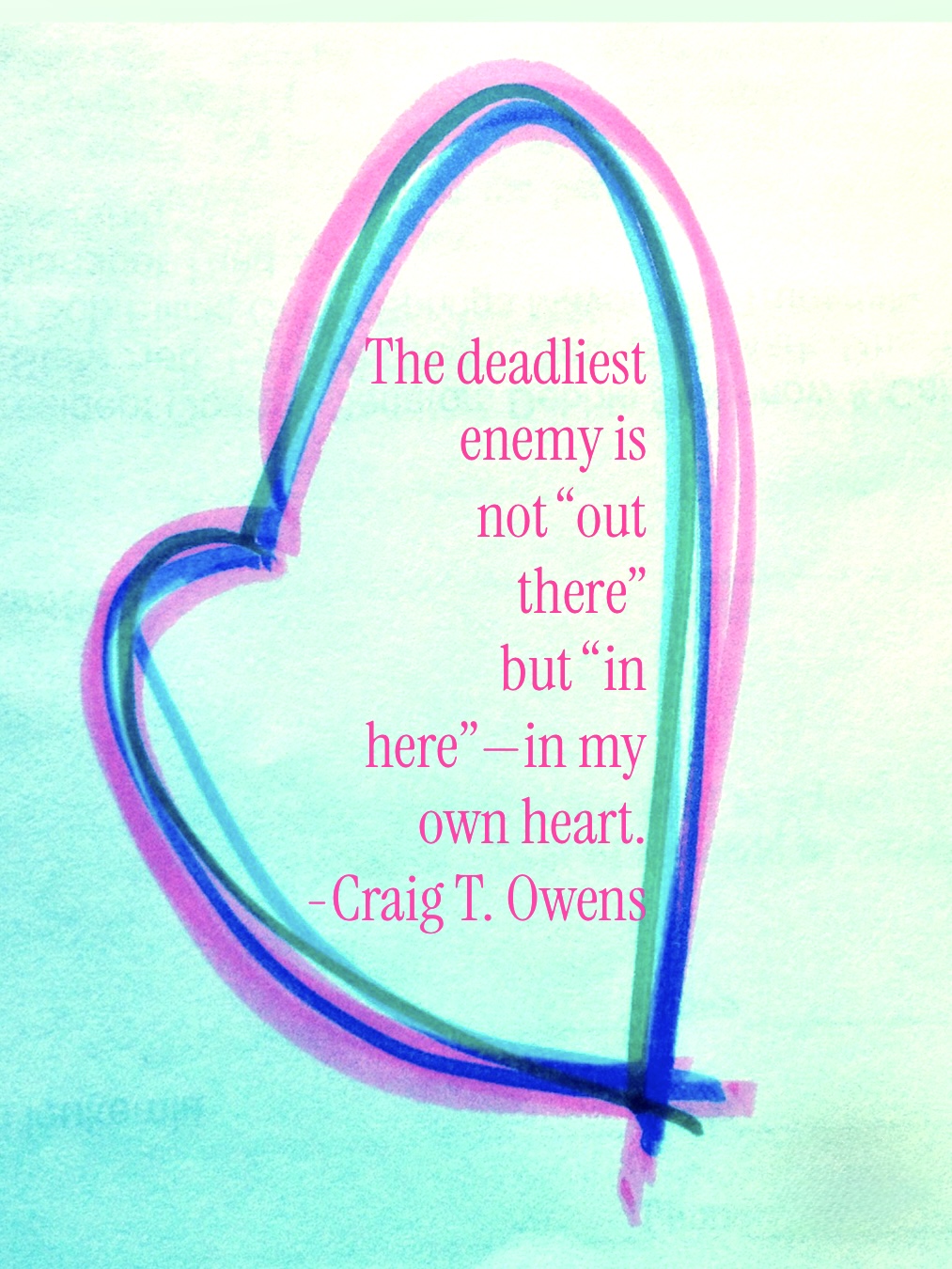
David sees violence and conflict, but he is quick to conclude that the enemy is not “out there” but “in here.” Notice the phrases “in the city” and “within the city.”
This is why Jesus tells us to deal with the plank in our own eye first (the things in here), and then I can see clearly to address what may be out there (see Matthew 7:1-5). He also tells us to pay attention to the clear indicators that something is wrong “in here” in Matthew 15:18-20.
Yes, we should address false gods and evil practices. But G.K. Chesterton warns us to make sure we are addressing the right things—
“Idolatry is committed, not merely by setting up false gods, but also by setting up false devils; by making men afraid of war or alcohol, or economic law, when they should be afraid of spiritual corruption and cowardice.”
God-fearing leaders must always address their own areas of corruption as the first and highest priority. It’s only after this heart-check that we can truly lead people away from things which are holding them back from fully following God.
Holy Spirit, if I feel the need to point my finger at what’s wrong “out there,” may I first yield to Your finger pointing out what’s wrong “in here” in my own heart. Once I have recognized, confessed, and corrected what’s wrong in me, equip me to be a lovingly-strong and empathetic guide to help others around me.
“Tragedy is the highest expression of the infinite value of human life.” —G.K. Chesterton
Clinton Manley says, “Though we often read by ourselves, we never read alone. When you open up a book, you sit down with an author. The book is fundamentally a technology of conversation; it fosters the meeting of minds across time and space.” Referencing several classical works and the Scripture, Manley reminds us that we become what we read.
“It has always been easy to hate and destroy. To build and to cherish is much more difficult.” —Queen Elizabeth II
“Those of us who have been true readers all our life seldom fully realise the enormous extension of our being which we owe to authors. We realise it best when we talk with an unliterary friend. He may be full of goodness and good sense but he inhabits a tiny world. In it, we should be suffocated.” —C.S. Lewis
In biblical times, the Jews looked down on the Samaritans. But not Jesus. One of His longest conversations is with a Samaritan woman. If He had a poor attitude about her, she would have felt that. Instead, she felt His love. Jesus died so that “whoever believes in Him would not die but would have eternal life.” We need to treat everyone like one of the whoever’s that Jesus died to save.
One hundred years ago, William M. Faux called the churches in the Assemblies of God to pray more for our missionaries. “Pray, beloved, pray for missions. Are more workers needed? Yes. Praying is the secret of securing them. Are more funds needed? Yes. Prayer is the force that opens men’s hearts to give to God their resources. Is greater spirituality needed? Yes, surely. Prayer is the agency that brings greater spirituality to the entire church (Matthew 9:38). Louder than the Macedonian cry ‘Come over and help us,’ which rang out to Paul, sounds the cry today, ‘Brethren, pray for us.’ Let the Scripture warning ring in our souls—‘God forbid that I should sin against the Lord in ceasing to pray for you.’ Prayer is the greatest force that we can wield. It is the greatest talent which God has granted us. And this talent He has given to every Christian.”
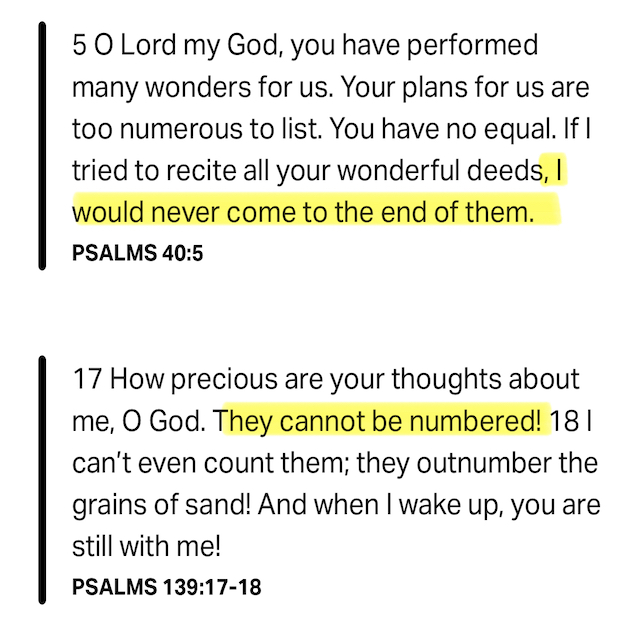
“Faith knows that every seashore on earth has less sand than God has wondrous deeds and thoughts toward us.” —Tanner Swanson
“I had always vaguely felt facts to be miracles in the sense that they are wonderful: now I began to think them miracles in the stricter sense that they were willful. I mean that they were, or might be, repeated exercises of some will. In short, I had always believed that the world involved magic: now I thought that perhaps it involved a magician. And this pointed a profound emotion always present and sub-conscious; that this world of ours has some purpose; and if there is a purpose, there is a person. I had always felt life first as a story: and if there is a story there is a story-teller.” —G.K. Chesterton
John Piper discusses how Christian apologists can contend for the faith properly without sliding into “word fights.”
Oh, how great is Your goodness, which You have laid up for those who fear, revere, and worship You, goodness which You have wrought for those who trust and take refuge in You before the sons of men! (Psalm 31:19 AMPC)
“God is not a symbol of goodness. Goodness is a symbol of God.” —G.K. Chesterton
Remember that all of the attributes of God existed before the words for those attributes existed. Words like love and awesome and power and goodness were created to point us to the I AM.
God is all of these attributes and infinitely more than any attributes we can ever describe or define.
Leaders would do well to remember that they lead a group of unique individuals. Let the unique gifts of those unique people be used in unique ways, and watch both the individuals and the organization grow!
“As Tyler Cowen wrote in The Free Press, ‘Whether or not you work in the AI sector, if you put any kind of content on the internet, or perhaps in a book, you are likely helping to train, educate, and yes, morally instruct the next generation of what will be this planet’s smartest entities. You are making them more like you—for better or worse.’ Now, maybe someone thinks, ‘I’ve hardly got any followers, who cares what I post? It probably won’t matter.’ But the principle means we should care. The philosopher Immanuel Kant famously offered his ‘categorical imperative’ as a test for ethical decisions: ‘Act only according to that maxim whereby you can at the same time will that it should become a universal law.’ In other words, we should only do what we think would be good for everyone to do.” —Axis.org
How much good inside a day?
Depends how good you live ’em.
How much love inside a friend?
Depends how much you give ’em. —Shel Silverstein
A fantastic mini-biography of Otto J. Klink who went from being a Christian, to an atheist socialist, to failed presidential assassin, to a Pentecostal author and evangelist. Wow!
“My acceptance of the universe is not optimism, it is more like patriotism. It is a matter of primary loyalty. The world is not a lodging-house at Brighton, which we are to leave because it is miserable. It is the fortress of our family, with the flag flying on the turret, and the more miserable it is the less we should leave it. The point is not that this world is too sad to love or too glad not to love; the point is that when you do love a thing, its gladness is a reason for loving it, and its sadness a reason for loving it more.” —G.K. Chesterton
Marshall Segal said this about our daily Bible reading time, “I want to walk through a five-step prayer you could pray when you sit down with your Bible to meet with God. The five steps are built on an acronym for FEAST. Focus my mind; Enlighten my eyes; Address my sin; Satisfy my soul; Train my hands.”
“A man of character will make himself worthy of any position he is given.” —Mahatma Gandhi
“A retentive memory may be a good thing, but the ability to forget is the true token of greatness. Successful people forget. They know the past is irrevocable. They’re running a race. They can’t afford to look behind. Their eye is on the finish line. Magnanimous people forget. They’re too big to let little things disturb them. They forget easily. If anyone does them wrong, they consider the source and keep cool. It’s only the small people who cherish revenge. Be a good forgetter. Business dictates it, and success demands it.” —Elbert Hubbard
“Leadership is not about being in charge, but about taking care of the people in your charge.” —Simon Sinek
Flowing Data has a fascinating look at how people spend their time during the day. Their adjustable chart shows activities by age, sex, and time of day. It reminds me of a blog post I shared about time management, where I noted, “You cannot add more Tick, Tocking! time to your day, but you can keep more of your day from Drip, Dropping! away.”
“We might think, ‘Well, hey, if I’m devoting myself all the time to looking out for others’ needs, who’s going to be looking out for mine?’ The Lord, of course, because He knows what you need even before you ask Him, and He has ways of meeting your needs that are more wonderful than you in your cleverness or strength could ever conjure or provide (cf. Matthew 6:25-34).” —T.M. Moore
“We all know that exercise makes us feel better, but most of us have no idea why. We assume it’s because we’re burning off stress or reducing muscle tension or boosting endorphins, and we leave it at that. But the real reason we feel so good when we get our blood pumping is that it makes the brain function at its best, and in my view, this benefit of physical activity is far more important—and fascinating—than what it does for the body. Building muscles and conditioning the heart and lungs are essentially side effects. I often tell my patients that the point of exercise is to build and condition the brain.” —Dr. John Ratey
T.M. Moore has a hard but good word for Christians: “If this day, and this expectation and hope [when we heard King Jesus say, ‘Well done, good and faithful servant’], are not the driving force for every aspect of our lives and work, then it is doubtful we have really understood the Good News of the Kingdom or received the salvation freely offered to us by the King. I say this again: If we are not motivated and driven, day by day, by the prospect of hearing ‘Well done, good and faithful servant,’ then we need to examine ourselves, whether we truly know the Lord of glory. That’s pretty hard language, I know, but let’s face the reality: If we have not submitted to Jesus as Lord of every area of our life, all the work we’ve been given to do, then we are still living for ourselves, not Him.” —T.M. Moore
On our 100th episode, Greg and I talk about how important it is for leaders to let people learn through their struggle, so we need to reject the temptation to jump in to help them too soon. Check out the full conversation The Struggle is Real (but Necessary).
John Piper was asked how to identify false teachers or prophets, and he gives four biblical tests to determine this. But I also appreciate this admonition: “Don’t set the bar so low that you only stop listening to people if they can be properly called false teachers. Lots of people are teachers who are simply misguided and unhelpful in many ways but might not come under the ban of being called a false teacher. Set your standards high. Listen to people who are truly God-centered, Christ-exalting, Bible-saturated, Spirit-dependent, who bear the marks in their lives of authenticity.”
In imploring Christians to not shrink back from difficult trials but to rise and conquer in the strength of the Spirit, Greg Morse makes this observation: “When the risen Christ walked among His early churches (as He walks among them still), His eye was very keen to observe and His heart very ready to address a particular kind of person in every assembly: ‘the one who conquers’ (Revelation 2:7, 11, 17, 26; 3:5, 12, 21). To each of the seven churches, He summons and strengthens the one who would overcome, prevail, hold fast, keep strong, stand firm, and move forward—the victors in Christ amid a larger group in the church who only profess to know Him.”
Two separate geological studies found a period in history where rock formations were impacted by massive amounts of water. ICR adds, “Because conventional geologists deny the historical accuracy of Genesis, they operate at a loss. They see evidence of massive erosion and tremendous water flow at the end of the Tejas Megasequence and just prior to the Ice Age but are hampered by their uniformitarian thinking to explain it. But the Bible gives us answers. Genesis describes a global flood that peaked on Day 150. The sedimentary rocks across all of the continents confirm this peak occurred at the end of the Zuni Megasequence (at the K-Pg). And the rocks confirm that the Tejas Megasequence records the subsequent receding phase.”
There was a Man who
dwelt in the east centuries ago,
And now I cannot look at a
sheep or a sparrow,
A lily or a cornfield,
a raven or a sunset,
A vineyard or a mountain,
without thinking of Him. —G.K. Chesterton
Clinton Manley addresses the place of physical exercise in the life of a Christian. Before sharing three astute observations about this interaction, he notes, “Body or soul is a false dichotomy. As Paul makes clear in 1 Corinthians 9:24–27, physical fitness and spiritual fitness don’t have to be either-or; they’re best as both-and. The body and soul have an inseparably reflexive relationship: the body affects the soul, and the soul affects the body. God created us to glorify Him by enjoying Him, and the body is the soul’s training partner in the pursuit of spiritual pleasures.”
“Who will trust me with a spiritual body if I cannot control even an earthly body?”—C.S. Lewis
Some human employers may ask us to do business for them without giving us a good example or enough resources. But when Jesus told us to be about the Father’s business, He gave us an example and the full empowerment of the Holy Spirit! Check out this full sermon.
“Compromise is a costly word; non-compromise, even more so.” —Bono
Shane Morris said, “But as much as AI’s potential can cause harm, blaming it alone misses the point and likely makes these problems worse. Humans are the fallen ones, and that fallenness manifests in all kinds of destructive ways. Machines, strictly speaking, don’t have morals or intentions. They can only reflect ours.” Check out his podcast AI is not the problem, we are.
“I do not believe that a nation dies save by suicide. To the very last every problem is a problem of will; and if we will we can be whole. But it involves facing our failures as well as counting our successes.” —G.K. Chesterton
I love reading and I have a long list of what I would like to read next. Scott Hubbard addresses this question: “Perhaps the question ‘What should I read or listen to?’ would come into sharper focus if we had a better sense of why we read at all. ‘Why read?’ has more than one right answer. We read to learn, to rest, to deepen friendship with fellow readers, to enjoy the craft of skilled wordsmiths. But alongside these good reasons, consider three others that put our reading into the service of greater loves.”
“I only hope that we never lose sight of one thing—that it was all started by a mouse.” —Walt Disney
“The scientific man does not aim at an immediate result. … His duty is to lay the foundation for those who are to come, and point the way.” —Nikola Tesla
This week marked the 100th anniversary of a court case that was known as “the trial of the century,” perhaps you have heard it called the Scopes Monkey Trial. It was, and has been, more sensation than substance. Check out this post that puts this trial in its proper perspective.
Controlling leaders shut down creativity among their teammates, which leads to higher turnover. If your team isn’t sharing their good ideas with you or if they are leaving you, that may be an indicator that you are too controlling. Check out the full conversation on The Craig and Greg Show
“As a fact, men only become greedily and gloriously material about something spiritualistic. … Take away the supernatural, and what remains is the unnatural.” —G.K. Chesterton
Astronomical technology like the James Webb Space Telescope (JWST) are providing breathtaking images. They are also creating problems for the scientific theories of the origins of our universe. University of California Santa Barbara physicist Caitlin Casey, said, “It makes sense—the Big Bang happens and things take time to gravitationally collapse and form, and for stars to turn on. There’s a timescale associated with that…. And the big surprise is that with JWST, we see roughly 10 times more galaxies than expected at these incredible distances.” There is a more straightforward answer found in Genesis 1:1, “In the beginning, God created the heavens and the earth.”
“Knowing where God wants people to be and taking the initiative to use God’s gifts and God’s methods to get them there, in reliance on God’s power through Christ, with God’s appointed people following.” —John Piper, giving his definition of godly leadership
The Bible records the names of five Persian kings. One of them called “Darius the Persian” in Nehemiah 12:22 requires some historical cross-referencing to identify. The Bible Archeology Report presents another one of their fascinating archeological biographies on this Persian king.
“The greatness of a leader is in his humility before God, not in his eloquence before men.” —Anonymous
The most viewed and downloaded resource on my blog is my chart of the kings of the united kingdom of Israel and the divided kingdoms of Israel and Judah. I was thrilled to discover this week that Jacob Edson at Biblegateway has taken my chart even deeper!
T.M. Moore has vital counsel for pastors, “Jesus must increase in us, and we must decrease. But that doesn’t just happen by carrying out whatever our ‘spiritual work’ requires of us week-in and week-out. Our ‘natural gifts’ cannot replace spiritual ones, and ‘mental powers’ are no match for the mind of Christ. It is a shepherd’s ‘duty’ to attend to the care and nurture of his soul, for unless we are diligent in this, we will not be able to lead the Lord’s sheep into a greater experience of our great salvation or a fuller realization of His Kingdom.”
Don’t judge your creative efforts by the world’s likes (or even by its silence). If you did your best with the talents that God gave you, the applause from nail-scarred hands is all that really matters.
“It will be vain for me to stock my library, or organize societies, or project schemes, if I neglect the culture of myself; for books, and agencies, and systems, are only remotely instruments of my holy calling; my own spirit, soul, and body, are my nearest machinery for sacred service; my spiritual faculties, and my inner life, are my battle axe and weapons of war.” —Charles Spurgeon
“A man who has faith must be prepared not only to be a martyr, but to be a fool.” —G.K. Chesterton
The paleontological evidence of dinosaur fossils is most easily explained by the Flood described in the Bible. ICR reports, “Virtually every dinosaur fossil ever found is ensconced in sedimentary or (rarely) volcanic sediments, indicating a sudden and catastrophic deposition. … So why would paleontologists entertain bizarre extinction explanations such as slipped discs, sunspots, or magnetic reversals? Because if a scientist dismisses the global Flood out of hand, then anything goes when trying to explain the dinosaur demise.”
People need to know how much you love them before they will listen to any correction you may need to give them. “Real friends hurt each other.”Check out the full sermon here.
David Mathis shares a faith-building message of confidence during times of crisis. He takes his text from Psalm 46—“Whatever trouble comes, Psalm 46 tells us, with its first word, where to turn. Not to a change in circumstances. Not to our best efforts to fix the problem. Not to our anxious strategies to avoid pain and loss. But rather, turn to God.”
“There is not a facet of our lives, not an interest or occupation, not a nook or cranny of the cosmos, where God does not intend that His glory should shine forth and be known. Indeed, even now He is showing His glory in created things, and even in much of the culture that human beings make to meet their own needs (Psalm 19:1-4; Psalm 68:18). God is manifesting His glory; it is there to be noted and pondered. The task of those entrusted with the Kingdom economy is to serve as docents of the glory of God, bringing His glory to light and making Him known for all to see in these last days. … Our mission in these last days is to glorify God by living out the reality of His indwelling Presence among the people to whom He sends us day by day (cf. Micah 4:1-8). In all our relationships, cultural activities, conversations, families, vocations, and diversions, what will it look like, and how will it appear to others when the glorious Presence of God is being refracted through us?” —T.M. Moore
“The resurrection of Jesus from the dead was the one unvarying refrain of the apostles. This chapter [1 Corinthians 15] is the fullest discussion of it in the New Testament. It is one of the most significant and grandest chapters in the Bible because of the meaning it gives to human life. …The resurrection of Jesus from the dead is the one most important and most established fact in all history. And the story of it has come down to us through the centuries, beautifying human life with the halo of immortality; making us feel sure that because He lives again we too shall live; making our hearts thrill with the thought that we are immortal, that we have begun an existence that shall never end; that nothing can harm us; that death is merely an incident in passing from one phase of existence to another; that wether here or there we are His, doing the thing He has for us to do; that millions of ages after the sun has grown cold, we ourselves shall still be young in the eternities of God.” —Dr. Henry Halley
Would you like to get better sleep and lower your stress levels? Check this out: “If you share a bed with your sweetie, consider incorporating this step into your nighttime routine if you aren’t already: a snuggle sesh…. A study found that couples who cuddled prior to drifting off experienced less stress and more feelings of security in the relationship.”
“The Bible tells us to love our neighbours, and also to love our enemies; probably because they are generally the same people.” —G.K. Chesterton
John Piper is asked an interesting question from Ephesians 6:12—are our adversaries merely flesh-and-blood humans or are demonic forces at work? “Flesh and blood apart from Christ is always under the sway of the spirit of the age, and it’s always under the sway of the prince of the power of the air, and it’s always acting out of its own bodily, mental desires. Therefore, in one sense, there is no separation in our warfare with human sinfulness and demonic schemes. They overlap; they’re intertwined.”



 Confuse them, Lord, and frustrate their plans, for I see violence and conflict in the city. Its walls are patrolled day and night against invaders, but the real danger is wickedness within the city… (Psalm 55:9-14 NLT)



 Craig T. Owens