Staggering Seduction

Listen to the podcast of this post by clicking on the player below, and you can also subscribe on AppleSpotify, or Audible. 

The northern tribes of Israel had been defeat by the Assyrians and gone into exile because of their persistent and unrelenting sins against God. You would think that this would be a vivid enough warning to get the attention of the people of Judah, but sadly it wasn’t. 

King Manasseh sinned and then doubled-down on his sinning. The prophets thundered their warnings, and Manasseh not only kept his sins going but he kept pulling more and more people down into sin with him. 

Isaiah pointed to the example of Israel’s sin—

     Woe to Samaria the crown of pride of the drunkards of Ephraim [the ten tribes], and to the fading flower of its glorious beauty, which is on the head of the rich valley of those overcome and smitten down with wine! … But even these reel from wine and stagger from strong drink: the priest and the prophet reel from strong drink; they are confused from wine, they stagger and are gone astray through strong drink; they err in vision, they stumble when pronouncing judgment. (Isaiah 28:1, 7 AMPC) 

Notice the words like reel and stagger, as though intoxicated by alcohol. 

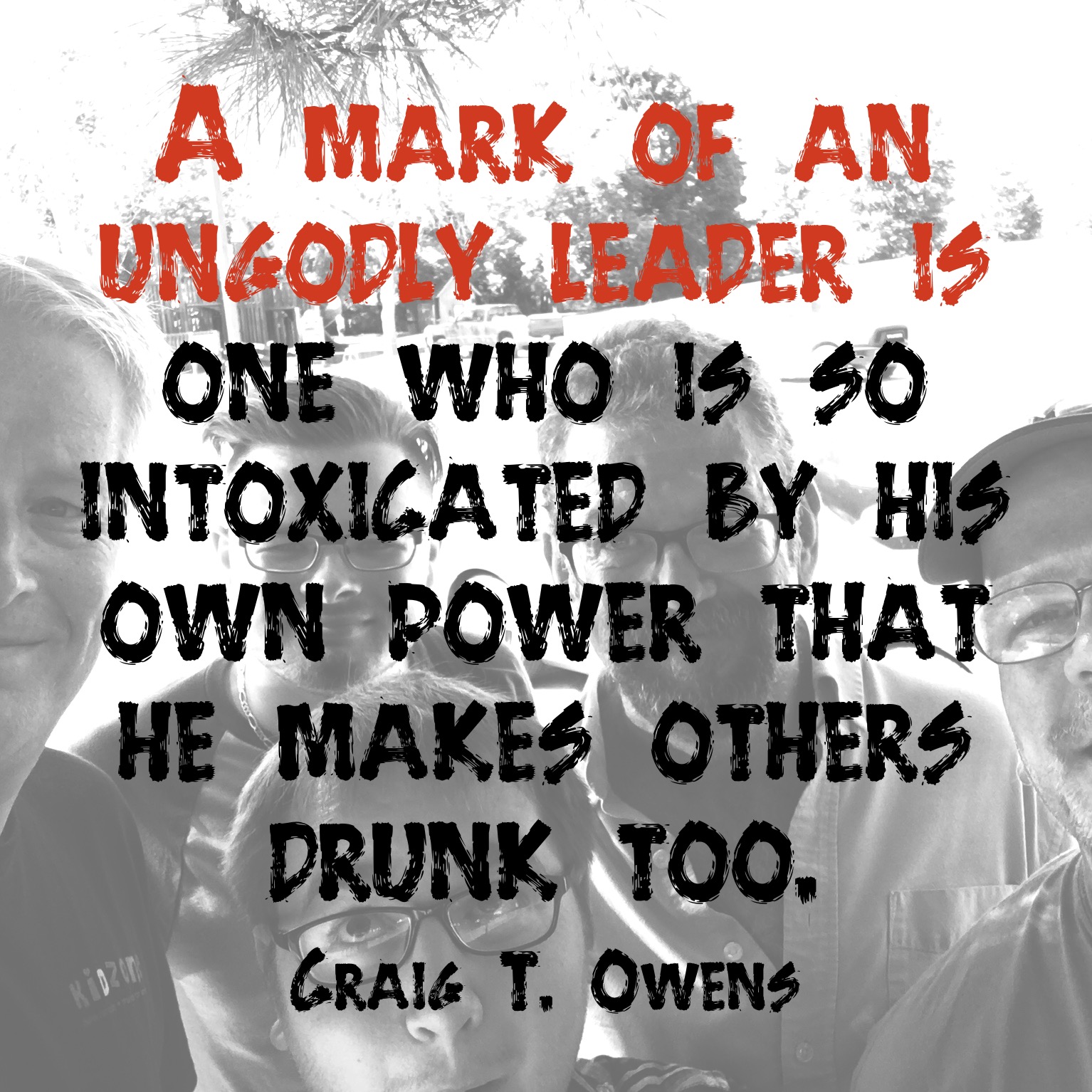
A mark of an ungodly leader is one who is so intoxicated by his own power that he makes others drunk too. 

Look at this description of Manasseh: “But the people [of Judah] would not listen; and Manasseh seduced them to do more evil than the nations did whom the Lord destroyed before the Israelites!” (2 Kings 21:9). 

The Hebrew word translated “seduced” is the same Hebrew word that Isaiah used for the staggering and going astray of a drunkard. 

This is the power that leaders have for both good and evil. A sober-minded, godly leader can encourage people toward righteousness, but an ungodly leader who is intoxicated by his power seduces people to join him in his unrighteousness. Manasseh was described as “making Judah sin, by doing evil in the sight of the Lord” (v. 16).

Certainly there are people who choose a sinful lifestyle during the tenure of a godly leader, and there are people who steadfastly choose righteousness during the tenure of an ungodly leader. But the Bible issues strong warnings to those leaders who misuse their God-appointed positions of leadership to lead people astray (see Ezekiel 3:17-21, 33:1-9). 

Leaders, be on guard that a position of leadership doesn’t seduce you to stray from righteousness. Don’t forget that God chose you for this role, so to Him you will have to stand to give an accounting of your leadership. I pray you can say that you soberly and sincerely pursued righteousness and led your people in that pursuit as well. I want you to hear, “Well done, good and faithful servant” and not, “Depart from Me.” 

This is part 86 in my series on godly leadership. You can check out all of my posts in this series by clicking here.

►► Would you please prayerfully consider supporting this ministry? My Patreon supporters get behind-the-scenes access to exclusive materials. ◀︎◀︎

Know, Go, Show

Listen to the podcast of this post by clicking on the player below, and you can also subscribe on AppleSpotify, or Audible. 

There is a recurring theme throughout the Book of Judges and then later is repeated in the years leading up to Israel’s exile: A godly leader passes off the scene and the people return to their old selfish, godless lifestyle. This sinful life brings God’s punishment, which causes the people to cry out to God for help. God raises up a leader who leads the people in repentance and a return to God. As a result, God’s blessings again flow to His people. Then that leader passes off the scene and the cycle repeats. 

This recurring thought is in the middle of a particularly dark time for Israel: “In those days there was no king in Israel; every man did what was right in his own eyes” (Judges 17:6; see also 18:1). 

The entire 17th and 18th chapters of Judges is a sickening story of the Israelites utterly turning their back on God so they could go do whatever they want. And worst of all, we see godless leaders taking advantage of the situation to line their pockets with worldly riches. 

Just because there is a God-fearing leader on the scene doesn’t guarantee that the people will follow his or her lead and devote themselves to God. But a godless leader almost always results in people debasing themselves by thumbing their nose at God’s laws. 

God raises up leaders and holds them accountable for their actions. He told Ezekiel that there would be consequences for both boldly speaking God’s message or for keeping silent (see Ezekiel 3:16-21). 

God calls His leaders to know His ways, to walk in integrity in that way, and then to call others to walk in that way too. 

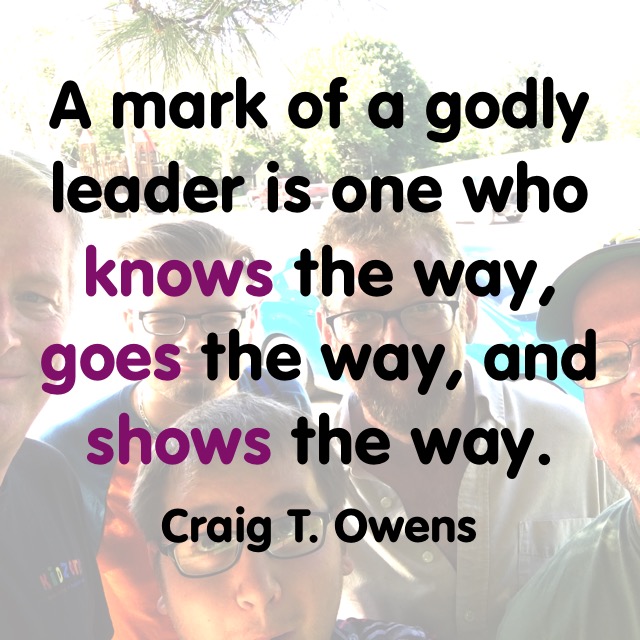
A mark of a godly leader is one who knows the way, goes the way, and shows the way.

This is part 84 in my series on godly leadership. You can check out all of my posts in this series by clicking here.

►► Would you please prayerfully consider supporting this ministry? My Patreon supporters get behind-the-scenes access to exclusive materials. ◀︎◀︎

Links & Quotes

Even if the world’s legal system seems unjust, Jesus says by continuing to press our case with the public servants He has put in place, we are really trusting God to bring us His perfect justice. Check out my full sermon on how the Bible from Moses to Jesus explains how to define the legal term, “An eye for an eye, a tooth for a tooth.”

I have lots of new content every week, which you can check out on my YouTube channel.

“A significant amount of research and scholarship (both scientific and theological) indicates that a young Earth is the most straightforward, conservative way to interpret God’s Word. … The most unambiguous way to interpret the Bible is according to its grammatical-historical sense, or the intended meaning of the authors. A literal interpretation accounts for all figures of speech in the text, providing the most straightforward method of exegeting Scripture. To this point, when Jesus quoted the Old Testament, it was always clear that He considered its passages as factual and true.”  Check out the post Long Ages and the Bible—What’s the Problem? 

“Your brain is made up of neurons that communicate with each other through synapses. Delta-FosB is one of the chemicals that creates neural circuits—i.e., ‘pathways’—to help those neurons communicate more quickly and efficiently. … Basically, what you experience as getting better and better at something is your brain ‘rewiring’ itself to become faster and more efficient at sending the same messages between the same neurons.” This works for both healthy and unhealthy activities. In this article from Fight The New Drug, research shows how regular consumption of pornography is hampering your brain’s ability to have normal, healthy relationships.

Dr. Henry Halley, in his Halley’s Study Bible, observed, “Note, too, the unceasing emphasis on the resurrection throughout this book. It was the pivotal point in Peter’s sermon on Pentecost (2:24, 31-32), in his second sermon (3:15), and in his defense before the Sanhedrin (4:2, 10), It was the burden of the apostles’ preaching (4:33). It was Peter’s defense in his second arraignment (5:30). A vision of the risen Christ converted Paul (9:3-6). Peter preached the resurrection to Cornelius (10:40). Paul preached it in Antioch (13:30-37), Thessalonica (17:3), Athens (17:18, 31), and Jerusalem (22:6-11), to Felix (24:15, 21), and to Festus and Agrippa (26:8, 23).” You can check out all of the Scriptures he mentions in this quote here.

Stephen Witmer asks an important question: “Which is closer to the center of your life as a Christian: what you’re doing for God, or what God has already done for you through Jesus Christ? Which one grounds your identity more deeply, affects your mood more frequently, rouses your passions more highly? Your answer to these questions will deeply shape the stability, tenacity, happiness, boldness, and humility of your Christian experience. Jesus wants to provide you grounds for unshakable joy.” Check out this example Witmer shares from an exchange between Jesus and His followers. 

“Informing your opinion of the comparative merits of Christian men, never forget the old rule: ‘distinguish between times.’ Place yourself in each man’s position. Do not judge what was a right course of action in other times, by what seems a right course of action in your own.” —J.C. Ryle

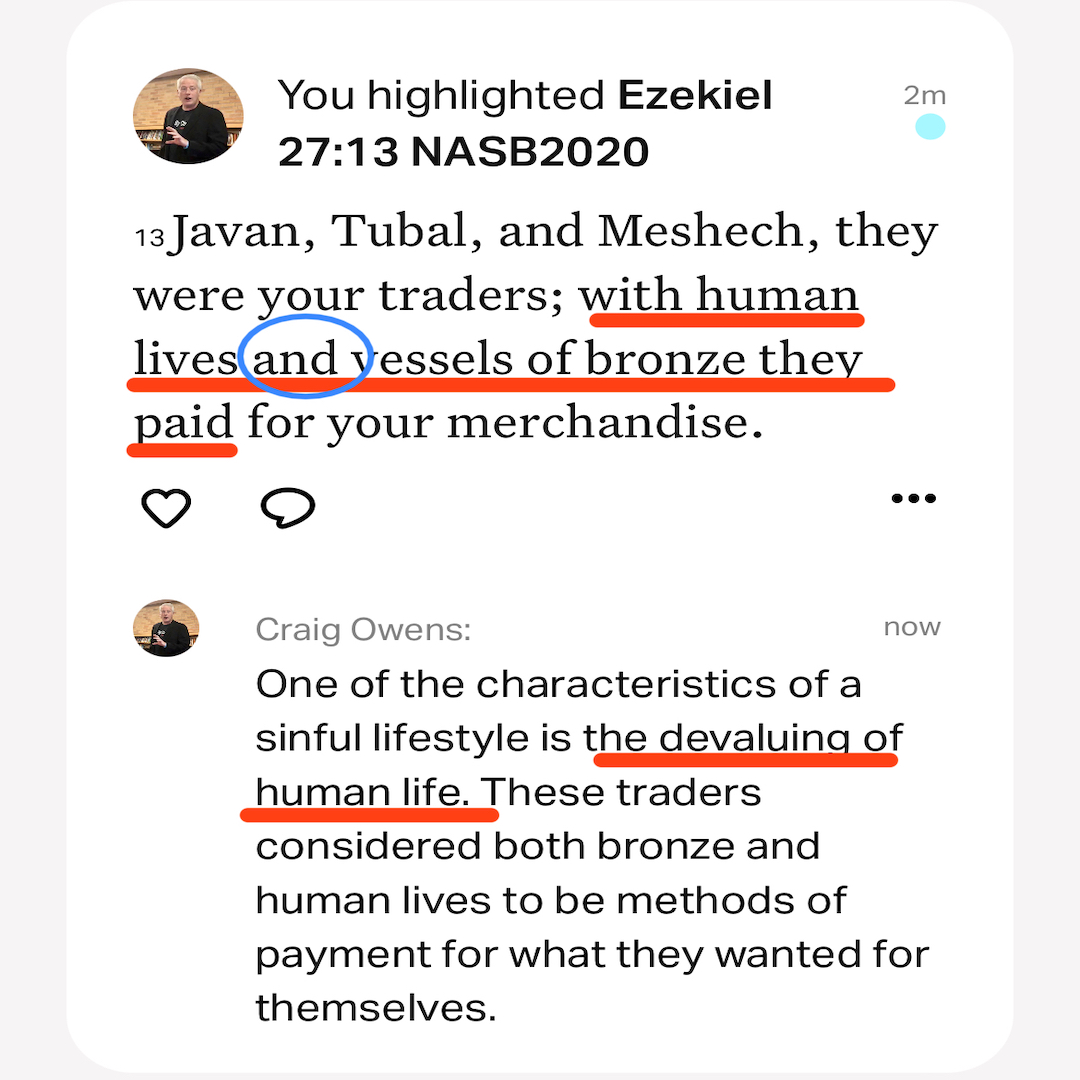
God holds human life as precious in His sight. Whenever anyone asks me why I support the sanctity of human life, my answer is simple, “Because God holds it sacred.” Consequently, God punishes those who devalue human life.

My friend, Pastor Tim Dilena, shares a thought about how God often uses people as the answer to our prayers.

Rebelling Against Government And God

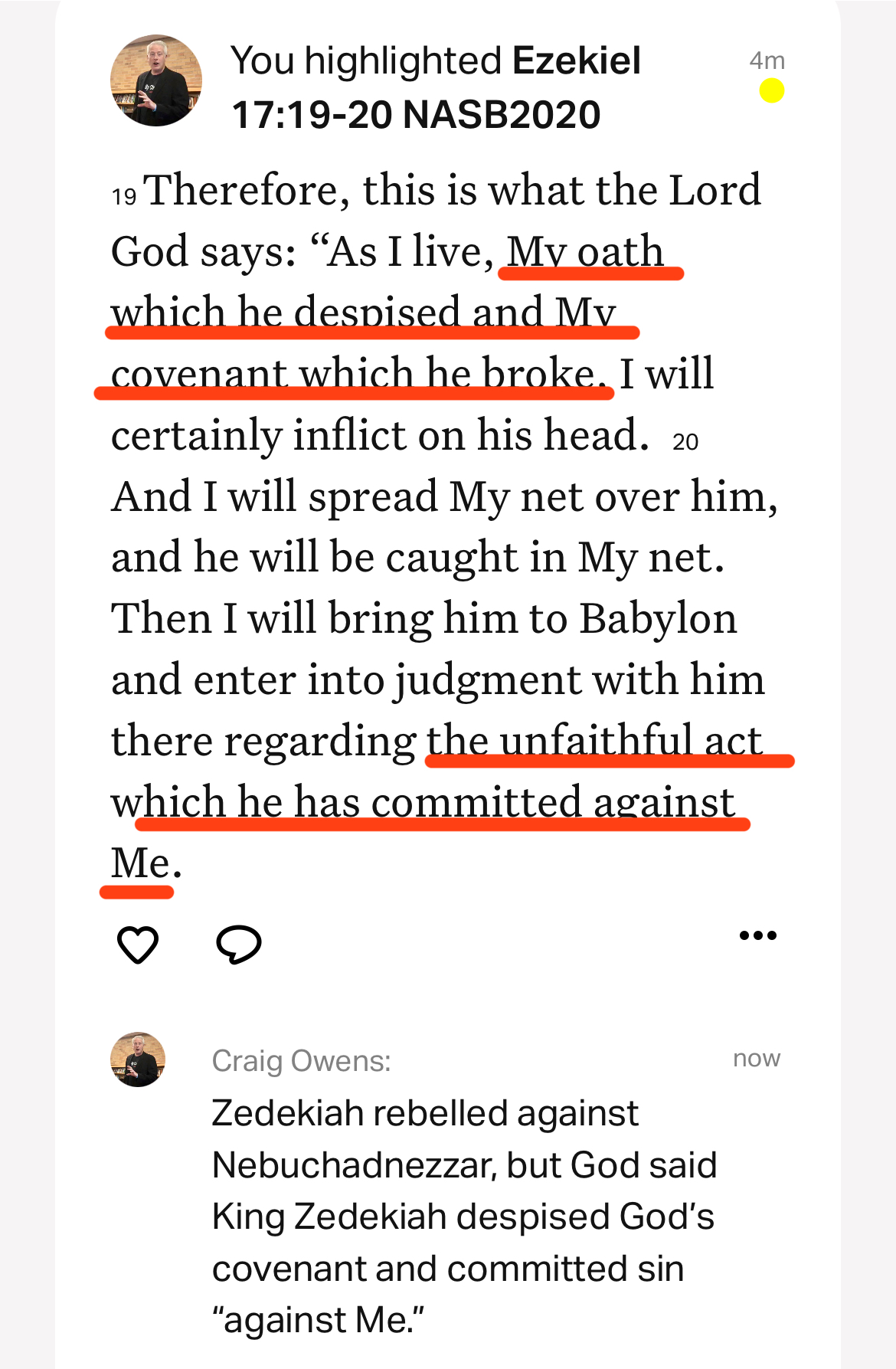
Therefore, this is what the Lord God says: “As I live, My oath which he [Zedekiah] despised and My covenant which he broke, I will certainly inflict on his head. And I will spread My net over him, and he will be caught in My net. Then I will bring him to Babylon and enter into judgment with him there regarding the unfaithful act which he has committed against Me. (Ezekiel 17:19-20) 

Zedekiah rebelled against Nebuchadnezzar, but God said King Zedekiah despised God’s covenant and committed sin “against Me.” 

All governing authorities on earth are God’s servants. God used Babylon as His means of punishing Judah for her sin. When King Zedekiah conspires with Pharaoh to attack Nebuchadnezzar, God says Zedekiah is really rebelling against God Himself!

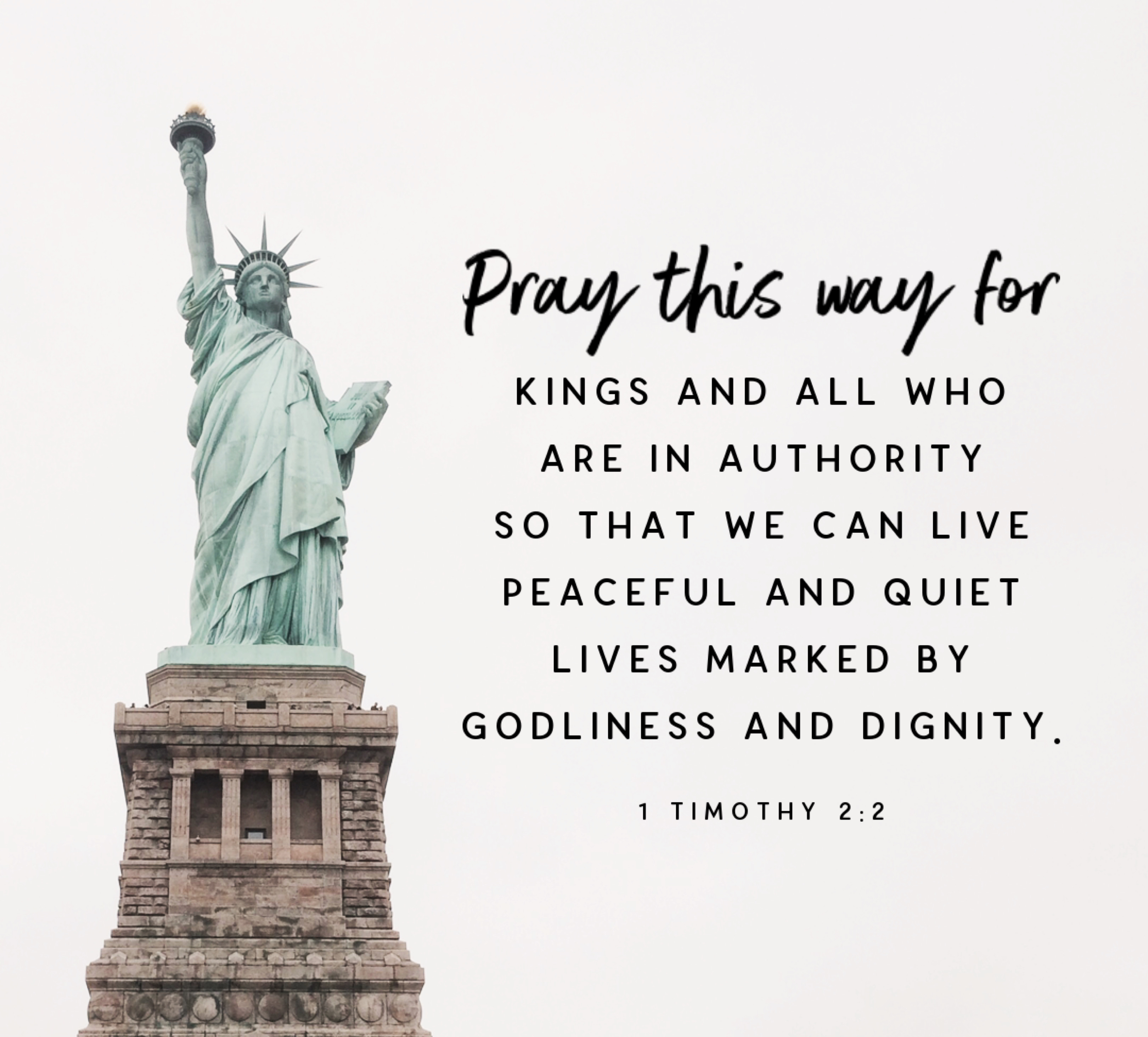
Christians are called to pray for those in governmental leadership. To dig a little deeper on this topic, check out two previous blog posts and sermon videos:

Links & Quotes

It’s easy to get along with those we like. But God calls on Christians to do the hard—but rewarding—work of getting along with everyone! Check out this full sermon about the strength in Christian unity.

I have lots of new content every week, which you can check out on my YouTube channel.

“Dad always said you could fall off the same ladder you climbed up.” —Hank Aaron

Paleontologists have noted that what Creationists would call pre-Flood mammals lived longer than similar mammals today. “This research should be of interest to Bible-believing Christians because, as chronicled in Genesis 5, humans in the pre-Flood world were experiencing much greater lifespans. Moreover, the advanced ages of the Genesis 5 patriarchs at the births of their sons strongly suggest delayed sexual maturation and possible delayed skeletal maturation, too. The Bible gives no hint that this amazing longevity was in any way supernatural.”

“If we leave our failure, we don’t learn from our failure. If we learn from our failure, we seldom have to leave because of our failure.” —John Maxwell 

Dr. Steve Nichols hosts a great podcast called 5 Minutes In Church History. In the episode this week, he talked about the church politics Jonathan Edwards had to confront when he first arrived in Stockbridge. It came to a head in a letter Edwards received: “All it did was go into, again, politics, accusing Edwards of mis-running the school, which wasn’t true, and deflecting the blame and the focus away from the Williams family. And now Edwards needs to vindicate himself. Well, all that to say, we think of these church history figures, and we see their portraits, we sometimes forget that they’re actually people, and they had to deal with challenges too.” These types of faultfinding accusations are what I address in my book When Sheep Bite.

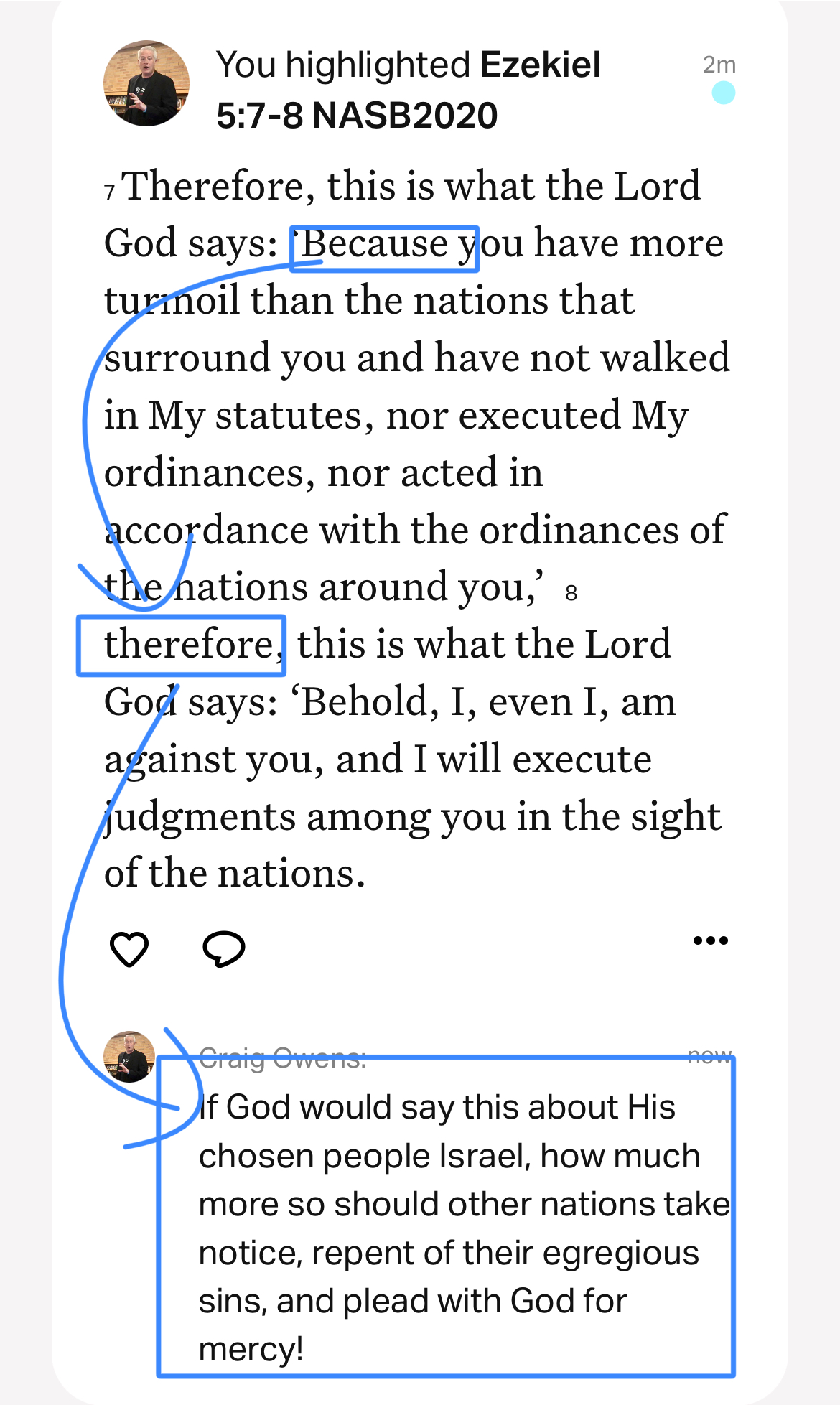
If God would say this (Ezekiel 5:7-9) about His chosen people Israel, how much more so should other nations take notice, repent of their egregious sins, and plead with God for mercy!

Hellbent

Listen to the podcast of this post by clicking on the player below, and you can also subscribe on AppleSpotify, or Audible. 

Here’s how God describes a wicked nation:

Woe to her who is rebellious and defiled, the oppressive city! She obeyed no voice, she accepted no discipline. She did not trust in the Lord, she did not approach her God. Her leaders within her are roaring lions, her judges are wolves at evening; they have no bones to gnaw in the morning. Her prophets are insolent, treacherous men; her priests have profaned the sanctuary. They have done violence to the Law. (Zephaniah 3:1-4)

These are people who were once so passionate for God and are hurtling toward His judgment on their sinful lifestyle—

  • thumbing their noses at their own civil laws 
  • calling their own justice system into question 
  • governed by leaders who are focused on flexing their power for themselves 
  • afflicted by judges ruling by the desires of those who give them “bones to gnaw” 
  • subject to preachers who twist and distort Scripture to suit their own desires 

These things can come from nothing but pride that says, “We know best. We don’t need some out-of-date, behind-the-times god telling us what to do!” 

These prideful people are hellbent on pursuing their sinful lifestyle—rejecting God’s warning of impending and certain judgment—because they have fooled themselves into believing there is no God! 

Our history books are filled with stories of other proud nations that thought this same way, but God both announced and carried out His righteous judgment on them. And still, we foolishly believe we are better than them, that we can avoid the inscrutable eyes of God. 

God is looking for one righteous man or woman who will hold to His righteous standard, and who will stand in the gap to intercede for rebellious, hellbent people (Ezekiel 22:30). 

Will you be that one?

►► Would you please prayerfully consider supporting this ministry? My Patreon supporters get behind-the-scenes access to exclusive materials. ◀︎◀︎

The Rebirth Of Israel

My friend Douglas Carmel shared this amazing article in one of his recent ministry newsletters. I have reprinted it here with his permission—

Has this ever happened before in the history of the world? That a people should go into exile, be dispersed, and yet survive for 2000 years without a national homeland. And then to come back again—speaking their same language and returning to their same capital city. This alone should make an atheist question their atheism. Why? This is a miraculous, singular event. No country had ever done such a thing before in the history of mankind, except Israel. And yet, this is exactly what was foretold in the Hebrew Scriptures. 

The prophet Ezekiel also stated God’s promise: “For I will take you from the nations, gather you from all the lands and bring you into your own land” (Ezekiel 36:24). 

Also, in Ezekiel 37, there is an unforgettable vision of a valley of dry bones. The bones come to life in stages: first sinews on the bones, then flesh, then skin, and finally, the breath of life (Ezekiel 37:6–10). 

God then explains this vision to Ezekiel: “Son of man, these bones are the whole house of Israel” (Ezekiel 37:11). In other words, this is a prophecy about the Jewish people’s restoration to their Promised Land from all around the world. It is well in keeping with what we see actually occurring during our lifetime. Namely, the regathering of Israel will occur in stages, which it has done and is still doing. 

So how did we get to the State of Israel today? 

Let’s go back to the first and second centuries, just past the time of Jesus/Yeshua. Deuteronomy 28 contains prophecies regarding this second dispersion. It should be noted that this second dispersion was “from the one end of the earth even unto the other” (v. 64). This was to be a global dispersion, unlike the first one, which was just to Assyria and Babylon. 

Just after the time of Yeshua/Jesus, Israel rebelled against Roman rule. In 70 AD and again in 135 AD, Jewish rebels sought to fight against Rome. In response, the Roman army destroyed Jerusalem and its Temple under Titus in 70 AD, and the Jewish people were either killed or expelled from their land by Roman force. Under the rule of the Roman Emperor Hadrian, the Jews were dispersed all over the world by 135 AD. These facts are well-known in secular history sources as well. 

At this time, it was the Romans who changed the name of the land of Israel to Palestine. That was done to rub salt in the wounds of the Jews by changing the name of their beloved homeland to that of their ancient foes, namely, the Philistines (think Goliath’s people).  

It is important to note that while the Jewish people as a whole were dispersed by the second century, there always remained a small remnant of Jewish people scattered throughout the land, living in small communities. (Note: There is much more history involved than we can list here in this short article.)

After the Romans, came the Muslims. Except for a short time during the Crusades, the land was continuously ruled by Muslim Empires. That brings us to modern times. The British won the land of “Palestine” from the Ottoman Empire during World War I. About this time, Jewish people began to return in large numbers in the late 1800s. Eventually, the British army pulled out of “Palestine” in 1948 after the UN had given Israel the right to exist (as if they needed that approval). On May 14th, 1948, the State of Israel was reborn, and the name “Palestine” was dropped. 

Israel was attacked the very next day by all their neighbors, and guess what? Against all odds, Israel won! 

After several more wars that Israel had to fight for their survival, they still exist, and thus you see the headlines today. As you can deduce, this is an extremely short breakdown of Jewish history in the land. There were many more details involved, which we skipped over. 

Now, mind you, we are not saying that Israel today is just fine without their Messiah (they are not), nor are we saying that the secular government of Israel is perfect (they are not). But we are saying that, in the big picture of things, Israel being back in her land after 2000 years is something to take note of. 

It is indeed a miracle, and those who call for her eviction again “from the land to the sea” are unknowingly fighting against God’s miracle. 

Check out more from Rock of Israel Ministries here. And also check out an amazing message Douglas shared with our church here

Worth The Effort

Listen to the podcast of this post by clicking on the player below, and you can also subscribe on AppleSpotify, or Audible. 

The Bible is not only the inspired Word of God but it is rooted in history too. Every prayer was prayed by a real person in distress, and every song of praise was lifted up by someone who personally experienced God’s deliverance. 

The reason why this is so important is that it makes God’s Word relatable and applicable to us. If the Bible merely contained moral stories set in some make-believe world, we may have a hard time seeing how to apply the principles to our daily lives. But, thankfully, this isn’t the case. We can read the real-life experiences of real historical people and then we can allow the Holy Spirit to help us apply this inspired Word to our lives. 

There is a collection of 15 songs in the Book of Psalms called “The Songs of Ascent.” Even these songs have an important historical background. 

The books of Kings and Chronicles tell the sad history of Israel and Judah sliding farther and farther away from God until finally, God must punish them. He punishes Judah by bringing King Nebuchadnezzar against them, who destroyed the temple at Jerusalem and carried the people into exile in Babylon. But even as they are being taken away, God speaks a prophetic word through Jeremiah that in 70 years He will raise up another leader, Cyrus king of the Persians, who will allow the exiles to return home. You can read all of these historical accounts in 2 Chronicles 36:15-23; Jeremiah 29:10-14; and Isaiah 44:28-45:6. 

Second Chronicles ends with this proclamation from King Cyrus: “The Lord, the God of heaven, has given me all the kingdoms of the earth and He has appointed me to build a temple for Him at Jerusalem in Judah. Anyone of His people among you—may the Lord his God be with him, and let him go up” (2 Chronicles 26:23). 

The phrase “let him go up” is both literal (since Jerusalem is 2500 feet above sea level) and spiritual. Listen to these words from King Solomon, “The way of life winds upward for the wise, that he may turn away from hell below” (Proverbs 15:24 NKJV). 

The Songs of Ascent were a rallying cry—an encouragement to all pilgrims to keep climbing up. 

In Hebrew literature, the main point is usually found in the middle of the poem or story, unlike our Western literature which puts the payoff at the end. In the first Song of Ascent, the middle is verse 4. But the second half of Psalm 120 seems out of place for people ascending up to Jerusalem to worship God. Verse 5 begins with the words, “Woe to me.” 

The psalmist is expressing his pain in living among the people of Meshech and Kedar. The people of Meshech were vicious people who traded human lives for money and who conducted themselves as terrorists (Ezekiel 27:13; 32:26). Their name literally means “drawing away.” The people of Kedar were nomadic sons of Ishmael. Being nomadic means they were never at rest. Their name literally means “dark place.” Very noteworthy is that there is no mention of God in verses 5-7.  

The middle verse of this song (v. 4) turns the people of Meshech and Kedar over to God. It is a reminder that we are not the ones to dispense justice. If God knew how to overthrow the powerful kingdoms of Judah, Babylon, and the Medes, if He knew to call Cyrus by name at just the right moment, He also knows how to deal with these sinners. 

This Song of Ascent shows the stark contrast between keeping our eyes on the dark culture around us versus keeping our eyes on the God who is never weighed down by the darkness. As we go higher up, we focus more on God; as His saints focus on Him, His light shines on them; as His light shines on them, they point sinners living in dark valleys to the God of light and love. 

Staying down is easy. Getting up requires intentional effort. Going up requires us to overcome the pull of sin and the frustration of watching for judgment to fall on sinners. 

Continually going up glorifies God, has eternal rewards for saints, and creates a compelling testimony for sinners.

Going up is a lot of effort, but the rewards are so worth it! As the apostle Paul reminded his friends in Rome, “I consider that our present sufferings are not worth comparing with the glory that will be revealed in us” (Romans 8:18). Let’s keep climbing up and let’s keep lifting our eyes to the only One who has the eternal light. 

If you’ve missed any of the messages in our look at the Songs of Ascent, you can find them all here. 

►► Would you please prayerfully consider supporting this ministry? My Patreon supporters get behind-the-scenes access to exclusive materials. ◀︎◀︎

In, On, And Through

Listen to the podcast of this post by clicking on the player below, and you can also subscribe on AppleSpotify, or Audible. 

I’ve talked before about the benefits of calling the Old and New Testaments the First and Second Testaments. This helps me not to subconsciously slip into the thought that “old” means outdated or that “new” means a replacement of what came before it. When I say First and Second I remember that there cannot be a Second without a First, that the First anticipates the Second and the Second fulfills the First. 

The people of the First Testament experienced the Spirit of God in an often-repeated phrase: “the Spirit of the Lord came on” someone. It usually came on them for a specific task or season. For instance…

  • 70 leaders to help Moses (Numbers 11:25)
  • the judges that delivered Israel from their enemies (Judges 3:10, 6:34, 11:29, 14:6, 15:14)
  • the anointing for Israel’s king (1 Samuel 16:13)
  • empowerment for prophets to prophesy (Ezekiel 11:5)

(Check out all of the above references by clicking here.)

When the Holy Spirit came on these men, there was a noticeable supernatural anointing and empowerment, but more times than not these men also had visible and sometimes crippling stumbles. 

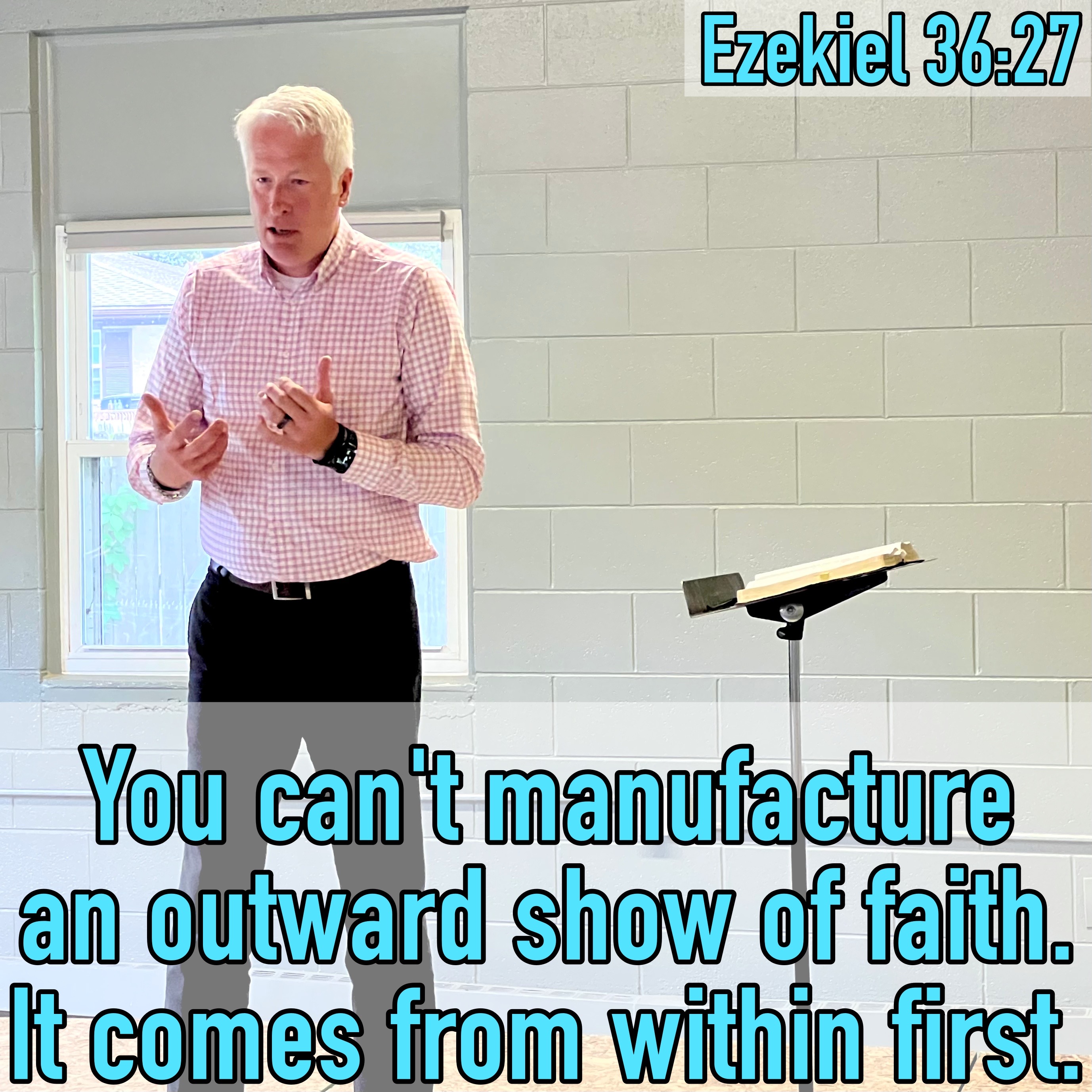
What happens on the outside often stays on the outside. Sort of like the little boy whose mom brought him to church one Sunday. The little boy was constantly standing up on his chair and disturbing everyone around him. Finally, the exasperated mother whispered, “If you don’t sit down I’m going to take you to the restroom and spank you.” The little boy immediately sat down with his arms tightly crossed. He looked at his mom and said, “Outside I may be sitting down but inside I’m standing up!” 

God looks at the heart. He told the Israelites that their inward defiance didn’t outweigh their outward religious practices. And Jesus said that people who prophesied, cast out demons, and performed miracles, but still had an unrepentant heart, would hear Him say, “I never knew you” (Isaiah 1:12-13; Matthew 7:21-23). 

In the First Testament, we see a desire for the Holy Spirit to be more than on—a desire for Him to come in. David prayed, “Create in me a pure heart, O God, and renew a steadfast spirit within me” (Psalm 51:10). And God promised His people, “I will give them an undivided heart and put a new spirit in them … And I will put My Spirit in you and move you to follow my decrees and be careful to keep My laws” (Ezekiel 11:19, 36:27). 

That is exactly what happened on that Pentecost Sunday immediately following Christ’s resurrection and ascension. The Christians were baptized in the Holy Spirit. He came in them and brought them into the Godhead (John 14:20). 

Jesus described this “in-ness” in the picturesque language of a branch joined to the vine. The branch cannot produce any fruit on its own, but it abides in the vine so that the fruit-producing power can flow into the branch (see John 15:1-5). 

Paul identified this fruit of the Spirit as “love, joy, peace, forbearance, kindness, goodness, faithfulness, gentleness and self-control,” and he concluded with the phrase, “against such things there is no law” (Galatians 5:22-23). The law always sets limits, but when the Holy Spirit abides in us, the production of fruit is limitless! 

Being baptized in the Holy Spirit means that we allow Him to come in us and then to work on us. It’s only when the Holy Spirit has worked in us that can He flow through us to others. Jesus said that we would receive the Spirit’s empowerment to be witnesses—that’s an inward change that produces an outward fruit.

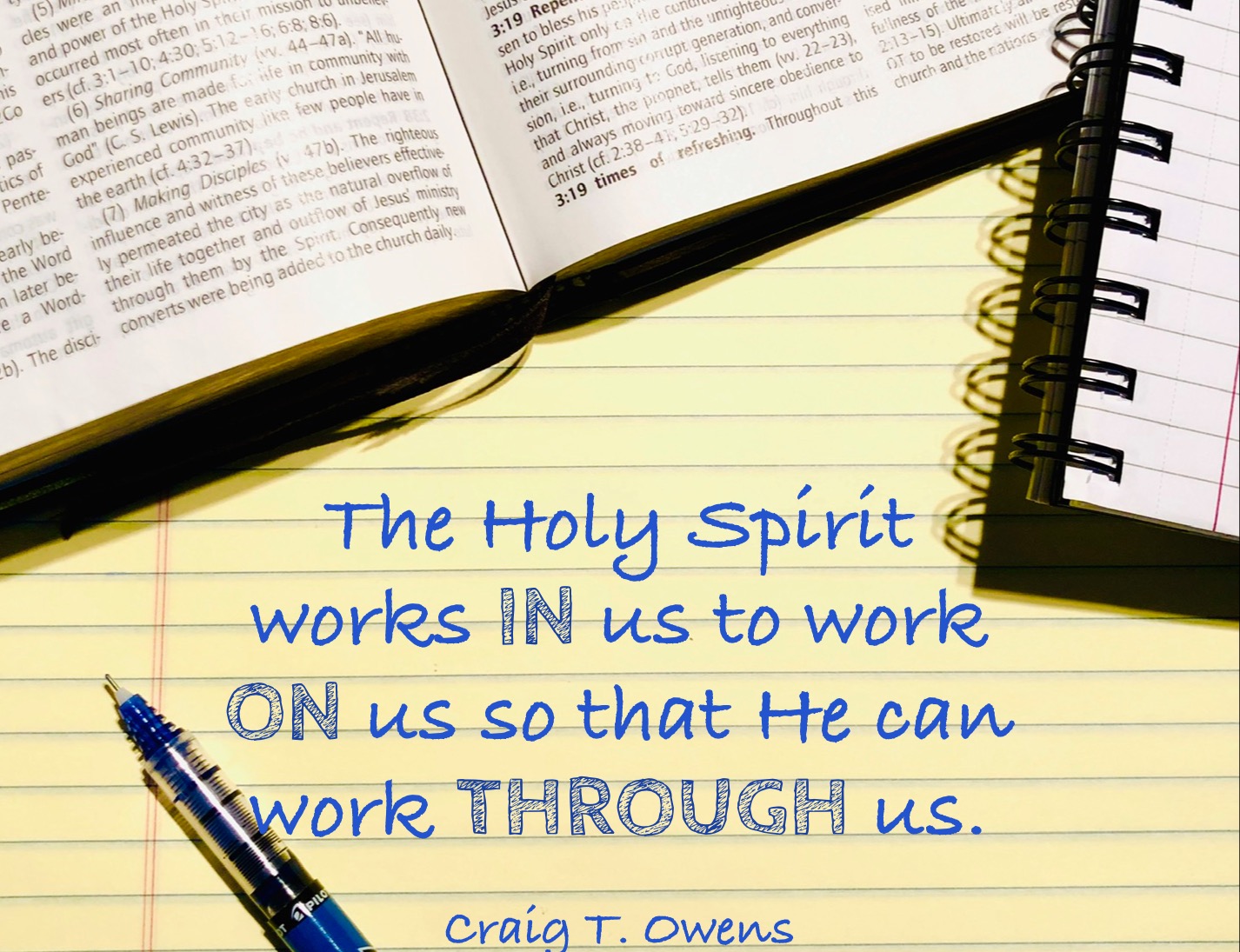
The Holy Spirit works in us to work on us so that He can work through us. So don’t stop at just salvation, but be baptized in the Holy Spirit! 

If you’ve missed any of the messages in our series on the Pentecostal experience, you can find all of those messages by clicking here. 

►► Would you please prayerfully consider supporting this ministry? My Patreon supporters get behind-the-scenes access to exclusive materials. ◀︎◀︎

Trading Truth For Popularity

Listen to the podcast of this post by clicking on the player below, and you can also subscribe on AppleSpotify, or Audible. 

I am sure everyone has heard the comical philosophical question, “Which came first: the chicken or the egg?” At Creation, the chicken clearly came first. But in other instances, sometimes the correct answer is not either-or but both-and. 

The apostle Paul warned his protege Timothy, “For the time will come when men will not put up with sound doctrine. Instead, to suit their own desires, they will gather around them a great number of teachers to say what their itching ears want to hear” (2 Timothy 4:3). In other words, the people are saying, “The truth makes us uncomfortable, so tell us something that makes us feel good. If you do, you will be rewarded by our popular support.” 

Nearly 600 years earlier, God had something to say to those popular teachers, “Woe to the foolish prophets who follow their own spirit and have seen nothing!” (Ezekiel 13:3). The New King James Version says they “prophesy out of their own heart” and the New American Standard Bible says they “prophesy from their own inspiration…following their own spirit.” In other words, they are speaking a popular message, not a truthful message. 

So which came first: the chicken of people with itching ears or the egg of false prophets with a popular message intended for itching ears? I think this is a true both-and. It’s both people looking for a feel-good message, and false prophets realizing they can be rewarded for sharing a popular feel-good message. 

Absolutely no one benefits from a prophecy from my own inspiration. True prophets of God don’t want people following their own spirit but following the Spirit of God. 

A mark of an ungodly leader is one who uses God’s name only as his platform for personal gain.

To those false prophets, God says, “Woe are you, for My judgment will fall on you.” To those with itching ears who trade popularity for truth, Paul says to Timothy, “Have nothing to do with them” (2 Timothy 3:1-5). 

This is part 72 in my series on godly leadership. You can check out all of my posts in this series by clicking here.

►► Would you please prayerfully consider supporting this ministry? My Patreon supporters get behind-the-scenes access to exclusive materials. ◀︎◀︎