“Many—would I overstate the case if I said the majority?—of those who confess their faith in Christ and enter into association with the community of believers have little joy in their hearts, no peace in their minds, and from all external appearances are no better morally than the ordinary educated citizen who takes no interest whatever in religion and, of course, makes no profession of Christianity. Why is this? I believe it is the result of an inadequate concept of Christianity and an imperfect understanding of the revolutionary character of Christian discipleship. …
“True faith brings a spiritual and moral transformation and an inward witness that cannot be mistaken. These come when we stop believing in belief and start believing in the Lord Jesus Christ indeed. …
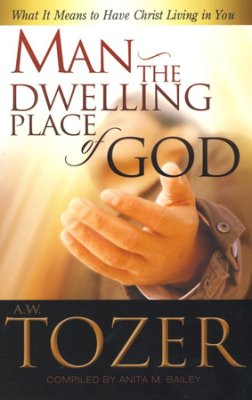
“One of the first changes will be a shift of interest from earth to heaven, from men to God, from time to eternity, from earthly gain to Christ and His eternal kingdom.” —A.W. Tozer, in Man—The Dwelling Place Of God
This is a weekly series with things I’m reading and pondering from Oswald Chambers. You can read the original seed thought here, or type “Thursdays With Oswald” in the search box to read more entries.
Ordinary Preparation For Extraordinary Service
What are the workshops that supply the munitions for God’s enterprises? The workshop of missionary munitions is the hidden, personal, worshiping life of the saint. …
We imagine we should be all right if a big crisis arose; but the crisis only reveals the stuff we are made of, it does not put anything into us. “If God gives the call, of course, I shall rise to the occasion.” You will not, unless you have risen to the occasion in the workshop. If you are not the real article before God there, doing the duty that lies nearest, instead of being revealed as fit for God when the crisis comes, you will be revealed as unfit. …
“Jesus, knowing that the Father had given all things into His hands, and that He came forth from God and goeth unto God…”—we might have expected the record to go on: “He was transfigured before them”; but we read that the next thing Our Lord did was of the most menial commonplace order—“He took a towel, and girded Himself. Then He began to wash the disciples’ feet.” Can we use a towel as Our Lord did? Towels and basins and feet and sandals, all the ordinary sordid things of our lives, reveal more quickly than anything what we are made of. It is not the big occasions that reveal us, but the little occasions.
Are you spending time every day abiding with Jesus and worshiping Him? Are you willing to do “the little things” that God gives you to do?
These are the things that will make God’s saints ready for “the big things” that come along. Don’t look for the big things, just do the ordinary things God desires of you every day, and then you will be more than ready for the extraordinary things in which God places you.
This is a weekly series with things I’m reading and pondering from Oswald Chambers. You can read the original seed thought here, or type “Thursdays With Oswald” in the search box to read more entries.
Second Mile Christianity
To go the second mile means always do your duty, and a great deal more than your duty, in a spirit of loving devotion that does not even know you have done it. … The supreme difficulty is to go the second mile with God, because no one understands why you are being such a fool. The summing up of Our Lord’s teaching is that it is impossible to carry it out unless He has done a supernatural work in us. …
The interests of the Son of God and of the disciple are to be identical. How long it takes to manifest that identity depends on the private history of the disciple and his Lord. …
We do not need the grace of God to stand crises; human nature and pride will do it. We can buck up and face the music of a crisis magnificently, but it does require the supernatural grace of God to live twenty-four hours of the day as a saint, to go through drudgery as a saint, to go through poverty as a saint, to go through an ordinary, unobtrusive, ignored existence as a saint, unnoted and unnoticeable. The “show business,” which is so incorporated into our view of Christian work today, has caused us to drift far from Our Lord’s conception of discipleship. It is instilled in us to think that we have to do exceptional things for God; we have not. We have to be exceptional in ordinary things, to be holy in mean streets, among mean people, surrounded by sordid sinners. That is not learned in five minutes.
Jesus calls His disciples to go the second mile. Others won’t understand us, and few (if any) people will applaud us for doing so.
Like a novice runner, maybe we can’t go the whole second mile the first time out. Maybe not even the second or third time. But can we go a bit further the second time than we did the first? And a bit further the third time than we did the second? That’s what discipleship is all about: Letting Jesus help us go a bit further each time.
If you stick with it, soon you will be going the second mile and not even realize it. Other may not realize it either, but God always sees when we do, and He is pleased!
Amy Carmichael was a committed follower of Jesus Christ! She served as a missionary in India, where she operated an orphanage, for 55 years. During all that time, she never took a furlough, but remained at her post, faithfully loving Indian children with God’s love. She wrote a number of books, but perhaps the most hard-hitting is a little book simply called If.
This isn’t a book for everyone. In fact, Amy herself wrote, “It is clear, I think, that such a booklet as this is not meant for everyone, but only for those who are called to be undershepherds.” By ‘undershepherds,’ Amy is referring to those who feel God has called them into full-time vocational ministry.
(A little side-note. I feel the Bible is clear that all followers of Christ are to be involved in ministry [see Ephesians 4:11-16], but God has appointed some to positions where their ministry is also their vocation. These ‘undershepherds’ [see 1 Peter 5:2-3] will have to give account to God for the handling of their vocational ministry [Hebrews 13:17]. It is to these folks that Amy writes.)
Amy set the bar high for herself. She expected to be continually growing in her level of commitment to Christ, and she expected that her outward life would continually show greater devotion to her Savior. If comes out of Amy’s personal introspection in the Holy Spirit’s presence on how she was progressing in her faith-walk with God.
If is written as a series of challenges that all follow the same format: “If I don’t measure up to God’s standard in this area … then I know nothing of Calvary love.” I realize this sounds challenging. In fact, this book smacked me right between the eyes! This is why If is only for a small segment of people.
This is a weekly series with things I’m reading and pondering from Oswald Chambers. You can read the original seed thought here, or type “Thursdays With Oswald” in the search box to read more entries.
What’s Holding You Back?
[In these quotes, Oswald Chambers is commenting on a story recorded in Mark 10:17-22.]
“One thing you lack.” Do I really want to be perfect? Do I really desire at all costs to every other interest that God should make me perfect? Can I say with Robert Murray McCheyne—“Lord, make me as holy as You can make a saved sinner”? Is that really the desire of my heart? …
“Go, sell everything you have and give to the poor…. Then come follow Me.” These words mean a voluntary abandoning of riches and a deliberate, devoted attachment to Jesus Christ. We are so desperately wise in our own conceit that we continually make out that Jesus did not mean what He said, and we spiritualize His meaning into thin air. Jesus saw that this man depended on his riches. If He came to you or me He might not say that, but He would say something that dealt with whatever He saw we were depending on. …
Never push an experience you have had into a principle by which to guide others. If you take what Jesus said to this man and make it mean that He taught we were to own nothing, you are evading what He taught, by making it external. Our Lord told the rich young ruler to loosen himself from his property because that was the thing that was holding him. …
One of the most subtle errors is that God wants our possessions. He does not; they are not of any use to Him. He does not want my property, He wants myself.
From So Send I You
God wants you. All of you. He wants you without any strings attached to anything else.
“Is that really the desire of my heart?”
Listen closely to His voice. What is He asking you to loosen your hold on, so that you can hold on exclusively to Him? Don’t let temporary things hold you back from being perfectly His forever!
God’s plan has always been for His leaders to organize and oversee His ministry.
The important thing for us to distinguish is “His.” It’s not a man or woman saying, “I will be a leader,” or even a God-appointed leader saying, “I am going to build up my ministry.”
The New Testament gives us a fourfold purpose for the Body of Christ:
Mobilizing for evangelism
Organizing for more meaningful ministry
Making disciple-makers
Caring for one another
We see God’s leaders involved in all of these aspects—
Mobilizing for evangelism—Peter pointed out the need for an apostle to be appointed to replace Judas, thus returning their ranks to the 12 apostles just as Jesus had originally said (Acts 1:15-22).
Organizing for more meaningful ministry—Everywhere Paul founded a church, he also appointed leaders to oversee and shepherd that church.
Making disciple-makers—Paul tells us that God appointed five offices of leaders in the church who had the specific task of preparing church members to do the ministry of building maturity in the church (Ephesians 4:11-16).
Caring for one another—The First Church set the pace for providing care for all who were in need, including organizing leaders to oversee specific care ministries (Acts 6:1-5).
What about a church congregation’s responsibility to their leaders? I see five areas:
Hold them accountable to the Word (Acts 17:11). The Bible has to be THE standard to which leaders are held.
Give them your confidence and submission after they have shown accountability to their biblical mandate (Hebrews 13:17).
This is a weekly series with things I’m reading and pondering from Oswald Chambers. You can read the original seed thought here, or type “Thursdays With Oswald” in the search box to read more entries.
The One God Uses
Missionary enterprise, to be Christian, must be based on the passion of obedience, not on the pathos of pity. … In the New Testament the emphasis is not on the needs of men, but on the command of Christ, “Go ye.” …
Any sense that the cause of Christ will be benefited if I give myself to it, or any trace of listening to the suggestion of others that I should be of value in my Lord’s service, receives no encouragement from Jesus. …
What is the test we put first for work at home or abroad? Sentimentally, we put the call of God first, but actually we are inclined to fix on the abilities of certain people. Our Lord pays not the remotest attention to natural abilities or natural virtues; He heeds only one thing—Does that man discern Who I am? does he know the meaning of My Cross? The men and women Jesus Christ is going to use in His enterprises are those in whom He has done everything. …
The one who says “Yes, Lord, but…” is always the one who is fiercely ready, but never goes. …
Beware of the inclination to dictate to God as to what you will allow to happen if you obey Him.
From So Send I You
God uses specific people for His service. They are ones who are:
Obedient to His call to “Go”
Humble
Changed from the inside out by Christ’s Atonement
Quick to follow
Not dictating to God the “where” or “when” or even the outcome of their obedience
“Evangelical Christians commonly offered Christ to mankind as a nostrum to cure their ills, a way out of their troubles, a quick and easy means to the achievement of personal ends. They use the right words, but their emphasis is awry. The message is so presented as to leave the hearer with the impression that he is being asked to give up much to gain more. And that is not good, however well intentioned it may be.
“What we do is precisely what a good salesman does when he presents the excellence of his product as compared with that of his closest competitor. The customer chooses the better of the two, as who would not? But the weakness of the whole salesmanship technique is apparent: the idea of selfish gain is presented in the whole transaction. …
“In those early Galilean days Christ’s followers heard His call, forsook the old life, attached themselves to Him, began to obey His teachings and joined themselves to His band of disciples. This total commitment was their confirmation of faith. Nothing less will do. And it is not different today. He calls us to leave the old life and to begin the new. There must never be any vacuum, never any place of neutrality where the world cannot identify us.” —A.W. Tozer, Man—The Dwelling Place Of God
Listen to the podcast of this post by clicking on the player below, and you can also subscribe on Apple, Spotify, or Audible.
Before ascending back to Heaven, Jesus commissioned His followers. He gave them a mission that Christians often refer to as The Great Commission.
Jesus said, “All authority in heaven and on earth has been given to Me. Therefore go and make disciples of all nations, baptizing them in the name of the Father and of the Son and of the Holy Spirit, and teaching them to obey everything I have commanded you. And surely I am with you always to the very end of the age.”
There are several pictures in the New Testament of how the Church could live out this Great Commission, but one of the pictures that I find the most helpful is that of a Body.
The human body is an amazing creation! Just to accomplish the simple task of picking up something between our thumb and forefinger is a miracle in itself. The structure of bones and ligaments and tendons, the interaction of nerves in the fingers coordinating with the optical nerve, not to mention the enzymes and blood vessels that are all doing their part.
Yet if any part is not functioning properly, that simple action becomes more difficult. Maybe it even becomes impossible.
The Church is the same way. Every part of the Church Body has to be functioning in healthy order for the whole Body to be effective.
Here are four aspects of a healthy Church Body that the Apostle Paul lists in Ephesians 4:
Caring for one another
Mobilizing for evangelism
Making disciple-makers
Helping organize for more meaningful ministry
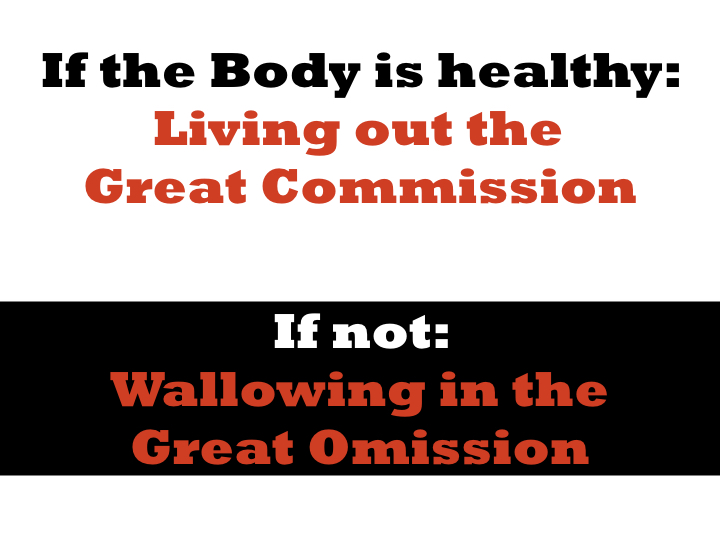
If every part of the Body is doing its part, we’re Living out the Great Commission.
If some parts are missing or unhealthy, we’re Wallowing in the Great Omission.
It’s not about your church (small “c”) or my church. It’s about all Christian disciples being a part of one Church—one Body—going into all the world and making disciples of all peoples. That’s what the Church is supposed to be doing!
This is a weekly series with things I’m reading and pondering from Oswald Chambers. You can read the original seed thought here, or type “Thursdays With Oswald” in the search box to read more entries.
Where Are Your Feet?
“Where did Jesus placed His feet? He placed them by the sick and the sorrowful, by the dead, by the bad, by the twisted and by the good. He placed His feet exactly where we have to place ours…, in the ordinary rough and tumble of human life as it is. ‘I will make the place of My feet glorious [Isaiah 60:13].’”
From Run Today’s Race
Run Today’s Race contains short statements from Oswald Chambers intended to stimulate Christians to ponder things like:
All of Isaiah 60 is about God’s glory being revealed on earth through Jesus Christ. Am I letting Christ’s glory shine through my life?
Do I only look for “super-spiritual” moments, or am I aware that God can make wherever I place my feet a glorious place?



 “Many—would I overstate the case if I said the majority?—of those who confess their faith in Christ and enter into association with the community of believers have little joy in their hearts, no peace in their minds, and from all external appearances are no better morally than the ordinary educated citizen who takes no interest whatever in religion and, of course, makes no profession of Christianity. Why is this? I believe it is the result of an inadequate concept of Christianity and an imperfect understanding of the revolutionary character of Christian discipleship. …





 Craig T. Owens