12 Quotes From “Notes On Isaiah”

Oswald Chambers always has more insights than I can possibly share with others: he is a true treasure-trove of biblical illumination! Check out my review of his Notes On Isaiah by clicking here. Below are a few shorter quotes from this book. If you would like to read some longer passages, check out my weekly series called Thursdays With Oswald. 

“What we are apt to call interruptions are God’s way of introducing us to a new knowledge of Himself.” 

“The supernatural power of satan never reasons, it appeals to man’s superstition, not to his conscience.”

“I have no right to have anything less than the hope and the belief of Jesus Christ with regard to the worst and most hopeless of men.” 

“We have to keep the call of God alive, and continually recall to our minds what we are here for. … There is no danger of spiritual retrogression if we will keep in mind the times, one or more, when the Spirit of God has touched us.” 

“God’s dates are not man’s. God seems to pay no attention to our calendars; He has a calendar of His own in which He suddenly surprises a man in the midst of his days. Leave room for God. We expect God only on special days, in particular meetings; that is not God’s way. He comes suddenly, at midnight or at noonday.” 

“We are to be in the world while not of it, and to denounce by lip and life the things that are wrong.” 

“The mark of the beast is already here, and it will grow clearer before the man of sin is revealed (see 2 Thessalonians). It is slighting no one to say that prosperity in this order of things along with godliness is impossible, and growingly more impossible.” 

“Undisciplined imagination is the greatest disturber not only of growth in grace, but of spiritual sanity [Isaiah 26:3].” 

“Conscience does not shout in thunderclaps, you can easily drown its record, but it goes on, and if you do not heed it for a while because of sensational sinning, as soon as the sensation exhausts itself, back comes the monotonous tick, tick, that nearly drives a man mad. God will never make us listen to Him; we have to will to listen.” 

“Belief in God will always manifest itself in right principles, but if you put principles first you will end in disbelief in God.” 

“The only place of confidence is personal trust in God and patient waiting for Him. … To trust in the goodness of God is not enough, it is not eternal and abiding; we have to trust God Who is infinitely more than goodness.” 

“If in the face of all the appeals of common sense you remain true to God, that is the ‘proof of your faith’ which will be found to the glory of God.” 

A Leader’s Integrity

…for I have not concealed the words of the Holy One (Job 6:10).

Job is making a case for his integrity. One of the evidences he produces is this: He responds to God’s voice. He doesn’t ignore Him, or pretend he didn’t hear Him, or offer justifications for why he’s not obeying God. “I have not concealed anything God has said to me!”

Not only that, but he invites God to continue to speak to him—

Teach me, and I will hold my tongue; cause me to understand wherein I have erred. How forceful are right words! (v. 24)

What is man, that You should exalt him, that You should set your heart on him, that You should visit him every morning, and test him every moment? (7:17-18)

It’s amazing to think that God cares enough about me that He would speak to me, test me, and correct me if I err or go astray!

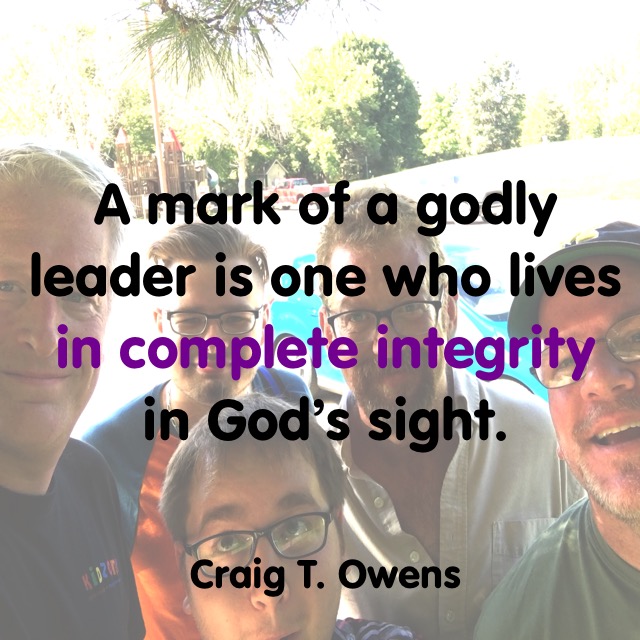
A mark of a godly leader is one who lives in complete integrity in God’s sight.

Or as John Maxwell says, “Being God’s kind of leader means refusing even the smallest compromise in what you believe.”

My desire is this … May I, like Job, be able to say that I have not concealed nor ignored any of Your words, O God, but that I respond quickly and obediently to all Your loving words to me.

This is Part 15 in my series on godly leadership. You can check out all of my posts on this topic by clicking here.

Tozer: We Must Face Up To This

“Our Lord told of two men who appeared before God in prayer, a Pharisee who recited his virtues and a publican who beat on his breast and pleaded for mercy. The first was rejected, the other justified [see Luke 18:9-14].

“We manage to live with that story in some degree of comfort only by keeping it at full arm’s length and never permitting it to catch a hold of our conscience. These two men are long ago dead and their story has become a little religious classic. We are different, and how can anything so remote apply to us? So we reason, on a level only slightly above our unconscious, and draw what comfort we can from the vagueness and remoteness of it all.

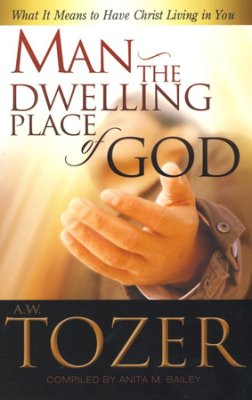
“But why should we not face up to it? The truth is that this happens not a long while ago, but yesterday, this morning; not far away, but here where some of us last knelt to pray. These two men are not dead, but alive, and are found in the local church, at the missionary convention and the deeper life conference here, now, today.” —A.W. Tozer, from Man—The Dwelling Place Of God

Thursdays With Oswald—How God Prepares Us For His Service

Oswald ChambersThis is a weekly series with things I’m reading and pondering from Oswald Chambers. You can read the original seed thought here, or type “Thursdays With Oswald” in the search box to read more entries.

How God Prepares Us For His Service 

     Preparation is not something suddenly accomplished, but a process steadily maintained. It is easy to imagine that we get to a settled state of experience where we are complete and ready; but in work for God it is always preparation and preparation. … 

     In writing to the Philippians Paul mentions two “perfections”: “not as though I…were already perfect” (3:12); “Let us therefore, as many be perfect…” (3:15). The first refers to the perfection of attainment; the second to the perfection of adjustment to God. … When we are sanctified, we are perfectly adjusted to God, but we have done nothing yet, we are simply perfectly fit to begin. … Think of Christ’s eyes fastening on us and pointing us out before God as He says—“Father, that is My work; that is the meaning of Gethsemane, that is the meaning of Calvary. I did all that man’s work in him, all that woman’s work in her; now You can use them.” … 

     When we are first put right with God, it is the great general principles that are at work, then God begins to make the conscience sensitive here and there. Don’t quench the Spirit. His checks are so tiny that common sense cannot detect them. … When He checks, never debate, but obey at once. … He does not come with a voice like thunder, with strong emphatic utterance—that may come ultimately; but at the beginning His voice is as gentle as a zephyr. At the same time it carries an imperative compulsion—we know the voice must be obeyed. The “go” of preparation is to let the Word of God scrutinize.

From So Send I You

When we invited Jesus into our lives to be our Lord and Savior, we are perfectly ready to be used in service for God.

Now begins the saint-ifying process. The Holy Spirit will gently, but insistently, point out what we need to address. The more sensitive we are to those “checks,” and the quicker we are to obey the Spirit’s prompting, the better prepared we are to answer God’s call to “go.”

Are you letting the Voice of God scrutinize you, so that you can be prepared to be used in service for Him?

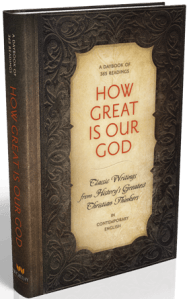
13 More Quotes From “How Great Is Our God”

Scholars, tradesmen, politicians, theologians, pastors, and martyrs—all have spoken or written about the greatness of God over the past two millennia. In How Great Is Our God we are treated to a sampling of these writings. Check out my full book review by clicking here, and then enjoy this second set of quotes.

“Some of us, no doubt, have to live outwardly solitary lives. We all live alone after fellowship and communion. We die alone, and in the depths of our souls we all live alone. So let us be thankful that the Master knows the bitterness of solitude, and has Himself walked that path. Jesus Christ’s union with the Father was deep, close, constant; altogether transcending any experience of ours. But still He sets before us the path of comfort for every lonely heart: ‘I am not alone, for the Father is with Me.’ If earth be dark, let us look to Heaven. If the world holds no friend, let us turn to Him who never leaves us. If dear ones are torn from our grasp, let us grasp God.” —Alexander Maclaren

“The blessedness of individuals must not be determined by the value of their known wealth, but according to the voice of their conscience within them.” —Ambrose

“If God gave you not only earth but heaven, that you should rule over sun, moon, and stars, and have the rule over the highest of the sons of men, it would not be enough to satisfy you, unless you had God Himself.” —Jeremiah Burroughs

“Father in Heaven! What is a man without You! What is all that he knows, vast accumulation though it may be, but a chipped fragment if he does not know You!” —Soren Kierkegaard

“Great are You, O Lord, and greatly to be praised; great is Your power, and Your wisdom is infinite. You awaken us to delight in Your praise; for You made us for Yourself, and our heart is restless, until it rests in You. They that seek the Lord shall praise Him: for they that seek shall find Him, and they that find shall praise Him. I will seek You, Lord, by calling on You; and will call on You, believing in You; for to us You have been preached.” —Augustine

“In the Old Testament, there are twenty times as many references to the second coming of Christ, as to His first coming. … The Cross must ever precede the Crown. He came with the Cross, fulfilling Isaiah 53; and now He is coming with the Crown, the Messiah and King.” —Aimee Semple McPherson

“The Word is the one Shepherd of things rational which may have an appearance of discord to those who have not ears to hear, but are truly at perfect concord. … For all the Scripture is the one perfect and harmonized instrument of God, which from different sounds gives forth one saving voice to those willing to learn, which stops and restrains every working of an evil spirit.” —Origen

“So desperate is the need that we have no time to engage in vain babblings. While we are discussing the exact location of the church of Galatia, men are perishing under the curse of the law; while we are setting the date of Jesus’ birth, the world is doing without its Christmas message.” —J. Gresham Machen

“If the Christian plan is true, then all others are false. If others are true, then there was no need of the sacrifice on the Cross.” —Albert Barnes

“I want through the day to walk with God; God has taken charge of me, He is going with me Himself; I am going to do His will all day in His strength; I am ready for all that may come.” —Andrew Murray

“When the time for the Advent of the Antichrist approaches, people’s minds will grow cloudy from carnal passions, and dishonor and lawlessness will grow stronger. Then the world will become unrecognizable. People’s appearances will change, and it will be impossible to distinguish men from women due to their shamelessness in dress and style of hair. 

There will be no respect for parents and elders, love will disappear, and Christian pastors, bishops, and priests will become vain men. At that time the morals and traditions of Christians and the Church will change. People will abandon modesty, and dissipation will reign. Falsehood and greed will attain great proportions; and lust, adultery, homosexuality, secret deeds, and murder will rule in society. 

At that future time, the churches of God will be deprived of God-fearing and pious pastors, and woe to the Christians remaining at that time; they will completely lose their faith because they will lack the opportunity of seeing the light of knowledge from anyone at all.” —Nilus the Elder (d. 430 AD) 

“It is the Bible itself that drives us out beyond ourselves and invites us, without regard to our worthiness or unworthiness, to reach for the last highest answer. … We need only dare to follow this drive, this spirit, this river, to grow out beyond ourselves toward the highest answer. This daring is faith; and we read the Bible rightly when we read it in faith. The Bible unfolds to us as we are met, guided, drawn on, and made to grow by the grace of God.” —Karl Barth

“Who is regulating affairs on this earth today—God or the devil? That God reigns supreme in Heaven, is generally conceded; that He does so over this world, is almost universally denied—if not directly, then indirectly. More and more are men relegating God to the background. … Therefore we need not be surprised that men exclude Him from the realm of human affairs. … In light of this [Isaiah 55:8-9], it is only to be expected that much of the Bible conflicts with the sentiments of the carnal mind, which is at enmity against God.” —Arthur Pink

You can check out the first set of quotes I shared from How Great Is Our God by clicking here. Stay tuned: more quotes coming soon!

Is Sin For Me Sin For You?

In our recent Q Series, I was asked a great question: If God has told me that something is a sin for me, does that mean that it is a sin for everyone?

Using a personal example from my life, and using two biblical examples (in Samson and John the Baptizer) I shine some light on this question …

You might also be interested to check out some other Q&As regarding the Bible, end-times prophecy, parables, and prayer.

Love Beyond Imagining!

God has always been revealing Himself. Sometimes it’s in His Creation, or the conscience He placed inside every human, or the prophets who remind us of God’s ways. But ultimately God revealed His fullness in the Person of Jesus.

Nancy Guthrie wrote

“God has always wanted His people to know Him—not in a generic or shallow way, but personally, as He truly is. So He revealed Himself in a progressive way, not only through His name, but also through His glorious presence that dwelt in the Temple, through the Law, and through His mighty deeds on behalf of His people. But these revelations all led up to a definitive revelation in the Person of Jesus.

One of the ways the love of Jesus was revealed to us is in the story of Ruth and Boaz. This is one of my favorite Bible stories. It’s a short story, so please check it out when you have 10 minutes to read it.

Here’s the part of the story I want to share today. Ruth is…

  • a foreigner in Israel (she has no citizenship)
  • a widowed woman (she has no legal standing)
  • without money and no way to earn money, which means she is merely in survival mode
  • so far in debt that creditors are about to foreclose on the one remaining asset she and her mother-in-law have.

Ruth meets a man named Boaz, who is…

  • a rich land owner;
  • a “man of standing,” which can mean hero
  • well respected by the city leaders
  • a popular and successful employer
  • God-fearing and above-and-beyond obedient to God’s laws

Ruth, in an unexpected twist, asks Boaz to marry her!

Boaz has nothing to gain and everything to lose by agreeing to this marriage proposal, but he does it anyway!

In the language of the day, Ruth asks Boaz to “cover me with the corner of your robe.” This becomes the picture that Jesus will ultimately fulfill.

Not only does the corner of Christ’s robe heal people physically (Matthew 9:20-22; 14:34-36), but it also signifies His willingness to take in marriage anyone who is as utterly helpless as Ruth was.

Ruth had nothing but debts; we have nothing but debts. Ruth was barely surviving unless help came; we are headed for death without Jesus.

Boaz took Ruth as she was and gave her citizenship, legal standing, and riches. He covered her shame and allowed her to stand boldly in the city square.

Jesus takes us as we are and gives us citizenship in Heaven, a legal standing before Almighty God, all of His riches, and then…

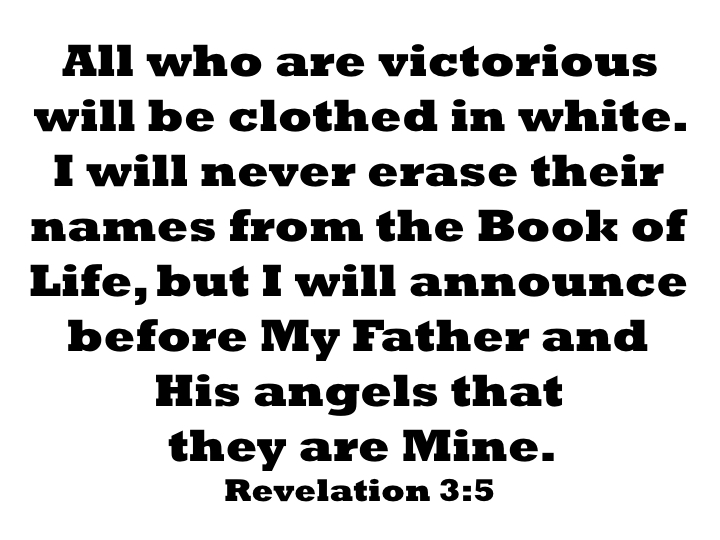
All who are victorious will be clothed in white. I will never erase their names from the Book of Life, but I will announce before My Father and His angels that THEY ARE MINE! (Revelation 3:5)

Oh, how Jesus loves us!!

Thursdays With Oswald—Making Saints

Oswald ChambersThis is a weekly series with things I’m reading and pondering from Oswald Chambers. You can read the original seed thought here, or type “Thursdays With Oswald” in the search box to read more entries.

Making Saints 

     It is not sufficient for a Christian to walk in the light of his conscience; he must walk in a sterner light, in the Light of the Lord. … 

     I am not judged by the light I have, but by the light I have refused to accept. … This is the condemnation, that the Light, Jesus Christ, has come into the world, and I preferred darkness, i.e., my own point of view. The characteristic of a man who begins to walk in the light is that he drags himself into the light all the time. He does not make excuses for things done in the dark, he brings everything to the light, and says, “This is to be condemned; this does not belong to Jesus Christ,” and so keeps in the light. … 

     The New Testament view of a saint is a more rugged type. You and I are a mixture of dust and Deity, and God takes that sordid human stuff and turns it into a saint by Regeneration. A saint does not mean a man who has not enough sin to be bad, but a man who has received from Jesus Christ a new heredity that turns him into another man. … 

     Conscience and character in the saint, then, means the disposition of Jesus Christ persistently manifested.

From The Shadow Of An Agony 

In order to become the saints God intends for us to be, Oswald Chambers says one big thing is required of Christians: Constantly bringing our thoughts and actions into the Light of Jesus.

I think this is what Paul means when he tells us to take captive every thought to make it obedient to Christ (2 Corinthians 10:5). And this is certainly what David invited when he prayed, Search me, O God, and know my heart; test me and know my anxious thoughts. See if there is any offensive way in me, and lead me in the way everlasting (Psalm 139:23-24).

I pray we will always be bringing our thoughts and actions into the Light, and never preferring the darkness of our own point of view!

7 Quotes From “The Philosophy Of Sin”

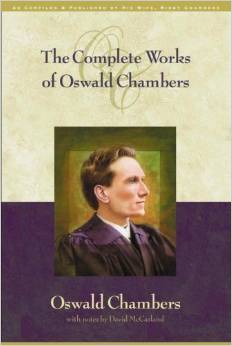
The Complete Works Of Oswald ChambersOswald Chambers always makes me think deeply, but The Philosophy Of Sin was a graduate-level, deep-thinking book on theology and philosophy for me! Check out my review of this book by clicking here. Below are some quotes I especially enjoyed.

“To people who are satisfied on too shallow a level the Bible is a book of impertinences, but whenever human nature is driven to the end of things, the Bible becomes the only Book and God the only Being in the world.”

“The life of nature is neither moral nor immoral; our bodies are neither moral nor immoral, we make them moral or immoral. Our Lord had a body, and we read that He hungered; it was not a sin for Him to be hungry, but it would have been a sin for Him to have eaten during the forty days in the wilderness, because His Father’s word at that time was that He should not eat. It is not a sin to have a body, to have natural appetites, it is a sin to refuse to sacrifice them at the word of God.”

“Lust simply means, ‘I must have this at once’; it may be a bodily appetite or a spiritual possession. The principal lust works on is, ‘I must have it at once, I cannot wait for God’s time, God is too indifferent,’ that is the way lust works.”

“If all Jesus Christ can do is to run a parallel counteraction with what satan can do, His right name is ‘Culture,’ not ‘Savior’; but His revealed nature was stated by the angel to Mary, and repeated over and over again, ‘Thou shalt call His name Jesus; for He shall save His people from their sins.’ The slight views of salvation, the sympathetic drifty views that all Jesus Christ can do is to put in us a principle that counteracts another principle, will cause anyone who is got to the last limit to blaspheme God for a thing like that. It all comes from a flimsy, wrong view of sin. If that is all He can do, what is the good of calling Him Savior? … It is sin that He came to cope with; He did not come to cope with the poor little mistakes of men, they cope with their own mistakes; He came to give them a totally new stock of heredity, that is, He came to implant into them His own nature, so that satan’s power in the soul is absolutely destroyed, not counteracted.”

“This aspect of the death of Jesus takes us into a spiritual domain beyond the threshold of the thinking of the majority of us. The cry of the Cross, ‘My God, My God, why hast Thou forsaken Me?’ is unfathomable to us. The only ones—and I want to say this very deliberately—the only ones who come near the threshold of understanding the cry of Jesus are not the martyrs, they knew that God had not forsaken them, His presence was so wonderful; not the lonely missionaries who are killed or forsaken, they experience exultant joy, for God is with them when men forsake them: the only ones who come near the threshold of understanding the experience of God-forsakenness are men like Cain—‘My punishment is greater than I can bear’; men like Esau, ‘…an exceedingly bitter cry’; men like Judas. Jesus Christ knew and tasted to a fuller depth than any man could ever taste what it is to be separated from God by sin.”

“How Jesus Christ does cleanse our conscience! It is freedom not only from sin and the damage sin has done, but emancipation from the impairing left by sin, from all the distortions left in mind and imagination.”

“The conscience formed in us by the Holy Spirit makes us amazingly sensitive to the things that tell against the honor of God.”

I’ll be sharing other quotes from this book in the near future, and I also share an extensive passage from the current Chambers’ book I am reading every Thursday. If you want to be notified when those quotes are posted, please enter your email address in the box to the right and click “Sign me up!”

I share quotes from Oswald Chambers and other inspirational authors daily on both Tumblr and Twitter.

The Philosophy Of Sin (book review)

The Complete Works Of Oswald ChambersIt’s not often that philosophy and theology appear in the same sentence, let alone in the same book! But a special mind like Oswald Chambers is one who can masterfully pull that off, and he does so in his book The Philosophy Of Sin.

Chambers describes sin and salvation from sin like this: “Sin is the radical twist with a supernatural originator, and salvation is a radical readjustment with a supernatural Originator.” Philosophy is the science of getting to the root of the matter, applying all the wisdom we can muster. As you might image, in this book Chambers digs deeper than most theologians do, and thinks wider than most philosophers do.

Chambers takes a graduate-level look at topics like sin, redemption, salvation, judgment, backsliding, temptation, conscience, and humanity. This book is a real paradigm-expander and shouldn’t be read by anyone who is looking for some “light” reading. You will need to have your Bible open as you read this book, because Chambers will shine a light on biblical passages probably unlike anyone else has. But, wow!, what a payoff you will have from working through this weighty book!

If you are a seasoned Christian who is ready for a mental challenge, The Philosophy Of Sin is for you.