‘The Depth Of My Love For You’

Listen to the podcast of this post by clicking on the player below, and you can also subscribe on AppleSpotify, or Audible. 

The apostle Paul’s letters to the church in Corinth show two things: a lot of correction and a lot of love. In fact, it’s in the middle of some correction and redirection about the misuse of spiritual gifts that Paul gives us the quintessential definition of love in 1 Corinthians 13. 

Paul also wrote, “For I wrote you out of great distress and anguish of heart and with many tears, not to grieve you but to let you know the depth of my love for you” (2 Corinthians 2:4). 

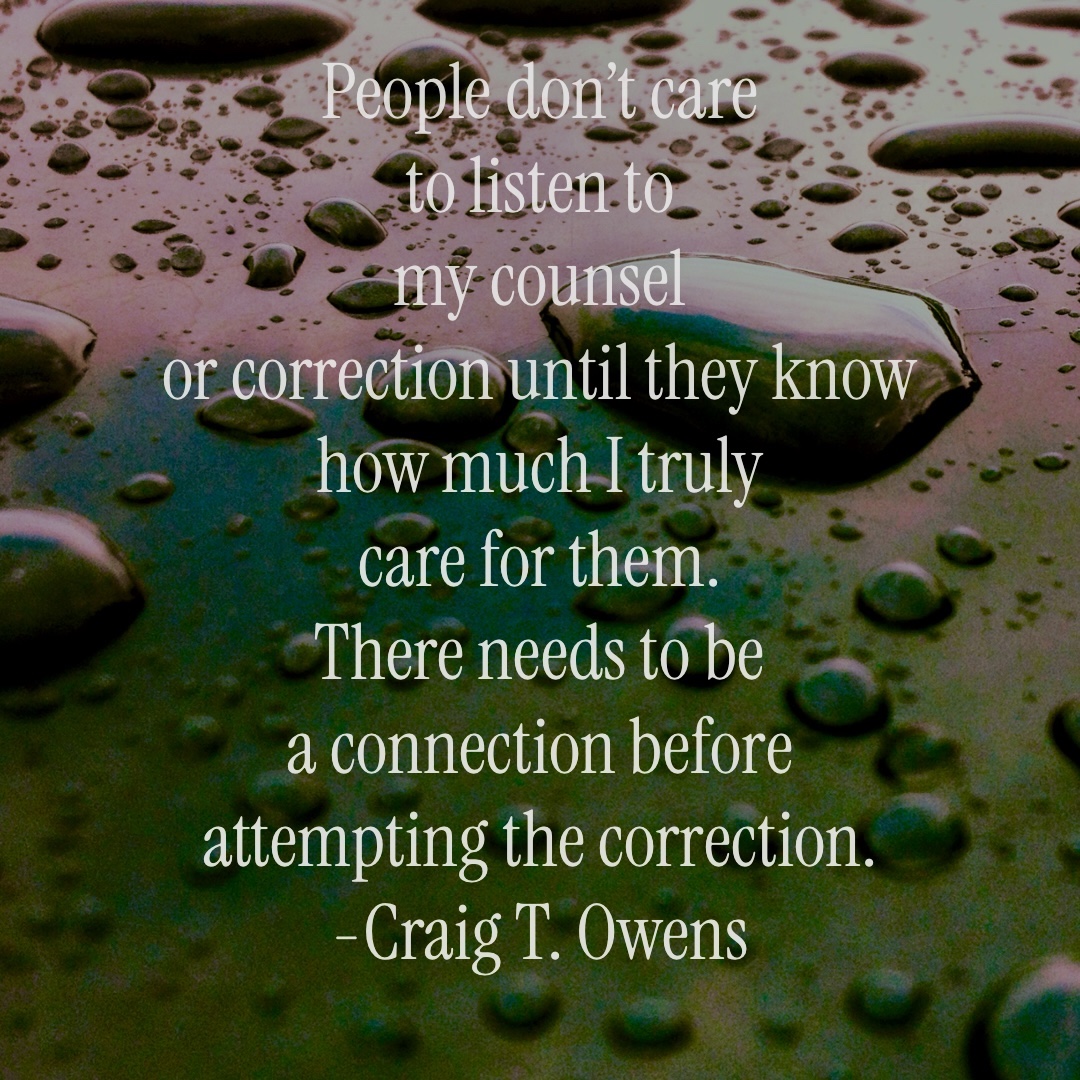
The truth does need to be spoken to wayward sheep, but it has to be birthed in love and spoken in love or else it will alienate more than help. People don’t care to listen to my counsel or correction until they know how much I truly care for them. 

There needs to be a connection before attempting the correction. 

I have an entire chapter in my book When Sheep Bite on this topic. Here’s an excerpt—

     It is possible that our grace-filled response to our biting sheep may make the difference to their eternal home. The apostle Paul told Timothy that those sheep who were out of line were trapped by the devil, and unless Timothy did something those sheep may never break free—

     And the Lord’s servant must not be quarrelsome but must be kind to everyone, able to teach, not resentful. Opponents must be gently instructed, in the hope that God will grant them repentance leading them to a knowledge of the truth, and that they will come to their senses and escape from the trap of the devil, who has taken them captive to do his will. (2 Timothy 2:24-26) 

     For some reason many shepherd leaders have made “confrontation” a dirty word, or have sullied its usefulness by confronting in an ungodly way. One thing that will help us handle confrontation the right way is to remember why we confront: The goal of confrontation is restoration, not destruction! 

     There is a cliché that says, “Once bitten, twice shy.” As I mentioned earlier, after we’ve been bitten we need to allow the Holy Spirit to search our hearts to point out anything in us that may have contributed to such a painful outburst from that sheep. Perhaps after doing all of that you attempted to confront a sheep and it didn’t go so well. As a result, you are now a bit shy to confront another wayward sheep. Dick Brogden wrote:

     “Experience so easily leads us to cynicism. Information too easily leads to pain. Leadership often makes us jaded because we’ve seen so much junk, all the effects of broken people breaking people. … A strong heart determines that it will stay soft, that it will absorb hurt, disappointment, and reality, and yet believe that God can redeem people and circumstances.” 

     Handled correctly, confrontation can lead to restoration, a deeper intimacy, and newfound maturity. Handled incorrectly, and, well, let’s just say it can get very ugly!

     I imagine we have all heard stories of the fallout from confrontation in another pasture, or perhaps we know the painful consequences in our own pastures. But let’s try for a moment to put those past experiences or secondhand stories out of our minds and take a fresh look at how to handle confrontation. 

     Samuel was going to be sent by God to confront King Saul about the sin he had committed. Look at this passage: “Then the word of the Lord came to Samuel: ‘I am grieved that I have made Saul king, because he has turned away from Me and has not carried out My instructions.’ Samuel was troubled, and he cried out to the Lord all that night” (1 Samuel 15:10-11). 

     Did you catch how Samuel responded? He cried out to the Lord all that night. 

     Perhaps if we, as godly under-shepherds, cried before we confronted the results might be more healthy. Billy Graham noted, “Tears shed for self are tears of weakness, but tears shed for others are a sign of strength.” (from Chapter 5 ‘Cry Before You Confront’) 

If you have some difficult but necessary words to speak to someone, take time to cry before you confront. Ask the Holy Spirit to reveal to you the most loving way to handle this situation. Cry before you confront, and may your tears soften your heart to speak truthful words saturated in your love for God and your love for this wayward saint. 

Please pick up a copy of When Sheep Bite to learn more biblical strategies for handling biting sheep and for healing from biting sheep. If I can be of help to you, please get in touch with me.

P.S. You may also be interested in a whole series about growing and showing our love called Loving the Unlovable.

►► Would you please prayerfully consider supporting this ministry? My Patreon supporters get behind-the-scenes access to exclusive materials. ◀︎◀︎

Good Grief From A Friend

Listen to the podcast of this post by clicking on the player below, and you can also subscribe on AppleSpotify, or Audible. 

After God created Adam, He said, “It’s not good for you to be alone.” That’s just as true today: God didn’t intend for us to journey on our own, but He gives us companions along the way. 

Last week we saw that God has to sometimes cause us grief to get our attention when we are straying from His path. He sometimes puts people in our lives to do the same thing. 

There’s a reason God puts the people in our lives that He does. We are called to speak the truth in love (Ephesians 4:15). But that sometimes means people will get upset with us (Galatians 4:16). “Real friends hurt each other. … Truth is the primary way faithful friends should wound each other—it is the help that hurts.” —Dick Brogden 

(Check out all of the verses in this post by clicking here.) 

The Corinthians thought they were super-spiritual, but Paul had to call them out on their foolishness (1 Corinthians 3:3; 5:1-2). Before Pauls’ letter, the Corinthians seemed happy. His letter caused them grief, but it was good grief that led to repentance and true joy (2 Corinthians 7:8-10). 

To keep silent when a brother or sister is straying is not God-honoring. We are not to be the sin police, but we are to address sinful issues (James 5:19-20). 

As King David flirted with the idea of how he could get something that he thought would make him happy, an anonymous attendant tried to get his attention. David ignored this and then tried to sweep it under the rug. In fact, he thought he got away with his sin (2 Samuel 11:1–12:7). 

But God sent Nathan to speak a hard word to David. We don’t know when Psalm 141 was written, but we know that David did write it. Perhaps it was penned at the time of Nathan’s loving confrontation. He said, “Let a righteous man strike me—that is a kindness; let him rebuke me—that is oil on my head” (Psalm 141:5). 

We do know that David wrote Psalm 51 after Nathan’s loving hard word, and in this prayer we see David’s confession, repentance, and a request for God’s joy to replace David’s grief. 

So how do New Testament-era Christians use good grief to help fellow saints? 

  1. Examine yourself first (Matthew 7:1-5). Make sure you aren’t plagued by the same sin you have noticed in a brother or sister. 
  2. Cry before you confront, just as the prophet Samuel did before he had to deliver a hard word to King Saul (1 Samuel 15:10-11). 
  3. Confront in love with the goal of restoration, but make sure you are confronting someone who know you love them and who will receive your loving word  (Proverbs 27:5; 9:8). 
  4. Pray that their grief will be turned to joy (Luke 22:31-32; Galatians 6:1; Psalm 51:12). 

Friendships with fellow saints are precious and they are vital. We need iron to sharpen iron (Proverbs 27:17) so that we will all stand before the throne together for eternity. 

This is the final message in our series Grief Into Joy. If you missed any of the messages, you can check them all out by clicking here. 

►► Would you please prayerfully consider supporting this ministry? My Patreon supporters get behind-the-scenes access to exclusive materials. ◀︎◀︎

Confronting To Restore

Listen to the podcast of this post by clicking on the player below, and you can also subscribe on AppleSpotify, or Audible. 

If an organization is going to grow in a healthy way, leaders must learn how to correctly address wrong attitudes and behaviors. They do this best when they use confrontation only as a means to restoration. 

You can watch or listen to the full conversation Greg and I had on this topic on this episode of The Craig and Greg Show. 

You may also be interested in a couple of previous posts I have shared: 

And to really go deep on this topic, please check out my book When Sheep Bite. 

►► Would you please prayerfully consider supporting this ministry? My Patreon supporters get behind-the-scenes access to exclusive materials. ◀︎◀︎

Exposing The Bitterness Of Gossip

Listen to the podcast of this post by clicking on the player below, and you can also subscribe on AppleSpotify, or Audible. 

A bite we have all experienced is gossip. We called flattery the sneaky bite, but I think gossips believe they are actually being sneaky—that somehow they are getting away with their gossip.  I think gossip is also sneaky because we can be pulled into a gossipy conversation almost without realizing what is happening. 

That’s because gossip usually has a veneer of truth on it. That thin coating of truth may be sugary sweet, but the words hide a bitter poison that is intended to undermine the one that is being talked about. Twice Solomon says, “The words of a gossip are like choice morsels” (Proverbs 18:8, 26:22). The Contemporary English Version translates this verse even more graphically: “There’s nothing so delicious as the taste of gossip! It melts in your mouth.” But Solomon also warns, “A perverse person stirs up conflict, and a gossip separates close friends” (Proverbs 16:28). 

Consider the story in Numbers 12:1-9. 

(Check out all of the Scriptures in this post by clicking here.)

Moses had married a Cushite woman, a marriage that was neither morally nor legally wrong. If someone simply said, “Moses married a woman from Cush” they would have been speaking the truth. The gossips (Miriam and Aaron) want to use a truthful statement for the purpose of making a case to prove their point. These siblings crossed the line when they stopped talking about the idea and start talking about Moses. This is especially true when their conversation about Moses was to make him look inferior or to make themselves look superior. 

I think a label that is very apropos for this is “character assassination.” An assassin gets close enough to strike, but also has an alibi to cover themselves. So, too, the gossip can inject their poison to denigrate someone’s character, but then use the alibi of saying, “What? Did I say something untruthful?” 

There is truth in their questions that God has used all three of them to delver messages and to sing worship songs, but in light of their statement in verse 1 they are clearly asking these questions with poisonous intent. You can especially spot gossip by this characteristic sign: They talk about a person, but they won’t talk to that person. We are not told to whom Miriam and Aaron may have been speaking to in verse 2, but it certainly wasn’t Moses. That means they were trying to get other people to rally to their side. 

When we have been the target of a gossip’s words, we should follow the example that Moses gave us.  

  1. Remember that God has heard the gossip (Numbers 12:2b, 4-8). 
  2. Check your pride (v. 3). If you feel you must address the gossip, you must address the topic without attacking the gossiper (see Romans 12:17-18). 
  3. Be careful of who you are correcting. It’s best to let God do the correcting (Numbers 12:8-9), but if do need to speak to the person, be cautious of adding fuel to the fire (Proverbs 9:7-9). 
  4. Desire restoration. Moses interceded for Miriam’s healing (Numbers 12:13), and Jesus has the idea of restoration and unity in the Church in mind in Matthew 18:15-16. 
  5. Stay away from the unrepentant gossiper. If the gossiper doesn’t acknowledge their sin, we have to limit our interaction with that sheep (Matthew 18:17) . After Miriam was healed of her leprosy, there is no other mention of her until she died which is probably an indication that Moses didn’t have any additional conversations with her. Paul gave Timothy similar counsel about Alexander (1 Timothy 1:19-20; 2 Timothy 4:14-15).

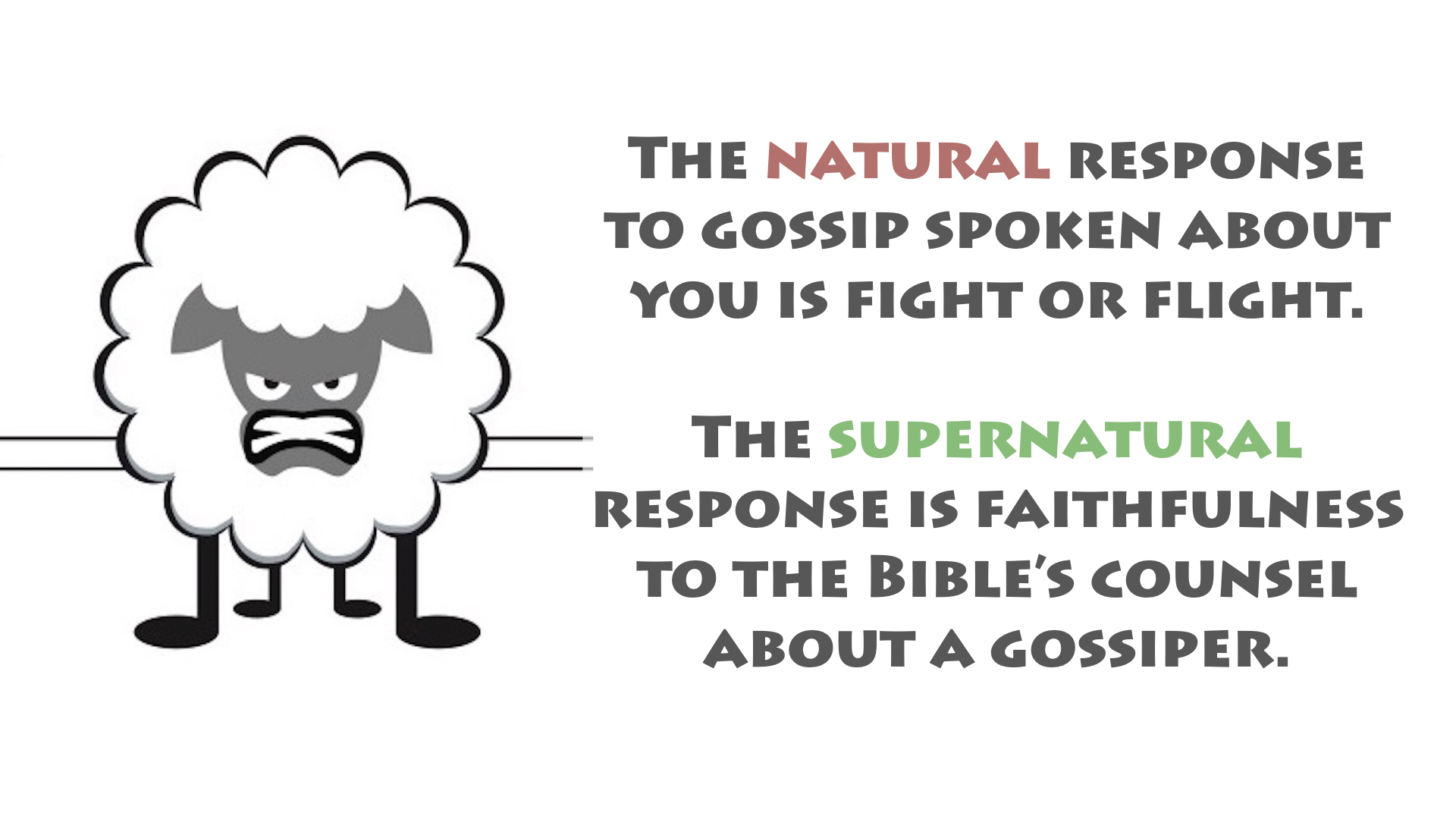
The natural response to gossip spoken about you is fight or flight. The supernatural response is faithfulness to the Bible’s counsel about a gossiper. 

And one final word to all of us: Don’t become a gossip yourself! 

Just as God hears those gossiping about you, He hears you gossiping about others! 

Don’t…

  • …talk about people who aren’t in the room. Remember the Golden Rule of treating others the way you want to be treated (Luke 6:31). 
  • …share information that isn’t yours to share (Proverbs 25:9). 
  • …listen to a gossip. If they gossip to you about others, they will gossip about you to others! 

Gossip, as Solomon warned us, separates even the closest of friends. We must identify it and deal with both the gossip and the gossiper in a God-honoring, biblically-sound way. And we must avoid becoming a gossip ourselves. 

If you’ve missed any of the other sheep bites we’ve talked about in this series, you can find them all by clicking here. And if you are a pastor, check out my book When Sheep Bite, where I address the bites of sheep from a leadership paradigm. 

►► Would you please prayerfully consider supporting this ministry? My Patreon supporters get behind-the-scenes access to exclusive materials. ◀︎◀︎

Do Not Judge?

Listen to the podcast of this post by clicking on the player below, and you can also subscribe on AppleSpotify, or Audible. 

As we learned last week, we are not the judge, nor the jury, nor the prosecution, nor even the sin police in deciding appropriate retribution. With that in mind, let’s consider Statement #15 in our series—Do not judge. Is that in the Bible? 

Yes, those three words are there, spoken by Jesus, in Matthew 7:1. But then again, we need to say, no, because these words don’t mean we are not to make determination about the rightness or wrongness of something. 

(Check out all of the Scriptures in this post by clicking here.)

Let’s zoom-out a bit get the context of the words Jesus spoke. Who was His audience for these words? This is a part of the Sermon on the Mount (Matthew 5–7). Notice in the opening words, “His disciples came to Him, and He began to teach them” (5:1-2). So Jesus isn’t speaking to the world at-large, but He is talking with His disciples. 

Jesus was very specific in His wording. In talking about the world, He uses words like people (5:11) or men (5:16; 6:1, 5). When talking about His disciples, He uses one word quite frequently: brother (3x in 5:22-24). 

Matthew 7:1 is still in this sermon, and the word brother appears 3x in vv. 3-5. So these are instructions primarily for Christians to use with other Christian brothers and sisters. 

The words judge here in the Greek means, “Those who judge severely (unfairly), finding fault with this or that in others.” To me, “this or that” sounds like a deliberate searching for something wrong, but Jesus assures us that this will boomerang on the judgmental person (v. 2; Luke 6:37). 

In modern psychology, we find terms like:  

  • mirroring = a psychological term the means quickly seeing what’s in others because it’s in me 
  • projection = taking the negative things in me and projecting them onto others

Paul addresses both of these thoughts in Romans 2:1-3, where the word for judging here is the same Greek word Jesus uses in Matthew 7.

Paul concludes his remarks by reminding us that God treats us kindly (Romans 2:4). David echos this same thought in Psalm 103:8-10, 13-14. 

When you read the whole passage in Matthew 7:1-5, please notice the words “brother,”  “first,” and “then.”  

Jesus does not mean that I am not to point out to my brothers and sisters any areas of concern. Jesus did this, as well as nearly every epistle writer. What it does mean is that correction needs to be gentle and never condemning. In other words, I want to lovingly help someone before they have to stand before The Judge. 

That’s why I need to first humbly recognize that what I see in others may be apparent to me because I am afflicted with the same thing. That’s why Jesus says first deal with my own plank. Examine myself  before I try to correct a brother or sister (1 Corinthians 11:28; 2 Corinthians 13:5). 

After I have allowed the Holy Spirit to deal with my plank, I will then have the empathy to help my brother or sister (2 Corinthians 1:3-4). Trying to get someone else to repent of something that still exists in my life is hypocritical. 

If I see something wrong in someone else:

  1. First ask the Holy Spirit to search me. 
  2. If necessary, confess it, repent from it, ask forgiveness, make things right. 
  3. Then lovingly and humbly share with your brother or sister (Ephesians 4:15). 

If someone else sees something wrong in me, I should follow the exact same steps! 

This is not easy, but it is vital for the Body of Christ to grow in a healthy way. 

If you’ve missed any of the other messages in this installment of our series Is That In The Bible?, you can find them all here. 

►► Would you please prayerfully consider supporting this ministry? My Patreon supporters get behind-the-scenes access to exclusive materials. ◀︎◀︎

The Goals Of Confrontation

Listen to the podcast of this post by clicking on the player below, and you can also subscribe on AppleSpotify, or Audible. 

Say the word “confrontation” and many people cringe. “I try to avoid confrontations with others,” people will quickly say. 

The origin of the word comes from a derivative of the word for “forehead.” The original intent of confrontation was simply putting the facts in front of someone’s face so that they could acknowledge them. 

The problem for most of us (myself included) is two-fold: 

  1. I don’t like to be confronted with things I may be doing incorrectly or incompletely. 
  2. I don’t like making others defensive when I confront them with the things they may be doing incorrectly or incompletely.

As a result, we usually don’t confront others and they usually don’t confront us. Sadly, this can keep us from maturing in areas where we may be able to soar if we could only make some minor changes. 

Christians should be especially open to confrontation from a brother or sister. After all, Solomon told us, “Wounds from a friend can be trusted, but an enemy only multiplies kisses” (Proverbs 27:6). And Jesus warned us, “Woe to you when all men speak well of you, for so did their fathers to the false prophets” (Luke 6:26 NKJV). 

The best confrontation is self-confrontation in the presence of the Holy Spirit. After we have submitted to that loving spotlight, then we can proceed with our loving confrontation with our brothers and sisters. 

Remember this: 

The goals of Christian confrontation are restoration and maturity. 

We want to see wandering saints return to God’s path, and we want those saints who are immature to blossom into Christ-like maturity that brings glory to God. 

I have prepared a flowchart that can help you with a biblical framework for the work of confrontation. Please work through this flowchart slowly and prayerfully. Don’t rush any step, but make sure you can answer an honest “yes” to each question. When you get to the last step, keep in mind these three Ms:

  1. Maturity—self-confrontation and confrontation of others should always be moving us toward maturity. 
  2. Mutual accountability—agree to stay involved in this process, with each of you remaining accountable to each other. 
  3. Mercymercifully restore the one who has strayed so that the entire Christian body of believers can be strengthened.

Here are some resources to help you:

►► Would you please prayerfully consider supporting this ministry? My Patreon supporters get behind-the-scenes access to exclusive materials. ◀︎◀︎

Links & Quotes

Healthy leaders look in the mirror first before they confront a teammate on something that needs to change. Check out the full conversation Greg and I had on The Craig and Greg Show about defeating the two-headed leadership killer of ignorance and arroganceI have lots of new content every week, which you can check out on my YouTube channel.

“I am often, I believe, praying for others when I should be doing things for them. It’s so much easier to pray for a bore than to go and see him.” —C.S. Lewis, Letters to Malcolm: Chiefly on Prayer

“The greatest weapon against stress is our ability to choose one thought over another.” —William James

The most empowered and empowering person is the one who remains in Jesus.

“Whereas three or more incidents of intense stress within a year (say, serious financial trouble, being fired, or a divorce) triple the death rate in socially isolated middle-aged men, they have no impact whatsoever on the death rate of men who cultivate many close relationships.” —Daniel Goleman, Richard Boyatzis & Annie McKee, Primal Leadership

T.M. Moore has an outstanding series of posts on how Christians should interact with the governments in the lands in which they live. I highly recommend this series to you. T.M. wrote, “We have seen that justice is a jewel of many facets. In its obligatory facet, justice requires that we love our neighbors simply because they are made in the image of God. We must regard them, and do with them, as we wish to be regarded and done with ourselves. In its preventive facet, justice demands that we use forethought in all our actions to make sure, as far as possible, that our neighbor or his property is not injured by what we do. Distributive justice encourages us to share generously with our neighbors and others in need. Restorative justice comes into play when the balance of neighbor love has become disturbed and the one guilty of disturbing it is required to set things right again. Each of these forms of justice, grounded in the Law of God, is very much a part of life in our society today. It is simply mindless or prejudicial to insist that we should have no input from Scripture or the Law of God, either in the public square or in the making of public policy. Our nation was founded on Biblical principles of justice, and to deny this is to rewrite history past and to put in jeopardy history to come.”

The Greek word translated as “consider” in Hebrews 3:1 means to observe closely, to consider attentively, to fix your eyes or mind upon it. In its context, this verb is usually directing us to the end result of being in awe, kindling a renewed faith, and being rejuvenated with a new resolve to move forward. This is what happens especially when we consider Jesus❣️

Unity Enhances Our Witness

Listen to the podcast of this post by clicking on the player below, and you can also subscribe on AppleSpotify, or Audible. 

Last week we mentioned that one of the things the Holy Spirit did after the Day of Pentecost was to unite individual Christians into the Church. In a world divided by religious and political factions, the unity of the Christians set them apart. Is our culture any different? Of course not! So the unity that the Holy Spirit brings is just as vital today. 

In Psalm 133, David longs for this unity among believers. This psalm is in the collection of “Songs of Ascent.” That means that pilgrims to Jerusalem sang these songs as they literally went up the hill to Jerusalem. Psalm 133 opens with David singing, “How good and pleasant it is when brothers and sisters live together in unity” (v. 1). 

Maybe David thought back to the time when people were joining him to give him support as king—David went out to meet them and said to them, “If you have come peaceably to me to help me, my heart shall be knit to you” (1 Chronicles 12:17 AMP). In the next two verses of Psalm 133, David explains how this unity from being knit together is seen as a blessing. 

Last week, we talked about the blessing of peace the priests pronounced on the people. That word for “peace” is shalom which could be defined as “nothing missing.” But couldn’t we also say that shalom is “no one missing”? Yes, because each and every part of the Body of Christ is vital and indispensable! 

We see this same unity when the followers of Jesus were baptized in the Holy Spirit on the Day of Pentecost. Acts 2:1 says these Christians were “all together” (or some translations say “one accord”). This is one word in Greek (homothumadon) which describes the beauty of unity. One Greek dictionary defines this word,  “The image is almost musical; a number of notes are sounded which, while different, harmonize in pitch and tone. As the instruments of a great concert under the direction of a concert master, so the Holy Spirit blends together the lives of members of Christ’s church.”

This picture of a majestic musical is further amplified in the next verses of Acts 2 where people from all over the world heard these Christians praising God in their own native tongues. Luke goes on to use homothumadon again and again throughout Acts to show what a powerful testimony their unity was to the watching world.  

Paul emphasized the need for unity in the Church when he wrote—

As a prisoner for the Lord, then, I urge you to live a life worthy of the calling you have received. Be completely humble and gentle; be patient, bearing with one another in love. Make every effort to keep the unity of the Spirit through the bond of peace. There is one body and one Spirit, just as you were called to one hope when you were called; one Lord, one faith, one baptism; one God and Father of all, who is over all and through all and in all. (Ephesians 4:1-6) 

How does the Holy Spirit help us handle our differences and keep this unity? We first need the Spirit’s help to distinguish whether it’s a biblical, unbiblical, or non-biblical issue. 

  • Biblical issues must send us back to the Bible to find the truth (2 Timothy 3:16-17). 
  • Unbiblical issues—where a brother or sister is living in a way contrary to Scripture—call on us to speak the truth in love and correct in love only after allowing the Holy Spirit to examine our own lives (Ephesians 4:15; Matthew 7:1-5; James 5:19-20). Notice that we are to do this with fellow brothers and sisters, not with those outside the Church.  
  • Non-biblical issues are the trickiest. These are issues over which we should immediately stop fighting as we defer to the weakest brother or sister (Romans 12:10, 14:19-21).  

(I wrote much more about biblical, unbiblical, and non-biblical issues here, and how to correctly apply the principle of confrontation here.)

The Church needs this unity today. We need to be in “one accord.” In a world divided by religious and political factions, our unity enhances our witness.

If you’ve missed any of the messages in our series We Are: Pentecostal, you can check them all out by clicking here. 

►► Would you please prayerfully consider supporting this ministry? My Patreon supporters get behind-the-scenes access to exclusive materials. ◀︎◀︎

Lubricate The Message With Tears

Listen to the podcast of this post by clicking on the player below, and you can also subscribe on AppleSpotify, or Audible. 

Therefore groan, son of man! Groan before them with broken heart and bitter grief. And when they ask you, “Why are you groaning?” you shall say, “Because of the news that is coming.” (Ezekiel 21:6-7)

Judah’s sin had exhausted God’s patience. Now punishment was coming in the form of the invincible Babylonian army, and Ezekiel was tasked to deliver the news. 

I and my fellow pastors often have to speak a heavy word. How we speak this word may make all the difference in the world in how it is received. We cannot speak brashly nor robotically. The Word of God should break our own hearts first, just as it did to Nehemiah.  

I must tell people about the consequences of their sin, but I must tell them with groaning. 

I must warn people of the horrors of hell, but I must warn them with bitter grief. 

I must confront a wayward brother or sister, but I must do so with a broken heart. 

I hope all my fellow pastors will join me in praying this: Holy Spirit, help me! May Your word break my heart before I open my mouth. May tears always lubricate the painfully loving words I must speak! 

►► Would you please prayerfully consider supporting this ministry? My Patreon supporters get behind-the-scenes access to exclusive materials. ◀︎◀︎

Warnings To The Churches (book review)

J.C. Ryle died in 1900, placing his writings two centuries before our own. And yet his Warnings To The Churches sound an alarm that is just as relevant to the Church and her leaders as if it were written last week! 

Bishop Ryle spoke and wrote with an authority that sounded much like the Old Testament prophets thundering, “Thus saith the Lord!” And at the same time, you can also hear his ardent love for Christ’s Bride as tenderly as the beloved disciple John, who called himself “the disciple whom Jesus loved.” Taken together, that means Ryle’s words are steeped in authoritative, loving Scripture. 

He pulls no punches in pointing out how even Church leaders have bought into a definition of “church” that doesn’t quite line up with the way Jesus defined it. He reminds pastors of their heavy responsibility to preach the Word of God in all its purity. Just like Jesus, Ryle warns church leaders of the “leaven of the Pharisees and Sadducees.” And he calls for loving confrontation of those leaders who have succumbed to the “leaven” just as Paul confronted Peter. 

This is a challenging book to read simply because of the gut-level honest introspection that it will require. I certainly couldn’t read through this book thinking I’ve got my act together, and I doubt few others will be able to either. If you are a church leader and you would like Ryle’s iron to sharpen your iron, Warnings To The Churches is a definite must-read for you.