5 Quotes From “Light And Truth—The Old Testament”

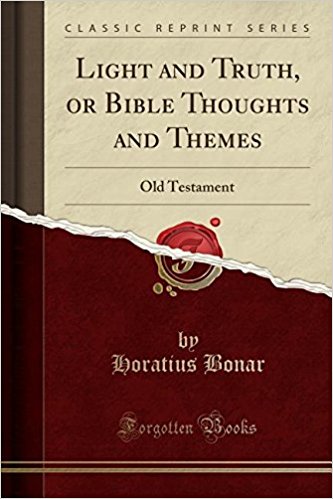
I like to think of Horatius Bonar as a tour guide as I read through the Bible, pointing out themes and insights I might have otherwise missed. Check out my full review of Light and Truth—Old Testament by clicking here. 

The elders [1 Chronicles 21:16]. They acknowledge the stroke and the sin: ‘It is the Lord.’ They clothe themselves in sackcloth, they fall upon their faces. So far as we know, they had not shared David’s sin, yet they at once place themselves by his side in confession and humiliation. David had sinned (v. 8), Israel had sinned (2 Samuel 24:1). They identify themselves with both. It is thus that we should take up a ruler’s sin, or a brother’s sin, or a nation’s sin; not blazoning it abroad in private gossip, or in the newspapers, but taking it on ourselves, and carrying it to God.” 

“We do great injustice to the Old Testament saints and to their privileges, and no less so to the God who made them what they were, when we conceive of them as possessing an imperfect justification, or an imperfect and uncertain knowledge of their justification. Paul’s declaration was explicit on this point: ‘I know Whom I have believed’; and yet it was not a jot more explicit than that of Job: ‘I know that my Redeemer lives.’ When Paul said, ‘It is God that justifies, who is he that condemns?’ he was only speaking what Job had spoken in ages before: ‘I know that I shall be justified. Who is he that will plead with me?’” [Job 13:18-19]

“Everything in God’s character, has by the Cross of Christ been turned into a reason for trusting Him. The more man knows of Him the more he trusts. Trust is the natural and inseparable response of the soul to the divine revelation of the character of God. It is not what man sees in himself, of his good deeds or good feelings, of his graces, or his repentance, or his regeneration, or his faith; but what he sees in God, that calls out confidence.” 

“It is with no distant, unheeding God that we have to do; but with that God who fixes the bounds of our habitation, who counts our hairs, who feeds the ravens, notes a sparrow’s death, clothes the lilies of the field. He is nearer to us than the nearest earthly object or being; more closely in contact with us than we are with one another.” 

“We disjoined God from creation, and so see nothing in it of divine life and power. … The separation of God from His works is one of the awful features of human unbelief. How much more of Him should we know, were we to interpret His works aright. … These skies of His are not bent over us in beauty without a meaning. These seas of His do not roll for nothing. These flowers of His are not fragrant and fair for nothing. They do not say to us, ‘God is your enemy, He hates you’; but ‘God is your friend, He pities you, yearns over you, wishes to make you happy.’ How full a gospel does creation to preach to us, according to its kind and measure!”

The Wonder Of God’s Forgiveness

King David was intimately confident that God would hear his prayers. No matter what—even if David had sinned.

The prophet Nathan confronted David after David had committed adultery with another man’s wife, gotten her pregnant, and then had her husband killed to try to cover up their affair. David assumed he had gotten away with it, but God sent Nathan to tell David that He knew all about it.

David immediately went to prayer.

His prayer is instructive for us when we sin too. David’s appeal to God for forgiveness is based solely on God’s ability and willingness to forgive, not on any merits David brings.

In this prayer, David presents a tally sheet. On his side of the ledger, he lists my transgressions, my iniquity, my sin, my bloodguilt. He sums it up with, “Against You, You only, have I sinned and done what is evil in Your sight.

David also tallies up God’s side of the ledger: You are right, You are just, You are righteous.

We might be tricked into thinking that a Perfect Being like this wants nothing to do with a sinful creature like you and me. But this is completely wrong! David appeals to God’s unfailing love, and Your great compassion. He lists God’s desire to cleanse, wash, blot out sins, restore, and release from blood-guiltiness.

David said, “I have sinned against the Lord.” And immediately Nathan responded, “The Lord has taken away your sin.”

Sin is all on me! Restoration is all on God!

With this in mind, we learn that the mark of a maturing Christian is not one who never sins, but one who…

  1. …feels a broken heart because of their sin (see Psalm 51:10)
  2. …confesses my sin
  3. …confidently asks for His forgiveness
  4. …helps others who have sinned (v. 13)
  5. …continues to abide in Jesus (vv. 10-12)

God is quick to forgive. Are we equally as quick to ask for His forgiveness?

You can study more of the lessons from the prayers of David:

How Confident Are Your Prayers?

David hasn’t done anything wrong. He’s never tried to lead a rebellion against King Saul. In fact, he’s never even talked poorly about Saul. And yet Saul is out to kill David!

David tries to get as far away as he can, choosing to live in the desert so that he might get some relief from Saul. Still Saul comes after him with a force of 3000 men! Every time David moves, Saul’s men are hot on his trail. David described his situation like this

My mortal enemies surround me. Their hearts are cold and calloused toward me, and they speak terrible things about me. They track me down and surround me. They are like hungry lions, crouching, waiting to pounce on me!

If you were in David’s sandals, how confident would you be that God could get you out of the situation? Remarkably, David’s confidence was as high as it could be!

David not only was confident that God would hear him, but that He would listen to him. More than that, David knew God would pay attention to him. And then David boldly said, “I call on You, O God, for you WILL answer me.”

How could David pray such a confident prayer? The answer is in this principle…

There is a direct correlation between intimacy and confidence.

David made two very intimate claims about his relationship with God:

  1. You will keep me as the apple of Your eye
  2. You hide me in the shadow of Your wings

The apple of the eye is the pupil. Our eyes are amazingly designed to not only take in information but to protect themselves. If something is getting too close to our eye, the eyelids blink in protection faster than we can consciously tell them to. So David was claiming that God would protect him by reflex!

The shadow of Your wings was a reference to the top of the Ark of the Covenant; a place called the mercy seat. Here is where the priest sprinkled the blood of a sacrificial lamb to atone for the people’s sin and to appeal to God’s mercy. The mercy seat was over-shadowed by two angels’ wings.

David was saying that God kept him in this intimate place—covered by God’s mercy and protection!

Jesus also told us about intimate confidence when He said, “If you remain in Me, and My words remain in you, ask whatever you wish, and it will be given you” (John 15:7).

  • Intimacy: remain IN Jesus, and let His words remain IN you
  • Confidence: ask whatever you wish, and it will be given you

Are your prayers this confident? If not, don’t work on raising your confidence, but work on increasing your intimacy. Check your intimacy level with questions like:

  • Am I abiding in Jesus?
  • Are His words abiding in me?
  • Do I have any unconfessed sin?
  • Is my prayer a “Your kingdom come, Your will be done” prayer?

Focus on intimacy, and then watch your confidence soar! 

If you are interested in learning more about the prayers of David, I have also discussed his prayer for help, his prayer of crying out loud, and his prayer of praise.

The Transparency That God Loves

Have mercy … heal me … deliver me … save me … (Psalm 6:2, 4).

A mark of a godly leader is one who is not afraid to share his vulnerabilities.

David freely admits his fear of punishment, his need for God’s help, and his grief that robbed him of sleep.

But he also admitted just as freely his rock-solid assurance of God’s help:

  • The Lord has heard my weeping
  • The Lord has heard my supplication
  • The Lord will receive my prayer

Godly leaders are confidently transparent before God and before those around them. God delights in that transparency, and He delights to answer vulnerable prayers.

This is Part 17 in my series on godly leadership. You can check out all of my posts on this topic by clicking here.

11 More Quotes From “The Broken Way”

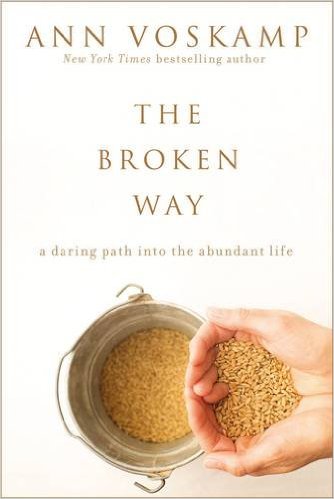
Ann Voskamp’s book The Broken Way wrecked me … in a good way! Ann shows us how Jesus steps into our brokenness, and how He then prepared us to take His love into other people’s brokenness. It’s a fantastic book, so you really should check out my book review by clicking here.

“I am not the mistakes I have made; I am the righteousness He has made. I am not the plans I have failed; I am the perfectness He has finished. I am not the wrongs I have done; I am the faultlessness He has been. I am not the sins I have chosen; I am chosen by the Beloved, regardless of my sins. In Christ, I am chosen, accepted, justified, anointed, sealed, forgiven, redeemed, complete, free, Christ’s friend, God’s child, Spirit’s home.”

“You’ve got to give your gifts or they may become your idols.”

“The thread of your life becomes a tapestry of abundant colors only if it ties itself to other lives. The only way to strengthen the fabric of society is to let the threads of your life break away to let Christ, who is in us, weave around other threads. … The strong must disadvantage themselves for the weak, the majority for the minority, or the community frays and the fabric breaks.”

“We will be known for our actual fruits, not the intentions of our imaginations.”

“Don’t we all have to unlearn fear before we can truly learn to love?”

“Jesus comes to give you freely through His passion what every other god forces you to try to get through performance.”

“Compassion says there will only be abundance for me when there is abundance for you.”

“Instead of flexing His muscle, Jesus surrendered His muscle to the nail. Instead of leveraging His position, He leveraged Himself out on a Cross. He made sacrifice His default position. Instead of stonewalling people with His authoritative power, He laid down His authority, lay down in a tomb, lay in a suffering death till the stone was rolled away.”

“The focus of God’s people is not to create explanations for suffering, but to create communities around suffering, co-suffering communities to absorb suffering and see it transform into cruciform grace.”

“Suffering is not a problem that needs a solution as much as it’s an experience that needs compassion.”

“Faith is confidence in the kindness of God, no matter the confusion of circumstances.”

You can read other quotes I’ve shared from The Broken Way here and here.

A Leader’s Confidence

Give ear to my words, O Lord, consider my meditation. Give heed to the voice of my cry, my King and my God, for to You I will pray (Psalm 5:1-2).

When David prays, he prays with confidence—he is confident that God will hear him.

Where does his confidence come from? From these two truths about the nature of God:

  1. You are a God who takes no pleasure in wickedness (v. 4), so David must confess his sin quickly.
  2. In fear of You I worship (v. 7), so David doesn’t have to cower before God wondering if God will forgive his sin.

David didn’t take the condition of his soul for granted (v. 5), but he came quickly into God’s presence because he knew of God’s mercy to forgive.

Not only was David confident that God would hear his prayer, but he also eagerly anticipated receiving…

  • …God’s answer to his prayer
  • …God’s joy
  • …God’s blessing
  • …God’s protection

A mark of a godly leader is one who prays confidently and then eagerly expects God to answer.

If you want confidence in your earthly leadership, do what David modeled: Enter God’s presence quickly and confidently, and then eagerly anticipate what God is going to do!

This is Part 16 in my series on godly leadership. You can check out all of my posts on this topic by clicking here.

Thursdays With Oswald—More Joyous

This is a weekly series with things I’m reading and pondering from Oswald Chambers. You can read the original seed thought here, or type “Thursdays With Oswald” in the search box to read more entries.

More Joyous 

     God is so immediately near and so immensely strong that I get more and more joyous in my confidence in Him.

From Run Today’s Race

Run Today’s Race contains short statements from Oswald Chambers intended to stimulate Christians to ponder things like:

  • Can I feel God near to me?
  • Do I know His strength more today than I did a year ago?
  • Am I filled with God-inspired joy?
  • How confident am I in God’s nearness and strength?

Pour It Out!

“We can simply pour from the fullness of our heart the burdens of our spirit and the sorrow that seems to crush us. We can know that God hears, loves, understands, receives, and separates from our prayer everything that is in error, imperfect, or wrong. And then He presents the remainder, along with the incense of the great High Priest, before His throne on high.

“We may be assured that our prayer is heard, accepted, and answered in Christ’s name. … Do we truly know the power of our supernatural weapon of prayer? Do we dare to use it with the authority of a faith that not only asks but also commands? God baptizes us with holy boldness and divine confidence, for He is looking not for great people but for people who will dare to prove the greatness of their God!” —A.B. Simpson

[see Romans 8:26-27; Psalm 141:2; Revelation 5:8, 8:3-4]

5 Key Parts To A Synergy Relationship

img_1970King David of Israel was a stud! Outstanding song writer, professional shepherd, bear killer, lion killer, giant killer, decorated army general, and ultimately king of Israel.

Near the end of his life we read an extensive list of Mighty Men that supported David. Some of these guys were also giant killers. One guy singlehandedly defeated 300 enemies, another guy defeated 800 bad guys, one guy killed a lion, and on and on the list goes.

I believe it is clear that David wouldn’t have become king without the support of his Mighty Men, and these guys probably wouldn’t have been recognized as “Mighty Men” without David’s support.

This is a classic definition of synergy. Synergy is when the outcome is so much greater than just the addition of the parts. Sort of like 1 + 1 = 5.

All of us can be a part of synergistic relationships, if we will include these five key parts.

[1] Humility

Without humility, you will never let anyone else into your life, and it’s doubtful they will let you in. Humility says, “I don’t have all the answers. I need some help in fulfilling my God-given dream. I have some areas of weakness where you are strong.”

[2] Confidence

Just like humility, without confidence it’s doubtful others would allow you access to their lives. Confidence says, “I have some something I am willing to offer you. I have a God-given strength in an area where you may be struggling.” The Apostle Paul said, all of us have strengths that God has given us that are to be used to help others (1 Corinthians 12:7; Ephesians 4:7).

[3] Collaboration

Quite simply, in order for synergy to work, the people in the relationship have to be willing to labor together. Paul used the example of one person planting the seed and another person watering the seed. Both laborers are necessary if there is going to be a harvest.

[4] Patience

The journey with others may be slower and messier than traveling solo, but it’s so much more rewarding (see Ecclesiastes 4:9-12).

[5] Investment

Synergy is really about there being a return on investment. But if you’re not willing to invest your time, your learning, your love, can you really expect there to be a synergistic return?

I just wrapped up a year-long investment with a group of guys from my church. What an amazing time! I am definitely better for having been involved with this synergy group, and I believe all of the other guys would tell you the same thing. You, too, can experience this same joy by investing in a synergy group of your own!

Poetry Saturday—HOPE

john-maxwellHope—Holding On, Praying Expectantly

What does hope do for mankind?
Hope shines brightest when the hour is darkest.
Hope motivates when discouragement comes.
Hope energizes when the body is tired.
Hope sweetens when the bitterness bites.
Hope sings when all melodies are gone.
Hope believes when the evidence is eliminated.
Hope listens for answers when no one is talking.
Hope climbs over obstacles when no one is helping.
Hope endures hardship when no one is caring.
Hope smiles confidently when no one is laughing.
Hope reaches for answers when no one is asking.
Hope presses toward victory when no one is encouraging.
Hope dares to give when no one is sharing.
Hope brings the victory when no one is winning. —John Maxwell