6 Ways To Make Sure Everything You Do Is Sacred

It's all sacredAround 1300 AD, the Church began propagating a myth. It showed up in two words that were created around that time: clergy and laity.

Simply stated, clergy is from a root word that means “the learned men … the ones enlighten for ministry.” And laity is anyone not in that inner circle.

Insecure leaders did this to maintain control. They continued to read the Scriptures in Latin, which few could read, so they made sure that the clergy alone had a Bible, and they alone became the expounders of how the Bible told us to live.

In the clergy-laity divide, they also created a sacred-secular divide.

When Paul addresses the Colossians he does so with anything but a clergy-laity divide in mind. He calls them the holy and faithful brothers in Christ (Colossians 1:2). The KJV translates holy as saints, for that’s how Paul indeed sees them. And he sees them as his very own faith-filled brothers.

Paul also has anything but a sacred-secular divide in mind as he instructs then—whatever you do, whether in word or deed.

He makes it clear that everything we do as faith-filled, holy saints is to be sacred and God-honoring.

How do we do whatever we do in a sacred, God-honoring way? We ask these six questions:

[1] Can it be done with a clear conscience? (Acts 23:1; 24:16)

  • “It is not WHAT a man does that determines whether his work is sacred or secular, it is WHY he does it.” —A.W. Tozer

[2] Will it promote the Gospel? (Philippians 1:27)

[3] Is it a good deed? (Acts 10:38; James 3:13)

[4] Does it point people to God? (1 Peter 2:12; 1 Corinthians 10:31)

[5] Can I do it in the name of Jesus? (Colossians 3:17do it ALL in the name of Jesus)

[6] Does it cause others to be thank-full? (Colossians 3:17giving THANKS to God the Father).

Live according to your high calling, for all you do is sacred!

(To check out more thoughts on Colossians 3:15-17, click here and here.)

You Are God’s Lavish Gift To Others

GratefulI have noticed a couple of things about thank-full people (people who are full of thanks). In a single word the difference is ABUNDANCE.

  • Thank-full people have an abundance mentality—they believe there’s plenty for everyone; that God’s grace overflows and is boundless.
  • Thank-full people want others to find this abundant life too. As Charles Spurgeon prayed, “I would then that the quickening Spirit would come down upon me, and upon you, upon every one of us in abundance, to create men valiant for truth and mighty for the Lord.”

This abundance mentality is what Paul is referring to when he writes, “Let the word of Christ dwell in you richly” (Colossians 3:16). Both words dwell and richly convey someone who is so saturated in the abundance of God, that they cannot help wanting to share it with everyone!

So how do Christians lavish their thank-fullness and peace-fullness on others? The rest of that verse in Colossians tells us:

  1. We teach.
  2. We admonish with all wisdom.
  3. We sing.

Teaching others is always rooted in love, and is for the benefit of the other person (Ephesians 4:15, 25, 29).

Wisdom is the Greek word sophia. It means heavenly insight that is extremely practical. That’s what we need when we admonish those we love. This word means to warn people if they are on a wrong path. We love them enough to speak a loving word of warning (Proverbs 27:5-6).

And we sing out of our abundant overflow. The word of Christ dwells in us so richly that it literally bursts out of us in song! Have you ever been around someone so full of God’s presence that their words almost seem to be a song?

But don’t miss out on this. The lavish gift God wants to pour out on people is YOU! Notice how many times the pronoun you is used in Colossians 3:15-17. YOU are God’s gift to your family, your friends, your co-workers, your community!

Don’t rob others of this amazing gift by becoming ungrateful.

Grateful is graceful. 
Graceful is thankful. 
Thankful is worshipful.
Worshipful is God-full.

“The essence of Christianity is that we give the Son of God a chance to live and move and have His being in us, and the meaning of all spiritual growth is that He has an increasing opportunity to manifest Himself in our mortal flesh.” —Oswald Chambers

What will you do to remain thank-full, and remain God’s lavish gift to others?

Part three of our 3-part series on gratitude is coming up this Sunday. If you don’t have a home church in the Cedar Springs area, I would be so thank-full to have you come join us!

4 Powerful Truths About Peacefulness

PeacefulnessHave you ever noticed the importance the Apostle Paul gives to “peace”? Not just any kind of peace, but the peace that is linked with God’s grace.

Paul always puts grace and peace together. Every one of his letters opens with “grace and peace. The only exceptions are his two personal letters to Timothy where he says “grace, mercy and peace.

In his letter to the Colossians we get a clue to why this is, when he writes, “Let the peace of Christ rule in your hearts, since as members of one body you were called to peace. And be thankful” (Colossians 3:15).

Let me start at the end of the verse. The word “thankful” is the Greek word euchristos. It’s where we get our word Eucharist (or Communion). The root word (charizomai) means to (a) live gracefully, (b) forgive gracefully, (c) rescue gracefully, (d) restore gracefully. That’s just how Jesus—the Prince of Peace—lived on earth, and that’s what His broken body and spilled blood purchased for us: peace with God.

So a thankful Christian is a peaceful Christian. Or another way of saying this: a Christian’s peace-fullness comes from thank-fullness.

When we “let the peace of Christ rule” in our heats, it’s because we understand what His grace has purchased for us. And we want others to know this grace and peace as well!

  1. Peacefulness is contagious—a peace-full person has plenty of peace to share.
  2. Peacefulness is unifying—fear makes people run away, but peace brings them close to God and close to each other (Luke 2:14; John 14:27).
  3. Peacefulness promotes worship—we don’t worship what we fear, but we worship what we are drawn to (Luke 19:38; Hebrews 10:22).
  4. Peacefulness signals victory—the absence of conflict is peace (Romans 16:20).

If you don’t have peace in your life, can I suggest that you might want to start by looking at your thank-fulness level. When you are thankful for what the Prince of Peace did on the Cross for you, it’s so much easier to become thankful for all the other blessings that He gives as well. This thank-fullness will raise your level of peace-fullness!

On Sunday we are going to continue to look at the power and beauty of grace-filled gratitude. Please join us!

Graceful Gratitude

Graceful GratitudeAs we approach Thanksgiving Day, it’s natural for people to think about thanking. This shouldn’t be the case for Christians though…

Christians should be so full of thanks that every day is a day of thanks-giving!

There is a power in thankfulness. There is something attractive about gracious people. There is a security and a peace that comes from knowing just how many blessings have been lavished on me by my Heavenly Father.

Beginning this Sunday, I am going to share a series of three messages from three verses in the book of Colossians. We are going to look at the power of being people of graceful gratitude.

If you don’t have a church home in Cedar Springs, I would be so honored if you would join us. If you cannot make it in person, check out our live broadcast on Periscope at 10:30am (search for user @craigtowens).

The Love & Hate Of God

SamekhI don’t think there’s anyone reading this that hasn’t—at one time or another, or perhaps even right now—struggled with feeling distant from God’s love. Maybe you felt like you blew it, or gave in to temptation, or things aren’t going as you had hoped, and you thought, “Where are You, God? Do You still care about me?” This message is for you!

“God is closer to us than we are to ourselves and that is why we do not notice Him.” —Thomas Merton

The section of the 119th Psalm called samekh (see verses 113-120) is a helpful passage for reminding ourselves just how near God is to us. Some people get nervous thinking about God being close to them, to the point where they want to run away. But you must have this clear in your mind—

God is near me to help and support me, not to harass and condemn me! 

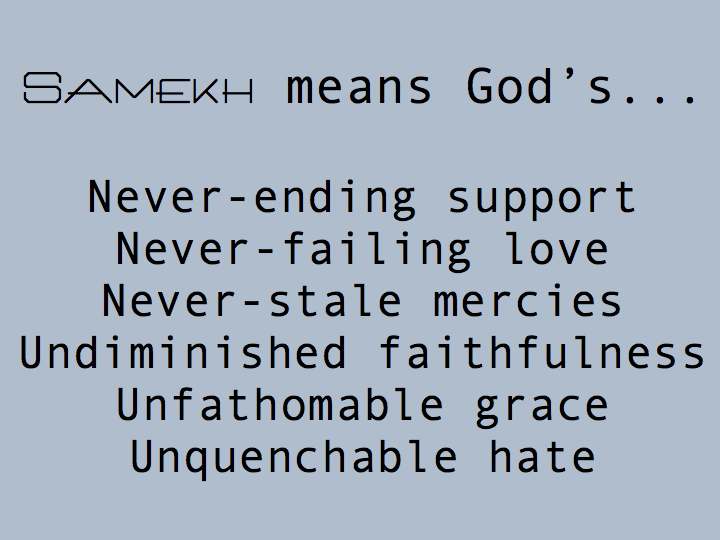
Samekh means...Samekh is the only Hebrew letter which is completely enclosed. And when you look at it, samekh looks like a shield. Indeed the word means more than God’s omnipresence. Samekh means…

  • God’s never-ending support
  • God’s never-failing love
  • God’s never-stale mercies
  • God’s undiminished faithfulness
  • God’s unfathomable grace
  • God’s unquenchable hate

Wait a minute! God’s unquenchable hate?!? Yes! God loves you so much, that He hates anything that would draw you away from Him. So this section of Psalm 119 is filled with words like love, hope, refuge, uphold, and sustain. But it also has words like hate, away from me, reject, and discard.

God wants you to know how close He is to you. God is FOR you and He is AGAINST anything that would pull you away. Read the words in Psalm 91 and see how God protects you and then attacks the enemies of your soul. In the NewTestament, feel God’s closeness as we are told that…

Oh, how God love you! He wants you to feel His closeness, so He loves you and He hates the enemies of your soul! Bask in that today.

If you have missed any of the messages in our P119 series, you can access them all by clicking here.

Myth Buster

Dick BrogdenGuest Blogger: Dick Brogden

Currently there is an inordinate emphasis on size and speed when it comes to the development of the church. Church history soberly shows that orthodoxy tends not to spread as swiftly as heresy and that bad teaching outpaces good. It is the slow, steady repeated truth of God that builds the enduring church. The largest church at the end of the first century was found in Rome, thought by most scholars to be around two hundred members. The churches in Ephesus, Corinth, Philippi, Colosse, and Thessalonica (among others) were most probably between fifteen and fifty. The record of Acts takes place over about fifty years. Biblical precedent indicates that it takes about a generation to get a few churches to what we now consider modest size. One myth is that the church has to grow quickly; another that a strong church is a big church. The best churches tend to grow slowly and steadily, and the normal first century church comprised less than fifty people.

Disciples, too, are forged over time. If a church is but a collection of disciples, then it makes sense that strong churches require time to become solid. Another common myth today in mission is that all new disciples need is the Bible and the Holy Spirit. As appealing as this sounds, it has never been true in history, and if we are honest, it has not been true for any of us experientially. Consider how many books, sermons, mentors, friends, and external inputs help shape and form our spirituality over time. None of us grew to where we are without multiple sources of input over disparate seasons, all the input submitted to the authority of Holy Spirit and the Word. Biblically there always remains the need for an outside catalyst to help correct our biases and heresies. A group of people studying the Scriptures can just as easily end up pooling ignorance as illumining one another. Acts 15 is a classic example of ongoing external input necessary for the formation of strong disciples and churches. The negative example of external input (requiring circumcision) does not negate the massive, ongoing positive external input.

Paul and Barnabas report the wonderful turning of the Gentiles to Jesus. They also report the negative external pressure. James and the counsel respond by correcting the error and reinforcing what is necessary. In Acts 15:20, James delineates what they should not do–former religious forms and rituals. Paul reminds the council that coming to Jesus demands conversion (v. 3) and James cites Peter that the Gentiles must come out of false religion (v. 14). In Acts 15:32, Judas and Silas “exhort and strengthen the brethren with many words.” In verse 35, Paul and Barnabas teach and preach to the Gentiles and in verse 36, Paul and Barnabas commit to revisit their converts to ensure they are walking correctly. Disciples and churches are forged over time. Let us continue to believe that God will do great things and bring millions into His church. Let us continue to understand that it is slow, steady, life-on-life work to make disciples and build churches.

Responding To The Voice

FlatlandIn 1880, Edwin A. Abbott wrote Flatland, a book that would later become a favorite of Albert Einstein. Abbott was a college-trained mathematician and a theologian; in fact he was actually better known for his theological writings than for Flatland. Later on Einstein would say that “things should be made as simple as possible, not simpler.” In other words, don’t dumb-down the concept, but state it on a level where more people can grasp it. That’s why, I believe, Einstein loved Flatland.

Flatland is told through the eyes of Square, a two-dimensional shape that lives in Flatland. Square has length and width, but no height. So the inhabitants of Flatland can move back-and-forth, and side-to-side, but not up-and-down. To get an idea of this, put your eye right on the level of a tabletop, and look at an item on the table. Imagine you can only see what is touching the tabletop (but nothing that rises any higher or lower than that), and you will get an idea of Square’s two-dimensional world.

One day Sphere visits Flatland. Sphere is three-dimensional, so he can move up-and-down. This means that Square can only see the part of Sphere that happens to be in his line of sight at that immediate moment. So he sees just a “slice” or “layer” of Sphere as Sphere moves through Flatland. Sometimes Sphere is nothing more than a disembodied voice when he is hovering above Flatland.

This gives us a little bit of an idea of how we perceive God. He exists in dimensions that we cannot fully comprehend, so we only see “slices” of Him as He passes though our line of sight. Sometimes He is just a disembodied Voice—or as the Bible calls Him, the Word of God.

But the Word of God compressed Himself into our dimension (John 1:14). All of the fullness—all of the other-dimension-ness—of His omnipotence, omnipresence, omniscience came to our “level” in the Person of Jesus Christ (Philippians 2:6-7). The Word was the complete and total fullness of God (John 1:1-3; Colossians 2:9). But unlike Square who couldn’t fully know Sphere, God is fully knowable in The Word—in Jesus Christ!

The question is: What are you going to do with The Word? The Word of God (the Bible) allows us to fully know The Word of God (Jesus). But we need to be willing to let the Holy Spirit strip away our puny, smaller-dimensioned, finite thinking of God.

Alvin TofflerAlvin Toffler wrote, “The illiterate of the future are not those who cannot read or write, but those who cannot learn, unlearn, and relearn.”

I would modify this to say, “Those illiterate of The Word (Jesus) are not those who cannot read The Word (the Bible), but those who won’t let the Holy Spirit help them learn, unlearn, and relearn who God is.” 

There is so much more to learn about The Word (Jesus), so let the Holy Spirit guide you in your reading of The Word (the Bible). I pray as Paul did that you will begin to experience more of the multi-dimensional-ness of God as revealed in The Word—

I pray that out of God’s glorious riches He may strengthen you with power through His Spirit in your inner being, so that Christ may dwell in your hearts through faith. And I pray that you, being rooted and established in love, may have power, together with all the Lord’s holy people, to grasp how wide and long and high and deep is the love of Christ, and to know this love that surpasses knowledge—that you may be filled to the measure of all the fullness of God. (Ephesians 3:16-19)

If you have missed any of the messages in this series called Who Is Jesus?, you can find them all here.

Giving Thanks For Gifted People

Listen to the podcast of this post by clicking on the player below, and you can also subscribe on AppleSpotify, or Audible.

Have you ever noticed how quickly we label people? We tend to give them a label based on their education, their socio-economic status, their race, their age, their job, even their choice of vocabulary.

We may not verbally express these labels, but we think them. And we will always treat people as we label them! In fact, it’s impossible to treat someone differently than you think about them.

What sort of label does God use? Well, He says that He knit you together in your mother’s womb; that He saw all of the days of your life before you were even a twinkle in your father’s eye; He knows the number of hairs on your head; He knows the thoughts in your head; He knows what you’re going to say before you say it. And then there’s this beautiful thought—

For we are God’s workmanship, created in Christ Jesus to do good works, which God prepared in advance for us to do. (Ephesians 2:10)

The label God puts on you:

My one-of-a-kind, irreplaceable, invaluable masterpiece!

When you are givingthanksgiving for people (that means you are always thankful for people), you will begin to see them as God’s masterpieces too!

Everyone you meet is God’s gift. He gave them to humanity to do the good works which He prepared in advance for them to do. You are surrounded by gifted people!

If you don’t see people this way—or if you tend to label them with less-than-flattering tags—perhaps you should begin to pray for them. Try a prayer like this:

I thank my God for you; in fact, I always thank God for you. And every time I thank God for you, I pray for you, night and day. In all my prayers for you, I always pray with joy, being confident of this, that He who began a good work in you will carry it on to completion until the day of Christ Jesus. And this is also my prayer: that your love may abound more and more in knowledge and depth of insight, so that you may be able to discern what is best and may be pure and blameless until the day of Christ, filled with the fruit of righteousness that comes through Jesus Christ—to the glory and praise of God. So I urge you to join me in offering requests, prayers, intercession and thanksgiving for everyone. (This prayer is taken from Romans 1:8; 1 Corinthians 1:4; Colossians 1:3; 2 Timothy 1:3; Philippians 1:3-11; 1 Timothy 2:1)

Don’t just express your thanks for people on Thanksgiving Day, but be givingthanksgiving all the time. Remember: everyone you meet is a gifted person because everyone you meet is God’s one-of-a-kind, irreplaceable, invaluable masterpiece.

Check out the other message in this two-part series series here.

►► Would you please prayerfully consider supporting this ministry? My Patreon supporters get behind-the-scenes access to exclusive materials. ◀︎◀︎

Sola Christo

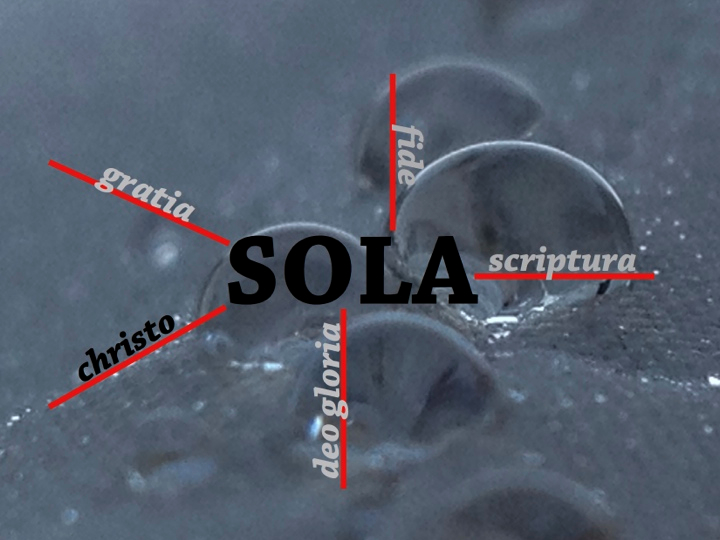
Sola Christo means that it is by Christ’s work alone are we saved. We must get this firmly in our minds, and be aware of anything which reduces Christ, augments Christ, or replaces Christ. 

I don’t believe in studying cults (the counterfeit). Instead, I study the Real, the Authentic, the One and Only. I want to know Jesus so well, that I can easily spot a counterfeit.

God is Spirit (John 4:24)

Jesus is God made flesh (John 1:14)

God is invisible; Jesus is the visible representation of the Godhead (1 Timothy 1:17; Colossians 1:15; Isaiah 9:6)

There’s no way to the Father but through Jesus (1 Timothy 2:5-6)

Jesus wasn’t created; He is Creator (John 1:1-3)

Jesus isn’t a greater angel; He is God (Philippians 2:6)

Jesus isn’t a superior human being; He became a human to save us (Philippians 2:7-8)

Jesus did have a physical body (Luke 24:39)

Jesus did feel pain, experience emotion, wrestle with temptation; get tired and hungry (Matthew 4:2; Matthew 26:38; Hebrews 4:15)

Jesus actually physically died on the Cross and was actually physically resurrected (1 Peter 3:18; 1 Corinthians 15:3-8, 12-28)

Jesus is fully Man and fully God without diluting either of them (Matthew 3:16-17)

Jesus is…

Creator

Sustainer

Savior 

Redeemer

King

Judge

Lord

That’s my King!

If you have missed any of the messages in this series, you can find them all here.

Full

These are my unedited notes in my personal journal after reading…

Devote yourselves to prayer, being watchful and thankful. And pray for us, too, that God may open a door for our message, so that we may proclaim the mystery of Christ, for which I am in chains. Pray that I may proclaim it clearly, as I should. Be wise in the way you act toward outsiders; make the most of every opportunity. Let your conversation be always full of grace, seasoned with salt, so that you may know how to answer everyone. (Colossians 4:2-6)

Wisdom = sophia → heavenly wisdom that is earthly practical. I use this wisdom to “let my conversation be always full of grace, seasoned with salt, so that I may know how to answer everyone” (v. 6).

Every opportunity … always full of grace … answer everyone

How do I stay “salty” and graceful?

Grace-full comes from being prayer-full, watch-full, and thank-full (v. 2). And these come from being devoted to those things. I am not grace-full by accident; it is the fruit of prayer-fullness, watch-fullness, and thank-fullness. I don’t accidentally pray, watch, and give thanks; those come because I am devoted to them.

Or rather, devoted to the One who is eternally grace-filled. The One who is supremely worthy to be worshiped, and adored, and served, and glorified. I worship Him and glorify Him best when I tell others about Him. After all, I don’t glorify and promote anything in which I’m only casually interested. My devotion to God spills out in my devotion to prayer, watching, and thanking. And this develops the fruit of grace-fullness, which draws others to God.

O Lord, may I be utterly FULL of You!