The Value Of The Old Testament

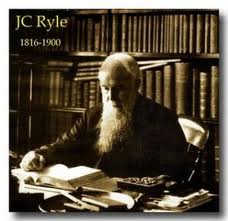
“Jesus exalted the law of God, and made its importance more evident even than it had been before. In a word, ‘He magnified the law and made it honorable’ (Isaiah 42:21). …

“Let us beware of despising the Old Testament under any pretense whatever. Let us never listen to those who bid us throw it aside as an obsolete, antiquated, useless book. The religion of the Old Testament is the embryo of Christianity. The Old Testament is the Gospel in the bud. The New Testament is the Gospel in full flower. The Old Testament is the Gospel in the blade. The New Testament is the Gospel in full ear. …

“Let us, for another thing, beware of despising the law of the Ten Commandments. Let us not suppose for a moment that it is set aside by the Gospel, or that Christians have nothing to do with it. The coming of Christ did not alter the position of the Ten Commandments one hair’s breadth. If anything, it exalted and raised their authority (Romans 3:31). …

“In the last place, let us beware of supposing that the Gospel has lowered the standard of personal holiness, and that the Christian is not intended to be as strict and particular about his daily life as the Jew. … The more light we have, the more we ought to love God. The more clearly we see our own complete and full forgiveness in Christ, the more heartily we ought to work for His glory. …

“Jesus shows us that the law, as expounded by Him, was a far more spiritual and heart-searching rule than most of the Jews supposed.” —J.C. Ryle, in Expository Thoughts On The Gospels

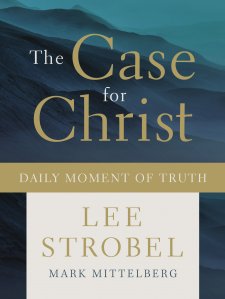
The Case For Christ Daily Moment Of Truth (book review)

This is a fantastic study guide from Lee Strobel and Mark Mittelberg. It was originally published with the title Today’s Moment Of Truth. 

Most Christians will tell you they love God “with all my heart.” That’s a good start, but according to Jesus, there needs to be more. Jesus told us to love God with all our heart, soul, mind, and strength. It’s especially these last two areas that concerned Strobel and Mittelberg enough to put together a wonderful book: The Case For Christ Daily Moment Of Truth.

Strobel and Mittelberg were concerned (and rightly so) that Christians were engaging their heart and soul in their Christian witness, but not developing their mind and strength to the same extent. As a result, when someone challenges them to explain why they believe what they believe, many Christians struggle to answer convincingly.

Lee Strobel and Mark Mittelberg are both top-notch Christian apologists. They don’t just present solid evidence for the Christian faith, but they do so in a winsome, inoffensive way. And through 180 different lessons, they train all who read The Case For Christ Daily Moment Of Truth to do the same.

Each day you will read a quote from a notable atheist or Christian skeptic, and then be trained in solid apologetics to refute their claims. You will be given Scripture verses, proofs from all disciplines of science, and some good old-fashioned common sense. This book will expand your spiritual muscles and your mental muscles. Each day’s reading will only take a couple of minutes, but you will be well-prepared for any challenges to your faith. A must-read for all Christians!

I am a Zondervan book reviewer.

12 Quotes From “The Strenuous Life”

Teddy Roosevelt believed firmly that a nation rose or fell as individuals exercised strong character or lived a slothful life. He not only preached it, he lived it! The Strenuous Life is a collect of TR’s speeches that emphasized what he called “the manly characters.” Check out my full book review by clicking here. 

“We do not admire the man of timid peace. We admire the man who embodies victorious effort; the man who never wrongs his neighbor, who is prompt to help a friend, but who has those virile qualities necessary to win in the stern strife of actual life.” 

“A man’s first duty is to his own home, but he is not thereby excused from doing his duty to the State; for if he fails in this second duty it is under the penalty of ceasing to be a freeman. In the same way, while a nation’s first duty is within its own borders, it is not thereby absolved from facing its duties in the world as a whole; and if it refuses to do so, it merely forfeits its right to struggle for a place among the peoples that shape the destiny of mankind.” 

“If we stand idly by, if we seek merely swollen, slothful ease and ignoble peace, if we shrink from the hard contests where men must win at hazard of their lives and at the risk of all they hold dear, then the bolder and stronger peoples will pass us by, and will win for themselves the domination of the world. Let us therefore boldly face the life of strife, resolute to do our duty well and manfully; resolute to uphold righteousness by deed and by word; resolute to be both honest and brave, to serve high ideals, yet to use practical methods. Above all, let us shrink from no strife, moral or physical, within or without the nation, provided we are certain that the strife is justified, for it is only through strife, through hard and dangerous endeavor, that we shall ultimately win the goal of true national greatness.” 

“Scant attention is paid to the weakling or the coward who babbles of peace; but due heed is given to the strong man with sword girt on thigh who preaches peace, not from ignoble motives, not from fear or distrust of his own powers, but from a deep sense of moral obligation.” 

“Strive manfully for righteousness, and strive so as to make your efforts for good count.” 

“We are in honor bound to put into practice what we preach; to remember that we are not to be excused if we do not; and that in the last resort no material prosperity, no business acumen, no intellectual development of any kind, can atone in the life of a nation for the lack of the fundamental qualities of courage, honesty, and common sense.” 

“If a man permits largeness of heart to degenerate into softness of head, he inevitably becomes a nuisance in any relation of life. If sympathy becomes distorted and morbid, it hampers instead of helping the effort toward social betterment.” 

“The quality of self-help is so splendid a quality that nothing can compensate for its loss; yet, like every virtue, it can be twisted into a fault, and it becomes a fault if carried to the point of cold-hearted arrogance, of inability to understand that now and then the strongest may be in need of aid, and that for this reason alone, if for no other, the strong should always be glad of the chance in turn to aid the weak.” 

“The Bible always inculcates the need of the positive no less than the negative virtues, although certain people who profess to teach Christianity are apt to dwell wholly on the negative. We are bidden not merely to be harmless as doves, but also as wise as serpents. It is very much easier to carry out the former part of the order than the latter; while, on the other hand, it is of much more importance for the good of mankind that our goodness should be accompanied by wisdom than that we should merely be harmless. If with the serpent wisdom we unite the serpent guile, terrible will be the damage we do; and if, with the best of intentions, we can only manage to deserve the epithet of ‘harmless,’ it is hardly worth while to have lived in the world at all.” 

“The boy who is going to make a great man, or is going to count in any way in after life, must make up his mind not merely to overcome a thousand obstacles, but to win in spite of a thousand repulses or defeats.” 

“Softness of heart is an admirable quality, but when it extends its area until it also becomes softness of head, its results are anything but admirable.” 

“A man is worthless unless he has in him a lofty devotion to an ideal, and he is worthless also unless he strives to realize this ideal by practical methods. He must promise, both to himself and to others, only what he can perform; but what really can be performed he must promise, and such promise he must at all hazards make good.” 

More quotes from TR are coming soon, so stay tuned! 

Thursdays With Oswald—Jeremiah 29

Oswald ChambersThis is a weekly series with things I’m reading and pondering from Oswald Chambers. You can read the original seed thought here, or type “Thursdays With Oswald” in the search box to read more entries.

Jeremiah 29

[These are notes from Oswald Chambers’ lecture on Jeremiah 29.] 

     The great message of the prophets is that evil and tyranny are there by the permissive will of God, there is never any room for thinking that these things happen by chance (cf. Isaiah 45:7). Never tie God up in His own laws; He is never guided by precedence. If a prophet is more concerned with logic than with loyalty to God, he will always mislead. … 

     We have no control whatever over external history; God has, and as saints we have to wait in patience wherever we are placed in the providential order of tyranny. …  

     Build houses and settle down; plant gardens and eat what they produce. Marry and have sons and daughters; find wives for your sons and give your daughters in marriage…. Also, seek the peace and prosperity of the city to which I have carried you into exile. Pray to the Lord for it, because if it prospers, you too will prosper (Jeremiah 29:5-7). Jeremiah commands the people to obey God’s order in the dust and dirt of captivity. When we become rightly related to God we are loosened from everything around us, and the danger is to imagine we have to get out of the world. Our Lord did not pray that His disciples should be taken out of the world, but that they should be kept from the evil. It is nothing but unmitigated cowardice to get out of the world; we have to remain unspotted in the midst of it. “Do you mean to tell me I can live a holy life there?” If you cannot, the grace of God is a fiction. External surroundings make no difference to our inner life, but our inner life makes a telling difference on our surroundings (see Philippians 2:15). … 

     Our problem is not one of proportion: how much worldliness can I live in? but of spiritual insight which will enable me to live a holy life in the midst of worldliness, looking for the fulfillment of God’s promises. 

From Notes On Jeremiah

Christians living here on earth are truly “temporary residents” or “aliens and strangers,” as Peter calls us. As such, we sometimes feel a bit perplexed about the evil all around us and how we’re supposed to respond to it and to the Earthlings who question us about it. 

Chambers reminds us that God is not surprised by the evil, nor is He surprised where we are. All of these things are under His sovereign control. 

We are not to give in to evil, compromise with evil, or even try to pretend that evil doesn’t really exist. We are to live with our eyes fixed on Jesus regardless of our evil surroundings. This is the only way we will shine like stars in our evil world, and point the way for Earthlings to have a relationship with Christ for themselves. 

Shine on! 

I ❤️ My Church!

If you lived in the early first century AD—and if the donkey carts had bumper stickers—I’ll bet that you would have seen “I ❤️ My Church” bumper stickers on everything the early Christians owned. 

Both the Bible and historians of that day talked about the positive societal changes that Christians were making in their communities, and how every place they lived and worshipped got better. 

Why not today? 

Why not in your community? 

I believe Christians can—and should—live in such a way that everyone in their communities would sit up and take notice of the positive changes. If Christians really lived this way, we wouldn’t even need “I ❤️ My Church” bumper stickers because our lives would be the best advertisement there was! 

Join me this Sunday as we learn how the first Christians lived such positive, society-changing lives, and how we can do the same thing today. Join us in person or on Facebook Live this Sunday. 

10 More Quotes From “The Christian In Complete Armour”

The Christian In Complete Armour is a classic work about a Christian’s spiritual warfare. Check out my review of this amazingly insightful book by clicking here, and check out other quotes I’ve shared from this book by clicking here. 

“When you see men of power and intellect using their talents against God, weep for their souls.”

“God permits satan’s temporary reign in order to increase the saint’s eternal joy.”

“If you see someone taking along, treacherous journey alone and unprotected, you conclude he expects no thieves on the road and you might well question his wisdom. Many pretenders to Christianity travel in a similar fashion. They tell you they are on their way to heaven, yet they show little inclination to travel in the company of the saints—as if they had no need of fellowship on the journey! Most of them go unfortified, without anything even resembling armor. Others brandish some vain, flighty hopes of the mercy of God, without so much as a single Scripture for ammunition. Such ‘hope’ is a rusty pistol and will fly in the fool’s face when he tries to use it.”

“Do you think for a moment your Heavenly Father would give His archenemy a sword too mighty for you, His own child, to overcome?”

“Let this encourage those of you who belong to Christ: The storm may be tempestuous, but it is only temporary the clouds that are presently rolling over your head will pass, and then you will have fair weather, an eternal sunshine of glory.”

“Trusting in your own goodness will eventually destroy it. Inherent grace is weak. Force it to endure the yoke of the law, and sooner or later it will faint by the wayside, unequal to the task of pulling the heavy load of your old nature. What you need is Christ’s yoke, but you cannot take it until you shed the one that harnesses you to works.” 

“How we would ridicule the man who, when the sun shines in at his window, tries to trap the sunbeams indoors by closing the shutters. But we are just as foolish to take our present joy, then turn away from God’s presence, supposing that we have all we need. You can feel the heat from the sun only when you stand beneath its rays; you can feel God’s comfort only as you keep your face turned toward Him.”

“Watchfulness is more important for the Christian soldier than any other. In temporal battles soldiers fight against men who need sleep the same as themselves, but the saint’s enemy, satan, is always awake and walking his rounds. Since the devil never sleeps, the Christian puts himself in grave danger by falling asleep spiritually—that is, by becoming secure and careless. … The weakest temptation is strong enough to foil a Christian who is napping in security.”

“A thief is just getting up when honest men are going to bed. The devil, I am sure, begins to tempt when saints cease to watch.”

“While the Holy Spirit is a comforter, He is also a convincer: He comforts us by teaching us.”

Life Is Hard! Now What?

Jesus told Peter, and now Peter tells us—Christians are going to be insulted and persecuted for believing in Jesus. So the fact that life is hard shouldn’t come as a surprise. Peter then goes on to elaborate on how Christians should live in spite of the mistreatment. 

“The more Christians are unlike the world, the more it hates us; the more we are like our Lord, the more the world will persecute us.” —Horatius Bonar

How should Christians respond to insults and persecution? Peter outlines the Christian’s response in 1 Peter 4:12-19

dear friends, do not be surprised (v. 12). I like this verse in the Amplified Bible: Do not be amazed and bewildered at the fiery ordeal which is taking place to test your quality, as though something strange (unusual and alien to you and your position) were befalling you. After all, Jesus told us this was coming (see John 15:18-20). 

but rejoice that you participate in the sufferings of Christ (v. 13a). Notice that this should be the sufferings OF Christ, not of our own making. 

—let suffering lead to Spirit-led reflection (notice the if’s in vv. 14-18, and the if’s in what Jesus said in John 15:18-20). We need to make sure our suffering is because we’re standing for Jesus, not because we’re being jerks! David asked God to check if his actions were the cause of his persecution (Psalm 7:3-4) and we should too. If we discover that we’re the one to blame, quickly apologize, ask for forgiveness, and make things right.  

keep your focus on when His glory is revealed (v. 13b). Time is short, and the rewards are sure so don’t remain focused on the immediate pain, but look up to the longterm gain.  

do not be ashamed to suffer for Jesus (v. 16). Jesus told us not to be ashamed of Him because He is not ashamed of us (Luke 9:26; Hebrews 2:11). 

stay committed to your faithful Creator (v. 19a). Staying committed means getting even closer to God in the hard times.

continue to do good (v. 19b). What does continue to do good look like? Peter lists things like being self-controlled, helping others that are being persecuted, showing proper respect, having a good work ethic, not trading insult for insult, and many other commands. Bottom line: doing good means living like Jesus lived while He was on Earth (see Acts 10:38). 

So, Christian, I’ve got two questions for you—

How are you handling insults and persecution? Are you continuing to do good despite the mistreatment? 

Remember Jesus is coming soon, and His rewards are with Him for how we have lived. “Behold, I am coming soon, and I shall bring My wages and rewards with Me, to repay and render to each one just what his own actions and his own work merit.” —Jesus (Revelation 22:12) 

Join me this Sunday as we continue to learn how Christians are to live as aliens and strangers while we visit Earth. If you’ve missed any messages in this series, you may find the complete list by clicking here. 

10 Quotes From “Yours, Jack”

Reading the collection of letters in Yours, Jack was a real treat, helping me to get to know the personality of the man behind so many of my favorite books. To read my full book review on these letters from C.S. Lewis, please click here. 

“Now the story of Christ is simply a true myth: a myth working on us in the same way as the others, but with this tremendous difference that it really happened: and one must be content to accept it in the same way, remembering that it is God’s myth where the others are men’s myths: i.e., the Pagan stories are God expressing Himself through the minds of poets, using such images as He found there, while Christianity is God expressing Himself through what we call ‘real things.’” 

“God not only understands but shares the desire which is at the root of all my evil—the desire for complete and ecstatic happiness. He made me for no other purpose than to enjoy it. But He knows, and I do not, how it can be really and permanently attained. He knows that most of my personal attempts to reach it are actually putting it further and further out of my reach. With these therefore He cannot sympathize or ‘agree’: His sympathy with my real will makes that impossible.” 

“The truth is that evil is not a real thing at all, like God. It is simply good spoiled. That is why I say there can be good without evil, but no evil without good. … Evil is a parasite. It is there only because good is there for it to spoil and confuse.” 

“So few of us will really rest all on Him if He leaves us any other support.” 

“The practical problem about charity (in our prayers) is very hard work, isn’t it? When you pray for Hitler and Stalin, how do you actually teach yourself to make the prayer real? The two things that help me are (A) A continual grasp of the idea that one is only joining one’s feeble little voice to the perpetual intercession of Christ, who died for those very men (B) A recollection, as firm as one can make it, of all one’s own cruelty which might have blossomed, under different conditions, into something terrible. You and I are not, at bottom, so different from these ghastly creatures.” 

“No amount of falls will really undo us if we keep on picking ourselves up each time. We shall of course be very muddy and tattered children by the time we reach home. But the bathrooms are all ready, the towels put out, and the clean clothes are in the airing cupboard. The only fatal thing is to lose one’s temper and give it up. It is when we noticed the dirt that God is most present to us: it is the very sign of His presence.” 

“I think we are meant to enjoy our Lord and, in Him, our friends, our food, our sleep, our jokes, and the bird’s song and the frosty sunrise.” 

“Keep clear of psychiatrists unless you know that they are also Christians. Otherwise they start with the assumption that your religion is an illusion and try to ‘cure’ it: and this assumption they make not as professional psychologists but as amateur philosophers. Often they have never given the question any serious thought.” 

Away with tears and fears and troubles! United in wedlock with the eternal Godhead Itself, our nature ascends into the Heaven of Heavens. So it would be impious to call ourselves ‘miserable.’ On the contrary, Man is a creature whom the Angels—were they capable of envy—would envy.” 

“Notice how we are perpetually surprised at Time. (‘How time flies! Fancy John being grown-up and married? I can hardly believe it!’) In heaven’s name, why? Unless, indeed, there is something in us which is not temporal.” 

More C.S. Lewis quotes coming soon. And you can also check out some of the quotes I’m sharing on Tumblr and Facebook. 

Thursdays With Oswald—Jeremiah 16

Oswald ChambersThis is a weekly series with things I’m reading and pondering from Oswald Chambers. You can read the original seed thought here, or type “Thursdays With Oswald” in the search box to read more entries.

Jeremiah 16

[These are notes from Oswald Chambers’ lecture on Jeremiah 16.]     

     “All things are lawful… but all things are not expedient,” says Paul, i.e., all things are lawful to me as a natural man, but not expedient to me as a spiritual man because I am under a superior command. … 

     How many of us have begun to realize our privilege of not doing things? The liberty to waive our rights is the great privilege of Christian sanctity. One of the meanest things is to say, “I don’t do certain things because it will damage me.” Paul’s argument is—“I don’t do certain things because it will damage someone else” (see 1 Corinthians 8:9-13). … 

     In the days before you knew God you did any number of things which God overlooked, but try and do them now, and if you persist you will realize what is written in Psalm 106:15—“And He gave them their request; but sent leanness into their soul.” 

From Notes On Jeremiah

A Christian should be able to say a guilt-free, excuse-free “No” to anything that would be inexpedient for themselves OR for others around them. 

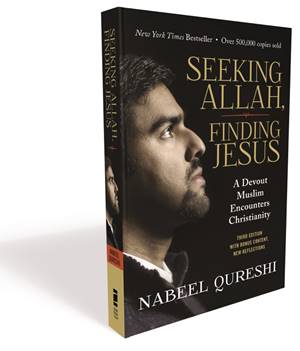
Seeking Allah, Finding Jesus—expanded edition (book review)

In 2015, a family member who works in predominately Muslim areas of the world recommended that I read Seeking Allah, Finding Jesus. This book opened my eyes and heart to our Muslim brothers and sisters around the globe who haven’t heard how Jesus can meet each one of us personally. 

The 10th anniversary of the book is being released next week with all new content, and I couldn’t be happier to recommend it to you. (There are also some special offers for you if you pre-order this book on NabeelQureshi.com.)

When I first read Seeking Allah, Finding Jesus I wrote…

“This book is told in the narrative style of an autobiography, as Nabeel walks us through his devout Muslim upbringing, and the conversations and confrontations that got him thinking about his religion in contrast to Christianity. The book has a “documentary” feel to it, as Nabeel takes us inside his home, school and mosque to let us see his life portrayed almost in real-time. Many of the conversations include Arabic phrases, which Nabeel footnotes at the beginning of the book, and then continues to use without the footnoted translation later, allowing the reader to become more immersed in his world.”

This is the same great content you will find in this expanded edition as well. In addition, there are some added bonuses too:

  • An epilogue where Nabeel answers some of the frequently asked questions like how his family responded to him becoming a Christian, and how he met his wife.
  • You will also hear from his wife Michelle, and a transcribed interview between Nabeel and David Wood, who was instrumental in his conversion to Christianity. 
  • Several expert essays from Christian apologists.
  • Some frequently asked questions about Islam.

As I wrote in my review of the first edition, I wholeheartedly repeat here: By reading Seeking Allah, Finding Jesus, I (re)discovered a whole new way to pray for my Muslim friends, as well as feeling like I may now carry on a more intelligent conversation with them about their cherished beliefs. Please get a copy of this book for yourself! 

I am a Zondervan book reviewer.