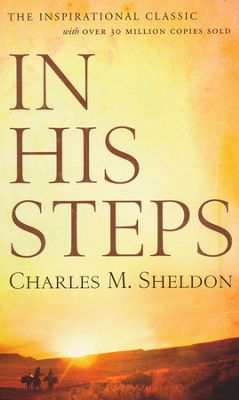
In His Steps by Rev. Charles Sheldon is a timeless classic that every Christian should read (you can check out my book review by clicking here). This quote is a part of the final message that one of the main characters, Pastor Henry Maxwell, delivers at a prominent church in Chicago.
What would happen if in this city every church member should begin to do as Jesus would do? It staggers our minds to imagine the results! We all know that certain things would be impossible that are now practiced by church members. What would Jesus do in the matter of wealth? How would He spend it? How would Jesus be governed in the making of money? Would He take rentals from saloons? From tenement property?
What would Jesus do about the great army of unemployed who tramp the streets and curse the church, or are indifferent to it, lost in the bitter struggle for the bread that tastes bitter when it is earned on account of the desperate conflict to get it? Would He say it was none of His business?
What would Jesus do in the center of a civilization that hurries so fast after money that the girls employed in great business houses are not paid enough to keep soul and body together without fearful temptations? Where the demands of trade sacrifice hundreds of lads in a business that ignores all Christian duties toward them in the way of education and moral training and personal affection? Would Jesus, if He were here today as a part of our age and commercial industry, feel nothing, do nothing, say nothing in the face of these facts that every businessman knows?
How would you answer Pastor Maxwell’s questions?
Some good reading & watching from today…
“Avoid relations with unbelievers in which your relation endorses the unbelief or consequent sins, and avoid the kinds of relationships that involve the interweaving of deep personal values (like marriage). On the other side, don’t avoid relationships where you can have clear testimony to the truth and are allowed to stand on Christian principles, even if you are sometimes criticized for getting too close.” —John Piper
Nick Roen has a very thoughtful post that every Christian should read: Orienting On Homosexual Orientation.
One of the all-time favorite Detroit Tigers was Ty Cobb. This is a great post about Ty Cobb versus Babe Ruth in home runs.
Yes! 4 Ways To Use Failure Well.
Jen Wilkin has a good post for parents: Help Your Kids Say ‘No’ To Porn.
This is a great way of looking at this: True Patriotism Is Axing Taxes To Keep Companies In The USA.
[VIDEO] “Where have we entered when the Bill Of Rights is a partisan matter?” Watch Sen. Ted Cruz defend our First Amendment rights.
This is a weekly series with things I’m reading and pondering from Oswald Chambers. You can read the original seed thought here, or type “Thursdays With Oswald” in the search box to read more entries.
Consecration Isn’t Just For Pastors
Consecration is not the giving over of the calling in life to God, but the separation from all other callings and the giving over of ourselves to God, letting His providence place us where He will—in business, or law, or science; in workshop, in politics…. We are to be there working according to the laws and principles of the Kingdom of God….
“Business is business” is not true for the Christian. Business is a sphere of labor in the world where a man exhibits the laws and principles of the Kingdom, otherwise he is a coward, a deserter, and a traitor to that Kingdom.
From Christian Disciplines
Jesus calls all Christians to be salt and light; to season and shine wherever God has placed us. We are consecrated for service to God is we are working by biblical principles, no matter what job we happen to be doing.
I’m still working through the pages of notes I took during the Willow Creek Leadership Summit a couple of weeks ago. Another speak whom I really appreciated was Patrick Lencioni. I’ve read many of his books, and I think he has such a knack for explaining business principles in a way that seem so easy to process and apply.
Patrick talked about the two needed ingredients for organizational success: things that are smart and things that are healthy. He said that most of the time we cannot do the smart things because we are not healthy enough to do them.
So, how do we make our organization healthy? Here are four disciplines he encouraged us to pursue:
1. Build and maintain a cohesive team at the top. [This is behavioral alignment.]
2. Create clarity by asking these questions:
These need to be core values, not our aspirational values.
There should only be one or two endemic values.
Core values are those that we will stick to even if we don’t get rewarded for it.
These are the myriad of intentional decisions we make that help us be successful.
As an example, consider the three strategic anchors for Southwest Airlines: (1) make the customer happy; (2) keep the plane on time; (3) keep fares low.
3. Over-communicate the answer to the above six questions. I love this: Patrick said, “If your people cannot do a good impression of you, you’re not communicating enough.”
4. Reinforce the system through creative ideas.
The bottom line: “Organizational health provides significant advantages for organizational success.”
I’m working on the application of these thoughts for the organizations I help lead, and I’m really excited to encourage some conversations around these great thoughts from Patrick Lencioni.
Ken Blanchard’s books always cause me to ask, “Why didn’t I think of that?!” He writes in such a way that seems so practical and so applicable, that it would seem like common sense practice. But as we all know, common sense is not always that common! In Helping People Win At Work, Ken Blanchard and Garry Ridge do it again.
The sub-title of the book is based on a program Garry instituted in his company: Don’t mark my paper, help me get an A. And the idea is quite simple: Let’s tell our employees/kids/students what we’re looking for right up front, and then help them earn an A. Instead of performance reviews or tests being uncertain in their outcome, let’s make sure everyone knows what’s coming and how they can “pass” the test. This removes the uncertainty and the anxiety, and increases morale and productivity.
Simple! Common sense! And very rare.
It goes back to Ken Blanchard’s great statement, “Let’s catch people doing something right.” Most bosses/parents/teachers try to catch people doing something wrong. But this approach only reinforces the negative, and makes everyone shy away from the one in authority.
I highly recommend this easy-to-read (and even easier-to-apply) book to employers, teachers, and parents. It is well worth your time to apply these principles.
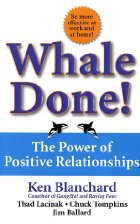
I love the business and intra-personal insights that Ken Blanchard shares in all of this books. In Whale Done, I learned from Sea World’s Shamu how I can inspire people to better performance.
Following the story of a frustrated business manager, husband, and father, Ken shows us how catching people doing something right is the key to turning around performance. And in the process, we also create more pleasant work and home environments. Ken’s premise is simple:
“The more attention you pay to a behavior, the more it will be repeated. …If you don’t want to encourage poor behavior, don’t spend a lot of time on it.”
Instead of focusing on what someone is doing wrong, we should be looking for opportunities to say to others, “Whale Done!” In other words, put the bulk of our energy into encouraging people to keep doing the right things, by redirecting our energy away from the mistakes.
It’s revolutionary, but it’s also very exciting. As soon as I finished reading Whale Done, I immediately handed it to my wife and said, “You’ve got to read this!” And I would say the same thing to all parents, pastors, teachers, and business leaders.
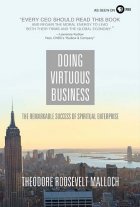
The quote on the front cover of Doing Virtuous Business by Theodore Roosevelt Malloch says it well: “Every CEO should read this book.” I agree!
It seems that our mainstream media has become more and more anti-capitalism and anti-private business. It seems a small — but very vocal — group would prefer that our government oversee every business enterprise. According to Theodore Malloch, nothing could be farther from the biblical way of thinking about business.
By using both real-time examples of virtuous businesses and the wisdom of Scripture, Mr. Malloch makes the strong case that businesses operating on biblical virtues become spiritual enterprises that can benefit all of society. As a former business owner myself, I couldn’t agree more.
A few quotes from the book to whet your appetite—
By creating wealth, we use God’s gifts responsibly, and provided that we work toward that goal in a spirit of humility and gratitude, we benefit all those with whom we deal long the way.
When people join together in an enterprise, they create a new person, the firm itself, which is something greater than the sum of its parts. It, too, has a soul, and if its members honor God, then it, too, honors God.
Profitability comes last among the principles: it is not the primary goal of the company, but the consequence of doing business in the right way, so as to honor God.
A company guided by faith will possess the virtues that I have described in this book: it will have the courage and perseverance to pursue its goals and also the humility, compassion, and forgiveness to guard against arrogance and offensiveness.
This is the first book I have read in quite awhile that deals head-on with the weak arguments the anti-capitalists use. And it does so winsomely, kindly, and quite persuasively. I repeat it again: every CEO should read this book!
I am a Thomas Nelson book reviewer.
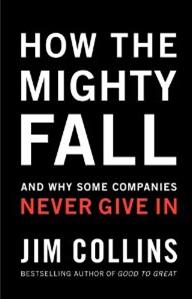
This is the third in the series of books from Dr. Jim Collins: Built To Last, Good To Great, and now How The Mighty Fall. This is a book that Dr. Collins wished he didn’t have to write, as he uncovers the markers that contributed to the failure of once-great companies.
If you are a frequent reader of my blog, you’re probably wondering why I’m reading/reviewing a business book. The answer is simple: the principles Jim Collins uncovers in his books are rock-solid principles of success and failure, regardless of the organization in which they are practiced or ignored. In all three of his books, I have mined so many great truths to apply to my personal life, as well as the organizations I lead.
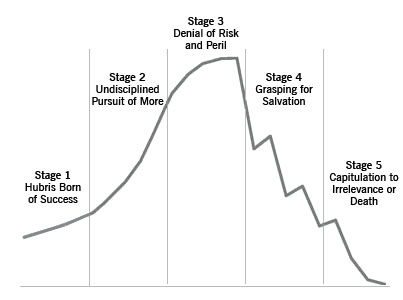
In How The Mighty Fall we learn about the five stages of decline for once-great organizations. Working backward from his evidence, Dr. Collins then gives us “markers” to look for in our own organizations that would tip us off to the stages of decline.
Why study this? Because I want to lead a great church! This quote from the book especially resonates with me:
“The point of struggle is not just to survive, but to build an enterprise that makes such a distinctive impact on the world it touches, and does so with such superior performance, that it would leave a gaping hole — a hole that could not be easily filled by any other institution—if it ceased to exist.” (emphasis added)
If you are involved in the leadership of any organization (whether for-profit or non-profit), I would encourage you to devour all three of Jim Collins’ books.