The Last Arrow (book review)

When I read an Erwin McManus book, I always feel like an arrow shot out of a bow: ready to launch into areas where I should be living. So it’s very appropriate that McManus’ newest book is entitled The Last Arrow! 

The premise of the book comes from a story in the Old Testament where King Jehoash has come to the prophet Elisha for help and counsel. Elisha tells Jehoash to strike the ground with his quiver of arrows, Jehoash does so, but only three times and then he stops. Elisha is furious with the king! In essence, Elisha is saying to Jehoash, “Why are you holding back? Why are you trying to store up resources for the next life? Now is the time: keep on striking until the very last arrow is spent!”

Erwin McManus writes, “My intention for this book is that you would never surrender, that you would never settle, that you would save nothing for the next life. May you die with your quivers empty. May you die with your hearts full. … This book is about not underestimating how much God intends for your life.” 

YES!!

In chapter after chapter, Pastor McManus encourages us to keep pressing forward, not letting our past holding us back, getting the right people around us, standing our ground, and living for a greater future. He shares examples from Scripture, his own life, and the lives of some extraordinary “last arrow” people he’s met along his journey. All in all, this book will fire you up! 

Near the last page of the book you will be cheering as McManus writes, “If you truly live before you die, your life will have a power that not even death can conquer”! 

I am a Waterbrook book reviewer.

5 Quotes From “Light And Truth—The Old Testament”

I like to think of Horatius Bonar as a tour guide as I read through the Bible, pointing out themes and insights I might have otherwise missed. Check out my full review of Light and Truth—Old Testament by clicking here. 

“The elders [1 Chronicles 21:16]. They acknowledge the stroke and the sin: ‘It is the Lord.’ They clothe themselves in sackcloth, they fall upon their faces. So far as we know, they had not shared David’s sin, yet they at once place themselves by his side in confession and humiliation. David had sinned (v. 8), Israel had sinned (2 Samuel 24:1). They identify themselves with both. It is thus that we should take up a ruler’s sin, or a brother’s sin, or a nation’s sin; not blazoning it abroad in private gossip, or in the newspapers, but taking it on ourselves, and carrying it to God.” 

“We do great injustice to the Old Testament saints and to their privileges, and no less so to the God who made them what they were, when we conceive of them as possessing an imperfect justification, or an imperfect and uncertain knowledge of their justification. Paul’s declaration was explicit on this point: ‘I know Whom I have believed’; and yet it was not a jot more explicit than that of Job: ‘I know that my Redeemer lives.’ When Paul said, ‘It is God that justifies, who is he that condemns?’ he was only speaking what Job had spoken in ages before: ‘I know that I shall be justified. Who is he that will plead with me?’” [Job 13:18-19]

“Everything in God’s character, has by the Cross of Christ been turned into a reason for trusting Him. The more man knows of Him the more he trusts. Trust is the natural and inseparable response of the soul to the divine revelation of the character of God. It is not what man sees in himself, of his good deeds or good feelings, of his graces, or his repentance, or his regeneration, or his faith; but what he sees in God, that calls out confidence.” 

“It is with no distant, unheeding God that we have to do; but with that God who fixes the bounds of our habitation, who counts our hairs, who feeds the ravens, notes a sparrow’s death, clothes the lilies of the field. He is nearer to us than the nearest earthly object or being; more closely in contact with us than we are with one another.” 

“We disjoined God from creation, and so see nothing in it of divine life and power. … The separation of God from His works is one of the awful features of human unbelief. How much more of Him should we know, were we to interpret His works aright. … These skies of His are not bent over us in beauty without a meaning. These seas of His do not roll for nothing. These flowers of His are not fragrant and fair for nothing. They do not say to us, ‘God is your enemy, He hates you’; but ‘God is your friend, He pities you, yearns over you, wishes to make you happy.’ How full a gospel does creation to preach to us, according to its kind and measure!”

Light And Truth—The Old Testament (book review)

Horatius Bonar is a brilliant commentator on Scripture! His insights are on full display in Light And Truth—The Old Testament. 

But I do have one complaint about this book: it’s too short! Bonar has four volumes of commentary on the New Testament (the Gospels, Acts and the Larger Epistles, the Lesser Epistles, and Revelation), but sadly only one volume for all of the Old Testament. 

Bonar’s style is not an exhaustive verse-by-verse—or even chapter-by-chapter—commentary on Scripture, but more of a theme-by-theme. Having read the four New Testament volumes first, I knew what to expect when I picked up this book on the Old Testament. Although at times he may remain silent on large swaths of Scripture, when he does spot something that moves his pen to action, it is brilliant insight. 

It bears repeating something I noted in a previous review of Bonar’s commentaries: “The Bible is inspired by the Holy Spirit, so He is the best source of illumination when reading Scripture. But Horatius Bonar is clearly a man immersed in the overall message of the Bible, and guided by the Holy Spirit in his writings.” Bonar is an excellent tour guide to help you see items of significance as you journey through the Old Testament. 

If you would like to check out my earlier reviews of Bonar’s Light & Truth series: 

Reliving The Passion (book review)

The path that Jesus walked that led from His arrest, to His shameful mistreatment at the hands of religious and irreligious alike, to His crucifixion, and ultimately to His death on Golgotha was so packed with significance and emotion that it has come to be known simply as “the passion of Jesus.” Walter Wangerin, Jr. invites us to walk alongside Jesus through the thought-provoking words in his book Reliving The Passion.

Reliving is set up to be a 40-day journey from Ash Wednesday through Resurrection Sunday, and uses mainly the Gospel of Mark as its source material. Along this journey you will see and learn and feel things you may have previously overlooked.

Wangerin says, “When we genuinely remember the death we deserve to die, we will be moved to remember the death the Lord in fact did die.” To help us remember the passion of Jesus Christ, Wangerin frequently speaks to us in first person. Sometimes he places himself on the scene, and sometimes he invites us to see and feel the passion of Jesus through the eyes of someone who was an eyewitness to those moments of Christ’s passion. In every instance, he invites us to view and feel the passion of Jesus for ourselves.

This is an excellent book for you to read year after year as you approach the Lenten season. Let us never forgot how much God’s love was fully expressed during His journey to the Cross.

Normally I post quotes from books I am reviewing after I have posted the review. But for Reliving, I posted quotes every day throughout the 40-day reading. You can check out all of these quotes by clicking here.

10 Quotes From “Sacred Rest”

Dr. Saundra Dalton-Smith thinks you may be too busy to read her book Sacred Rest, and she was candid enough to admit that she was almost too busy to write it! But rest is absolutely vital to keep our lives on track and productive. Check out my full review of Dr. Dalton-Smith’s book by clicking here.

“When I am resting because my body is weak, I need to remember that I’m not wasting the day doing nothing. I am doing exactly what I need to do. I’m recovering.” —Anonymous 

“There has to be a bridge between good and bad sleep, and that bridge is rest. Sleep is solely a physical activity. Rest, however, penetrates into the spiritual. Rest speaks peace into the daily storms your mind, body, and spirit encounter. Rest is what makes sleep sweet.”

“All rest is not created equal. Much of what we consider rest fails to work because it is not restful. Shifting our activities or changing the location of where we are active is no more restful than doing those same activities at home. The most effective rest occurs when we are purposefully reviving the parts of our life we regularly deplete. Any so-called rest that does not meet this goal isn’t rest; it’s just more work adding to the busyness.”

“As important as it is to rest your body, it’s equally important to quiet your mind from the ongoing influx of information it receives. Much like our social media news feeds, our mental background noise is often infused with negativity. Thoughts about the future are contaminated with anxiety, thoughts about the past are tainted with regret, and thoughts about the present are spoiled with discontentment. The mind is magnificent, but it has its own agenda. Rather than willingly focusing on positive affirming thoughts, the mind prefers to settle upon negative ones that intensify stress, worry, anger, and frustration. It will attempt to occupy your attention with useless information, depleting your time and your energy. Mental rest involves relinquishing the constant stream of thoughts entering your mind quickly and obtaining a sense of cerebral stillness.”

“One should not set about treating the body without the soul. This is exactly why most ailments are beyond the capabilities of Greek healers: they neglect the whole when that is what they should be paying attention to.” —Plato

“Physical pain increases when you are under emotional stress and spiritual distress. Anything you can do to improve emotional pain will also improve how you feel physically.”

“Social rest is when we find comfort in our relationships and social interactions. … Studies show an improved immune system, better cardiovascular health, and less dementia in those who regularly enjoy the companionship of close confidantes.”

“We are not made for rest; rest was made for us. Rest is God’s gift back to His people. His presence is how He connects us to His rest. It is part invitation and part prescription.”

“Excuses are invented reasons we create to defend our behavior. It’s how we rationalize our neglect and how we avoid taking responsibility for our choices. … With excuses, we’ve placed external blame for internal problems and stay in a cycle of unproductivity.”

“A well-rested life is a secret hidden in plain sight. It is a life at one with God, self, and others. It’s a life strengthened by winding down the expectations of others and charging up your expectations for yourself. You become in tune with what you need to be at your best. You become comfortable with your strengths and knowledgeable about your weaknesses. You then use that information to pour into the areas needing strengthening and reinforce areas already strong. You find your sweet spot in living, loving, being, doing, and resting.”

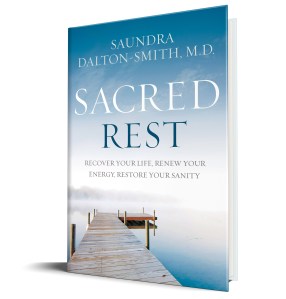
Sacred Rest (book review)

Medical doctor Saundra Dalton-Smith opens her book Sacred Rest with a telling line: “Let’s be honest; we are all just too busy. I am too busy to write this book, and you are probably too busy to read this book.” How true that is! We desperately need quality rest to recuperate from our busy lives, but we’ve fooled ourselves into thinking that rest is a waste of time.

Some people mistakenly think that sleep is rest. But, as Dr. Dalton-Smith quickly points out, that isn’t true. Sleep is required for our good health, but sleep is a natural by-product of rest. Rest isn’t just taking a nap; it goes so much deeper and wider than that.

A good portion of this book is built-around Dr. Dalton-Smith’s acrostic R-E-S-T. She says, “Let me share a little medical secret with you. The most underused, chemical-free, safe, effective, alternative medicine is spelled R-E-S-T: Recognize your risk, Evaluate your current position, Science and research, Today’s application.”

In Sacred Rest, you will learn not only what parts of our lives need rest, but also some highly practical ways to get that rest we so desperately need. This book is not written in medical terminology, but in easy-to-understand principles that anyone can grasp.

Dr. Dalton-Smith shares how she has followed her own prescription for rest, and the difference it has made in her life. Quite simply she says, “What I am promising is that as you begin to understand the role rest plays in your life you will do the following: replace the stress of intense living with the peace of intentional rest, and identify your rest deficit and discover which types of rest you need most.”

Please!—Make time in your busyness to read this book on rest so that you can learn how to be the most you can be without burning yourself out.

I am a Faith Words book reviewer.

Workmen Of God (book review)

Oswald Chambers constantly tried to follow what Paul spoke to Timothy, “And these things you have heard me say in the presence of many witnesses entrust to reliable men who will also be qualified to teach others” (2 Timothy 2:2). In Workmen Of God, we have a collection of lectures Chambers is giving to those “reliable men” and women who were either already working in pastoral ministry or preparing to do so.

It’s amazing how Chambers could so effectively and specifically apply biblical principles to the audiences he addressed. For instance, some might think that those pastoring a local church and those ministering as a missionary would receive roughly the same sort of training. But a collection of Chambers’ lectures to those in missionary work (in his book So Send I You) has completely different ministry principles from the lectures he delivers to pastors in this book.

But in both books, we are privileged to read what Chambers’ friend and coworker Mary Hooker called “a wealth of spiritual vitamins.” She went on to say, “And now this latest book [Workmen Of God] goes forth, at a time when soul-sickness is more than ever rampant. The messages are full of spiritual discernment and diagnosis.”

If Chambers’ time was a time of rampant “soul-sickness,” how much more so do we need his insight today!

Indeed, Chambers talks to pastors about their work among those entrenched in their unbelief, those who are skeptical, those who are backslidden, those who are hypocrites, and those who have sick souls. He also challenges pastors on how to minister to themselves so that they are prepared to minister to any soul in which God brings them in contact.

Although written over 100 years ago, this book is still a treasure-trove for anyone in pastoral ministry today!

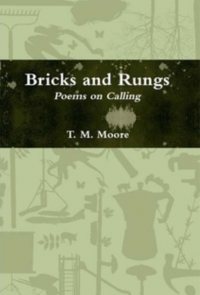
Bricks And Rungs (book review)

T.M. Moore is a first-rate theologian, so everything he writes is well-grounded in Scripture. However, when most people think of “theology,” they think of a lifeless treatise that is boring to read, or perhaps difficult to grasp. But T.M. totally shakes things up in Bricks And Rungs with rock-solid theology presented in beautiful poetic verse.

Bricks And Rungs is all about finding our purpose or calling in life. T.M. says—

“Most people have a sense of being here for some reason. They must become something, achieve something, or come to know something which they consider to be unique to them. Something is out there for them, beckoning them, drawing and wooing them beyond themselves to realize more of something, however that is envisioned or whatever it may be.

“Calling is experienced as a summons from without, a beckoning which resonates with something within, something deeply personal, leading us to aspire to more than what we know or are or have at present. …

“Everyone has a sense of calling. Christians know this to be a summons from God, a command which their lives are intended to fulfill by knowing God and serving Him. The Christian knows that each human being is called to know God and, knowing Him, to serve Him gladly and fruitfully. Calling thus involves our need to be blessed and to be a blessing to others.”

Some of these poems are autobiographical to T.M. Moore, some are reflections on Scripture, and some are musings about how each of us discovers our own calling. But all of these poems will open a window in your soul to hear God’s voice speaking to you about your own unique calling.

Take some time to linger over these insightful words.

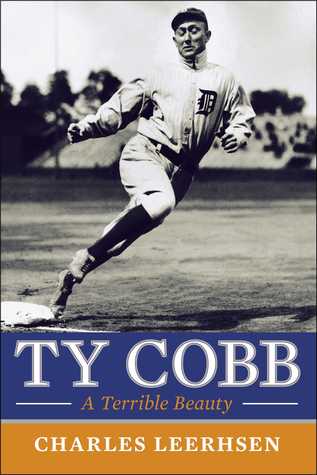
Ty Cobb: A Terrible Beauty (book review)

Ty Cobb was baseball’s first superstar and its first inductee into the Major League Baseball Hall of Fame. Yet when most people think of him, they think of a racist jerk. Was he? Charles Leerhsen unpacks Ty Cobb’s life in an outstanding biography entitled Ty Cobb: A Terrible Beauty.

Leerhsen himself initially believed all the negative reports about Cobb. He wrote:

“When I started researching this book I believed, like a lot of people, that Ty Cobb was a maniac, meaning a racist and a mean, spikes-sharpening son of a bitch. This was not a professional opinion based on knowledge; it was an assumption based on stories I’d been hearing all my life. People said it in bars; Ken Burns said it in his baseball documentary, so it must be true—that sort of thing. That I’d come to this conclusion without investigating the matter myself made the myth more, not less, powerful for me. … The experience [of researching and writing this book] taught me a lesson about how assumptions can shape our thinking, and hence our lives. Just because you’ve heard something a thousand times doesn’t mean it’s true.”

As Leerhsen began meticulously going through the real-time daily accounts of Cobb’s life, when he began reviewing original source material, all his preconceived ideas about Ty Cobb began to melt away. Leerhsen discovered that an opportunistic journalist named Al Stump almost wholly made up the derogatory claims about Cobb from unnamed sources. And as the cliche goes, the bad stuff is easier to believe than the good stuff, so the lies about Cobb stuck.

Ty Cobb was a phenomenal baseball star. He set 90 Major League records in his career, and he still holds the records for:

  • Combined runs scored and runs batted in (4065)
  • Highest career batting average (.366)
  • Most batting titles (11)
  • Most steals of home (54)
  • Stealing second, third, and home in succession (5) … once he did that on consecutive pitches!
  • The youngest player to compile 4000 hits and score 2000 runs

Not only does Leerhsen rebut all of the lies about Cobb, but he uncovers the life of a man who almost singlehandedly made Major League Baseball the national pastime that it became.

There’s also a great lesson to be learned here—never judge someone by what “they” say, but get the facts for yourself!

All baseball fans—and especially Detroit Tigers fans like me—will thoroughly enjoy this book.

Jesus’ Terrible Financial Advice (book review)

When a trained and certified financial advisor says you’re making a mistake with your finances, you will probably listen to him. But what if the one giving the terrible financial advice is Jesus? John Norton (a CPA with a Ph.D. in accounting) looks at the financial advice of Jesus in a whole new light in his book Jesus’ Terrible Financial Advice.

I’ll be honest with you: this book is not at all what I expected. When I hear someone say that Jesus gave “bad financial advice,” I just assume it’s a tongue-in-cheek lead in to a discussion on tithing or giving to missions. But as the subtitle of the book hints, John Norton flips the table on every financial concept that you’ve ever heard taught by the world’s financial experts.

Many people wrongly think that Jesus was anti-wealth, and that to be a truly “sold-out” follower of Jesus, Christians have to give up all semblance of nice things. But that’s not what Jesus taught or lived! Neither did Jesus say that Christians are to pursue wealth on earth. Does that sound like confusing double-talk? Far from it! It’s the truth that John unpacks in this very readable book. John tells us right up front, “I relied on just one rule while writing this book: ‘If my theology disagrees with God, one of us is wrong, and it’s not Him.’”

If you’ve ever struggled with how a Christian is supposed to handle the wealth and possessions of this world, this book will come as a welcome insight into what Jesus really wants for His children: freedom to glorify God!

“Like Jesus’ early followers, we are at a crossroads. He flips the tables on everything we thought we knew about peace, prosperity, and the pursuit of happiness. Jesus’ teachings about money and wealth hit us where we live, shake us free from a life that leads to death, and leave us immeasurably more blessed than we ever imagined. All with the single-minded purpose of bringing glory to His Father.” (John Thornton)

I believe you will be as pleasantly surprised at this book as I was.

I am a Moody Publishers book reviewer.