Saturday In The Psalms—Like No One Else

Praise is awaiting You, O God… (Psalm 65:1).

Why is praising awaiting God? Because no one else does what He does!

  1. He hears all our prayers
  2. He turns no one away
  3. He atones for our transgressions
  4. He helps us approach Him
  5. He fills our lives with good things
  6. He longs for us to dwell with Him
  7. He satisfies our deepest longing
  8. He is All-Righteous
  9. He does awesome things!
  10. He is Salvation
  11. He is Confidence
  12. He answers our prayers
  13. He is Creator
  14. He is Wonderful
  15. He is Beauty
  16. He is All-Powerful
  17. He is Provider
  18. He is Abundance
  19. He is Good
  20. He is Joy

There is no like You, O God!

So my praise will be lifted to You—to You my vows will be fulfilled!

A Leader’s Integrity

…for I have not concealed the words of the Holy One (Job 6:10).

Job is making a case for his integrity. One of the evidences he produces is this: He responds to God’s voice. He doesn’t ignore Him, or pretend he didn’t hear Him, or offer justifications for why he’s not obeying God. “I have not concealed anything God has said to me!”

Not only that, but he invites God to continue to speak to him—

Teach me, and I will hold my tongue; cause me to understand wherein I have erred. How forceful are right words! (v. 24)

What is man, that You should exalt him, that You should set your heart on him, that You should visit him every morning, and test him every moment? (7:17-18)

It’s amazing to think that God cares enough about me that He would speak to me, test me, and correct me if I err or go astray!

A mark of a godly leader is one who lives in complete integrity in God’s sight.

Or as John Maxwell says, “Being God’s kind of leader means refusing even the smallest compromise in what you believe.”

My desire is this … May I, like Job, be able to say that I have not concealed nor ignored any of Your words, O God, but that I respond quickly and obediently to all Your loving words to me.

This is Part 15 in my series on godly leadership. You can check out all of my posts on this topic by clicking here.

The Power In Rejoicing

Rejoice in the Lord always. I will say it again: Rejoice! … Do not be anxious about anything, but in everything, by prayer and petition, with thanksgiving, present your requests to God (Philippians 4:4, 6).

Paul isn’t playing around here—when he says to rejoice, it’s not a suggestion or a good idea. He says REJOICE with the force of a commandment!

Even the Greek word for rejoice isn’t a mild “yea!” It carries with is the idea of big joy! It’s the kind of rejoicing that is…

  • exceedingly great!
  • overflowing!
  • bubbling up!
  • never ending!
  • continuously gushing!

Why would Paul make this kind of rejoicing a command? Because God is serious about pointing us to the only path that will guard our hearts and minds. When we are rejoicing, praying, and thanksgiving, then the peace of God, which transcends all understanding, will guard your hearts and minds in Christ Jesus (Philippians 4:7).

Do you realize how much of our worrying is pointless? My friend Scott pointed out the following research:

  • 40% of the things we worry about will never even happen
  • 30% of the things we worry about happened in the past and cannot be changed
  • 12% of our worries are regarding health issues we don’t even have
  • 10% of our worries are about our friends and loved ones which are based on rumors

That means … only 8% of the things we worry about have any basis in reality!

Think about that—9 out of 10 things that consume our minds with worry aren’t even worth our time!

That’s why Paul commands rejoicing as a means to freedom and peace.

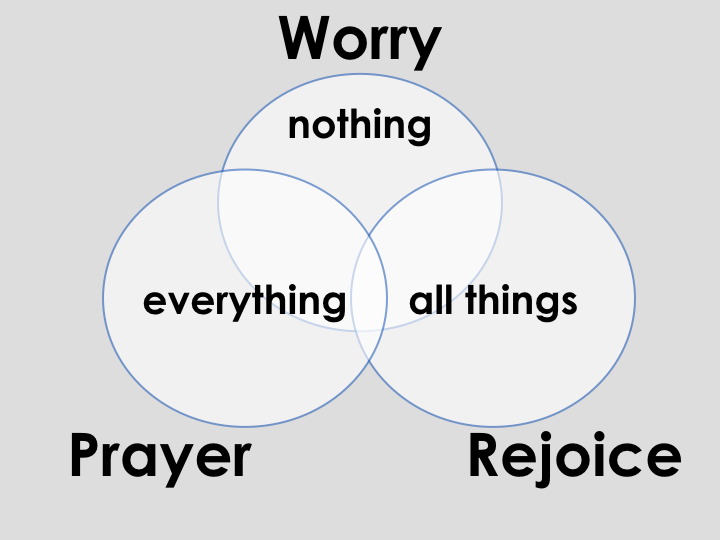
  • What should we worry about? Nothing! 
  • What should we pray about? Everything!
  • What should rejoice about? All things!  

This is the one and only path to transcendent peace! 

This is part two in our series The Antidote For Anxiety. Be sure to check out the video below, and also check out the first part of this series—Honk! Honk! Honk!

Saturday In The Psalms—Joy In The Desert

A psalm of David when he was in the wilderness of Judah (preface to Psalm 63).

Being in a desert place, you would expect David to say things like, “my soul thirsts,” “my flesh longs,” and “I am in a dry and thirsty land where there is no water.”

But what’s unexpected is what David found that satisfied. Not food and water, but “my soul thirsts for You,” “my flesh longs for You,” and “O God, You are my God.”

David knew that when outward conditions were at their worst, his focus needed to be at its best—and it needed to be on God. So David made the following commitments:

  • Early will I seek You
  • I have looked for You
  • I remember You on my bed
  • I meditate on You in the night watches
  • My lips shall praise You
  • My soul follows close behind You
  • I shall rejoice in God

Because of these commitments, David could reach the following conclusions:

  • Your lovingkindness is better than life
  • My soul is satisfied
  • I will rejoice in the shadow of Your wings
  • Your right hand upholds me

David found joy in the desert by changing his focal point!

I can reach the same conclusions that David reached, IF I am willing to make the same commitments David made.

In the desert places, I must deliberately and continually turn my eyes and thoughts FROM the desert TO God’s goodness.

A Leader Must Be Consistent

There was a man…whose name was Job (Job 1:1).

Job is described by the author of this book like this: “that man was blameless and upright, and one who feared God and shunned evil. … This man was the greatest of all the people of the East” (vv. 1, 3).

God Himself described Job like this: “There is none like him on the earth, a blameless and upright man, one who fears God and shuns evil” (1:8). Even after Job’s calamities, God repeats this description and adds, “and still he holds fast to his integrity” (2:3).

satan acknowledged that Job feared God (1:9). But that slanderer accused Job of being a mercenary—that is, he said Job only feared and obeyed God because of what he got out of the bargain (1:10). But the liar missed something: Job’s obedience came before God’s blessing, and Job’s worship came after Job lost all his earthly possessions.

“In all this Job did not sin nor charge God with wrong” (1:22), and “in all this Job did not sin with his lips” (2:10).

A mark of a godly leader is one who acts consistently in good times and bad times.

It’s a good question for godly leaders to ask: why do I obey God? why do I trust Him? why do I fear Him? is it so that I can get something out of it? is it because I’ve already received something? is it so that I can avoid punishment?

Or do I obey, trust, and fear God because He is worthy of all that—and more!—regardless of anything else? Godly leaders consistently ask both sets of questions and answer an assured “Yes” to the last question.

This is Part 14 in my series on godly leadership. You can check out all of my posts on this topic by clicking here.

Saturday In The Psalms—Don’t Be A Fool

The fool has said in his heart, “There is no God” (Psalm 53).

You can choose this paradigm if you like. But if you do, here’s what you can expect—

Corruption … you will reap from others the corruption you sow

No one seems trustworthy … you will live your life untrusting and not being trusted

Limited understanding … “without God we’re just a lucky convergence of matter and energy, and after death there’s a vast nothing,” says the fool. But anyone who’s ever fallen in love knows there is something more than just matter and energy.

Everyone seeks his own self-interest … no one does good just to do good (we’re back to the untrusting lifestyle again!)

Fear and terror of the unknown … these lurk constantly in the back of your mind

Missing out on eternal blessings … what if you’re wrong? what if there really is a God who wants to be in relationship with you? If that’s true, you are squandering your life. You are living for the moment, and about to miss out on an eternity of pleasure in God’s presence.

A fool sticks his fingers in his ears, closes his eyes, and refuses to even consider an alternative—“There. Is. No. God!”

Don’t be a fool!

Will you at least be willing to consider the possibility that this Universe was created on purpose? Will you at least be willing to consider that the Creator made you to have a relationship with Him?

The fool tries to make all of life fit into his tiny box. The wise person knows there’s so much more.

Don’t be a fool!

Antidote For Anxiety

Anxiety is a joy-crushing, life-sapping, happiness-draining burden. Anxiety is also something that plagues more people around us than we care to admit.

But there is hope in our anxiety, because there is an antidote for our anxiety.

The Bible outlines a simple strategy that helps us not only recover from the downward pull of anxiety but also shows us how to quickly fight off anxiety the next time it rears its ugly face in our hearts.

Join me at Calvary Assembly of God every Sunday in November as we share the antidote for anxiety that will set you free and restore your happiness.

8 Quotes From “Live Dead Journey”

Live Dead Journey are notes from missionaries on the front lines. You can check out my book review by clicking here. One of the things that stood out to me was the focus of these “tour guides” on their time abiding with Jesus. Here are some quotes that share their heart on this.

“Abiding time is extravagant daily time with Jesus.” –Dick Brogden

“Jesus spent close to 90 percent of His life in a village of twelve families, and even His three years of ministry were characterized by time alone with the Father. Moses spent forty years in Midian and had multiple trips to the mountain with God. Paul spent thirteen years in preparation, some of it in the Arabian Desert, and prayed constantly. Adam, Joseph, David, Elijah, Daniel, Mary, John, and others all gave God extravagant time. When we examine the lives of any heroes of the faith, we can see that they lingered daily with Jesus.” –Dick Brogden

“Jesus has become my safe place. When stability is not present in life here, I can lean on Him. When friends are not constant, Jesus is. He knows what I need and provides everything. Jesus is enough for me.” –Joy Hawthorne

“I’ve learned that not spending time with Jesus today is one step in not spending time with Him tomorrow.” –Miriam Davis

“One thing I have discovered is that I can’t survive throughout the day on just one block of time with Jesus. So at some other point in my day, I spend time basking in His presence. … Abiding is a lifestyle.” –Eva Bridges

“To help draw out the lessons from a passage, I now look for the following. Is there:

  • A command for me to obey?
  • A promise for me to claim?
  • A sin for me to avoid or repent of?
  • An example for me to follow (good) or avoid (bad)?
  • A truth to believe?
  • A prayer to pray?” –Jeff Griffin

“I’ve realized that what I desire I become–Jesus is my desire, and I want to be like Him.” –Cathy Stone

“How extravagant are you toward Jesus with your time? Do you lavish time on Jesus? Do you give Jesus the most energetic and focused times of your day? Or do you tend to give Jesus the crumbs of your schedule?” –Dick Brogden

10 More Quotes From “The Christian In Complete Armour”

William Gurnall penned wise words for Christian warriors nearly 400 years ago, but their timelessness is still evident today. Check out a few more quotes from The Christian In Complete Armour. 

“When we consider satan’s many years of experience in studying natural knowledge, we will not accept his predictions as prophecies but see him as a learned naturalist with a short and dark text of natural causes. … Neither satan nor any other creature is able to foretell events which do not arise from natural causes nor follow moral and political probabilities. Prophecies in Scripture are locked up in the cabinet of the divine will to prove their heavenly extraction. They must come from God, Who can tell us what only He knows.”

“Look closely at the label to see whether the armor you wear is the workmanship of God or not. There are many imitations on the market nowadays. It is satan’s game, if he cannot keep the sinner satisfied in his naked, lustful state, to coax him into some flimsy thing or other that by itself will neither do him good nor satan harm. Perhaps it is church attendance, or good works, or some self-imposed penance by which he intends to impress both God and man. … Thus thousands perish who supposed they were armed against satan, death, and judgment—when all along they were miserable and naked. … God’s armor can never be made to fit over the suit [a self-satisfied man] has fashion for himself.”

“Knowledge is to faith as sunshine is to the farmer. Without it, faith cannot see to do her work. Nor can the work, once finished, be adequately inspected in the dim light of half-truths. If you do not ground yourself in the truth of the Gospel, satan will play upon your ignorance to thwart your spiritual growth.”

“You give satan a dangerous advantage if you see his wrath and fury bent in general against the saints, and not against you specifically: satan hates me; satan accuses me; satan temps me. Conversely, you lose much comfort when you fail to see the promises and providences of God as available for your own specific needs: God loves me; God takes care of me.”

“Until the love of a sin is quenched in the heart, the fire will never die out. How is this accomplished? Jerome says one love extinguishes another—that is, the love of Christ must quench the love of sin.”

“If you are a Christian, what is there to fear? You have no life to lose if you have already given yourself to Christ. And while God has not promised immunity from suffering, He has undertaken to bear your losses and pay you a hundredfold, though your reward may not come until another world.”

“A thief has no legal right to the wallet he takes from his victim simply because he puts it in his pocket and claims it is his own. Nor is the wrong thus committed ever made right by the passing of time. Years may go by before he is discovered; he will be as guilty on the day of his arrest as on the day he perpetrated the crime. Now a thief on the throne is no different from one in the alley. satan has indeed kept his stolen title a long time, but he is no less a criminal than on the day he first took Adam’s heart from God.”

“I grieve to see the soul fallen so far beneath its divine origin! The body, which was intended to be its servant, has instead become its master, and rules with a merciless hand.”

“When you cause anyone to sin, you take the devil’s office out of his hands. Let him do it himself if he can, but never allow him to use you as his hireling. Tempting someone else to sin is worse than sinning yourself. Those who tempt others plant their own wickedness in fertile fields and raise up new seed to the devil.”

“One reason we are so easily persuaded to sin is because we do not understand satan’s purpose. … Shall I tell you? Do you think your pleasure or profit is his goal? Not likely! His aspirations are all for himself. He has a personal grudge against God, and he brings you, by sinning, to join his quarrel. What he fails to mention is that you jeopardize your very soul to defend his pride and lust. But he is hardly worried about your welfare. He loses no more sleep over your certain damnation than a demented general does over the men he sends on a suicide mission. Knowing this, why would you ever join satan in his fight against God?”

You can read my full review of William Gurnall’s book by clicking here. I have shared other quotes from The Christian In Complete Armour here, here, and here.

Handling Tough Texts

How do you handle a hard passage in the Bible? Peter wrote this about Paul, “His letters contain some things that are hard to understand….” But if we don’t take the time to wrestle with that passage, Peter says this is what happens next: “…which ignorant and unstable people distort, as they do the other Scriptures, to their own destruction” (2 Peter 3:16).

So here’s a 5-step plan I use when I am working through a challenging passage of Scripture.

  1. Ask the Holy Spirit to help you

All Scripture is inspired by the Holy Spirit (2 Timothy 3:16), and the same Holy Spirit lives in a Christian (1 John 2:20). Think about that: the same Holy Spirit that inspired an author to write the words of Scripture is the same Spirit that will illuminate them to you!

  1. Read the difficult passage in context

We will make our task much easier when we “zoom out” from the difficult text and read the whole passage surrounding the difficult verse/phrase. Perhaps we need to “zoom out” even farther to understand why the whole chapter or book was written.

  1. Identify the parts that are clear

Start off by identifying the parts that you do understand, and then see what light that shines on the tricky text.

  1. Cross reference with other Scriptures

Never, ever, ever draw a conclusion from just one passage of Scripture. Paul reminded his audience that he used the “whole counsel of God’s Word” (Acts 20:27) in forming his sermons. If the challenging passage contains an Old Testament passage, look it up; if it references an historical event, read that history. I also like to use biblegateway.com’s excellent search feature to find cross references.

  1. Draw conclusions on what appears to be the main point

Only after you have done step #1-4 should you attempt to draw some conclusions. You will set yourself up for error if you draw a conclusion first, and then try to find other texts in the Bible that agree with you.

The Apostle Peter writes something rather challenging in his first letter. In fact, Martin Luther said this about 1 Peter 3:18-22: “A wonderful text is this, and a more obscure passage perhaps than any other in the New Testament, so that I do not know for a certainty just what Peter means.” If you would like to see how I walk through the 5-step plan on this “obscure passage,” please check out the video below.

If you’ve missed any messages in this series, you may find the complete list by clicking here.