Absalom said to Ahithophel, “Give us your advice. What should we do?” … Ahithophel said to Absalom, “I would choose twelve thousand men and set out tonight in pursuit of David. I would attack him while he is weary and weak. I would strike him with terror, and then all the people with him will flee. I would strike down only the king and bring all the people back to you….” This plan seemed good to Absalom and to all the elders of Israel.
But Absalom said, “Summon also Hushai the Arkite, so we can hear what he has to say as well.” When Hushai came to him, Absalom said, “Ahithophel has given this advice. Should we do what he says? If not, give us your opinion.”
Hushai replied to Absalom, “The advice Ahithophel has given is not good this time….”
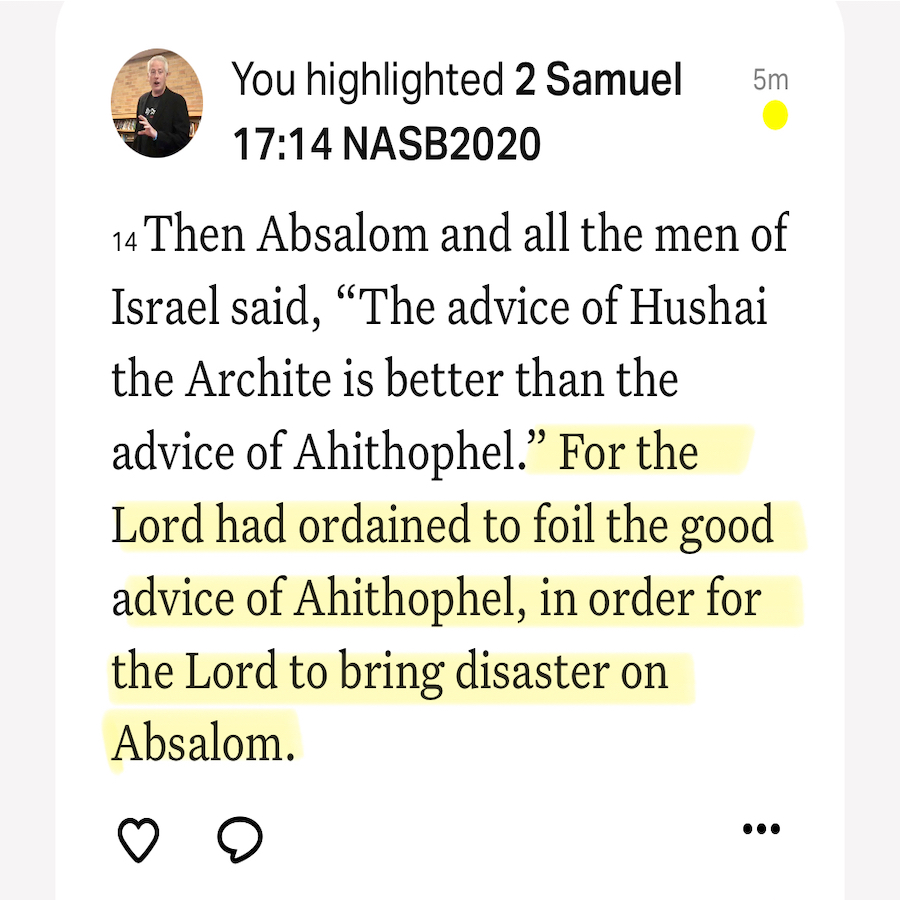
Absalom and all the men of Israel said, “The advice of Hushai the Arkite is better than that of Ahithophel.” For the Lord had determined to frustrate the good advice of Ahithophel in order to bring disaster on Absalom. (2 Samuel 16:20; 17:1-7, 14).
Absalom (unlike his father) didn’t consult God, but consulted men.
Ahithophel had a personal agenda. All he wanted to do is get revenge on David for what he had done to Uriah and Bathsheba. Notice Ahtihophel’s wording: “I will kill only the king” (v. 2).
What was Ahithophel’s beef with David? Uriah—the man whose wife David stole, the man whom David had killed to cover up his affair—was Ahithophel’s son (2 Samuel 23:34, 11:3)!
Hushai, the the other man who gave Absalom counsel, also had an agenda. Hushai is repeatedly given one description: Friend of David (2 Samuel 15:37, 16:16-17; 1 Chronicles 27:33). So Hushai’s sole focus is saving his friend’s life.
Humans always give their advice with their own bias or agenda.
Then David came to Baal-perazim and defeated them there; and he said, “The Lord has broken through my enemies before me like the breakthrough of waters.” Therefore he named that place Baal-perazim. And the Philistines abandoned their idols there, so David and his men carried them away. Now the Philistines came up once again and overran the Valley of Rephaim. So David inquired of the Lord… (2 Samuel 5:20-23).
David was facing the same enemy on the same battlefield. Yet David did presume that God wanted him to attack the Philistines in the same way as before, or even that he was supposed to attack them at all.
“So David inquired again of God.”
The Philistines carried out yet another raid in the valley. David inquired again of God, and God said to him, “You shall not go up after them; circle around behind them and come at them in front of the baka-shrubs.” … David did just as God had commanded him, and they defeated the army of the Philistines from Gibeon even as far as Gezer (1 Chronicles 14:13-14, 16).
It was the same situation and same enemy, but David asked God how to proceed. God gave David a new strategy for this second situation, “David did just as God had commanded him” and won another victory.
Listen to the podcast of this post by clicking on the player below, and you can also subscribe on Apple, Spotify, or Audible.
My podcast partner Greg and I just recorded an episode of our leadership podcast about Christmas traditions. I think there more traditions associated with this time of year than with any other event on our calendars. Traditions keep us connected to our roots, but they also help us feel like we can be in control of things.
There has been a tradition in countries with monarchies that whenever a king died, the people would say something like, “The king is dead. Long live the king!” They would say this because the next king ascended to the throne immediately after his predecessor died. Except when a nation had been defeated, the traditional cry of, “The king is dead” was unanswered by, “Long live the king!”
It appears at this moment that a new tradition has to be started—one where we take leadership over our own fates.
The apostle Peter noted that people awaiting the Second Coming of Jesus would question if that event was ever going to happen. And the prophet Malachi closed the Old Testament with people saying much the same thing: “There doesn’t seem to be any advantage to following God’s laws, so maybe we should just do things our own way” (2 Peter 3:3-4; Malachi 3:13-15).
But then we turn the page to the dawn of the New Testament, and Matthew writes his Gospel about the First Advent of Jesus. He wants to show us that although the line of earthly kings in Israel may have been broken, the promised King of kings had now come to earth.
I’m intrigued by the exceptions Matthew lists in his opening genealogy to illustrate this truth. First, as you might expect, the phrase “thefather of” appears 39 times. This tells us a biological fact of life. These men didn’t know if they had fathered a son or a daughter, what their child’s contribution to the world might be, or even if their child would live faithfully to God.
Matthew opens his genealogy by saying “the son of” twice. First, Matthew lists Jesus as the son of David—the king to whom God gave a very special promise of an eternal King coming from David’s family line. Then Matthew traces the genealogy back further to say “the son of Abraham”—the one through whom God said He would bless all nations (2 Samuel 7:11-16; Genesis 12:1-3).
And what about the exceptional women Matthew records in this male-dominated genealogy? We have Tamar, Judah’s daughter-in-law, who tricked him into fathering a child by her; Rahab, a Canaanite prostitute who put her faith in God; Ruth, a Moabitess who left her homeland because she trusted God; Bathsheba, an adulteress who became David’s wife; and then Mary, the mother of Jesus, who was called “highly favored” of God (Luke 1:28).
The phrase “son of” appears one more time when the angel calls Joseph by this title (Matthew 1:20). Jospeh is also called “thehusband of Mary” (Matthew 1:16).
Whereas Abraham and David were rewarded for their faithfulness to God and were told of future blessings, Joseph’s act was different. Joseph had a choice. He was told that the Child in Mary’s womb would be the Messiah. Now Jospeh had to decide: Would he choose to believe this? Would he choose to bear the shame and reproach to accept his role as father?
We have the a similar choice today: Will we choose to believe that God has announced His plan and that He is fulfilling His plan?
Here’s the simple truth. It appears as two statements, but it is really the same thought—
The Advent of Jesus has come. The Advent of Jesus will come.
The First Advent of Jesus should build our anticipation for the Second Advent. His First Advent should be proof that God keeps His promise.
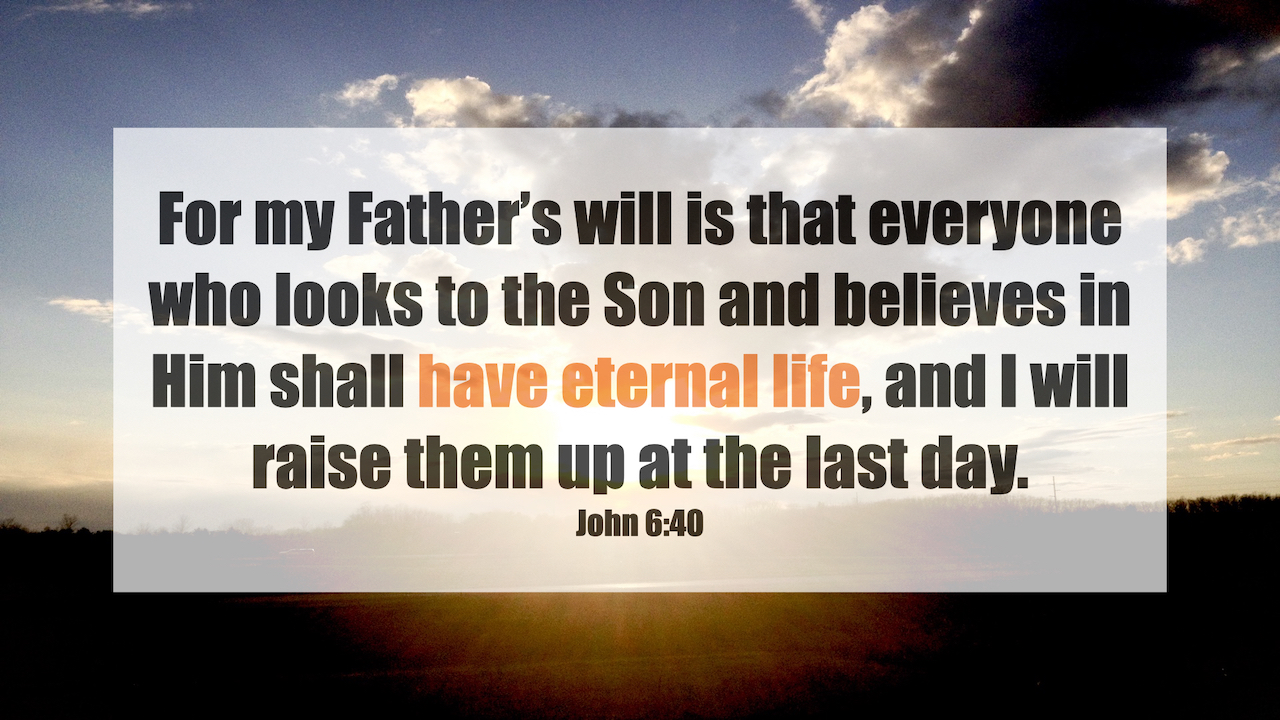
Jesus told us that believing God’s promise would bring us into God’s family. Jesus said, “For My Father’s will is that everyone who looks to the Son and believes in Him shall have eternal life, and I will raise them up at the last day” (John 6:40).
The apostle Paul also assures us, “So in Christ Jesus you are all children of God through faith” (Galatians 3:26).
Let’s not blindly follow the traditions of previous generations, but let us chose for ourselves to believe in God’s promised Messiah, to trust that He alone can give us eternal life, and then let us live in both celebration of His First Advent and expectation of His Second Advent.
T.M. Moore is in a series of posts about the Kingdom of God being revealed on earth. He wrote, “Jesus’ vision of the proximity of the Kingdom, therefore, was a threefold vision: The Kingdom is yet to come in all its fullness (there and then); nevertheless, at the same time, the Kingdom is unfolding in our midst (here and now); and thus every follower of Jesus Christ must make it their primary concern to seek and attain to more and more of the Kingdom of God every day of their lives. Then and there, here and now, more and more: This is how we must think about the Kingdom of God and our involvement in it.”
For many years, the theory of evolution has been unraveling. As more and more discoveries are being made, Darwin’s theory is becoming less tenable. John Stonestreet and Shane Morris wrote a recent blog post on this. Their article opens with this: “In 1973, evolutionary biologist Theodosius Dobzhansky wrote that “nothing in biology makes sense except in light of evolution.” Almost 50 years later, an increasing number of scientists are asking whether evolution makes any sense in light of what we now know from biology.”
The most effective leaders consistently see the world through their teammates’ eyes. Check out this full conversation on The Craig And Greg Show.
“Imagine yourself as a living house. God comes in to rebuild that house. At first, perhaps, you can understand what He is doing. He is getting the drains right and stopping the leaks in the roof and so on: you knew that those jobs needed doing and so you are not surprised. But presently He starts knocking the house about in a way that hurts abominably and does not seem to make sense. What on earth is He up to? The explanation is that He is building quite a different house from the one you thought of—throwing out a new wing here, putting on an extra floor there, running up towers, making courtyards. You thought you were going to be made into a decent little cottage: but He is building a palace. He intends to come and live in it Himself.“ —C.S. Lewis
“No prophet or priest, king or great leader has ever told us to dare to address God as our Father, except Jesus! He is the only One who has taught us to call God, our Maker and Creator, Father. In the Old Testament, that relationship is mentioned only a few times (for example, Exodus 4:22-23; 2 Samuel 7:14). But in the gospels, it is mentioned 165 times. Jesus wanted to instill in us how important God’s fatherhood is. It is not a mere creed. It is a relationship that is central to our new life in Christ and essential in our worship to Him.” —Sobhi Malek
Listen to the podcast of this post by clicking on the player below, and you can also subscribe on Apple, Spotify, or Audible.
The main point in Hebrew literature is usually found in the middle. In Psalm 122 that would be verse 5 where we seethe keyword in this verse is thrones—“thrones for judgment” and “thrones of the house of David.” Before this, we have the call to go up to Jerusalem (the City of Peace) in the first four verses, and after this, we have overwhelming, saturating peace in the last four verses.
But I wonder: How do thrones—especially a throne of judgment—bring about peace?
Remember that these are songs of ascent: we are called upward. I think “up” implicitly appears in verse 1—“I rejoiced with those who said to me, ‘Let us go UP to the house of the Lord,’—and “up” explicitly appears in verse 4—“That is where the tribes go UP, the tribes of the Lord, to praise the name of the Lord.”
There is clearly a longing to go up to meet with God, but I also detect a note of uncertainty. Let me show you what I see. First of all, verse 3 in the New Living Translation says about Jerusalem that “its seamless walls cannot be breached.” And yet the walls were breached in 586 BC when Jerusalem fell to the Babylonians. So anyone singing this song of ascent after the time of exile would have known that the walls weren’t as secure as David hoped they would be.
Second, verse 4 in the Contemporary English Version says that “every tribe of the Lord obeys Him.” And yet it was the disobedience of every tribe of the Lord that led to their defeat and then their 70-year exile. So, again, anyone singing this song of ascent after the time of exile would know about the punishment for disobedience.
In an earlier Psalm, David asked God who could go up to the Holy City, and then he answered his own question like this—
The one whose walk is blameless, who does what is righteous, who speaks the truth from their heart; whose tongue utters no slander, who does no wrong to a neighbor, and casts no slur on others; who despises a vile person but honors those who fear the Lord; who keeps an oath even when it hurts, and does not change their mind; who lends money to the poor without interest; who does not accept a bribe against the innocent. (Psalm 15:1-5)
That description also sounds a bit unachievable to me, because who has ever fulfilled all of the items on that list perfectly?
So we get to verse 5 and read about the thrones. The word “throne” means the seat of honor, authority, and power. It represents the place where the final and unchallengeable word is spoken. There is a final day of judgment before God’s throne, which John records in Revelation 20:11-15.
And yet, that day of judgment is not here yet. Jesus quoted the prophecy from Isaiah about Himself in His first sermon, but He purposely left off the last phrase about the day of judgment. He, instead, ended with the phrase where He had come to “proclaim the year of the Lord’s favor” (Isaiah 61:1-2; Luke 4:17-21). We see this thought again in John’s Gospel—
For God so loved the world that He gave His one and only Son, that whoever believes in Him shall not perish but have eternal life. For God did not send His Son into the world to condemn the world, but to save the world through Him. (John 3:16-17)
If we try to earn our own way into the Eternal Jerusalem, we will find that the walls can be breached, our obedience is not consistent, and that we are unable to keep that full list in Psalm 15. As a result, we face a throne of judgment.
But when we place our faith in what Jesus did for us on the Cross, where He paid the price for our sin, took away our unrighteousness, and gave us His righteousness in its place, then we will stand before the throne of shalom.
In the second half of Psalm 122, the words we read are peace, secure, peace, security, brothers and friends, peace, prosperity. That word “peace” is the Hebrew word shalom, which means nothing lost, nothing missing. Jesus wants us to be in the Eternal Jerusalem with Him for ever and ever.
Christ’s desire is that none should be separated from Him (see 2 Peter 3:9-14), so we could also say that shalom means no one lost, no one missing. We should want everyone—every tribe, nation, and people—to be with us in the Eternal Jerusalem forever!
I rejoiced with those who said to me, “Let us go UP to the house of Lord.” Let’s not go alone. Let’s bring as many people with us as we can to enjoy the eternal shalom of God’s Holy City!
If you’ve missed any of the other messages in our look at the Psalms of Ascent, you can find them all here.
Because of the miraculous things that God had done through Elisha, word began to spread about God’s power that was on display through this godly prophet. In fact, word even spread to other countries, including the land of Aram where was a highly decorated military commander named Naaman lived. This revered leader was afflicted by leprosy. The king of Aram sent Naaman to Elisha to be cured of this disease (see 2 Kings 5).
When Naaman came to Elisha, he was given instructions to bathe himself seven times in the Jordan River. Initially, Naaman balked at this, but eventually, he humbled himself in obedience and was miraculously healed of his leprosy!
Naaman had come to Israel and Elisha with the intention of buying a miracle (just take a look at the treasures that he brought with him). Elisha would not accept money or gifts from Naaman. Not that there’s anything wrong with a prophet receiving gifts, but not when the intention of the giver is to give a bribe.
This is where Gehazi makes a fatal mistake. Gehazi has a conversation with himself (notice the phrase “he said to himself”) that he should have had with Elisha. He determined that he and Elisha were owed something for their ministry work. Gehazi then compounded this unhealthy conversation by telling one lie after another lie to justify the conclusion he had reached.
Elisha knew that God keeps track, that God keeps perfect records, that God will reward far better than any man ever could. He said, “Is this the time to take money or to accept clothes?” No! We need to let God determine the timing and the gift.
As a result, the leprosy that had left Naaman now attacked Gehazi. In reality, it was a leprosy of his heart that merely appeared on his skin. Gehazi was then dismissed from his ministry position with Elisha.
Sadly, I’ve witnessed many ministry leaders who have derailed their leadership with an “I deserve this” attitude. Thinking “I’m owed this” took their eyes off God and put them on the rewards they thought they should have received. How sad this is!
Our constant prayer should be, “Holy Spirit, guard my heart against the leprosy of entitlement. Help me keep the ‘I’m owed this’ attitude far, far away from my heart’s door.”
Listen to the podcast of this post by clicking on the player below, and you can also subscribe on Apple, Spotify, or Audible.
Wounds from a sincere friend are better than many kisses from an enemy (Proverbs 27:6 NLT).
Proverbs 27 may have more wisdom about our friends than any other chapter in this book. But sprinkled throughout the entire book of Proverbs is outstanding wisdom about our closest relationships. Allow me to share just a few observations with you.
Friends love me through my worst moments (17:17) because they have committed to stick closer than a brother to me (18:24).
I must be careful not to make friends with a hot-tempered person (22:24), and to be cautious of people who want to be friends with me only for what I can give them (19:4).
My true friends will wound me in love to help me become the best that God intended me to be (27:5-6, 9, 17), so I must never forsake these friends (27:10).
False friends will gossip to me and about me, but my true friends will guard my secrets and guard my reputation (16:28; 17:9).
In order to have true friends, I first have to be a true friend.
David was the gold standard for every king of Israel who followed him. Numerous times throughout the history of Israel, we will see a note that a certain king either followed God like David, or turned from God unlike David. Yet there exists a wart on David’s portrait: an adulterous affair with the wife of a man in his inner circle, and then subsequent lies and a murder to cover up the affair. “The thing David had done displeased the Lord” (see 2 Samuel 11).
But I’d like to turn your attention to when this affair occurred: “In the spring, at the time when kings go off to war…David remained in Jerusalem” (2 Samuel 11:1). He was without his usual comrades. The men who knew David best, who could probably sense if something was amiss, weren’t around to warn him. When David tried to find out the identity of the bathing beauty on the roof next door to his palace, an unnamed attendant tried to remind him, “Isn’t that Bathsheba, the wife of Uriah?” but David dismissed him.
Elijah was arguably the most forceful and fearless prophet in Israel’s history. Not only did he stand up to the evil kings of Israel, but he spoke out against the kings of surrounding nations, too. In answer to Elijah’s prayer, God brought a drought on the land, and again in answer to Elijah’s prayer, God sent rain. Elijah challenged the 450 prophets of the god Baal and the 400 prophets of the goddess Asherah to a duel to the death, which ended up in a decisive victory for Yahweh. Yet, shortly after this massive victory, Elijah was depressed to the point that he wanted to die.
What led to Elijah’s depression? Something very similar to David’s slide into adultery: He was alone. Elijah ran away from Queen Jezebel’s death threat, left his servant behind, and proceeded all by himself into the desert. It was when he was without a comrade that he prayed to God, “I’ve had enough. Take my life” (see 2 Kings 17–19).
And what about Peter? He boldly claimed his loyalty to Jesus, even to the point of wielding a sword at the guards who came to arrest his Master. But when Peter was alone, after the other disciples fled, he denied three times that he knew Jesus (Matthew 26:33, 51, 69–75).
God designed us to be in relationship with others. His statement to Adam in some of the earliest words of the Bible—“It is not good for you to be alone”—are words for us still today. —from the chapter “Going Farther”
We need true, God-fearing friends close to us. Ask God to bring those friends around you, and ask the Holy Spirit to make you into that kind of friend for those He does bring around you.
David was the gold standard for every king of Israel who followed him. Numerous times throughout the history of Israel, we will see a note that a certain king either followed God like David, or turned from God unlike David. Yet there exists a wart on David’s portrait: an adultrous affair with the wife of a man in his inner circle, and then subsequent lies and a murder to cover up the affair. “The thing David had done displeased the Lord” (see 2 Samuel 11).
But I’d like to turn your attention to when this affair occurred: “In the spring, at the time when kings go off to war … David remained in Jerusalem” (2 Samuel 11:1). He was without his usual comrades. The men who knew David best, who could probably sense if something was amiss, weren’t around to warn him. When David tried to find out the identity of the bathing beauty on the roof next door to his palace, an unnamed attendant tried to remind him, “Isn’t that Bathsheba, the wife of Uriah?” but David dismissed him.
Elijah was arguably the most forceful and fearless prophet in Israel’s history. Not only did he stand up to the evil kings of Israel, but he spoke out against the kings of surrounding nations, too. In answer to Elijah’s prayer, God brought a drought on the land, and again in answer to Elijah’s prayer, God sent rain. Elijah challenged the 450 prophets of the god Baal and the 400 prophets of the goddess Asherah to a duel to the death, which ended up in a decisive victory for Yahweh. Yet, shortly after this massive victory, Elijah was depressed to the point that he wanted to die.
What led to Elijah’s depression? Something very similar to David’s slide into adultery: He was alone. Elijah ran away from Queen Jezebel’s death threat, left his servant behind, and proceeded all by himself into the desert. It was when he was without a comrade that he prayed to God, “I’ve had enough. Take my life” (see 2 Kings 17–19).
And what about Peter? He boldly claimed his loyalty to Jesus, even to the point of wielding a sword at the guards who came to arrest his Master. But when Peter was alone, after the other disciples fled, he denied three times that he knew Jesus (Matthew 26:33, 51, 69–75).
God designed us to be in relationship with others. His statement to Adam in some of the earliest words of the Bible—“It is not good for you to be alone”—are words for us still today.
In a recent episode of “The Craig And Greg Show,” Greg and I discussed one of our favorite verses in the Bible: Wounds from a friend can be trusted, but an enemy multiplies kisses (Proverbs 27:6).
If you want to go far, don’t try to go alone. If you want an accountability partner that can keep warts away from your leadership legacy, don’t go alone. If you want to extend your leadership influence, don’t go alone. If you want to honor God’s investment in you, don’t go alone. Get those friends around you who love you enough to speak the truth!
Listen to the podcast of this post by clicking on the player below, and you can also subscribe on iTunes or Spotify.
Have you heard the cliché, “Experience is the best teacher”? I don’t think that’s really true. I’ve known a lot of people who have had some huge experiences but haven’t learned a single lesson from them. Honestly this is the better statement: Evaluated and recalled experience is the best teacher.
Many of my “life lessons” have cost me money. For instance, I was told numerous times by my parents, grandparents, and my driving instructor not to speed, but I didn’t learn that lesson the easy way. It cost me financially. I recovered from that, and I’ve only had one speeding ticket in the 40 years that followed!
Most of us can recover from a financial loss. But other life lessons cost us more dearly: our broken physical health, lost intimacy in a relationship, a damaged reputation, or missed opportunities. Then we walk around with the weight of guilt, baggage, second-guessing, and regret. Jesus didn’t die on a Cross for us to live weighed down like this!
God wants to help us! So why do we wait to call on Him until after we’ve tried to do it ourselves? Or until after we’re so deep in trouble or weighed down with baggage? Perhaps we think, “This is such a tiny thing. I can handle it myself.”
Solomon said it was the tiny things that brought ruin
God told Cain that it was the sin that was crouching at his door that wanted to take him down
The devil prowls around and looks for the most opportune time to pounce on us
Portia Nelson summed it up well in her short story that I think all of us can relate to…
Chapter 1
I walk down the street.
There is a deep hole in the sidewalk.
I fall in.
I am lost… I am helpless. It isn’t my fault.
It takes forever to find a way out.
Chapter 2
I walk down the same street.
There is a deep hole in the sidewalk.
I pretend I don’t see it.
I fall in, again.
I can’t believe I am in the same place. But it isn’t my fault.
Chapter 3
I walk down the same street.
There is a deep hole in the sidewalk.
I see it is there.
I still fall in… it’s a habit… but my eyes are open, I know where I am.
It’s my fault. I get out immediately.
Chapter 4
I walk down the same street.
There is a deep hole in the sidewalk.
I walk around it.
Chapter 5
I walk down another street.
—Portia Nelson
Prayer helps us avoid the holes in our sidewalk, the crouching sin at our door, the prowling devil, and the lurking temptations. But more than that, prayer puts us on the right path to avoid all of these things in the first place (see Proverbs 3:5-6; Isaiah 30:21; 2 Samuel 22:34, 37)!
God doesn’t have to get ready to help us; He’s already ready to help us. He’s just waiting for us to ask for His help.
No matter how little or big the challenges, with God I can overcome!
No matter how obvious or hidden the hole is, with God I can go down the right street!
No matter how many times I fall in the hole, God can get me out!
No matter how much the devil wants to bring me down, with God I can live righteously!
No matter how many times sin pounces on me and I give in to it, God can forgive me!
Don’t wait a moment longer to call on your heavenly Father in prayer. Let Him hear your voice early and often—He loves to hear from you and respond to you!
Listen to the podcast of this post by clicking on the player below, and you can also subscribe on iTunes or Spotify.
The best way to be a first responder in prayer is to work on making prayer a habit. Prayer needs to come first. Remember: I can do more than pray, but I shouldn’t do anything until I have prayed.
King David showed us his nearly-identical “bookend prayer” that he prayed both at the beginning of his reign as king and again just before he died. We can pray similar bookend prayers when we begin with a petitionary prayer—“God, please help me”—and finish with a thankful prayer—“God, thank You for helping me.” We can also try to expand those bookends toward the middle, allowing us to live as the apostle Paul admonished in 1 Thessalonians 5:17:
Pray without ceasing
Pray continually
Never stop praying
Jesus gave us a model prayer at the heart—the very middle—of His Sermon on the Mount. This sermon has 107 verses of Christ’s words, making the middle verse Matthew 6:6, which starts, “When you pray….” Notice the model Jesus gave us:
Hallowing God—Our Father in heaven, hallowed be Your name
Bringing our petitions—Give us our daily bread, help us forgive, deliver us from evil
Worshiping God for His answers and for Who He is—Yours is the kingdom and the power and the glory forever. Amen!
Surrounding this prayer is a Christ-centered life that is:
Blessed (the beatitudes)
God-glorifying—so they may see your good works and glorify your Father in heaven
Perfect—be perfect, even as your heavenly Father is perfect
Compassionate—when you give to the needy
—Model Prayer—
Disciplined—fasting, handling your treasures
Anxiety-free—do not worry
Fruitful—every good tree bears good fruit
Secure—your foundation is on the rock
You see: Prayer helps us live out a God-honoring testimony, and that God-honoring testimony is empowered by prayer. Prayer is both the bookends AND at the heart of a Christ-centered life.
The heart of a God-honoring prayer is to live out a God-honoring testimony.
David’s bookend prayer follows the same model Jesus gave us: hallowing God, making petitions, and then worshipping God.
Christians need to be BOTH first responders in prayer AND continual responders in prayer—prayer at the beginning, prayer at the heart, and prayer at the end. This way, when God does answer, there is no doubt that He was the One who answered, and it wasn’t just because of something we did.
Prayer fuels our testimony. Our testimony glorifies God. At the heart of this testimony, our answered prayers glorify our heavenly Father and point others to Him.
Let me say it again: The heart of a God-honoring prayer is to live out a God-honoring testimony.



 Absalom said to Ahithophel, “Give us your advice. What should we do?” … Ahithophel said to Absalom, “I would choose twelve thousand men and set out tonight in pursuit of David. I would attack him while he is weary and weak. I would strike him with terror, and then all the people with him will flee. I would strike down only the king and bring all the people back to you….” This plan seemed good to Absalom and to all the elders of Israel.