Listen to the podcast of this post by clicking on the player below, and you can also subscribe on Apple, Spotify, or Audible.
When I was on the Thriving In Ministry podcast, Kyle Willis shared about a time he was at a church leadership seminar with Carey Niewhof. In an anonymous survey among the participants, more than 90 percent of these pastors and church leaders reported feelings of burnout.
Let that sink in: 9-out-of-10 church leaders at a leadership conference were experiencing burnout.
If church leaders are tired, they are ineffective. If church leaders are ineffective, their churches will lack vitality to remain on-mission.
Clearly, something needs to change.
Check out this clip from our conversation where I advocate some changes that church leaders need to make. Here are two of the biggest changes:
Leaders need to learn how to work from a place of rest
Leaders need to learn how to practice self-care more consistently
In my book Shepherd Leadership, I have a section of five chapters where I talk about the example that Jesus set for us to be mentally, physically, spiritually, and emotionally healthy. I encourage you to check out this book for yourself.
Listen to the podcast of this post by clicking on the player below, and you can also subscribe on Apple, Spotify, or Audible.
Jesus began to speak to them in parables… (Mark 12:1).
This is only the fourth parable that Mark records, and as the final parable that Jesus uses in this Gospel, it brings His public ministry to a close.
Jesus concludes this parable by quoting from Psalm 118. This psalm is the last of the “Hallel Psalms” to be sung at the conclusion of the Passover celebration—it is the psalm that looks eagerly to the Messiah‘s arrival. It contains the words that the crowds just used on Palm Sunday: “Lord, save us! Lord, grant us success! Blessed is He who comes in the name of the Lord” (Psalm 118:25-26; Mark 11:9-10).
At the conclusion of this parable, the religious leaders “knew He had spoken this parable against them” (Mark 12:12).
This is important for pastors as they prepare their sermons, but it’s also important for every Christian. We face challenges every day. The Holy Spirit can give us the timeliest of words. The Word of God is the inspired message for us. It is just as relevant and applicable today as it was the day the words were penned. The same Holy Spirit who inspired the authors of Scripture is the same Holy Spirit in us today who will illuminate and apply the Word for us (John 14:26).
Let’s not find our “timely word” from the ever-changing attitudes and opinions of culture, but let us continually go back to the unchanging, always-timely, always-relevant Word of God. That is the only place to find the timeliest of words every single time!
Listen to the podcast of this post by clicking on the player below, and you can also subscribe on Apple, Spotify, or Audible.
Last week we learned that we have a job to do. If we want to see Jesus come back to take us Home, we need to share the Good News with everyone. Jesus said that we didn’t have to obey Him in this Great Commission by ourselves, but we can go in His authority and with the empowerment of the Holy Spirit (Matthew 24:14; 28:18-20; Acts 1:8).
In Acts 1:8 notice that Jesus said we are “be My witnesses.” This isn’t an action first, but they are actions that spring out of who we are. So we need to ask: How are we to be His witnesses? Answer: By being blessed by God!
God has desired that we know the blessing of His presence since the very beginning. He instructed the priests to bless the people with these words:
The Lord bless you and keep you; the Lord make His face shine on you and be gracious to you; the Lord turn His face toward you and give you peace. (Numbers 6:24-26)
The Hebrew word for “peace” in this passage is shalom. One of the most basic definitions for shalom is “nothing missing.” In other words, we are blessed people when we realize there is nothing keeping us back from God’s presence.
If you asked someone in the Old Testament where they thought God’s presence was, they would probably point you to the Tent of Meeting or the Tabernacle in Jerusalem. But that was merely a foreshadowing of what God truly desired for His relationship with us. Jesus promised His followers, “On that day you will realize that I am in My Father, and you are in Me, and I am in you” (John 14:20). So if Jesus is in the Father, and we are in Him, that means we are also in the Father. In this position, we can experience the nearness to the Father that Jesus knows (see Ephesians 1:3-8).
This nearness is our source of peace: Now may the Lord of peace Himself give you peace at all times and in every way. The Lord be with all of you (2 Thessalonians 3:16). In this verse, the Greek word for “peace” is eirene, which means a soul at utter peace with God because it is assured of its eternal Home in God’s presence.
Blessed people are abundance people. Blessed people have all their needs supplied so that they can be a conduit of blessing to others. Our increasing awareness of God’s blessing empowers us to be witnesses for Him.
Let me take you back to the Book of Psalms. In Psalm 67, the psalmist asks for God’s blessing on his life four times in just seven short verses. Why does he desire this blessing? It’s not for himself but for others. Look at just the first two verses of this psalm:
May God be gracious to us and bless us and make His face shine on usTHAT Your ways may be known on earth, Your salvation among all nations.
Recall that Jesus commissioned us to go to all nations and that the Holy Spirit empowers our witness to all peoples. This psalmist is asking for God’s blessing so that he can be a witness to everyone. Nine times he says that he desires that all nations or all peoples will know and worship the Most High God.
God’s blessing on His people is really SO THAT all peoples and nations can see His blessing and turn to Him. One of the roles of the Holy Spirit in a believer’s life is to remind us that we are indeed blessed in Jesus, and that we have a mission to fulfill in taking that blessing to others.
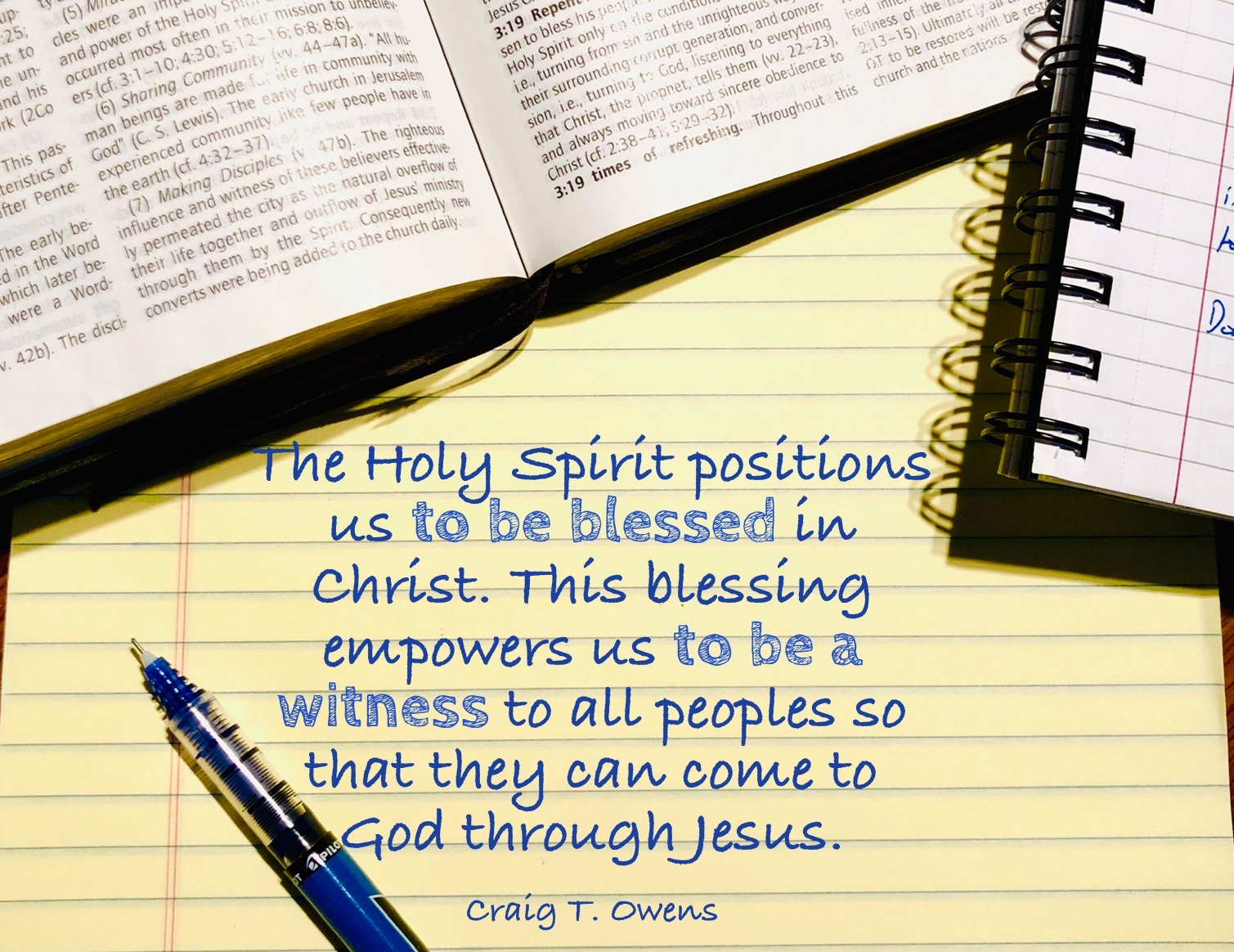
The Holy Spirit positions us to be blessed in Christ. This blessing empowers us to be a witness to all peoples so that they can come to God through Jesus.
It is good for us to pray for the Spirit’s blessing on our lives so that we can BE a blessing to all nations and peoples.
If you would like to check out all of the other messages in our series called We Are: Pentecostal, please click here.
Leaders always go first. I want to develop myself so that I have something to give to other emerging leaders around me. If I’m not growing, I’m not going to be able to help others. Check out this full conversation Greg and I had our on leadership podcast The Craig And Greg Show. And be sure to check out all of my videos on my YouTube channel.
“The important thing is not to stop questioning. Curiosity has its own reason for existing. One cannot help but be in awe when he contemplates the mysteries of eternity, of life, of the marvelous structure of reality. It is enough if one tries merely to comprehend a little of this mystery every day. Never lose a holy curiosity.” —Albert Einstein
This is sort of gross, but kind of cool at the same time. “A new study in the journal Scientific Reports concludes that 12 severed hands discovered in 2011 at Tell el-Dab’a (the site of the ancient Hyksos capital of Avaris) constitute the first bioarchaeological evidence of the gruesome ‘trophy taking’ practice of amputating the right hands of defeated enemies.” Read more about this find here. This is a corroboration of the ‘trophy taking’ David performed for King Saul in the Bible.
The more scientists learn about Creation, the more in awe of our Creator I am! Recently, researchers have discovered even more happening inside our cells that keep everything operating optimally. And then there’s this: “Besides the origin of the eye, Darwin had a problem with the origin of flowering plants (angiosperms—plants that produce seeds within an enclosure, i.e., a fruiting plant), known as Darwin’s abominable mystery. The biblical model of origins maintains that the first forms of life created by God were land plants on Day 3 of the creation week. Land plants were fully-formed and functional—‘in the beginning.’”
Dan Reiland encourages leaders to look at their weaknesses differently. “The chinks in your armor allow you to develop empathy and compassion. They give you insight to human nature. They help you genuinely connect with people. Without these things it’s difficult to lead with God’s heart.”
I am a proud member of the Assembly of God fellowship, so I especially loved reading this report on Breakpoint:
“According to recent research by pastor Ryan Burge of eight major Protestant denominations, only the Assemblies of God has seen a steady increase in church membership since 1987. Each of the others, mostly denominations that are fully progressive theologically and culturally, are experiencing steady decline.
“Denominations like The Episcopal Church, Evangelical Lutheran Church in America, and the Presbyterian Church (USA) began long ago to move away from orthodoxy and capitulate to new ideas about sex, gender, and marriage. On the other hand, the Assemblies of God (AG) remained committed to orthodoxy on matters of Scriptural authority, the Deity of Christ, the Resurrection, and on sexual matters. It supports the protection of life at all stages, marriage between one man and one woman, and it insists that the body determines identity as male and female.
“Christians are constantly pressured, within the Church and without, to evolve on these issues or, we are told, we will die out. It seems however, that biblical orthodoxy draws people in. Maybe because it provides an anchor in confusing times.”
Listen to the audio-only version of this podcast by clicking on the player below, or scroll down to watch the video.
Accepting a new position is a very exciting experience! Whether it’s a promotion in your current organization or an opportunity elsewhere, it’s very tempting to want to immediately throw your full attention into the next project. In this episode, Greg and I discuss the necessity of maintaining a balance between that excitement and recognizing that the people on your team now still need your leadership. This might create more work for you in the short term, but the long-term benefits of transitioning well will be huge for you!
[0:33] Any fresh starts for leaders have to be handled thoughtfully.
[2:44] Leaders of integrity give their best effort all the way to the end.
[4:08] How can we maintain a humble attitude when we have been selected to be promoted to a new position?
[6:08] There are different things to keep in mind when moving to a new position in the same organization vs. moving to a new organization.
[8:02] Both of us share stories about friends who benefitted by leaving their old organizations well, and they identify what the true litmus test for leaving well is.
[10:14] Greg also has a negative example to share.
[11:03] How do senior leaders handle coworkers who leave poorly?
[13:06] How do we keep ourselves from being distracted by our new position while we attempt to finish well in our old position?
[16:15] How do we arrive well in our new position?
[18:35] We need to always keep in mind that we are leaving or joining a team of many—we aren’t a team of one.
[22:57] Finishing well is a compliment to the organization you are leaving, and beginning well is a compliment to the organization you are joining.
Check out this episode and subscribe on YouTube so you can watch all of the upcoming episodes. You can also listen to our podcast on Spotify and Apple.
In my book Shepherd Leadership, I talk about the simple three-word phrase that has helped me maintain this balance: God chose me. The fact that God did the choosing should give me the confidence to cast vision, but the humility that God chose me—out of all of the other people He could have chosen—should bring an appropriate humility that allows me to involve other leaders on my team.
If you would like to watch this full interview on the Leading From Alignment podcast, please go here. And if you would like to check out other clips I’ve already shared, please click here.
I’ll be sharing more clips from this interview soon, so please stay tuned. Shepherd Leadership: The Metrics That Really Matter is available in print or ebook, and in audiobook through either Audible or Apple.
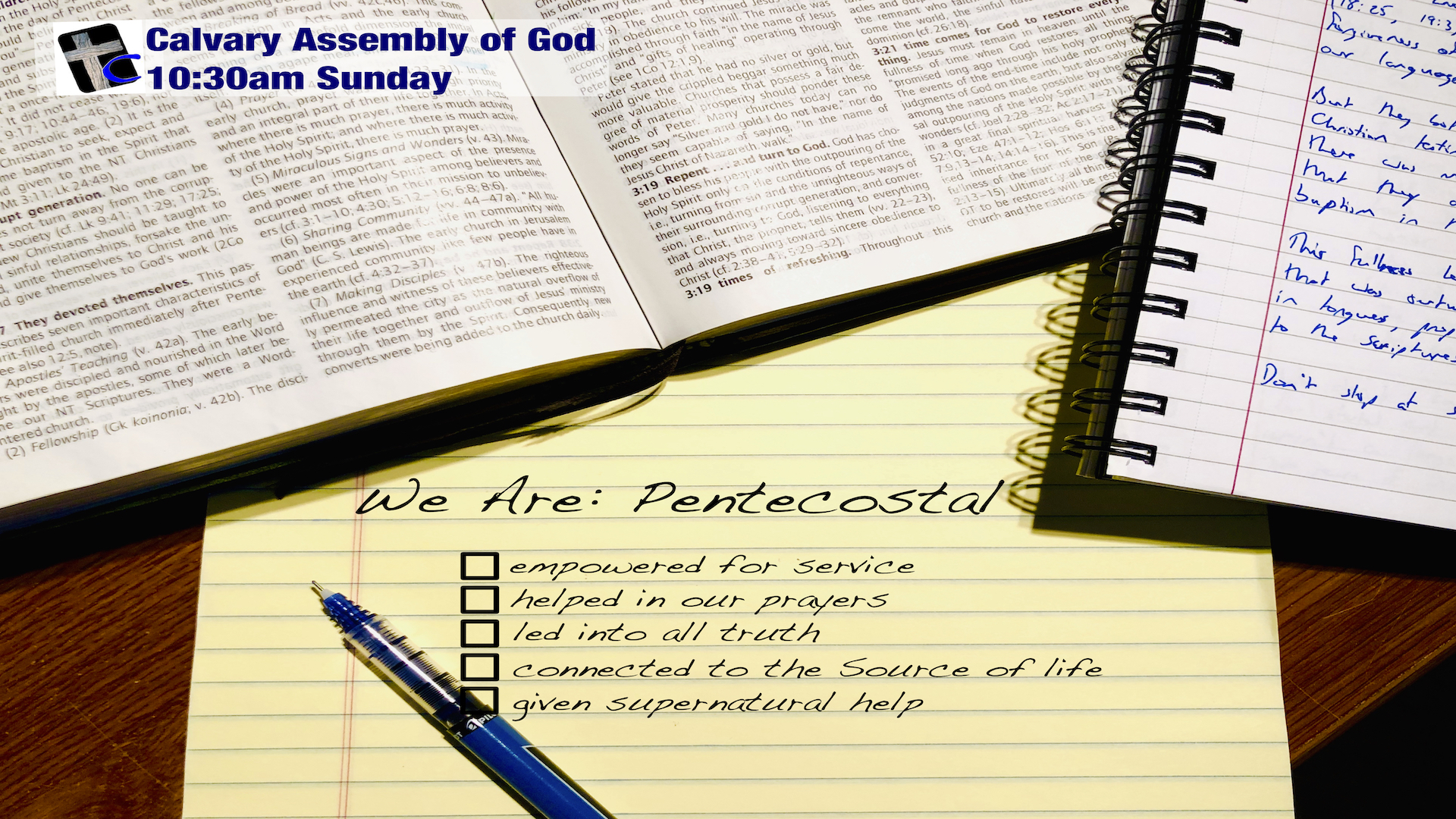
Pentecost for over 1500 years was a celebration in Jerusalem that brought in Jews from all over the world. But on the Day of Pentecost which came just ten days after Jesus ascended back into heaven, the meaning of Pentecost was forever changed!
Followers of Jesus—now empowered by an infilling of the Holy Spirit—began to take the good news of Jesus all over the world. These Spirit-filled Christians preached the Gospel and won converts to Christ even among hostile crowds, performed miracles and wonders, stood up to pagan priests and persecuting governmental leaders, and established a whole new way of living as Christ-followers.
We, too, can be Pentecostal followers of Jesus Christ today. We can experience an anointing and an empowering in our lives that turns ordinary Christianity into extraordinary Christianity!
Please join me this Sunday at Calvary Assembly of God as we rejoin this series. You can check out what I taught in this series in 2019 by clicking here, the messages from 2020 are here, the messages from 2021 are here, and the messages from 2022 are here.
Listen to the podcast of this post by clicking on the player below, and you can also subscribe on Apple, Spotify, or Audible.
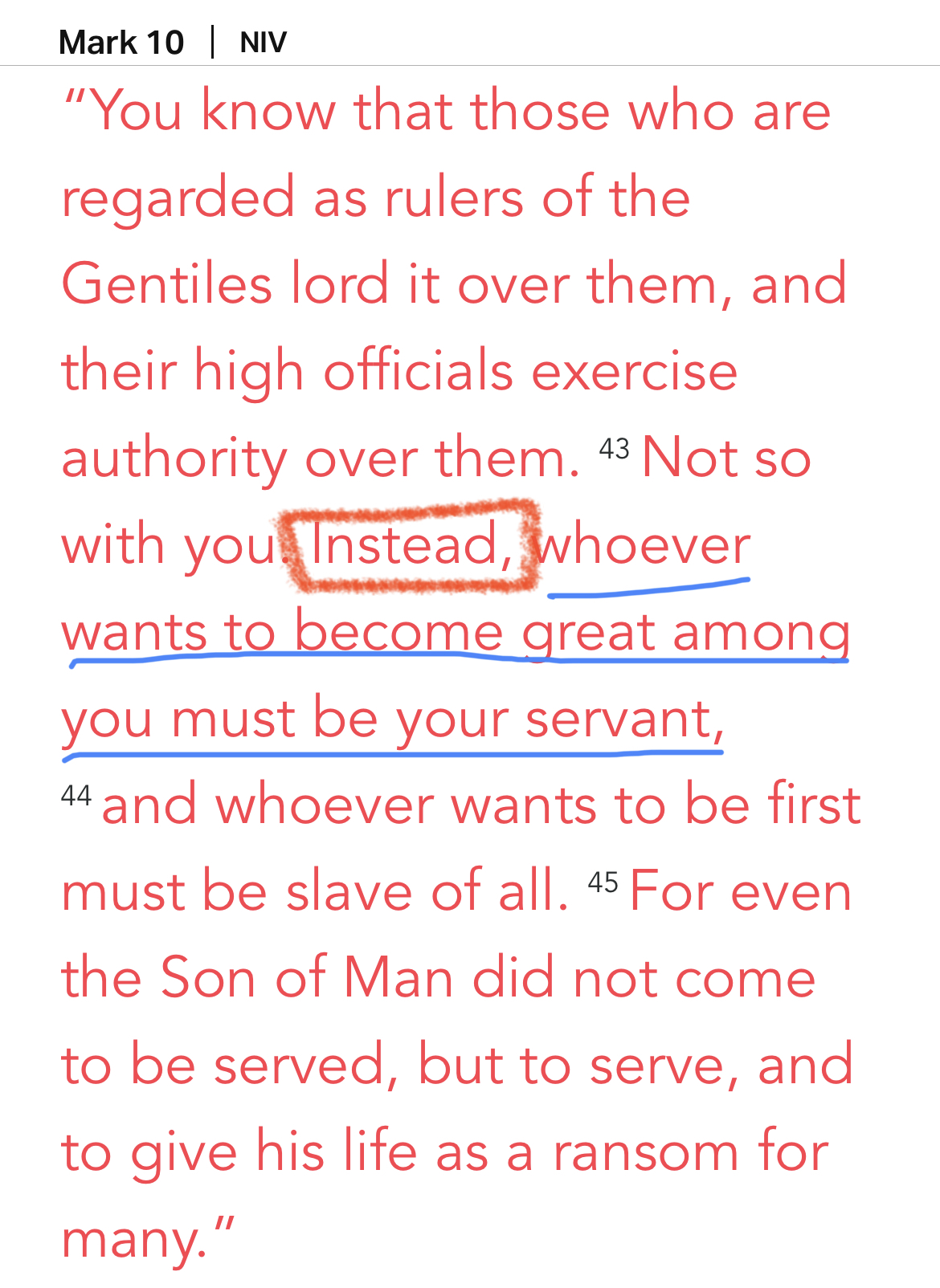
So Jesus called them together and said, “You know that the rulers in this world lord it over their people, and officials flaunt their authority over those under them. Not so with you. Instead…” (Mark 10:42-43).
A Christlike leader is an “instead” leader.
Instead of exercising authority, exercising humility.
Instead of being served, serving everyone else.
Instead of being first in line, being last in line.
Instead of seeking recognition, seeking anonymity.
Instead of collecting titles, collecting calluses.
Instead of receiving, giving.
Jesus, help me to be an “instead” leader—to strive to more consistently lead like You.
If you were one of Christ’s disciples, wouldn’t you think it would be time for Jesus to take a victory lap? Maybe He could show up at the next meeting of the Sanhedrin, or in Pontius Pilate’s courtroom, or King Herod Antipas’ throne room. You can almost hear their longing for this when they asked Jesus, “Lord, are You at this time going to restore the kingdom to Israel?” (Acts 1:6).
Jesus answered that question by saying, “Your race is just now beginning!” You see, Christ’s resurrection wasn’t the end of the race, but an important—absolutely indispensable—part of our ongoing race. “I will be raised back to life again” was a bold claim, but it wasn’t the final bold claim. There is one more for us to consider.
The resurrection of Jesus is our assurance that what Jesus says He will do, He will do. One of the things He promised is, “I am going to prepare a place for you and I will come back to get you” (John 14:1-3). The place Jesus has prepared for us is the end of our race—the finish line for which every Christian should be longing.
The disciples asked Jesus how they could know when His return was getting closer. He gave them a lot of things to watch for, but He concluded by saying, “And this gospel of the kingdom will be preached in the whole world as a testimony to all nations, and THEN the end will come” (Matthew 24:14).
In order for us to go Home, the whole world—people in all nations—have to hear the Good News of the Kingdom of God.
In one of the boldest claims of all, Jesus says He has ultimate authority, and that He is commissioning us to use His authority for the express purpose of our missionary work to all nations. Notice the “therefore” which indicates what we are to do with His authority—
All authority in heaven and on earth has been given to Me. Therefore go andmake disciples of all nations, baptizing them in the name of the Father and of the Son and of the Holy Spirit, and teaching them to obey everything I have commanded you. And surely I am with you always, to the very end of the age. … But you will receive power when the Holy Spirit comes on you; and you will beMy witnesses in Jerusalem, and in all Judea and Samaria, and to the ends of the earth. (Matthew 28:18-20; Acts 1:8)
The apostle Paul appreciated this analogy of running a race. Just before it was time for Paul to go Home, he told his friend Timothy, “I have fought the good fight, I have finished the race, I have kept the faith” (2 Timothy 4:7).
Earlier in his life, Paul used a running example when he wrote to the Christians at Corinth—
Do you not know that in a race all the runners run, but only one gets the prize? Run in such a way as to get the prize. Everyone who competes in the games goes into strict training. They do it to get a crown that will not last, but we do it to get a crown that will last forever. Therefore I do not run like someone running aimlessly; I do not fight like a boxer beating the air. No, I strike a blow to my body and make it my slave so that after I have preached to others, I myself will not be disqualified for the prize. (1 Corinthians 9:24-27)
Paul gives us three don’ts and three dos in this passage:
Don’t fail to train, don’t run aimlessly, don’t get disqualified by focusing on the temporal
Do go into strict training, do stay focused on the eternal, do run for the prize of hearing Jesus say, “Well done!”
Do you want to go Home? Do you want Jesus to come again to take all of His children Home? Then finish the race of telling everyone in the whole world the Good News about Jesus.
The Holy Spirit can speak to us through other people. Be sure to check out all of my videos on my YouTube channel.
“A time will come when instead of shepherds feeding the sheep, the church will have clowns entertaining the goats.” —Charles Spurgeon
“It is possible to adopt an outward demeanor of great meekness, while inside our appetite for applause is insatiable. . . . Oh, what a constant companion, what a tyrannical commander, what a sly, subtle and insinuating enemy is this sin of pride!” —John Stott
“Every word from God comes with the power to make that word happen.” —Kevin Berry
“The question is not, ‘Should we pray for the lost people of our community?’ The question is, ‘Will we?’ Will we pray for our neighbors, our community, our nation, and our world? Will we seek the peace of the world and the wellbeing of all our fellow humans before the Lord in prayer? [Jeremiah 29:7]
“If we will not, then we must face up to the fact that we are disobeying a divine mandate, abandoning our neighbors to their folly, and stoking the fires of indifference—if not outright scorn—for the unbelieving world around. But if we will pray, who knows what God might be willing to do?
“Those prayers may be prayers of anguish and anger at times; but they must also be prayers for God to work in the hard hearts of our unsaved neighbors, just as He has worked in ours, to bring new life, forgiveness, and hope to those who now live apart from God in a world full of rebellion and sin.” —T.M. Moore
Axis is a great resource to help parents communicate effectively with their pre-teen and teenage children. In the wake of the school shooting in Nashville, Axis posted this: “We have created resources to help parents and caring adults have conversations about violence and school shootings. Consider our Conversation Kit on Violence, our Parent’s Guide to School Shootings, our Parent’s Guide to Talking About Violence, and our Parent’s Guide to Anxiety, for starters.”
“Failure is a part of success. There is no such thing as a bed of roses all your life. But failure will never stand in the way of success if you learn from it.” —Hank Aaron



 When I was on the Thriving In Ministry podcast, Kyle Willis shared about a time he was at a church leadership seminar with Carey Niewhof. In an anonymous survey among the participants, more than 90 percent of these pastors and church leaders reported feelings of burnout.







 Craig T. Owens