Free? To Do What?

Listen to the podcast of this post by clicking on the player below, and you can also subscribe on AppleSpotify, or Audible.

At the En Gedi Youth Center, the students loved when our schedule said “free time.” To them: Free time = me time!

Is that how you see your “free time.” Is your free time your me time?

For a Christian, being free should mean something completely different. It’s not time for me, but Peter wrote:

Live as free men, but do not use your freedom as a cover-up for evil; live as servants of God. (1 Peter 2:16)

Free time is not me time, where I get to decide what to do, when I want to do it, and with whom I want to do it. That’s actually slavery to my passions or appetites.

Freedom is the ability to quickly obey God in service.

Any time I delay in obeying God’s call to serve, I am really disobeying Him. If I call Jesus my Savior and my Lord, then He has freed me from the entanglements of sin so that I may quickly say “Yes” to His call to service.

I love the King James Version’s phrasing of this verse: not using your liberty for a cloak of maliciousness. I am either obedient and serving, or I am disobedient and malicious. There is no middle ground.

No excuses.

No cover-ups.

I know I am free when I am thrilled to be able to quickly and readily answer God’s call to be a servant.

►► Would you please prayerfully consider supporting this ministry? My Patreon supporters get behind-the-scenes access to exclusive materials. ◀︎◀︎

Who Do You Think You Are? (book review)

Who Do You Think You AreIf you’ve ever heard Mark Driscoll speak, you know that he pulls no punches as he unashamedly uses the Bible to address the situations we all face. Who Do You Think You Are? is no exception.

Your friends, Madison Avenue, your colleagues, even your family members are all trying to influence you. They all weigh-in on who you are, or who they think you should be. But Pastor Mark Driscoll wants to show you who the Bible says you are. So using the book of Ephesians in the Bible, Pastor Mark convincingly and lovingly will show you that you are…

  • In Christ
  • A saint
  • Blessed
  • Appreciated
  • Saved
  • Reconciled
  • Afflicted
  • Heard
  • Gifted
  • New
  • Forgiven
  • Adopted
  • Loved
  • Rewarded
  • Victorious

Pastor Mark writes in a very readable, conversational style as he uses the powerful words of Ephesians, along with some personal stories from his own life, as well as the lives of others he has known, to make sure you know how God sees you. In a world where everyone else wants to squeeze you into a different mold, how freeing it is to discover how God sees you, and to know that God loves you because you’re you!

This was a very encouraging read. I’d recommend this to anyone struggling with peer pressure or with their own self-identity. I also think this would be an excellent book to use in a small group setting, perhaps even among a recovery group.

I am a Thomas Nelson book reviewer.

I have shared some quotes from this book here.

Weighing The Positives And Negatives*

WeighingDon’t you get annoyed when an overly-religious person spouts off some pie-in-the-sky, feel-goodism that sounds religious, but doesn’t seem to have any grounding in the real world?

Like when a church leader says, “Praise be to the God and Father of our Lord Jesus Christ” when you are in the midst of a painful situation? This is one of those statements that’s great for church, but not so great for the battlefield of life, right?

Actually that statement was made by the apostle Peter (see 1 Peter 1:3).

He didn’t shout it in a church service, but in a letter to Christians who were on the run from their persecutors. Many of them had lost their homes and businesses, had to leave their hometowns, were separated from their families, and were having their very lives threatened. Peter didn’t just shout this praise, he explained its origin, too.

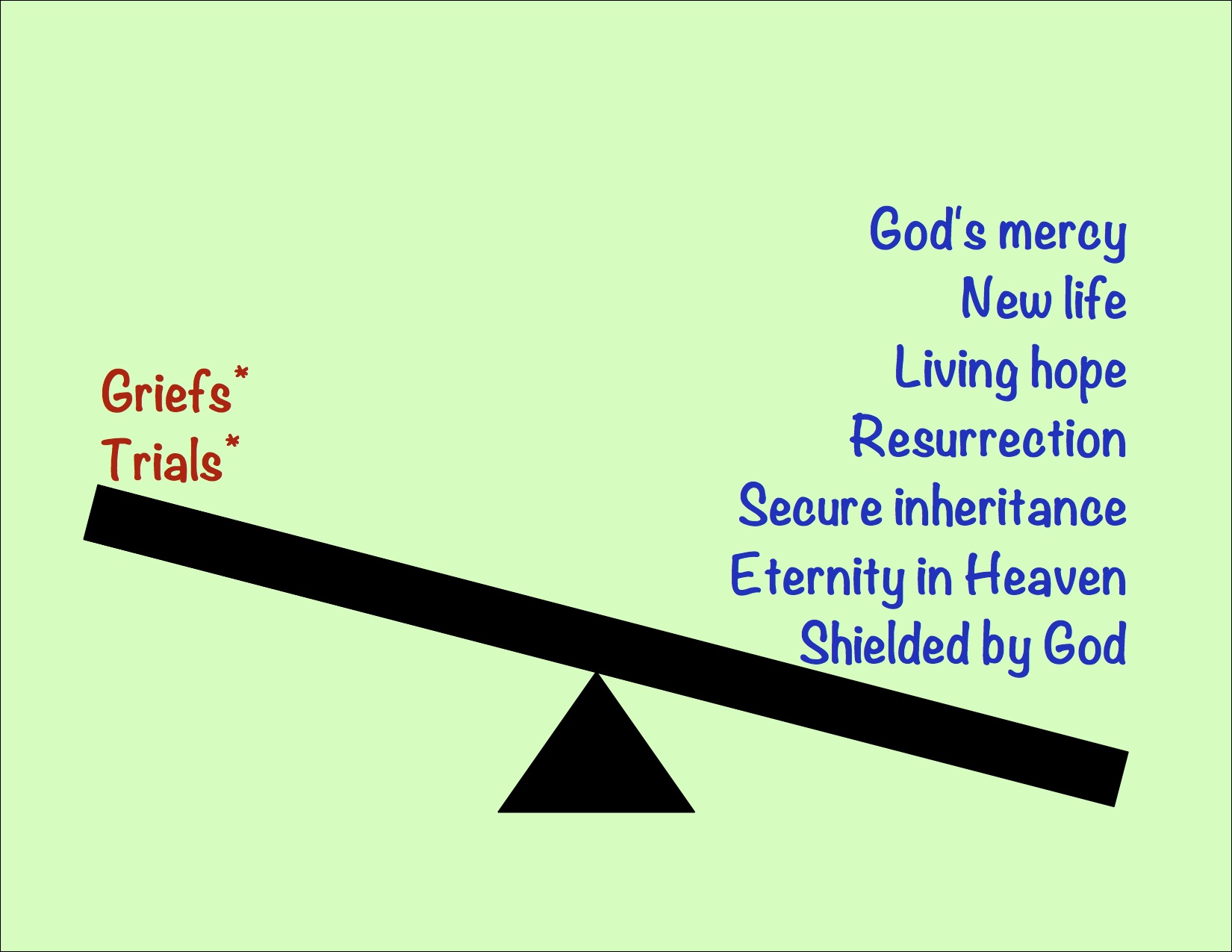
Over the next few verses he asks us to consider what a relationship with Jesus Christ would bring us, and then to put the positives and negatives on a scale—

The Positives

  • God’s mercy
  • New life
  • Living hope
  • Resurrection from the dead
  • Secure inheritance
  • An eternity with God in Heaven
  • God’s power shielding us

The Negatives*

  • Grief
  • Trials

*

So whether we look at the eternal positives or the temporary “negatives” there is cause for rejoicing. When a Christian is in a difficult situation, he must remember this:

  1. This situation is only temporary
  2. This situation will ultimately bring glory to God

Weigh the positives and negatives and you will see that what you are going through now cannot even begin to compare to the glory of God that is coming! The apostle Paul echoed Peter’s words when he wrote, “I consider that our present sufferings are not worth comparing with the glory that will be revealed in us” (Romans 8:18).

So keep your eyes on Jesus, and keep shouting your praise to Him.

Holy Spirit, please help me to look away from the temporary and keep my eyes on my eternal God and Savior.

Bullying

UnstoppableI wish this were not so: Bullying is real.

This is a hot-button issue for me, because there is something in my personality that gets fired up by a bully, more than almost any other issue. Bullies are truly cowards, but to the one being bullied at school or at work, that doesn’t seem true. Many times someone getting bullied feels they are all alone, which is why others need to be aware and step in to help.

In his book Unstoppable, Nick Vujicic talks about when he was bullied at school (you can read my book review of Unstoppable by clicking here). He then offers a list of symptoms to be aware of in someone close to you.

Common signs that someone is the victim of bullying include:

  • Increased reluctance to go to school or work events that peers attend
  • Refusing to discuss the day’s events upon coming home
  • Torn clothing, unexplained injuries, and stolen items
  • Asking for extra money to take to school
  • Carrying weapons to school
  • Reporting headaches, stomach problems, and nervousness before leaving and upon returning home
  • Reporting an inability to sleep or having bad dreams
  • Increased problems concentrating
  • Major changes in eating habits, either more or less
  • Little or no social interaction with peers
  • Self-harming through cutting, scratching, hair pulling, and other means
  • Appearing fearful to leave the house
  • Running away from home
  • Sudden drop in school or work performance
  • Dramatic darkening of mood before leaving and upon returning home
  • Negative and self-critical expressions

From his personal experience, Nick also offers this wise advice—

If you are a victim of bullying, remember that the most important battle you must win is the one within. What someone else says or does to you should never define who you are. God created you for a purpose. You have value in His eyes. Put your faith in that, and then put that faith into action by rising above any criticism, gossip, or abuse that happened in the past. You were perfectly made by God. Don’t let anyone tell you differently. A bully wants you to believe that you are less than you are, because putting you down makes the bully feel superior. You don’t have to play that game. Focus instead on building upon your gifts. God will take care of the rest. Joy and fulfillment will come as you walk the path created for you and only you.

If someone is bullying you at school or at work, please tell someone close to you. Trust me: they want to help you!

Let’s be aware of these telltale signs in those we love, and then step in to help where needed. A great resource to help you navigate the nasty world of bullying is The Jeremiah Project 51. Please click on the link and check out their resources.

Fuller Love

Listen to the podcast of this post by clicking on the player below, and you can also subscribe on AppleSpotify, or Audible.

Love is not always flowery and sweet, where everyone gets along, and no one is ever mean or even unkind. Actually that’s not love; that’s selfishness. You’re saying, “I will love you because it makes me feel good. I get something special out of this when I am kind and loving to you.”

The ancient Greeks had different words for love. Whereas we use love for food (“I love my pasta”), and the same word for special people (“I love my wife”). But we all know that I’m not really saying my wife and a plate of spaghetti are on the same level.

So the Greeks had a word for love for the inanimate (like food and music), and a word for this-makes-me-feel-so-good (like sex and alcohol), and a word for treating someone humanely or kindly (sometimes called brotherly love). These are well-known loves, but they are very fragile. The law of diminishing returns says that each time I experience one of these loves, its ability to please me the next time is slightly reduced, until at one point this thing/person no longer satisfy me at all. In fact, they may even cause my stomach to churn in nausea.

But there was one more word the Greeks used for love, that the biblical writers used almost exclusively. This word (agape) is not tuxedos and dancing gowns and chandeliers. This love shows up in work clothes, with callouses on its hands and knees, because it’s determined to serve someone else no matter what!

This is the kind of love God exhibited toward us—God shows and clearly proves His own love for us by the fact that while we were still sinners, Christ died for us (Romans 5:8).

And this is the kind of love Jesus commanded us to exhibit toward others… even toward those we think are unloveableBy this all men will know that you are My disciples, if you love one another. … If you love those who love you, what credit is that to you? Even “sinners” love those who love them. And if you do good to those who are good to you, what credit is that to you? Even “sinners” do that (John 13:35; Luke 6:32-33).

This is the kind of full love that those apart from Jesus Christ do not know, but they can see it and be drawn to it if Christians will demonstrate it. Henry Drummond said this—

“Never offer men a thimbleful of gospel. Do not offer them merely joy, or merely peace, or merely rest, or merely safety; tell them how Christ came to give men a more abundant life than they have, a life abundant in love. … Then only can the gospel take hold of the whole of a man, body, soul and spirit. … Only a fuller love can compete with the love of the world.

Let’s show the world a fuller love, and in so doing we will show them Jesus!

If you missed any of the messages in our Loving the Unlovable series, you can check them all our here.

►► Would you please prayerfully consider supporting this ministry? My Patreon supporters get behind-the-scenes access to exclusive materials. ◀︎◀︎

My Brothers

My brothersPastor, I love how the Apostle James consistently addresses his audience in his epistle. Over a dozen times in his five short chapters, Pastor James addresses his congregation as my brothers (sometimes the phrase is even my dear brothers).

The word brothers is always the Greek word adelphos, which means from the same womb. James didn’t elevate himself, nor put down others in the church; he constantly put himself on the same plain. He was saying, “Look, I struggle with what you struggle with—we all have the same issues. I’m not immune to these things because I’m the so-called leader of the Jerusalem church. I have to keep alert and keep on working in these areas too!”

Sometimes James adds the adjective dear (or as the KJV says, beloved). This word is from the root word which means to be fond of someone, to love dearly, or to be well pleased. James, in essence, is saying, “I like you! You’re not just someone that goes to church with me, but you’re a dear friend.”

As the adage goes—People don’t care how much you know until they know how much you care. So almost every point James covers in this epistle is introduced by the my brothers tag. It’s his way of reminding them, “I’m sharing this with you because I really like you, and I want us to grow closer to God together.”

Wow! What a great example for me as a pastor. I’m not immune to struggles. I’m not in a separate category. I’m in this with my dear brothers and sisters, and I want us to all overcome and grow in our level of intimacy with God together.

UPDATE: This is one of the major themes in my book for pastors called Shepherd Leadership. I hope you will check it out!

Thursdays With Oswald—Helping Me Do What God Desires

This is a weekly series with things I’m reading and pondering from Oswald Chambers. You can read the original seed thought here, or type “Thursdays With Oswald” in the search box to read more entries.

Helping Me Do What God Desires

     My spirit has no power in itself to lay hold of God; but when the Spirit of God comes into my spirit, He energizes my spirit, then the rest depends upon me. If I do not obey the Spirit of God and bring into the light the wrong things He reveals and let Him deal with them, I shall grieve Him, and may grieve Him away. 

     …That is a most wonderful thing in Christian psychology, viz., that a saint chooses exactly what God pre-determined he should choose. If you have never received the Spirit of God this will be one of the things which is “foolishness” to you; but if you have received the Spirit and are obeying Him, you find He brings your spirit into complete harmony with God. … 

     When God’s Spirit comes into our spirit, we can will to do what God wants us to do. “For it is God which worketh in you both to will and to do of His good pleasure” (Philippians 2:13). … 

     We cannot give ourselves the Holy Spirit; the Holy Spirit is God Almighty’s gift if we will simply become poor enough to ask for Him. … But when the Holy Spirit has come in, there is something we can do and God cannot do, we can obey Him. If we do not obey Him, we shall grieve Him. “And grieve not the Holy Spirit of God” (Ephesians 4:30). 

From Biblical Psychology

Jesus told us that the Holy Spirit would be our constant Companion in helping us come into one-ness with the Father and Son. The key question is this: Am I obeying the Spirit’s promptings?

I will never progress in my spiritual development unless I am readily obeying what the Spirit is revealing. 

Father, I need your Holy Spirit! As I feel the Spirit working in me, may I never grieve Him, but instead fully deal with whatever He reveals to me.

16 Quotes From “God’s Workmanship”

God's WorkmanshipWhere to start? It’s always hard to share a few quotes from a book that is so rich, but I hope these fews quotes will not diminish the depth of Oswald Chambers’ wisdom. These are just a very few of the outstanding quotes from God’s Workmanship (you can read my full book review by clicking here).

“Whenever I say, ‘I want to reason this thing out before I can trust,’ I will never trust. The reasoning out and the perfection of knowledge come after the response to God has been made.”

“We can never become God’s people by thinking, but we must think as God’s people. … Intellect is meant to be the handmaid of God, not the dictator to God. … We have to work out, not our redemption, but our human appreciation of our redemption. We owe it to God that we refuse to have rusty brains.”

“Separating myself from other people is the greatest means of producing deception because there is nothing to clash against me. Immediately people clash against me I know whether my beautiful thinking really expresses ‘me,’ or is a garment that disguises the real ‘me.’ If my actual life is not in agreement with my thinking the danger is that I exclude myself from actualities which bring home to me the knowledge of what I am, in spite of what I think. ‘I am a Christian worker and must put on this garb!’ That is sanctimonious jargon; the only thing that will hold me right is a personal relationship to Jesus, and that life is essentially simple, there is no break into secular and sacred, the one merges into the other, exactly as it did in the life of our Lord.”

“I want to ask a very personal question—How much do you want to be delivered from? You say, ‘I want to be delivered from wrong-doing’—then you don’t need to come to Jesus Christ. ‘I want to walk in the right way according to the judgment of men’—then you don’t need Jesus Christ. But some heart cries out—‘I want, God knows I want, that Jesus Christ should do in me all He said He would do.’ How many of us ‘want’ like that? God grant that this ‘want’ may increase until it swamps every other desire of heart and life.”

“When you are baptized with the Holy Ghost, there is only One you see, One you love, One you live for from early morning till late at night, One you die for. Every thought is gripped and held enthralled by the Master of human destiny, the Lord Jesus Christ, and the whole life is devoted to Him.”

“All that I want to possess without the power to give, is of the nature of sin. … I cannot rob God of anything, but I rob myself of God every time I stick to what I possess.”

“What kind of attitude have we got toward Jesus Christ? are we dictating to Him in pious phraseology what we intend to let Him do in us, or letting His life be manifested in our mortal flesh as we obey?” 

“‘The Truth’ is our Lord Himself; ‘the whole truth’ is the inspired Scripture interpreting the Truth to us; and ‘nothing but the truth’ is the Holy Spirit, ‘the Spirit of truth,’ efficaciously regenerating and sanctifying us, and guiding us into ‘all the truth.’”

“When I am rightly related to God, the more I love the more blessing does He pour out on other lives. The reward of love is the capacity to pour out more love all the time. … I surrender myself—not because it is bad, self is the best thing I have got, and I give it to God; then self-realization is lost in God-realization.”

“Another demand God makes of His children is that they believe not only that He is not bewildered by the confused hubbub of the nations, but that He is the abiding Factor in the hubbub.”

“God never hears prayer because a man is in earnest; He hears and answers prayer that is on the right platform—we have ‘boldness to enter into the holy place by the blood of Jesus’ (rv), and by no other way. It is not our agony and our distress, but our childlike confidence in God.”

“The evidence of the new creation in me is that I submit to God more and more easily, surrender to Him more and more readily. …God does the supernatural re-creating and the setting free of the will, I have to do the doing.”

“You can only be made a Christian by a miracle, and you can stop at any point you like. ‘I don’t intend to go through this’—and you don’t need to; but it will be a terrific awakening when you see Jesus and realize that you prevented His getting glory in your life.” 

“People say they are tired of life; no man was ever tired of life; the truth is that we are tired of being half dead while we are alive. What we need is to be transfigured by the incoming of a great and new life.”

“Resting in the Lord does not depend upon external circumstances, but on the relationship of the life of God in me to God Himself. Fussing generally ends in sin. We imagine that a little anxiety and worry is an indication of how wise we really are; it may be an indication of how wicked we really are. ‘Come unto Me,’ says Jesus, ‘and I will give you rest.’ Do Jesus Christ’s words apply to me? Does He really know my circumstances? Fretting is sinful if you are a child of God. Get back to God and tell Him with shame that you have been bolstering up that stupid soul of yours with the idea that your circumstances are too much for Him. Ask Him to forgive you and say, ‘Lord, I take Thee into my calculation as the biggest factor NOW!’”

“Have you ever realized that God challenges the saints to a tremendous conflict, the conflict of believing the Gospel in the face of an indifferent world? It is easy to say we believe in God as long as we remain in the little world we choose to live in; but get out into the great world of facts, the noisy world where people are absolutely indifferent to you, where your message is nothing more than a crazy tale belonging to a bygone age, can you believe God there?”

Loving The Unloveable

Loving The Unlovable [web]Jesus came to love us. And for those that have received His love, He commands us to love others just like He loved us. In fact, Jesus said all of the commandments in the Bible could be summed up in just one word: LOVE.

Love the Lord your God with all your heart and with all your soul and with all your mind and with all your strength…. Love your neighbor as yourself. There is no commandment greater than these. (Mark 12:30-31)

But what about people who aren’t very lovable? Are we really supposed to love them? Isn’t there some sort of “escape clause” to let us out of loving those people who get on our nerves, or who are mean to us?

Although you probably already know what the answer is (in case you don’t: we’re commanded to love everyone), the Bible helps us learn how and why to love the unloveable.

If you missed any of the messages in this series, check them out here:

God’s Workmanship (book review)

God's WorkmanshipWhether in a lecture, a sermon, a book, or a magazine article, Oswald Chambers challenges me like few other authors do. God’s Workmanship is a collection of lectures and articles which were odds-and-ends until his wife compiled them just prior to her death.

Many people know Chambers through his highly popular devotional My Utmost For His Highest. In that devotional book, Chambers shares a short thought, usually centered around a single passage of Scripture. In God’s Workmanship, the feel is very much the same. Each of the nearly 50 pieces which comprise this book are based around a single verse or a short passage from the Bible, but Chambers has more “space” to elaborate on his themes than he did in his devotional book.

The topics are varied, but rich. Themes such as grace, redemption, truth, possessions, personal relationships, the Bible, personal devotions, God’s holiness, sin, blessings, and suffering are covered so succinctly, eloquently, and biblically. Next to My Utmost, God’s Workmanship is a great introduction to the breadth of Oswald Chambers’ godly wisdom.