The Joy Of Trials

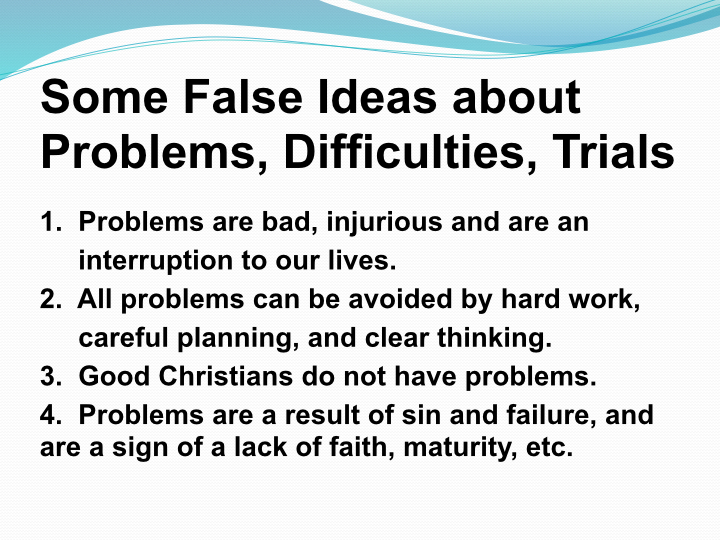
Drawing othersA quick show of hands: How many of you would consider your difficult situations a blessing from God?

Probably not a lot of hands went up, but it’s true.

Peter lists six blessings of God for which we can bless Him (see 1 Peter 1:3-3-9):

  1. God’s great mercy
  2. New birth
  3. Living hope
  4. An inheritance that can never perish
  5. God’s shielding power
  6. Trials

Trials?! Yep!

Peter is quick to tell us that trials only last for a little while, but they are sent our way to prove that our faith is genuine. He says that trials result in praise, glory and honor from God to us, and that successfully going through our trials lead to “an inexpressible and glorious joy.”

In trials you probably don’t feel like praising God, but our God-breathed soul is made up of more than just emotions. We also have been given a mind and a will. So here’s what I would suggest—in your trials, use your mind to reflect on the blessings of God. Then use your will to open your mouth. When you you do this, you will experience the emotion of an inexpressible and glorious joy.

In other words: you are more likely to act yourself into feeling than you are you feel yourself into action!

Look at how David did this in Psalm 34. In a huge trial…

  • …he used his mind and will: I will extol the Lord at all times.
  • …then his emotions kicked in: My soul will boast in the Lord.
  • …his worship helped others: let the afflicted hear and rejoice.
  • …and this pointed everyone to God: Glorify the Lord with me; let us exalt His name together.

Seeing your trials as a way to bless God not only benefits you, but it draws others to God’s sustaining power as well.

If you’ve missed any messages in this series, you may find the complete list by clicking here.

Links & Quotes

link quote

Jackie Hill Perry on how the church can reach those who are LGBT—

Was the Constitution written in a way that was designed to protect freedom and limit the government’s size? Here is how Robert George answers that—

Voddie Baucham talks about how to fight pornography—

Re. Trent Franks makes a passionate appeal for Planned Parenthood to be defunded—

Bobby Conway talks with J. Warner Wallace, a cold case detective, about how he uses his investigative skills to examine the existence of God—


Do You Want To Be Average?

average“Average” is what the failures claim to be when their family and friends ask them why they are not more successful.
“Average” is the top of the bottom, the best of the worst, the bottom of the top, the worst of the best. Which of these are you?
“Average” means being run-of-the-mill, mediocre, insignificant, an also-ran, a nonentity.
Being “average” is the lazy person’s cop-out; it’s lacking the guts to take a stand in life; it’s living by default.
Being “average” is to take up space for no purpose; to take the trip through life, but never to pay the fare; to return no interest for God’s investment in you.
Being “average” is to pass one’s life away with time, rather than to pass one’s time away with life; it’s to kill time, rather than to work it to death.
To be “average” is to be forgotten once you pass from this life. The successful are remembered for their contributions; the failures are remembered because they tried; but the “average,” the silent majority, is just forgotten.
To be “average” is to commit the greatest crime one can against one’s self, humanity, and one’s God. The saddest epitaph is this: “Here lies Mr. and Ms. Average—here lies the remains of what might have been, except for their belief that they were only ‘average.’” —Edmund Gaudet

Preach Like John

John the BaptistThis is a post for my fellow preachers (but the rest of you are free to listen in as well).

When Jesus says someone is the greatest preacher in history, it gets my full attention. Think about what John didn’t have…

  • No church building
  • No platform or pulpit
  • No worship team
  • No sound system
  • No Logos software
  • No library or study
  • No commentaries
  • No PowerPoint or handouts

He only had the Word of God and the Holy Spirit.

His sermons were thoroughly grounded in Scripture (Luke 3:4-6).

His sermons were anointed by the Holy Spirit (Luke 1:66).

His message was simple: “Repent from your sins, and produce fruit in keeping with repentance” (Luke 3:3, 8).

His messages prompted people to ask, “What should we do?” and he gave them Spirit-anointed answers (Luke 3:10-14).

His messages “exhorted the people” and brought “the good news to them” (Luke 3:18).

His sermons unashamedly called out sin (Luke 3:19).

And he will go on before the Lord, in the spirit and power of Elijah, to turn the hearts of the fathers to their children and the disobedient to the wisdom of the righteous—to make ready a people prepared for the Lord. (Luke 1:17)

Fellow preachers, may we be of the same spirit in our preaching!

A Letter To Exiles

Aliens and StrangersWe are two weeks into our series called Aliens and Strangers, in which we are looking at the book of 1 Peter on how Christians are to live as citizens of Heaven. I have greatly appreciated John Piper’s teaching called “Look At The Book,” where the Scripture is front-and-center.

Pastor Piper has just begun a series on 1 Peter as well. Here is his introduction to this book—

If you are in the Cedar Springs area and don’t have a home church, I would love for you to visit us this Sunday morning. If you cannot make it in person, please tune-in via Periscope (search for @craigtowens) at 10:30am.

9 More Quotes From “Keep Your Love On!”

Keep Your Love OnKeep Your Love On! is an outstanding resource for anyone who wants to repair or strengthen a relationship. As I said in my book review, I think pastors and marriage counselors should definitely get a copy of this book. Here are a few more quotes.

“If you want to preserve relationships, then you must learn to respond instead of react to fear and pain. Responding does not come naturally. You can react without thinking, but you cannot respond without training your mind to think, your will to choose, and your body to obey. … Powerful people are not slaves to their instincts. Powerful people can respond with love in the face of pain and fear. This ‘response-ability’ is essential to building healthy relationships.”

“If you were raised with a powerless, fear-driven mindset based on the belief that you can control people and they can control you, then you will naturally perceive God as a controlling Punisher. You will take the laws of the Old Testament—all the verses and stories about wrath, judgment, and the fear of the Lord—and conclude, ‘See, God wants to control us, and we need to be controlled.’ … The problem is that the Bible doesn’t show us a God Who is pursuing the goal of distance between Himself and a bunch of scary sinners. Instead, the Bible reveals a God Who is relentlessly closing that distance and paying the ultimate price to repair the disconnection we created in our relationship.”

“Fear and love are enemies. They come from two opposing kingdoms. Fear comes from the devil, who would like nothing more than to keep you permanently disconnected and isolated. Love comes from God, Who is always working to heal and restore your connection with Him and other people and bring you into healthy, life-giving relationships. … When Paul told Timothy that the spirit of love is also the spirit of power and a sound mind, he implied that its opposite, the spirit of fear, is the spirit of powerlessness and a weak, divided mind. When you grow up partnering with the spirit of fear, as most of us do, you learn to simply hand over your brain and your power, letting fear take control. But as soon as you decide to partner with the spirit of love, you have to think and make powerful choices.”

“Do you want to win the battle between fear and love in your relationships? You can start by making these two fundamental commitments: (1) It’s my job to control myself. I do not get to control other people. (2) My number-one goal and priority in relationships is building and protecting connection.”

“Each display of love, no matter how seemingly small, is a powerful act of spiritual warfare that removes anxiety from the environment, replaces it with freedom and safety, and invites each person to bring his or her best self forward in the relationship.”

“True honor is the practice of two powerful people putting one another before themselves, empowering one another, working together to meet one another’s needs, and adjusting as necessary in order to move together toward the shared goal of the relationship.”

“In order for us to practice self-control, we must have a goal. We must have something we are saying ‘Yes’ to, which necessarily comes with things that we must say ‘No’ to. … When we find ourselves with more freedom than self-control, then that freedom erodes the quality of our life and friendships. Self-control is what allows us to manage increasing levels of freedom in our life and relationships.”

“When you put a person in the position of God, you set him or her up for failure. … Mysterious as it is, making ourselves accountable to God and putting ourselves under His authority is the only way we can become powerful and learn to govern ourselves. … When two people are consistently pursuing a connection with the Perfect One, that connection will set the pace for their connection with each other. They will be learning to love from Love Himself, which can only bring the best into their relationship.”

“The faster you can get to the question, ‘What do you need?’ the faster you can start doing something about it. Unfortunately, because many people are not used to being listened to, they don’t know what they need, or how to communicate it. They think they have to present a solid case for someone to help them, agree with them, or change for them.”

You can read the the first batch of quotes I shared here.

My book review is posted here.

Diary Of A Jackwagon (book review)

Diary of a JackwagonI’m a huge Tim Hawkins fan! He proves time and time again that you don’t have to be crass to be funny, but that intelligent insights are perhaps a bigger laugh than the base stuff. So I was really looking forward to reading Diary Of A Jackwagon.

This book, Tim explains, is like his personal journal of observations. So you get a little insight into his craft. Indeed it was fascinating to read some of the seed thoughts that became a bit in his public comedic routine.

When J.C. Ryle was writing a biography on George Whitefield, he noted that there was a huge difference between hearing a sermon and reading a sermon. I felt the same about this book. Tim Hawkins uses his voice inflections, facial expressions, singing and musical abilities, and body contortions to create a full comedic experience for the viewer. Unfortunately, this doesn’t translate over very well to the reader. So if you already know who Tim Hawkins is, please read this book and enjoy. However, if you’ve not had the pleasure of seeing Tim’s comedy routine, please pull up some YouTube videos before reading this book. Trust me: it will be much more enjoyable this way.

I am a Thomas Nelson book reviewer.

Links & Quotes

link quote

“The reason we know so little about God’s wisdom is that we will only trust Him as far as we can work things out according to our own reasonable common sense.” —Oswald Chambers

“To know God in His glory is to know ultimate reality—defining beauty, goodness, and truth. It is to enter into the heart of reality itself and to glimpse eternity in a most personal, intimate, and loving way. This is what God desires for us, that our hearts might soar within His glory and rejoice in things too wonderful to express.” —T.M. Moore

“My greatest fear in life is standing before the Lord and hearing Him say, ‘I had so much more for you, but you held on too tightly.’” —Larry Burkett

“Give me good proofs of what you have alleged: it is not enough to say—in such a bush there lies a thief—in such a cave a beast; you must show him to me ere I shoot, else I may kill one of my straggling sheep.” —William Shakespeare

“A man must keep his friendship in constant repair.” —Samuel Johnson

Eric Metaxas asks, “Why would a national museum refuse to remove an exhibit honoring one of the leading racists of the 20th century?” Check out his profound answer.

Bear Grylls praying over Barak ObamaThank you, Bear Grylls, for giving us a great example to follow! May we all pray for our President.

Exactly right: Christians cannot stand by and do nothing about these precious people displaced by war.

A very interesting legal look at the Kim Davis situation in Kentucky.

Reconnecting the Disconnection

DisconnectThere is a disconnection problem in the United States of America. Consider this:

  • John Adams, one of our nation’s founding fathers said, “The general principles on which the fathers achieved independence were the general principles of Christianity.”
  • Every president from George Washington to Barak Obama has invoked the name of God in his inaugural address.
  • 96% of Americans say they believe in God.
  • 80% of Americans call themselves Christians.

And yet:

  • Our grade schools make no mention of “God”, some even to the point of not reciting the pledge of allegiance.
  • Higher education is openly antagonistic toward God and Christians.
  • The entertainment industry normalizes lifestyles that are openly unbiblical.
  • Even our US government has done things like legalizing murder in the form of abortion, and sanctioning homosexuality by calling their unions “marriage.”

The Bible calls Christians “aliens and strangers in the world.” Perhaps the term “aliens” is not so much for what we say we believe, but how we live what we believe. 

So Peter opens his letter to “strangers in the world” by telling Christians how to live in a way that can reconnect this disconnection.

  • Humble—because we sinners have been chosen (v. 2a) to become citizens of Heaven.
  • Confident—because of the foreknowledge of God the Father (v. 2b) that can never be thwarted.
  • Teachable—because the process of the sanctifying work of the Spirit and obedience to Jesus Christ (v. 2c) requires us to be humbly-confident, teachable servants.
  • Graceful and peaceful (v. 2d)—because what we believe about God’s invitation to come to Him, Christ’s payment that makes that possible, and the Holy Spirit’s sanctification should be lived out in graceful and peaceful lives.

Would your Earthling family members say you are graceful and peaceful? 

Would your Earthling coworkers say you promote grace and peace on the job? 

Would your Earthling neighbors say you make the neighborhood graceful and peaceful? 

Would the Earthling business owners you frequent say your gracefulness and peacefulness is more evident than in the citizens of Earth?

Search me, God, and know my heart test me and know my anxious thoughts. See if there is ANY offensive way in me, and lead me in the way everlasting. (Psalm 139:23-24).

If you’ve missed any messages in this series, you may find the complete list by clicking here.

Poetry Saturday—The Oyster

Pearl oysterThere once was an oyster, whose story I’ll tell,
Who found that some sand had gotten into his shell.
It was only a grain, but it gave him great pain,
For oysters have feelings, although they are plain.
Now, did he berate the harsh workings of fate
That had brought him to such a deplorable state?
“No,” he said to himself, “since I cannot remove it,
I’ll lie in my shell and think how to improve it.”
They years rolled around, as the years always do,
And he came to his ultimate destiny… stew.
Now the small grain of sand that had bothered him so
Was a beautiful pearl all richly aglow.
This tale has a moral, for isn’t it grand,
What an oyster can do with a morsel of sand?
Think… what could we do, if we’d only begin
With some of the things that get under our skin. —Anonymous (I heard this poem as a part of a brilliant message on dealing with life’s irritations)