Thursdays With Oswald—Jeremiah 6

Oswald ChambersThis is a weekly series with things I’m reading and pondering from Oswald Chambers. You can read the original seed thought here, or type “Thursdays With Oswald” in the search box to read more entries.

Jeremiah 6

[These are notes from Oswald Chambers’ lecture on Jeremiah 6.] 

     Providence is God’s oversight and in-ruling of the men on this earth, and men without the Spirit of God alternately disbelieve and hate the providence of God. … When we have the Spirit of God we do not understand what God is doing, but we know God. Faith is the process by which our confidence is built up in a Person Whose character we know, however perplexing the present things may be that He is doing. Fate is superstitious yielding to a person whose character we do not know and have not the slightest confidence in but have succumbed to. … 

     If we cling to things that are going to be shaken, then God will not prevent us being shaken with them, until we learn to let go of everything that He has condemned. 

From Notes On Jeremiah

God is in charge. God rules this earth and the men on this earth. 

Even for Christians, this is a hard concept to grasp, but it’s impossible for men without God’s Spirit to comprehend. Christians may not fully understand what is happening, but they can know Who is making it happen. 

God tells us, “Call to Me and I will answer you and tell you great and unsearchable things that you do not know” (Jeremiah 33:3). 

God also gives us a choice between a curse and a blessing—Cursed is the one who trusts in man, who draws strength from mere flesh and whose heart turns away from the Lord. … But blessed is the one who trusts in the Lord, whose confidence is in Him. They will be like a tree planted by the water that sends out its roots by the stream. It does not fear when heat comes; its leaves are always green. It has no worries in a year of drought and never fails to bear fruit. (Jeremiah 5, 7-8)

It’s your choice: Confidence in One you know (with His blessing), or superstitiously yielding to one you don’t know (with God’s shaking). 

10 Quotes + 1 Infographic From “Cold-Case Christianity”

Cold-Case Christianity by J. Warner Wallace is educational in a number of ways. Not only will you learn more about police investigations and courtroom deliberations, but Christians and skeptics alike will learn about the reliability of the biblical account concerning Jesus. You can check out my full book review by clicking here. 

“The Christian tradition is actually intellectually robust and satisfying, even if we believers are occasionally unable to respond to your challenges. The answers are available; you don’t have to turn off your brain to be a believer. Yes, it is possible to become a Christian because of the evidence rather than in spite of the evidence.” 

“Faith is actually the opposite of unbelief, not reason. … The biblical definition of faith is a well-placed and reasonable inference based on evidence.” 

“What about cases that have no direct evidence connecting the suspect to the crime scene? Can the truth be proved beyond a reasonable doubt when all the evidence we have is circumstantial? Absolutely. 

“Jurors are instructed to make no qualitative distinction between direct and circumstantial evidence in a case. Judges tell jurors, ‘Both direct and circumstantial evidence are acceptable types of evidence to prove or disprove the elements of a charge, including intent and mental state and acts necessary to a conviction, and neither is necessarily more reliable than the other. Neither is entitled to any greater weight than the other.’” 

“William Dembski (the well-known mathematician, statistician, theologian, and intelligent-design advocate) has argued that specified complexity (and, therefore, the intervention of an intelligent agent) can be identified by using an ‘explanatory filter.’ If an object or event (1) cannot be explained by some natural law that necessitates its appearance, (2) exists in spite of the high improbability that it could occur as the result of chance, and (3) conforms to an independently existing and recognizable pattern, the most reasonable inference is that it is the product of an intelligent designer.” 

“The early church fathers and leaders recognized that the Gospels were the eyewitness testimony of the apostles, and they set the Gospels apart for this reason. The ancient Christian author Tertullian wrote in AD 212: ‘The same authority of the apostolic churches will afford evidence to the other Gospels also, which we possess equally through their means, and according to their usage—I mean the Gospels of John and Matthew—whilst that which Mark published may be affirmed to be Peter’s whose interpreter Mark was’ (Against Marcion). 

“Skeptics cannot reject the reasonable inferences from the evidence we do have, simply because there may possibly be some evidence we don’t have; skeptics also need to defend their doubt evidentially.” 

“The reasonable inference from the circumstantial evidence is that the Gospels were written very early in history, at a time when the original eyewitnesses and gospel writers were still alive and could testify to what they had seen.” 

“Some have argued that the Gospels are late because none of the authors specifically identifies himself in the accounts. … BUT … The Gospels are not the only ancient documents that fail to identify the author within the text of the manuscripts. Tacitus (the Roman senator and historian who lived from AD 56 to AD 117) wrote a history of the Roman Empire from the reign of Augustus Caesar to Nero entitled Annals. Tacitus was, in fact, present during much of this period of time, but failed to include himself in any of his descriptions or identify himself as the author.” 

“While it is possible that the Gospels were not written by the traditional first-century authors and were given these attributions only much later in history, it is not evidentially reasonable. If skeptics were willing to give the Gospels the same ‘benefit of the doubt’ they are willing to give other ancient documents, the Gospels would easily pass the test of authorship.” 
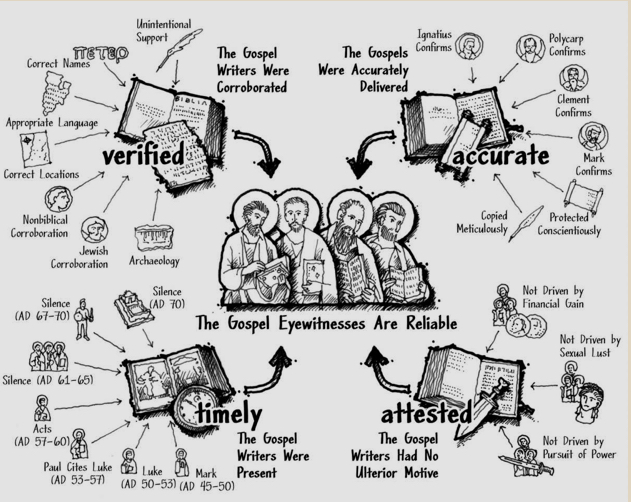
“The most reasonable inference is that the gospel writers were present, corroborated, accurate, and unbiased. If this is the case, we can conclude with confidence that their testimony is reliable.” 

“Love’s Labor”

Work is no curse; from the beginning we
were made for work, to seek the goodness of
the Lord, to multiply His beauty, love,
and truth, and serve His creatures happily.
When work is as a gift and ministry
received, a sacred calling from above,
then will each labor be engaged with love
and excellence, imparting dignity
and grace to those it serves, that they may see
in every labor a reflection of
the God who by His sacrifice of love
has worked the miracle that sets us free.
   You are love’s labor, everyone can see,
   especially as you labor long with Me. —T.M. Moore, from his book Bricks And Rungs

Cold-Case Christianity (book review)

From Perry Mason and Dragnet to Blue Bloods and Law & Order, I’ve always been a fan of watching detectives and attorneys sorting through all of the evidence to find the truth. I’m also passionate about Christian apologetics, so Cold-Case Christianity by J. Warner Wallace is totally in my wheelhouse! 

Wallace is a cold-case detective and he’s also a Christian, but criminal investigative work was a part of his life long before he had a relationship with Jesus. In fact, Wallace grew up as an avowed atheist and openly mocked Christians for their “faith.” That is until someone challenged him to investigate the claims of the Bible regarding Jesus as he would investigate one of his cases. 

The similarities are fascinating. In most cases, Wallace cannot interview eyewitnesses, but has to rely on other evidence. Slowly, diligently, he tracks down each lead to come to the most reasonable conclusion. It was exactly the same with the biblical claims about Jesus: the eyewitnesses have long since died. Using his talents for successfully solving crimes which had been left unsolved for years and years, Wallace one day told his wife, “I think it might be true. I think Jesus is who the Bible says He is.” 

Wallace now shares with his readers how they too can use the same skills to explain to skeptics why the biblical case for the authenticity of Jesus is reasonable. He takes us out to the crime scenes as we look for evidence, into the interview room to talk to witnesses, and into the jury box to weigh all of the evidence. 

Skeptics of Christianity will find this book eye-opening, and Christians will find this book informative and helpful to them as they become Christian case makers. This book reads like a detective story to me, and I think others will be just as fascinated with the content as I was.

God’s Gift To The World

You are a gift. You are God’s grace gift to the world. 

Max Lucado said it this way: “You are you-nique. 

God made you on purpose and for a purpose.

God implanted unique abilities in you from conception (see Psalm 139:13). And check out what God said to Jeremiah, “Before I formed you in the womb I knew and approved of you…” (Jeremiah 1:5). Before you were even conceived, God already knew all about you AND He approved of you! 

Why did God implant these unique abilities in you? Because He knew of the unique opportunities you would face during your lifetime (see Psalm 139:16). Because God is for you, He gave you all that you would need to successfully face every opportunity that came your way. 

Every one of us has been given these grace gifts of unique talents and opportunities. The Bible says, “to each one of us grace has been given as Christ apportioned it” (Ephesians 4:7). If God is for you, and God is for me, then that means that you have been gifted to be a blessing to me and I have been gifted to be a blessing to you (Romans 12:3-6; 1 Corinthians 12:4-7).

Let me state it again: every one of us has been entrusted by God with unique talents in order to successfully face the unique opportunities that He knew we would face. Jon Bloom reminds us, “Some are given more, some are given less, but all are given much.” 

So what do we do with what we’ve been entrusted? There are two possibilities: (1) We can invest our talents and abilities in a way that glorifies God, or (2) We can squander the talents God has given us. 

How do you squander the grace gift of your life? 

  1. Not discovering it—I have a gift?
  2. Devaluing it—I’m nothing special.
  3. Overvaluing it—I’m super-important. I don’t need anyone else.
  4. Laziness—I don’t want to mess it up, so there’s no need for me to invest my gift.
  5. Short-sightedness—My gift is just for me, so it doesn’t matter what I do with it.

I hope we can all say what Erma Bombeck wrote: “When I stand before God at the end of my life, I would hope that I would not have a single bit of talent left but could say, ‘I used everything You gave me.’”

How do you honor God with your you-niqueness? I can tell you in just three simple words—You be you! 

If you will just be who God made you—not downplaying your talents, not wishing you had someone else’s talents—that’s when you will feel fulfilled, and God will be glorified, and the rest of the world will be blessed! So…

YOU BE YOU! 

Saturday In The Proverbs—But… (Proverbs 10)

[Each chapter in the Book of Proverbs contains thoughts that fit into a theme; they are not just random thoughts gathered together. In this “Saturday In The Proverbs” series, I will share a theme that I see in each chapter. But the cool thing about God’s Word is that you may see an entirely different theme. That’s great! If you do, I would love for you to share it in the comments below.]

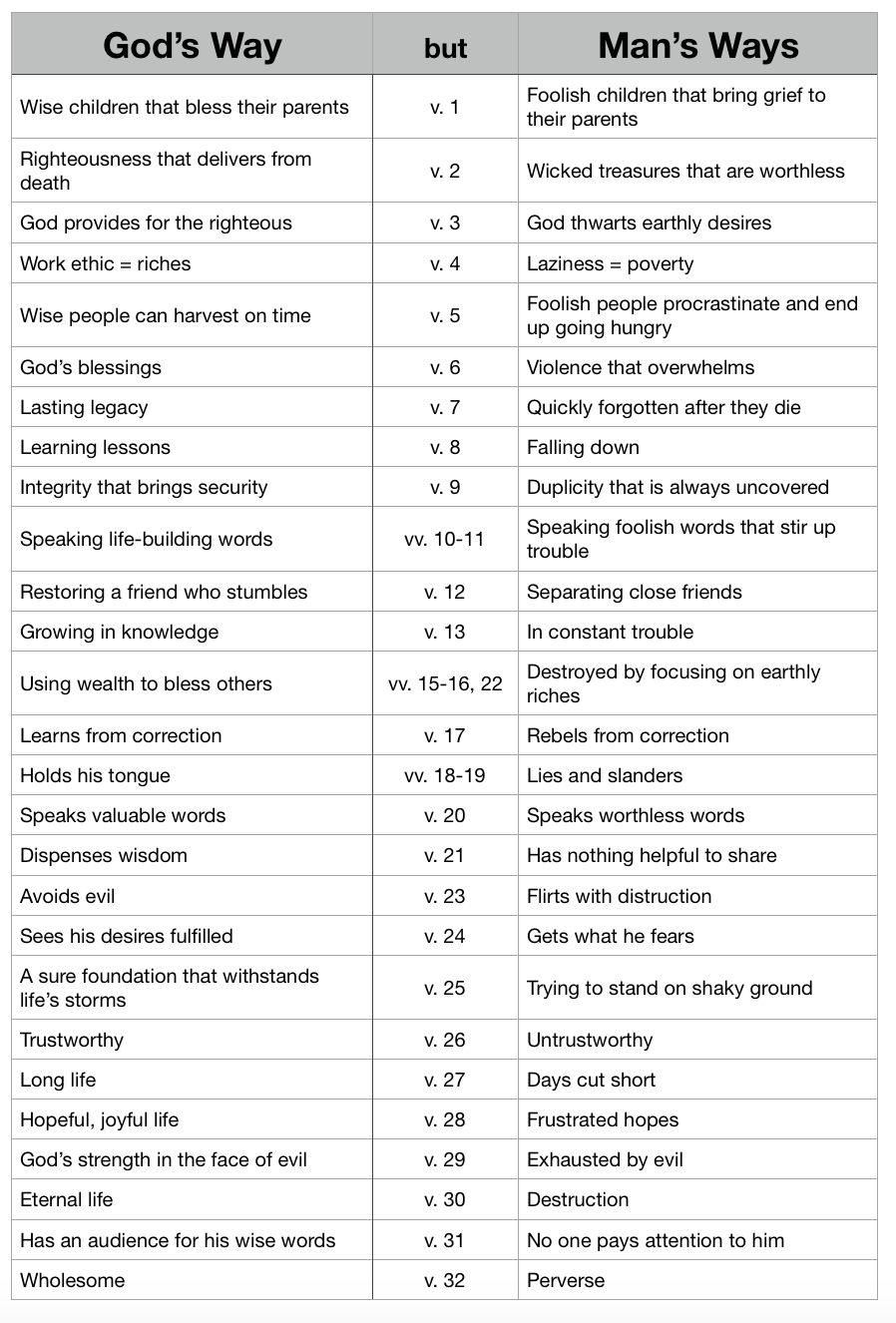
But… (24 times in Proverbs 10).

These proverbs of Solomon make clear the distinctions between God’s way and man’s way. Doing things God’s way brings all sorts of blessings, but trying to do things man’s ways is a dead-end road. 

Check out the contrasts—


(click on the image to see a larger view or click here to download a PDF → Proverbs 10 – but)

The Integrity Of A Godly Leader

I will instruct you and teach you in the way you should go; I will guide you with My eye. (Psalm 32:8)

“God does not expect leaders to be perfect, but to be whole. To have integrity means to be whole, as in a whole number (an ‘integer’). Despite their human frailties, leaders can effectively guide those who follow.

“This Scripture reminds us that leaders must closely observe the flock for its needs and problems. God expects spiritual leaders to serve as guides. A guide takes a person or group safely to a planned destination. The Hebrew words for ‘guide’ gives us several clues as to what God expects from those He uses as leaders:

  • A guide is a spiritual head who unites and directs people in their walk with God.
  • A guide takes people on the straight path that leads to fellowship with God.
  • A guide gives accurate and godly counsel to those who need it.
  • A guide leads with gentleness and trustworthiness, making others feel safe.
  • A guide bases his or her direction on the Spirit and the Word of God.” —John Maxwell, in The Maxwell Leadership Bible

Thursdays With Oswald—Jeremiah 5

This is a weekly series with things I’m reading and pondering from Oswald Chambers. You can read the original seed thought here, or type “Thursdays With Oswald” in the search box to read more entries.
Jeremiah 5

[These are notes from Oswald Chambers’ lecture on Jeremiah 5.] 

     The Bible is not so much a revelation about God as a revelation of God who is adequate to deal with the worst. …  

     The tumbling and turmoil in human history is caused everywhere by the consuming fire of God rather than by the futile rage of the devil. In reading history the saint sees that the great presence and power is God, not the devil. …

     Hordes of barbarians and powers of worldly dominion are unconscious of God, but God uses them for His own purpose. Nothing happens by chance. When our Lord stood before Pilate He said, “You would have no power over Me if it were not given to you from above” (John 19:11). The tyranny of the Roman Empire over God’s people was the providential order of God, and Jesus recognized that this was so, He did not start a revolution, or say, “We must fight against this” (John 18:36). Perils are clear to God’s mind alone, but they mean panic to everyone who does not know the mind of God. …  

     We learn the marvelous truth that we may become more than conquerors through our right relationship to God over everything that may come against us. …  

     In order to make proper changes in a nation’s life, you must change the people’s wants. 

From Notes On Jeremiah 

All over the globe, it appears that evil is holding sway and that sin is running rampant. It could appear as if the devil is winning, and Christians are just desperately trying to hold on to the end. But is that what it means when the Bible says that we are more than conquerors? 

Let’s be clear about this—God is in control. 

God may use barbarians, dictators, and evil people to accomplish His purposes, but they are all under His control. These forces have bounds past which they may not go. Any power they have has been given to them from above. 

If we forget this, we can easily fall into a hand-wringing panic. But let’s remind ourselves again and again that God is in control! If our relationship with Him is right, then we truly soar over these temporal upheavals; we become more than conquerors through Him Who loves us!

Having Conversations With Yourself

Why are you cast down, O my soul…? (Psalm 42:5, 11). 

There can be no healing if there isn’t first an admission of need. 

This psalmist recognizes: 

  • the dryness of his soul
  • his depression
  • the taunts of his enemies
  • the ‘good ol’ days’ 

He not only questions his soul, but he admits to himself and to God, “My soul is cast down within me.” But each time he has this conversation with himself, he reminds himself of the same conclusion—“God is worthy of praise and I can put my hope in Him!” 

We have to stop listening to crippling self-pity and begin talking to ourselves about our well-placed confidence in God. He is worthy of our praise! He will satisfy me like nothing else can. He is the only One in whom I can put my hope. 

As Augustine reminded himself, “Thou hast formed us for Thyself, and our hearts are restless till they find rest in Thee.”

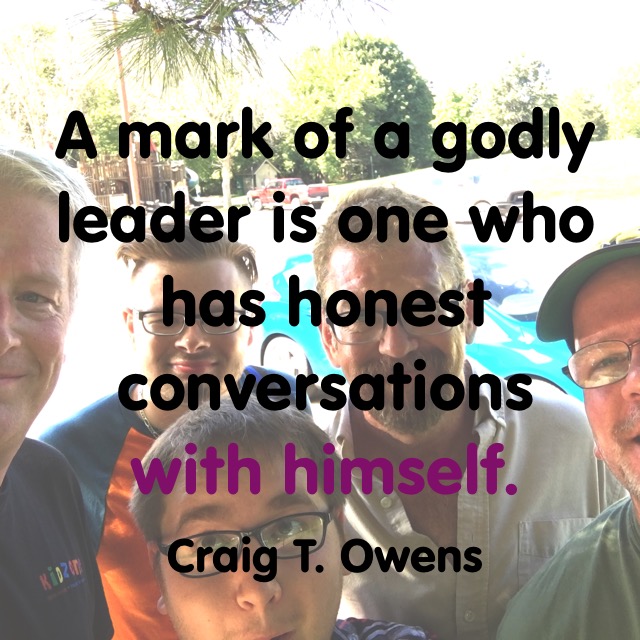
A mark of a godly leader is one who has honest conversations with himself. 

Don’t listen to your downcast thoughts; talk back to your downcast thoughts and tell yourself the only place where real hope can be found. 

This is part 23 in my series on godly leadership. You can check out all of my posts on this topic by clicking here.

10 More Quotes From “The Christian In Complete Armour”

I loved this book! Check out my review of The Christian In Complete Armour by clicking here. You can also check out the other sets of quotes from this book by clicking here. 

“If you are a saint, you do not need to fear that satan will infiltrate your soul. God will not permit it. But the devil can and does attack along the borders of your faith. Though you are not the proper subject of his power, you are and always will be the chief object of his wrath. He wrestles with you at every opportunity, and you will only overcome him as long as God supplies His strength on your behalf.”

“Power is the rightful attribute of God alone. We mortals make a poor showing when we claim it as our own…. Tremble, therefore, at any power you have unless you use it for God. A plague of locusts is no more destructive in a field of ripened wheat than prideful power is to a man’s grace. Are you powerful? How do you spend this gift from God? On His work, or on the satisfaction of your own lusts?”

“God uses the tribulation instead to sand and polish your faith, so that in the end it is finer and more precious than ever.”

“The boundaries of satan’s empire are circumscribed and limited. First, the time this prince rules is ‘in this world,’ not hereafter. Second, the place he rules is ‘in this world,’ not heaven. And third, the subjects whom he rules are ‘the darkness of this world,’ not the children of light.”

“What is heaven worth if you cannot bear a little shame? If they spit on your face, Christ will wipe it off. They may laugh at you now, but not later. The final outcome has already been declared, and you have sided with the Victor.”

“The bee will not sit on a flower that has no nectar. Neither should the Christian entertain a thought that does not feed his spirit.”

“satan has a habit of stopping the ears from hearing sound doctrine before he opens them to listen to corrupt.”

“Pride must have the most and best of everything to satisfy its appetite. This voracious lust will devour your spirit of praise. When you should be blessing God, you will be applauding yourself. It will eat up Christian love, and cause you to disdain the fellowship of other Christians. It will keep you from acknowledging the gifts of others, because that would take away some of the glory you want for yourself. Ultimately, pride so distorts our taste that we can relish nothing drawn from another’s dish.”

“Another indicator that you are caught in the trap of spiritual pride is envy of others’ gifts. … Envy is an affront to the character and person of God. When you envy, you are questioning God’s right to administer His gifts as He sees best. You are also maligning the goodness of God. You are angry that God wants to bless someone besides you. Would you not have God be good? You might as well say you would not have Him be God, for He can no more cease to be good than He can cease to be God! When your envy prods you to belittle the gifts of other Christians, you are really belittling God who gave them.”

“Count on the strength of your own godly attributes, and you will grow lax in your duties for Christ. Knowing you are weak keeps you from wandering too far from Him.”