10 Prayers From A.W. Tozer In “The Wisdom Of God”

A.W. Tozer’s book The Wisdom Of God is a call to see Wisdom as a Person, not as a quality. As such, Tozer opens each chapter with a short prayer that we would bolster our relationship with Wisdom. Here are a few phrases from those prayers. 

“Let me not succumb to the limitations of my own reasoning and knowledge but leap beyond that and stepped into the reality of Thy Holy presence. Amen.” 

“Pour into my soul that which will enable me to see Thee as Thou wouldst have me to see Thee.” 

“O Wisdom, the incarnate Christ, fill my heart with desires that please Thee and show to the world around me Thy amazing grace.” 

“O God, Thou Eternal Wisdom, may I embrace that which You have created me for, and may out of my life flow the thanks and praise You so desire. Let me live my life by the wisdom of Thy Son, the Lord Jesus Christ.” 

“May Thy wisdom flow into me and out to the world around me, creating in me a vessel for Thy glory.” 

“O Holy Spirit, I praise Thee through the divine wisdom that Thou hast poured into my life, enabling me to understand who I am and who Thou art and how we come together.” 

“Let me not stay my heart till I have discovered Thee in all Thy fullness.” 

“Manifest Thy grace and wisdom in my life today as a witness to those around me.” 

“O Lord God, Thy wisdom has been poured into my heart, creating such a longing for Thee that nothing in this world can satisfy.” 

“Heavenly Father, open my eyes to recognize Thy hand in my life. … May I be aware of my surroundings in light of what Thou art doing.” 

You can check out my full book review of The Wisdom Of God by clicking here. And be sure to read some of the quotes I shared from this book by clicking here.

Is It Really The 11th Hour?

When we’re down to the last minutes before a crucial deadline, we often refer to it as “the eleventh hour.” 

Have you been there? You’re sweating it out, wondering if God is going to come through for you. Or perhaps thinking about what you might need to handle yourself in order to meet the deadline. And then God comes through for us, and we let out a deep sigh of relief and gratitude. 

But why a sigh? Were we worried that God wouldn’t come through? Did we think God’s supply was limited? And what made us think that it was “the eleventh hour” anyhow? 

What we often think is the eleventh hour is really God’s first hour! God is never late. He’s never scrambling to come up with what we need. We might be the ones “scrambling,” but God never is. He always has the perfect resources at the perfect moment. 

We should know this because the Bible tells us: God who did not spare His own Son, but gave Him up for us all—how will He not also, along with Him, graciously give us all things? (Romans 8:32) 

Jesus tells a story about an eleventh-hour situation in Matthew’s Gospel. Men were waiting around to work for the day when a landowner came along to hire them. He hired some guys first thing in the morning and agreed to pay them a full day’s pay. He hired some other workers at 9:00 AM and promised to pay them fairly, and then he hired even more workers at noon and at 3:00 PM, also promising to pay them what was fair. Finally, he hired some workers at 5:00 PM—literally at the eleventh hour—without any mention of pay. 

At the end of the day, every single worker was paid a full day’s wage. Every single one of them. Jerry Bridges notes why this is significant: 

“Each worker, regardless of how long he had worked, received a day’s wages. He received not what he had earned on an hourly basis, but what he needed to sustain his family for a day. … Those eleventh-hour workers were hired because they needed to receive a day’s wages. They had been standing all day waiting for someone to hire them so they could earn money to support their families. They needed to work more than the landowner needed their work. He hired them, not because of his need, but because of their need.” (emphasis added)

You see, God knows what you NEED and He generously supplies that NEED right on time.

Jesus taught us to pray, “Give us this day our daily bread.” The problem comes when we start looking down the road wondering what’s going to happen tomorrow, and the next day, and the next day (see Matthew 6:11, 31-34). 

God’s favor toward us is out of all proportion to our work or sacrifice. He gives exactly what we need, exactly when we need it. 

If you’re feeling anxious—like the clock is ticking down to the eleventh hour—perhaps you should recall how God has provided for you in the past. Then discipline your thoughts from running ahead to tomorrow as you pray, “Give me this day what I need.” 

Here’s a prayer I’m praying—

“God, I remember the wonderful deeds You have done for me. They are constantly in my thoughts. I cannot stop thinking about Your mighty works in the past. Therefore, I ask you today for my daily bread. Let my heart be on guard against scrambling as though I were in an eleventh-hour situation. You are my all-loving, all-gracious Father. You know what I have need of even before I ask. May my attitude be one of assured contentment in your abundant, right-on-time supply. May you be glorified as others see this confidence in my attitude.”

Saturday In The Proverbs—How To Spot Folly (Proverbs 9)

[Each chapter in the Book of Proverbs contains thoughts that fit into a theme; they are not just random thoughts gathered together. In this “Saturday In The Proverbs” series, I will share a theme that I see in each chapter. But the cool thing about God’s Word is that you may see an entirely different theme. That’s great! If you do, I would love for you to share it in the comments below.]

“Whoever is simple, let him turn in here…” (Proverbs 9:4, 16).

Both Wisdom and Folly call out to the same thing to people who are lacking understanding: “Come into my house!” So how do you tell the difference?

Simply put—Wisdom raises the bar, and Folly lowers it. Wisdom will make you work; Folly cuts corners.

Wisdom works hard to prepare for her guests. She then asks them to:

  • eat what she prepared
  • forsake their foolishness
  • submit to correction
  • learn new things
  • fear God

Folly, on the other hand, is simply loud. She prepares nothing. Instead:

  • she offers stolen goods
  • she justifies breaking the rules
  • she never corrects nor instructs
  • she has no fear of God
  • she simply looks for those who will go along with her

But only Wisdom can give knowledge of God, understanding of His ways, multiplied days, long life, and life-enhancing wisdom. Folly can give nothing but empty words and dead-ends.

Be careful of which hostess is asking you to “come into my house.”

Thursdays With Oswald—Jeremiah 4

Oswald ChambersThis is a weekly series with things I’m reading and pondering from Oswald Chambers. You can read the original seed thought here, or type “Thursdays With Oswald” in the search box to read more entries.

Jeremiah 4

[These are notes from Oswald Chambers’ lectures on Jeremiah 4.]

     The great truth underlying calamity is that the truth and way of God is seen but abandoned because it is too difficult. Unless we understand this we shall misjudge God in His dealings with His people and imagine that He is too stern. … Abandon is not rebellion yet; abandon simply means—“That is a nice vision, but it is not for me.” … 

     The battle is lost or won in the secret places of the will with God alone, never first in external circumstances. … When that is done we can go forth with the smiling certainty that our battle is won, nothing will ever again enthrall us on that line. The world, the flesh and the devil have not the slightest power over the man who can rule his own spirit, who has fought the battle out before God and won there. …

     When the secret places of our will before God are revealed you know exactly what you have to do. Let the Word of God bore a hole in your self-complacency about the particular thing He has hauled you up about and then put in another Word that He brings to you, and you will soon find His dynamite at work. … 

     We are choked by a little thing that has not its root in God, which God condemned and we pathetically wept over but left there. … Never put a thing off and say, “It does not matter, no one sees.” No, but they will see you go down like standing corn before the scythe in external circumstances, because you played the traitor to God in secret. If God has revealed anything to you for the tiniest glimmer of a second and you don’t obey Him and cultivate that territory for Him, you will go down when the crisis comes. … 

     The basis of life on earth apart from God is chaos. … No whining and no shirking will ever help us to escape the utter confusion that is at the basis of every bit of human life that has ignored God. … 

From Notes On Jeremiah 

Our battles are won or lost in secret long before they are ever fought externally. 

God’s Holy Spirit wants to dynamite the areas of our life that would cause us to falter in the day of battle. If we will allow Him to deal with these things in private, we will be more than conquerors when that day of external temptation finally comes. 

If we maintain the “It’s no big deal” attitude with God in private, we shall surely be defeated by the temptations when they do come. 

The choice is yours…

7 Quotes From “The Wisdom Of God”

A.W. Tozer never pulls his punches! The Wisdom Of God is no different as he calls the corporate church and individual Christians back to the biblical understanding of God’s wisdom. Check out my full book review by clicking here. 

“What would wisdom and spiritual understanding, for example, make out of man? Would the man filled with wisdom and spiritual understanding write cheap poetry? I would certainly hope not. What then does he do? Walk around in a brown robe and pull loose from the world, hiding in a cloister or an ivory tower? Absolutely not.

“What is the purpose then of this baptism of the ancient wisdom of God into the heart of a man? The old wisdom man said it was to make a man a friend of God. Paul said, ‘That ye might walk worthy of the Lord unto all pleasing, being fruitful in every good work, and increasing in the knowledge of God; strengthened with all might, according to His glorious power, unto all patience and longsuffering with joyfulness’ (Colossians 1:10-11). This is the practical meaning of this infusion of divine wisdom into the man walking with God.” 

“The purpose of God in Redemption is not just to save us from hell. The purpose of God in redemption is to save us unto heaven. To be totally saved, He has to save us from something in order to save us unto something. We are saved from sin, which is the negative side. We are saved unto holiness, which is the positive side. We are saved from hell, but we are saved unto heaven. We are saved from the devil, but we are saved unto Christ.” 

“When we deal with our sin, repent, and the Lord has taken our sin away, we are as wise as the angels and as discrete and as knowing as the seraphs before the throne, for we have an afflatus of that wisdom.” 

“In our day, we have degraded Christianity to be a kind of soft vaccine against hell and sin. We gather people, stick them with a religious needle, and say, ‘If you just accept Jesus you will not go to hell, you will go to heaven when you die. Keep living as well as you can, and when you die you’ll go to heaven.’ Many are preaching what I refer to as a kind of lifeboat salvation, and even the songs today reflected that idea.

“Certainly, this is an inadequate concept of Christianity. The purpose of God in redeeming man was not to save them from hell only, but to save them to worship, and to allow them to be born into that eternal wisdom that was with the Father, which is synonymous with that eternal life that was with the Father and was revealed unto men.” 

“You can promote religion without divine wisdom and power. You can promote your denomination. You can promote and build up your church numerically and financially, but in these ways, you cannot promote true Christianity.” 

“The evangelical church waivers today because it has burst out in two directions: One, in the direction of entertainment and pleasure for the like-minded ones. The other, in the direction of scholarship for the serious-minded. This is the new evangelicalism of today. An effort to do by scholarship what can only be done by wisdom and power. It is a glass eye trying to see.” 

“What I am praying for is that God Almighty would come upon this generation of Christians and make them dissatisfied with the cold, humanistic, intellectual evangelicalism of our time, and make us so thirsty for an afflatus of divine wisdom and power that they press through and receive that baptism.” 

The Wisdom Of God (book review)

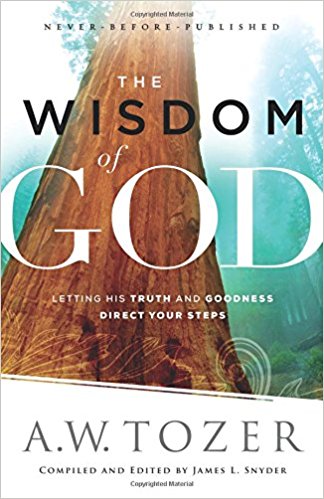
A.W. Tozer takes us deep into the classic Hebrew understanding of Wisdom in this never-before-published collection of sermons entitled The Wisdom Of God. 

Rev. James L. Snyder has done the maturing Christian a great service in compiling these Tozer sermons into this powerful collection. Most people think of wisdom as an attribute of God, but the Hebrews understood Wisdom to be the Person of God. Wisdom isn’t just something you gain; it’s Someone you get to know more and more intimately. 

In his introduction, Rev. Snyder writes, “‘There are known knowns—things we know we know,’ Donald Rumsfeld once famously said. And there are known unknowns—things we do not know. ‘But there are also unknown unknowns,’ the former U.S. Secretary of Defense added, ‘the ones we don’t know we don’t know.’ Dr. Tozer would have said Amen to that most enthusiastically. As soon a person admits he does not know everything, he is in a position to learn something. What many people do not understand is that the unknown unknowns can and do sabotage lives.”

Dr. Tozer helps us realize these unknown unknowns about Wisdom, not only to keep us from sabotaging our lives but also so that we can soar into the fullness of an intimate relationship with Wisdom. Digging deep into the Hebraic wisdom literature, Dr. Tozer will help you see Wisdom in a light you may have never realized before. 

For any Christian who wants to go deeper into their relationship with God, The Wisdom Of God is a welcomed collection. 

I am a Bethany House book reviewer. 

Do People Know That You Know That God Is Good?

Listen to the podcast of this post by clicking on the player below, and you can also subscribe on AppleSpotify, or Audible.

If you’ve been reading or watching my series on God’s favor the last few weeks, I hope you truly know this: God is for you! 

But the key question for Christians comes down to this—Do others know that you know that God is for you? 

You see, God is for you because God is joyful and happy, and He wants you to not only know this but to radiate this joy and happiness to those around you. 

Here’s how it works:

(1) Joy is an inside job. The dictionary defines joy as “a feeling of great delight caused by something exceptionally good or satisfying.” When we know by our personal experience with Him how good God is, joy is birthed in our hearts as we see Him as All-Good and All-Satisfying. 

(2) Joy is regardless of my external circumstances. Some people try to pursue happiness apart from joy. Trying to get happy without having the foundation of joy is like having a flower that has been picked from the plant. Happiness may be pretty for a short while, but it is already fading because it is completely dependent on the environment around it. True happiness isn’t dependent on external circumstances because it is rooted in something far greater. 

(3) Knowing God’s favor fuels our joy. There is a Hebrew word for know which means “knowledge through intimate, personal experience.” Psalm 100 describes happy people and their joyful praise. Their joy comes from this: They know that their Lord is God and that He is good. This joy comes from seeing and savoring God’s favor.  

(4) Our internal joy should bubble up into external happiness. All throughout the Bible, we read how those who are filled with joy as they get to know this exceptionally good, all-satisfying God cannot help but burst out in songs of happy praise (see Psalm 28:7 and Luke 10:21).

(5) Our external happiness becomes our testimony. In Psalm 126 we read that God’s people who were full of God’s joy burst out into happy praise. When they did the people around them recognized that God had done great things for them. 

Check this out—

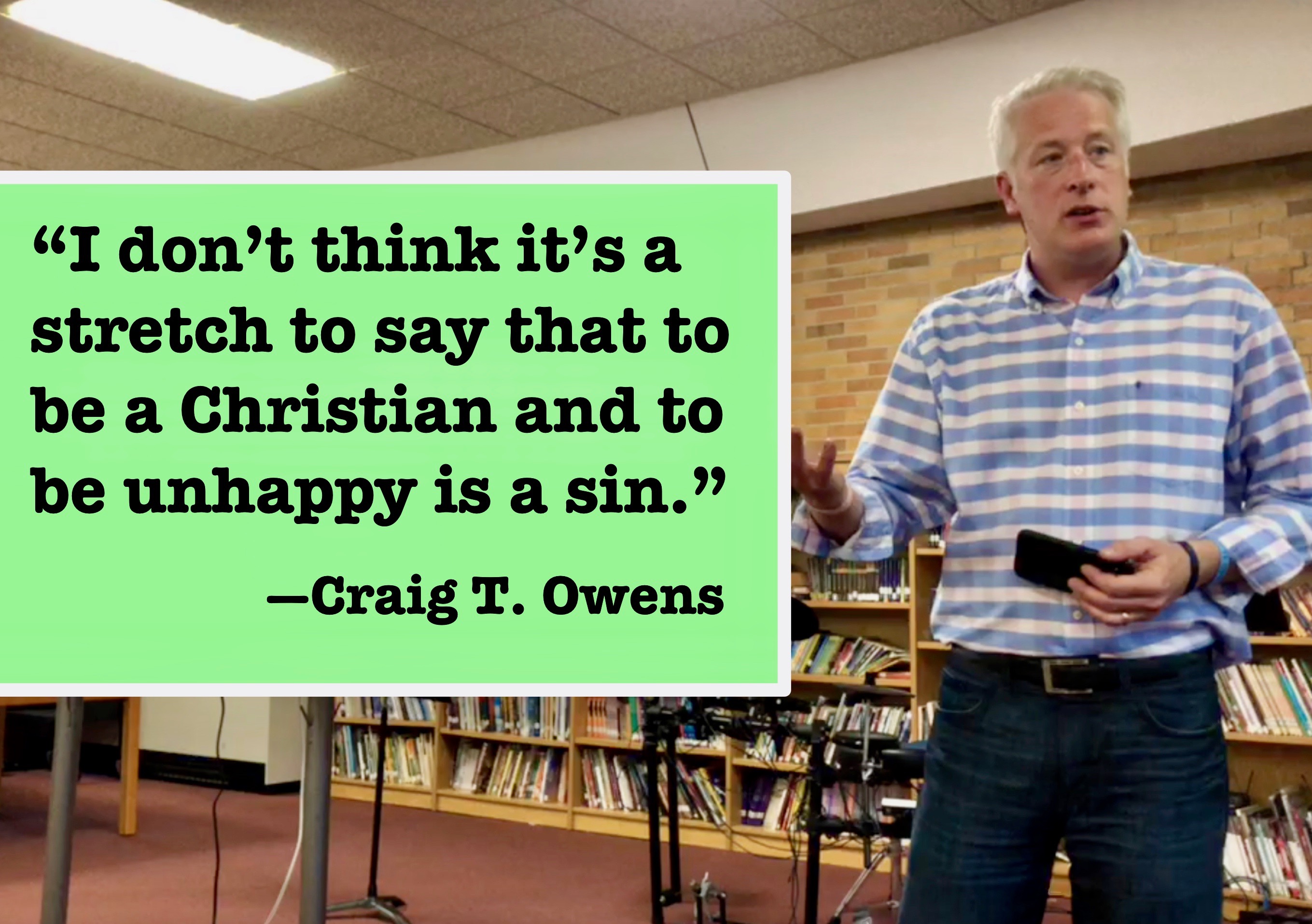
“I don’t think it’s a stretch to say that to be a Christian and to be unhappy is a sin. An unhappy Christian gives God no praise, robs Him of glory, and paints God in a bad light. A happy Christian knows the Lord is his strength, his comfort, his supply. The happy Christian lifts God high and invites others to know this All-Good, All-Happy God too!” —Craig T. Owens 

So let me ask you again: If you call yourself a Christian, do people know that you know that God is for you? Are you making God look All-Good and All-Satisfying by your deeply fueled joy and your face-brightening happiness? 

What a testimony it is when God’s people are happy in Him! 

►► Would you please prayerfully consider supporting this ministry? ◀︎◀︎

If you have missed any of my other posts about God’s favor, you may check them out by clicking here.

Saturday In The Proverbs—Do You *Really* Want To Hear This? (Proverbs 8)

[Each chapter in the Book of Proverbs contains thoughts that fit into a theme; they are not just random thoughts gathered together. In this “Saturday In The Proverbs” series, I will share a theme that I see in each chapter. But the cool thing about God’s Word is that you may see an entirely different theme. That’s great! If you do, I would love for you to share it in the comments below.]

Does not wisdom cry out…? (Proverbs 8:1).

Wisdom is accessible to all. Wisdom is not hiding; she is in plain sight and calls out to everyone (vv. 2-4). The question is: Do I want to find Wisdom? Do I really want to hear what she has to say? 

The Apostle Paul tells us to take all our thoughts captive and filter out the thoughts that aren’t obedient to Christ (2 Corinthians 10:5). In other words, I need to eliminate the thoughts that are impure, false, vile, discouraging, unloving, proud, or un-praiseworthy (Philippians 4:8). 

Wisdom herself says her words are: 

  • excellent
  • right
  • truthful
  • righteous
  • pure
  • easy to understand
  • sound
  • strengthening

The rewards for really listening to Wisdom’s words are pretty great too: 

  • treasures 
  • righteousness
  • justice
  • God’s blessings
  • eternal life
  • God’s favor

So with all that in mind, how would you answer the question now: Do you really want to hear what Wisdom has to say to you?

Albert Einstein On The Library Of The Universe

“I’m not an atheist, and I don’t think I can call myself a pantheist. We are in the position of a little child entering a huge library filled with books in many languages. The child knows someone must have written those books. It does not know how. It does not understand the languages in which they are written. The child dimly suspects a mysterious order in the arrangement of the books but doesn’t know what it is. That, it seems to me, is the attitude of even the most intelligent human being toward God. We see the universe marvelously arranged and obeying certain laws but only dimly understand these laws. Our limited minds grasp the mysterious force that moves the constellations.” —Albert Einstein

Thursdays With Oswald—Jeremiah 2-3

Oswald ChambersThis is a weekly series with things I’m reading and pondering from Oswald Chambers. You can read the original seed thought here, or type “Thursdays With Oswald” in the search box to read more entries.

Jeremiah 2-3

[These are notes from Oswald Chambers’ lecture on Jeremiah 2-3.]

     God is the “adornment” of His people; but God says, “My people have forgotten Me days without number”; the dead set of their life has been away from God (Jeremiah 2:32). Forgetting as an infirmity of mere consciousness is one thing; but forgetting by steadfastly refusing to recognize is another thing. These people had deliberately turned out of God’s way. They were wantoning after some other god than the God Who was holy (2:33). …  

     The thing that shocks us most is not the thing that shocked Jesus most. Social immorality shocks us till we don’t know where we are; but what struck the heart of Jesus Christ with horror was immorality against God, pride against Himself (see Luke 16:15). …  

     The innocence arising from evil is always like this—“I’ve done nothing.” It is the innocence we are all born with; sooner or later it takes its stand with evil and only knows good by contrast; whereas the innocence arising from the presence of the Spirit of God takes its stand with good and knows evil only by contrast. If we hand our hearts over to God we need never know in experience what Jesus Christ says of the human heart is true (see Mark 7:20-23). 

From Notes On Jeremiah

This is a tough concept that takes some quiet introspection in the presence of the Holy Spirit. Christians should ask themselves: Do I know the difference between good and evil because I’m doing evil and the opposite of what I’m doing is good, or because I’m doing good and the opposite of what I’m doing is evil? 

Originally, Eve knew evil only as the opposite of how she was living. But when satan tempted her to take the forbidden fruit, Eve now knew evil as something she was doing. Jesus said evil is what would naturally come out of our heart, unless “we hand our hearts over to God” and allow His Spirit to supernaturally bring out of us the Christlike fruit He produces. Is this happening in your life?