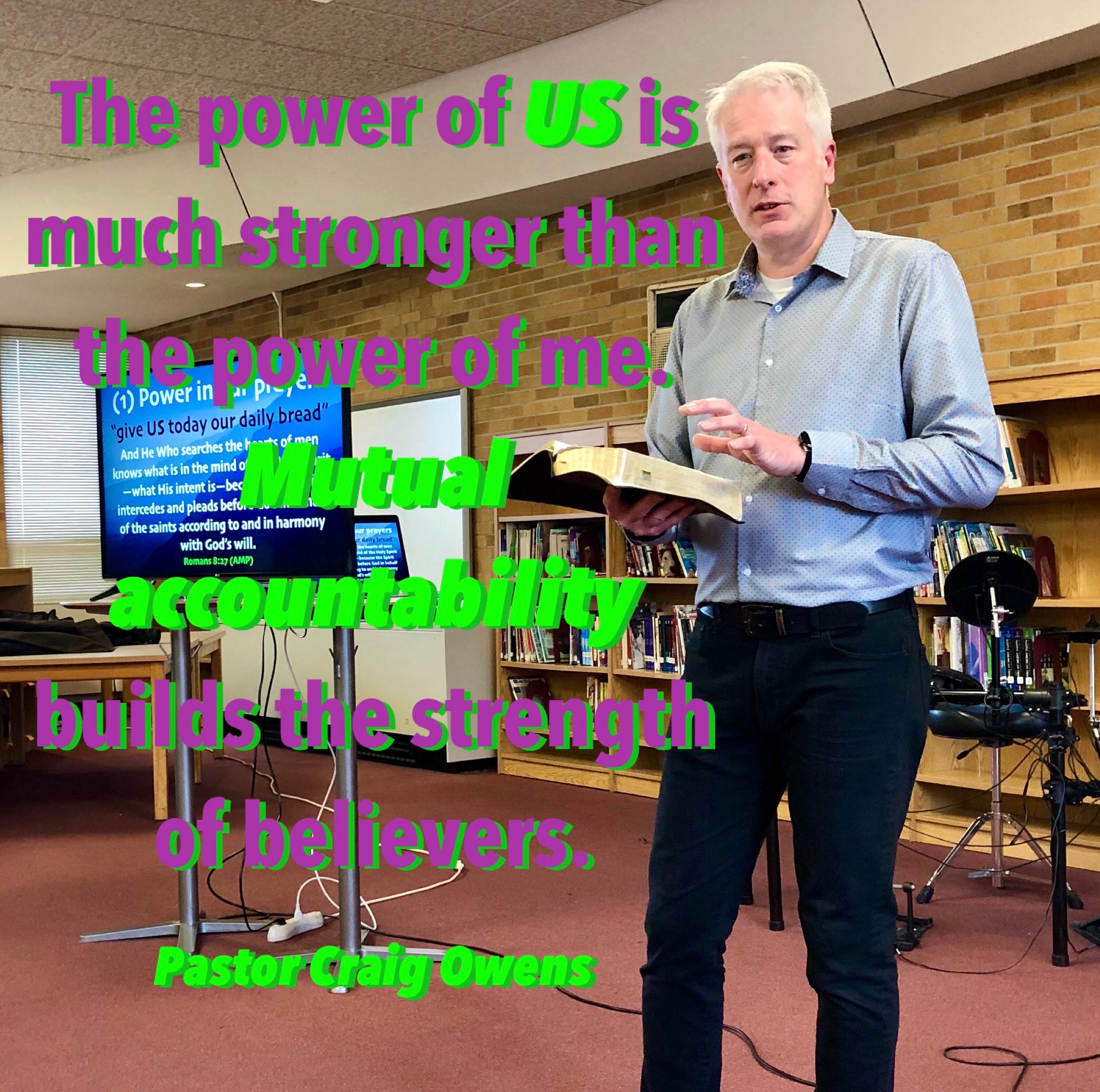
A Praying Family

Not one word in Scripture is wasted: not one word is redundant or replaceable. When Jesus taught us to pray to a Heavenly Father, He taught us to say, “OUR Father.” That means we are all His children, with His Holy Spirit helping us to grasp this—The Spirit Himself testifies with our spirit that WE are God’s children. Now if WE are children, then WE are heirs—heirs of God and co-heirs with Christ… (Romans 8:16-17). 

Did you know that the word saints never appears in the singular in Scripture? No one person is singled out for his or her saintliness. Because we are saintS, praying together to OUR Father, this means accountability. For some people, accountability is a bad word. It seems to them to feel like someone is looking over their shoulder or checking up on them. But Christians should never feel this way! I like how Ken Blanchard defines this: “Accountability means: We owe each other for something we’ve agreed upon.” 

What have the saints of God agreed upon? That God is our Father, that Jesus is His Son and our Brother, and that the Holy Spirit is our Helper. We’ve agreed that if we are brothers and sisters in God’s family, we are mutually accountable to one another. 

In the context of the prayer Jesus taught us to pray, being mutually accountable means: 

  1. Power in our prayersgive US today our daily bread. Jesus talks about the power in agreement, and the apostle Paul emphasizes how the Holy Spirit helps believers harmonize in prayer with each other and with God’s will (Matthew 18:19-20; Romans 8:27). 
  1. Strengthening of our characterforgive US our debts, as WE also have forgiven our debtors. Jack Hayford points out that, “The believer’s best defense against self-deception is through mutual accountability to one another.” In order for our character to be strengthened, we have to allow others to speak into our lives—even the lovingly painful words (Proverbs 27:17, 6). 
  1. Protection from falling to temptationlead US not into temptation, but deliver US from the evil one. Samson became entangled with a prostitute when he was all by himself; Elijah became depressed when he sent his servant away; David fell into sin when he was alone; Peter denied Christ when all of the other disciples had run away. That’s why the writer of Hebrews counsels us to stick close to our Christian family members (Hebrews 10:21-25). 

In an earlier post, I noted that how we view God is going to determine what we pray and what we expect after we pray. Coming together and praying together will help us see God better. Just as the angels around the throne are always crying out to each other “Holy! Holy! Holy!”, when we come together we can show our fellow saints what we’ve learned about our holy Father’s love and power. This is both an encouragement to others and allows others to be an encouragement to us too. Then together we can pray more boldly and expect great things in response to our prayer. 

Being mutually accountable to the saints in prayer…

  • hallows God as our Father

  • glorifies Jesus as our Brother

  • honors the Spirit as our Helper

God never intended that you would have to walk through life alone. He wants us to share the journey with fellow saints—His family made up of our brothers and sisters. This praying family truly honors God’s name! 

Join me on Sunday as we continue to learn more about prayer. 
Poetry Saturday—What Is Prayer?

Prayer is the soul’s sincere desire,
Unuttered or expressed;
The motion of a hidden fire,
That trembles in the breast.

Prayer is the burden of a sigh,
The falling of a tear;
The upward glancing of an eye,
When none but God is near.

Prayer is the simplest form of speech
That infant lips can try;
Prayer, the sublimest strains that reach 
The Majesty on high.

Prayer is the Christian’s vital breath,
The Christian’s native air;
His watchword at the gates of death—
He enters heaven with prayer.

Prayer is the contrite sinner’s voice,
Returning from his ways;
While angels in their songs rejoice
And cry, ‘Behold, he prays!’ 

The saints in prayer appear as one,
In word, in deed, and mind;
While with the Father and the Son,
Sweet fellowship they find.

No prayer is made by man alone
The Holy Spirit pleads;
And Jesus, on th’ eternal throne
For sinners intercedes.

O Thou! by Whom we come to God,
The Life, the Truth, the Way;
The path of prayer Thyself hast trod:
Lord, teach us how to pray. —James Montgomery

Thursdays With Spurgeon—Our Father In Heaven

This is a weekly series with things I’m reading and pondering from Charles Spurgeon. You can read the original seed thought here, or type “Thursdays With Spurgeon” in the search box to read more entries.

Our Father In Heaven

     I believe that this prayer [“Our Father in heaven, hallowed be Your name”] was never intended for universal use. Jesus Christ taught it not to all men, but to His disciples, and it is a prayer adopted only to those who are the possessors of grace and are truly converted. In the lips of an ungodly man, it is entirely out of place. Does not one say, “You are of your father the devil, and the desires of your father you want to do” (John 8:44)? Why then should you mock God by saying, “Our Father in heaven”? 

     Let none despise this prayer. It is matchless, and if we must have forms of prayer, let us have this first, foremost, and chief. But let none think that Christ would tie His disciples to the constant and only use of this. Let us rather draw near to the throne of heavenly grace with boldness, as children coming to a father, and let us tell forth our wants and our sorrows in the language that the Holy Spirit teaches us. …

     If we say, “Our Father in heaven,” we must remember that our being sons involves the duty of obedience to God. When I say “my Father,” it is not for me to rise up and go in rebellion against His wishes. If He is my Father, let me note His commands and let me reverentially obey. If He has said, “Do this,” let me do it, not because I dread Him, but because I love Him. And if He forbids me to do anything, let me avoid it. …

     We are one in the family of God and no one is ahead of the other. One may have more grace than another, but God does not love one more than another. One may be an older child than another, but he is not more a child. One may do mightier works and may bring more glory to his Father, but he whose name is the least in the kingdom of heaven is as much the child of God as he who stands among the king’s mighty men. Let this cheer and comfort us when we draw near to God and say, “Our Father in heaven.” … 

     And after you have prayed that, rise up and act it. Say not “our Father” and then look upon your brethren with a sneer or frown. I beseech you, love like a brother and act like a brother. Help the needy. Cheer these sick. Comfort the fainthearted. Go about doing good; minister to the suffering people of God wherever you find them. Let the world take notice of you—that you are when you are on your feet what you are upon your knees—that you are a brother to all the brotherhood of Christ, a brother born for adversity, like your Master Himself.

From The Fatherhood of God

This kind of prayer speaks of…

  • access
  • responsibility
  • power
  • love
  • provision
  • assurance
  • protection
  • acceptance
  • joy
  • and more blessings than we can ever enumerate! 

What a blessing to pray to a Heavenly Father who is also Holy God.

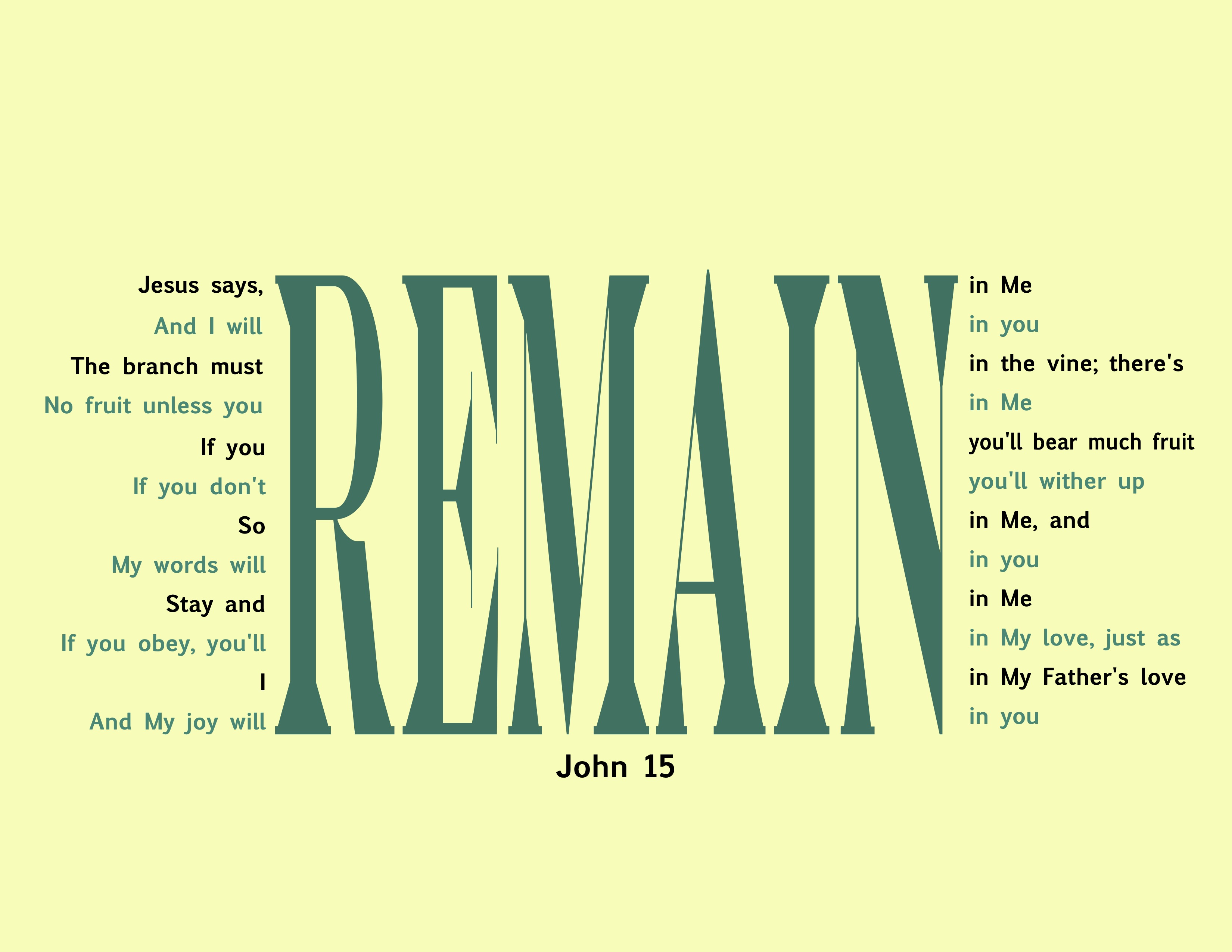
Remain

20 Facts & Tips About Your Body Clock

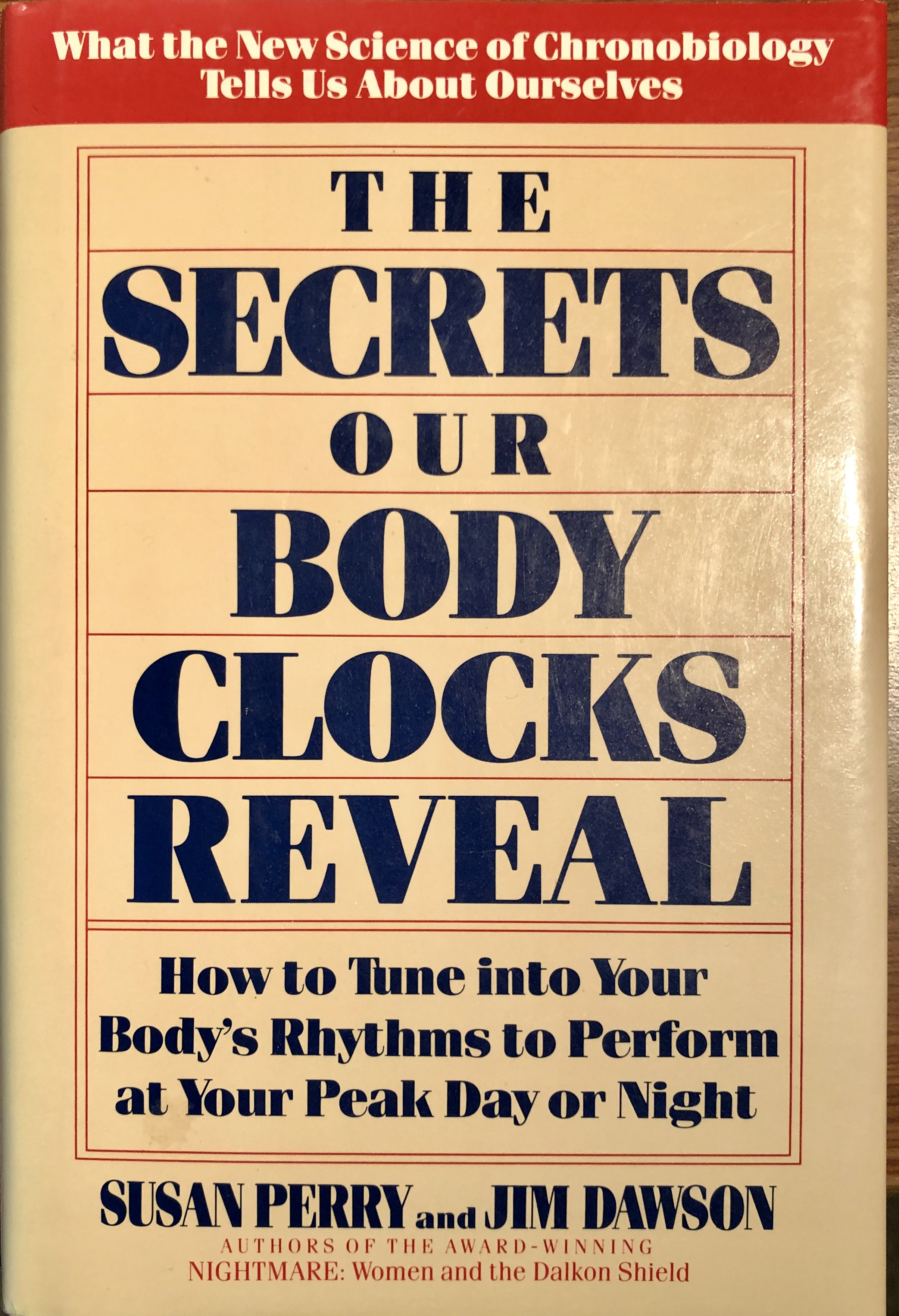
I really enjoyed reading The Secrets Our Body Clocks Reveal (you can read my full book review by clicking here). From this book, I’ve begun implementing a few of the tips I discovered. Here are a few of the facts and tips that I found interesting. 

  1. “Most of us reach our peak of alertness around noon. … We are least alert during the early morning hours—specifically, between 3:00 a.m. and 6:00 a.m.” 
  2. “Your immediate, or short-term, memory is best during the morning hours. … Your long-term memory is a different matter, however. Afternoon is the best time for learning material that you want to recall days, weeks, or even months later. … How well you remember things depends on when you learn them, not when you recall them.” 
  3. “On average, we tend to do best on cognitive tests—things that require the greatest mental effort—during the morning hours, particularly the late morning hours.” 
  4. “All of your senses—taste, sight, hearing, touch, and smell—are their keenest during the twilight hours of late afternoon and early evening.” 
  5. Tips for keeping your daily rhythms on beat: (1) get out in the sun for at least fifteen minutes each day, and (2) try to follow a regular daily routine.
  6. “Fortunately, there is another way to avoid the Monday morning blahs. Stay up as late as you like, but make sure you get up at your regular wake up time. In other words, don’t sleep in. And don’t take naps during the day. Then, when night rolls around again, you’ll find yourself able to fall asleep at or before your regular bedtime, and you’ll avoid pushing your cycle ahead.” 
  7. “Scientists have also discovered that short naps (twenty minutes or less) are just as revitalizing as long ones—and less disruptive to regular sleep rhythms. In addition, regular nappers wake up more refreshed than those who take only an occasional nap. When naps are part of the regular daily rhythm, they are less disruptive.” 
  8. “Generally, our moods peek around four hours after we awaken.” 
  9. “A regular exercise program can go along way toward easing the physical effects of stress. … The exercise program must be regular, however; sporadic physical activity, such as an occasional game of tennis or softball, or an activity that is not appropriate to your physical condition, can be a harmful stressor.” 
  10. “Melatonin’s daily rhythm is similar to that of legendary vampires: it appears at the onset of darkness and begins to disappear at the break of dawn. In other words, darkness triggers the chemical’s release; sunlight suppresses it. It should come as no surprise, therefore, that melatonin reaches its seasonal peak in the body during the dark winter months.” 
  11. “Beards tend to grow the most on Sunday and the least on Wednesday.” 
  12. “If you wake up in the morning with a temperature of 99° F, you are very likely coming down with a cold, the flu, or some other kind of illness. But if you have that same reading around dinner time, you may be in perfect health. The reason, of course, is that your temperature rises during the day. A high reading early in the day is a greater indication of illness than the same reading late in the day.” 
  13. “Take a commonplace drug like aspirin, for example. When swallowed at 7:00 a.m., aspirin stays in the body for up to twenty-two hours. When the same dose is taken at 7:00 p.m., it is completely out of the body within seventeen hours.” 
  14. “When you know your rhythms are out of sync, be aware that you are particularly vulnerable to illness. It is the time to be extra careful about keeping your distance from people with the flu or other viruses.” 
  15. “The best thing you can do for a tension headache is to learn how to relax. As soon as the headache begins, lie down, if possible, so you can take the strain off your neck, since this is the location of most of the muscles that tense up and cause a tension headache. Close your eyes and breathe deeply to return oxygen to your strained muscles. Better yet, ask a sympathetic friend or loved one to gently massage your neck and shoulders.”
  16. “Eat your biggest meal at breakfast, your next biggest at lunch, and your smallest at dinner.” 
  17. “About every ninety minutes, most people experience an urge to put something into their mouths. … Generally, it will pass in about fifteen minutes.” 
  18. “According to recent studies conducted at Northwestern University, both morning and night people perform simple mental tasks better during the morning hours after consuming the caffeine equivalent of one to three cups of coffee. But when the tasks become more complex, only night people do better under the influence of caffeine. For morning people, the higher dose of caffeine, the more mistakes they make.” 
  19. “Carbohydrates help calm and focus your mind.” 
  20. “Protein foods increase your alertness and help you feel more energetic. … Protein can be eaten either alone or with a carbohydrate food to energize the mind. For carbohydrates to have their calming effect, they must be eaten alone.” 

Susan Perry and Jim Dawson also shared what they uncovered about the importance of sleep. Click here to read about their research 

The Secrets Our Body Clocks Reveal (book review)

Do you know when is your best time to work on a mentally-challenging project? Or perform an athletic event? Or even take a nap? Our body clocks function predictably, but the issue is knowing what rhythm your particular body is following. In The Secrets Our Body Clocks Reveal, Susan Perry and Jim Dawson help us discover how to tap into our optimal performances.

The ups-and-downs, alert-and-tired, focus-and-distracted cycles of our body are largely predictable. Our bodies operate fairly consistently on a “clock” that can be learned. Once you know your rhythms, you can adjust your daily activities to operate at your very best. This book gives you amazing insight into the research of chronobiologists, and lots of charts to help you track your body’s clock, and even highly practical tips for how to re-adjust your clock if things have gotten askew. 

You will learn about how to keep things in sync, as well as how to get things back in sync after an illness or traveling to a new timezone. You will discover the best time of day to do certain activities, how to plan your sleep schedule, how to anticipate and regulate your mood changes, your “health thermometer,” and even how your diet can work with your body clock. 

This is a highly practical book! If you want to get back in sync or raise your performance levels, I recommend you check out The Secrets Our Body Clocks Reveal.

Prayer Expectations

Many of our prayers could be much bolder and much more specific than they are. Why is that? Because how we view God is going to determine what we pray and what we expect after we pray.

When we pray, we approach an All-Loving Father, and we approach an All-Powerful God. I have found that typically people get warmed by the idea of Father and get scared by the idea of God. They say things like: “What if my prayers don’t hallow God’s name? What if He’s mad at me? What if I pray an improper prayer?” 

God wants us to come to Him in prayer, so He makes Himself very accessible! The Father is both Father and God; the Son is both Friend and King; the Spirit is both Comforter and Convictor. We get ALL of this in One God. 

Charles Spurgeon had this word of encouragement: “If You are my Father, then You love me. If I am Your child, then You will regard me, and poor though my language is, You will not despise it.” Jesus came to earth fully God and fully man, making Him our perfect intermediary (see Job 9:32-35; 1 Timothy 2:5; Hebrews 7:25). And the Holy Spirit helps interpret our groaning prayers (Romans 8:26-27). 

Have you ever noticed that neither the prophets of the Old Testament, nor Jesus in the Gospels, nor the apostles in the New Testament ever prayed, “God, if this is Your will please do such-and-such”? They simply prayed. Or more accurately, they prayed so boldly and specifically it almost sounded like a command: “Stand up” or “Be clean” or “Go, your prayer has been answered.” 

When you and I are praying to an All-Loving and All-Powerful Father, with Jesus interceding for us, and the Spirit helping us, we too can pray these bold and highly specific prayers. 

After all, if you don’t pray specifically and expectantly, how will you know when your prayer is answered? 

I find John Piper’s acrostic very helpful in praying these bold and expectant prayers. He calls it APTAT: 

  • A—Admit I can’t do anything without Christ. This hallows His Name. 
  • P—Pray for help to do it. 
  • T—Trust a specific promise of God to help me (two general promises are found in Isaiah 41:10 and Romans 8:32). 
  • A—Act. Do the things I need to do: apply for the job, ask forgiveness, schedule a meeting. 
  • T—Thank Him when I’m done. 

Two final thoughts—

  1. Make prayer more of a listening relationship than a talking relationship. 
  2. Give yourself some grace as you are maturing; don’t expect immediate perfection. Start praying and then let the Father, the Son, and the Spirit help you mature in your prayer life. 

I hope you can join me this Sunday as we continue to work on our plans to pray.

Poetry Saturday—Give To The Winds Thy Fears

Give to the winds thy fears,
hope and be undismayed;
God hears thy sighs and counts thy tears;
God shall lift up thy head.

Through waves and clouds and storms,
He gently clears the way;
wait thou His time, so shall this night
soon end in joyous day.

Still heavy is thy heart,
still sink thy spirits down?
Cast off the weight, let fear depart,
and ev’ry care be gone.

What though thou rulest not,
yet heav’n, and earth, and hell
proclaim, God sitteth on the throne,
and ruleth all things well.

Leave to His sov’reign sway
to choose and to command.
so shalt thou wond’ring own His way,
how wise, how strong His hand!

Far, far above thy thought
His counsel shall appear,
when fully He the work hath wrought,
that caused thy needless fear.

Thou seest our weakness, Lord,
our hearts are known to Thee;
O lift Thou up the sinking heart,
confirm the feeble knee.

Let us in life, in death, 
Thy steadfast truth declare,
and publish with our latest breath
Thy love and guardian care. —Paul Gerhardt (translated by John Wesley)

Thursdays With Spurgeon—The Oftener The Better

This is a weekly series with things I’m reading and pondering from Charles Spurgeon. You can read the original seed thought here, or type “Thursdays With Spurgeon” in the search box to read more entries.

The Oftener The Better 

     It is strange that spiritual blessings are our only possessions that we do not employ. We get a great spiritual blessing and we let the rest get on it for many a day. There is the mercy seat, for instance. Ah, my friends, if you had the cash box as full of riches as that mercy seat is, you would go often to it, as often as your necessities require. But you do not go to the mercy seat half so often as you need to go. Most precious things God has given to us, but we never overuse them. The truth is, they cannot be overused. We cannot wear a promise threadbare. We can never burn out the incense of grace. We can never use up the infinite treasures of God’s lovingkindness. … 

     How seldom do we ask counsel at the hands of the Lord! How often do we go about our business without asking His guidance? In our troubles how constantly do we strive to bear our burdens, instead of casting them upon the Lord, that He may sustain us! And this is not because we may not, for the Lord seems to say, “I am yours, soul; come and make use of Me as you will. You may freely come to My store, and the oftener the better. Welcome.” … 

     Have not God in name only. Since He allows you to have such a Friend, use Him daily. My God will supply all your wants. Never want while you have a God. Never fear or faint while you have a God. Go to your treasure and take whatever you need. There is bread and clothes, and health and life, and all that you need. O Christian, learn the divine skill to make God all things; to make bread of your God, and water, and health, and friends, and ease. He can supply you with all these. … 

     Oh! Child of God, let me urge you to make use of your God. Make use of Him in prayer. I beseech you, go to Him often, because He is your God. … Fly to Him; tell Him all your wants; use Him constantly by faith, at all times. …  

     Go to God continually, importunately, confidently. Delight yourself in the Lord, and He will bring it to pass. Commit your way to the Lord, and He will guide you by His counsel and afterward receive you to glory (Psalm 73:24).

From God In The Covenant 

Oh what peace we often forfeit
Oh what needless pain we bear
All because we do not carry
Everything to God in prayer

Godly Leaders Need (+) Desires

…if someone desires to be a church leader, he desires an honorable position (1 Timothy 3:1). 

Desires—Paul uses two different Greek words for this one English word. The first word is orego. In the (+) sense it means to stretch out in order to grasp something. In the (-) sense it means to give one’s self up to the love of money.

The second word is epithymeo. In the (+) sense it means to long for a good thing (see Matthew 13:17; Luke 22:15). In the (-) sense it means to covet what is forbidden (see Matthew 5:28; James 4:2).

So (+) or (-) leadership comes down to desire. If I want a leadership position for what I can get, that is a (-) desire. Should you then seek great things for yourself? Do not seek them… (Jeremiah 45:5). 

But if I desire a leadership position for what I can give, that is a (+) desire. Not so with you. Instead, whoever wants to become great among you must be your servant, and whoever wants to be first must be slave of all. For even the Son of Man did not come to be served, but to serve, and to give His life as a ransom for many (Mark 10:43-45). 

With these differing desires in mind, the list of qualifications for church leaders in verses 2-7 and 8-13 should be viewed through the (+)/(-) desire lenses:

  • Why should I be above reproach: (-) so that I can get something, or (+) so that I can serve others better?
  • Why should I be faithful in marriage: (-) so that I look good, or (+) so that I am strengthened by my spouse to serve? 
  • Why should I be temperate, self-controlled, respectable, hospitable, an able teacher, sober, gentle, agreeable, content, and so on? The answers to those questions determine what desire I have.

A godly leader desires to glorify God and serve others, so a godly leader willingly submits to the Holy Spirit to address any area of (-) desire that may derail the God-honoring (+) desires. Just as Jesus is the Ultimate Servant-leader, I too must “have the same mind as Christ Jesus” (Philippians 2:5).

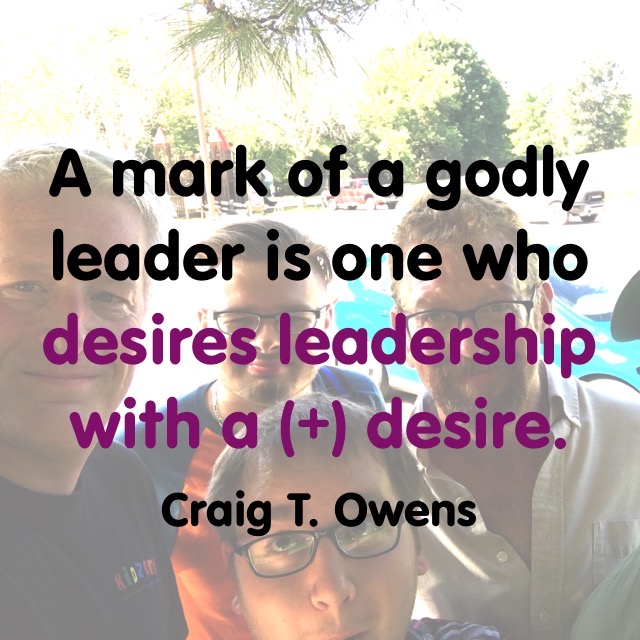
A mark of a godly leader is one who desires leadership with a (+) desire.

This is part 43 in my series on godly leadership. You can check out all of my posts in this series by clicking here.