Thursdays With Spurgeon—Do I Have Faith?

This is a weekly series with things I’m reading and pondering from Charles Spurgeon. You can read the original seed thought here, or type “Thursdays With Spurgeon” in the search box to read more entries.

Listen to the podcast of this post by clicking on the player below, and you can also subscribe on iTunes or Spotify.

Do I Have Faith? 

     Man cannot please God without bringing to himself a great amount of happiness…. It is because [God] gives him the blessings of adoption, pours upon him the bounties of His grace, makes him a blessed man in this life, and ensures him a crown of everlasting life, which he will wear and which will shine with unfading luster when the wreaths of earth’s glory have all been melted away. … If, then, we are right in saying that to please God is to be happy, the one important question is, how can I please God? … 

     Without faith it is impossible to please [God]’ (Hebrews 11:6). That is to say, do what you may, strive as earnestly as you can, live as excellently as you please, make what sacrifices you choose, be as eminent as you can for everything that is lovely and of good repute—yet none of these things can be pleasing to God unless they are mixed with faith. …  

     Have you faith? Shall I help you to answer that question? I will give you three tests, as briefly as ever I can, not to weary you….

    1. He who has faith has renounced his own righteousness. 
    2. Then true faith may be known by this: It begets a great esteem for the person of Christ. Do you love Christ? Could you die for Him? Do you seek to serve Him? Do you love His people? 
    3. He who has true faith will have true obedience. If a man says he has faith and has no works, he lies. If any man declares that he believes in Christ and yet does not lead a holy life, he lies.

From Faith

Both my parents and my grandparents on both sides of my family tree were Christians. They had faith in the God of the Bible. In my younger years, I thought just believing what they believed was good enough. But I had to come to a point where I could say, “I don’t have faith in God because my parents and grandparents do, but because I really believe it is true.” In other words, not just Jesus is the Savior, but Jesus is MY Savior. 

Does having faith mean I have no doubts? No, there are still things I don’t fully understand. Faith means believing God for the things I do understand and still trusting Him with the things I don’t understand yet. 

That’s pretty much the resume of every person in the great faith chapter of the Bible (Hebrews 11). For instance, Noah didn’t understand what a worldwide flood was, but he built an ark in faith; Abraham didn’t know how God would make him the father of many nations, but he moved from his homeland by faith; Joseph didn’t know how God would deliver the Israelites from Egypt, but he gave instructions by faith; and on and on the list goes. 

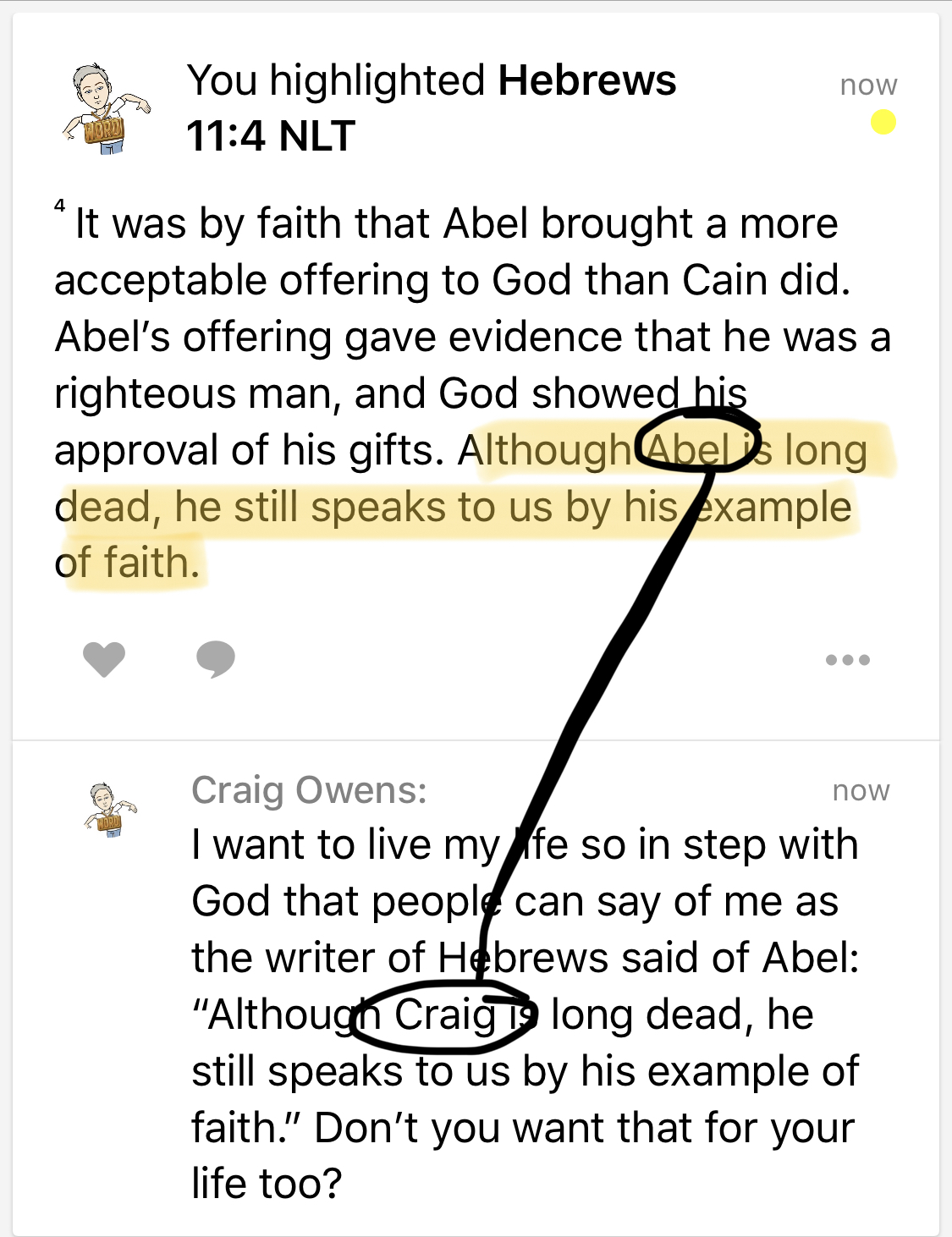
I commented on Hebrews 11:4 on YouVersion, “I want to live my life so in step with God that people can say of me as the writer of Hebrews said of Abel: ‘Although Craig is long dead, he still speaks to us by his example of faith.’ Don’t you want that for your life too?” 

The Bible itself tells us that faith comes into our heart by hearing the Word of God. If your faith is struggling, I would encourage you to open your Bible, ask the Holy Spirit to illuminate the Word to you, and begin reading with an open heart and mind. That’s exactly what I did, and I came to the conclusion that I believed the God of the Bible not because my parents did, but because He showed Himself to me to be Real. 

If you are struggling with your faith in God, I’d love to talk with you. Please get in touch with me and let’s begin a dialogue.

Please Consider Supporting This Ministry

For over 12 years and nearly 5000 posts, I have endeavored to provide my readers with sound biblical content. From devotionals, to sermons, to book reviews, and quotes, each blog post is intended to give my readers as much solid content as possible. 

Recently I have begun making my blog posts available for free in an audio format both on my website, and for subscribers through Apple and Spotify. And I am constantly adding new videos to my YouTube channel. 

May I ask you to consider something? If this ministry has blessed you, would you please consider becoming one of my Patreon supporters? As a Patreon sponsor you will get access to all my free content PLUS you will have access to exclusive content that only supporters get to see.  

Posted in Uncategorized. Tags: , . Comments Off on Please Consider Supporting This Ministry

Biblical Mindfulness

Listen to the podcast of this post by clicking on the player below, and you can also subscribe on Apple or Spotify.

I have always been mindful of Your unfailing love…. (Psalm 26:3).

The dictionary defines “mindful” as simply being aware. Unfortunately, many psychologists today have constricted this term to mean simply being aware of the present moment, especially one’s own emotions in the present moment. 

In the New Living Translation, this verse has David saying to God, “I am always aware of Your unfailing love.” God’s unfailing love is an eternal attribute of God, and David says he is perpetually contemplating this attribute. But notice how David applies mindfulness not just to his present moment, but to his past and future as well. In fact, David invites God to examine his heart and mind to verify that David is always properly mindful of God’s love.

Notice the past, present, and future tenses David uses—

Past (v. 1):

  • I have led a blameless life 
  • I have trusted in the Lord without wavering 

Present (vv. 3, 7, 11):

  • Your love is ever before me 
  • I walk continually in Your truth
  • I proclaim aloud your praise
  • I lead a blameless life

Future (v. 12):

  • In the great assembly I will praise the Lord

Notice that between David’s claim that he has led a blameless life and that he is still leading a blameless life, we read his request for God to, “Test me, O Lord, and try me, examine my heart and my mind.” David was perpetually mindful of God’s awareness of both his thoughts and his lifestyle.

Being mindful of God’s love means looking back in gratitude to recall God’s past provision, looking around in worship to see God’s ongoing involvement, and looking ahead in hope to anticipate God’s unending grace. 

Unlike modern-day psychology which tells us mindfulness is a narrowing of our thoughts, biblical mindfulness is an expanding of our thoughts. Biblical mindfulness sees God’s past work and His future grace, and brings those to bear on our present circumstances. 

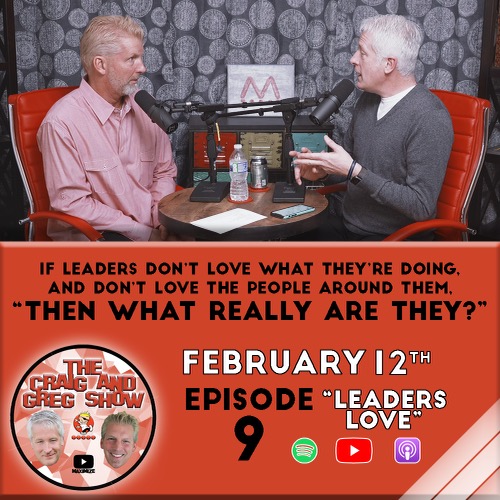
The Craig And Greg Show: Leaders Love

On this episode of “The Craig And Greg Show” we talk about: 

  • Greg won’t pick a husband for his daughter’s arranged marriage  
  • Gary Chapman’s outstanding book The Five Love Languages 
  • if leaders don’t love what they’re doing and they don’t love the team around them, are they really leaders?  
  • Greg challenges leaders to go beyond the Golden Rule in communicating with others
  • leaders naturally communicate in their native love language but they must learn how to communicate in the languages of their teammates
  • once you start speaking someone else’s love language consistently, you fill their love tank and then all of the love languages become effective  
  • servant leadership is defined as learning and speaking the love languages of my teammates
  • how leaders can use love languages to more effectively transmit a vision or announce a new project
  • download the free Love Languages assessment → 5 Love Languages assessment 

Check out this episode and subscribe on YouTube so you can watch all of the upcoming episodes. You can also listen to our podcast on Spotify and Apple.

Talking To GOATs (book review)

Listen to the podcast of this post by clicking on the player below, and you can also subscribe on Apple or Spotify.

I’m a student of leadership, so I love to learn about what makes leaders “tick,” how they overcome obstacles and deal with adversity, and watch how they prepare themselves to be the best they can be. Broadcaster Jim Gray has had a front-row seat (literally!) to some of the most outstanding athletes in recent history, and he unpacks his stories about these leaders in his book Talking To GOATs. 

For those of you wondering, GOAT stands for “greatest of all time.” We’re talking about people who stand out from their peers over a long period of time, those who set the standard for everyone else, those who have so excelled that their sport has had to change things up to try to accommodate them! Superstars like Muhammad Ali, Tom Brady, Michael Jordan, Tiger Woods, Mike Tyson, Hank Aaron, and Michael Phelps. 

Jim Gray’s book is a behind-the-scenes look at not only the hard work he put in to produce and present interviews with these GOATs, but also insights rarely seen of the intense work these athletes put in to become the GOATs of their particular sport. Jim shows us how both he and these athletes deal with setbacks, criticism, the challenges that come with success, and their own internal drive to keep being the best. 

This book isn’t all about athletes, but it’s a bit of a memoir of Jim’s life too. I really enjoyed learning about the role that Jim’s parents, and especially his dad, played in helping Jim get into these “front row seats” to cover these amazing athletes. Jim is also very candid about how he has processed the inevitable criticism that comes from interviewing a certain athlete in a way that not every fan appreciated. It was a very enjoyable read. 

The sports fans in your life will almost certainly know who Jim Gray is, and they will love hearing what went into some of the more memorable moments in sports broadcasting. My son gave me this book as a gift and I thoroughly enjoyed it, so I know that the sports fans that you love will also give you kudos if you send Talking To GOATs their way.

Our Daily Diet

Listen to the podcast of this post by clicking on the player below, and you can also subscribe on Apple or Spotify.

A couple of weeks ago I shared how Jesus made prayer the literal heart of His Sermon on the Mount. Prayer is what empowers us to live a perfect, God-honoring life. In the introduction of His model prayer, Jesus gives us two don’ts and one do. 

DON’T #1: Don’t be a hypocrite. That word literally means a play-actor. More than anyone else ever will, God sees who we really are. We cannot fool Him so there is no reason to fake it. For proof, check out some of the gut-level-honest prayers David records in the psalms!  

DON’T #2: Don’t babble. The Greek word here is unique: It’s made up of the name of a poet named Battus who was needlessly wordy, and the Greek word for word. In Greek, the word battologeō is an onomatopoeic word (like our English words that sound like what they really are describing: words like whoosh, buzz, or smack). It means rambling with our mouth, but our hearts and heads simply aren’t engaged as well. 

DO: Jesus gives us a DO, which is built right into the two don’ts: Do come to God as your Father (also see Luke 11:9-13). Our perfect Father knows perfectly what we need, and He alone can perfectly meet that need. Jesus uses our need for daily food to show how even earthly fathers provide for their children. So the very first petition in His model prayer for us is, “Give us today our daily bread.” 

“When prayer has become secondary, or incidental, it has lost its power. Those who are conspicuously men of prayer are those who use prayer as they use food, or air, or light, or money.” —M.E. Andross 

My friend’s trainer recently told him, “You cannot out-exercise a bad diet.” I think this is just as true in the realm of prayer: You cannot out-________ a bad prayer diet. You cannot…

  • …out-religion a bad prayer diet, as though your religious exercises can make up for a lack of prayerful food.  
  • …out-talk a bad prayer diet, or “babble,” as Jesus said.  
  • …out-strategize a bad prayer diet, as one successful man attempted to do (see Luke 12:16-20).

Jesus said our heavenly Father is just waiting for us to ask Him for what we need. In Psalm 5, David explained how attentive God is, even understanding our cries, our sighs, and our groans. So David’s conclusion was: “Lord, every morning You hear my voice. Every morning, I tell You what I need, and I wait for Your answer. 

Friends, we need to be first responders in prayer. Make it a habit every morning to let God hear your voice before anyone else does. DON’T make a show out of it or babble some words you don’t really feel, but DO talk with your loving heavenly Father about what you need for this upcoming day. He has already prepared a good, healthy diet for you, so ask Him to give you this day what you need, and then be expectant all day long in the ways your Father will answer you.

If you’re missed any of the other messages in our Be A First Responder series in prayer, you can access the full list by clicking here.

Poetry Saturday—An Owens Haiku

Listen to the podcast of this post by clicking on the player below, and you can also subscribe on Apple or Spotify.

Craig loved Betsy first.
Then came three lovable kids.
All five love Jesus.

Then God sent us west.
To the town of Cedar Springs.
We all love our church.

God added spouses.
Lovable mates for our kids.
The blessings increase. —Craig T. Owens

Thursdays With Spurgeon—Talking Back To Your Old Family

This is a weekly series with things I’m reading and pondering from Charles Spurgeon. You can read the original seed thought here, or type “Thursdays With Spurgeon” in the search box to read more entries.

Listen to the podcast of this post by clicking on the player below, and you can also subscribe on iTunes or Spotify.

Talking Back To Your Old Family

     When a man is adopted into a family and comes thereby under the regime of his new father, he has nothing whatever to do with the old family he has left behind and he is released from subjection to those whom he has left. And so, the moment I am taken out of the family of satan, the prince of this world has nothing to do with me as my father and he is no more my father. I am not a son of satan; I am not a child of wrath. 

     …When the law comes to a Christian with all its terrible threats and horrible denunciations, the Christian says, ‘Law! Why do you threaten me? I have nothing to do with you. I follow you as my rule, but I will not have you to be my ruler. I take you to be my pattern and mold, because I cannot find a better code of morality and of life, but I am not under you as my condemning curse.’ …  

     If one man adopts another child into his family, he cannot give it his own nature as his own child would have had. And if that child whom he will adopt should have been a fool, it may still remain so. He cannot make it a child worthy of him. But our heavenly Father, when He comes to carry out adoption, gives us not only the name of children, but the nature of children, too. He gives us a nature like His well-beloved Son, Jesus Christ.

From Adoption

Charles Spurgeon was called “the prince of preachers” for good reason! His word pictures are so biblically-accurate and so easy to recall, that anyone can grasp the concepts he shares from the Scripture. I have two takeaways from this portion of his sermon: 

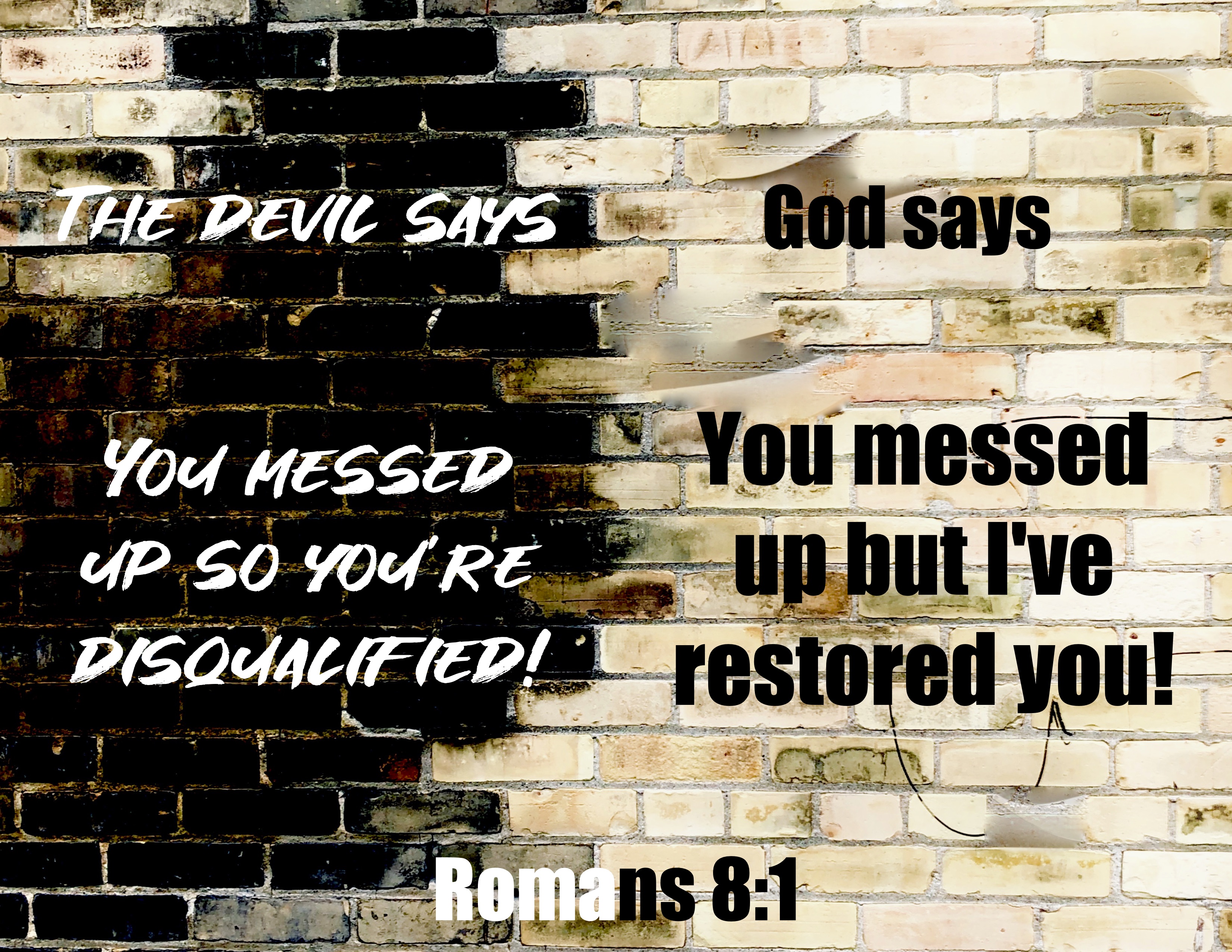
First, we need to talk back to our old family. The name “satan” means accuser: he accuses, condemns, slanders, and does his best to separate. When a Christian has been adopted into God’s family, there is no condemnation for the one who now calls God, “Abba Father” (see Romans 8:1-17). 

This is where we need to call out satan’s lies. I mean literally call them out. We need to talk back to the devil and tell him the truth, just as Spurgeon said in his example of talking back to the Law. Let me say it again: literally speak the truth out loud. The devil needs to hear it and your own ears need to hear it too: “I am no longer subject to your jurisdiction. You have no say over me any longer. I am a child of God. My sins have been forgiven and forgotten; therefore, there are no grounds left for any condemnation!”


Second, we need to talk back to our old nature. After being adopted into God’s family, the Holy Spirit undertakes a process to conform us to the image of Jesus. This process is called sanctification, but I like to call it saint-ification. 

This is where we call out what we used to be. And, again, I challenge to literally speak these words out loud. Don’t say, “I’m so impatient,” but tell yourself (out loud!), “I am becoming the patient saint Jesus wants me to be.” Don’t say, “I’ll never get this right,” but tell yourself, “I am learning more and more about Christ’s nature with each attempt.” Talk back to these old habits from your old family, and tell them about the new saintly habits the Holy Spirit is developing in you. 

The book of Revelation tells us that the saints overcame the slanderous devil by the blood of Jesus and by the words of their testimony. Speak out those life-affirming words every time that slanderer tries to make you forget into whose family you have been adopted!

“These Things”

Listen to the podcast of this post by clicking on the player below, and you can also subscribe on Apple or Spotify.

…whoever does these things will never be shaken (Psalm 15:5). 

David says “these things” are what allow us to come into God’s presence, but we cannot consistently nor completely do “these things” without the help that can only come from being in God’s presence. So I have to already be doing “these things” in order to get into His presence in order to get empowered to do “these things”?! 

That seems like a classic, no-win, Catch-22! 

So… how do I get into God’s presence in the first place?

Simple: I can’t. 

Only Jesus can. 

Thankfully, He made it possible for me to come in: He became the Door! 

Only by Jesus can I come in. Only in Jesus can I be empowered. Only with Jesus can I consistently do “these things.” 

What are “these things” that David listed that both allow me to come into God’s presence and then keep me in God’s presence? David said we must…

  1. …walk blamelessly before God. Or as Jesus said, “Be perfect, therefore, as your heavenly Father is perfect” (Matthew 5:48). I am blameless in God’s sight only when I am in Jesus.  
  2. …speak truthfully: from the heart, no slander on my tongue, no unkind words in my mouth, no gossip on my lips. 
  3. …live courageously: honoring what is good and opposing what is evil. 
  4. …keep my oaths: making my yes mean yes, not making any excuses, helping others to do the same. 

“These things” both glorify God and keep me in God’s presence. And “these things” attract others to His presence too. But I don’t try to do “these things” in my own strength—that would make me God—nor just as a religious To-Do List—that would make me a Pharisee. But I take a cue from the apostle Paul—

But whatever I am now, it is all because God poured out His special favor on me—and not without results. For I have worked harder than any of the other apostles; yet it was not I but God who was working through me by His grace (1 Corinthians 15:10). 

It is grace—a free gift of God—that enables me to do “these things” not in my own strength, but in His strength! 

I don’t try harder to do “these things” that keep me secure in God’s presence, but I trust more profoundly in His grace that continually empowers me to successfully do “these things” every single day.

The Art Of Writing And The Gift Of Writers (book review)

Listen to the podcast of this post by clicking on the player below, and you can also subscribe on iTunes or Spotify.

I am eternally grateful to my high school English teachers who not only taught me the fundamentals of reading literature and writing in different styles, but who immensely sharpened my skills. But can you imagine having C.S. Lewis as a writing mentor? That’s what you are getting when you read The Art Of Writing And The Gift Of Writers. 

This book is compromised of essays and book reviews written by Lewis, interviews that Lewis gave, and even a transcript of an extemporaneous conversation with other authors who had congregated in Lewis’ rooms at Magdalen College. 

Learning how a gifted writer like Lewis crafted his own books was insightful, as well as how he interpreted the writing process of other authors. He even talked about how he choose to handle literary critics. But most energizing of all for me was the freedom he gave me to be myself in the writing process. He made it abundantly clear that other authors shouldn’t try to emulate his literary style—nor any other author’s style either—but to use their unique talents to write their unique works of literature. 

Since Lewis has been one of my favorite authors for most of my life, I found the journey into his mind to be absolutely fascinating. I would recommend this book for any author, aspiring author, or fellow fan of C.S. Lewis’ books and essays.