This is a weekly series with things I’m reading and pondering from Charles Spurgeon. You can read the original seed thought here, or type “Thursdays With Spurgeon” in the search box to read more entries.
Listen to the podcast of this post by clicking on the player below, and you can also subscribe on iTunes or Spotify.
Sent To Show Jesus To The World
And the glory that You gave Me I have given them, that they may be one just as We are One: I in them, and You in Me; that they may be made perfect in one, and that the world may know that You have sent Me, and have loved them as You have loved Me. (Jesus, in John 17:22-23)
The essence and cause of the glory that the Father gave the Son was, first of all, that He endowed Him with the Holy Spirit. ‘God does not give the Spirit by measure. The Father loves the Son, and has given all things into His hand’ (John 3:34-35). The Holy Spirit descended upon our Lord in His baptism and abode upon Him so that in the power of the indwelling Spirit He lived, spoke, acted, and in all that He did, the Spirit of God was manifest. …
Now this glory, our Lord has given to all His disciples. Upon each true disciple, the Spirit of God rests according to his measure. If we have not the anointing to the fullest, it is either from lack of capacity or by reason of our own sin, for the Spirit of God is given to the saints—He dwells with us and will be in us always. My brothers and sisters, I would to God we realized this, that the glory of the Holy Spirit that was given to Christ is also given to us, so that it is ours to think, to feel, to speak, to act under His guiding influence and supernatural power! What are we apart from the Holy Spirit? How can we hope to convince even one man, much less the world, that God has sent His Son unless the Holy Spirit is with us? …
If men would see God, let them look at Jesus, for there is He to be seen! And with bated breath we add—let them look at Christ’s people, for there also is God revealed! It is the glory of the saints that they are the mirror of the divine character! …
Christ Jesus was sent to reveal the Father, sent to reclaim the wandering souls of men, sent to seek and to save the lost. And this is exactly what every true Christian is sent into the world to do. He is commissioned to reveal God in his every act and word. He is commissioned to win back rebellious hearts. He is commissioned to save the sons of men and bring them up out of the horrible pit into which their sins have cast them. …
Jesus was the Son of God, and He overcame the world in the power of His Sonship. Now, this glory that the Father gave Him, He has given us, that we, too, may be accepted; that we, too, may have access; that we, too, may have prevalence in prayer; that we, too, may have the Spirit of Adoption; and that we, too, may trample upon sin and overcome the hosts of darkness. This is the glory that rests upon all the faithful!
The word Selah appears nearly 70 times in the Bible, almost exclusively in the Psalms. Although it is primarily a musical term, it applies beautifully to our summer series.
Selah can mean…
a pause from the noise to reflect;
a preparation for an exciting accent; or
a reflective time of consideration
Throughout the Psalms, Selah appears at the end of a verse, at the end of the psalm, or sometimes even mid-sentence. But each one of them is perfectly placed by the Spirit-inspired authors to get us to take a breath and deeply contemplate what we just read or sang.
Summertime is typically a time for us to pause from our regular routine. Perhaps it’s a vacation, time with friends and family, driving around with the windows down and the music blasting, or just a quiet walk through woods or along a beach. In any case, whether we realize it or not, we’re actually doing Selah in these break-from-the-routine activities.
Join me this Sunday as we continue our summertime look at each of the Psalms that ask us to Selah. I think you will find that this Sunday summertime pause will be both refreshing and encouraging. You can join me either in person or on Facebook Live.
Since this is a continuation of our summer series, you can check out the Selahs we discussed by clicking here for the 2018 messages, here for the 2019 messages, and here for the 2020 messages.
Listen to the podcast of this post by clicking on the player below, and you can also subscribe on Apple or Spotify.
Psalm 93 opens with these powerful words: The LORD reigns.
Consider this: When we see the word LORD in all capital letters in our English translations of the Bible, we are reading God’s covenant name—Yahweh or Jehovah. This Limitless Power allows us to call Him by His personal name!
How can our finite minds even begin to fathom this? Listen to the psalmist’s words—
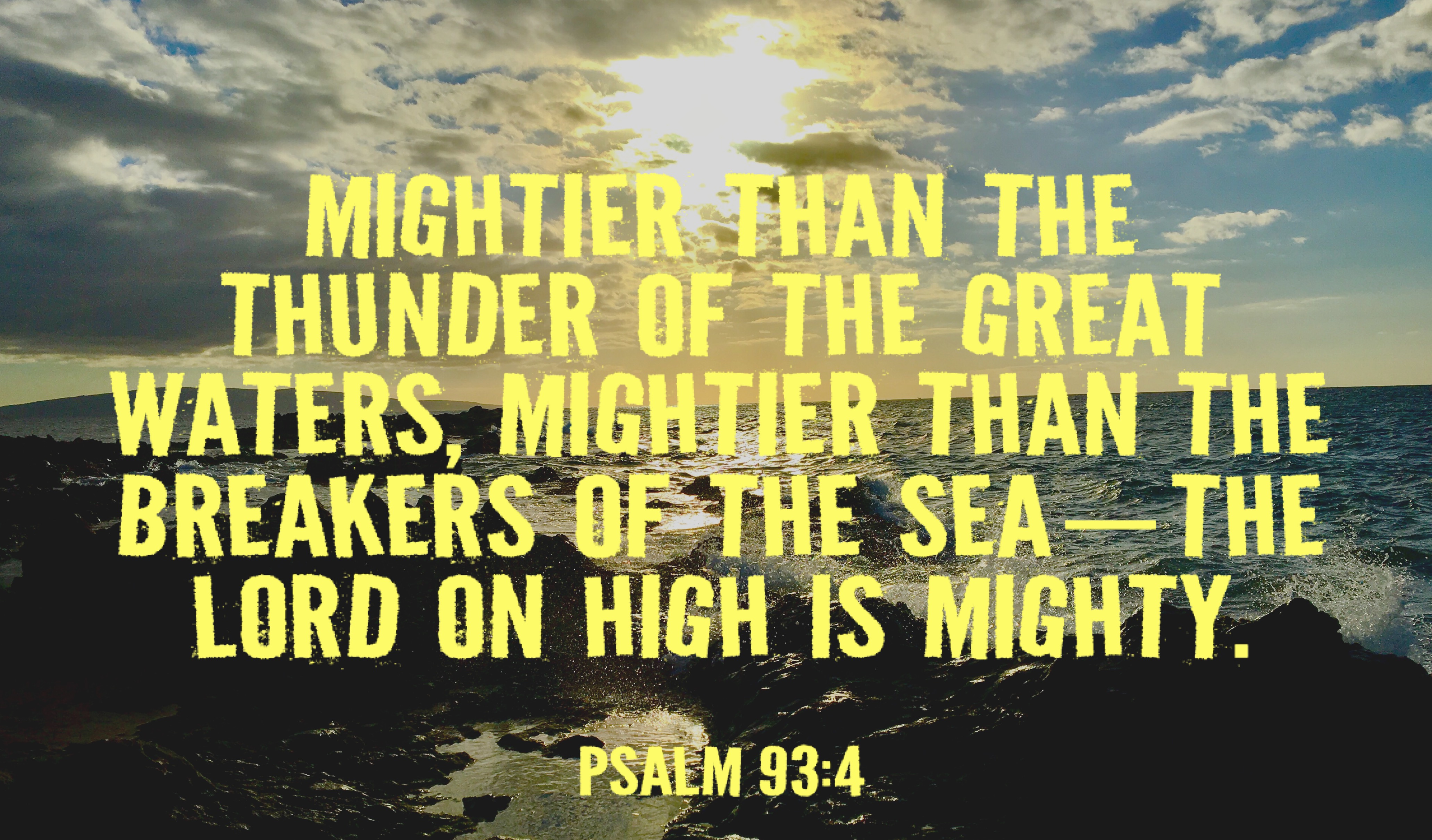
The LORD reigns, He is robed in majesty; the LORD is robed in majesty and is armed with strength. The world is firmly established; it cannot be moved. Your throne was established long ago; You are from all eternity. The seas have lifted up, O LORD, the seas have lifted up their voice; the seas have lifted up their pounding waves. Mightier than the thunder of the great waters, mightier than the breakers of the sea—the LORD on high is mighty. Your statutes stand firm; holiness adorns Your house for endless days, O LORD.
You can almost hear this psalmist struggling to help us comprehend the majesty of God. But how does a molecule comprehend the vastness of a planet? Creation sometimes roars and sometimes thunders, but even that only shows us a small glimpse of the Creator.
Do you see how established, orderly, firm, and secure this universe is? Even it had a starting point. Its Creator, however, has existed for all of eternity!
Have you ever been to the ocean and felt the pounding of the waves and heard the deafening roar of the breakers? That’s barely a toe-tapping of the might of Yahweh.
In the closing verse of this psalm, we read these words: “Your statutes stand firm.” Jehovah has given us a way to begin to comprehend Him. He has given us His statutes. This God who is unlimited in power has given us words we can live by. We can rely on them because they are backed by this limitless God! His promises stand firm forever. Nothing can shake God or His Word, so that means nothing can shake me when I stand on Him.
Standing on God’s Word means we are standing on Limitless Love and Limitless Strength.
Listen to the podcast of this post by clicking on the player below, and you can also subscribe on Apple or Spotify.
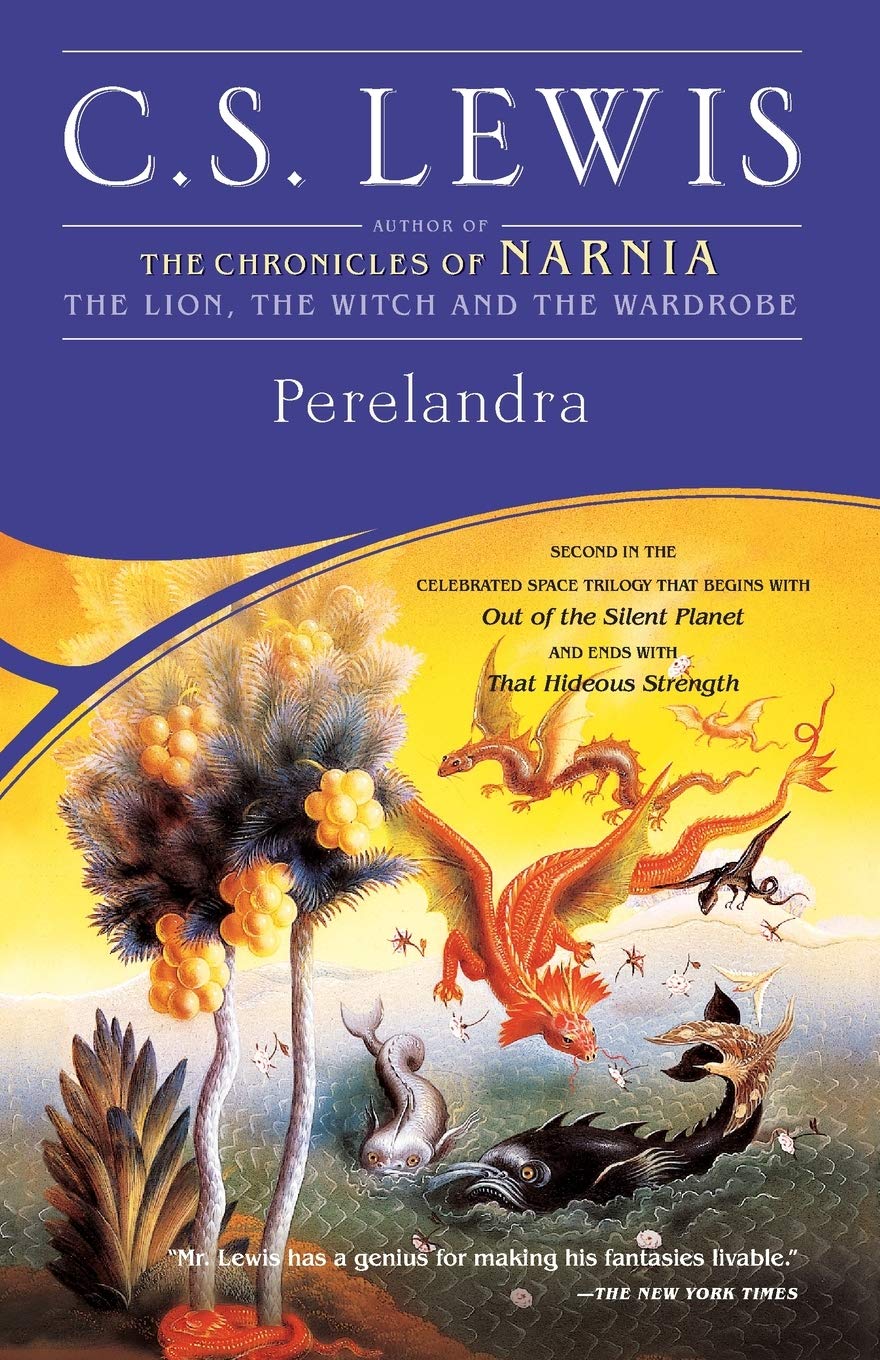
Perelandra by C.S. Lewis is the second book in Lewis’ space trilogy. Of all the books in this series, this is the only book that I would recommend reading the first book—Out Of The Silent Planet—first, so that you can fully appreciate the story.
Out Of The Silent Planet took place on Malacandra (or Mars) where our protagonist Dr. Elwin Ransom learns the Old Solar language and clashes with the antagonist Dr. Edward Weston. Perelandra (or Venus) is the setting of this second book, which essentially picks up right from the conclusion of book one.
Although C.S. Lewis had much stricter definitions for terms like “allegory” or “parable,” his fantasy stories in both this space trilogy and his Narnian books clearly are telling a much grander and more real Story than merely the fictional accounts in these books. This concept is on full display in Perelandra.
In the biblical account of the temptation of Eve, the whole affair is covered rather quickly. The devil says, “Eat the fruit,” to which Eve replies, “We’re not supposed to.” And then the devil says, “Nothing bad will happen to you if you do eat it,” and she does it. In Perelandra, C.S. Lewis takes us back to that scene and imagines the debate that might have happened, with Ransom counseling the Lady of Perelandra to obey, and Weston (or at least Weston’s body) trying to convince her to bravely disobey. The interplay between these three characters is quite fascinating.
This story is a very enjoyable read on its own, but I found that the backstory of Out Of The Silent Planet increased my enjoyment in reading this book again. Whenever you choose to read this book, you are in for—with all due apologies to C.S. Lewis—a lovely allegory!
a previous episode where we discussed how leaders handle general problems [0:28]
the distinction between conflict management and conflict leadership [1:30]
managers who try to make people get along vs. leaders who empower people to solve their own issues [2:44]
my 3 tips to prepare yourself before a meeting with your teammates [3:38]
how to look beyond the “triggers” to the root issue of a problem [5:04]
most people share the same values but conflict happens when they express that value differently [6:17]
leaders allow for the differences in style and personality [7:15]
how leaders can proactively prepare themselves and their team members to navigate personnel conflicts [8:00]
Greg relates conflict leadership to parenting terminology [10:15]
leaders need to stay among their team members [11:29]
what “peace” really is and where conflicts usually originate [12:50]
team members bring their past experiences with them [14:20]
Craig & Greg are ready to help coach you [16:30]
Check out this episode and subscribe on YouTube so you can watch all of the upcoming episodes. You can also listen to our podcast on Spotify and Apple.
When we first meet Boaz, he is described as “a man of standing.” Some Bible translations say “a man of wealth,” which is an acceptable definition. In fact, the word can mean strength, wealth, valor, or prominence, but the root word means something brought forth out of travail and pain. That tells us that Boaz wasn’t born a man of standing, he became a man of standing by going through difficult times, not giving in to the downward slide of culture, and remaining true to God.
Boaz had a steel-forged integrity!
Believe me, it would have been easy for Boaz to compromise! This was a dark time of selfishness in Israel’s history. A time where just doing the bare minimum was acceptable because most of the Israelites were selfishly doing whatever would benefit them (Judges 21:25).
The other description we read about Boaz is that he is a “kinsman-redeemer.” This same word is used in this verse: “Plead my cause and redeem me; revive me and give me life according to Your word” (Psalm 119:154). A redeemer is one who is close by to help, has the strength or resources to help, and is willing to help. Of course, the perfect example of a Kinsman-Redeemer is Jesus, who became our human kinsman so that He could rescue us (see Hebrews 2:14; Philippians 2:7-8).
Boaz was given the opportunity to do this for Naomi and Ruth, and he seized the opportunity with gusto. Far from being a “bare minimum” man, Boaz always went the second mile to bless Ruth and Naomi:
he practiced the “hospitality clause” plus he protected Ruth and gave her more than was required
he provided food for his workers plus he provided food for Ruth and Naomi
he blessed his workers plus he blessed Ruth in the name of the Lord
Ultimately, Boaz did indeed become the kinsman-redeemer for Naomi (by paying off all the debts of her deceased husband) and for Ruth (by marrying this non-Israelite woman and bringing her into the family line of Jesus).
Boaz was King Solomon’s great-great-grandfather. When Solomon was completing the temple in Jerusalem, he erected two pillars at the entrance: one was named Boaz, and the other was Jakim (with means “God will establish”). Taken together these pillars proclaim the message: By His integrity and faithfulness, God establishes and makes firm.
Boaz exhibited integrity at every opportunity, which is what forged his character and made him “a man of standing.” Boaz demonstrated that integrity is really faith in God plus faith-filled, second-mile, others-focused actions.
“Faith without works is just wishful dreaming.
Works without faith is just religious posturing.
Works with faith is God-glorifying!” —Craig T. Owens
Men of God, please remember this:
Every Word of God that you read or hear is a test—will you obey Him or will you compromise?
Every setback you go through is a test—will you learn and grow or will you sulk and shrink back?
Every success you experience is a test—will you bless others or will you hoard your blessings?
Every decision you make in a dark culture is a test—will you just have faith, just have bare-minimum works, or will you exhibit the steel-forged integrity that comes from putting your faith to work?
God’s blessing on your life of integrity will show others a picture of Jesus. God’s blessing on your life of going the second mile will show others that it is God who establishes and makes firm.
Don’t rob your family, don’t rob us, don’t rob future generations of the outpouring of God’s blessing because you are selfish or compromising. Stand strong, trust God, go the second mile, be the kinsman-redeemer for those in need, and then watch for God’s blessings!
This is a weekly series with things I’m reading and pondering from Charles Spurgeon. You can read the original seed thought here, or type “Thursdays With Spurgeon” in the search box to read more entries.
Listen to the podcast of this post by clicking on the player below, and you can also subscribe on iTunes or Spotify.
Context Is King
And the glory that You gave Me I have given them, that they may be one just as We are One: I in them, and You in Me; that they may be made perfect in one, and that the world may know that You have sent Me, and have loved them as You have loved Me. (Jesus in John 17:22-23)
Some words serve many uses and have many meanings. We are very apt to make mistakes if we give the same sense in all places to the same word. The word world throughout Scripture is used with a very remarkable variety of meaning, and one had need to have his wits about him and to read carefully in order to know what is the precise source of the term in each place where it occurs. …
I say again, the word world, therefore, has many shades of meaning ranging from that jet black meaning in which the world lies in the wicked one—‘Love not the world, neither the things that are in the world’ (1 John 2:15)—upward to the milder sense in John 1:10, ‘He was in the world, and the world was made through Him, and the world did not know Him.’ And yet higher to the bright meaning, ‘The kingdoms of this world have become the kingdoms of our Lord and of His Christ’ (Revelation 11:15). It is not in the worst sense that our text speaks of the world, but in the same manner as we find it used in such passages as these: ‘The Lamb of God who takes away the sin of the world!’ (John 1:29). ‘God was in Christ reconciling the world to Himself, not imputing their trespasses to them’ (2 Corinthians 5:19). And again in 1 John 2:2, ‘And He Himself is the propitiation for our sins, and not for ours only but also for the whole world.’
It is certain that ‘God so loved the world that He gave His only begotten Son, that whoever believes in Him should not perish but have everlasting life’ (John 3:16), and we cannot suppose that the great Redeemer would refuse to pray for those whom He was given. I understand in this particular place by the word world the whole mass of mankind upon the face of the earth who are not as yet converted. …
For the sake of the world, He would have the church in a high state of holy beauty and strength. May His gracious prayer be answered in all of us by the working of the Holy Spirit! … Our wish is to bring multitudes to the Savior and to conquer province after province of this revolted world for King Jesus. ‘Let the whole earth be filled with His glory’ (Psalm 72:19) is a prayer that we cannot, we dare not, we would not fail to pray!
From The Glory, Unity, And Triumph Of The Church
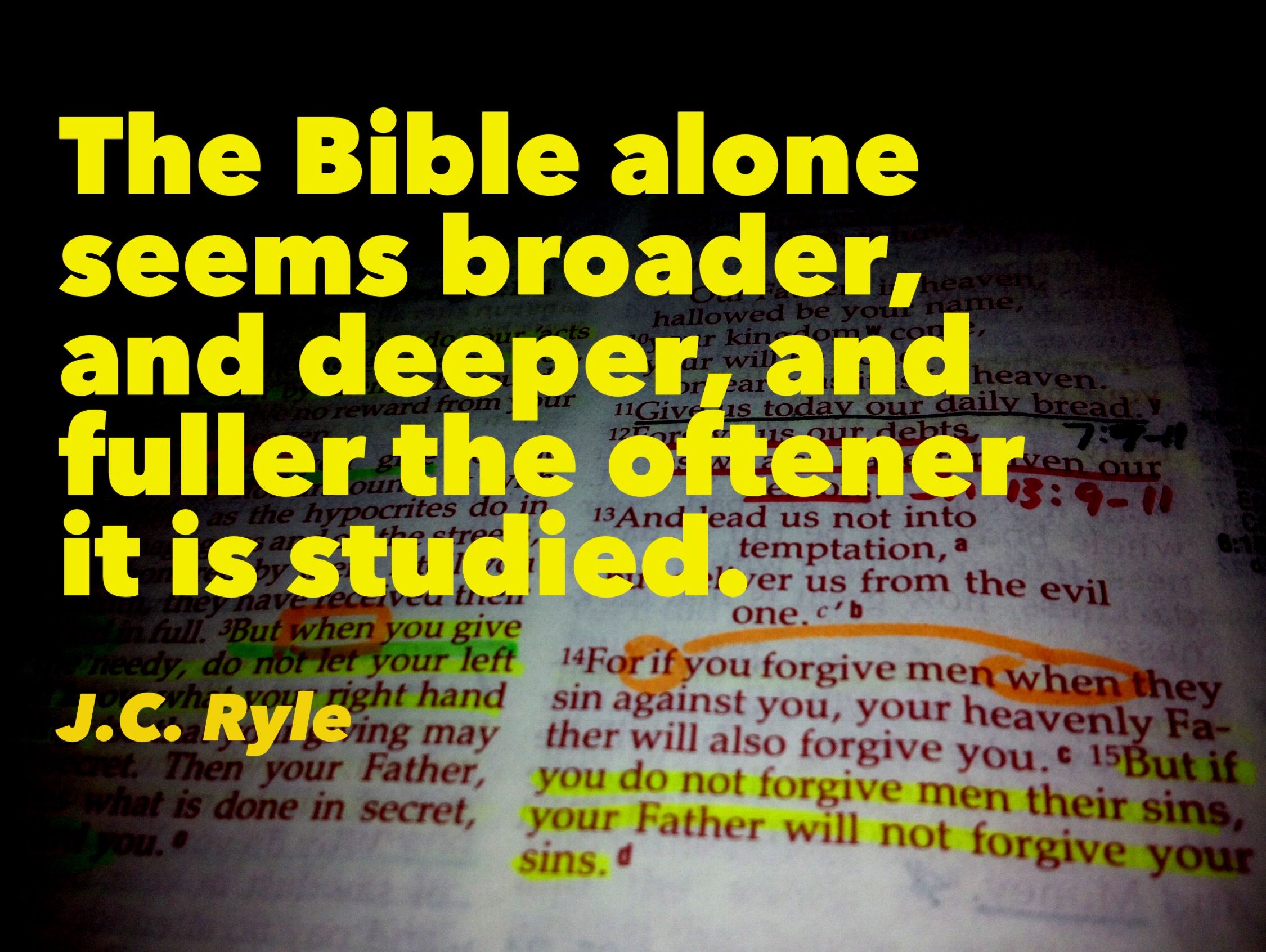
When we are studying our Bibles, we must remember that context is so vital. We have to read each inspired word in its proper context so that we know how to believe, think, live, and pray. I urge you to slow down in your Bible reading—aim for better and richer comprehension than to just try to read a lot in one sitting. Sometimes in my own personal Bible study time, I may spend several minutes just thinking about one phrase, and that may be the only part that I read on that particular morning.
However you read your Bible, make sure you are reading each part in its proper context. Pray before you begin reading and ask the Holy Spirit—Who inspired the Scriptures—to illuminate them to your heart and mind. These thoughtful Bible studies will do more to grow your spiritual maturity than simply rushing through your reading time.
But mostly it’s a story of unexpected love. It’s a perfect portrayal of God’s redemption, and it’s beautifully lived out by an unlikely heroine and hero: It’s the eternal love story of Ruth + Boaz.
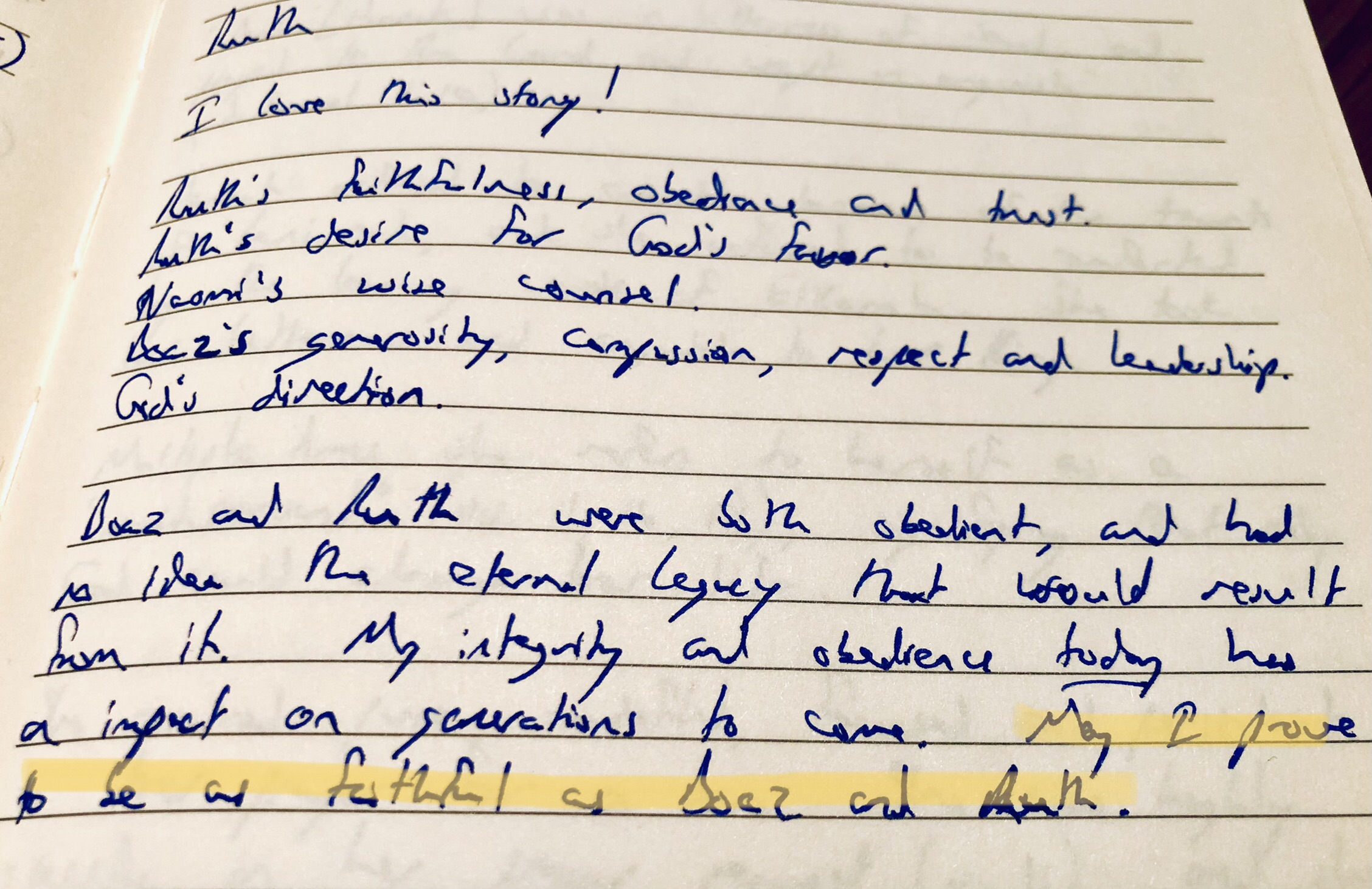
While thinking about this story, I wrote in my journal nearly four years ago, “May I prove to be as faithful as Boaz and Ruth.” Indeed, it’s hard to find better examples!
This story is still teaching lessons to us today. On Mother’s Day, we looked at this love story through the eyes of Ruth, and on Father’s Day, we saw the lessons Boaz lived out for us.
You can check out the Mother’s Day message about Ruth by clicking here.



 The heart of Man is not compound of lies,






 Craig T. Owens