Scott Klusendorf wrote, “If Roe and Casey are struck, it will be a truly historical moment, and pro-lifers should indeed celebrate. Nine unelected judges on the Supreme Court will no longer have sole legal authority to determine abortion policy. Rather, the legislative and executive branches of the federal government, along with those in the individual states, will now decide how the practice is governed. Put simply, the American people—your friends, your classmates, your coworkers, and your family members—will now determine if unborn humans enjoy the same legal protections as you and I, or get relegated to the dumpster.” This is a fascinating article about how pro-life Christians should prepare for a post-Roe America.
Even the pro-abortion research firm The Guttmacher Institute reports “an estimated 100,000 children are killed after the first trimester of pregnancy each.” Let that sink in: 300 lives are snuffed out every day by burtual, inhumane abortion techniques!
Dr. Tim Clarey at the Institue for Creation Research explains how the dinosaurs in the Juassic Park series are “imaginary dinosaur science.” He then lays out the facts.
J. Warner Wallace is a cold-case detective. His investigation into the biblical claims of the death and resurrection of Jesus led him to become a Christian. In this video he explains his thought process as an atheist—
The word Selah appears nearly 70 times in the Bible, almost exclusively in the Psalms. Although it is primarily a musical term, it applies beautifully to our summer series.
Selah can mean…
a pause from the noise to reflect;
a preparation for an exciting accent; or
a reflective time of consideration
Throughout the Psalms, Selah appears at the end of a verse, at the end of the psalm, or sometimes even mid-sentence. But each one of them is perfectly placed by the Spirit-inspired authors to get us to take a breath and deeply contemplate what we just read or sang.
Summertime is typically a time for us to pause from our regular routine. Perhaps it’s a vacation, time with friends and family, driving around with the windows down and the music blasting, or just a quiet walk through woods or along a beach. In any case, whether we realize it or not, we’re actually doing Selah in these break-from-the-routine activities.
Join me this Sunday as we continue our summertime look at each of the Psalms that ask us to Selah. I think you will find that this Sunday summertime pause will be both refreshing and encouraging. You can join me either in person or on Facebook or YouTube.
Since this is a continuation of our summer series, you can check out the Selahs we discussed by clicking here for the 2018 messages, here for the 2019 messages, here for the 2020 messages, and here for the 2021 messages.
Listen to the podcast of this post by clicking on the player below, and you can also subscribe on Apple, Spotify, or Audible.
I just love it when science catches up with what God has already pronounced in the Bible!
I’ve blogged previously about psychology, archeology, and astronomy uncovering truths that have already been stated in the Bible, but there are also numerous recent medical discoveries that confirm what Scripture has already been telling us.
Like the fact that there is a healthy way to relieve stress, and that retaining the stress hormone cortisol in our bodies for too long has serious implications. The apostle Paul tells us to not “be anxious about anything” but to enjoy “the peace of God which transcends all understanding” (Philippians 4:4-7).
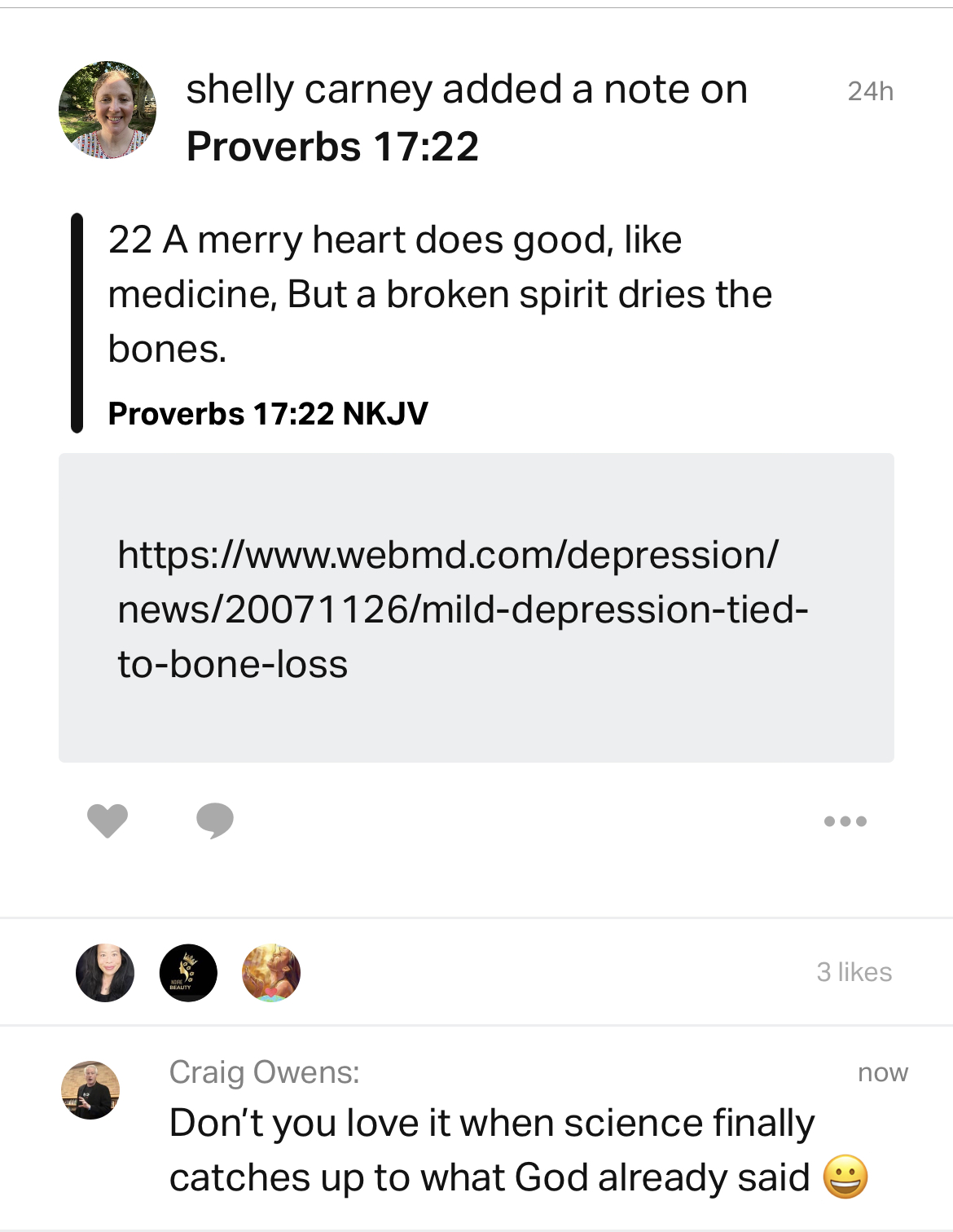
And then there is this finding that my YouVersion friend Shelly pointed out. “A happy heart is good medicine and a cheerful mind works healing, but a broken spirit dries up the bones” (Proverbs 17:22 AMP).
In a WebMD article, medical science confirms this truth of dried-up bones resulting from depression. They wrote, “Even mild depression may significantly increase a woman’s risk for developing osteoporosis. … The level of bone density loss attributed to depression in the study was similar to that previously associated with other well-known osteoporosis risk factors, including smoking cigarettes and getting little or no exercise. … Bone mineral density testing revealed that 17% of the depressed women showed evidence of bone thinning at a particularly vulnerable area of the thigh bone, compared to 2% of women who were not depressed.”
The Bible is God’s inspired Word to humankind, which means it is never out of date. The principles God has shared with us stand the test of time and are continually verified by the brightest scientific minds.
So here is my challenge to you: Take God at His Word, and apply the principles He has given you. I think you will find how much better your life will go when you live God’s way.
[5:40] Greg reminds leaders that there isn’t an award for not taking a vacation
[6:46] Greg has seen the fallout from overly-tired leaders, and I share some ideas for leaders to help themselves and their teammates de-stress
[9:31] How do leaders build playtime into their regular work schedule?
[11:10] Share your ideas with us!
[11:34] Greg shared some playtime activities he used in his organizations
[12:27] Why do leaders think they have to be so serious?
[15:15] Some thoughts for leaders to help their teams
[16:51] Greg emphasizes again the importance of self-care and they guys talk about how we can help other leaders practice self-care
[19:03] Our coaching huddles can help you grow your leadership
[20:02] Is it possible to find work-life balance?
Check out this episode and subscribe on YouTube so you can watch all of the upcoming episodes. You can also listen to our podcast on Spotify and Apple.
Listen to the podcast of this post by clicking on the player below, and you can also subscribe on Apple, Spotify, or Audible.
John Maxwell was right: “Everything rises and falls on leadership.”
As the leader goes, so goes the family, the neighborhood, the business, the church, the country. Just as Israel’s leaders fell into sin and took the people down with them, so too the religious and political leaders in America are leading people to sin.
God told Ezekiel, “See how each of the princes of Israel who are in you uses his power to shed blood” (Ezekiel 22:6). These ungodly leaders were described as:
The bottom line: God says, “You have forgotten Me” (v. 12).
This kind of evil must be punished by an All-Righteous God.
But God is still merciful. He is still looking for just one who will turn away from the sins of the culture and live righteously. He is looking “for someone among them who would build up the wall and stand before Me in the gap on behalf of the land so I would not have to destroy it” (v. 30).
God is looking for just one leader who will seek God’s glory and not personal gain, who will stand for righteousness even if he has to stand alone.
Will you be that one?
I pray I may be that one!
I pray for godly leaders to stand up! “Holy God, may we stand for You in this evil culture. May Your Holy Spirit strengthen us to stand unmoved against the onslaught of depravity. Strengthen us against the evil one and against evil people, knowing that greater are You in us than the evil that is in the world. May we be the ones that refuse to bend our knee to anyone or anything but You. In the powerful name of Jesus, I pray this. Amen!”
Listen to the podcast of this post by clicking on the player below, and you can also subscribe on Apple, Spotify, or Audible.
Last week I mentioned that there are numerous people who only appear in the Bible once. They come on the scene—many of them nameless to us—to play their part and then we never hear aboutthem again.
But we still hear fromthem because their lives are still teaching us.
There are several “one-timers” listed by Luke in the Advent story. Luke was a first-rate historian, researching his subject and talking to eyewitnesses to the events. Some of these one-timers have a few details Luke shared with us:
Zechariah and Elizabeth—we know their family lineage (priestly), Zechariah’s role in the temple, and the fact that Elizabeth was barren
Shepherds—we know where they came from (the fields surrounding Bethlehem) and their occupation.
Anna—we know her tribe (Asher), her father (Phanuel), and role (prophetess), and that she had been married and is now widowed.
But all Luke can say of Simeon is, “There was a man called Simeon…” (Luke 2:25-35).
Although, even that short introduction is packed with meaning.
Simeon in Greek means harkening while Simeon in Hebrew means heard. So he was both one who heard God and one who was heard by God. This speaks to me of an intimacy of relationship. Simeon didn’t view his conversation with God as a monologue but as a dialogue. I think that far too often we view our Bible reading time as God simply speaking to us, and our prayer time as us speaking to God. But both of these activities should be a two-way dialogue.
A.W. Tozer has a great definition of a godly leader that I believe accurately portrays Simeon: “A true and safe leader is likely to be one who has no desire to lead but is forced into a position of leadership by the inward pressure of the Holy Spirit and the press of the external situation.”
I think this means that a safe, godly leader is one who sees what is happening in a Christ-less culture, who then cries out in pain to God, and then who hears the Holy Spirit telling him how to live a holy life in that Christ-less culture.
We could call this external pressure grief over unrighteousness. Simeon so stood out in his culture that Luke calls him “righteous.” This is one whose way of thinking, feeling, and acting is wholly conformed to the will of God.
He also calls Simeon “devout.” This is a compound Greek word that only Luke uses in the New Testament which means to catch good things and make them your own. Simeon took hold of the things of God, made them his own, and then observed them carefully.
Finally, Luke tells us that Simeon was “waiting for the consolation.” He was living expectantly to see God’s Word come to its fulfillment. He could do all of this because the Holy Spirit was upon him and the Holy Spirit had revealed truth to him.
That phrase “revealed to him by the Holy Spirit” again speaks to the intimate relationship Simeon had with God.
Simeon knew that what God promises, He fulfills. He knew the consolation God had promised through Isaiah (Isaiah 40:1-2), and then Simeon saw its fulfillment in Jesus the Christ—
“Sovereign Lord, as You have promised, You may now dismiss Your servant in peace.For my eyes have seen Your salvation,which You have prepared in the sight of all nations:a light for revelation to the Gentiles, and the glory of Your people Israel.” (Luke 2:29-32)
In today’s darkening, Christ-less culture, godly men like Simeon are needed again.
Dads, do you feel the external pressure of today’s culture? If so, I pray that you will also feel the inward strengthening of the Holy Spirit drawing you into a more intimate relationship with Himself.
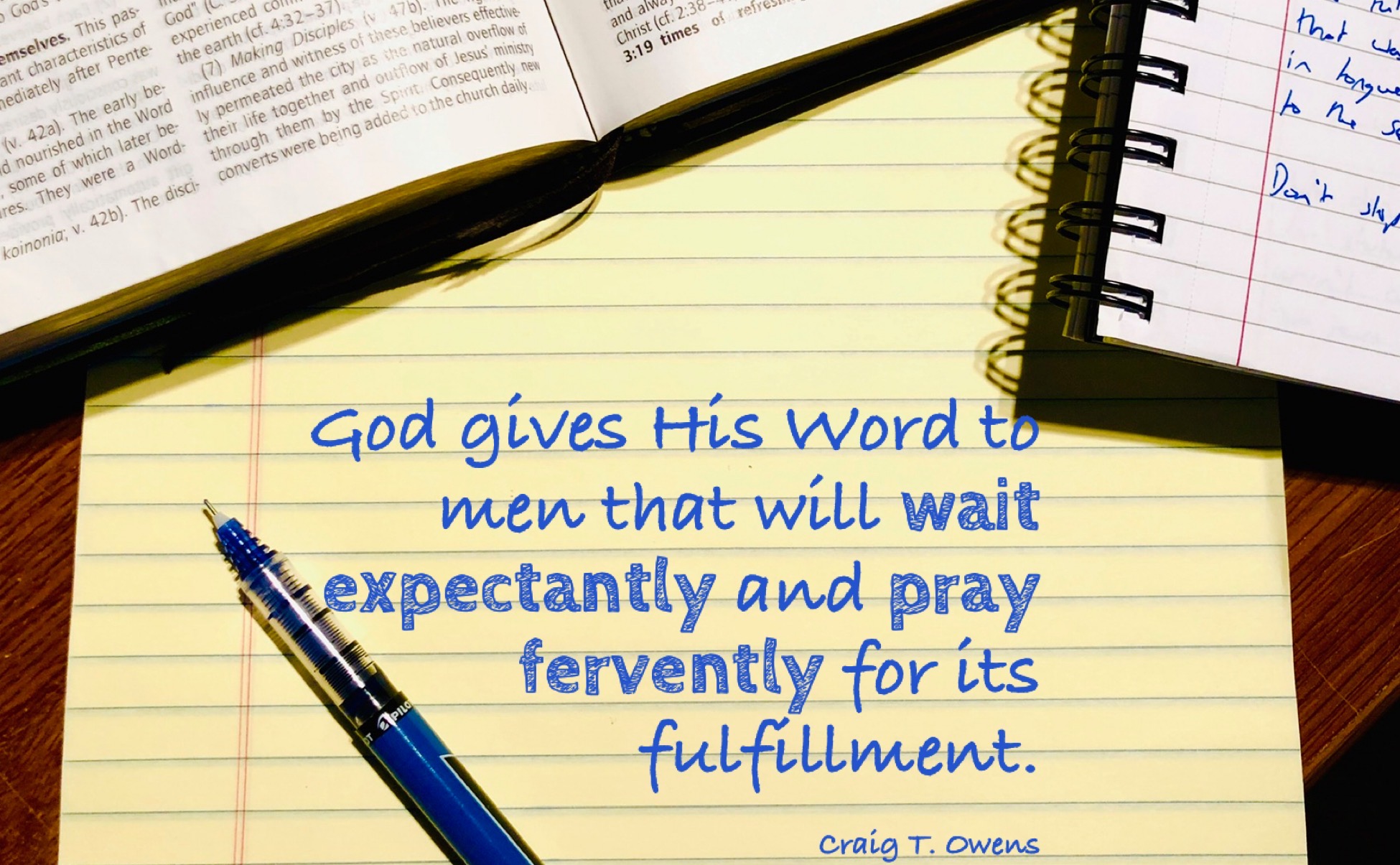
God gives His Word to men that will wait expectantly and pray fervently for its fulfillment. God is looking for men—for Dads—that will not cave in to cultural pressure.
Guys, let the Holy Spirit’s inward pressure strengthen you to stand strong. As you see the external downward spiral away from God, don’t collapse, don’t complain, but hear God’s Word and remain a righteous and devout man for your family and your community.
Listen to the podcast of this post by clicking on the player below, and you can also subscribe on Apple, Spotify, or Audible.
I had a great time on the Ailbe Podcast with Rusty Rabon.
Rusty referred to the opening chapter of my book Shepherd Leadership: The Metrics That Really Matter where I talk about how many of our churches and church leaders are attempting to climb the wrong ladder of success. Rusty noted how many people become frustrated because they are not seeing the success the way that so many people define it.
Before addressing frustrated pastors, I first spoke to the board members that are supporting that pastor.
In Shepherd Leadership I wrote,
“Businesses think in terms of quantitative gains—things they can count—but churches and nonprofits should be thinking in terms of qualitative gains—a quality improvement that isn’t as easily counted. I think we all know this, and yet we still persist in wanting to define success in a church or a nonprofit by those quantitative standards such as attendance growth, donations, and the like. When we think qualitative over quantitative, suddenly what seemed “small” is so significant and so valuable that it cannot be calculated!”
I’ll be sharing more clips from this interview soon, so please stay tuned. If you would like to check out the other clips I have already shared from this podcast, please check them out here. Shepherd Leadership: The Metrics That Really Matter is available in print or ebook, and in audiobook through either Audible or Apple.
Ken Blanchard shared a blog post based on one of the chapters in his book Simple Truths Of Leadership (which I highly recommend to leaders!). He wrote, “When you catch yourself doing things right, everything in your life will improve—especially your relationships. Why? Because it’s fun to be around people who like themselves. After all, if you’re not your own best friend, who will be? And as my dad used to say, ‘If you don’t toot your own horn, others might use it as a spittoon!’”
This is a weekly series with things I’m reading and pondering from Charles Spurgeon. You can read the original seed thought here, or type “Thursdays With Spurgeon” in the search box to read more entries.
Listen to the podcast of this post by clicking on the player below, and you can also subscribe on Apple, Spotify, or Audible.
Top Priority
…For the mouth of the Lord has spoken (Isaiah 1:20).
Every word that God has given us in the Bible claims our attention because of the infinite majesty of Him who spoke it. … See that you refuse not Him who speaks. O my hearer, let it not be said of you that you went through this life, God speaking to you in His book, and you refusing to hear! It matters very little whether you listen to me or not. But it matters a very great deal whether you listen to God or not. It is He who made you. In His hands is your breath. And if He speaks, I implore you, open your ears and be not rebellious. There is an infinite majesty about every line of Scripture, but especially about that part of Scripture in which the Lord reveals Himself and His glorious plan of saving grace in the Person of His dear Son Jesus Christ. …
For what He has spoken He still speaks to us, as freshly as if He spoke it for the first time. …
God’s Word has a claim, then, upon your attention because of its majesty and its condescension. But, further, it should win your ear because of its intrinsic importance. ‘The mouth of the Lord has spoken,’ so it is no trifle. God never speaks vanity. No line of His writing treats of the frivolous themes of the day. That which may be forgotten in an hour is for mortal man and not for the eternal God. When the Lord speaks, His speech is Godlike, and its themes are worthy of one who is dwelling in infinity and eternity. …
He speaks to you of great things that have to do with your soul and its destiny. It is not a vain thing for you, because it is your life. Your eternal existence, your happiness or your misery, hang on your treatment of that which the mouth of the Lord has spoken. … Treat not the Word of the Lord as a secondary thing that might wait your leisure and receive attention when no other work is before you. Put all else aside and hearken to your God.
From The Infallibility Of Scripture
Charles Spurgeon is so on-target with these words. Believe it or not, this sermon was actually delivered to his fellow pastors. But the words are true for all of us—we must make listening to God’s Word our first priority.
Every single word of Scripture is inspired by the Holy Spirit. And I do mean every single word. Even the order in which the words are listed is inspired. So when you read your Bible, ask the Holy Spirit—the Author of the text—to illuminate the words to you. Ask questions like:
What did that mean then?
What does it mean now?
What does it mean for me?
Does something in my life need to change?
If you make your time with God a priority, He will reveal more of Himself to you each time you open your Bible.
Listen to the podcast of this post by clicking on the player below, and you can also subscribe on Apple, Spotify, or Audible.
It’s not uncommon to hear children on the playground complaining, “That’s not fair!” Common but somewhat expected.
Unfortunately, it still seems to be common among adults who feel they got the short end of the deal to grouse, “That’s not fair!” Common but immature. Sadly, I have to admit that there are times that I find myself complaining that I didn’t get a fair deal.
If anyone could complain about not getting His “fair share” it would be God. He gives His all to people who easily forget His blessings, quickly chase after other things, and still grumble that they aren’t getting a fair deal.
God never complains, but He does ask questions: “My people, what have I done for you? How have I burdened you? Answer Me” (Micah 6:3). In the next two verses, God twice calls on His people to “remember” all that He has done for them.
We must answer God. But it seems to me that our obedience to Him is the only reasonable response to all of the blessings He has poured out on us. God doesn’t demand burdensome sacrifices from us, but He simply wants us to act justly, love mercy, and walk humbly before Him (v. 8).
What God asks of me is out of all proportion with what He has given me, who He is for me today, and the future He has secured for me.
Fair? No way, it’s completely unfair. God gives me everything and what He asks in return is so minor. Let’s make it our daily joy to act justly, to love mercy, and to walk humbly before our loving God!














 Craig T. Owens