The Doom Hanging Over Our Nation

“Since Roe vs. Wade in 1973, more than 50,000,000 babies have been murdered.

“How many missionaries were murdered in their mother’s wombs?

“How many astute business people gifted in creating wealth to give to missionary work among the unreached were slain before they drew a breath or donated a dollar?

“How many billions of hours of intercessory prayer have been lost because men and women who would have stormed heaven on their knees for the sake of those who have never heard were never heard themselves?

“How much damage, loss, and injury has been done to the spread of the gospel because we killed millions of God’s missionary hearted children in utero? … 

The doom of any nation that rebels against God is sure. The fact that God allows any good to come out of a nation that has brutally murdered 50,000,000 children can only be explained by His unfathomable mercy and the fact that there is a remnant that still lives for the glory of God among the nations. Missionary activity—that is Jesus-centered and gospel-preaching—is scorned and ridiculed by secular America today. Ironically, that activity may be the only reason God has not destroyed this land.” —Dick Brogden, in Missionary God, Missionary Bible

Thursdays With Spurgeon—Blessed Assurance

This is a weekly series with things I’m reading and pondering from Charles Spurgeon. You can read the original seed thought here, or type “Thursdays With Spurgeon” in the search box to read more entries.

Blessed Assurance

     The Holy Spirit, who enabled me to believe, gave me peace through believing. I felt as sure that I was forgiven as before I felt sure of condemnation. I had been certain of my condemnation because the Word of God declared it, and my conscience bore witness to it; but when the Lord Jesus justified me, the same witnesses made me equally certain. The Word of the Lord in the Scripture says, “He who believes in Him is not condemned” (John 3:18), and my conscience bore witness that I believed, and that God in pardoning me was just. Thus I had the witness of the Holy Spirit and also of my own conscience, and these two agreed in one. …  

     I find the apostle Paul speaking by the Holy Spirit and saying, “Having been justified by faith, we have peace with God” (Romans 5:1). If I know that my trust is fixed on Jesus only, and that I have faith in Him, were it not ten thousand times more absurd for me not to be at peace than for me to be filled with joy unspeakable? It is but taking God at His Word, when the soul knows as a necessary consequence of its faith that it is saved. …  

     Has Jesus saved me? I dare not speak with any hesitation here; I know He has. His word is true; therefore I am saved. My evidence that I am saved does not lie in the fact that I preach, or that I do this or that. All my hope lies in this, that Jesus Christ came to save sinners. I am a sinner, I trust Him, then He came to save me, and I am saved. I live habitually in the enjoyment of this blessed fact, and it is long since I have doubted the truth of it, for I have His own Word to sustain my faith.

From The Autobiography Of Charles Spurgeon

The joy that Spurgeon recounts in his conversion is the same joy that is available to all who call on Jesus in faith. As Spurgeon was prone to quoting passages of hymns in his sermons and books, these words of his remind me of a favorite hymn as well—

Blessed assurance, Jesus is mine;
Oh, what a foretaste of glory divine! 
Heir of salvation, purchase of God,
Born of His Spirit, washed in His blood. 
This is my story, this is my song,
Praising my Savior all the day long!

9 Quotes From “Surprised By Paradox”

Jen Pollock Michel has given us a thought-provoking look into her thoughts of some of the and solutions to the either-or challenges many Christians face. Please be sure to check out my full book review by clicking here. 

“Allowing for paradox does not represent a weakened approach to theological understanding. On the contrary, it allows for a robust theology, one that is filled with the sort of awe that not only regards God as unimaginably wondrous but also awakens in us the same desire Moses had to see Him as He is.” 

“As psychologists have described it, awe is ‘the experience of encountering something so vast—in size, skill, beauty, intensity, etc.—that we struggle to comprehend it and may even adjust our world to accommodate it.’ Awe is our slack-jawed response to natural phenomena like waterfalls and childbirth. To feel awe is to confirm a beautiful, wild universe, a world we neither made nor control. … For those of us inclined to religious belief, awe nurtures our certainty about God.”

“Modernity gave us more certainty than uncertainty—or at the very least certainty in certainty. We’ve come to an unassailable confidence that mystery, by dint of inquiry and scientific effort, can be wrestled and pinned down and made to cry uncle. We are no longer victims of the unknowable: we are masters of our own understanding. The great modern lie is one of infinite human autonomy and control.” 

“It is an old sin seduced by an old lie that we can be like God, perfectly knowing as He knows.… As soon as we think we have God figured out, we will have ceased to worship Him as He is.” 

“I also get tricked into thinking that the world must quiet around me if I mean to meet God. I forget the paradox of the burning bush: that Moses met God at Horeb on an unspectacular day, that his encounter with God was less planned and more happenstance. God did not speak to Moses as the prophet sat cross-legged and silent, his hands folded in reverent to prayer. God blazed up in the landscape of an ordinary Wednesday afternoon. This seems to be how it goes with God: a spiritual life is a material one.” 

“The paradox of God’s story is that He’s chosen to write its timelessness in the ticking heart of His Son and that He’s choosing to write it in our ticking hearts too.” 

“If the kingdom is good news, it surely isn’t safe. Because there is no square inch of our lives Jesus doesn’t intend to rule.” 

“To define grace apart from the Cross would be to say that God is simply given to leniency. It would be to essentially say that there are rules which we break and break badly, but God reassures us kindly that ‘it’s no big deal.’… The Cross speaks a thundering word about the cosmic big deal that is sin.” 

“To receive grace, we need humility. The only prerequisite for grace is empty hands. We have done nothing to make God notice us, and He is not impressed by us.” 

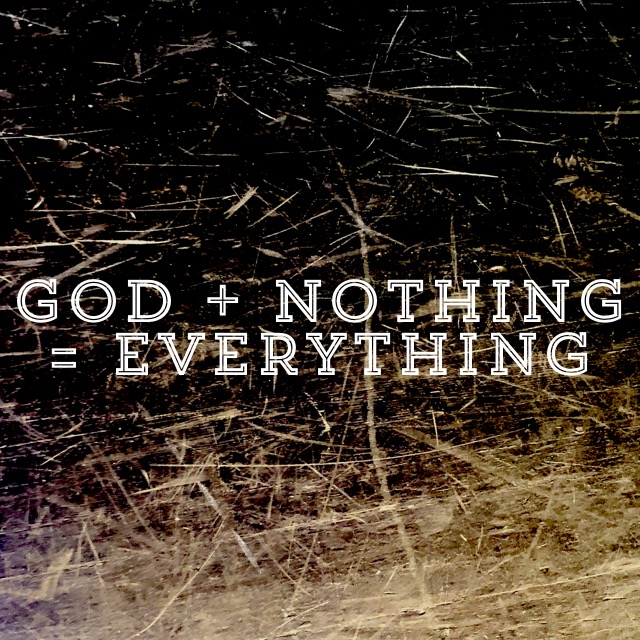
God + Nothing

You cannot serve God and _____________.

What goes in the blank? Not wealth, health, position, prestige, popularity, success. We turn all those good and legitimate things into God’s rival when our focus is on any one of them. 

Bottom line—NOTHING can go in that blank. All we need is God. 

“Your Father knows what you need” (Matthew 6:8). If you need wealth to complete His purpose for your life, He will give it to you. If you don’t, He will withhold it. But He will always give you your daily bread. 

If you need a prominent position, He will place you there; if you don’t, He will withhold that position. In either place, we still submit as faithful servants to holy God. 

If success will allow me to bring glory to God, He will give me success; if falling flat on my face will allow me to bring glory to God, He will knock me down.

If physical health will allow me to share the Gospel with others, God will keep me healthy; if I can serve Him best from a place of physical limitation, I can still do all things through Christ who strengthens me.

“My God is able to supply all your needs” (Philippians 4:19). He gives me all that I need to fulfill His plans for me. “So do not worry” about your bank balance, your standing in the community, your health, your family, or anything else. His grace is sufficient for you.

What goes in the blank? Nothing. 

God + Nothing = Everything you need!

Surprised By Paradox (book review)

Many years ago, as I struggled with some of the either-or challenges of Christianity, I read C.S. Lewis’ wisdom that the safest course between two either-or extremes was a course straight between them. Jen Pollock Michel embraces this profound wisdom in her thoughtful book Surprised By Paradox—The Promise of And in an Either-Or World.

Jen wrestled with many of the same either-or struggles I wrestled with, which I actually found encouraging. The reason I find this encouraging is that it tells me that I’m not alone in my wrestling, and you aren’t either! So embracing the same C.S. Lewis wisdom that helped guide me, Jen opens up her heart to us in an intimate journey of discovery. 

Surprised By Paradox felt like I was getting a glimpse at Jen’s personal diary. Every chapter seemed like it could start out “Dear Diary…” with Jen sharing what prompted her wrestling thoughts, the alternatives she considered, and then the AND solution that God revealed to her. I could feel her growing in insight and confidence as I turned to each successive chapter. 

This book will cause you to question and ponder and wrestle as well. And that’s a good thing! To help you along the way, there are some very helpful discussion questions sprinkled throughout the book. Although these would be fine questions for you to answer on your own, I encourage to invite someone else alongside you on your journey. Surprised By Paradox will help you and your friends grow in your spiritual maturity. 

I am an IVP book reviewer. 

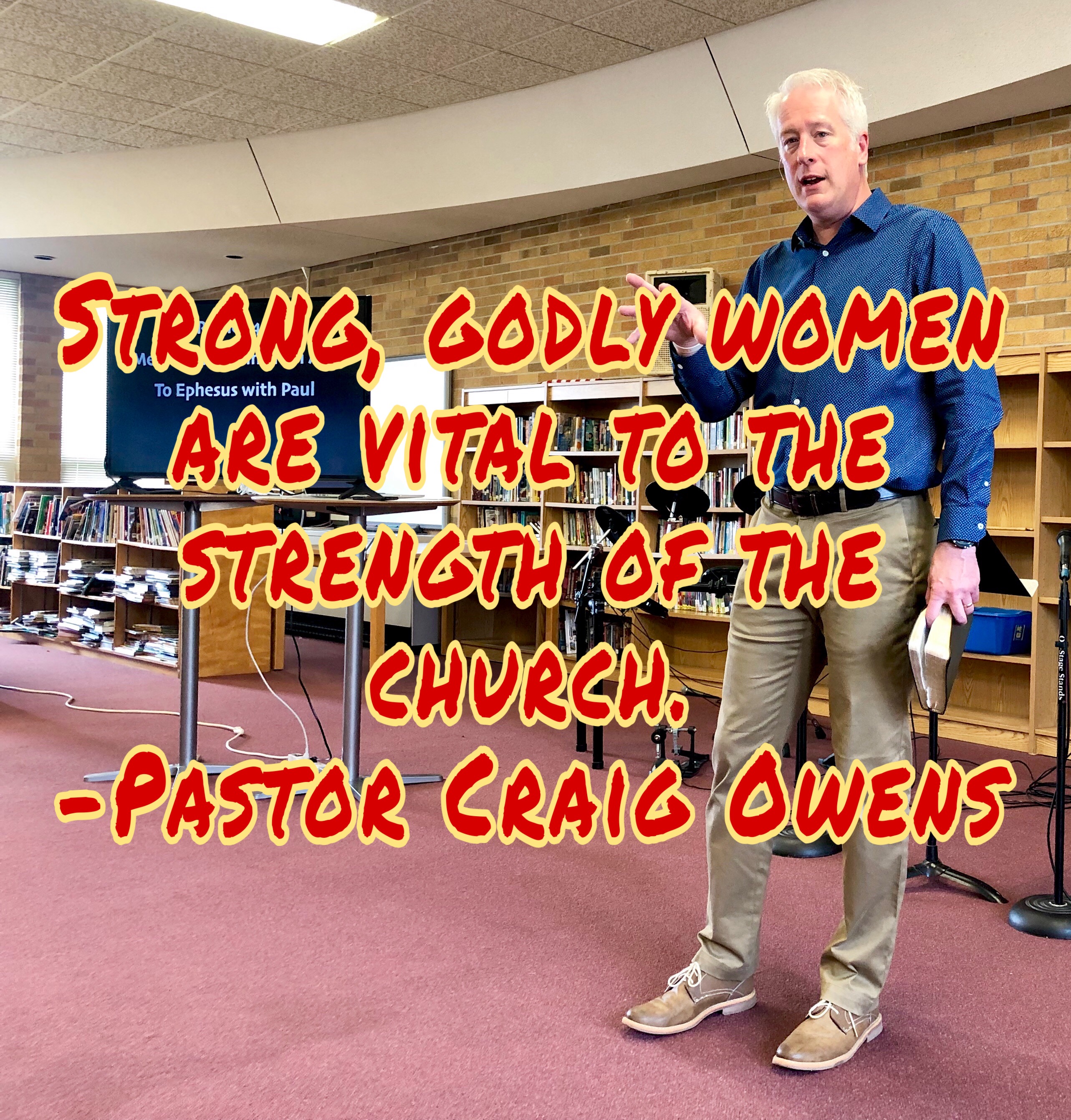
5 Lessons From An Amazing Mother

There is a Pentecostal Christian woman that we first meet in the Book of Acts, and then we see her name scattered throughout Paul’s letters. She may be the most prominent woman among all of the Apostle Paul’s companions and probably is responsible for spreading the Gospel more and farther than any other woman recorded in the Bible. 

Scripture doesn’t tell us if she had children of her own but she is certainly the spiritual mother of more Christians than we will ever be able to count!

Prisca is her birth name. She is a Jew, and most likely a freeborn Roman (just as Paul was). She is from the prominent Acilius family, so combined with Prisca her name is called Priscilla. She married Aquila and they both worked as leather makers (also known as tentmakers). 

Let’s take a look at Priscilla’s travel itinerary—

Pricilla left Rome because of Emperor Claudius’ decree in 49 AD and traveled to Corinth, where she met Paul (Acts 18:1-3, 11, 18-19). 

After spending almost 2 years with Paul in Corinth, they traveled to Ephesus with Paul, where she met and mentored Apollos (Acts 18:24-26). Apollos became a trusted friend to Paul; in fact, Paul calls him a synergos (where we get our English word for synergy). In other words, Paul thought his ministry was more effective because of his partnership with Apollos, but that is all thanks to Priscilla’s involvement! 

Priscilla returned to Rome sometime after Claudius’ death in 54 AD. She probably returned home to prepare the way for Paul’s visit there (Romans 1:10-11; 15:23-24; 16:3). 

And at some point she returned to Ephesus, probably to help Timothy as he pastored the church there (2 Timothy 4:19). 

Here are 5 lessons we can learn from Priscilla’s life—

  1. Be baptized in the Holy Spirit. This is what she taught to others, so it is undoubtedly how she lived as well. 
  1. Use the gifting God has given you. Except for one place, Priscilla is always listed first ahead of her husband. This is unprecedented anywhere else in the New Testament. That tells us that despite what the Greco-roman culture tried to enforce, Priscilla was the predominant teacher/preacher in her family.
  1. Work hard. Priscilla had to be fairly well-to-do to be able to travel to at least three major cities and to host churches in her home, and yet we see her working with her hands to provide for her family and for the church. 
  1. Be bold. Jesus said the baptism in the Holy Spirit would give us boldness, and Priscilla demonstrated that powerfully (Romans 16:4). 
  1. Be synergistic. Paul also called Priscilla a synergos. Paul used this word sparingly for people who had put everything on the line for the sake of the Gospel. He used synergos for people like Apollos, Timothy, Titus, and Luke. Priscilla is the only woman who gets this invaluable term.  

We don’t know if Priscilla was a biological mom, but she was definitely a spiritual mom. She was empowered by the Holy Spirit, and probably is responsible for spreading the Gospel more than any other woman recorded in the Bible. You can follow in her footsteps! 

If you missed any of the messages in this series, you can access the full list of messages by clicking here. 

Poetry Saturday—A Mother’s Day Wish

When I consider how my life is spent
The most that I can do will be to prove
‘Tis by His side, each day, I seek to move.
To higher, nobler things my mind is bent
Thus giving of my strength, which God has lent,
I strive some needy souls’ unrest to soothe
Lest they the path of righteousness lose
Through fault of mine, my Maker to present.
If I should fail to show them of their need
How could I hope to meet Him, face to face,
Or give a just account of all my ways.
In thought of mind, in word, and in each deed
My life must prove the power of His grace
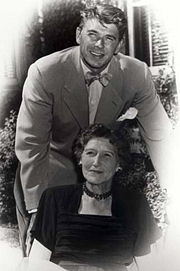
By every action through my living days. —Nelle Reagan (President Ronald Reagan’s mother)

“Ye Shall Be As Gods”

“By two great lies was man led away from God. By the same two lies has the estrangement been kept up. On these two lies the world has been feeding ever since the Fall. Their fruit has been woe and death—‘Ye shall not die’ and ‘Ye shall be as gods.’ …

“The world’s history is the same. Our race has been eating the fruit of lies [Hosea 10:13]; not simply of sin, but of lies. The sorrows, sighs, tears, pains of our race are the fruit of lies—the original lie of Paradise, and a thousand such since then. …

“The two original satanic lies are continually coming up, and along with them myriads of others, all leading us astray. Each day brings forth the lie, the fruit, the eating thereof. satan, or the world, or the flesh, or a friend, or a book, or a scene whispers the lie; it is fair and specious, we believe it; it brings forth fruit, we eat of it, and the end is bitterness and disappointment. We feed on lies. … We persuade ourselves that this world is good, and pleasant, and excellent, so we pursue it in preference to the world to come. …

“Jesus says, ‘Yes, ye shall not surely die, but that deliverance shall not be in the way you think. Death is the wages of sin, yet I bring life to the sinner, everlasting life, life through the belief of the Truth, even as death came through the belief of a lie. Yes, ye shall be as gods, but not in your way. I will make you partakers if the divine nature, not by eating the forbidden tree, but by eating of Me.’” —Horatius Bonar, in Light & Truth—The Old Testament

Thursdays With Spurgeon—Keep The Focus On The Savior

This is a weekly series with things I’m reading and pondering from Charles Spurgeon. You can read the original seed thought here, or type “Thursdays With Spurgeon” in the search box to read more entries.

Keep The Focus On The Savior

     I have heard men tell the story of their conversion, and of their spiritual life, in such a way that my heart has loathed them and their story, too, for they have told of their sins as if they did boast in the greatness of their crime, and they have mentioned the love of God, not with a tear of gratitude, not with the simple thanksgiving of the really humble heart, but as if they as much exalted themselves as they exalted God. Oh! When we tell the story of our own conversion, I would have it done with great sorrow, and with great joy and gratitude, remembering how little we deserve these things. … 

     My Master, I cannot understand how You stoop Your awful head to such a death as the death of the Cross, how You could take from Your brow the coronet of stars that from old eternity had shone resplendent there. But how You should permit the thorn-crown to gird Your temples astonishes me far more. That You should cast away the mantle of Your glory, the azure of Your everlasting empire, I cannot comprehend. But how You should have become veiled in the ignominious purple for a while and then be mocked by impious men who bowed to You as a pretended king; and how You should be stripped naked to Your shame, without a single covering, and die a felon’s death. This is still more incomprehensible. But the marvel is that You should have suffered all this for me! … 

     I, a lad, found the Lord of glory. I, a slave to sin, found the great Deliverer. I, the child of darkness, found the Light of Life. I, the uttermost of the lost, found my Savior and my God. I, widowed and desolate, found my Friend, my Beloved, my Husband. Oh, how I wondered that I should be pardoned! It was not the pardon that I wondered at so much; the wonder was that it should come to me. 

From The Autobiography Of Charles Spurgeon

How sad that many times the story of our salvation focuses more on how bad we were, and gives so little glory to how amazing our Savior’s rescue was. 

Just as the Apostle Paul called himself the chief of sinners, and stood in amazement that Christ’s love would reconcile him to God, so Spurgeon stood amazed that Jesus would stoop to die for “the uttermost of the lost.” 

It’s fine to tell people what used to be, but please make sure your story focuses more on how amazing it is that God’s love saved you from those sins. Amazing love! How can it be that You, my King, would die for me? 

Let’s keep the focus on the Savior! 

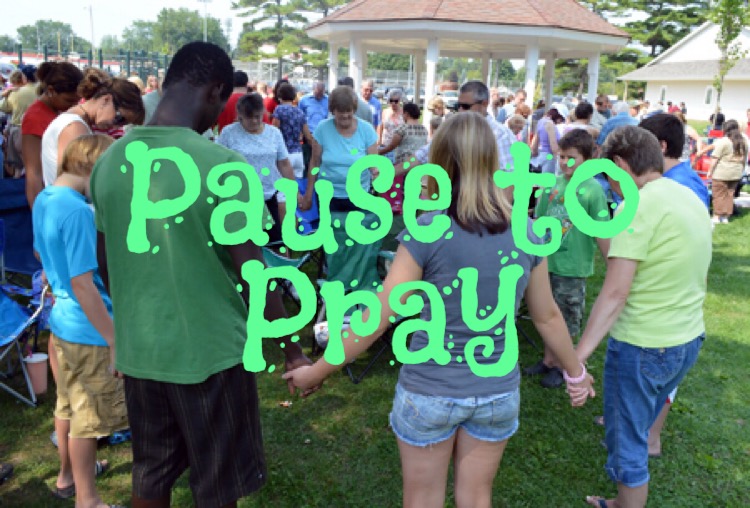
Pause To Pray

…Now the Philistines had come and spread out in the Valley of Rephaim; so David inquired of the Lord, “Shall I go and attack the Philistines? Will You deliver them into my hands?” … (2 Samuel 5:17-25)

The enemy poised to attack, but David paused. 

David is a man of action. But without a doubt, he is a more successful man of action when he is first a man of prayer. 

The Philistines encamped in the valley, preparing themselves to attack Israel. David has had no problem dealing with this enemy before so no one would have questioned David saying to his army, “God is with us. Let’s go attack these Philistines.” 

But David paused to pray and only went to war when God said, “Go—attack them straight on.” David obeyed and won a great victory (vv. 20-21). 

The Philistines returned to the exact same valley. Again no one would have faulted David for saying, “This is the same scenario as last time. God told us to attack before, so we already have His permission to go attack again.” 

But David paused to pray and this time God gave him a different battle strategy: “Circle behind them.” Same scenario, different battle tactic, but still the same victorious result (vv. 22-25). 

Just because something seems automatic doesn’t mean we should act quickly and prayerlessly.

Just because something seems the same doesn’t mean we should act on auto-pilot. 

In each situation: Pause to pray, wait for God’s direction, then follow through exactly as He says.