Links & Quotes

link quote

Some good reading and watching from today…

“The worst form of ill association is ungodly marriage. I do not know anything that gives me more satisfaction than to see our brethren and sisters, who have walked in the faith of God, united in marriage—the husband and wife, both fearing and loving God. It is a delightful spectacle, and bids fair to be the means of building up the church with a generation which shall fear the Lord. But a very fruitful source of ruin to church members is that of a young man or a young woman choosing an ungodly partner in life. They never can expect God’s blessing upon it. They tell you sometimes they hope to be the means of their friend’s conversion. They have no right to hope such a thing; it so seldom occurs. The much more likely thing is that the ungodly one will drag the other down to his level, than that the godly one shall pull the other up.” —Charles Spurgeon

“If homosexuals are bullied, we need to protect them. If they’re unjustly discriminated against, we need to help them. If they’re treated with contempt, the person hurting them should be stopped. If a family member comes out as gay and then is belittled, harmed, or vilified, then the offending family needs to be corrected. If Christians ridicule people who identify as gay or lesbian, they need to admonished. If a church doesn’t welcome seekers of all stripes (including people who identify as gay, lesbian, or bisexual), then it needs to change. But none of these circumstances are reasons to reinterpret Scripture to affirm homosexuality.” This is from a fascinating article: Bad Reasons To Adopt Pro-Gay Theology.


“Prudence means practical common sense, taking the trouble to think out what you are doing and what is likely to come of it.” —C.S. Lewis

“Resentment simply cannot dwell in a loving heart. Before resentfulness can enter, love must take its flight and bitterness take over.” —A.W. Tozer

“No nation ancient or modern has ever lost the liberty of freely speaking, writing or publishing their sentiments, but forthwith lost their liberty in general and became slaves.” —John Peter Zenger (in 1735 after winning his case that established the precedent for our freedom of the press)

“Never leave growing till the life to come!” —Robert Browning

“Why should you turn from God when you turn to your books, or feel that you must turn from your books in order to turn to God? If learning and devotion are as antagonistic as that, then the intellectual life is in itself accursed and there can be no question of a religious life for a student, even of theology.” —B.B. Warfield

[VIDEO] John Maxwell has some great advice on conflict.

Did you know there is a right way to procrastinate? Yep! Check this out.
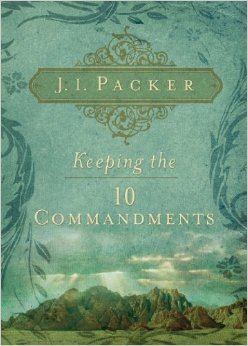
12 Quotes From “Keeping The Ten Commandments”

Keeping The Ten CommandmentsJ.I. Packer wrote a very readable, but scholarly, book examining how 21st-century people should live out the biblical Ten Commandments. You can read my full book review by clicking here, but I’m sharing some of my favorite quotes below.

“God’s love gave us the law just as His love gave us the gospel, and as there is no spiritual life for us save through the gospel, which points us to Jesus Christ the Savior, so there is no spiritual health for us save as we seek in Christ’s strength to keep the law and practice the love of God and neighbor for which it calls.”

“Where the law’s moral absolutes are not respected, people cease to respect either themselves or each other; humanity is deformed, and society slides into the killing decadence of mutual exploitation and self-indulgence.”

“The negative form of the Commandments has positive implications. ‘Where a sin is forbidden, the contrary duty is commanded’ (Westminster Larger Catechism, Question 99). The negative form was needed at Sinai (as in the West today) to curb current lawlessness that threatened both godliness and national life.” 

“Moral permissiveness, supposedly so liberating and fulfilling, is actually wounding and destructive: not only of society (which God’s law protects), but also of the lawless individual, who gets coarsened and reduced as a person every time.”

“Law-keeping is that life for which we were fitted by nature, unfitted by sin, and refitted by grace, the life God loves to see and reward; and for that life liberty is the proper name.”

“The Bible, however, takes promises very seriously; God demands full faithfulness of our vows. Why? Partly because trustworthiness is part of His image, which He wants to see in us; partly because without it society falls apart.”

“We honor God by respecting His image in each other, which means consistently preserving life and furthering each other’s welfare in all possible ways.”

“We have in us capacities for fury, fear, envy, greed, conceit, callousness, and hate that, given the right provocation, could make killers out of us all. … When the fathomless wells of rage and hatred in the normal human heart are tapped, the results are fearful.”

“When you lie to put someone down, it is malice; when you lie to impress, move, and use him, and to keep him from seeing you in a bad light, it is pride.”

“Reformed theologians said that God’s law has three uses or functions: first, to maintain order in society; second, to convince us of sin and drive us to Christ for life; third, to spur us on in obedience, by means of its standards and its sanctions, all of which express God’s own nature.”

“What is God’s ideal? A God-fearing community, marked by common worship (commandments 1, 2, 3) and an accepted rhythm of work and rest (commandment 4), plus an unqualified respect for marriage and the family (commandments 5, 7), for property and owner’s rights (commandments 8, 10), for human life and each man’s claim on our protection (commandment 6), and for truth and honesty in all relationships (commandment 9).”

“When God’s values are ignored, and the only community ideal is permissiveness, where will moral capital come from once the Christian legacy is spent? How can national policy ever rise above material self-interest, pragmatic and unprincipled? How can internal collapse be avoided as sectional interests, unrestrained by any sense of national responsibility, cut each other down? How can an overall reduction, indeed destruction, of happiness be avoided when the revealed way of happiness, the ‘God first, others next, self last’ of the Commandments, is rejected? The prospects are ominous. May God bring us back to Himself and to the social wisdom of His Commandments before it is too late.”

Links & Quotes

link quote

Some good reading from today…

“Go to bed seasonably, and rise early. Redeem your precious time… that not one moment of it may be lost. Be much in secret prayer. Converse less with man, and more with God.” —George Whitefield 

“Lord, let me not live to be useless.” —John Wesley

Jon Bloom looks at narcissism in a different way: Beware The Mirror.

“To be specific, the self-sins are self-righteousness, self-pity, self-confidence, self-sufficiency, self-admiration, self-love and a host of others like them. They dwell too deep within us and are too much a part of our natures to come to our attention till the light of God is focused upon them.” —A.W. Tozer

“Confession isn’t a punishment for sin; it’s an isolation of sin so it can be exposed and extracted.” —Max Lucado

We must learn to tell ourselves the truth on the basis of God’s Word.” —Oswald Chambers

During the cold & flu season, here is a great reason to kiss your sweetie: Kissing helps boost your immune system.

Unbiblical Church Growth

Jim CymbalaThis message from Jim Cymbala is a hard word, but right on target.

The apostles never tried to finesse people when they were presenting the gospel. Their communication was not supposed to be “cool” or soothing. They aimed for a piercing of the heart, for conviction of sin. They had not the faintest intention of asking, “What do people want to hear? How can we draw more people to church on Sunday?” That was the last thing on their minds. Such an approach would have been foreign to them.

Instead of trying to bring men and women to Christ in the biblical way, we are consumed with the unbiblical concept of “church growth.” The Bible does not say we should aim at numbers but rather urges us to proclaim God’s message in the boldness of the Holy Spirit. This will build God’s church God’s way.

Unfortunately, some churches now continually monitor how pleased people are with the services and ask what else they would like. We have no permission whatsoever to adjust the message of the gospel! Whether it seems popular or not, whether it is “hip” to the times, we must faithfully and boldly proclaim that sin is real but Jesus forgives those who confess.

Nowhere does God ask anyone to have a large church. He only calls us to do His work, proclaiming His Word to people He loves under the anointing and power of the Holy Spirit to produce results that only He can bring about. The glory then goes to Him alone—not any denomination, local church, local pastor, or church growth consultant. This is God’s only plan, and anything else is a deviation from the teaching of the New Testament.

Today we have an anti-authority spirit in America that says, “Nobody can tell me I need to change. Don’t you dare.”

Both in the pulpit and in pastoral counseling we have too often given in to this mentality and are afraid to speak the truth about sin. We keep appealing to Paul’s line about becoming “all things to all men” (1 Corinthians 9:22), not noticing that in the very next paragraph he says, “Run in such a way as to get the prize” (verse 24). Adapting our style to get a hearing is one thing, but the message can never change without leaving us empty-handed before the Lord.

UPDATE: This challenging word from Pastor Cymbala is one of the thoughts that helped form my thinking about what is considered “successful” in God’s eyes. I share these thoughts in my book Shepherd Leadership: The Metrics That Really Matter

Keeping The Ten Commandments (book review)

Keeping The Ten CommandmentsI am just completing a series of messages at my church on the Ten Commandments. This was no small undertaking, and one that I undertook with great reverence. I knew I needed some scholarly resources to guide my study time, and there is none who fits the bill better than J.I. Packer and his work Keeping The Ten Commandments.

Packer is indeed a most-learned man, but he has a God-given gift to discuss doctrine and theology on a level that is accessible to even someone like me! He doesn’t water-down the biblical doctrines contained in the Ten Commandments, but he presents God’s intent in them in a way that the reader can immediately grasp and then put into action.

Before looking at each of the commandments individually, Packer opens the book with a couple of chapters giving us a bird’s-eye view of how the Ten Commandments fit in with the balance of Scripture. Then he walks us through the commandments one-by-one, and concludes with a couple of chapters that help us live out the commandments today. Each chapter includes a “for further study” list of questions and Bible verses, which I highly recommend.

For getting to know the Ten Commandments better, Keeping The Ten Commandments should definitely be on your reading list.

Links & Quotes

link quote

Some good reading from today…

“Just because no one complains, it doesn’t mean that all parachutes are perfect.” —Anonymous

“I am not young enough to know everything.” —Oscar Wilde

“It is better to know some of the questions than all of the answers.” —James Thurber

More appalling misery created by the pro-abortion crowd: Planned Parenthood’s Horrible Treatment.

Very good: 7 Things All Great Friends Do.

“I must pray for the strength and courage to be truly obedient to Jesus, even if He calls me to go where I would rather not go.” —Henri Nouwen

“One of the greatest mercies God bestows upon us is His not permitting our inclinations and opportunities to meet. Have you not sometimes noticed that when you had the inclination to a sin there has been no opportunity, and when the opportunity has presented itself you have had no inclination towards it? satan’s principal aim with believers is to bring their appetites and his temptations together….” —Charles Spurgeon

“This is not Predestination: your will is perfectly free: but all physical events are adapted to fit in as God sees best with the free actions He knows we are going to do.” —C.S. Lewis

Blessing Or Burden?

Blessing or burdenGod’s commandments aren’t a bunch of Don’ts. If we look at them through the perspective of a loving Lawgiver, they are really Dos that will keep us in a place that God can bless.

Take the 9th Commandment: You shall not give false testimony against your neighbor (Exodus 20:16; Deuteronomy 5:20). This is the first of two commandments that emphasize the damage that can be done to our neighbor if we violate the law. Speaking falsely against someone does real harm to our neighbor, so in a sense God says, “Don’t do it!

But God also tells us what to Do so that He can bless us—

  • How good and pleasant it is when brothers live together in unity! … For there the Lord bestows His blessing, even life forevermore (Psalm 133:1, 3).
  • Psalm 15 says that he who will live in God’s presence is the one who speaks the truth from his heart and has no slander on his tongue, who does his neighbor no wrong and casts no slur on his fellowman (vv. 1-3).

The word for false in this commandment can mean: (1) an untruth; (2) insincere or deceptive words (e.g. flattery); (3) being purposely vague; or (4) speaking words that are true but harmful. So we Don’t want to do those, but what should we Do?

Jesus said that the way we speak is an indication of what has been going on in our heart and mind (Luke 6:45), so the way to fulfill the Do part of the commandment starts inside. A good guide is Paul’s list in Philippians 4:8—are my thoughts about my neighbor focused on what’s true? noble? right? pure? lovely? admirable? excellent? and praiseworthy?

In the New Testament, the word “blessing” is a compound word that literally means good words. So here’s the question I’m asking myself: Are my words to and about my neighbor a burden to them or a blessing?

If you have missed any of the messages in our series The Love In The Law, you can find them all by clicking here.

Keeping The Ninth Commandment

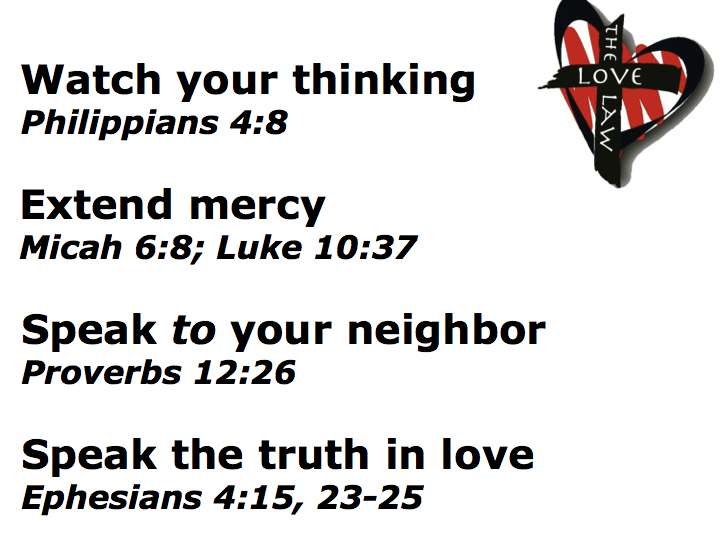
4 ways to give true testimonySome folks asked that I post a couple of things I shared in my message this morning about the ninth commandment: You shall not give false testimony against your neighbor.

Here are 4 ways to observe the positive side of this 9th commandment:

Good name in man and woman, dear my lord,
Is the immediate jewel of their souls.
Who steals my purse steals trash; ‘tis something, nothing;
‘Twas mine, ‘tis his, and has been slave to thousands;
But he that filches from me my good name
Robs me of that which not enriches him,
And makes me poor indeed. —Iago, in William Shakespeare’s Othello

Links & Quotes

link quote

Some good reading & watching from this weekend…

[VIDEO] John Maxwell has some good insight on dealing with skeptics, even if the skeptic is you!

The begging in ministries today is a result of men doing good things without being sent by God’s voice. Their own desires are being mistaken for God’s bidding.” David Wilkerson shred 4 ways to know you are correctly hearing the voice of God.

“The heart knows so much more than the mind.” —Henri Nouwen

“Lord, grant we may always keep between the two extremes of distrusting or tempting Thee.” —George Whitefield

“The principle virtue of music is a means of communication with God.” —Igor Stravinsky

“Where would you have been but for grace? To repeat the old saying of John Bradford, when he saw a cartful of men going off to Tyburn to be hanged, ‘There goes John Bradford but for the grace of God.’ When you see the swearer in the street, or the drunkard rolling home at night, there are you, there am I, but for the grace of God. Who am I? What should I have been if the Lord, in mercy, had not stopped me in my mad career?” —Charles Spurgeon

“There can be no such thing as chance from God’s point of view. Since He is omniscient His acts have no consequences which He has not foreseen and taken into account and intended.” —C.S. Lewis

[VIDEO] This short film is based on a true story from the front lines of a World War I battlefield on Christmas Eve 1914…

Poetry Saturday—My Strength Is Gone

Charles WesleyMy strength is gone, my nature dies;
I sink beneath Thy weighty hand;
Faint to revive, and fall to rise:
I fall, and yet by faith I stand.
I stand, and will not let Thee go,
Till I Thy Name, Thy Nature know.
Lame as I am, I take the prey;
Hell, earth, and sin, with ease o’ercome;
I leap for joy, pursue my way,
And as a bounding hart fly home,
Through all eternity to prove,
Thy Nature and Thy Name is love. — Charles Wesley, on what he conceived to be Jacob’s prayer as he wrestled with God (see Genesis 32:22-30)