God’s Silence And God’s Singing

“For the Lord your God is living among you. He is a mighty Savior. He will take delight in you with gladness. With His love, He will calm all your fears. He will rejoice over you with joyful songs.” (Zephaniah 3:17 NLT)

I’ve always loved this verse about God singing over me! I noticed something interesting in the Amplified Bible—not only God’s singing, but His silence. He is silent (making no mention) about my forgiven sins, but He sings His love about my future with Him. 

“The Lord your God is in the midst of you, a Mighty One, a Savior [Who saves]! He will rejoice over you with joy; He will rest [in silent satisfaction] and in His love He will be silent and make no mention [of past sins, or even recall them]; He will exult over you with singing.” (Zephaniah 3:17 AMPC)

Kim Walker-Smith wrote, “It’s a love that never stops pursuing us. There are moments when I don’t hear His love and moments when I don’t feel His love, but that does not change the fact that He is always giving His love.” He is always singing His love❣️

Thursdays With Oswald—No Undercover Christians

Oswald ChambersThis is a weekly series with things I’m reading and pondering from Oswald Chambers. You can read the original seed thought here, or type “Thursdays With Oswald” in the search box to read more entries.

No Undercover Christians

     The illustrations our Lord uses are all conspicuous—salt, light, and a city set on the hill. There is no possibility of mistaking them. …  

     “You are the salt of the earth.” Some modern teachers seem to think our Lord said, “You are the sugar of the earth,” meaning that gentleness and winsomeness without curativeness is the ideal of the Christian. Our Lord’s illustration of a Christian is salt, and salt is the most concentrated thing known. Salt preserves wholesomeness and prevents decay. It is a disadvantage to be salt. Think of the action of salt on a wounded, and you will realize this. If you get salt into a wound, it hurts, and when God’s children are amongst those who are “raw” their presence hurts. The man who is wrong with God is like an open wound, and when “salt” gets in it causes annoyance and distress and he is spiteful and bitter. … How are we to maintain the healthy, salty tang of saintliness? By remaining rightly related to God through Jesus Christ. …  

     “You are the light of the world.” Light cannot be soiled; you may try to grasp a beam of light with the sootiest hand, but you leave no mark on the light. A sunbeam may shine into the filthiest hovel in the slums of the city, but it cannot be soiled. … Thank God for the men and women who are spending their lives in the slums of the earth, not as social reformers to lift their brother men to cleaner sties, but as the light of God, revealing a way back to God. 

From Studies In The Sermon On The Mount

God wants you to be His salt and light in the world. Are you willing to do that? 

Salt preserves, but it also stings as it does so. Some people will lash out at you for being salt in their presence, but keep on loving them with the love of Jesus. 

Light guides, but it also reveals unpleasant things. Some people will lash out at you for revealing sinful things, but keep on loving them with the love of Jesus. 

Don’t let the hostile reaction of people send you “underground.” Keep being conspicuously, unmistakably God’s salt and light in a world that is in desperate need of cleansing and illumination! 

Teddy Roosevelt On Character

Theodore Roosevelt was well aware that talent alone wasn’t enough to sustain an individual, a family, or a nation. Talent and perseverance, he preached, must be supported by character. In a series of speeches bundled together in the book The Strenuous Life, TR had much to say about character development and integrity. You can check out my review of The Strenuous Life by clicking here. 

“It is a good thing to have a keen, fine intellectual development in a nation, to produce orators, artists, successful business men; but it is an infinitely greater thing to have those solid qualities which we group together under the name of character—sobriety, steadfastness, the sense of obligation toward one’s neighbor and one’s God, hard common sense, and, combined with it, the lift of generous enthusiasm toward whatever is right. These are the qualities which go to make up true national greatness.” 

“We do not need men of unsteady brilliancy or erratic power—unbalanced men. The men we need are the men of strong, earnest, solid character—the men who possess the homely virtues, and who to these virtues add rugged courage, rugged honesty, and high resolve.” 

“The men who with ax in the forests and pick in the mountains and plow on the prairies pushed to completion the dominion of our people over the American wilderness have given the definite shape to our nation. They have shown the qualities of daring, endurance, and far-sightedness, of eager desire for victory and stubborn refusal to accept defeat, which go to make up the essential manliness of the American character. Above all, they have recognized in practical form the fundamental law of success in American life—the law of worthy work, the law of high, resolute endeavor.” 

“After all has been said and done, the chief factor in any man’s success or failure must be his own character—that is, the sum of his common sense, his courage, his virile energy and capacity.” 

 “Bodily vigor is good, and vigor of intellect is even better, but far above both is character.” 

“In the long run, in the great battle of life, no brilliancy of intellect, no perfection of bodily development, will count when weighed in the balance against that assemblage of virtues, active and passive, of moral qualities, which we group together under the name of character…. Of course this does not mean that either intellect or bodily vigor can safely be neglected. On the contrary, it means that both should be developed, and that not the least of the benefits of developing both comes from the indirect effect which this development itself has upon the character.” 

“Character is shown in peace no less than in war. As the greatest fertility of invention, the greatest perfection of armament, will not make soldiers out of cowards, so no mental training and no bodily vigor will make a nation great if it lacks the fundamental principles of honesty and moral cleanliness.” 

“Alike for the nation and the individual, the one indispensable requisite is character—character that does and dares as well as endures, character that is active in the performance of virtue no less than firm in the refusal to do aught that is vicious or degraded.” 

Be sure to check out my review of Theodore Roosevelt’s Autobiography by clicking here, and read some additional quotes from TR here and here. 

The Value Of The Old Testament

“Jesus exalted the law of God, and made its importance more evident even than it had been before. In a word, ‘He magnified the law and made it honorable’ (Isaiah 42:21). …

“Let us beware of despising the Old Testament under any pretense whatever. Let us never listen to those who bid us throw it aside as an obsolete, antiquated, useless book. The religion of the Old Testament is the embryo of Christianity. The Old Testament is the Gospel in the bud. The New Testament is the Gospel in full flower. The Old Testament is the Gospel in the blade. The New Testament is the Gospel in full ear. …

“Let us, for another thing, beware of despising the law of the Ten Commandments. Let us not suppose for a moment that it is set aside by the Gospel, or that Christians have nothing to do with it. The coming of Christ did not alter the position of the Ten Commandments one hair’s breadth. If anything, it exalted and raised their authority (Romans 3:31). …

“In the last place, let us beware of supposing that the Gospel has lowered the standard of personal holiness, and that the Christian is not intended to be as strict and particular about his daily life as the Jew. … The more light we have, the more we ought to love God. The more clearly we see our own complete and full forgiveness in Christ, the more heartily we ought to work for His glory. …

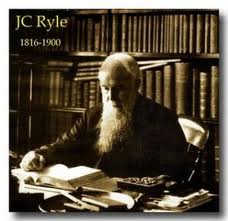
“Jesus shows us that the law, as expounded by Him, was a far more spiritual and heart-searching rule than most of the Jews supposed.” —J.C. Ryle, in Expository Thoughts On The Gospels

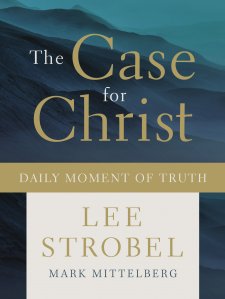
The Case For Christ Daily Moment Of Truth (book review)

This is a fantastic study guide from Lee Strobel and Mark Mittelberg. It was originally published with the title Today’s Moment Of Truth. 

Most Christians will tell you they love God “with all my heart.” That’s a good start, but according to Jesus, there needs to be more. Jesus told us to love God with all our heart, soul, mind, and strength. It’s especially these last two areas that concerned Strobel and Mittelberg enough to put together a wonderful book: The Case For Christ Daily Moment Of Truth.

Strobel and Mittelberg were concerned (and rightly so) that Christians were engaging their heart and soul in their Christian witness, but not developing their mind and strength to the same extent. As a result, when someone challenges them to explain why they believe what they believe, many Christians struggle to answer convincingly.

Lee Strobel and Mark Mittelberg are both top-notch Christian apologists. They don’t just present solid evidence for the Christian faith, but they do so in a winsome, inoffensive way. And through 180 different lessons, they train all who read The Case For Christ Daily Moment Of Truth to do the same.

Each day you will read a quote from a notable atheist or Christian skeptic, and then be trained in solid apologetics to refute their claims. You will be given Scripture verses, proofs from all disciplines of science, and some good old-fashioned common sense. This book will expand your spiritual muscles and your mental muscles. Each day’s reading will only take a couple of minutes, but you will be well-prepared for any challenges to your faith. A must-read for all Christians!

I am a Zondervan book reviewer.

What Is Shalom?

Shalom is the Hebrew word for peace. Some of the best definitions of shalom include ideas of completeness, soundness, and wholeness. One Jewish rabbi commented that when you say “Shalom” to someone, you’re really saying, “may you be full of well-being.” Or another way of thinking of shalom is—nothing missing, nothing broken. 

Some have tried to describe shalom as the absence of conflict, but that’s not quite accurate. On the verge of going into the Promised Land to fight their enemies, God commanded Aaron to speak a blessing of peace of the people (Numbers 6:24-26). And just before Jesus said, “Blessed are those who are persecuted because of righteousness,” He said, “Blessed are the peacemakers” (Matthew 5:9-10). 

Shalom is not controlled by outward circumstances. Shalom is a deep-seated, rock-solid, unshakable assurance that I am in God’s hand. 

Isaiah describes how we live in shalom like this—

You will guard him and keep him in perfect and constant peace whose mind—both its inclination and its character—is stayed on You, because he commits himself to You, leans on You, and hopes confidently in You. (Isaiah 26:3)

How do we do keep our mind stayed on God? The Apostle Paul says, “We take captive every thought to make it obedient to Christ” (2 Corinthians 10:5). Psychologists call this process metacognition: when we think about what we’re thinking about. It’s being aware of our anxious thoughts that are robbing us of shalom and then talking back to them. 

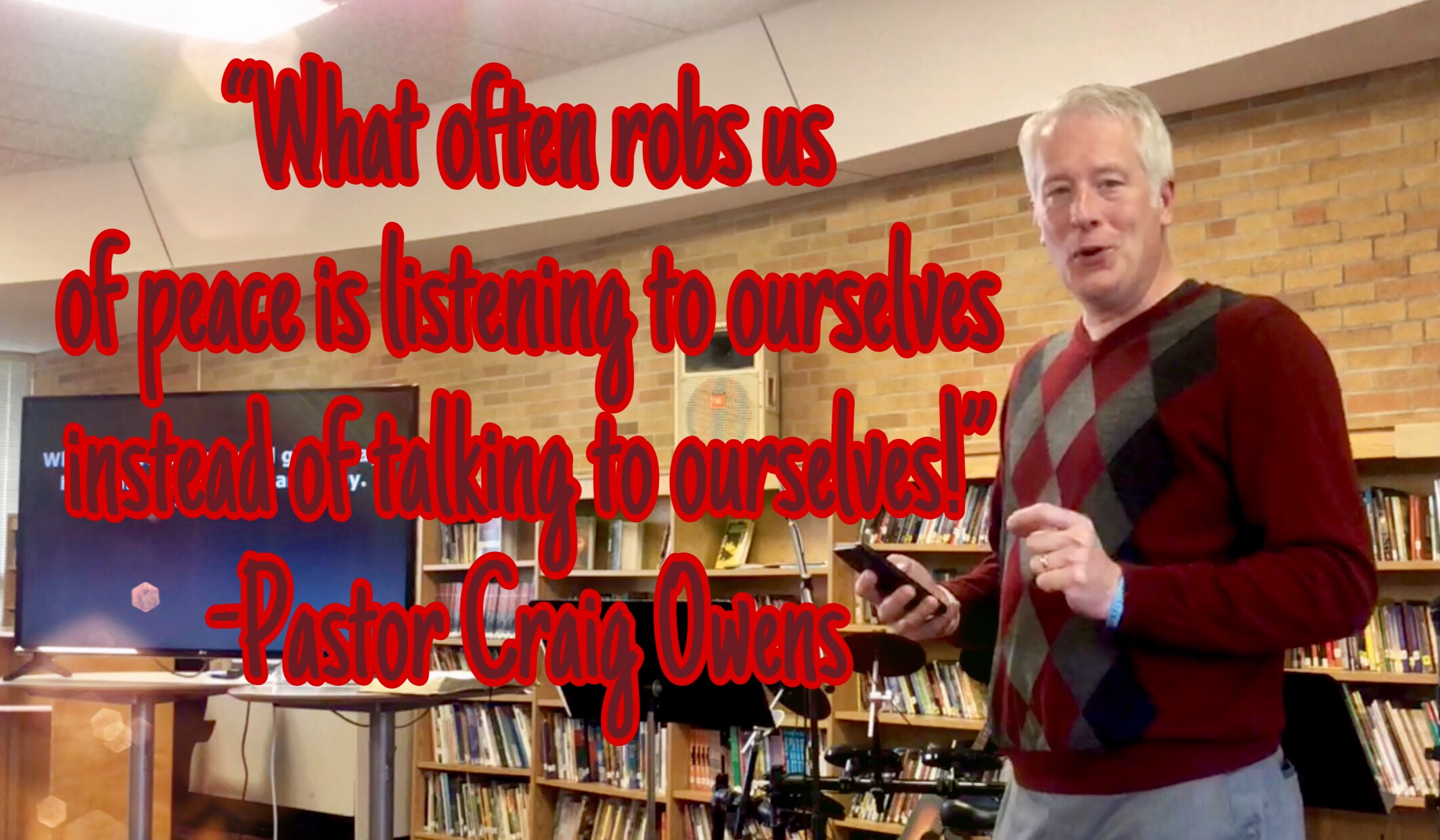
What often robs us of peace is listening to ourselves instead of talking to ourselves! 

Someone once asked evangelist Smith Wigglesworth, “Smith, how do you feel?” He replied, “I never ask Smith how I feel. I tell him how he feels!” Exactly right! 

Why do we make our thoughts obedient to Jesus? Because one of the titles given to Jesus before He was born was Prince of Peace (Isaiah 9:6), and Jesus assures us that His peace is unlike anything we can ever find in earthly things (John 14:27, 16:33). 

God’s peace is always there, but our divided minds keep us from experiencing His peace. So Isaiah tells us to keep our mind steadfast on God’s goodness, and Paul says the same thing—Don’t fret or worry. Instead of worrying, pray. Let petitions and praises shape your worries into prayers, letting God know your concerns. Before you know it, a sense of God’s wholeness, everything coming together for good, will come and settle you down. It’s wonderful what happens when Christ displaces worry at the center of your life. (Philippians 4:6-7)

I want to encourage you to practice what the Bible calls capturing your thoughts—or what psychologists call metacognition. Ask yourself, “Why am I thinking that?” Capture those thoughts and make them obedient to Christ. Don’t let your worrisome thoughts rob you of God’s shalom.

Join me this Sunday as we take a closer look at the “shalom cycle,” including the things that can derail it. 

Saturday In The Proverbs—This Is What Virtue Looks Like (Proverbs 31)

[Each chapter in the Book of Proverbs contains thoughts that fit into a theme; they are not just random thoughts gathered together. In this “Saturday In The Proverbs” series, I will share a theme that I see in each chapter. But the cool thing about God’s Word is that you may see an entirely different theme. That’s great! If you do, I would love for you to share it in the comments below.]

Do not give your strength to women … Who can find a virtuous wife…? (Proverbs 31:3, 10).

This proverb shows virtue on display in both a man and a woman. A man or woman of virtue…

… is a loyal spouse (vv. 3, 10, 12, 23, 28, 30)

… uses their strength appropriately (vv. 3, 17)

… avoids controlling substances (v. 4)

… upholds justice (vv. 5, 26)

… takes care of others (vv. 8, 9, 15, 20-21)

… is trustworthy (v. 11)

has a good work ethic (vv. 13-15, 18-19, 24, 27, 31)

… exercises good stewardship (vv. 16, 18, 25)

… renews themselves (v. 22)

… handles praise well (vv. 28-30)

How beautiful is a man or woman living out God’s virtue! 

Sunbeams From God

For You are the fountain of life, the light by which we see. Psalm 36:9

“I was standing today in the dark toolshed. The sun was shining outside and through the crack at the top of the door there came a sunbeam. From where I stood that beam of light, with the specks of dust floating in it, was the most striking thing in the place. Everything else was almost pitch-black. I was seeing the beam, not seeing things by it. Then I moved so that the beam fell on my eyes. Instantly the whole previous picture vanished. I saw no toolshed, and (above all) no beam. Instead I saw, framed in the irregular cranny at the top of the door, green leaves moving on the branches of a tree outside and beyond that, 90 odd million miles away, the sun. Looking along the beam, and looking at the beam are very different experiences.” —C.S. Lewis

“So we can say that when we ‘look along’ the heavens and not just ‘at’ the heavens, they succeed in their aim of ‘declaring the glory of God.’ That is, we see the glory of God, not just the glory of the heavens. We don’t just stand outside and analyze the natural world as a beam, but we let the beam fall on the eyes of our heart, so that we see the source of the beauty—the original Beauty, God Himself.  This is the essential key to unlocking the proper use of the physical world of sensation for spiritual purposes. All of God’s creation becomes a beam to be ‘looked along’ or a sound to be ‘heard along’ or a fragrance to be ‘smelled along’ or a flavor to be ‘tasted along’ or a touch to be ‘felt along.” —John Piper 

Thursdays With Oswald—How To Understand And Apply The Scriptures

This is a weekly series with things I’m reading and pondering from Oswald Chambers. You can read the original seed thought here, or type “Thursdays With Oswald” in the search box to read more entries.

How To Understand And Apply The Scriptures

     In order to understand the Sermon on the Mount, it is necessary to have the mind of the Preacher, and this knowledge can be gained by anyone who will receive the Holy Spirit (see Luke 11:13; John 20:22; Acts 19:2). The Holy Ghost alone can expound the teachings of Jesus Christ. The one abiding method of interpretation of the teachings of Jesus is the Spirit of Jesus in the heart of the believer applying His principles to the particular circumstances in which he is placed. “Be transformed by the renewing of your mind,” says Paul, “that you may prove,” i.e. make out, “what is that good, and acceptable, and perfect will of God” [Romans 12:2]. …

     Every mind has two compartments—conscious and subconscious. We say that the things we hear and read slip away from memory; they do not really, they pass into the subconscious mind. It is the work of the Holy Spirit to bring back into the conscious mind the things that are stored in the subconscious. In studying the Bible never think that because you do not understand it, therefore it is of no use. A truth may be of no use to you just now, but when the circumstances arise in which that truth is needed, the Holy Spirit will bring it back to your remembrance [John 14:26]. … 

     We do not hunt through the Bible for some precept to obey…but we live so in touch with God that the Holy Spirit can continually bring some word of His and apply it to the circumstances we are in. … The teaching of Jesus Christ comes with astonishing discomfort to begin with, because it is out of all proportion to our natural way of looking at things; but Jesus puts in a new sense of proportion, and slowly we form our way of walking and our conversation on the line of His precepts: Remember that our Lord’s teaching applies only to those who are His disciples.

From Studies On The Sermon On The Mount

What Chambers says about the Sermon on the Mount is true of any biblical passage we read: we need to have the Holy Spirit’s help to understand it and apply it to our unique life setting. 

Think of this—the same Holy Spirit who inspired the biblical writers is the exact same Spirit who will assist you in understanding that Word! Before I read the Bible I often pray: May the Spirit who inspired this Word now illuminate my mind to understand it and obey it. 

Try that prayer yourself and see how God’s Word is opened up to you.