
A Unique Look At “Church”

gods-people-are-the-saintsHave you ever noticed that nowhere in the New Testament do we see an “order of service” for a church congregation? It’s simply not there.

Neither is there a list of acceptable songs, or the design of a church building, or how or when Communion is served, or even what clothing the pastor is supposed to wear. Yet we modern-day Christians seem to spend a lot of time not only arguing about these non-essentials, but even (gasp!) evaluating the “churchness” of a church based on these things.

It’s understandable, then, when someone says, “I enjoy being a Christian, but I really don’t like going to church.” Or even insisting that they can be a Christian without attending a church.

But here’s where those statements miss the mark: “Church” was never intended to be merely a group of people who met at a designated address once a week.

The Church that Jesus described—and the Church the apostles were a part of—was a living organism. It was fellow followers of Jesus Christ interacting with each other as they worshiped the Lord.

The Apostle Peter describes a gathering of Christians in just one verse. In this verse he gives five descriptors of how Church should be done. To stress the point that every gathering of Christians is unique, three of Peter’s five descriptors are found nowhere else in Scripture.

  1. Live in harmony with one another (the first unique word)

One translation has this as “one mind.” Paul has a similar thought in 1 Corinthians 14:20. The bottom line—get on the same page working toward the same goal. What’s that goal? Pointing people to Jesus!

2.  Be sympathetic (the next unique word)

A definition we may better understand is “empathy.” This world literally means to “vibrate with others.” Be on in tune with what they’re going through that you can feel it just like it was happening to you.

      3.  Love as brothers

This is the Greek word philadelphos, which means to treat other Christians like they’re from the same womb as you.

4.  Be compassionate

That is: be strong enough to step into other people’s stuff. Keep on increasing your capacity to carry a bigger load for someone else (Galatians 6:2).

      5.  Be humble (the last unique word)

The King James Version translates this “courteous.” Not just being strong enough to help, but gentle enough that your help will be accepted.

Let me repeat: The Church is not a physical address where we gather once per week. YOU are the temple of God’s presence, which is why Jesus said if just two of His followers get together, He is right there with them. That’s right—two Christians can have “church” wherever they happen to meet

Don’t just go to church, BE the church. Don’t miss an opportunity to encourage, pray with, instruct, or learn from another Christ-follower whenever and wherever you happen to meet.

If you’ve missed any messages in this series, you may find the complete list by clicking here.

Countercultural Marriage

my-thoughts-or-gods-thoughtsThe Apostle Peter uses an appropriate term for Christians living on Earth: “Aliens and strangers.” This means that those who call Jesus their Lord are to live a counter-cultural lifestyle. Not a lifestyle that changes with the popular culture, but one that stays true to God’s Word.

There probably has never been a more controversial subject in any day or culture than marriage and the relationship between the sexes. Why are these terms “controversial”? I suspect it is because we are naturally bent toward being pragmatic people.

In pragmatism, the outcome determines meaning. If I find something easy to do, convenient for me, and I seem to get applause from those around me, then what I did must be right. However, if it’s challenging to stick with something, and seemingly only a few people approve of how I do it, then it must be wrong. That is letting culture determine morality, instead of letting God determine it.

As Peter begins to address the topic of marriage, and the interaction between spouses, he uses two similar phrases—“Wives, in the same way … Husbands, in the same way (vv. 1, 7).”

In the same way as what? Actually, if you look at the five verses that come before this you will see that it’s not what but Whom. Those verses are talking about our example in Jesus. Peter points out that Jesus showed:

  • submission to God’s purpose—His prayer was, “Not My will, but Yours be done.
  • longsuffering—He did not retaliate nor threaten His persecutors, but for the joy set before Him, He endured the shame of the Cross.
  • servant-leadership—At the last meal He had with His followers before being crucified, He washed their feet, and told them He had given them an example of how they were to serve others.
  • respectful behavior—Jesus willingly suffered the penalty for the world’s sin. He fulfilled the prophecy of Isaiah which said He remained silent before His accusers.
  • mercy—This always means not getting the penalty we deserve. Jesus came to save us when we were the least worthy of His love.
  • forgiveness—As the spikes were being driven through His wrists, Jesus said, “Father, forgive them for they don’t know what they’re doing.

Pragmatism looks at God’s design and says, “Yes, I understand that, but….” Pragmatism tries to find an “out” or a “loophole” that let’s someone change a definition or skip out on doing something God’s way.

If anyone ever had the authority to say, “Yes, Father, I know what You want Me to do, but look how they’re treating Me” it was Jesus.

A wife with a difficult husband may want to say, “Yes, I know I’m supposed to submit to my husband, but….” A husband with a nagging wife may say, “Yes, I know I’m supposed to treat my wife with consideration and respect, but….”

But Peter says, “Wives and husbands, exhibit the same submission, longsuffering, servant-leadership, respectful behavior, mercy and forgiveness toward your spouse as Jesus exhibited toward you!” 

So the question we need to ask is: Am I thinking about marriage—a husband’s role, a wife’s role—in counter-cultural biblical terms or in popular cultural terms?

If I find I am thinking culture’s thoughts, am I willing to try God’s way?

Join me next Sunday as we look at this passage again, and see how a wife and husband can love and serve each other in a God-honoring, counter-cultural way. If you’ve missed any messages in this series, you may find the complete list by clicking here.

Vegetables And Dessert

a-testimony-to-othersHave you ever noticed that kids would prefer to eat dessert more than vegetables? Well, maybe you’re an adult and you still feel the same way! But “veggies before dessert” is still a good motto to live by.

Why?

What happens if you eat only dessert? Do you eventually get healthier or are you setting yourself up for some unfavorable health conditions? What about if you only eat vegetables? The flavor may not be as good, but at least you’ll be getting healthier.

Jesus told His followers to expect the “veggie” times in time. He said, “In this world you will have trouble.” And He told us, “Then you will be handed over to be persecuted and put to death, and you will be hated by all nations because of Me.” There were no ifs or maybes in those statements!

As Christians living on Earth, the Apostle Peter calls us “aliens and strangers.” That means that both our attitude and our lifestyle should be, well, alien compared to Earthlings. Especially when we’re in a veggie time of life.

Jesus was the Perfect Man. He never said anything wrong, and He never did anything wrong. Yet He was insulted, persecuted, and eventually killed in the most horrific way imaginable. But here’s the amazing thing: Jesus went through all of this without retaliating or threatening judgment on His persecutors. Peter said that the way Jesus went through this was intended to be an example for us.

The writer of Hebrews agreedLet us fix our eyes on Jesus, the Author and Perfecter of our faith, Who for the joy set before Him endured the Cross, scorning its shame, and sat down at the right hand of the throne of God. Consider Him Who endured such opposition from sinful men, so that you will not grow weary and lose heart

Notice it says, “for the joy set before Him.” Other translations say “because of the joy awaiting Him” or “He never lost sight of where He was headed” or “He never lost sight of the joy ahead of Him.” In other words, Jesus knew what God’s plan was from before the beginning of time, so He—as Peter said—kept on entrusting Himself to God.

We have to do the same thing!

I have to confess something. When I quoted the “veggie” part of a couple of verses earlier in this post, I left off the “dessert” part…

  • “I have told you these things, so that in Me you may have peace. In this world you will have trouble. But take heart! I have overcome the world.” (John 16:33)
  • Blessed are those who are persecuted because of righteousness, for theirs is the kingdom of heaven. Blessed are you when people insult you, persecute you and falsely say all kinds of evil against you because of Me. Rejoice and be glad, because great is your reward in heaven….” (Matthew 5:10-12)

The way you handle your vegetable times—disease, insults, financial setbacks, outright persecution—can be a testimony to others. The way you go through these trials could help others turn to the Shepherd and Overseer of their souls.

Are you in a trial now? Keep on entrusting yourself to Him Whose plans cannot be thwarted

It might seem all “veggies” now, but you are getting healthier, and the “dessert” you cannot even imagine is on its way!

If you’ve missed any messages in this series, you may find the complete list by clicking here.

5 Ways To Be A Christlike Employee

Work like JesusHave you ever had a bad boss? One who was harsh, unreasonable, overly demanding, or just a plain meany? Do you think working for a “bad boss” means that you get to lower your standards?

Not if you are a Christian!

Christians are on Earth to represent Jesus. We are aliens and strangers here for a short time, but here to also point people toward Heaven. One place we have tremendous opportunity to do this is on our jobs.

Think about it: most people will work 30-40 hours per week, and probably work 40-50 years of their life. That’s a lot of hours in which to show that living for Jesus makes all the difference in the world. 

Peter addresses our work situation in his first epistle. In essence he says, “You may not be able to control your boss’s actions, but you can control your reactions. A Christian has a different attitude about workplace employers than Earthlings do.”

The two things that set Christian employees apart is their submission and their respect.

Submission means understanding the proper order. This isn’t just showing up on time, wearing the right uniform and checking off the right things on your job description. All of those things can be done with a lousy attitude, with an attitude that’s nothing like Christ’s attitude.

Submission means viewing our employers differently—

  • Obeying them like we would obey Jesus (Ephesians 6:5).
  • Being sincere when we say, “Yes, I’d be happy to do that” (Ephesians 6:5).
  • Working hard even when our employer isn’t watching us (Ephesians 6:6).

With that in mind, here are five ways to be an “alien employee.” That is, someone who honors God on-the-job…

  1. Work for God.
  2. Trust God to be your Provider, not your employer.
  3. Trust God to keep perfect records of your faithful service.
  4. Pray for God’s blessing on your employer.
  5. Pray for your employer to see Jesus in your work ethic.

Here’s a great question to ask yourself: If Jesus were filling out my employee evaluation, what would He say about my work ethic? 

If you’ve missed any messages in this series, you may find the complete list by clicking here.
4 Tips For Making Better Goals

1 Corinthians 10.31I have noticed a lot of similarities between the September back-to-school rush, and New Year’s Day. Except instead of resolutions, in the fall most people set new goals, or try to readjust their schedules to take advantage of a new season.

This is an excellent idea, and the perfect time to do it.

In a psalm written by Moses, he tells us to understand the value of our days, and be as wise as we can with what we do with each day God has given us (Psalm 90:12).

The Apostle Paul echoes these thoughts:

Be very careful, then, how do you live—not as unwise but as wise, making the most of every opportunity, because the days are evil. Therefore do not be foolish, but understand what the Lord’s will is. (Ephesians 5:15-17)

One way for us to make the most of every day is to wisely set some goals. Here are four tips that I’ve discovered to help me.

(1) The fewer the goals, the better.

Craig Groeschel said, “To do more things, do less things better.” I totally agree. I would suggest limiting yourself to just 1-2 goals at a time. Then put these one or two goals on your calendar first. In other words: Don’t prioritize your schedule, but schedule your priorities.

(2) Don’t fall into the sacred/secular trap.

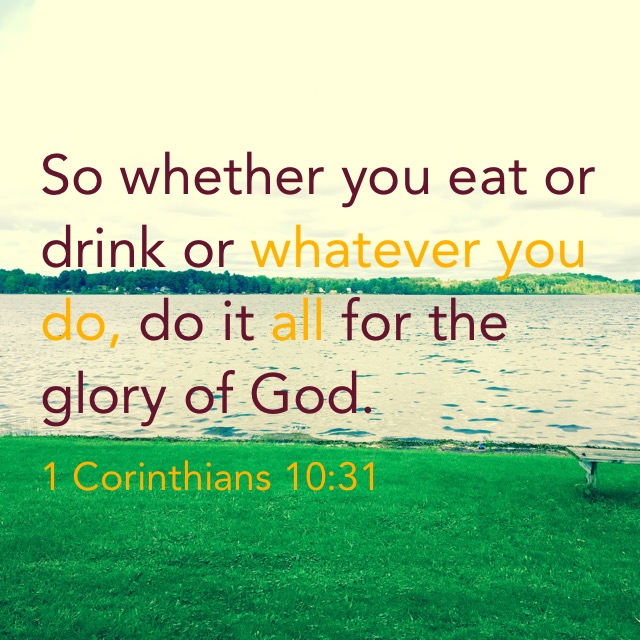
So many people—even Christians—think that there are spiritual goals and non-spiritual goals. But the Bible says, “So whether you eat or drink or whatever you do, do it all for the glory of God” (1 Corinthians 10:31). Every goal you set is a spiritual goal, because every goal should help you live your life wisely, in a way that honors and glorifies God.

(3) Make your goals S.M.A.R.T.

You may have heard these before, but I really like to use them. Make your goals:

  • Specific—not “I want to eat better” but “I want to eat two servings of fruits or vegetables each day.”
  • Measurable—have a way to track your progress toward your goal. How many pages did you read? how many calories did you eat? how many minutes did you work out?
  • Achievable—don’t set a goal to run 5 miles a day if you’ve only been a couch potato. Ramp your goals up little by little in a way that’s achievable for you.
  • Relevant—I like to ask a “so that?” question about each of my goals in make sure it’s moving me forward. “I want to exercise for 20 minute three times per week, so that my blood pressure comes down, so that I can live medicine-free, so that I can….” I think you get the idea. Keep going to make sure your goal is relevant for your life.
  • Time to review—set a date to revisit your goals and see if you need to adjust anything.

(4) Make a “stop doing” list.

You cannot do everything, so focus on the important, not the urgent. And remember not everything can stay on your calendar. For instance, if you want to read more in the evenings, you may have to eliminate some TV time; if you want to exercise in the mornings, you may have to eliminate that second cup of coffee.

Just a couple of verses after Moses challenges us to make the most of every day God has given us, he asks God for His helpMay the favor of the Lord our God rest upon us; establish the work of our hands for usyes, establish the work of our hands.

May God give you wisdom as you make new goals, and may He bless the work of your hands as you implement your new strategies.

I Love My “Job”

I cannot even begin to tell you how thrilled I am when I get to baptize folks in water who have made the decision to follow Jesus Christ as their Lord and Savior. Today it was even sweeter when I got to baptize a father and son!

IMG_7582IMG_7592 IMG_7589 IMG_7585


Rethinking Addiction

AddictionThis is a fascinating video that may just revolutionize the way you think about addictions and addicts.

Near the 4:45 mark of the video the statement is made about a new way of interacting with others. This, I believe, is what the Christian church should be doing. If we aren’t, I doubt we are living out the good news that Jesus taught. If you want to do an interesting study, check out how many times the phrase “let us” is used in the New Testament. Also note that the word saint never appears in the New Testament in the singular, but it is always saintS. This tells me that we were designed to be together.

“Human beings have a deep need to bond and form connections. It’s how we get our satisfaction. If we can’t connect with each other, we will connect with anything we can find—the whirr of a roulette wheel or the prick of a syringe…. We should stop talking about ‘addiction’ altogether, and instead call it ‘bonding.’ A heroin addict has bonded with heroin because she couldn’t bond as fully with anything else.” —Johann Hari

What do you think? Please share your thoughts in the comment below?

7 Tips For A Better Night’s Sleep

Psalm 4.8It’s no secret that being tired can lead to a lot of not-so-nice consequences. Everything from automobile crashes, to poor work performance, to foot-in-mouth statements, to giving in to temptations, to health issues are all traced back to not getting enough peaceful sleep.

But did you know that sweet sleep is something God wants to give you?

Psalm 127 says, “God grants sleep to those He loves.” Guess what? God loves you, and wants you to have a peaceful night’s sleep!

Here are some benefits to getting solid sack time:

  1. Muscles are repaired—the body “turns off” muscles during sleep so they can repair themselves.
  2. The hormone leptin, that regulates your appetite, is adjusted.
  3. Your blood pressure is lowered.
  4. Your heart rate is lowered.
  5. The energy-producing cells we all need are restocked.
  6. Your immune system is re-energized.
  7. Memories are consolidated from short-term memory banks to long-term memories.
  8. The hormones that allow you to concentrate are replenished.
  9. Your “database” of decision-making options is re-calibrated.
  10. Bottom line—you get healthier physically, mentally, emotionally, relationally, and spiritually.

All of this God wants to give to those He loves. “God loves me, so I’m going to sleep peacefully tonight!”

The problem is we often sabotage God’s blessing of sweet sleep by our own poor decisions during the day. So here are seven things you can do to cooperate with God’s blessing of sleep:

  1. Reduce stress. Stress causes your body to release cortisol, which prepares your body for fight-or-flight. This means when you’re trying to quiet down for the night, your body is still screaming, “Go, go go!” Stress is mainly triggered by worrying over things outside of our control, so check out what Jesus said to us about not worrying—Matthew 6:25-34.
  2. Reduce late-day caffeine. Caffeine has a half-life of six hours, so if you are pouring it into your body late in the date, you might fall into bed exhausted but the caffeine is keeping your brain buzzing. As a result, you don’t have the normal deep sleep patterns.
  3. Eliminate emotional caffeine. Arguments with other people release cortisol and adrenaline in your bloodstream. If these disagreements are happening later in the day, your body is fighting against God’s plan for your tranquil sleep. So take care of any disagreements quickly (Ephesians 4:26).
  4. Exercise. Getting some movement into your daily routine flushes cortisol and adrenaline from your bloodstream.
  5. Go to bed and get up at the same time. There’s a reason God made the sun to rise and set at predictable times. Your body also functions best on a predictable schedule.
  6. Reduce “blue lights” close to bed time. The blue light waves of dawn tell our bodies to stop releasing melatonin, the sleepy hormone. The red light waves of dusk tell our bodies to increase melatonin so we can go to sleep. But when we’re staring into the blue light of our phones and tablets, our body is being sent a conflicting signal.
  7. Pray. Two great passages you can pray before bedtime are Psalm 4:8 and Proverbs 3:24. Claim those promises of sweet sleep!

God loves you. He wants to give you the blessing of peaceful sleep. If you’re going to sleep peacefully tonight, make sure you are not sabotaging what God wants to give you.

If you’ve missed any of the messages in this series, you can access the complete list by clicking here

The Experiment That Spooked Einstein

Albert EinsteinScience does not have all the answers (despite what many scientists want to tell us!). Here is a quantum physics mystery that has baffled the best and brightest minds. Even Albert Einstein called this “spooky actions at a distance.”

Watch this short video and see what you think…

A few other Einstein quotes come to mind:

“There are only two ways to live your life: one is as if everything is a miracle, the other is as though nothing is a miracle.”

“The important thing is not to stop questioning. Curiosity has its own reason for existing. One cannot help but be in awe when he contemplates the mysteries of eternity, of life, of the marvelous structure of reality. It is enough if one tries merely to comprehend a little of this mystery every day. Never lose a holy curiosity.”

“Even though the realms of religion and science in themselves are clearly marked off from each other, nevertheless there exist between the two strong reciprocal relationships and dependencies … The situation may be expressed by an image: science without religion is lame, religion without science is blind.”

“Every one who is seriously engaged in the pursuit of science becomes convinced the laws of nature manifest the existence of a spirit vastly superior to that of men, and one in the face of which we with our modest powers must feel humble.”

4 Blessings From Trusting God + 1 Curse For Not

Choose lifeWhen you have a decision to make, isn’t it nice when you know the outcome of each option ahead of time? I mean, it makes it way easier to decide when you know what you’re going to get with each decision.

Like just before the Israelites head into the Promised Land, God says, “You can choose Me and have a whole lot of blessings, or you can choose another god and miss out on all My blessings” (Deuteronomy 30:11-20).

Easy choice, right?

I think the songwriter of Psalm 125 had that Deuteronomy passage in mind when he wrote his song of ascent. Basically, he says, you can trust God (v. 1) or you can walk on crooked paths (v. 5). What does it mean to trust God? Literally it means to have a confident expectation that He is Who He says He is, and He does what He says He’s going to do.

To help make the decision easier, the songwriter lists four blessings that come when we trust God—

  1. We become as secure and unshakeable as Heaven is (v. 1).
  2. We experience God’s “surroundedness” over, around, above and beneath us (v. 2).
  3. We escape evil’s clutches (v. 3).
  4. We experience God doing good for us (v. 4).

Of course, we can also choose not to trust God. We can try another path on our own. The curse for doing that is pretty sad—God will allow those who aren’t responsive to His voice to walk away from Him (v. 5).

Just like the story of the prodigal son (in Luke 15), the Father will allow you to walk away, but He will continue to long after you. And hopefully like that wayward son you will “come to your senses” and return to your Father. When you do, He will run to you, wrap you in His love, restore you to His family, and allow you to experience all of His blessings again!

The choice is up to you. I pray you will choose life and blessing and surroundedness, and God’s goodness toward you.

If you’ve missed any of the messages in this series, you can access the complete list by clicking here