I’m in a series right now at Calvary Assembly of God called We Are: Pentecostal. This is the second time we have rejoined this series because, quite honestly, there is just way too much for me to cover effectively!
I have pointed out how most people in the Old Testament had the Spirit of God come ON them, but in the New Testament, the Holy Spirit comes IN Christians. And I’ve made the case that IN > ON (read more about that by clicking here).
The Infographic Bible has a wonderful graphic depicting the On/In nature of the Spirit in the two Testaments—
And if you would like to see a short video where I try to illustrate the difference between on and in, please check this out.
Hannah only appears in the first two chapters of 1 Samuel, but her legacy thunders through her son, and its rumblings continue to reverberate today. At first glance, it seems somewhat ironic that Hannah’s name means grace (undeserved favor) because we tend to think of a grace-filled person as quiet and unassuming. We don’t typically think of grace as thundering, but indeed it does!
Notice 3 P’s from Hannah’s life—
Hannah is grace personified. She didn’t crumble because of Peninnah’s taunts, nor did she compromise on her heart’s prayer because of Elkanah’s compliments. She never responded verbally to either Peninnah or Elkanah, but she took all her anguish to God in prayer.
Hannah is persistent in prayer. Hannah lives out the definition of importunity—unswerving, unabated, persistent prayer. The Bible tells us, “year after year…in bitterness of soul Hannah wept much and prayed to the Lord … she kept on praying to the Lord.” Notice an important contrast: Peninnah means jewels (from earth), while Hannah means grace (from God). God wants to give us answers that are eternal.
Hannah is piously reverent. Three times Hannah called herself a servant. She is respectful to the high priest Eli even when he falsely accuses her of being drunk. After Eli assures Hannah that God is going to grant her prayer request, notice her reverent actions—she broke her fast, her face was no longer downcast, she worshipped before the Lord, and she and Elkanah tried again to get pregnant.
Hannah’s anguish drove her to God. Year after year her bitterness of soul kept her in God’s presence. And after God answered her prayer, her rejoicing continued to keep her in God’s presence. She was importunate in prayer.
But also notice that God was silent while Hannah prayed year after year. Oswald Chambers says,“God’s silences are His answers. … Some prayers are followed by silence because they are wrong [this wasn’t Hannah’s case], others because they are bigger than we can understand.”
God was going to give Hannah a son, but the time wasn’t right yet. God needed a strong man in a dark time, and it wasn’t dark enough yet.
Israel had to sink into even deeper darkness. While Samuel was still a young man, the Israelite army was defeated, Eli and his two sons all died, and the ark of the covenant of the Lord was captured. This prompted Eli’s daughter-in-law to name her son Ichabod—God’s glory has departed.
This darkness allows Samuel to lead the people into a revival and then on to victory (1 Samuel 7:3-10). But notice how God responded to Samuel’s revival prayer—the Lord thundered with a loud thunder against the Philistines and threw them into such a panic that they were routed before the Israelites.
God’s response was a fulfillment of Hannah’s prayer. After God answered her and gave her a son, Hannah’s song of rejoicing foretold God’s response that was coming years later in Samuel’s revival—“It is not by strength that one prevails; those who oppose the Lord will be broken. The Most High WILL thunder from heaven….”
Hannah’s song of rejoicing after years and years of bitter, importunate, persistent prayer was prophetic—and God’s thunderous answer to Hannah’s prayer is still rumbling today!
Moms, don’t stop praying! God wants to answer your prayer. The Holy Spirit will help you pray (Romans 8:26). God’s timing IS coming. He will thunder His thunder in answer to your persistent prayer!
When it comes to the Holy Spirit’s involvement in a Christian’s life: In > On.
Sometimes, instead of referring to the two major divisions of the Bible as Old Testament and New Testament, I prefer to use First Testament and Second Testament. This helps me remember that “Old” doesn’t mean outdated, and “New” doesn’t mean forgetting what came before it.
B.B. Warfield had a great analogy. He imagined the First Testament to be a perfectly-constructed mansion. Only the finest materials had been used, and the mansion had been constructed by the best craftsmen being overseen by the world’s premier Architect. The only problem was this mansion had no lights. With the appearing of Jesus in the Second Testament, finally the lights are turned on. Jesus reveals the beauty that was already there!
In the First Testament, we frequently read that the Holy Spirit comes ON people, usually for leadership functions. We see this phrase with Moses and his co-leaders, several of the judges, Israel’s first two kings, and many of the prophets (see Numbers 11:25; Judges 3:10, 6:34, 11:29, 15:14; 1 Samuel 11:6, 16:13; 2 Kings 2:15).
However, there is one leader in the First Testament about which we notice the Spirit came IN him. Twice Ezekiel says this (2:2, 3:24). This was hinting at a to-be-fulfilled promise in the Second Testament (36:25-27).
The Holy Spirit being IN God’s people—which makes them God’s leaders—is described by Jesus in Acts 1:5. Many translations render this verse, “You will be baptized with the Holy Spirit.” But the NIV footnote and The Message both say “in the Holy Spirit.” Indeed, the Greek word means “by, with, or in.” But in context to being baptized (which means immersed, submerged, cleansed, overwhelmed), I think the best word is: baptized IN the Holy Spirit.
Let me say it again: When it comes to the Holy Spirit’s involvement in a Christian’s life: In > On.
“You hardly need to pray to have the Spirit poured out, for that has been done. What you need is a baptism of the Holy Spirit; to go down personally into that glorious flood that has been poured forth. Oh, to be immersed in the Holy Spirit and into fire—covered with His holy influence—plunged into the Godhead’s deepest sea and lost in His immensity! Here is our life and power.” —Charles Spurgeon
Jesus wants all of His followers to be baptized IN the Holy Spirit. So He told us to keep on asking, keep on seeking, keep on knocking, keep on waiting for God’s promised infilling (Luke 11:9-13; Acts 1:4-8).
Don’t stop at salvation—with just the Holy Spirit deposited in you—press on to be submerged deep into the Holy Spirit.
Military squads dispatched to achieve an objective will receive a briefing, be given the resources they need to complete the mission, and then they will launch out to complete the task. They will report back to HQ: “We are Oscar Mike”—which means “we are on the move” or “we are on mission.”
Jesus was always Oscar Mike while He was on earth, and He has also called His followers to remain Oscar Mike with the objective He has given us.
Christians need to remember that our mission isn’t a destination and it’s not a one-time accomplishment. Without the Holy Spirit’s help, this is a difficult concept to keep in mind.
Jesus told His disciples that He must go to Jerusalem, which they probably interpreted as the place where He would say, “Mission accomplished.” They were thinking in terms of Jesus reestablishing Israel as God’s HQ. So we can understand how baffled they were when Jesus said, “We are going up to Jerusalem, and everything that is written by the prophets about the Son of Man will be fulfilled. He will be delivered over to the Gentiles. They will mock Him, insult Him and spit on Him;they will flog Him and kill Him.” In fact, Luke records, “The disciples did not understand any of this. Its meaning was hidden from them, and they did not know what He was talking about.”
They obviously became more confused when a blind beggar stopped Jesus, and when Jesus stopped to eat at the house of a notorious tax collector. Jesus sensed their misunderstanding so “He went on to tell them a parable, because He was near Jerusalem and the people thought that the kingdom of God was going to appear at once.”
Christ’s parable challenged His followers to stay Oscar Mike. He explained how they were to keep on investing in people. This is exactly what Jesus was doing: using the proper verb tenses, Jesus explained that “the Son of Man came to keep on seeking and to keep on saving the lost”(see Luke 18:31-19:13).
Don’t get so focused on the destination that you lose sight of the mission.
Earth is not the Christian’s home. We are just passing through and we must remain Oscar Mike as we do.
Jesus said that being baptized in the Holy Spirit would help us stay Oscar Mike because the Holy Spirit will give us…
… vital information
… ongoing communication
… real-life application of God’s Word to our circumstances
If Jesus was so reliant on the Holy Spirit while He was on earth, what would make us think that we should be any less reliant?
You and I need the Holy Spirit!
Stay on mission until God calls you home. Then you can say with the apostle Paul, “I have fought the good fight, I have finished the race, I have kept the faith. Now there is in store for me the crown of righteousness, which the Lord, the righteous Judge, will award to me on that day—and not only to me, but also to all who have longed for His appearing” (2 Timothy 4:7-8).
Transitions are always hard things. We are leaving the known for the unknown. Even if the known is unhealthy or painful, it’s still hard to go to the unknown.
Why are these transitions so difficult? Perhaps it’s because I’ve learned how to cope with the known, or I’ve gotten used to this “normal” life, or even I’ve simply learned to navigate any dysfunctional areas.
But is that really living? Am I managing my life or is God? When I’m against transitions, aren’t I really saying that I’ve put God’s plan for my life in my box?
Those questions trigger even more questions in my mind: Where’s God in all of this? Why can’t He just make my known better? Why is He leading me (or maybe even pushing me) into this unknown?
Jesus didn’t endure the unimaginable horrors of the Cross just so you could cope with life. Jesus came to bring us abundant life—not a barely-getting-by life or just a coping life!
How does He bring us into this abundant life? By leading us through transitions. And where is He in all our transitions? Closer than you think!
Adults eagles build their extremely large nests in the highest point they can find. Their nests are made of massive branches. In fact, they build some of the largest nests of all birds, and build them in the most inaccessible of places. Before their eggs are laid, the adult eagles will soften their nest with feathers pulled from their own body. From the time the eggs are laid until the eaglets leave the nest, they are never without a parent present—while one parent hunts, the other watches.
Eaglets first test their stumpy wings by jumping around in the nest, mimicking their parents. Eventually they will start “branching”—jumping to nearby branches—and then “fledging”—taking their first short flights from the nest. All under the watchful eye of the parents. Finally, the adult eagles will “stir up” their nest by blowing away all of the comforts of their plucked feathers, encouraging the eaglets to soar.
Moses said that this is how God cares for His children. First by shielding and guarding us, and then by stirring up our nest and encouraging us to soar!
Much like when Jesus ascended back to Heaven. He was going to physically leave His disciples, but He knew He had adequately trained his “eaglets” to soar without Him with them in bodily form.
But Jesus never leaves us spiritually. He said that His ascension back to heaven would allow for the Holy Spirit to be resident in each of His followers (see John 16:7-15). It is the Holy Spirit that continues to guide us, teach us, empower us, correct us, and lead us to SOAR into abundant, God-honoring, Christlike living.
There are many, many times of transition as we soar, but He never leaves us. The Holy Spirit is our constant Counselor. God shows His love for us by caring for us. God also shows His love for us by making us uncomfortable with the status quo.
May the times of transition cause us to rely even more on the very present help of the Holy Spirit.
Comfort, comfort My people, says your God. Speak tenderly to Jerusalem, and proclaim to her that her hard service has been completed, that her sin has been paid for, that she has received from the Lord’s hand double for all her sins.
That seems unfair! We receive double(!) for our sins! Here’s a 2-minute video where I explain what this means culturally—
Only when invoices were paid-in-full did they get doubled-up.
The Bible tells us that we’ve all sinned, and that the invoice or penalty for our sin is death. We have the IOUs of sin nailed to the door of our heart where God says “You owe Me your life!” But we cannot pay this debt by ourselves.
But Jesus can. And Jesus did! Check this out—
He personally carried our sins in His body on the Cross…. (1 Peter 2:24 NLT)
Having canceled and blotted out and wiped away the handwriting of the note with its legal decrees and demands which was in force and stood against us. This He set aside and cleared completely out of our way by nailing it to His Cross. (Colossians 2:14 AMP)
That’s what is good about Good Friday. Jesus knew that taking our sins on His body, and then allowing His body to be nailed to the Cross, would double-up and nail-down our sin once and for all!
When Jesus said, “It is finished!” He was really saying, “It is paid-in-full!”
Where is God in our trials? When we call, Jesus runs to our cry. He is able to help us because He knows exactly what our cries sound like. Aren’t you glad He does?!
While we are in these difficult times, you might find yourself asking a question I have asked, “Okay, God, I believe You are doing something, but what exactly are You doing?”
I can’t tell you specifically what God is doing in your life, because your story is unique and special. But I can tell you that during the hard, painful chapters of our lives, God is accomplishing at least five things in all of us.
God is opening our eyes to new paradigms
We will learn lessons in these fiery trials that we couldn’t possibly learn any other way.
God is building empathy in us which we didn’t have before
One dictionary definesempathy as “the power of understanding and imaginatively entering into another person’s feelings.” It’s only because of our trials that we no longer have to imagine what someone else is feeling, but instead we know exactly what they’re feeling and how we can help.
God is growing our patience
It’s been said that patience is the “mother of all other virtues.” Paul said that “these troubles produce patience” (Romans 5:3). As God grows your patience, He will also help you to grow all of the other Christlike virtues.
God is refining His character in us
Paul went on to add that not only does trouble produce patience, but “patience produces character” (Romans 5:4). During the times of difficulty and uncertainty, we become more aware of deficiencies in our character.
God is building in us an unshakable hope in His future grace
Hope is not wishful thinking; it’s well-founded believing!
I want to circle back to that word refining because I think that best sums up what God is doing in our painful times. Romans 8 tells us—The Spirit Himself thus testifies together with our own spirit, assuring us that we are children of God. And if we are His children, then we are His heirs also: heirs of God and fellow heirs with Christ—sharing His inheritance with Him; only we must share His suffering if we are to share His glory. But what of that? For I consider that the sufferings of this present time—this present life—are not worth being compared with the glory that is about to be revealed to us and in us and for us and conferred on us! (Romans 8:15-18)
So where’s God in this time of fire? He is overseeing our trial as a Perfect Refiner. Do you know how the silversmith knows he has purified the impurities from the silver ore? The silver is pure when he can see his own reflection in the silver!
In the heat of your trial, God is close to you. He knows the perfect temperature and the precise time that it will take to allow His face to be seen in you!
Sometimes you will see what God is doing through your furnace time, sometimes you won’t. But don’t ever bail out! God IS working! He is giving you a new perspective, a deeper empathy, more patience, an unshakable hope, and most of all—He is removing the impurities that will allow His face to be seen more clearly in you!
Chaos is all around us! There’s infighting both politically and religiously. Government officials are imposing new laws and regulations and restrictions. Lots of rival voices are clamoring to be heard. Loss of personal freedoms, civil liberties, and even the freedom of worship. Uncertainty about the future. Fear in the present.
Although this may sound like current conditions in the USA, I’m actually describing life in Israel around 31 BC.
The people of Israel were frustrated beyond words with the restrictions they faced. They thought they were living in their land and that they should be able to govern themselves as they saw best.
Have you ever been in that place of utter frustration? Are you there now? “What’s happening? Why is this not going according to plan? Isn’t there anything I can do? How long is this going to last? God, where are You in all of this?!”
We humans like to think we are in control. Or at least we like to think that we know God’s timetable. Throughout the Bible—and still today—the questions persist:
Those Israelites I described earlier were so frustrated with asking “How long?” and apparently getting no answer, that they frequently took matters into their own hands. This never turned out well for them. But God’s perfect timing was heading toward His perfect fulfillment.
We may not perceive it, but God IS doing more than we will ever know during our “How long?” times.
God’s perfect timing for His people couldn’t be until Caesar Augustus came on the scene and brought an end to the political uncertainty that kept everything in chaos. Nearly 30 years before Jesus was to be born in Bethlehem, Augustus was launching the pax Romana—the peace of Rome—all over the world. Pax Romana was creating the perfect environment in which Jesus could be born and minister, as well in which His followers could then take the Good News all over the world.
Jesus was born “in the fullness of time” (Galatians 4:4), around 5 BC, in a land where a Jordanian king (Herod the Great) served an Italian emperor (Caesar Augustus) to a people frustrated with waiting. But God knew exactly when and where and how to send His Son to be our Savior!
So, my friends—Trust God in the “How long?” times!
God’s perfect plan includes YOU, so guard against any anxious thoughts that would make you bail out of His perfectly-timed plan early. (see Psalm 139:16, 23-24)
Join me this Sunday as we continue our series called Where’s God?
I’m sure you’ve experienced what I’ve experienced. My nice, orderly world came crashing down all around me. It totally blindsided me! I got on my knees to do some serious soul searching and I prayed, “God I know you called me here. I know I’ve done what You’ve asked me to do. What’s happening? Why am I being attacked? Where are You, God?”
I’m sure you’ve been there too. “Where’s God?” has been the cry of countless people from the oldest book of the Old Testament until this very day. In dark times our world seems to shrink, and the weight of the entire world seems to rest on our shoulders. We begin to at first sigh and say, “Why me?” and then those sighs become sobs of “God, where are You?!”
“Left to ourselves we tend immediately to reduce God to manageable terms. We want to get Him where we can use Him, or at least know where He is when we need Him. We want a God we can in some measure control. We need the feeling of security that comes from knowing what God is like.…” —A.W. Tozer
Here’s the truth: We are always in a spiritual battle. It’s just hard to see it in the “good ol’ days.” But in the “bad ol’ days” we realize we don’t have it all figured out! The dark days are simply the reality of spiritual warfare revealed.
Answers don’t come easily because there are no easy answers!
One of Job’s friends named Zophar thought he had God all figured out. He concluded his easy answer that the wicked have a bad life and the righteous have a good life. So if things were going badly for Job, he must have messed up somewhere. Except Zophar was wrong! God Himself pronounced Job righteous (see Job 20:1-8; 1:8). Zophar’s easy answer now doesn’t seem so easy, does it?
I’ll say it again: In the hard times, answers don’t come easily because there are no easy answers.
In fact, Jesus told us, “I have told you these things, so that in Me you may have peace. In this world you will have trouble. But take heart! I have overcome the world” (John 16:33).
How did Jesus overcome the world of hurt and pain? He did it by taking a hands-on approach—Since the children have flesh and blood, [Jesus] too shared in their humanity…. For this reason He had to be made like His brothers in every way…. Because He Himself suffered when He was tempted, He is able to help those who are being tempted (Hebrews 2:14, 17-18).
The phrase “He is able to help” literally means that He runs to the cry!
In order to be able to run to our cry, Jesus has to know what our cries sound like and what our pain feels like. He had to taste all our pain for Himself. He had to feel all of them in a human body. The Limitless God was incarnated in limited flesh to experience everything we would ever feel.
Now that Jesus has died and been resurrected, our cries bring Him running to us with ALL of His LIMITLESS love and power and empathy!
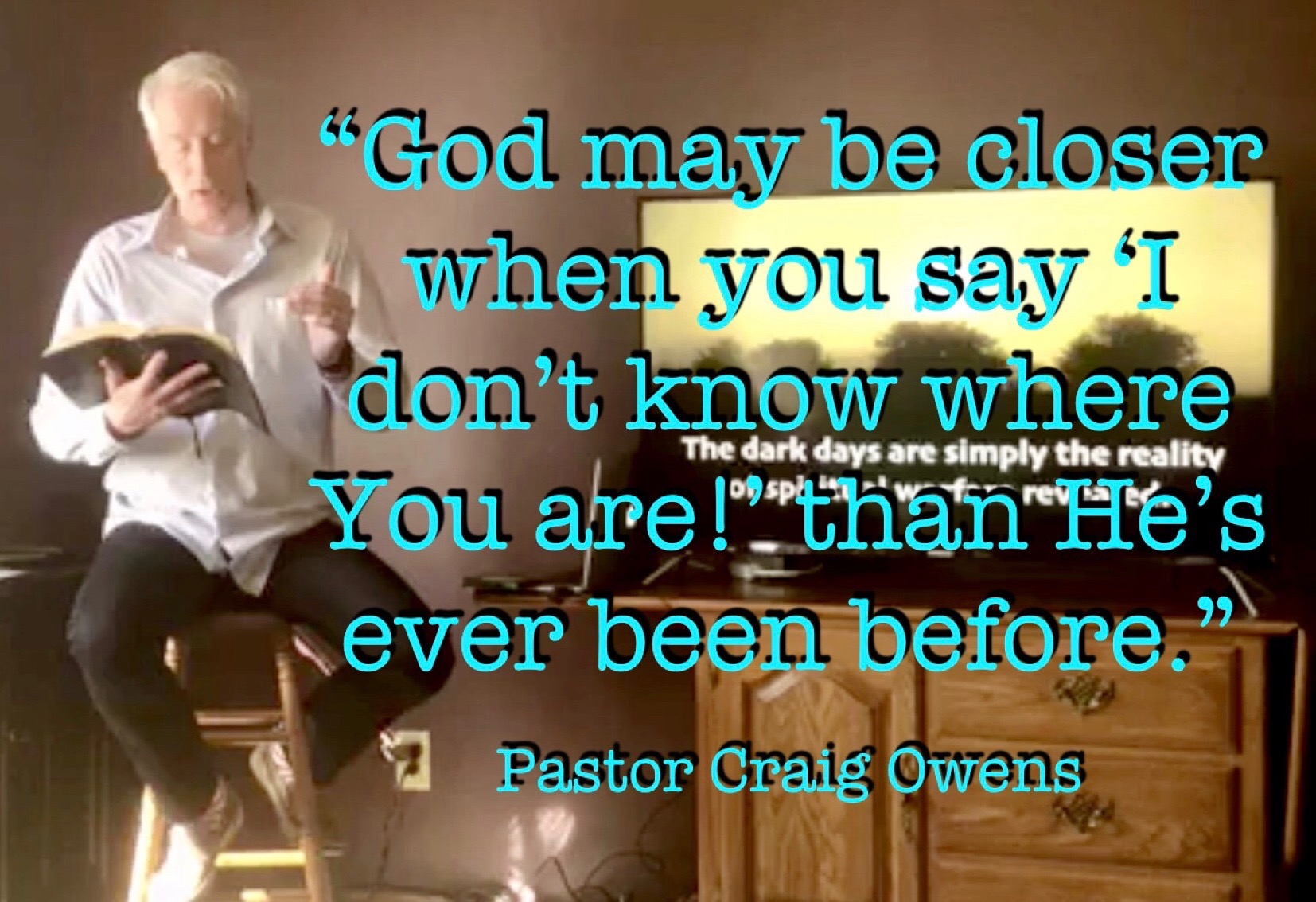
In the good ol’ days we may not recognize just how close God is to us. But when the bad days come and we cry out to Him, He comes running. Jesus may be closer when you say, “I don’t know where You are!” than He’s ever been before.
Go ahead and cry out. Jesus knows those cries. He hears you, He knows your pain, He runs to your cries, He comes close to help.
Join me next week as we continue this series asking “Where’s God?” in the specific difficulties that we face. We’ll ask questions like, “Where’s God in my depression?” and “Where’s God in my divorce?” and “Where’s God in this national calamity?” Please don’t miss these encouraging messages!
Sleep is so important for maintaining good physical and emotional health. In the book The Secrets Our Body Clocks Reveal, the authors share some interesting information on sleep.
“The clearest ninety-minute rhythm is the ‘sleepability’ cycle. About every ninety minutes, you enter a short period during which you are vulnerable to fatigue and sleepiness. …
“These rhythmic periods of sleepability are shorter during the morning hours than in the afternoon. That’s why it’s usually more difficult to take a nap in the morning than later in the day. Some of the time, you can fight off this fatigue—particularly if what you are doing is interesting or different. However, most of the time you would do best to give in to the rhythm and take a short break from your work—especially around the lunch hour, when you are already battling the early afternoon let down.”
“Scientists have found that when we are bored, under stress, or short of sleep, our ninety-minute cycles tend to shorten to roughly sixty minutes. That may explain why we eat and smoke more under stressful or boring circumstances.”
What deep sleep does for you:
Restores body and brain
Stimulates growth
Maintains mental health
What dream sleep does for you:
Consolidates and sorts memory
Enables learning
Ensures our physical safety
Things that can disrupt your sleep rhythms:
Dieting (loss of weight can cause more frequent awakenings during the night)
Caffeine
Alcohol
Low-sodium diet (elderly people only)
Cigarettes
Sleeping pills
Exercising vigorously if you’re not accustomed to it
A sleeping partner who snores or thrashers about in the night
Pets moving about in your bedroom
Sporadic, unpredictable noises
A room that is too warm (more than 75° F) or too cool (less than 60° F)
Hunger
Stress
Things that can enhance your sleep rhythms:
Regular aerobic exercising (at least twenty continuous minutes) particularly in the late afternoon
Sex right before bedtime
Following a bedtime ritual
Relaxation exercises right before bed
A bedtime snack high in carbohydrates
A dark and quiet bedroom
A “white noise”
“Many scientists now believe that we were meant to sleep twice a day, once during the afternoon and again at night. … In one study, college students who regularly napped showed improved scores on skill and memory tests taken just after a nap.”
“Scientists have also discovered that short naps (twenty minutes or less) are just as revitalizing as long ones—and less disruptive to regular sleep rhythms. In addition, regular nappers wake up more refreshed than those who take only an occasional nap. When naps are part of the regular daily rhythm, they are less disruptive.”
You can check out my full book review of The Secrets Our Body Clocks Reveal by clicking here. Some other quotes and statistics I shared from this book can be found here.
Another great book is Sleep: It Does A Family Good. That book review is here.












 Craig T. Owens