Overcoming Anxiety

God's answersI remember visiting Denver, Colorado. The scenery was so breathtaking, so I decided to go for an early morning hike. Quickly I discovered that my hike became breathtaking in more than one way! Even though I was in good shape, I had a hard time getting my breath because of the mile-high atmosphere.

I learned later that this is why many top athletes train in high elevation: it increases their lung capacity and endurance so that they now have an advantage when they compete against others.

God trains us on His mountains, but He made us to live and minister in the valleys. Our ascent into God’s mountaintop presence is so important for godly maturity!

In the first song of ascent, I noticed something unusual in the very first verse. Some Bibles translate the verbs in the present tense (I call on the Lord and He answers me), but some translations use the past tense (I called on the Lord and He answered me). Which is correct? Actually both of them are correct!

The verbs are written in the perfect tense—something done at a specific point in the past, but still relevant and powerful in the present. In other words, we can say it like this, “I called on the Lord in the past and He most definitely answered me. That gives me confidence to call on the Lord today, knowing that He will answer me again.”

Past answers lead to present power and future hope.

But—oh wow!!—check out how God answers us! The word literally means that God answers us in song. God so loves it when you trust Him enough to bring all your cares to Him, that He sings His answer to you. For the Lord your God is living among you. He is a mighty Savior. He will take delight in you with gladness. With His love, He will calm all your fears. He will rejoice over you with joyful songs (Zephaniah 3:17).

If we don’t continue to recall how God has answered us in the past, we’re missing out on the blessing of hearing Him sing His answers over us again today. As a result, we begin to live in the world’s valley-level turmoil and anxiety.

Peace is longed for in verses 6 and 7. The Christian wants to live in peace, but the world loves turmoil. Want proof? Just look at what makes the headlines today! The solution is to keep going back to God again and again and again—

Do not be anxious about anything, but in everything, by prayer and petition, with thanksgiving, present your requests to God. And the peace of God, which transcends understanding, will guard your hearts and minds in Christ Jesus. (Philippians 4:6-7)

Check out the full message to find the peace you are longing for!

If you don’t have a home church, please join us this Sunday as we continue our look at the psalms of ascent, or you can tune in to our live Periscope broadcast from wherever you are.

If you’ve missed any of the messages in this series, you can access the complete list by clicking here.

Thursdays With Oswald—Christ’s Temptations And Ours

Oswald ChambersThis is a weekly series with things I’m reading and pondering from Oswald Chambers. You can read the original seed thought here, or type “Thursdays With Oswald” in the search box to read more entries.

Christ’s Temptations And Ours

     The first temptation of Our Lord comes to us on this line—“Be sensible, You are here for the service of men, and surely it is the most practical thing to feed them and satisfy their needs.” The clamor abroad today is all on this line, “Put man’s needs first; never mind about the first commandment, the second commandment is the all-important one” (see Mark 12:29-31). … The insistent demand in the world today to put men’s needs before God’s will is the outcome of the reasoning of human wits and wisdom…. So long as our wits and human solutions are on the throne, to satisfy the needs of men is ostensibly the grandest thing to do. … 

     Our Lord was then asked to compromise: “You will become the King of men and the Savior of the world by judicious compromise; build Your kingdom on broad-minded lines; be judicious, You know there is evil in the world; then use it wisely, and don’t be so intense against sin; don’t talk about the devil and hell; don’t be so extreme and say a man needs to be born from above. Tolerate my rule of the world, call things ‘necessary evils’; tell man sin is not anarchy, but a disease; fall down and worship me and my way of looking at things, and I will withdraw and the whole world will be Yours.” … Will the Church that bows down and compromises succeed? Of course it will; it is the very thing that the natural man wants. … 

     satan tried to put Jesus Christ on the way to becoming King of the world and Savior of men in a way other than that pre-determined by God. The devil does not tempt us to do wrong things; he tries to make us lose what God has put into us by regeneration, the possibility of being of value to God. When we are born from above the central citadel of the devil’s attack is the same in us as it was in Our Lord—to do God’s will in our own way. … 

     Every temptation of satan will certainly seem right to us unless we have the Spirit of God. Fellowship with our Lord is the only way to detect them as being wrong. 

From The Psychology Of Redemption

Wow! Lots to contemplate here!

What do you think about the temptation of Jesus? Have you seen the same sort of temptations come your way?

One more thought from Chambers: “Temptation must come, and we do not know what it is until we meet it. When we do meet it, we must not debate with God, but stand absolutely true to Him no matter what it costs us personally, and we will find that the onslaught will leave us with higher and purer affinities than before.

Love = Patience

PatienceLast week I wrote about how we can be empowered to get along with everyone, everywhere. But something I didn’t mention (which might be obvious) is this: Connecting with everybody, everywhere is hard work!

We have to remember that relationship is the goal. We’re not trying to make converts to Christianity and rack up some sort of high score. We’re building relationships with people because we love people; and that love for them should motivate us to:

  1. Want what’s best for them
  2. Be willing to serve them

The Bible says this: And we urge you, brothers, warn those who are idle, encourage the timid, help the weak, be patient with everyone.

Everyone?! There’s that word again!

This word patient has five parts to its definition. I’m struck by how these aspects of patience also echo the definition of love in 1 Corinthians 13

  • Patience doesn’t lose heartLove is patient (1 Corinthians 13:4a)
  • Patience endures misfortuneLove is not self-seeking (13:5a)
  • Patience is slow to angerLove is not easily angered (13:5b)
  • Patience bears with the offenses of othersLove keeps no record of wrongs (13:5c)
  • Patience perseveres bravelyLove always protects, always trusts, always hopes, always perseveres. Love never fails (13:7-8)

How are you doing in your relationships? Are you losing heart? becoming angry? about ready to throw in the towel on a difficult relationship? Ask God to renew your love, and your patience level will increase as well. 

Let’s all strive to love others—even the difficult “others”—the way God loves us!

4 Ways To Share The Good News With Everyone

Everybody EveryoneJesus told His followers that their ministry assignment was to take His message of salvation throughout the entire world. One requirement to do this, is to be able to communicate with lots of people. Actually to be able to communicate with everyone.

Be careful to do what is right in the eyes of everybody. If it is possible, as far as it depends on you, live at peace with everyone. (Romans 12:17-18)

Really? Everybody and everyone?!

Yes!

Jesus said our Helper would be the Holy Spirit. He would come to empower us to be witnesses to everyone, everybody, everywhere (Acts 1:8).

We have been learning how to communicate with others better, but noticing their communication style “accent.” Check out this post to get some more insight into this. In a nutshell…

  • Doers are action-oriented
  • Planners like to work out all the details
  • People want to make sure everyone is connected
  • Visions are imagining a better future

So if you are a Doer, and you’re trying to share the Good News about Jesus with a Planner, you can probably see a potential problem. The Doer is speaking in bullet points, but the Planner is wanting a lot more facts and figures.

This is where the Holy Spirit can help us. He has the insight that we don’t, and He can direct our words, just as He directed Christ’s words (see John 12:49-50).

Here’s how to talk their talk when you’re sharing the Good News:

(1) Doer

  • Keep it brief
  • Share more facts than stories
  • Stress now/today
  • Rely on the Gospel of Mark (action oriented)

(2) Planner

  • Tell them the who, what, where, when, why, and how
  • Be ready for lots of questions
  • Give them time to process your information
  • Rely on the Gospel of Matthew (lots of background, lots of Old Testament references to answer the who, what, where, when, why and how)

(3) People

  • Develop a friendship first
  • Share more stories than facts
  • Don’t tell them, show them your personal life
  • Rely on the Gospel of Luke (lots of personal stories about changed lives)

(4) Vision

  • Share both the facts and the stories
  • Encourage them to “Imagine what would happen …”
  • Give them time to ask questions
  • Rely on the Gospel of John (very poetic and image-rich)

You can connect with everyone, everybody, everywhere and share the Gospel with them in an effective way. Allow the Holy Spirit to give you the insight you need.

Check out how I describe this in more detail here…

Bono & Eugene Peterson Discuss The Psalms

Mom, Your Prayers ARE Making A Difference

Mother's loveOne day a little girl was sitting and watching her mother do the dishes at the kitchen sink. She suddenly noticed that her mother has several strands of white hair sticking out in contrast on her brunette head. She looked at her mother and inquisitively asked, “Momma, why are some of your hairs white?” Spotting a teachable moment, her mother replied, “Well, every time that you do something wrong and make me cry or unhappy, one of my hairs turns white.” The little girl thought about this revelation for while and then asked, “Momma, how come all of grandma’s hairs are white?”

Mom, you have earned every one of those gray hairs or wrinkles through your loving care for us!

Gray hair is a mark of distinction, the award for a God-loyal life. (Proverbs 16:3)

The glory of the young is their strength; the gray hair of experience is the splendor of the old. (Proverbs 20:29)

Mom, your love for us can be summed up in one verse—Love always protects, always trusts, always hopes, always perseveres. (1 Corinthians 13:7)

And the Apostle Paul’s words to a young preacher are just as true for Moms as they were for Timothy: Keep a close watch on how you live and on your teaching. Stay true to what is right for the sake of your own salvation and the salvation of those who hear you. (1 Timothy 4:16)

Don’t give up, Mom! You need to persevere so that when you have done the will of God, you will receive what He has promised. (Hebrews 10:36)

What has God promised you about your family? Has He said your whole family will call on Jesus as their Savior? Then persevere in that. Has He said that your prodigal child will come home? Then persevere in that. Despite the odds, despite the obstacles, despite the setbacks, keep on loving them and praying for them. It IS making a difference!

Here’s an encouraging biblical example of a little-known Mom’s prayerful influence on a son that is listed in the genealogy of Jesus Christ…

Keep persevering in prayer, Mom. Your prayers ARE making a difference!

The Rewards For Getting Along With Difficult People

How To Get Along With OthersHere’s a shocking statement—Difficult people are difficult to get along with. I know, I probably just blew your mind with that one, but sometimes it’s important to state the obvious.

Christians should be the best at getting along with others. First of all, because they have the Holy Spirit to help them, and, second, because the world is watching to see if having a relationship with Jesus really does make a difference.

We’ve already learned that in order to change our behavior toward difficult people, we can’t change our behavior (check out my post on that topic here). Instead, we need to change our thoughts first. One thought to change is about ourselves, and another thought to change is the fact that Jesus promised rewards for those who loved difficult people—

If you love those who love you, what credit is that to you? Even sinners love those who love them. And if you do good to those who are good to you, what credit is that to you? Even sinners do that. And if you lend to those from whom you expect repayment, what credit is that to you? Even sinners lend to sinners, expecting to be repaid in full. But love your enemies, do good to them, and lend to them without expecting to get anything back. Then your reward will be great, and you will be children of the Most High, because he is kind to the ungrateful and wicked. (Luke 6:32-35)

One way to love others is by learning to “speak their language.” Most of us communicate with four different accents: Doer, People, Planner, Vision.

You can watch the video where I explain these styles in more detail, but you can learn their accent by listening for…

(1) How they handle stressful situations:

  • Doer—get hyper-focused
  • Planner—withdraw to plan
  • People—call a meeting
  • Vision—take time to daydream

(2) How they listen to others:

  • Doer—take short bullet points and then quick action
  • Planner—take detailed notes, and ask lots of detailed questions
  • People—make good eye contact, take very little notes, and then reiterate what was said
  • Vision—doodle, and express “ping pong ball” thoughts

(3) How they speak about folks with other “accents”:

  • Doer—this is taking too long; nothing ever gets done; they’re daydreamers
  • Planner—they jump the gun; they’re swayed by emotions; they’re unpredictable
  • People—why don’t they want to meet; they’re too aggressive; they’re too robotic
  • Vision—they don’t see the big picture; they’re too rigid; they’re too emotional

You CAN get along better with everyone. Romans 12:18 tells us that peaceful living with others depends on you and me. Let’s do this well so that Jesus is glorified!

Don’t Try To Change Your Bad Behavior

Thoughts to beahviorsAs I wrote previously, I believe Christians should be the best at getting along with others. First of all, Christians have been empowered by the Holy Spirit with the skills necessary to live at peace with everyone, IF we will only allow the Spirit to do the necessary work in us. And second, the way Christians treat others goes a long way toward either attracting or repelling others from a relationship with Jesus.

But here’s an important thing: If you don’t get along well with others now, don’t try to change your behavior!

Stephen Covey wrote, “To try to change outward behaviors does very little good in the long run if I fail to examine the basic paradigms from which those attitudes and behaviors flow.”

You see, behavior is the fruit. If we want to change the fruit, we need to back up a few steps.

The Apostle Paul used the life of Jesus as an example for Christians on how we can get along with others. But notice this: most of what Paul discusses is the “inside stuff.”

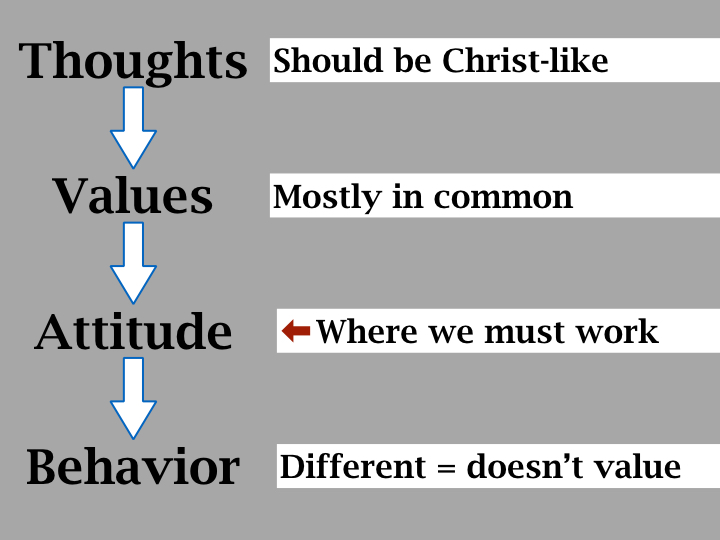
The progression goes like this (see Philippians 2:1-13)—

Thoughts → Values → Attitudes → Behaviors

(1) Thoughts—These need to be humble thoughts about God’s love toward us (v. 1).

(2) Values—Paul tells us to be “one in spirit and purpose” with others (v. 2). The definition of the Greek words here mean valuing the well-being of everyone. Paul then explains how our humility can lead to these win-win relationships (vv. 3, 4).

(3) Attitudes—“Your attitude should be the same as Christ Jesus” (v. 5). Jesus showed us what it was to have an attitude related toward obedience to God’s will.

(4) Behavior—If our thoughts, values and attitudes are rightly aligned to God, then our behavior will naturally be Christ-like as well. We see the example of Jesus in verses 6-8, and God’s reward for that behavior in verses 9-11. Then Paul calls on Christians to follow that pattern in our own lives (vv. 12, 13).

Most decent, reasonably-thinking human beings share the same values. Harry Truman said, “When we understand the other fellow’s viewpoint—understand what he is trying to do—nine times out of ten he is trying to do right.”

The problem is this: When the other person behaves differently from me, my natural tendency is to assume he doesn’t value what I value. In other words, I’m judging his value system on the way I normally behave.

The break-down is in my attitude. That’s the area I need to address. That’s the attribute of Jesus that Paul told us to copy.

So if I want to get along better with others, I shouldn’t try to change my behavior, but my attitude. My prayer should be: “I want this same attitude to be in me which was also in Christ Jesus. He served God and others, so I too want to follow His example of obedience, and I want to demonstrate my appreciation for all that Jesus has done for me by working hard to better get along with others. Help me change my attitude!”

Check out this video of the full message…

I hope you can join us next Sunday as we continue learning how to get along with others. Please join us in person or on Periscope.

Charles Spurgeon On Difficulties

C.H. Spurgeon“O tested soul, perhaps the Lord is sending you through this trial to develop your gifts. You have some gifts that would never have been discovered if not for trials. Do you not know that your faith never appears as great in the warm summer weather as it does during a cold winter? … Afflictions are often the dark settings God uses to mount the jewels of His children’s gifts, causing them to shine even brighter. …

“For how can you know if you have faith, until your faith is exercised? You can depend upon the fact that God often sends trials so our gifts maybe discovered and so we may be certain of their existence. And there is more than just discovering our gifts—we experience real growth in grace as another result of our trials being sanctified by Him.

“God trains His soldiers not in tents of ease and luxury but by causing them to endure lengthy marches and difficult service. He makes them wade across streams, swim through rivers, climb mountains, and walk many tiring miles with heavy backpacks.

“Dear Christian, could this not account for the troubles you are now experiencing? Could this not be the reason He is dealing with you?” —Charles Spurgeon

You Are An Empowered Peacemaker

My new attitude“The whole world—with one minor exception—is made up of others,” says John Maxwell. The ‘one minor exception’ is that person who’s looking back at you from the mirror every morning, so if you want to be successful in life, you better learn to get along with ‘the others.’

I believe this is especially important for those who call themselves Christians. Here are three reasons why—

  1. Our interaction with other Christians is a testimony to outsiders—John 13:34-35.
  2. Our positive interaction with outsiders can draw others to Christ—Colossians 4:5.
  3. Our negative interaction with outsiders can repel others from Christ—1 Peter 2:12.

So although it can be very (sometimes very, very!) challenging, we are called to find ways to get along with others. The Apostle Paul said:

Be careful to do what is right in the eyes of everybody. If it is possible, as far as it depends on you, live at peace with everyone (Romans 12:17-18, emphasis added).

When you see the phrase “if it is possible” you may think that Paul has given us an “out.” We could say, “I tried really hard to get along with that guy, but it just hasn’t worked, so I’m off the hook!”

But consider how another translation of the Bible states this phrase: Do all that you can to live in peace with everyone.

Jesus was asked to do something that had never been done before: heal two men born blind. Jesus asked these men, “Do you believe I am able to do this?” (Matthew 9:28). The men answered an emphatic, “Yes!” On another occasion a father asked Jesus to heal his son by saying, “If You can, please help us.” Jesus said, “‘If I can? All things are possible to those who believe.” The father immediately replied, “I do believe; please help my unbelief” (Mark 9:22-24).

If you are Christian, the Spirit of Jesus lives in you. So the question Jesus asks us about our difficult relationships is, “Do you believe I am able to help you?” Or perhaps more accurately He asks us, “Will you let Me help you?”

So the part of the verse which says, “if it is possible, as far at it depends on you” is really saying, “If you really believe Jesus is stronger than this strained relationship, will you let Him do something in you to bring about peace?”

We aren’t asking Jesus to change the other person; we’re asking Him to change us. We aren’t asking someone else to get on our page, or to see the world from our perspective; we’re asking the Holy Spirit to help us get on their page, to help us see the world they way they see it.

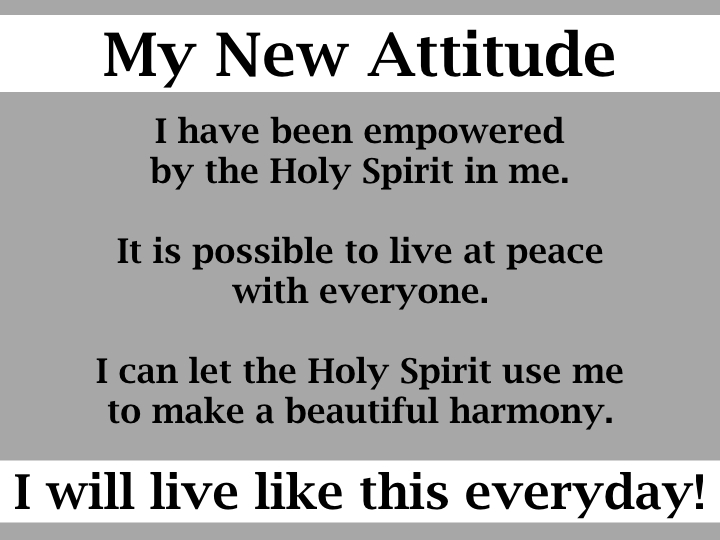
We need to have a new attitude. And I believe that attitude comes from a prayer like this—

I have been empowered by the Spirit of Christ in me. 
It is now possible for me to live at peace with everyone. 
I can let the Holy Spirit use to me make a beautiful harmony. 
I will keep on living like this every day.

Next Sunday we will be looking at some practical techniques and more biblical insights to help us excel in getting along with all ‘the others’ that make up the world. Please join us in person or on Periscope.